

On this page
Direct Answer: Who Are the Top RCCB Manufacturers?
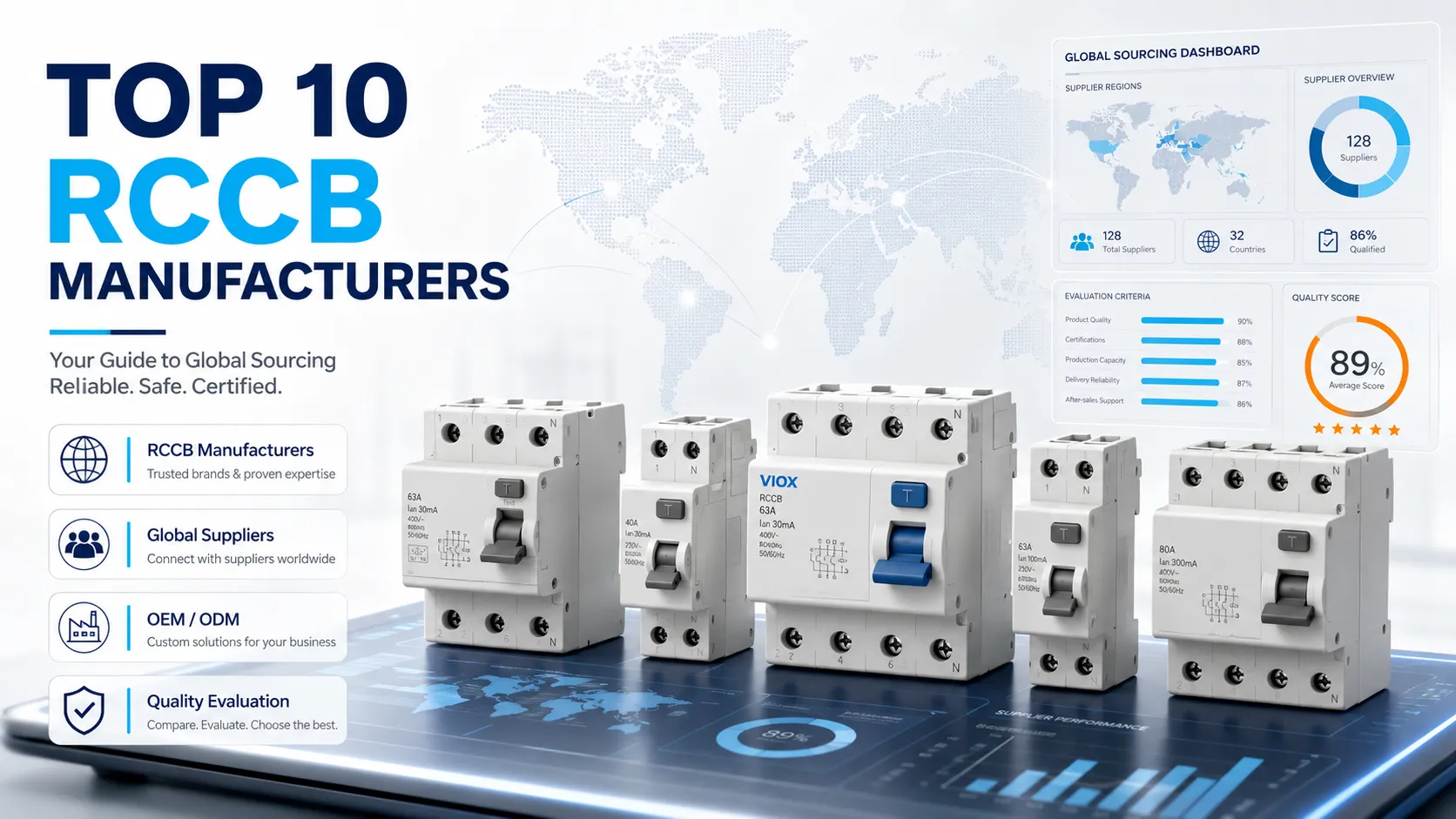
Commonly recognized global RCCB manufacturers and suppliers include Schneider Electric, ABB, Siemens, Eaton, Legrand, Hager, CHINT, LS Electric, Fuji Electric, and VIOX Electric. There is no universal best manufacturer: the right shortlist depends on the required RCCB range, target-market documentation, panel ecosystem, availability, and whether the buyer needs a global brand, local distribution, or an OEM/ODM manufacturing partner.
This is a global sourcing comparison—not a laboratory-performance, revenue, or market-share ranking. It does not use local retail popularity as the main evaluation criterion. Buyers specifically comparing the Indian residential market should use the separate Top 10 RCCB Brands in India guide.
For product-level evaluation, start with the VIOX RCCB product range. For factory and sourcing cooperation, see the VIOX RCCB manufacturer page.
What Makes a Good RCCB Manufacturer?
An RCCB is a residual-current protection device designed to disconnect a circuit when the monitored residual current reaches its operating threshold. For panel builders, distributors, OEM brands, and project buyers, the manufacturer matters because device suitability depends on product design, production consistency, documentation, and the exact application.
When comparing RCCB companies, look beyond the brand name. A reliable RCCB supplier should provide:
- clear product markings and datasheets;
- 2P and 4P product availability;
- rated-current options for the intended distribution system;
- rated residual operating current options such as 30 mA, 100 mA, and 300 mA where applicable;
- Type AC, Type A, Type F, or Type B options where required by the load and market;
- compliance documentation appropriate to the target market and project;
- evidence of consistent production and routine testing;
- stable packaging and labeling for distribution; and
- technical support for OEM or project sourcing.
For the technical standard background and evidence boundaries, see the guide to IEC 61008-1 RCCB requirements.
Global RCCB Manufacturer Comparison Table
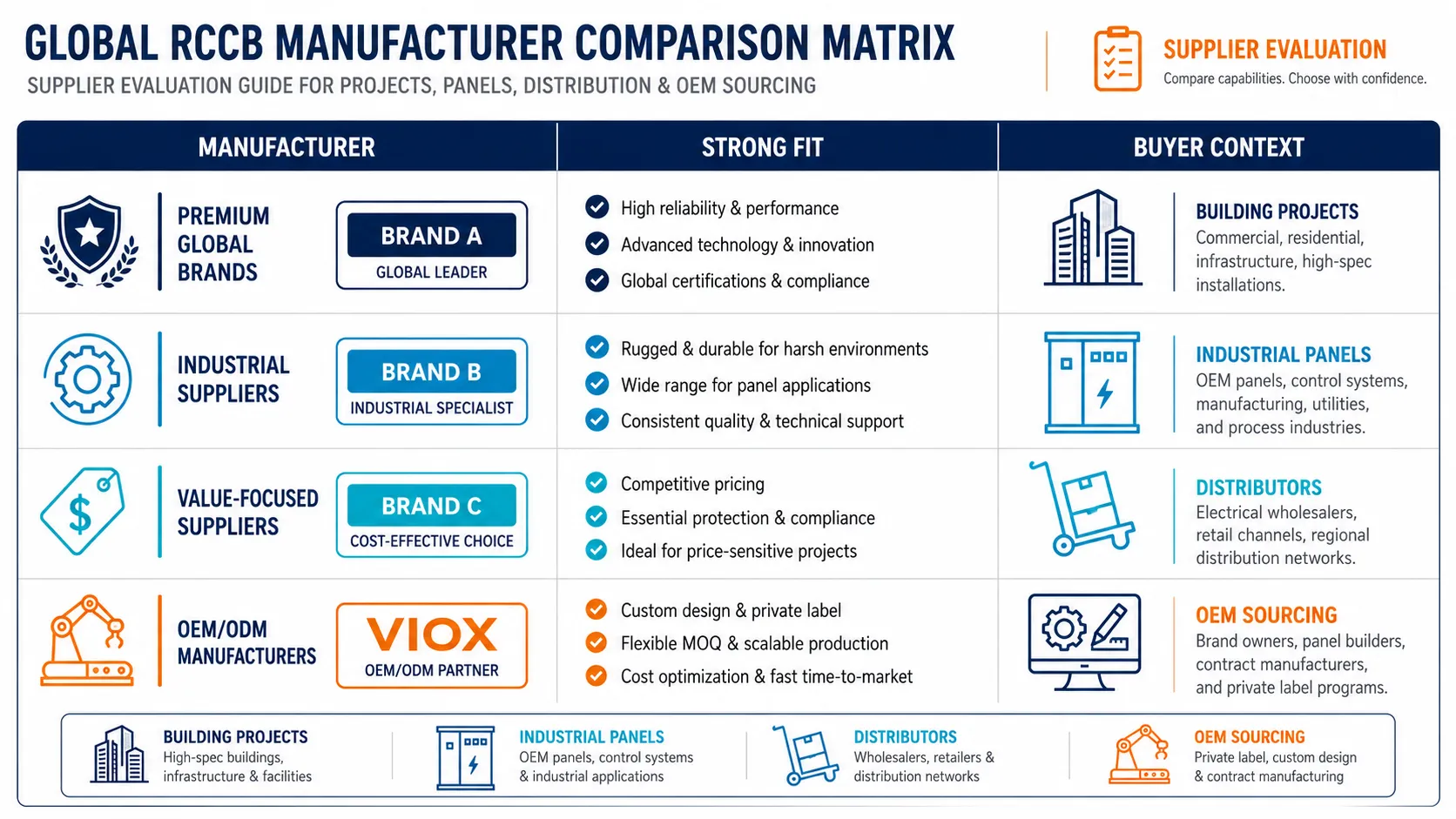
| Manufacturer | Strong Fit | Typical Buyer Context |
|---|---|---|
| Schneider Electric | Premium low-voltage protection and distribution systems | Commercial projects, panel builders, specification-driven projects |
| ABB | Electrical protection, automation, and industrial distribution | Industrial panels, infrastructure, global engineering projects |
| Siemens | Integrated electrical systems and industrial infrastructure | Industrial, commercial, and high-specification projects |
| Eaton | Circuit protection and power distribution systems | Commercial buildings, industrial facilities, OEM projects |
| Legrand | Residential and commercial electrical distribution | Building distribution, modular panels, wiring-device ecosystems |
| Hager | Residential and light commercial distribution | Distribution boards, modular protection, building electrical systems |
| CHINT | Value-focused global low-voltage electrical supply | Distributors, cost-sensitive projects, broad product availability |
| LS Electric | Industrial electrical and automation products | Industrial distribution, automation-related electrical systems |
| Fuji Electric | Industrial electrical equipment and control systems | Industrial projects, electrical control, power distribution |
| VIOX Electric | OEM/ODM RCCB supply and export-oriented sourcing | Distributors, OEM buyers, panel builders, private-label projects |
This table is a sourcing-oriented comparison based on typical buyer fit. Final selection must be verified against the exact RCCB model, ratings, application, target-market requirements, and current manufacturer documentation.
Representative RCCB Series by Manufacturer
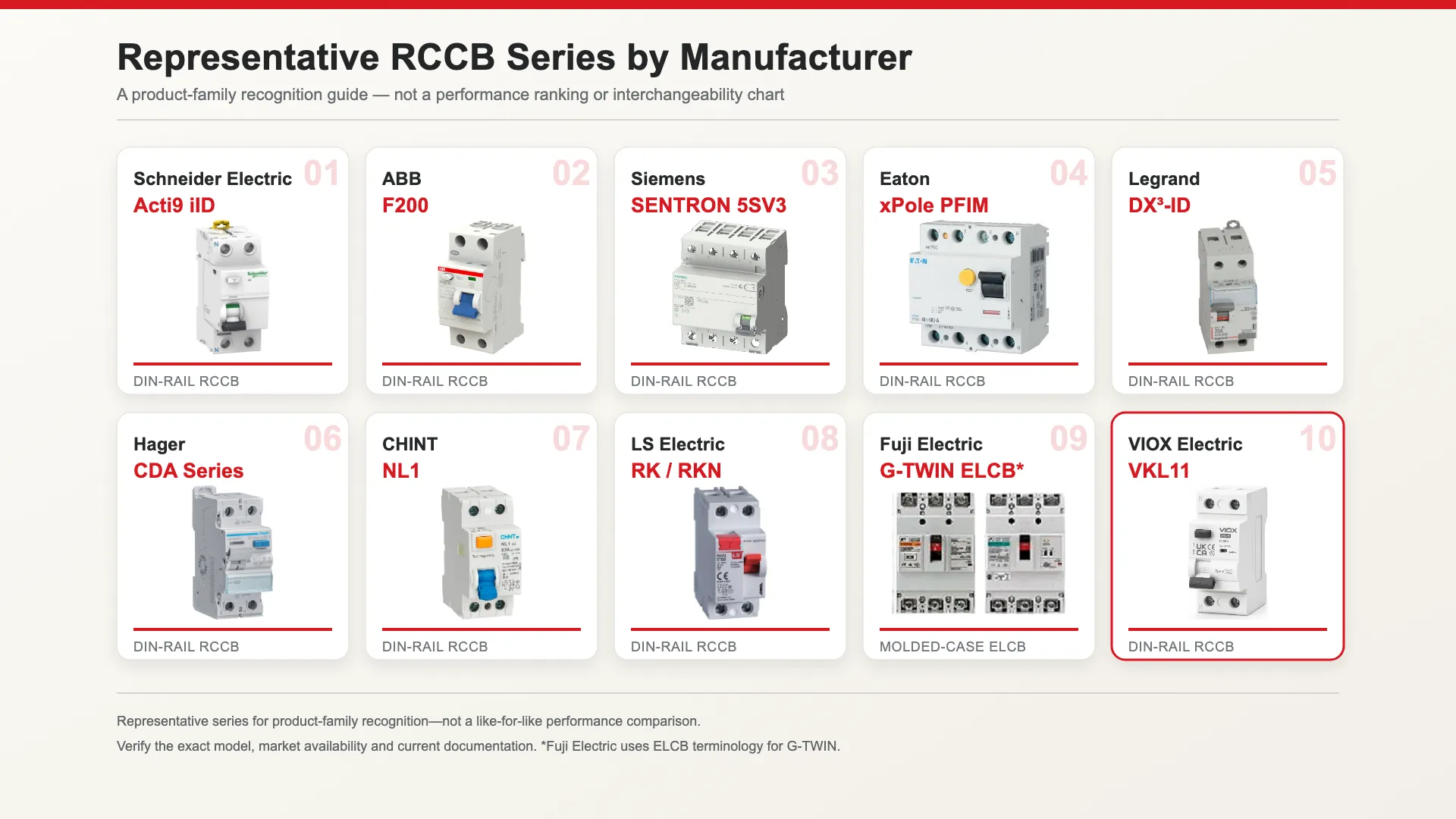
Use the series names below as starting points for product-family recognition and document retrieval, not as interchangeable equivalents. Available RCCB types, pole configurations, ratings, approvals, and product status vary by market. Fuji Electric’s G-TWIN range uses earth-leakage circuit breaker (ELCB) terminology and a molded-case format, so it should not be treated as a direct DIN-rail RCCB equivalent.
Top 10 RCCB Manufacturers and Suppliers
1. Schneider Electric
Schneider Electric is one of the most recognized names in low-voltage power distribution and protection. Its RCCB and RCD-related product families are often considered for commercial buildings, electrical panels, and specification-driven projects where global brand recognition and documentation depth matter.
The Acti9 iID is a representative Schneider Electric RCCB family to review. Schneider is often a strong fit when the project requires integration with a broader distribution-board ecosystem, established technical documentation, and strong global availability.
2. ABB
ABB is a major manufacturer of electrical protection, automation, and power distribution products. Buyers often consider ABB where RCCBs must fit into broader low-voltage protection systems, industrial panels, or infrastructure projects.
The F200 is a representative ABB RCCB family to review. ABB is usually evaluated for technical reputation, global supply structure, and compatibility with professional electrical distribution projects.
3. Siemens
Siemens is widely known for industrial electrical systems, automation, and power distribution. Its protection devices are often considered where the electrical system forms part of a larger industrial or building-infrastructure package.
The SENTRON 5SV3 is a representative Siemens RCCB family to review. Siemens can be a strong fit for higher-specification panels and projects where long-term system support and brand continuity are important.
4. Eaton
Eaton supplies a broad range of circuit protection, power distribution, and electrical control products. Its RCCB-related offerings are often considered in commercial, industrial, and OEM applications.
The xPole PFIM is a representative Eaton RCCB family to review. Eaton is often evaluated when buyers need a global supplier with experience across circuit protection and power-management systems.
5. Legrand
Legrand is well known in building electrical systems, wiring devices, and modular distribution products. Its RCCB products are often considered for residential and commercial distribution boards where panel appearance, modular compatibility, and building-system integration matter.
The DX³-ID is a representative Legrand RCCB family to review. Legrand is often a strong choice for building electrical distribution projects and contractors who prefer a complete modular electrical ecosystem.
6. Hager
Hager is a recognized supplier for residential, commercial, and light-industrial distribution systems. Its protection devices are associated with distribution boards, modular electrical products, and building electrical installation.
The CDA series is a representative Hager RCCB family to review. Hager is often considered when the project focuses on building distribution, clean panel layouts, and established modular product systems.
7. CHINT
CHINT is a large low-voltage electrical manufacturer with broad product coverage and global distribution. Its RCCB products are often considered by buyers looking for competitive pricing, wide availability, and broad low-voltage device selection.
The NL1 is a representative CHINT RCCB family to review. CHINT can be a practical option for distributors and projects where cost efficiency and product range are major decision factors.
8. LS Electric
LS Electric supplies industrial electrical and automation products, including low-voltage protection and control solutions. It is often considered in industrial and automation-related power distribution systems.
The RK series, including the RKN RCCB type, is a representative LS Electric family to review. LS Electric may suit buyers who need circuit-protection products as part of a wider industrial electrical package.
9. Fuji Electric
Fuji Electric is known for industrial electrical equipment, control systems, and power-related products. Its presence is strongest in industrial contexts where protection devices form part of a larger control or power-distribution environment.
The G-TWIN family is published as a molded-case earth-leakage circuit breaker range, not as a like-for-like modular DIN-rail RCCB. Buyers should therefore verify the required device category and local Fuji Electric range before including it in an RCCB shortlist.
10. VIOX Electric
VIOX Electric is positioned as an RCCB manufacturer and supplier for distributors, OEM buyers, panel builders, and export-oriented sourcing projects. Compared with large multinational brands, VIOX is normally evaluated for manufacturing cooperation, private-label support, product-range matching, and flexible supply.
The VKL11 is a representative VIOX RCCB family for standard Type AC, Type A, and high-immunity Type ASi requirements; other VIOX series address Type F, Type B, and EV-specific applications.
VIOX is most relevant when buyers need:
- RCCB sourcing for distribution channels;
- OEM or private-label cooperation;
- standard low-voltage protection product supply;
- support for product documentation and packaging alignment;
- supplier communication for repeat orders; or
- project-based low-voltage protection sourcing.
For buyers comparing factory cooperation rather than retail brand recognition, VIOX’s RCCB manufacturer page is the more relevant next step.
RCCB Manufacturer vs RCCB Brand: What Is the Difference?
The terms manufacturer, brand, supplier, factory, and distributor are often mixed together in search results. They do not always describe the same role.
| Term | Meaning | Buyer Question |
|---|---|---|
| RCCB manufacturer | Company that manufactures or controls production | Can it produce consistently and support the technical requirements? |
| RCCB brand | Market-facing brand name | Is the brand recognized by customers or project owners? |
| RCCB supplier | Company that supplies products commercially | Can it deliver the required models, documents, and support? |
| RCCB factory | Production-focused supplier | Can it support OEM, labeling, packaging, and repeat orders? |
| Distributor | Local or regional stock and sales channel | Can it provide timely delivery and replacement support? |
For a global sourcing decision, the best RCCB company is not always the most famous brand. It is the supplier whose product range, documentation route, pricing, lead time, and support fit the market and project.
RCCB Product Range Buyers Should Check
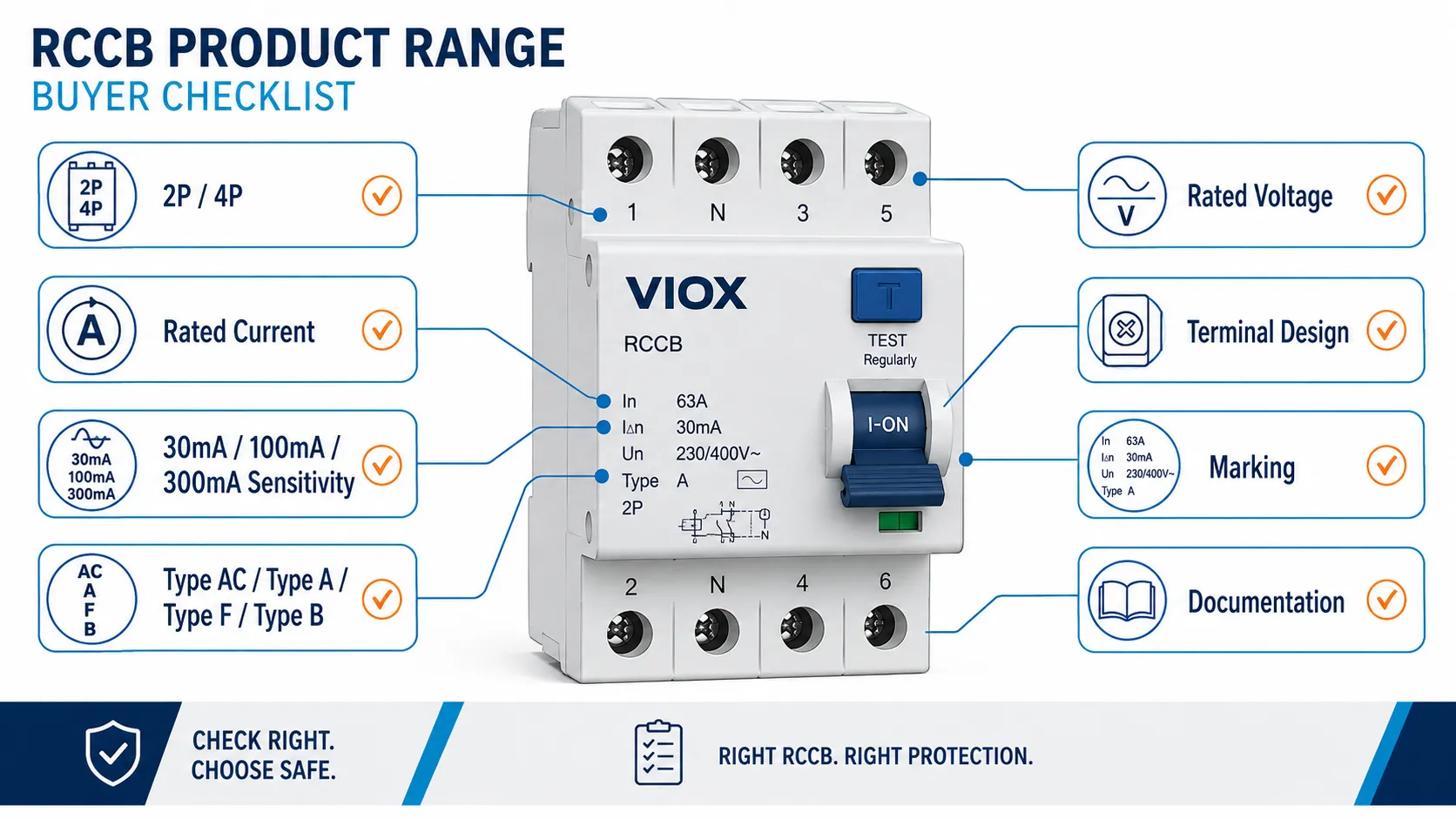
Before comparing suppliers, define the product requirement. Use the complete How to Choose an RCCB workflow, then evaluate each manufacturer against the resulting specification.
| Product Item | What to Check |
|---|---|
| Poles | 2P for an applicable single-phase arrangement; 4P for an applicable three-phase four-wire arrangement |
| Rated current | Must suit the design current and the coordinated overcurrent-protection arrangement |
| Rated residual operating current | 30 mA, 100 mA, 300 mA, or another value supported by the protection objective and applicable requirements |
| RCCB type | Type AC, Type A, Type F, or Type B according to the expected residual-current waveform, equipment instructions, and applicable rules |
| Rated voltage and frequency | Must match the distribution system and the exact device declaration |
| Mechanical design | Handle operation, trip indication, terminal design, mounting compatibility, and accessories |
| Standards documentation | Verify the applicable IEC, EN, national, local, or project evidence for the exact model |
| Packaging and marking | Confirm requirements for distributors, projects, or OEM programs |
For device-family boundaries, see the comparison of MCB, MCCB, RCB, RCD, RCCB, and RCBO.
Type AC, Type A, Type F, and Type B: Why RCCB Type Matters
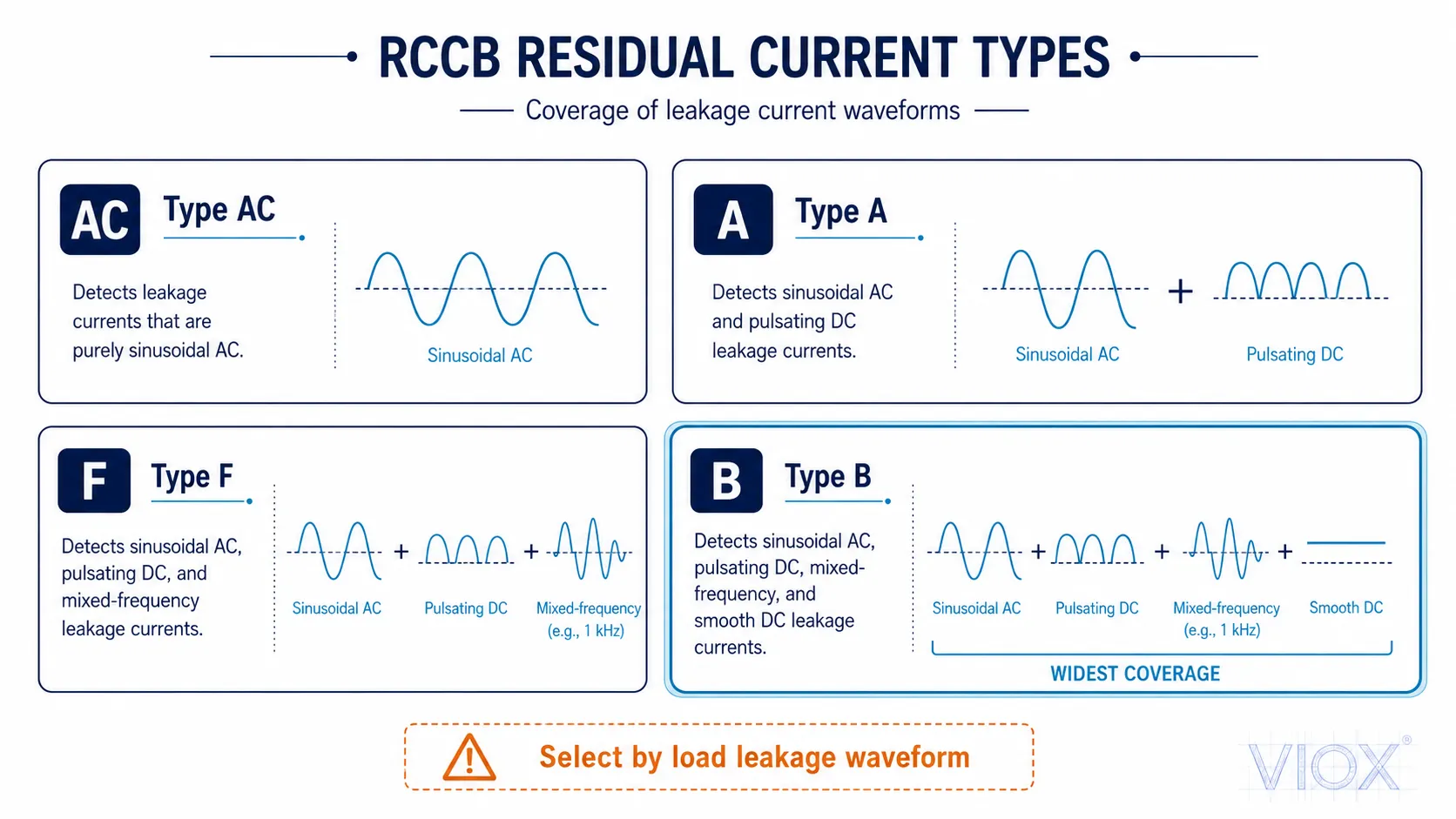
Selecting only by ampere rating and pole count is not enough. The RCCB type must match the residual-current waveforms that the connected equipment can produce.
| RCCB Type | Simplified Detection Scope | Selection Context |
|---|---|---|
| Type AC | Sinusoidal AC residual current | Loads and markets where Type AC is permitted and technically suitable |
| Type A | Sinusoidal AC and pulsating DC residual current | Many circuits containing single-phase electronic loads, subject to equipment instructions and local rules |
| Type F | Type A capability plus specified composite residual currents and higher-frequency behavior | Certain single-phase inverter or frequency-controlled loads when supported by the application requirements |
| Type B | Includes smooth DC residual-current detection within the applicable product standard and device characteristics | Power-electronic systems where the equipment instructions, system architecture, and applicable rules require it |
Type B is not a universal option for every EV, PV, variable-frequency drive, or uninterruptible-power-supply installation. Upstream coordination, the equipment manufacturer’s instructions, national rules, and any separate DC-detection arrangement still control the final selection. For the full decision boundary, use the dedicated RCCB Type AC vs A vs F vs B guide.
How to Evaluate an RCCB Manufacturer
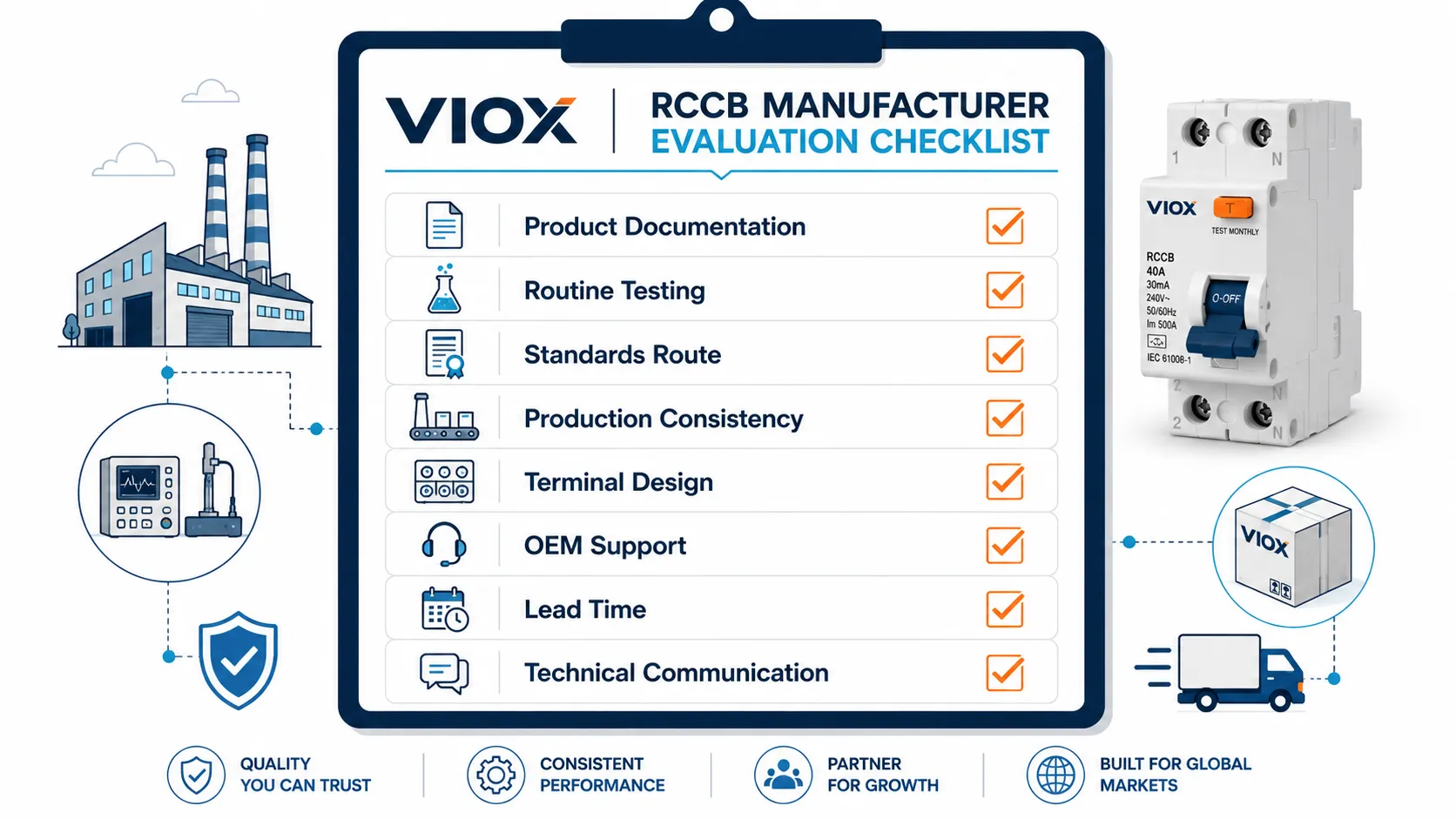
Use this checklist before approving a supplier:
| Evaluation Factor | Evidence to Request | Why It Matters |
|---|---|---|
| Product documentation | Current datasheet, model code, ratings, wiring information, application limits | Confirms whether the offered model matches the specification |
| Production consistency | Quality-control plan and batch-identification method | Helps buyers assess repeat-order consistency |
| Routine testing | Supplier explanation or records appropriate to the exact product and order | Residual-current operation and mechanical function must be controlled in production |
| Standards route | Certificates, reports, declarations, or other evidence required by the target market | A standard name in marketing copy is not enough to establish acceptance |
| Type availability | Exact Type AC, A, F, or B model documentation | Prevents substitution by a waveform type that does not match the load |
| Terminal and mechanical design | Drawing, connection limits, mounting details, accessory compatibility | Affects installation and panel integration |
| Marking clarity | Product-label artwork or approved sample | Helps installers and inspectors identify ratings correctly |
| OEM support | Branding, packaging, minimum-order, and change-control details | Important for private-label buyers and distributors |
| Lead time and continuity | Current lead time, capacity, change-notification, and continuity arrangements | Important for projects and repeat orders |
| Technical communication | Named contact and documented response process | Reduces model-selection and documentation errors |
Common Mistakes When Choosing RCCB Manufacturers
Mistake 1: Choosing Only by Brand Fame
A famous brand may be the safest choice for some specification-driven projects, but it may not fit every distributor, OEM, or export supply chain. Compare the required product range, commercial structure, supply continuity, and documentation support.
Mistake 2: Choosing Only by Price
Price does not verify markings, terminals, trip performance, production consistency, or target-market acceptance. Compare like-for-like models and request the evidence needed for the intended market.
Mistake 3: Ignoring Residual-Current Type
Modern loads can produce residual-current waveforms that are not handled by every RCCB type. Confirm Type AC, Type A, Type F, or Type B suitability from the equipment instructions, applicable rules, and exact RCCB documentation.
Mistake 4: Treating RCCB and RCBO as the Same Product
An RCCB does not provide the same overload and short-circuit functions as an RCBO. For the arrangement and selection differences, see RCBO vs RCCB + MCB.
Mistake 5: Not Checking Target-Market Requirements
Markets and projects can require different standards, markings, approvals, or documentation. Do not assume that acceptance in one market proves suitability in another.
FAQ
Who are the top RCCB manufacturers?
Commonly recognized RCCB manufacturers and suppliers include Schneider Electric, ABB, Siemens, Eaton, Legrand, Hager, CHINT, LS Electric, Fuji Electric, and VIOX Electric. The right option depends on the target market, application, documentation route, panel ecosystem, availability, and sourcing model.
What is the difference between an RCCB manufacturer and an RCCB supplier?
An RCCB manufacturer manufactures or controls production of the device. A supplier may be a manufacturer, distributor, exporter, or trading company. For OEM and repeat orders, verify production responsibility, traceability, documentation, and supply support.
What should I check before buying RCCBs in bulk?
Check rated current, rated residual operating current, pole count, voltage and frequency, RCCB type, coordination requirements, exact model documentation, terminal design, markings, packaging, lead time, and supplier quality-control evidence.
Is Type A RCCB better than Type AC RCCB?
Not universally. Type A has a broader residual-current detection scope than Type AC, but final selection depends on the load, equipment instructions, applicable rules, and the exact device characteristics.
Does an RCCB protect against overload?
An RCCB is selected for residual-current protection and requires suitable overcurrent coordination. Verify the complete protection arrangement rather than assuming the RCCB’s ampere rating is an overload trip setting. A suitable RCBO combines residual-current and overcurrent functions in one device.
What is the most important RCCB rating?
There is no single deciding rating. Buyers must evaluate rated current, rated residual operating current, pole count, voltage and frequency, RCCB type, time characteristics where relevant, and the required coordination and documentation together.
Can VIOX supply RCCBs for OEM or distributor projects?
VIOX supports RCCB supply discussions for OEM, private-label, distributor, and project requirements. Confirm the exact series, ratings, markings, packaging, documentation, order quantity, and target market with the VIOX RCCB manufacturing team before ordering.
Conclusion
The best RCCB manufacturer is not automatically the biggest brand. It is the supplier whose exact product range, quality controls, documentation route, availability, and commercial support match the project and target market.
For product-level review, compare the VIOX RCCB range. For OEM, distributor, and factory-sourcing requirements, contact the VIOX RCCB manufacturer team.