On this page
Leading MCB Companies at a Glance
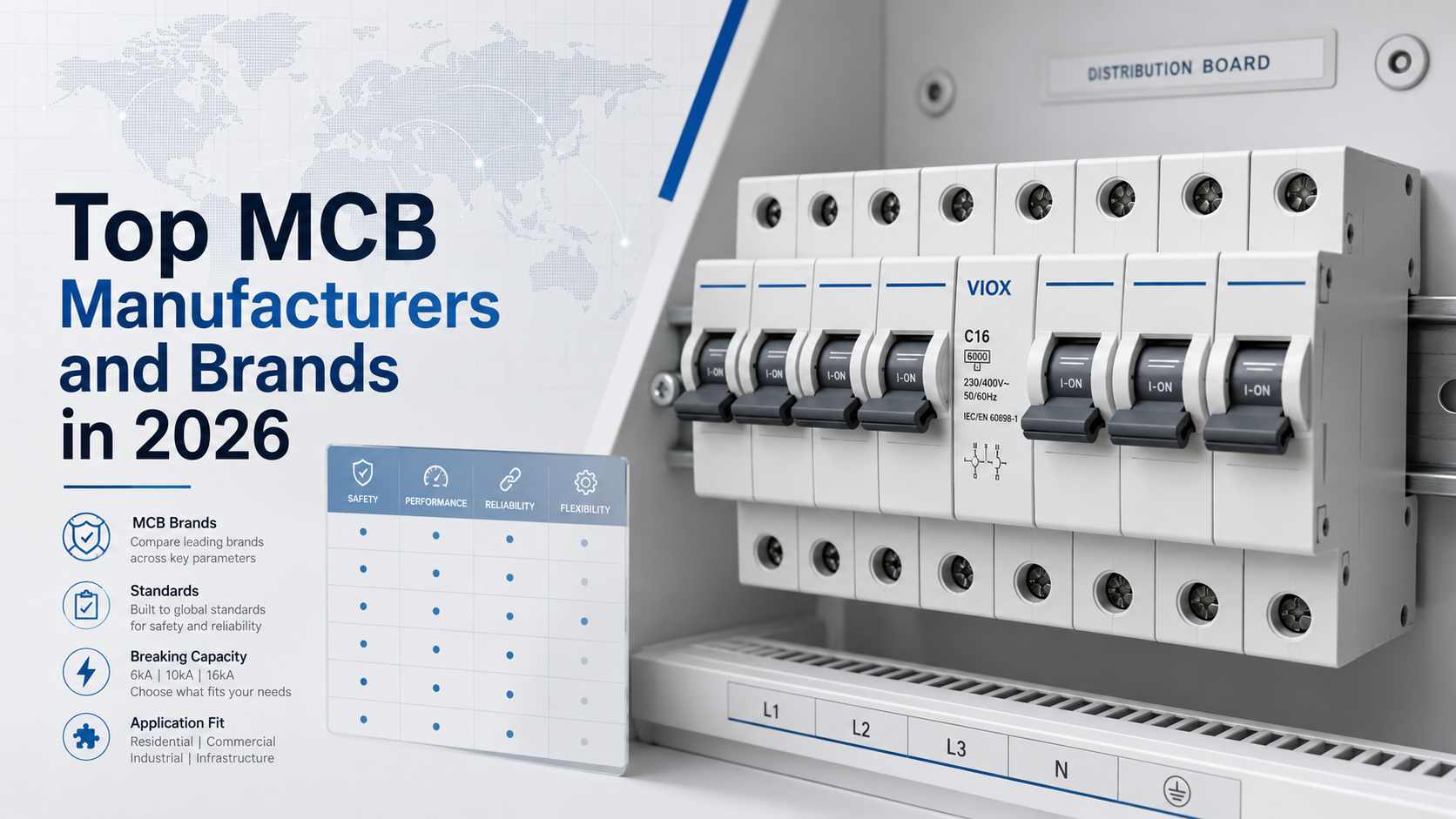
The right miniature circuit breaker supplier depends on the project, not only the logo on the device. Schneider Electric, ABB, Siemens, Eaton, Hager, Legrand, CHINT, Mitsubishi Electric, Fuji Electric, and VIOX are all established names, but they fit different markets, panel systems, certification routes, budgets, and application risks.
If you are buying miniature circuit breakers for a residential board, distribution panel, OEM project, solar DC system, industrial control cabinet, or distributor inventory, compare brands by standards, breaking capacity, trip curve range, AC/DC ratings, panel compatibility, supply stability, documentation, and total cost of ownership.
| Rank | MCB Manufacturer / Brand | Main Region | Best Fit | Typical Strength |
|---|---|---|---|---|
| 1 | Schneider Electric | Global | Residential, commercial, panel systems | Broad low-voltage portfolio and distribution network |
| 2 | ABB | Global | Industrial, modular protection, automation panels | Strong engineering ecosystem and modular accessories |
| 3 | Siemens | Global | Industrial automation and building infrastructure | Integration with industrial control and power distribution systems |
| 4 | Eaton | North America / Global | Residential, commercial, data centers | Strong North American circuit protection ecosystem |
| 5 | Hager | Europe / Global | Residential and commercial distribution boards | Installer-friendly modular systems |
| 6 | Legrand | Europe / Global | Building electrical systems | Wiring devices, distribution boards, and building infrastructure |
| 7 | CHINT | China / Global | Cost-sensitive IEC projects | Large-scale production and price-performance positioning |
| 8 | Mitsubishi Electric | Japan / Asia | Industrial automation and machine systems | Strong APAC industrial electrical presence |
| 9 | Fuji Electric | Japan / Global | Industrial electrical systems | Precision electrical and power equipment background |
| 10 | VIOX | China / Global | OEM, distributors, DC/PV, custom sourcing | Flexible supply, product range, and application-focused sourcing |
This ranking is not a universal quality score. A brand that is excellent for a European residential consumer unit may not be the best fit for a DC combiner box, high-inrush machine circuit, or private-label distributor program.
For product evaluation, see VIOX MCB products and the VIOX MCB manufacturer page.
Start Here Based on Your Buying Question
Different searches behind this topic have different intent. Use this guide according to the decision you are trying to make.
| If You Are Asking… | Read This Section |
|---|---|
| Which companies are commonly considered globally? | Top 10 manufacturer list |
| Which brand fits my application? | Application matrix and engineer’s verdict |
| Schneider vs ABB, Hager, Eaton, or CHINT? | Brand vs brand comparisons |
| Which brand fits India or emerging markets? | India and emerging markets section |
| Which supplier is better for OEM or distributor sourcing? | Supplier checklist and VIOX positioning |
| What technical factors should I verify? | Standards, breaking capacity, trip curve, AC/DC rating, and panel compatibility checks |
How We Compare MCB Manufacturers
A good breaker line is not only a famous name. For engineers, contractors, OEM buyers, and distributors, the decision should be based on application fit.
| Evaluation Factor | What to Check |
|---|---|
| Standards route | IEC 60898-1, IEC 60947-2, UL 489, or local market requirement |
| Breaking capacity | Icn, Icu, or rated short-circuit capacity must match prospective fault current |
| Service breaking capacity | Check whether Ics is declared and whether it is 50%, 75%, or 100% of Icn/Icu where applicable |
| Trip curve | B, C, D, K, or Z where available and appropriate |
| AC vs DC rating | AC MCBs must not be assumed suitable for DC circuits |
| Pole configuration | 1P, 1P+N, 2P, 3P, 3P+N, or 4P |
| Panel compatibility | Busbar, terminal, enclosure, and distribution board fit |
| Product documentation | Datasheet, certificate, wiring information, derating curves |
| Supply reliability | Lead time, MOQ, batch consistency, export support |
| Technical support | Ability to answer application and certification questions |
| Total cost of ownership | Initial price, downtime risk, replacement cost, compatibility, and support |
For basic residential MCB selection, buyers often focus on the marked breaking capacity, such as 6kA or 10kA. For commercial panels, OEM projects, and industrial distribution, Ics is a useful engineering signal because it describes service short-circuit performance after a fault interruption under the declared test basis. A high Ics ratio, such as Ics = 100% of Icn/Icu where declared, can indicate stronger post-fault service performance, but it must be verified from the exact datasheet and test documentation.
For a technical explanation of nameplate markings, see How to Read an MCB Nameplate.
Top 10 MCB Manufacturers in 2026
1. Schneider Electric
Schneider Electric is one of the most recognized global electrical brands for low-voltage distribution. It is often selected for residential, commercial, and building electrical systems where product availability, documentation, panel compatibility, and ecosystem support matter.
Schneider is a strong fit when the project needs a complete low-voltage protection lineup rather than only standalone MCBs. Buyers often consider Schneider for commercial buildings, residential distribution boards, and projects where electricians expect a familiar system.
Best fit: residential and commercial distribution, building electrical systems, panel ecosystem compatibility.
Buyer caution: verify the exact series, market version, standard, and panel compatibility. A brand name alone does not guarantee interchangeability across regions.
2. ABB
ABB is commonly associated with industrial electrical engineering, modular protection devices, and automation-related power distribution. ABB MCBs are often considered where system integration, accessories, and panel-level coordination matter.
For industrial and commercial users, ABB is usually evaluated not only as an MCB supplier but also as a broader electrical protection ecosystem.
Best fit: industrial panels, modular protection systems, automation-related distribution.
Buyer caution: premium brands can be over-specified for simple circuits. Match the product series to the application, not only the brand reputation.
3. Siemens
Siemens is strong in industrial automation, power distribution, and building technology. For buyers working with Siemens control systems or industrial infrastructure, choosing Siemens protection devices can simplify system-level standardization.
Siemens is often considered for projects where MCBs are part of a larger electrical and automation architecture.
Best fit: industrial automation, smart infrastructure, commercial and industrial panels.
Buyer caution: check local availability and the exact product family for the target market. Regional product ranges may differ.
4. Eaton
Eaton is a major name in circuit protection, especially in North American residential, commercial, data center, and industrial electrical systems. It is often considered where UL-market acceptance, panel compatibility, and service support are important.
For US and North American buyers, Eaton is frequently compared with Schneider/Square D, Siemens, and Leviton in residential and small commercial applications.
Best fit: North American panels, commercial buildings, data centers, residential distribution.
Buyer caution: North American panel compatibility is highly specific. Do not mix breaker brands or breaker families unless the panel listing and manufacturer documentation allow it.
5. Hager
Hager is widely recognized in European residential and commercial distribution boards. It is often selected by installers who value clean panel layouts, modular systems, and familiar consumer unit integration.
Hager and Schneider are often compared because both are frequently considered for residential and commercial distribution in European-style installations.
Best fit: European residential boards, commercial distribution boards, installer-friendly panel systems.
Buyer caution: verify regional approvals and product availability outside core markets.
6. Legrand
Legrand is a major building electrical infrastructure brand with strong coverage in wiring devices, distribution systems, enclosures, and smart building components. It is often considered for residential and commercial building projects where the MCB is part of a complete electrical installation package.
Best fit: building electrical systems, residential and commercial distribution, integrated wiring-device ecosystems.
Buyer caution: compare by product series and local certification route rather than assuming all Legrand products serve the same market segment.
7. CHINT
CHINT is one of the best-known Chinese low-voltage electrical manufacturers with strong global reach. It is frequently considered for IEC-based commercial and industrial projects where price-performance, availability, and scale matter.
CHINT is often compared with Schneider and Hager when buyers are weighing price-performance against premium brand ecosystems.
Best fit: cost-sensitive IEC projects, commercial distribution, large-volume procurement.
Buyer caution: check exact certificate model numbers, application ratings, distributor source, and local market acceptance.
8. Mitsubishi Electric
Mitsubishi Electric is strongly associated with industrial automation and electrical systems, especially in Asia-Pacific markets. It is often considered where MCBs are part of machine control, factory automation, or industrial electrical infrastructure.
Best fit: industrial automation, APAC industrial projects, machine-related electrical systems.
Buyer caution: verify whether the required MCB product range is available in the target country and whether it matches the project standard.
9. Fuji Electric
Fuji Electric has a long industrial electrical background and is relevant in power electronics, industrial electrical systems, and automation-related markets. Buyers may consider Fuji where Japanese industrial quality, precision, and system compatibility are important.
Best fit: industrial electrical systems, power control applications, APAC-focused projects.
Buyer caution: compare distributor coverage and replacement availability before specifying it for global projects.
10. VIOX
VIOX is positioned differently from the largest multinational brands. Instead of competing only on global brand recognition, VIOX is more relevant for OEM buyers, distributors, panel builders, and sourcing teams that need flexible supply, product range, private-label support, and application-focused MCB selection.
VIOX is especially relevant where buyers need:
- IEC-style MCB sourcing
- AC and DC circuit protection options
- Distributor or OEM supply support
- Flexible product selection
- Support across MCB, RCCB, RCBO, SPD, DC protection, and distribution products
Best fit: OEM sourcing, distributors, price-performance projects, DC/PV-related protection, flexible supply.
Buyer caution: as with any supplier, verify datasheets, standards, breaking capacity, trip curve, certificate model numbers, and application limits before approval.
For sourcing, see the VIOX MCB manufacturer page.
Brand Comparison Matrix
This matrix is designed for buyers who want more than a list of company names.
| Brand | Residential | Commercial | Industrial | Smart / Connected Ecosystem | Price-Value | OEM / Distributor Flexibility |
|---|---|---|---|---|---|---|
| Schneider Electric | Strong | Strong | Strong | Strong | Medium | Medium |
| ABB | Medium | Strong | Strong | Strong | Medium | Medium |
| Siemens | Medium | Strong | Strong | Strong | Medium | Medium |
| Eaton | Strong in North America | Strong | Strong | Strong | Medium | Medium |
| Hager | Strong in Europe | Strong | Medium | Medium | Medium | Medium |
| Legrand | Strong | Strong | Medium | Strong in building systems | Medium | Medium |
| CHINT | Medium | Strong | Medium | Medium | Strong | Strong |
| Mitsubishi Electric | Medium | Medium | Strong | Strong in automation | Medium | Medium |
| Fuji Electric | Medium | Medium | Strong | Medium | Medium | Medium |
| VIOX | Medium | Strong | Medium | Application-dependent | Strong | Strong |
Use this as a starting point, not a final approval list. The correct supplier still depends on local standards, panel design, fault current, application, and purchasing channel.
Best Fit by Application
| Application | Brands Often Considered | Why |
|---|---|---|
| Residential distribution | Schneider, Hager, Legrand, Eaton | Strong panel ecosystems and installer familiarity |
| Commercial distribution boards | Schneider, ABB, Siemens, Eaton, Hager | Broad low-voltage product range and documentation |
| Industrial automation panels | ABB, Siemens, Mitsubishi, Fuji, Rockwell where applicable | Strong industrial system background |
| North American load centers | Eaton, Schneider/Square D, Siemens, Leviton | Panel compatibility and UL-market availability matter |
| Cost-sensitive IEC projects | CHINT, VIOX | Price-performance and supply flexibility |
| OEM/private label sourcing | VIOX, CHINT, selected regional factories | Flexibility, MOQ, and sourcing support |
| DC/PV protection | VIOX, CHINT, ABB/Schneider depending on product range | DC voltage rating and arc interruption design matter |
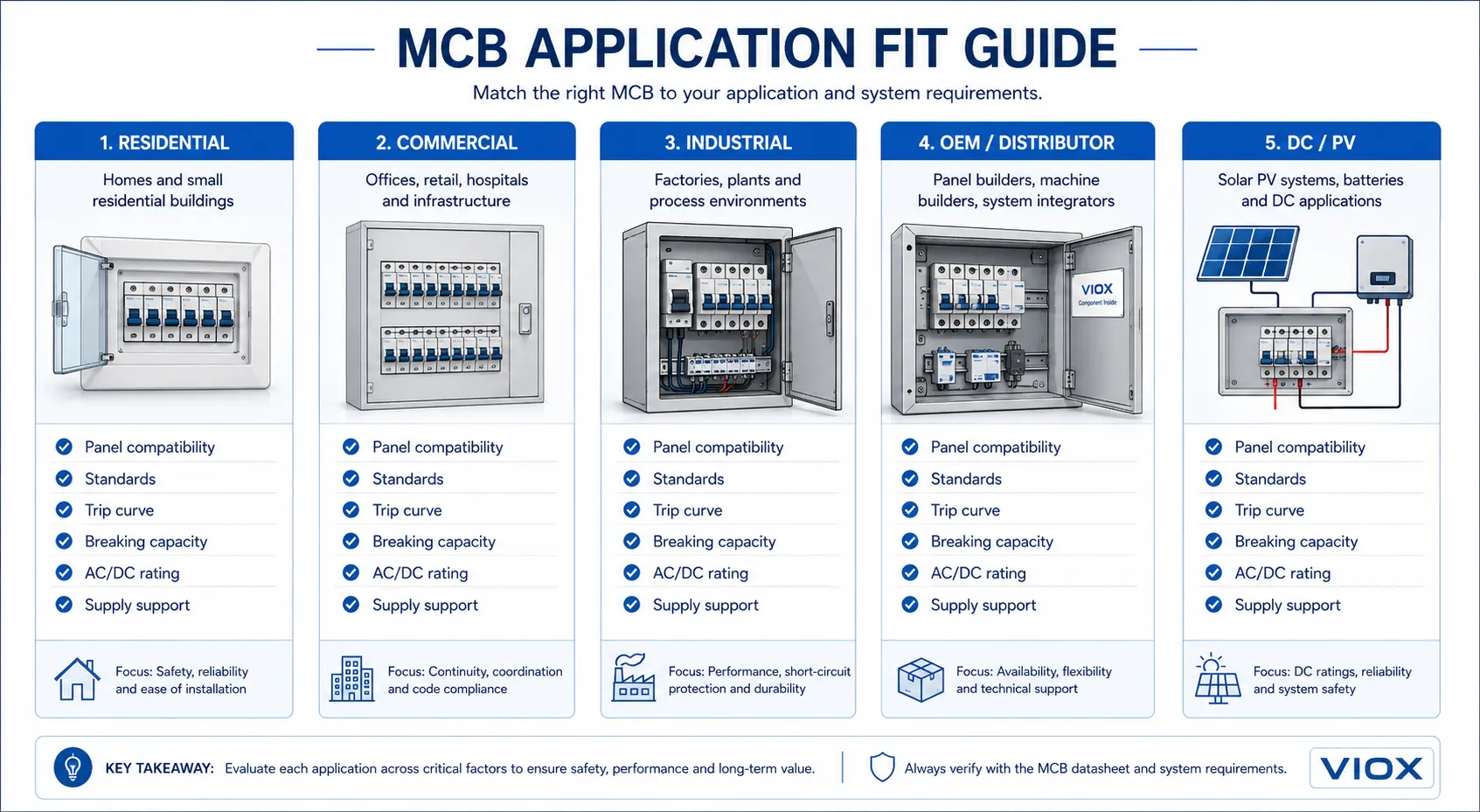
For DC applications, do not assume a standard AC MCB is suitable. See How to Choose a DC Circuit Breaker and DC Circuit Breaker Polarity.
Brand vs Brand Comparisons
Schneider vs ABB: Which Is Better for MCBs?
Schneider is often stronger when the project is a building electrical system with residential, commercial, panelboard, and wiring-device integration. ABB is often stronger when the project leans toward industrial modular protection, automation panels, and system-level electrical engineering.
| Question | Schneider Electric | ABB |
|---|---|---|
| Better for residential boards? | Often yes | Application-dependent |
| Better for industrial panel ecosystems? | Strong | Often strong |
| Better for broad building electrical systems? | Strong | Strong but less wiring-device focused |
| Buyer decision | Choose for building distribution and panel ecosystem | Choose for industrial modular protection and automation context |
Schneider vs Eaton: Which Fits North American Projects Better?
For North American residential and small commercial projects, the answer often depends on the panel system. Breaker compatibility is not only a brand preference; it is tied to panel listing, product family, and local code practice.
Eaton is a major North American circuit protection brand. Schneider Electric, especially through Square D in many markets, is also deeply established. Buyers should avoid choosing only by brand reputation and must check exact panel compatibility.
Hager vs Schneider: Which Is Better for Residential and Commercial Boards?
Hager is often valued by installers for European-style residential and commercial distribution systems. Schneider has broader global recognition and a wider low-voltage ecosystem.
| Buyer Priority | Better Fit |
|---|---|
| European residential consumer unit familiarity | Hager or Schneider, depending on market |
| Broad global commercial project | Schneider |
| Installer-friendly modular board system | Hager can be very competitive |
| Full low-voltage protection ecosystem | Schneider often has a broader range |
Chint vs Hager: Value Brand or Installer-Focused Brand?
CHINT is often considered when cost, scale, and IEC product availability are important. Hager is often considered when the project prioritizes installer familiarity, residential board systems, and European distribution aesthetics.
CHINT may be a better fit for large cost-sensitive commercial projects. Hager may be a better fit for residential and light commercial boards where the installer ecosystem is already built around Hager components.
Chint vs Schneider: Price-Performance vs Global Premium Ecosystem
CHINT is often evaluated as a strong value option in IEC markets. Schneider is often selected for projects that require broad system support, global brand recognition, and a complete low-voltage ecosystem.
For procurement teams, the choice is not simply “cheap vs expensive.” The correct comparison is:
- project approval requirements
- expected support level
- panel compatibility
- documentation
- local distributor availability
- replacement availability
- total cost if a mismatch causes downtime
VIOX vs Global Brands: When a Specialized Supplier Makes Sense
Global premium brands are strong when the project requires brand-standardized systems, owner specifications, or a large installed base. A specialized supplier such as VIOX can make sense when the buyer needs flexible sourcing, OEM support, distributor supply, DC/PV protection options, or price-performance in IEC-style markets.
VIOX is not a replacement for every premium brand in every project. It is a practical option when buyers need application-focused sourcing rather than only a globally famous label.
Engineer’s Verdict: Shortlist by Decision Type
This section is designed for buyers who need a fast shortlist.
| Decision Question | Practical Shortlist |
|---|---|
| Best overall for residential panels | Schneider, Hager, Legrand, Eaton, Siemens depending on region |
| Best for North American residential and small commercial | Eaton, Schneider/Square D, Siemens, Leviton depending on panel compatibility |
| Best for European residential and commercial distribution | Hager, Schneider, Legrand, ABB, Siemens |
| Best for industrial automation panels | ABB, Siemens, Mitsubishi Electric, Fuji Electric |
| Best for smart or connected electrical ecosystems | Schneider, Siemens, Eaton, ABB, Legrand depending on system |
| Best for cost-sensitive IEC projects | CHINT, VIOX, selected regional manufacturers |
| Best for OEM and distributor sourcing | VIOX, CHINT, and qualified private-label manufacturers |
| Best for DC/PV-related protection | Check dedicated DC-rated products from VIOX, CHINT, ABB, Schneider, and others |
For MCB selection fundamentals, see How to Choose the Right MCB.
India and Emerging Markets
India and other emerging markets often have a different buying logic from global specification projects. Buyers usually care about:
- local certification and approval
- electrician familiarity
- distribution network
- replacement availability
- price stability
- compatibility with local distribution boards
- warranty and after-sales support
Commonly searched or considered brands in these markets include Schneider Electric, Legrand, Siemens, ABB, Hager, CHINT, Havells, L&T, IndoAsian, and other regional suppliers. The correct choice depends on whether the project is residential, commercial, industrial, or OEM sourcing.
If this search segment becomes a major traffic source, it is worth creating a dedicated India-focused page and linking it from this global guide.
How to Choose an MCB Manufacturer or Supplier
Before approving an MCB supplier, ask these questions.
| Question | Why It Matters |
|---|---|
| Which standard applies: IEC 60898-1, IEC 60947-2, UL 489, or another local requirement? | Prevents wrong-market products |
| Is the breaking capacity enough for the installation point? | Avoids dangerous short-circuit mismatch |
| Is Ics declared, and how does it compare with Icn or Icu? | Helps judge service performance after short-circuit interruption |
| Are B, C, and D curves available? | Allows load-specific selection |
| Is the product AC-rated, DC-rated, or both? | Prevents unsafe DC use of AC-only breakers |
| Does the certificate model number match the quoted product? | Prevents documentation mismatch |
| Are derating curves available? | Important for temperature, altitude, and enclosure conditions |
| Can the supplier support stable batches? | Reduces distributor and OEM quality risk |
| Can the supplier explain application limits? | Shows real technical competence |
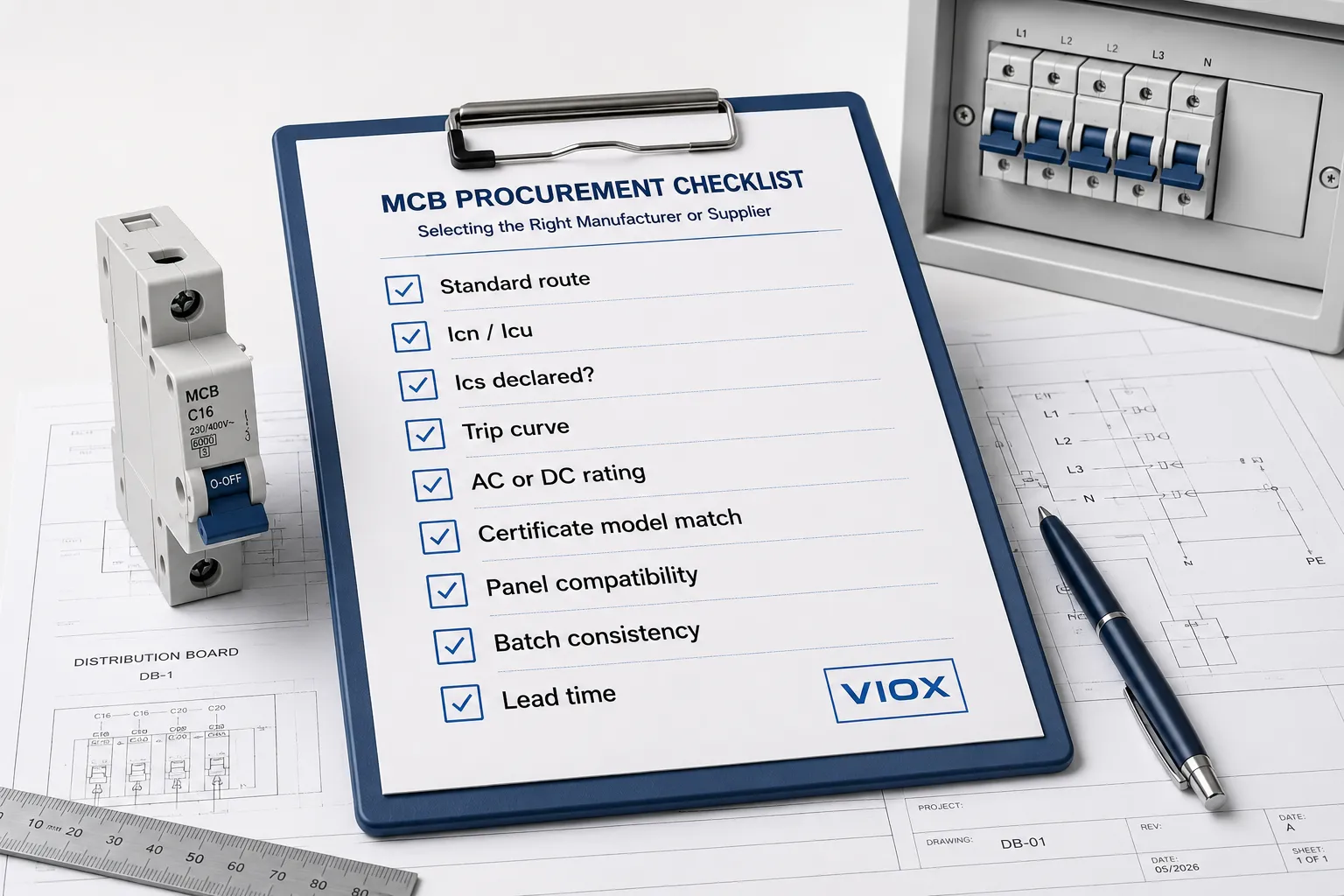
For breaking capacity selection, see 6kA vs 10kA MCB Breaking Capacity.
Common Mistakes When Comparing MCB Brands
Mistake 1: Assuming the Most Famous Brand Is Always the Best Fit
Premium brands are strong, but they are not automatically the most suitable choice for every circuit. A simple residential lighting circuit, a high-inrush motor circuit, and a DC solar combiner application have very different requirements.
Mistake 2: Ignoring Panel Compatibility
This is especially important in North America. A breaker must match the panel and listing requirements. Do not mix products only because the physical shape appears similar.
Mistake 3: Comparing Price Without Comparing Standards
A low price means little if the product lacks the correct standard, certificate, breaking capacity, or application rating.
Mistake 4: Using AC MCBs in DC Circuits
DC arcs do not naturally extinguish at zero crossing like AC arcs. Use only breakers with explicit DC voltage and current ratings.
Mistake 5: Treating One Brand as the Universal Answer
The right choice for a home panel may not be the right choice for a factory, OEM distributor, or solar DC system.
FAQ
Who are the top MCB manufacturers in the world?
Commonly recognized global MCB manufacturers and brands include Schneider Electric, ABB, Siemens, Eaton, Hager, Legrand, CHINT, Mitsubishi Electric, Fuji Electric, and VIOX. The best choice depends on market, application, standards, and panel compatibility.
Which MCB brand is best?
There is no single best MCB brand for every project. Schneider, Hager, Legrand, Eaton, and Siemens are often considered for residential and commercial panels. ABB, Siemens, Mitsubishi, and Fuji are often considered for industrial applications. CHINT and VIOX are often considered for cost-sensitive or flexible sourcing projects.
Which MCB brand is best for home use?
For home use, the best brand depends heavily on country and panel compatibility. Schneider, Hager, Legrand, Eaton, Siemens, and Leviton are commonly considered in different markets. Always follow the panel manufacturer’s approved breaker list and local wiring rules.
Schneider vs ABB MCB: which is better?
Schneider is often preferred for building distribution and broad low-voltage panel ecosystems. ABB is often preferred for industrial modular protection and automation-related systems. The better choice depends on the project, not only the brand.
Chint vs Schneider MCB: which should I choose?
Choose Schneider when the project needs a premium global ecosystem, strong owner acceptance, and broad system compatibility. Choose CHINT when price-performance, IEC product availability, and large-volume procurement are more important, provided the exact product meets the required standard and ratings.
Hager vs Schneider MCB: which is better?
Hager is strong in European residential and commercial distribution boards, especially where installers are familiar with its modular systems. Schneider has broader global coverage and a wider low-voltage ecosystem.
What should distributors check before buying MCBs from a manufacturer?
Distributors should check standards, certificate model numbers, breaking capacity, trip curves, AC/DC ratings, pole configurations, packaging, batch consistency, lead time, warranty process, and whether the manufacturer can provide stable documentation for resale markets.
Is VIOX an MCB manufacturer?
VIOX supplies MCBs and related low-voltage protection products for distributors, OEM buyers, panel builders, and industrial sourcing projects. Buyers should confirm the exact product datasheet, standard, ratings, and application requirements before approval.
Final Advice
Do not choose an MCB manufacturer only by global brand fame. Choose by application fit.
For residential projects, panel compatibility and local installer familiarity may matter most. For industrial panels, breaking capacity, trip curve, documentation, and system integration matter more. For DC/PV and OEM sourcing, explicit DC ratings, supply flexibility, and technical documentation become critical.
If your goal is a safe and reliable project, compare MCB brands by standards, ratings, panel fit, application risk, and support. If your goal is distributor or OEM sourcing, also compare supply stability, customization options, MOQ, labeling, and documentation quality.