

On this page
Quick Answer: How Do You Choose a DC Circuit Breaker?
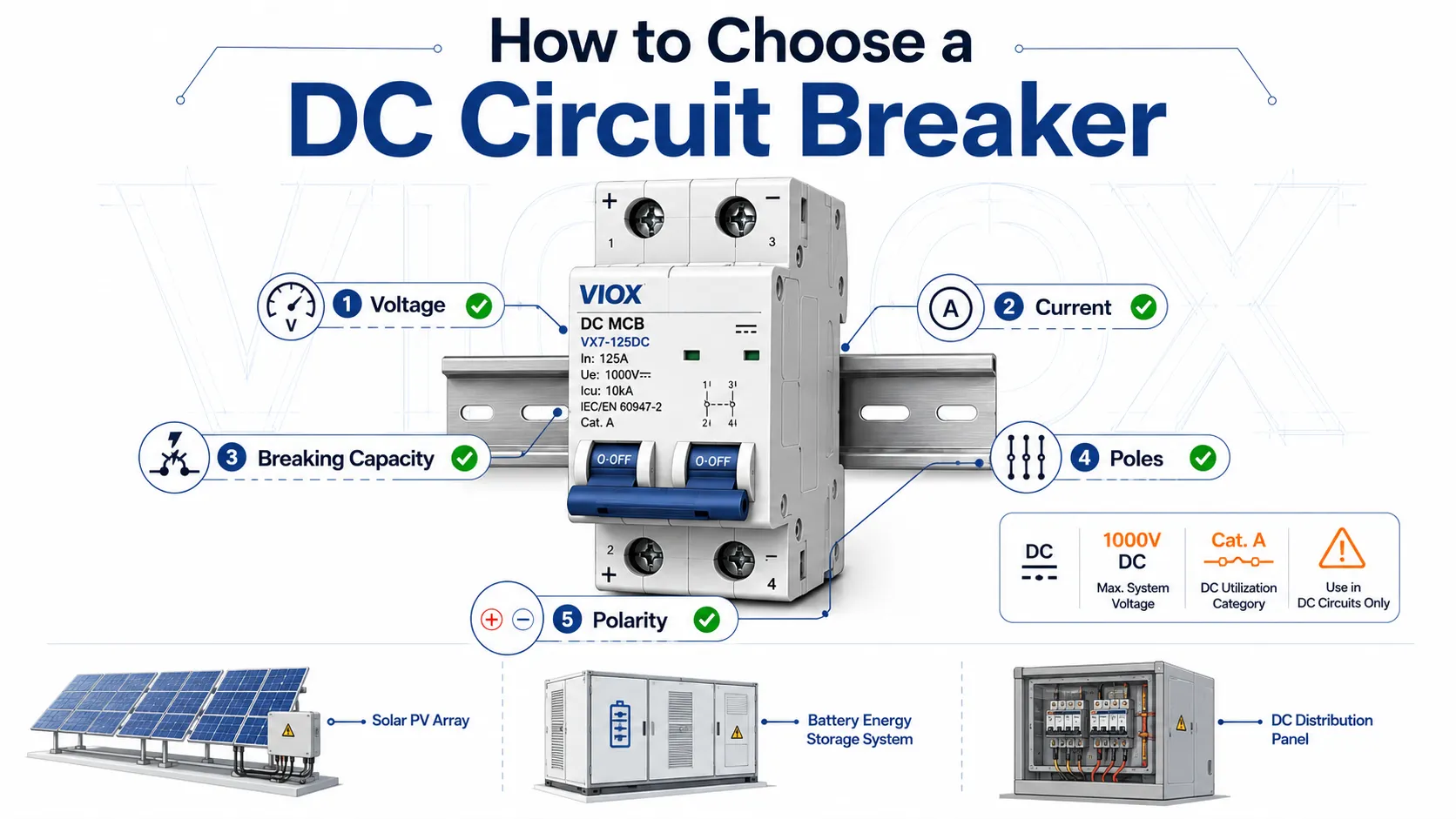
Choose a DC circuit breaker by checking six items in order: maximum DC voltage, continuous current, available fault current, pole configuration, polarity requirement, and application duty. Do not select by amp rating alone. A breaker that is correct for 32 A at low-voltage DC may still be unsafe for a 1000 V solar string or a bidirectional battery circuit.
The practical selection sequence is:
- Confirm the maximum DC system voltage, not only the nominal voltage.
- Calculate the design current and apply the required code or project sizing rule.
- Verify the DC breaking capacity against the available fault current.
- Choose the correct pole configuration and series wiring method.
- Check whether the breaker is polarized or non-polarized.
- Match the breaker type to the application: solar PV, battery, telecom, EV charging, or industrial DC distribution.
If you need the device definition first, start with What Is a DC Circuit Breaker?. If you are already evaluating modular breakers, the VIOX DC MCB product page is the commercial next step.
DC Circuit Breaker Selection Checklist
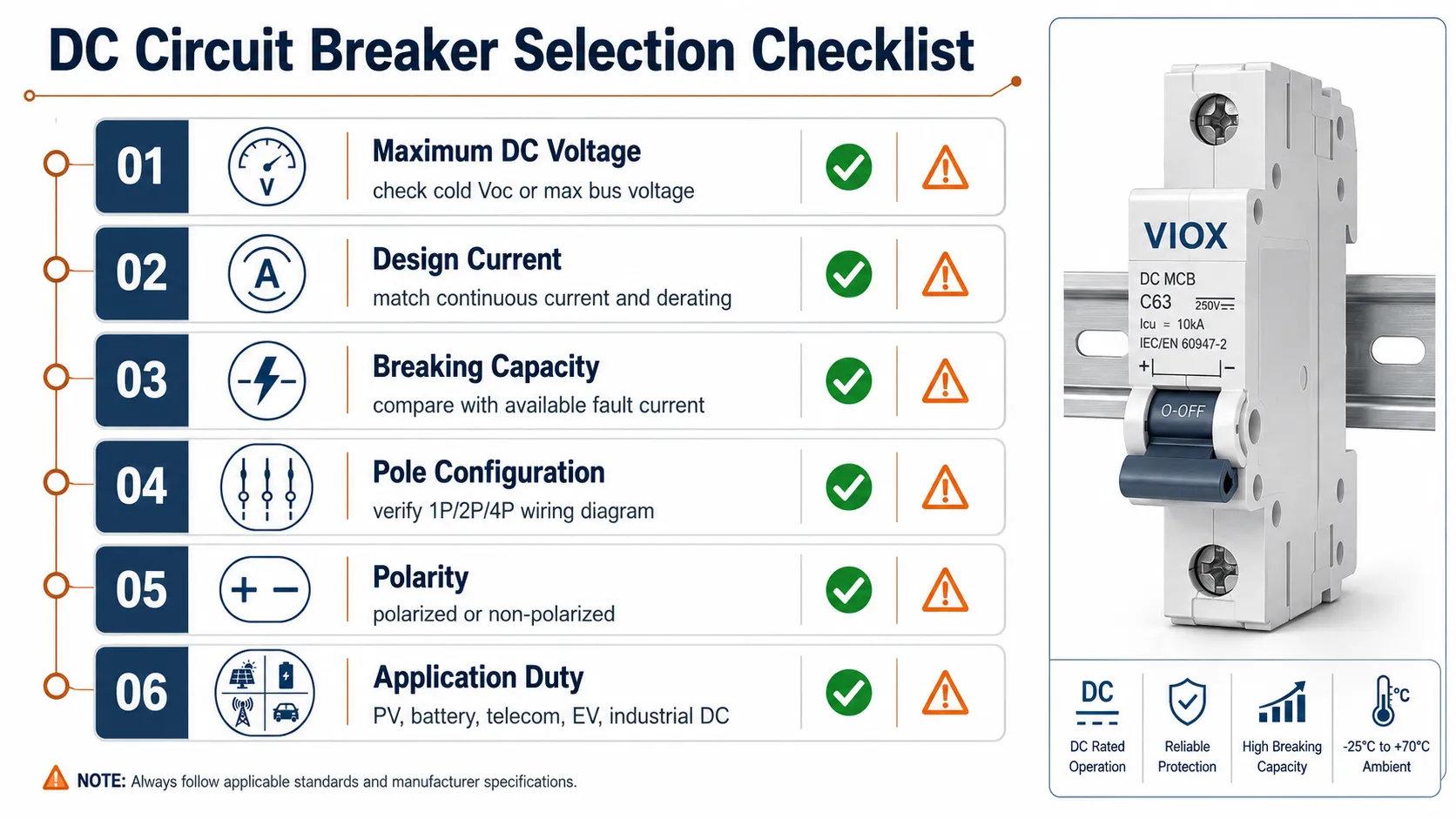
| Selection item | What to check | Common mistake |
|---|---|---|
| DC voltage rating | Maximum operating voltage, PV cold Voc, battery maximum charge voltage, or DC bus voltage | Selecting by nominal voltage only |
| Current rating | Continuous load current, PV Isc-based sizing, battery charge/discharge current, temperature derating | Choosing only the nearest amp number |
| Breaking capacity | Available short-circuit current at the installation point | Assuming all 6 kA or 10 kA breakers are interchangeable |
| Pole configuration | 1P, 2P, 3P, 4P, and whether poles must be wired in series | Treating pole count as only a wiring convenience |
| Polarity | Polarized, non-polarized, bidirectional, marked line/load terminals | Installing a polarity-sensitive DC breaker backward |
| Application duty | PV, battery, telecom, EV charger, industrial DC load, or control panel | Using one generic DC breaker for every DC system |
| Standard and marking | IEC 60947-2, UL 489/UL 489B where applicable, exact DC voltage/current markings | Trusting a vague "DC rated" label |
| Environment | Ambient temperature, enclosure heating, altitude, humidity, vibration, outdoor exposure | Ignoring derating and enclosure conditions |
Step 1: Match the DC Voltage Rating
Voltage is the first selection gate. If the breaker is not rated for the actual DC voltage, every other rating becomes irrelevant.
For DC systems, check the maximum voltage the breaker may see under real operating conditions:
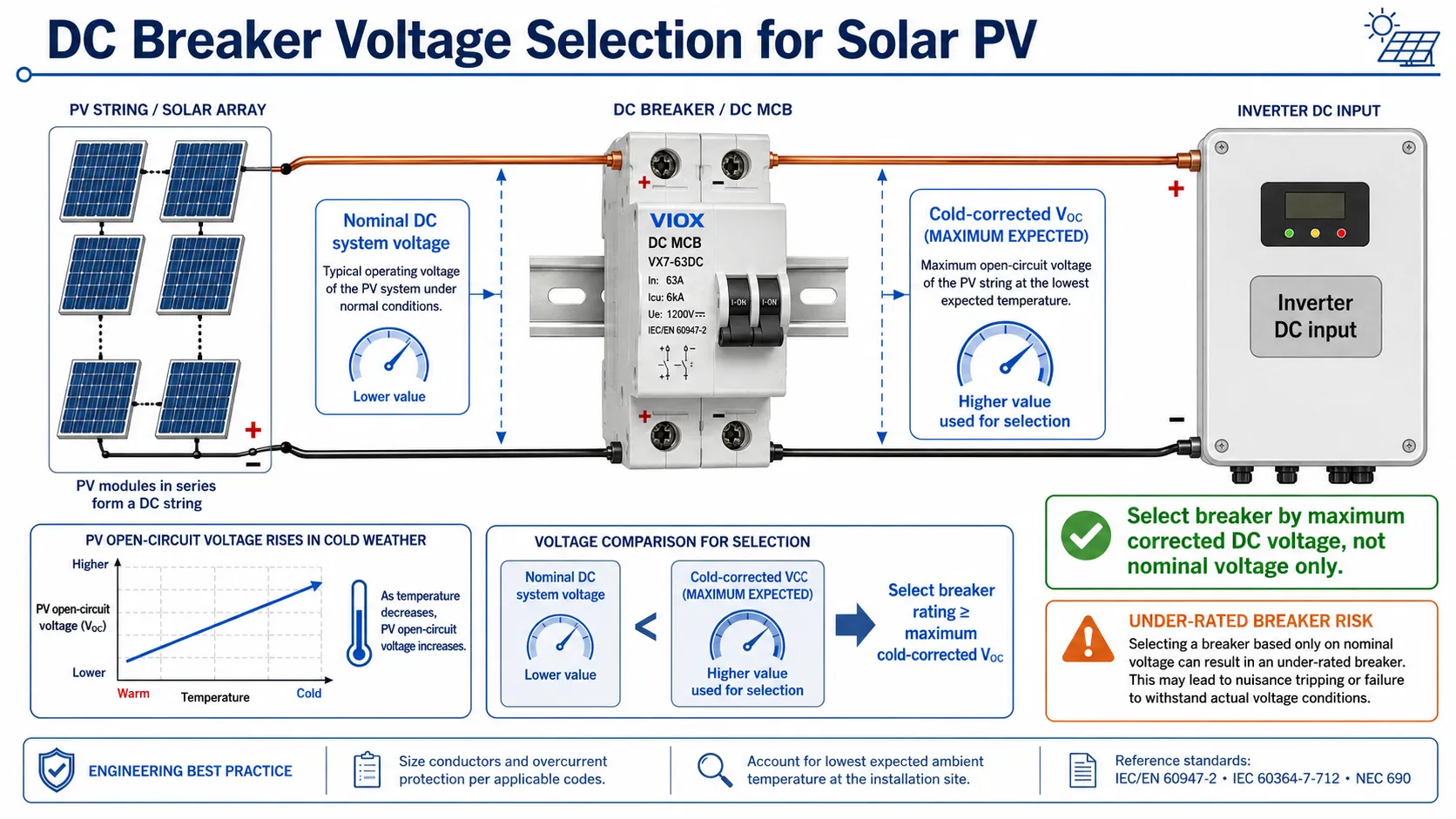
- Solar PV: use maximum string open-circuit voltage, including cold-temperature correction.
- Battery systems: use maximum battery charge voltage, not nominal battery voltage.
- EV charging and DC distribution: use maximum DC bus voltage under system operating limits.
- Telecom systems: use the highest float or equalization voltage of the DC power plant.
Do not use a breaker rated only for AC unless the datasheet explicitly gives a DC rating at the required voltage. DC arcs do not naturally pass through zero the way AC arcs do, so DC interruption requires a suitable arc chamber, contact design, magnetic blowout or equivalent arc-control structure, insulation spacing, and tested DC breaking capability.
PV voltage example
A PV string may be described as part of a "1000 V DC system," but the cold-morning open-circuit voltage can exceed the normal operating voltage. The breaker must be selected against the corrected maximum string voltage and the manufacturer’s DC rating, not only the inverter’s nominal system class.
DC breaker voltage rating >= maximum corrected DC voltageFor detailed sizing logic in PV contexts, see DC Circuit Breaker Sizing: NEC 690 vs IEC 60947-2.
Step 2: Calculate the Current Rating
The current rating must match the actual circuit duty. For a DC miniature circuit breaker (DC MCB), this usually means matching the rated current to the design current after applying the required standard, code, or project derating rule.
Typical inputs include:
- continuous load current
- PV string short-circuit current (Isc)
- battery charge and discharge current
- converter or inverter input/output current
- ambient temperature
- enclosure heating
- conductor size and insulation rating
- grouping with other breakers
Avoid applying one fixed multiplier to every DC system. North American PV installations, IEC industrial panels, telecom DC systems, and battery packs may use different design rules. The correct current rating should be reviewed with the governing standard, equipment manual, and conductor ampacity.
Current rating is not breaking capacity
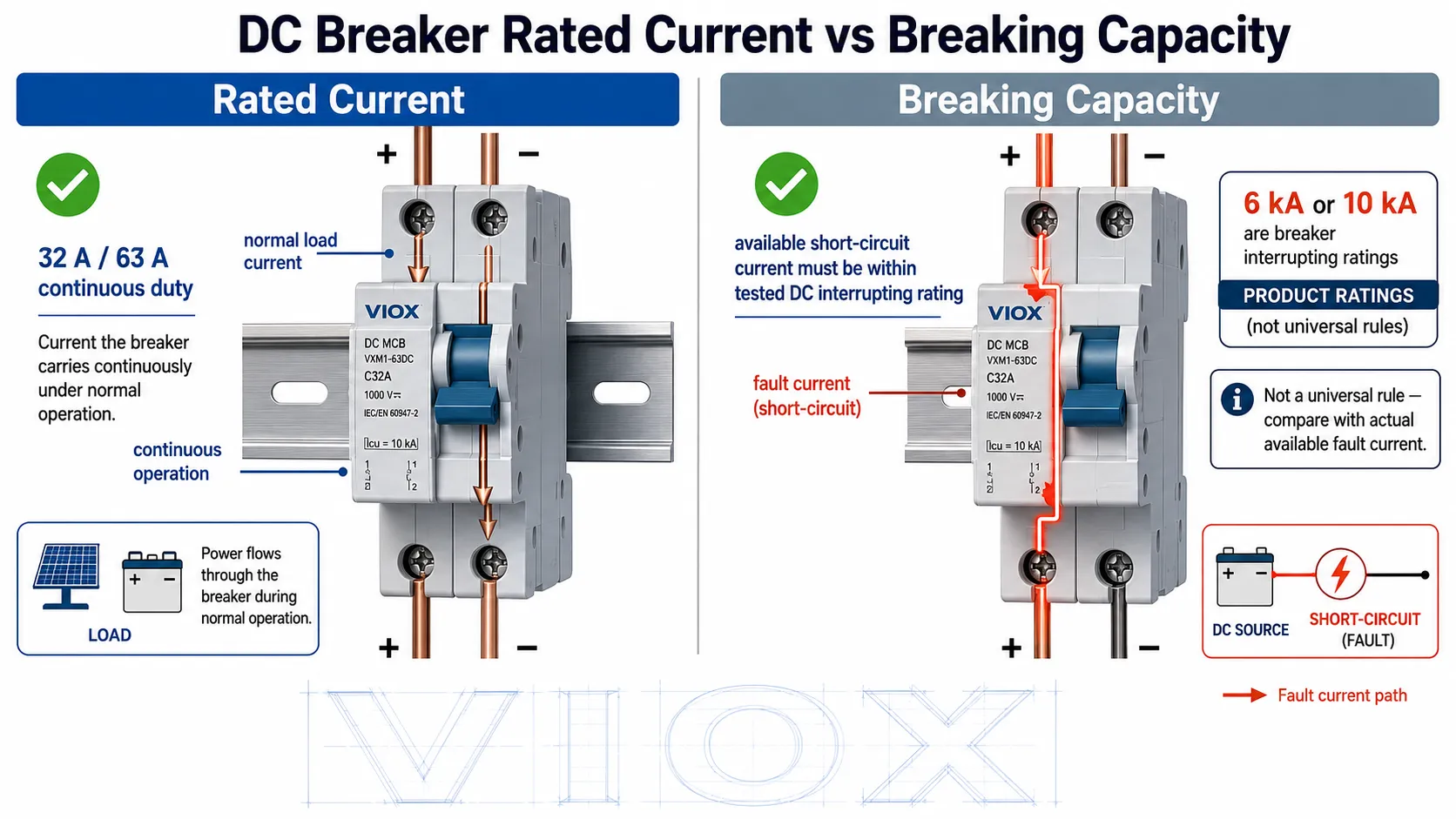
A 32 A DC breaker and a 63 A DC breaker describe continuous current capability. They do not tell you how much fault current the breaker can safely interrupt. That is the job of the breaking capacity rating.
Step 3: Check DC Breaking Capacity
Breaking capacity, also called interrupting capacity, is the maximum fault current the breaker can interrupt at its rated voltage under test conditions. This is one of the most important safety ratings in DC protection.
The breaker breaking capacity must be greater than or equal to the available short-circuit current at the installation point, with the required design margin and standard basis.
DC breaking capacity >= available short-circuit current| Application | Fault-current issue | Selection note |
|---|---|---|
| Solar PV string | Fault current may be limited by module/string behavior but can include reverse current from parallel strings | Check array architecture, number of parallel strings, and PV protection design |
| Battery storage | Battery fault current can be very high and sustained | Verify breaker interrupting rating against battery/system fault-current study |
| Telecom 48 V DC | Lower voltage but high available current from battery banks | Do not underestimate low-voltage high-current DC faults |
| EV charging DC section | High DC voltage and converter-based architecture | Coordinate breaker selection with charger OEM design and upstream protection |
| Industrial DC distribution | Converter, rectifier, and bus capacitance may affect fault behavior | Use project fault-current calculation and equipment datasheets |
Common breaker markings such as 6 kA or 10 kA are not universal recommendations. They are product ratings that must be compared with the actual prospective fault current and the exact DC voltage at which the rating applies.
For a deeper explanation of breaking capacity terminology, see MCB Breaking Capacity: 6kA vs 10kA.
Step 4: Choose Pole Configuration: 1P, 2P, 3P, or 4P
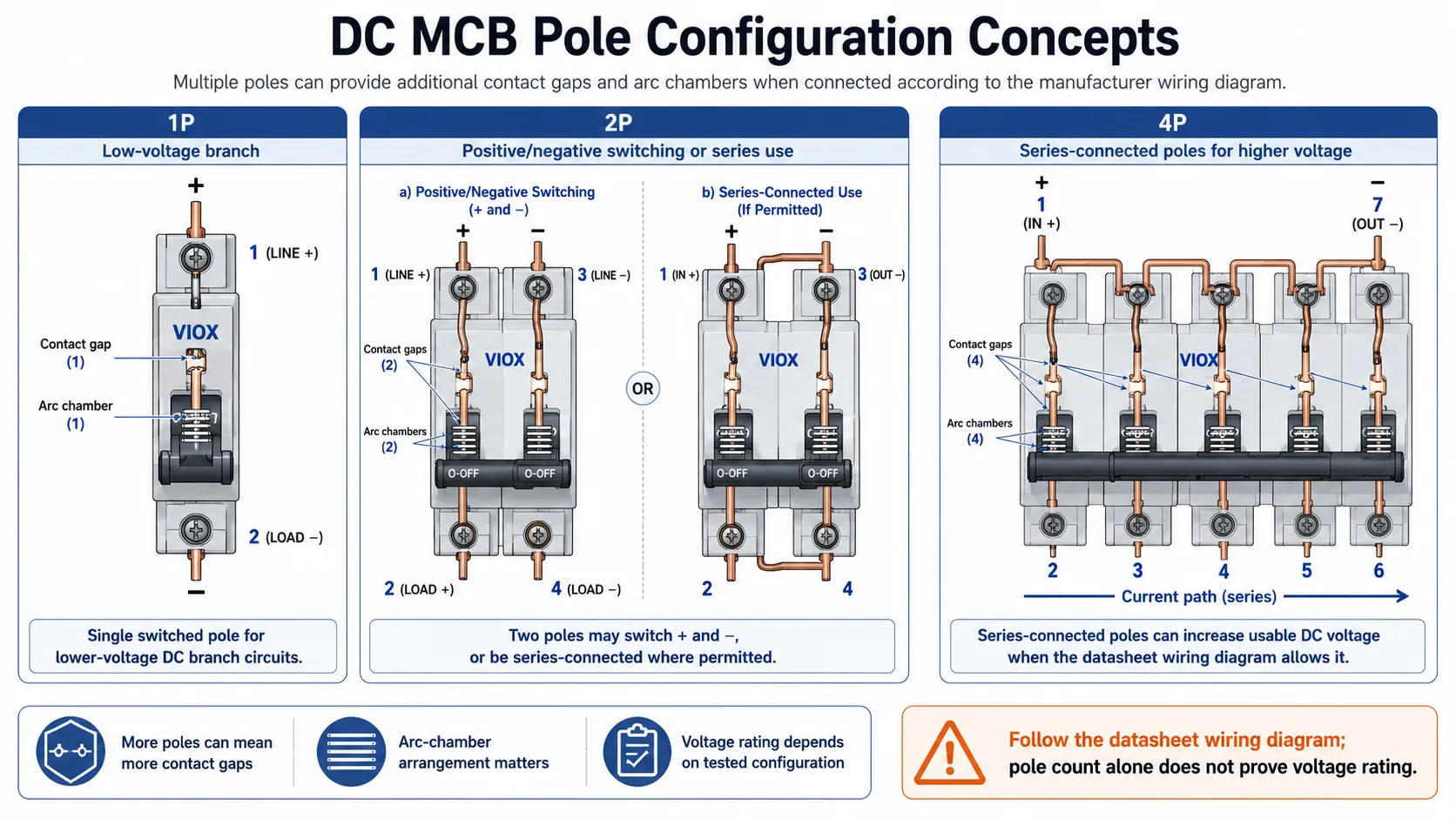
Pole configuration is not just about how many wires need to be connected. In high-voltage DC MCBs, multiple poles may be used in series to create several contact gaps and arc chambers. This helps the breaker interrupt higher DC voltage than a single pole could handle alone.
Typical configurations include:
| Pole configuration | Common use | What to verify |
|---|---|---|
| 1P DC breaker | Low-voltage single conductor protection | Exact DC voltage per pole and polarity |
| 2P DC breaker | Positive and negative conductor switching, or series-connected poles for higher voltage | Manufacturer wiring diagram |
| 3P DC breaker | Some higher-voltage or special DC arrangements | Required series wiring and unused-pole rules |
| 4P DC breaker | Higher-voltage PV or DC distribution designs where poles are series-connected | Total voltage rating depends on correct wiring |
Do not assume that a 4-pole breaker is automatically safer or higher-rated in every wiring arrangement. The datasheet must show how the poles should be connected for the stated DC voltage.
For high-voltage modular breaker design issues, see 1000V DC MCB Design Challenges.
Step 5: Check Polarity: Polarized vs Non-Polarized DC Breakers
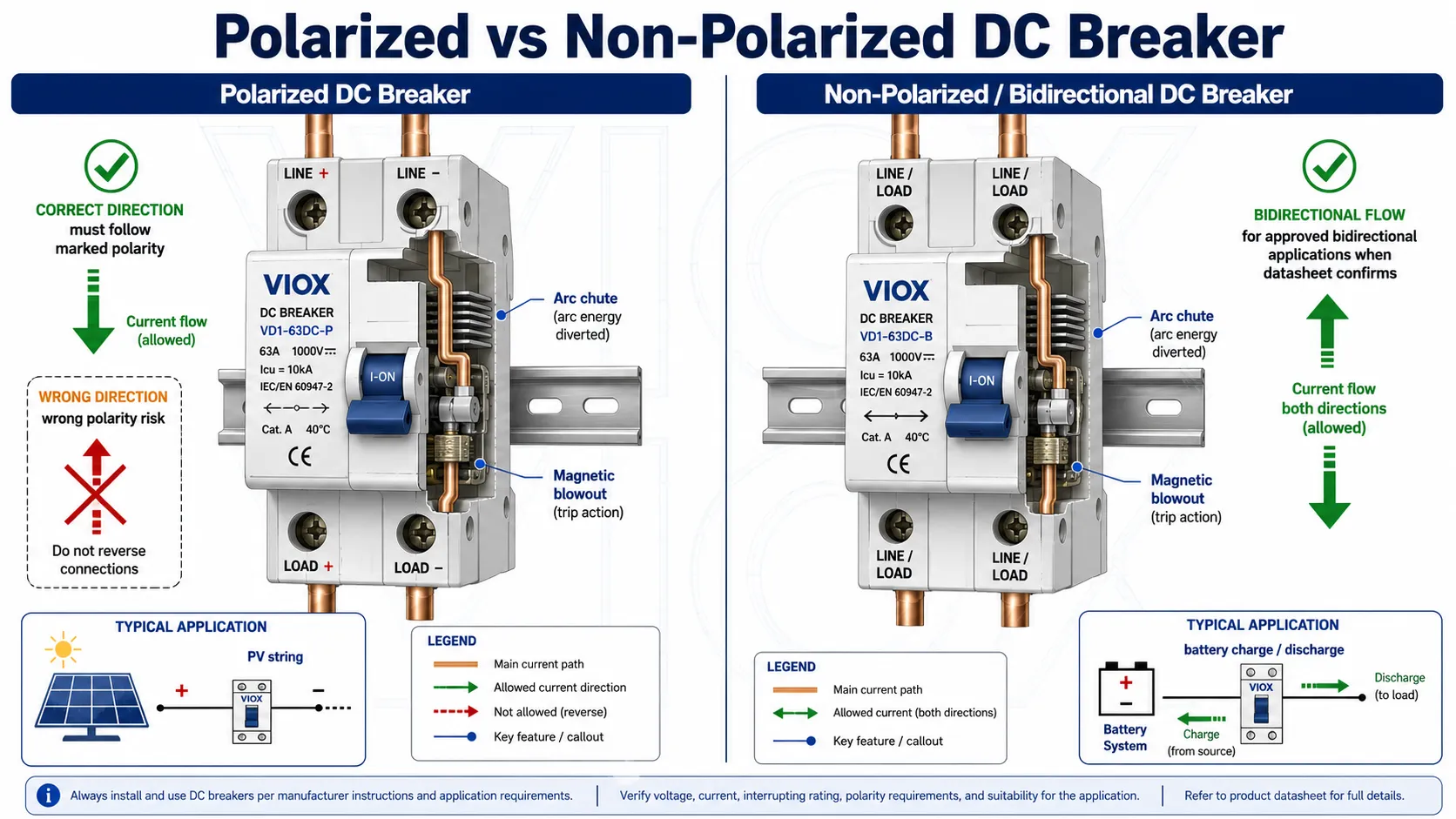
Some DC breakers are polarity-sensitive. They rely on magnetic arc movement arranged for a specific current direction. If the breaker is wired backward, the arc may move away from the arc chute instead of into it, reducing interruption performance.
Other DC breakers are designed as non-polarized or bidirectional devices when installed according to the manufacturer’s diagram. These are especially important in systems where current direction can reverse during normal operation.
| System type | Why polarity matters |
|---|---|
| Solar PV | String current normally flows one way, but reverse-current conditions may appear in parallel arrays |
| Battery storage | Charge and discharge current may flow through the same path in opposite directions |
| DC EV charging | Power electronics and protection architecture determine current paths |
| Telecom DC | Polarity is usually defined, but installation errors can still damage equipment |
If the circuit can carry current in both directions, do not assume a standard polarized breaker is acceptable. Use a breaker explicitly rated for that bidirectional duty or follow the system manufacturer’s protection design.
For a dedicated explanation, see the Polarity DC Circuit Breaker Guide.
Step 6: Select by Application
Solar PV Systems
Solar PV breaker selection is shaped by string voltage, cold Voc, Isc, reverse current paths, combiner box architecture, and outdoor enclosure conditions.
Check:
- maximum corrected string Voc
- string Isc and required sizing rule
- number of parallel strings
- DC breaking capacity at the rated voltage
- 1P/2P/4P series wiring diagram
- polarized or non-polarized design
- enclosure temperature and derating
In PV combiner boxes, the DC breaker works alongside fuses, surge protective devices (SPDs), and isolators. It does not replace every protection or isolation function. For the device boundary, see DC Isolator vs DC Circuit Breaker.
Battery Energy Storage Systems
Battery circuits can be more severe than they look on paper because fault current may be high, sustained, and bidirectional. A breaker must be selected against the battery system voltage, available fault current, current direction, protection coordination, and battery management system requirements.
Check:
- maximum battery voltage
- charge/discharge current
- available short-circuit current
- bidirectional current requirement
- coordination with fuses, contactors, BMS, and disconnects
- temperature and enclosure conditions
In high-energy battery systems, a standard low-voltage DC breaker may not be enough. For BESS-specific failure risks, see Why Standard DC Breakers Fail in BESS.
Telecom and 48 V DC Systems
Telecom power systems often use lower voltage but high battery-backed fault current. Selection should not be relaxed just because the voltage is lower.
Check:
- system float/equalization voltage
- continuous load current
- battery plant fault-current capability
- voltage drop and power loss
- remote alarm or monitoring needs
- panel space and terminal compatibility
EV Charging and Industrial DC Distribution
EV charging and industrial DC systems often include converters, rectifiers, capacitors, and control electronics. Breaker selection should be coordinated with the complete equipment design rather than chosen as a generic field accessory.
Check:
- maximum DC bus voltage
- available fault current
- converter and capacitor discharge behavior
- upstream and downstream protection
- OEM wiring diagram
- required certification or market approval
DC MCB vs DC MCCB: Which One Fits Your System?
| Feature | DC MCB | DC MCCB |
|---|---|---|
| Typical role | Modular branch or string protection | Higher-current feeder or main DC protection |
| Current range | Lower to medium current, depending on model | Medium to high current, depending on frame |
| Trip settings | Usually fixed | Often adjustable on larger models |
| Panel format | DIN-rail modular panels and combiner boxes | Larger distribution panels and industrial systems |
| Best fit | PV strings, small DC branches, telecom panels, compact DC distribution | Battery feeders, industrial DC feeders, higher fault-current systems |
If the circuit requires higher current, adjustable protection, or higher short-circuit performance than a modular DC MCB can provide, review a DC MCCB or a coordinated fuse/breaker strategy.
Common Selection Mistakes
1. Choosing by amperes only
A breaker rated 32 A is not automatically suitable for every 32 A DC circuit. Voltage, breaking capacity, polarity, pole wiring, temperature, and application duty must also match.
2. Using an AC breaker in a DC circuit
AC ratings do not prove DC interrupting capability. Use a breaker with explicit DC voltage, current, and breaking-capacity markings.
3. Ignoring PV cold Voc
PV voltage increases in cold conditions. A breaker selected only from nominal system voltage can be under-rated during cold open-circuit conditions.
4. Assuming 4P wiring is obvious
Many high-voltage DC MCBs require a specific pole series wiring method. Wrong wiring can leave one pole overstressed and reduce arc-extinction performance.
5. Ignoring polarity in battery circuits
Battery systems may charge and discharge through the same path. A polarity-sensitive breaker may be unsuitable if current can reverse.
6. Treating the breaker as an isolator
A DC circuit breaker provides overcurrent protection. A DC isolator provides manual isolation. Some devices may offer multiple functions, but the datasheet must prove the exact duty. For the difference, see DC Isolator vs DC Circuit Breaker.
Supplier and Datasheet Verification Checklist
Before approving a DC circuit breaker for a project, ask for:
- exact model datasheet
- DC voltage rating at the required pole wiring
- rated current and derating information
- breaking capacity at the rated DC voltage
- polarity marking and line/load requirements
- 1P/2P/3P/4P wiring diagram
- applicable standard basis such as IEC 60947-2 or UL 489/UL 489B where required
- terminal capacity and torque information
- operating temperature range
- certificate model number matching the quoted product
For product evaluation after you understand the selection logic, review VIOX DC MCB solutions or contact VIOX with your system voltage, load current, available fault current, wiring diagram, and target market.
FAQ
How do I choose the right DC circuit breaker?
Start with maximum DC voltage, then calculate current, check breaking capacity, choose pole configuration, verify polarity, and match the breaker to the application. Do not choose by amp rating alone.
Can I use an AC circuit breaker for DC?
Only if the datasheet explicitly gives a suitable DC rating for the voltage, current, breaking capacity, and wiring method. An AC-only rating is not enough.
What DC voltage rating do I need for a solar breaker?
Use the maximum corrected PV string open-circuit voltage, including cold-temperature effects, not just nominal system voltage. The breaker must be rated for that DC voltage in the required pole wiring configuration.
What breaking capacity should a DC breaker have?
The breaking capacity must be equal to or greater than the available short-circuit current at the installation point, with the margin and standard basis required by the project. Do not use 6 kA or 10 kA as a universal rule.
What is the difference between polarized and non-polarized DC breakers?
A polarized DC breaker must be wired according to the marked current direction. A non-polarized or bidirectional breaker is designed to interrupt current in either direction when installed according to the datasheet.
Why do some DC MCBs use multiple poles in series?
Multiple poles in series create several contact gaps and arc chambers. This can help a compact breaker interrupt higher DC voltage, but only if wired according to the manufacturer’s diagram.
Is a DC breaker the same as a DC isolator?
No. A DC breaker is primarily an overcurrent protective device. A DC isolator is primarily a manual isolation device. Some equipment may combine functions, but the ratings and standard markings must support the actual duty.
Which is better for DC systems: breaker or fuse?
It depends on fault current, voltage, reset preference, coordination, cost, and maintenance strategy. Fuses can provide very high fault-current interruption, while breakers are resettable. For the detailed tradeoff, see DC Circuit Breaker vs Fuse.
Summary
Choosing a DC circuit breaker is an engineering decision, not a catalog shortcut. The correct breaker must match maximum DC voltage, design current, available fault current, pole wiring, polarity, application duty, and installation environment.
For solar PV, pay special attention to cold-corrected Voc and combiner architecture. For battery systems, check bidirectional current and available fault energy. For telecom and industrial DC distribution, verify short-circuit current, derating, and protection coordination. When in doubt, use the breaker datasheet and system fault calculation as the final authority.