

On this page
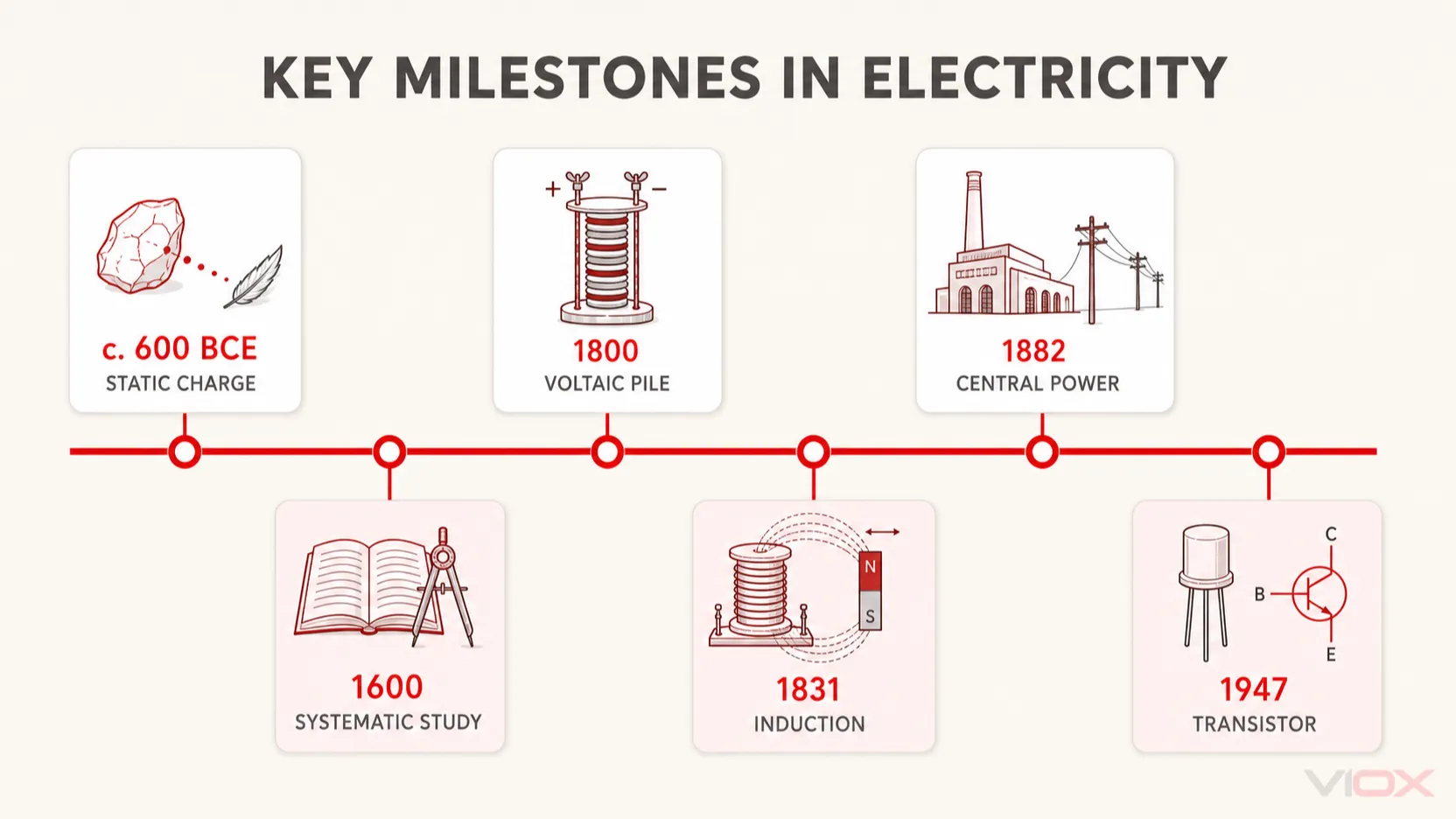
Electricity was not invented by one person. It is a natural phenomenon that people gradually learned to observe, measure, generate, transmit, and control. The modern electrical system emerged through a chain of contributions—from early observations of static charge to Volta’s battery, Faraday’s electromagnetic induction, practical power networks, and semiconductor electronics.
The timeline below separates four ideas that are often mixed together:
- Observation: noticing an electrical phenomenon;
- Scientific discovery: explaining or measuring how it behaves;
- Invention: creating a device that uses the phenomenon; and
- Commercialization: building a practical system that can serve many users.
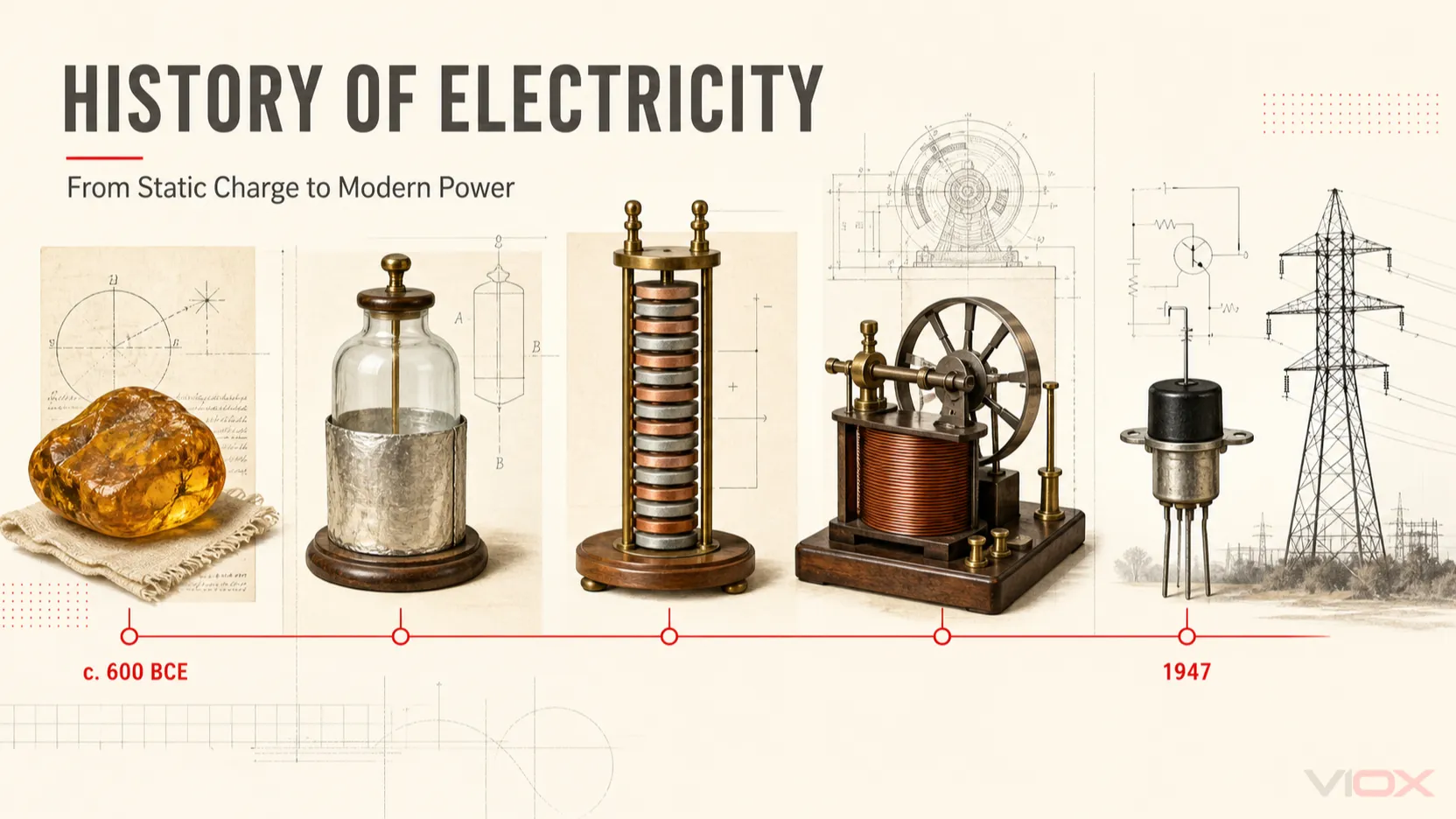
Electricity History Timeline at a Glance
| Date | Person or team | Milestone | Why it mattered |
|---|---|---|---|
| c. 600 BCE | Thales of Miletus, traditionally credited | Amber rubbed with material was observed to attract light objects | An early recorded observation associated with static charge |
| 1600 | William Gilbert | Published De Magnete and distinguished magnetic effects from the attractive effect produced by rubbed materials | Helped establish electricity and magnetism as subjects of systematic experiment |
| 1660s | Otto von Guericke | Built an early frictional electrostatic generator | Made repeatable static-electricity experiments easier |
| 1729 | Stephen Gray | Demonstrated that electrical effects could travel through some materials | Helped establish the distinction between conductors and insulators |
| 1745–1746 | Ewald Georg von Kleist and Pieter van Musschenbroek | Independently developed the Leyden jar | Provided an early method of storing electric charge |
| 1750s | Benjamin Franklin and other experimenters | Established the electrical nature of lightning and developed the lightning rod | Connected laboratory electricity with an atmospheric phenomenon and produced a practical protective device |
| 1785 | Charles-Augustin de Coulomb | Quantified the force between electric charges | Gave electrostatics a mathematical foundation |
| 1800 | Alessandro Volta | Presented the voltaic pile | Supplied continuous current for experiments instead of brief electrostatic discharges |
| 1820 | Hans Christian Ørsted; André-Marie Ampère | Demonstrated and analyzed the relationship between current and magnetism | Opened the path to electromagnets, motors, and electromagnetic theory |
| 1821 | Michael Faraday | Demonstrated electromagnetic rotation | Established a basic principle behind electric motors |
| 1827 | Georg Simon Ohm | Published the relationship now expressed as V = IR | Made current, voltage, and resistance quantitatively useful in circuit analysis |
| 1831 | Michael Faraday; Joseph Henry independently | Demonstrated electromagnetic induction | Supplied the operating principle behind generators and transformers |
| 1860s | James Clerk Maxwell | Unified electricity, magnetism, and light in electromagnetic field theory | Provided the theoretical framework for electrical engineering and radio |
| 1870s–1880s | Joseph Swan, Thomas Edison, and their teams | Developed practical incandescent lighting and the systems needed to operate it | Turned electric lighting into a deployable service rather than a laboratory demonstration |
| 1882 | Edison companies | Opened the Pearl Street direct-current station in New York | Demonstrated an early commercial central power system |
| 1880s–1890s | Galileo Ferraris, Nikola Tesla, George Westinghouse, William Stanley, and others | Developed and commercialized polyphase motors, transformers, and alternating-current systems | Enabled practical voltage transformation and wider-area power distribution |
| 1895–1896 | Westinghouse and the Niagara Falls project teams | Put the Niagara AC generation and transmission system into service | Demonstrated large-scale generation and delivery of power over distance |
| 1897 | J. J. Thomson | Identified the electron | Changed the scientific model of charge and matter |
| 1947 | John Bardeen, Walter Brattain, and William Shockley at Bell Labs | Developed the transistor | Replaced many vacuum-tube functions with smaller, lower-power semiconductor devices |
| 1954 | Bell Laboratories team | Demonstrated a practical silicon photovoltaic cell | Established a foundation for modern solar-electric generation |
| 1958–1959 | Jack Kilby and Robert Noyce | Developed complementary approaches to the integrated circuit | Made it possible to place multiple electronic components and interconnections on compact semiconductor structures |
No short timeline can include every contributor. These milestones were selected because each unlocked a new engineering capability: storing charge, producing continuous current, converting between electricity and motion, analyzing circuits, distributing power, or processing signals electronically.
Who Invented Electricity?
No one invented electricity. Lightning, static charge, and bioelectric effects existed long before humans studied them. The more accurate question is: who helped us understand and use electricity?
Different people supplied different parts of the answer:
- William Gilbert helped turn scattered observations into systematic investigation.
- Benjamin Franklin contributed to the understanding of charge and showed that lightning was electrical in nature.
- Alessandro Volta created a practical early source of continuous current.
- Ørsted, Ampère, Faraday, and Henry established the relationship between electricity, magnetism, motion, and induction.
- Ohm and Maxwell made electrical behavior mathematically describable.
- Swan, Edison, Tesla, Westinghouse, Ferraris, Stanley, and many engineering teams helped turn laboratory science into lighting, motors, generation, and power distribution.
- Semiconductor researchers later made modern control, communication, computing, and power electronics possible.
Attributing electricity to a single inventor erases the difference between discovering a natural phenomenon and designing a useful electrical system.
From Static Charge to Continuous Current
Early observations and electrostatic machines
The ancient amber story is often presented as the “discovery of electricity,” but it was an observation rather than a modern scientific explanation. The decisive change came during the scientific revolution, when experimenters began producing electrical effects repeatedly and comparing different materials.
Gilbert’s work around 1600 helped distinguish the attractive effect of rubbed materials from magnetism. Later electrostatic machines produced larger and more repeatable charges. Gray’s experiments showed that electrical effects could be conducted through some materials, while the Leyden jar made stored charge available for controlled experiments.
Franklin, lightning, and charge
Benjamin Franklin did not discover electricity. European and American researchers had already been studying electrical effects for decades. His work was important because it connected lightning with electrical discharge, advanced a positive-and-negative charge convention, and led to the practical lightning rod.
The familiar kite story should also be stated carefully. Franklin proposed the experiment, and contemporary reports describe a successful demonstration associated with him, but simplified retellings often add dramatic details that are not required to understand the scientific result.
Volta’s battery changed the experiment
Electrostatic devices produced high voltages but only brief discharges. Volta’s pile, announced in 1800, supplied a more continuous current. That gave researchers a fundamentally different tool: they could study chemical effects, heating, magnetism, and sustained current flow.
This is why the battery marks a genuine turning point. It did not “invent electricity”; it made controlled electrical experimentation far more productive.
Electromagnetism Made Motors and Generators Possible
In 1820, Ørsted observed that current in a wire deflected a nearby compass needle. Ampère developed the mathematical and experimental study of forces between currents. Their work showed that electricity and magnetism were connected.
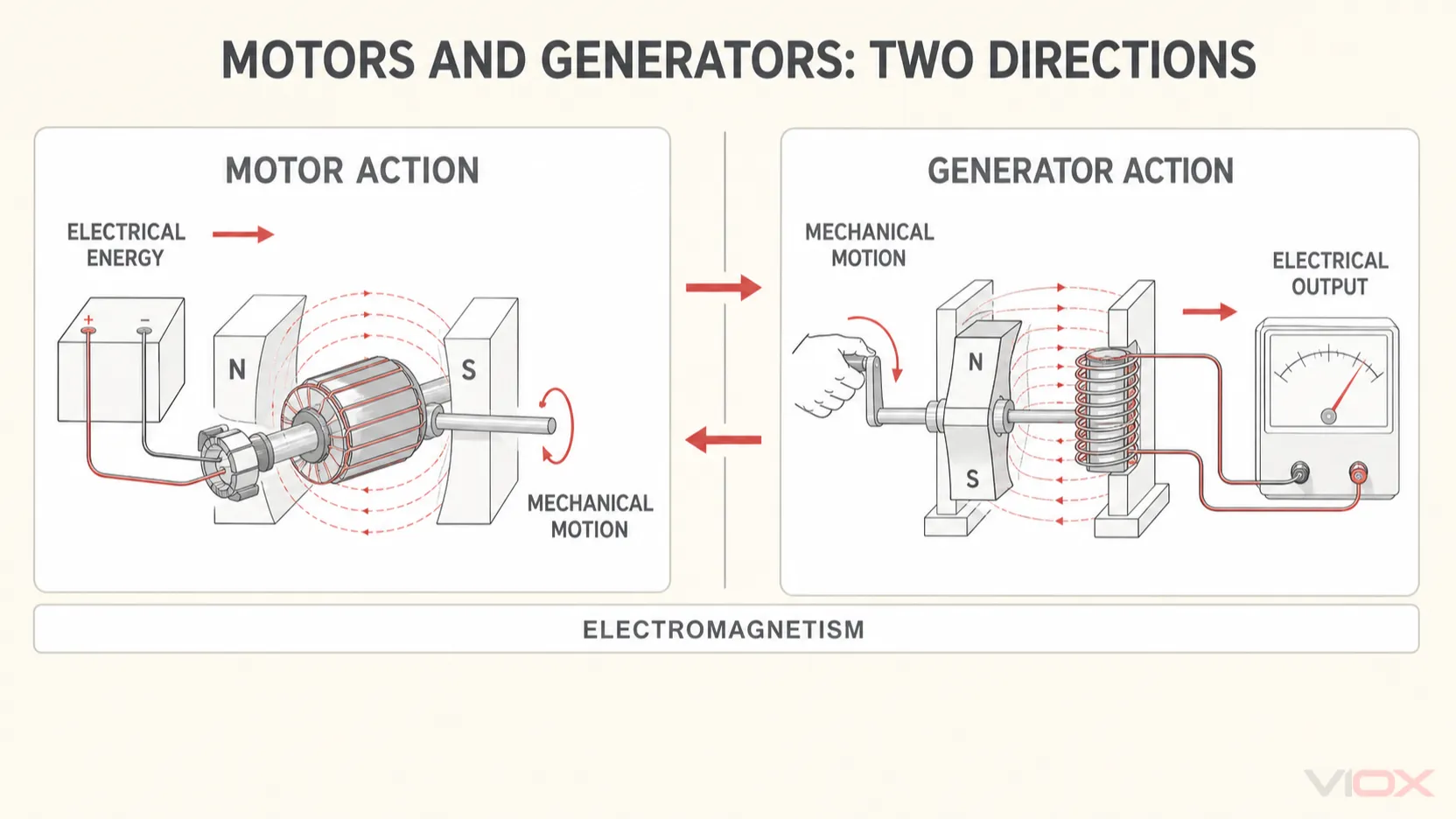
Faraday then demonstrated electromagnetic rotation in 1821 and electromagnetic induction in 1831. In engineering terms, these two ideas work in opposite directions:
| Principle | Energy conversion | Technology enabled |
|---|---|---|
| Motor action | Electrical energy → mechanical motion | Electric motors, actuators, contactor and relay mechanisms |
| Electromagnetic induction | Mechanical motion or changing magnetic flux → electrical output | Generators, transformers, induction equipment |
Joseph Henry discovered induction independently, although Faraday published first. Practical machines required many later improvements in magnetic materials, insulation, commutation, winding design, and manufacturing.
For a modern explanation of induction and voltage conversion, see how an electrical transformer works.
Measurement and Theory Turned Experiments into Engineering
Electrical technology could not scale through demonstrations alone. Engineers needed predictable relationships and common quantities.
Ohm’s work connected voltage, current, and resistance. Kirchhoff later formulated circuit rules for currents at junctions and voltages around loops. Maxwell unified earlier experimental findings into a theory of electromagnetic fields and showed that light is an electromagnetic phenomenon.
These developments changed electrical work from trial-and-error construction into a quantitative engineering discipline. Modern circuit calculations still use these foundations, even when the devices being analyzed are digital controllers, variable-frequency drives, or power converters. For practical formulas, see the VIOX guide to current, voltage drop, short-circuit current, and power factor.
Electric Lighting Became a Power System
The incandescent lamp was not the work of one inventor. Joseph Swan, Thomas Edison, and other researchers developed lamps using heated filaments in evacuated glass bulbs. Edison’s major contribution was not simply making a filament glow; his team pursued a commercially workable high-resistance lamp together with generators, wiring, sockets, switches, fuses, meters, and distribution infrastructure.
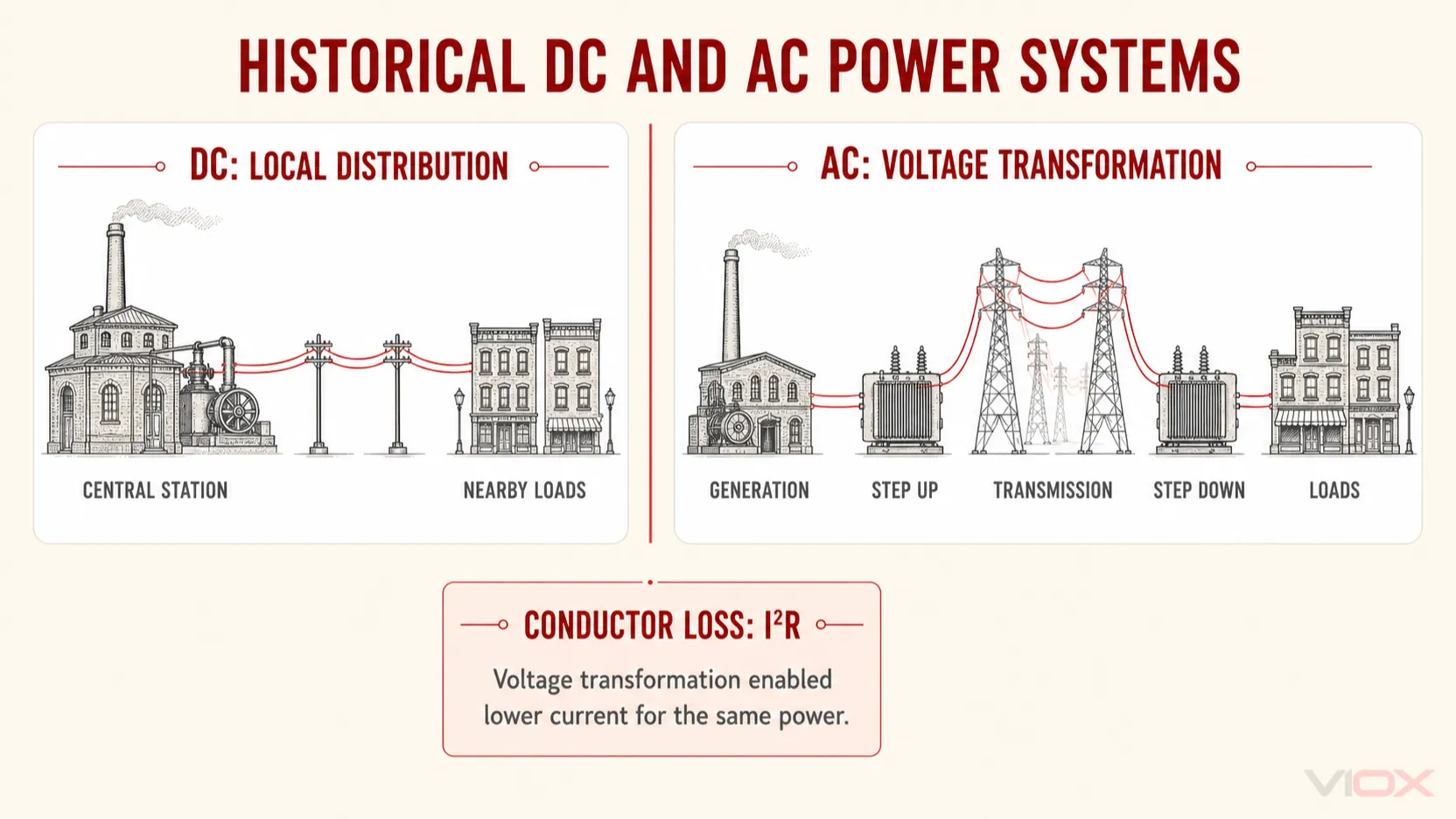
In September 1882, the Pearl Street station began serving customers in lower Manhattan with direct current (DC). It demonstrated that electricity could be generated centrally and sold as a service. Its coverage was limited, however, because the available DC distribution architecture was difficult to extend economically over long distances at useful customer voltages.
AC, DC, Tesla, Edison, and Westinghouse: What Actually Changed?
The popular “Tesla versus Edison” story compresses a large engineering and commercial transition into two personalities. A more accurate view is that multiple inventors, engineers, manufacturers, and financiers developed competing system architectures.
Edison promoted a DC distribution system. Westinghouse commercialized alternating-current (AC) equipment and licensed important Tesla patents. Tesla’s polyphase motor and system work was highly significant, while Galileo Ferraris independently developed rotating-magnetic-field concepts and William Stanley advanced practical transformer-based AC distribution.
AC is not inherently low-loss. For a given conductor, loss is primarily related to current through I²R heating. AC’s historical system advantage was that transformers made it practical to raise voltage for transmission—thereby reducing current for the same power—and lower it again near users. Modern high-voltage direct current (HVDC) proves that DC can also be highly effective for long-distance transmission when appropriate converter technology is used.
The Chicago World’s Fair in 1893 and the Niagara Falls project in 1895–1896 demonstrated the commercial scale of AC generation and distribution. For the underlying current distinction, see AC vs DC current.
From Power Networks to Modern Electronics
By the early twentieth century, generators, transformers, motors, protection equipment, and interconnected networks had established the basic architecture of electric power systems. The next transformation came from electronics—the control of electrical signals rather than only the delivery of bulk power.
The electron’s identification in the late nineteenth century helped reshape the physical model of electricity. Vacuum tubes enabled amplification and switching, but they were relatively large and power-hungry. The transistor, developed at Bell Labs in 1947, enabled smaller and more reliable electronic systems.
In 1958, Jack Kilby demonstrated a circuit whose elements were formed from semiconductor material. Robert Noyce subsequently developed a practical monolithic approach using the planar process and metal interconnections. The two are widely recognized as co-inventors of the integrated circuit, with distinct contributions. Integrated circuits led to compact control systems, computing, digital protection, communications, and the power electronics used in renewable-energy and EV applications.
Common Myths About the History of Electricity
| Common claim | More accurate explanation |
|---|---|
| Benjamin Franklin discovered electricity | Electricity was studied before Franklin. His work linked lightning to electrical phenomena and advanced charge theory and lightning protection. |
| Edison invented the light bulb | Many inventors developed incandescent lamps. Edison and his team produced a practical lamp-and-system approach and commercialized central electric service. |
| Tesla invented AC | Alternating current was known before Tesla. His polyphase system and motor patents were major contributions to practical AC power. |
| AC travels farther because AC itself loses less energy | Higher transmission voltage reduces current and I²R losses. AC’s historical advantage was convenient voltage transformation. |
| Electricity and electronics are the same | Electrical power engineering focuses heavily on generating, transmitting, switching, and using energy; electronics focuses heavily on controlling signals and power with devices such as tubes, transistors, and integrated circuits. The fields overlap. |
Frequently Asked Questions
When was electricity discovered?
There is no single discovery date. Ancient observers described effects associated with static charge, systematic electrical study accelerated from the seventeenth century, and the nineteenth century produced the foundations of modern electrical engineering.
Did Benjamin Franklin invent electricity?
No. Franklin investigated electricity, contributed to charge theory, connected lightning with electrical discharge, and developed the lightning rod. Electricity is a natural phenomenon, not a human invention.
Did Thomas Edison or Nikola Tesla invent electricity?
Neither invented electricity. Edison helped develop and commercialize practical lighting and DC distribution systems. Tesla made major contributions to polyphase AC motors and power-system technology. Both worked within a much larger international engineering effort.
What was the most important discovery in electrical history?
There is no universal single answer. Volta’s battery enabled sustained-current experiments; Faraday’s induction enabled generators and transformers; and semiconductor devices enabled modern electronics. Each depended on earlier discoveries and solved a different engineering problem.
Why was electromagnetic induction so important?
Electromagnetic induction made it possible to generate electricity from changing magnetic flux and to transform AC voltage. It remains fundamental to generators, transformers, induction motors, and many sensing devices.