

ဤစာမျက်နှာတွင်
US kitchens commonly use 120 V circuits for plug-in appliances and 240 V circuits for larger cooking equipment. European kitchens generally supply ordinary appliances at 230 V, but the UK and continental European countries do not share one circuit-design rulebook. Voltage changes the current required for a given load; national installation rules determine circuit allocation, conductor selection and protection.
The practical question is not which system is better. It is whether the kitchen’s simultaneous loads fit its branch circuits and supply, with protection appropriate to the country and equipment.
This comparison concerns residential installations, not commercial kitchens. It explains architecture rather than providing a wiring instruction. Have a qualified electrical professional verify the adopted rules, appliance instructions and existing installation before alterations.
US vs UK vs Continental Europe: Quick Comparison
| ဒီဇိုင်းဆိုင်ရာ မေးခွန်း | အမေရိကန်ပြည်ထောင်စု | ယူနိုက်တက်ကင်းဒမ်း | Continental Europe |
|---|---|---|---|
| Typical ordinary-appliance supply | 120 V, 60 Hz | 230 V, 50 Hz | Generally 230 V, 50 Hz |
| Larger cooking loads | Commonly 240 V between two hot conductors | Dedicated circuit, commonly 230 V; verify appliance and available supply | Single-phase or multiphase connection where supported; verify appliance diagram |
| General socket-circuit arrangement | Small-appliance branch circuits, commonly at least two 20 A circuits under NEC-based dwelling rules | Ring-final or radial circuits, designed under BS 7671 | Country-specific final circuits; do not assume the UK ring arrangement |
| Socket and circuit ratings | Receptacle rating and branch rating are separate checks | BS 1363 accessories are 13 A; a ring circuit can have a different protective-device rating | Socket types and ratings vary by country |
| Shock-protection terminology | GFCI | RCD or RCBO | RCD or RCBO, with national requirements |
| Arc-fault protection (လျှပ်စစ်မီးပွားကြောင့်ဖြစ်သော အန္တရာယ်ကာကွယ်မှု) | AFCI requirements depend on adopted NEC edition and circuit | AFDD requirements depend on applicable BS 7671 provisions | National implementation varies |
| Supply-capacity check | Service capacity and loading on both legs | Actual service and circuit capacity | Actual supply; per-phase loading if three-phase is available |
The US voltage/frequency baseline is described by the Department of Energy. European nominal voltage relationships are addressed in IEC 60038. These are supply characteristics, not permission to use a particular cable or breaker.
Why the Same Kitchen Load Draws Different Current
For a single-phase load, electrical input power relates to current as follows:
I = P / (V x power factor)Consider two hypothetical appliances drawing 1,500 W each, operating together. Assume steady operation, nominal voltage and power factor approximately 1. These are equivalent electrical loads, not a claim that the same physical appliance can be plugged into either system.
| အခြေအနေ | Current at 120 V | Current at 230 V |
|---|---|---|
| One 1,500 W load | 12.5 A | About 6.5 A |
| Two loads sharing one circuit | 25 A | About 13.0 A |
On a 120 V, 20 A branch, the combined 25 A load exceeds the branch rating. Allocating the loads to separate suitable circuits changes that result. At 230 V, the same combined input power draws less current, but this alone does not establish compliance with socket, cable, circuit or simultaneous-load requirements.
This explains why higher-power kettles are possible on suitable 230 V connections. It does not mean every 230 V kitchen can run all its appliances together. Nor does exceeding a breaker rating guarantee immediate tripping: operation follows the device’s time-current characteristic.
Electronic appliances and motors may have power factors, starting currents or operating cycles that require a more detailed assessment. Use actual input ratings, not a heating appliance’s output power or an assumed plug rating.
Supply Voltage Is Not the Same as Circuit Capacity
US split-phase supply includes both 120 V and 240 V
A typical US residential 120/240 V supply has two hot conductors and a center-point neutral. Each hot-to-neutral path provides 120 V; hot-to-hot provides 240 V. This is single-phase, three-wire service, not a three-phase supply. The DOE electricity industry primer illustrates this residential arrangement.
A 240 V cooking appliance is therefore not restricted to the power available from a 120 V countertop circuit. Some cooking equipment also needs a neutral for 120 V controls or other internal loads; follow its documented connection requirements. The equipment grounding conductor is not a substitute for neutral.
For the wider supply explanation, see why the US uses 120/240 V.
A European home may have single-phase or three-phase service
In a 230/400 V three-phase system, phase-to-neutral voltage is approximately 230 V and phase-to-phase voltage approximately 400 V. A single-phase home does not gain three-phase capacity simply because the surrounding network is three-phase.
Even where a cooker accepts a multiphase connection, its internal elements may operate phase-to-neutral at 230 V. Do not infer terminal connections or bridge arrangements from the phrase “400 V cooker.” Only the appliance’s connection diagram establishes the permitted configurations.
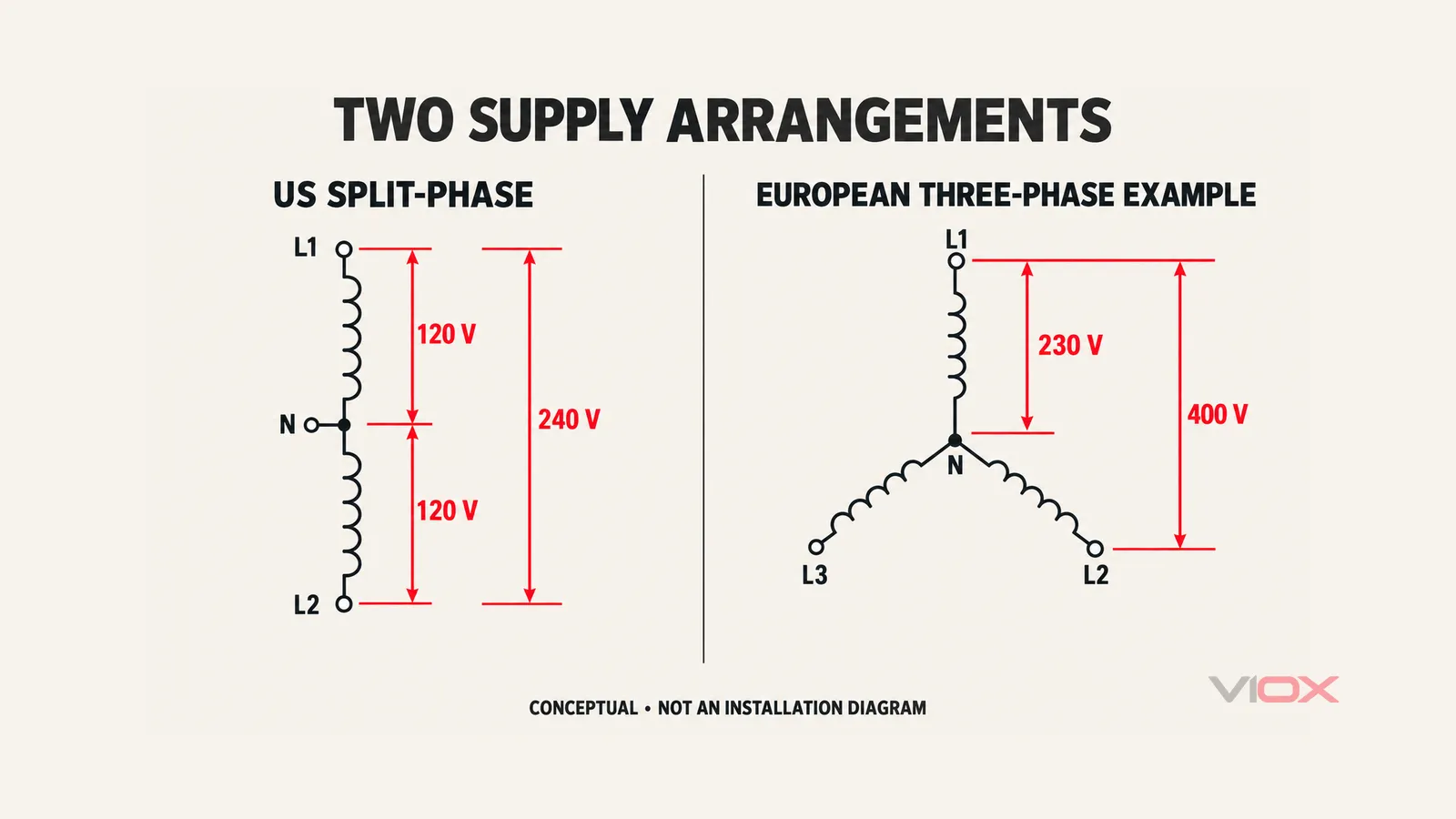
Supply relationships only. The European drawing shows one possible three-phase service, not every European home. Protective conductors, switching and installation connections are intentionally omitted.
Circuit Allocation: Two US Branches Are Not a UK Ring
US: reserve capacity for small-appliance loads
NEC-based dwelling design generally provides at least two 20 A small-appliance branch circuits serving designated kitchen and related-area receptacles. Larimer County’s residential guidelines describe that arrangement and separate kitchen lighting and built-in appliance loads from those circuits.
That is a minimum allocation principle, not proof that two circuits are sufficient for every kitchen. A designer still checks appliances, simultaneous demand, receptacle placement, permitted exceptions and local amendments. Two nearby receptacles may share one circuit; physical separation does not establish electrical separation.
Do not assume every refrigerator must have its own circuit, or that every fixed appliance can share the countertop circuits. Establish the applicable rule and equipment requirement for each load.
UK: distinguish the circuit from each fused plug
A UK ring-final circuit returns to its origin; a radial circuit does not. A familiar ring arrangement uses a 32 A protective device and 2.5 mm² conductors, subject to the design and installation conditions. The IET’s ring-circuit discussion explains why this depends on load distribution and the accessory system.
A 32 A ring does not make each BS 1363 socket or plug a 32 A connection. The plug fuse protects the connected flexible cable as part of that system, and the accessory has its own rating.
Ring continuity, spurs and load concentration matter. This is not a universal permission to protect any 2.5 mm² cable at 32 A. A correctly designed radial circuit is a different arrangement, not an incomplete ring.
Continental Europe: specify the country first
Do not copy the UK ring into a continental project, or assign one breaker size to all European kitchen sockets. National rules, installation methods and appliance instructions control the final arrangement.
For each country-specific design, identify socket circuits, fixed cooking equipment, dishwasher and other substantial loads separately. Then check conductor current-carrying capacity, protective-device coordination, installation conditions and voltage drop. Nominal voltage is only one input.
Three-Phase Service: Check Each Phase, Not Just Total Power
Suppose an illustrative 230/400 V home has a 25 A limit on each phase. Its ideal balanced power at power factor 1 is approximately:
3 x 230 V x 25 A = 17,250 WThat does not allow 17.25 kW on one phase. A hypothetical 5 kW single-phase kitchen load draws about 21.7 A. Add 2 kW of other loads on that phase and current becomes about 30.4 A, exceeding its 25 A limit even if the other phases are lightly loaded.
This example demonstrates allocation, not a trip-time prediction or a complete service calculation. Diversity, power factor, harmonics and actual protection must be evaluated separately. US split-phase services also require loading checks on both legs; balancing is not exclusively a European concern.
Protection: Overcurrent, Shock and Arc Faults Are Different Jobs
| ကာကွယ်ရေးလုပ်ဆောင်ချက် | US terminology | UK / European terminology | What must not be assumed |
|---|---|---|---|
| Overload နှင့် short circuit များ | Branch-circuit breaker | MCB or overcurrent part of an RCBO | A standalone residual-current device necessarily provides this function |
| Residual-current shock protection | Class A GFCI | RCD; RCCB or residual-current part of an RCBO | Equal thresholds, identical tests or automatic product interchangeability |
| Arc-fault detection | AFCI | AFDD | Overcurrent or residual-current protection automatically detects every hazardous arc |
US GFCI personal-protection products fall within the UL 943 testing framework. Class A GFCIs have a 4-6 mA operating band, described in IAEI’s explanation of GFCI fundamentals. European additional shock protection commonly uses RCDs rated no more than 30 mA, as explained by VDE. These are different specifications under different standards, not interchangeable performance labels. Neither is a guarantee against all electric shock.
An RCCB requires suitable overcurrent protection. An RCBO combines residual-current and overcurrent functions. Electrical Safety First’s technical guidance explicitly distinguishes these protection duties. For the fuller device comparison, see RCD vs GFCI.
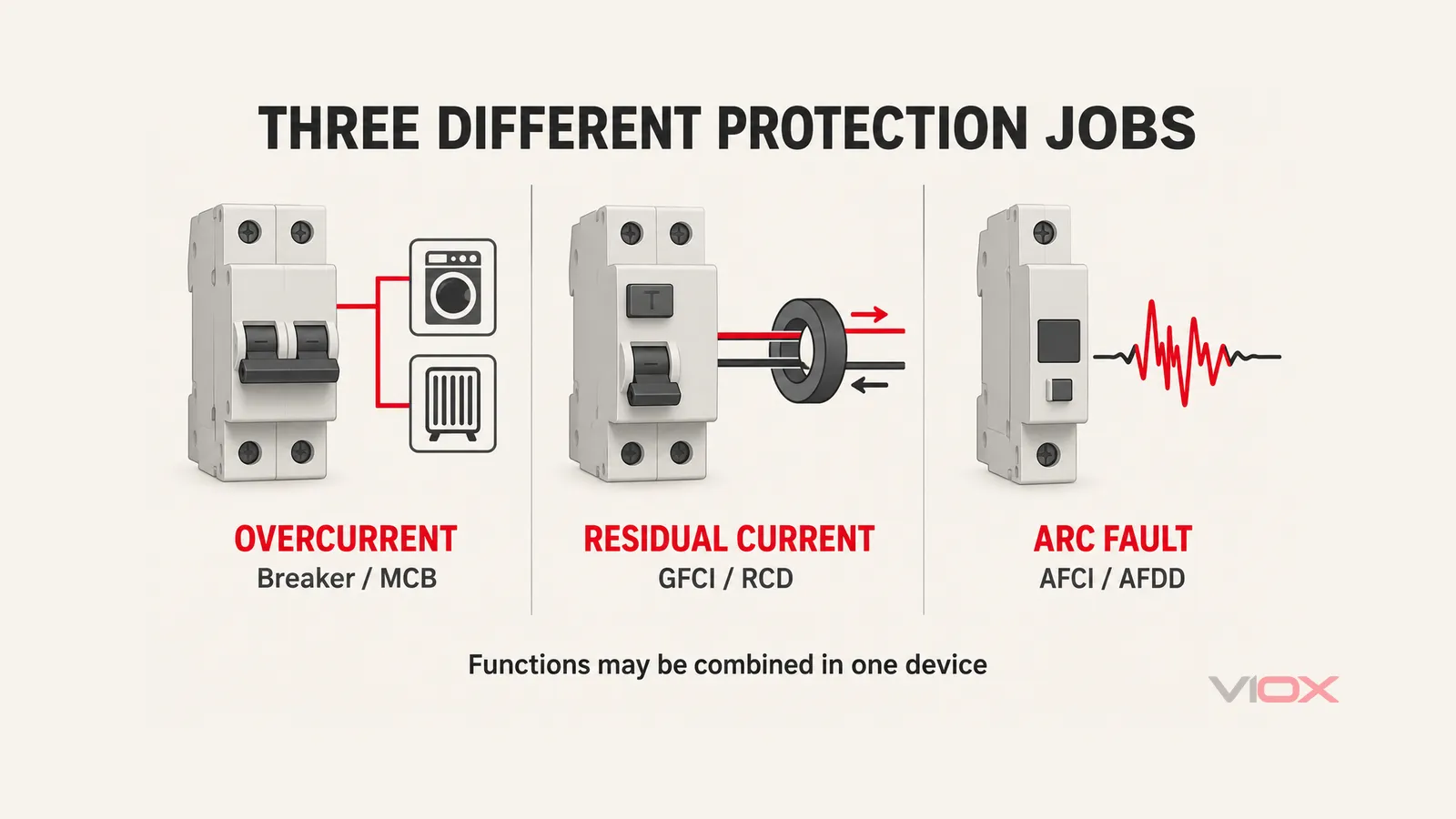
Functional comparison, not a wiring diagram. Integrated products may combine functions; the actual model and applicable standards determine which functions are provided.
Check the adopted rules rather than an online summary
The 2023 NEC expanded dwelling-kitchen GFCI coverage beyond countertop receptacles, as documented in Minnesota’s 2023 NEC review materials. Application still depends on the edition and amendments enforced locally. Older installations and alterations may have different obligations.
AFCI and AFDD requirements also depend on circuit scope, building category and applicable rules. Do not explain their differences solely through timber versus masonry construction. For US room-specific detail, use VIOX’s AFCI location guide alongside the local adopted code.
If several kitchen circuits lose power together, identify which device operated. A shared RCCB trip may indicate residual current; a main overcurrent device may indicate overload or another fault. Changing the rating before diagnosing the event can defeat protection.
Before Specifying a Kitchen Distribution Board
Give the designer or supplier these five inputs:
- Country and applicable rules: adopted edition, local amendments, new work or alteration, and inspection requirements.
- Actual supply: voltage, frequency, phase arrangement, earthing system and available service capacity.
- Appliance schedule: electrical input, permitted connection arrangement, starting behavior and likely simultaneous operation.
- Circuit plan: socket versus fixed loads, ring or radial where applicable, conductor conditions and per-phase allocation.
- Protection and assembly evidence: overcurrent rating, fault-current capability, residual-current type, arc-fault obligations and board/device compatibility.
For IEC-oriented projects, compare VIOX’s MCB range, RCCB အမျိုးအစားများ နှင့် RCBO အမျိုးအစားများ against those requirements. Confirm the exact model’s documentation and target-market acceptance before specification. An IEC product designation or a matching ampere number does မ establish suitability as a replacement in a US-listed panel.
The useful comparison is straightforward: voltage determines load current; circuit allocation determines how that current is shared; protection and local rules determine whether the arrangement is acceptable. Start there, rather than choosing a breaker from another country’s kitchen example.