On this page
Which Rooms Require AFCI Protection?
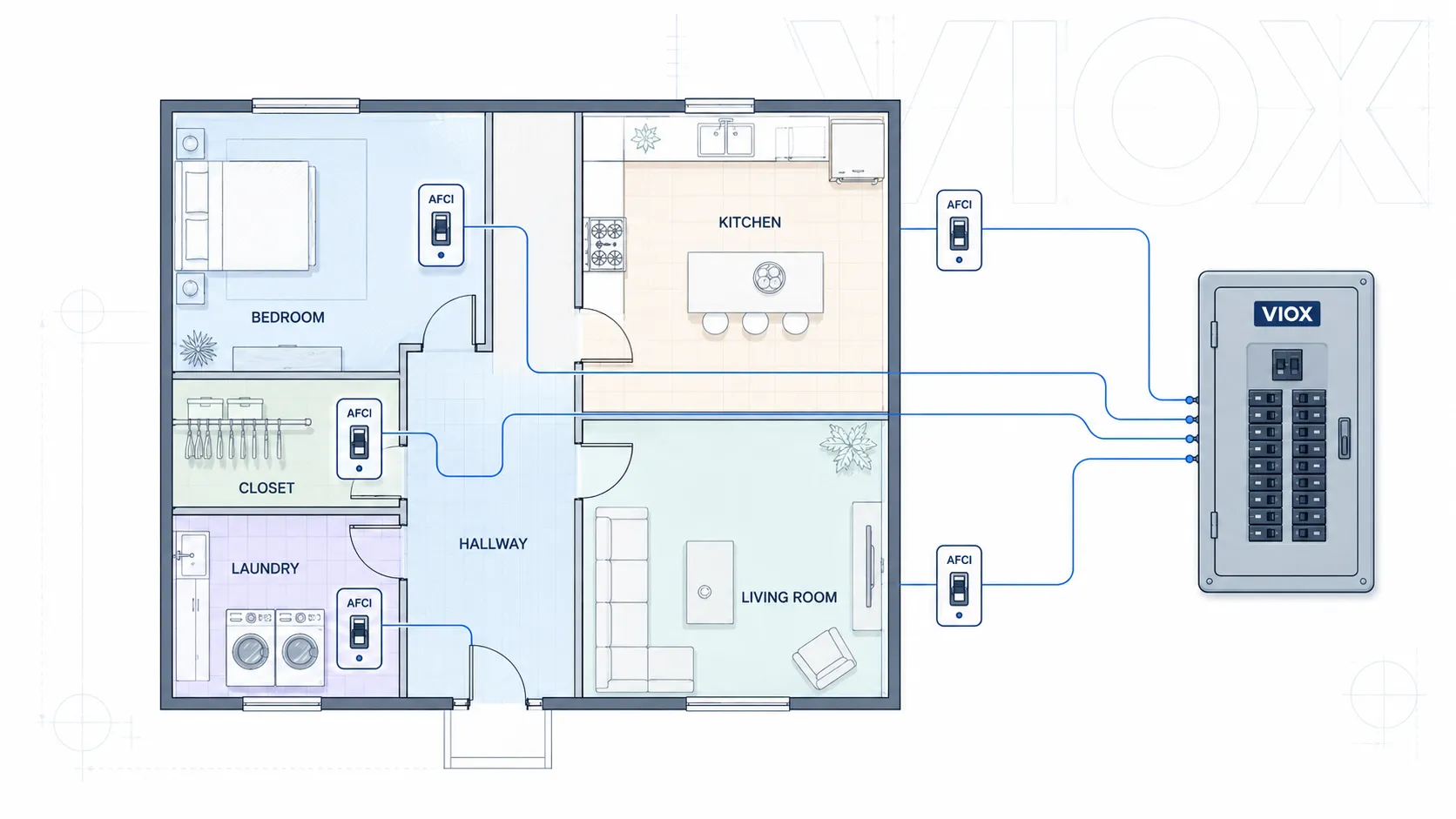
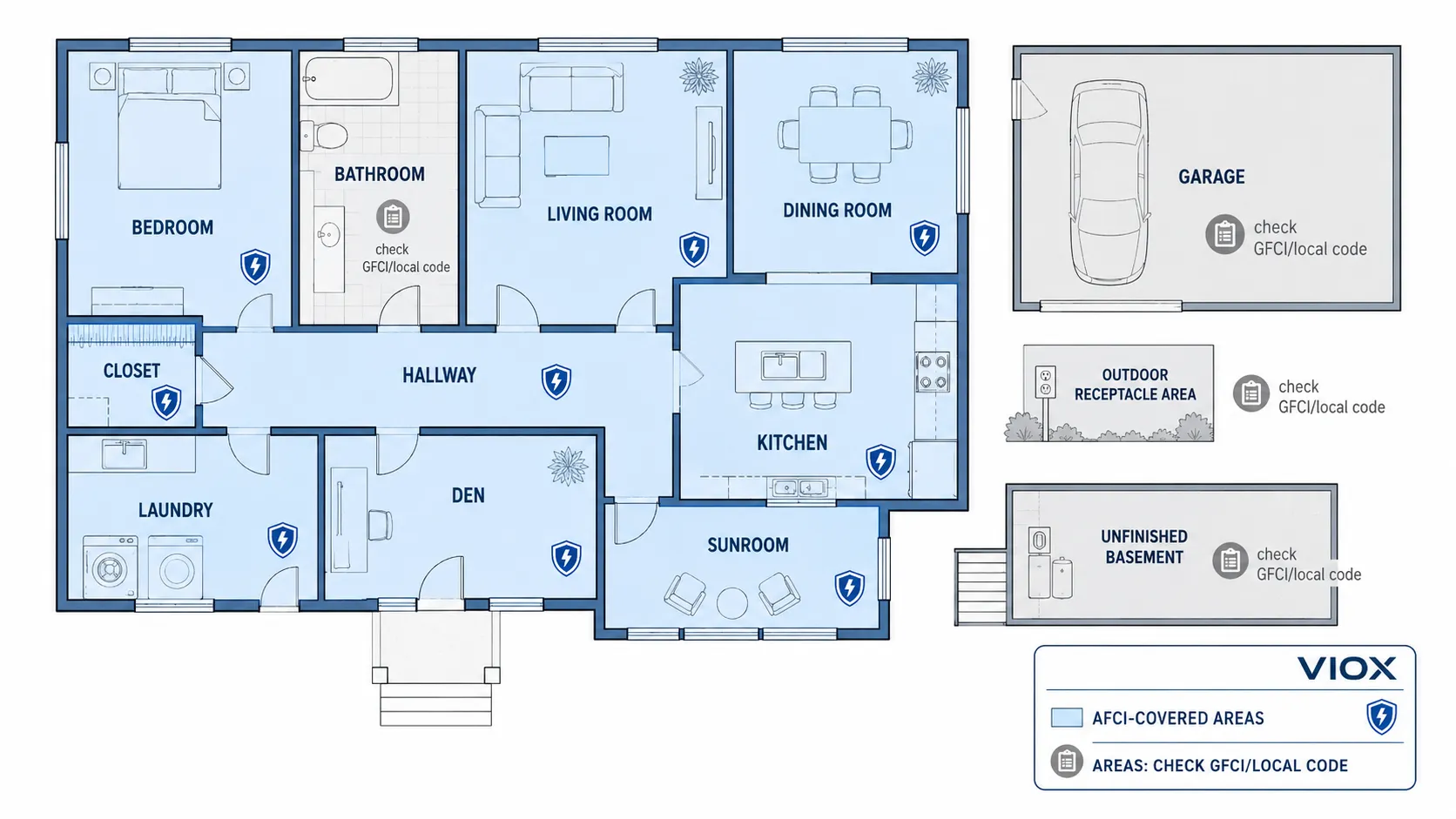
Under NEC-style U.S. residential wiring rules, arc-fault circuit interrupter (AFCI) protection is generally required for 120V, single-phase, 15A and 20A branch circuits supplying outlets or devices in kitchens, family rooms, dining rooms, living rooms, bedrooms, closets, hallways, laundry areas, and similar living spaces.
Bathrooms, garages, outdoor areas, crawl spaces, and unfinished basements are more commonly discussed under ground-fault circuit interrupter (GFCI) rules, not as the standard AFCI room list. However, local code amendments and the authority having jurisdiction (AHJ) always control the final requirement.
AFCI Room-by-Room Quick Reference
| Area of the home | AFCI commonly required? | Practical note |
|---|---|---|
| Bedroom | Yes | One of the earliest AFCI-required areas in NEC history. Includes receptacles, lighting outlets, and similar devices on covered circuits. |
| Living room / family room | Yes | General living areas are typical AFCI locations under modern NEC-style rules. |
| Dining room | Yes | AFCI protection is normally expected for 120V, 15A/20A branch circuits supplying outlets or devices. |
| Kitchen | Yes | Kitchen circuits often need both AFCI and GFCI protection, depending on circuit type and local code. |
| Laundry area | Yes | Laundry areas were added to the modern AFCI coverage list and commonly also involve GFCI requirements. |
| Hallway | Yes | Hallway receptacles, lighting outlets, and connected devices may fall under AFCI coverage. |
| Closet | Yes | Closet lighting and outlets on covered branch circuits should be checked for AFCI requirements. |
| Sunroom / recreation room / den / library | Yes | These are typical “similar living space” AFCI areas. |
| Bathroom | Usually not on the standard AFCI room list | Bathroom receptacles are strongly associated with GFCI protection; local rules may add AFCI or dual-function requirements. |
| Garage | Usually not on the standard AFCI room list | Garage receptacles are strongly associated with GFCI protection. AFCI may apply if local amendments or circuit routing require it. |
| Outdoor receptacles | Usually not on the standard AFCI room list | Outdoor receptacles are mainly a GFCI/weather-resistant/in-use cover topic. |
| Unfinished basement | Usually GFCI-focused | Finished basement living areas may be treated differently from unfinished utility spaces. |
What an AFCI Breaker Actually Protects Against
An AFCI is designed to reduce fire risk from dangerous electrical arcing. A standard breaker protects against overloads and short circuits, but some arcing faults can occur at current levels that are too low or too intermittent to trip a normal breaker.
Common arc-fault sources include:
- damaged cord insulation
- loose receptacle or switch terminations
- pinched cable behind furniture
- worn plugs or extension cords
- overheated or deteriorated wiring connections
- nails or screws that damage branch-circuit cable
AFCI protection is not the same as overload protection, short-circuit protection, or ground-fault protection. It is a separate fire-prevention layer intended to detect hazardous arcing signatures and open the circuit before heat can ignite surrounding material.
For a broader comparison of protection types, see VIOX’s guide to GFCI vs AFCI.
NEC Context: Why the Room List Matters
The NEC-style AFCI rule is not based only on the room name. It is based on the circuit and what that circuit supplies.
The key phrase to understand is:
120V, single-phase, 15A and 20A branch circuits supplying outlets or devices in specified dwelling-unit areas.
That wording matters for three reasons.
First, AFCI requirements usually focus on common residential branch circuits, not every circuit in the building.
Second, “outlet” does not mean only a wall receptacle. In NEC language, an outlet is a point where electricity is taken to supply equipment. That can include receptacles, lighting outlets, smoke alarms, ceiling fans, and similar connected devices.
Third, the room list includes “similar rooms or areas.” That gives the AHJ room to interpret spaces that function like bedrooms, living rooms, dens, halls, or other habitable areas.
This article focuses on U.S. NEC-style AFCI room requirements. In IEC markets, the related device category is usually discussed as an arc fault detection device (AFDD), with different standards and adoption rules. For that terminology, see VIOX’s guide to AFDD and IEC 62606 arc-fault protection.
Rooms That Commonly Cause Confusion
Kitchens
Modern kitchens are one of the easiest places to misunderstand AFCI rules because they often require more than one protection method. A kitchen branch circuit may need AFCI protection for arc-fault fire prevention and GFCI protection for shock protection, especially where receptacles serve countertop or appliance areas.
In practice, this may be handled by:
- a dual-function AFCI/GFCI breaker
- an AFCI breaker combined with downstream GFCI receptacles
- another locally approved arrangement
The correct solution depends on panel compatibility, device listing, wiring layout, and local code adoption.
Laundry Areas
Laundry areas are another common overlap zone. AFCI protection may be required because the laundry area appears in the AFCI room list, while GFCI protection may also be required because laundry equipment is associated with moisture, appliances, and receptacle shock hazards.
Do not assume “AFCI only” or “GFCI only” for laundry circuits. Check both requirements.
Bathrooms
Bathrooms are primarily a GFCI topic. A bathroom receptacle circuit may not be part of the standard AFCI room list, but this does not mean AFCI can never apply. If a circuit also supplies AFCI-covered spaces, or if local rules require dual protection, the design may change.
For new work, bathroom circuits should be checked by circuit routing and local code, not by room name alone.
Garages and Outdoor Areas
Garages and outdoor receptacles are strongly associated with GFCI protection. AFCI is not usually the first requirement people think of for these locations, but circuit routing can complicate the answer.
For example, if a branch circuit passes through or supplies both garage and habitable-space outlets, the installer must evaluate the complete circuit. The safest practical rule is simple: do not decide from the faceplate location only; trace the circuit and confirm the local code requirement.
Basements
Unfinished basements are usually discussed under GFCI rules. Finished basements, recreation rooms, basement bedrooms, home offices, and similar habitable spaces may fall closer to the AFCI-covered room list.
This is why “basement” is not enough information. A finished media room and an unfinished mechanical area are not treated the same in many residential code interpretations.
AFCI vs GFCI: Which One Does the Room Need?
Many rooms now need both types of protection, but they solve different hazards.
| Protection type | Main hazard addressed | Typical locations | What it does not replace |
|---|---|---|---|
| AFCI | Fire risk from hazardous arcing | Bedrooms, living rooms, kitchens, hallways, closets, laundry areas, similar living spaces | GFCI shock protection |
| GFCI | Shock risk from ground-fault current | Bathrooms, kitchens, laundry areas, garages, outdoors, basements, wet/damp areas | AFCI arc-fault fire protection |
| Dual-function AFCI/GFCI | Both arc-fault and ground-fault protection | Kitchens, laundry rooms, and circuits where both protections are required | Correct circuit design and proper troubleshooting |
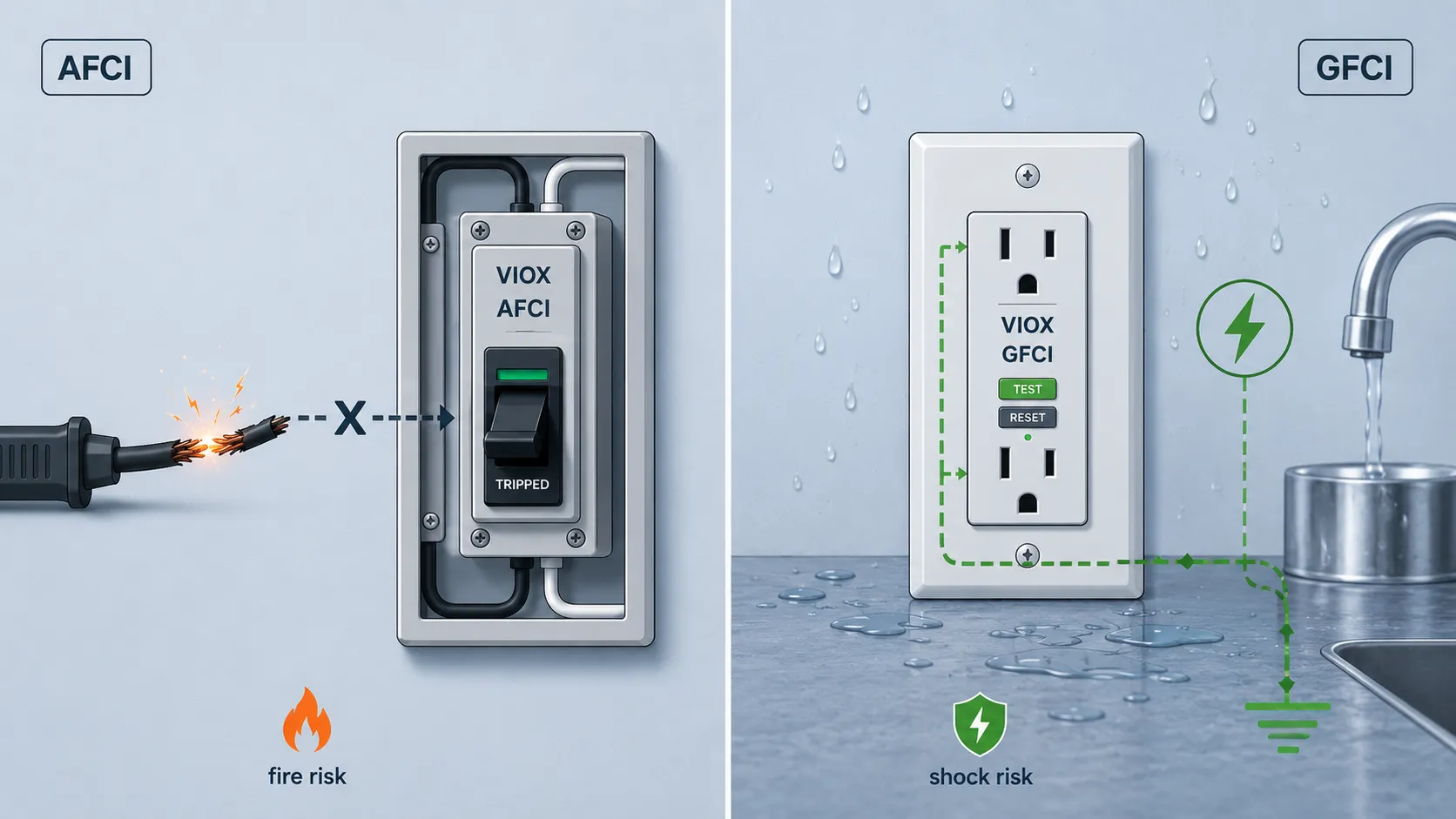
The mistake we see most often in residential panel discussions is treating AFCI and GFCI as competing choices. They are not competing devices. They detect different fault conditions, and some circuits may require both.
AFCI Breaker vs AFCI Receptacle vs Dual-Function Breaker
There is more than one way to provide AFCI protection, but the choice must match the wiring method, panel equipment, and local code.
| Device option | Where it is installed | Best fit | Important limitation |
|---|---|---|---|
| Combination-type AFCI breaker | Service panel or load center | Whole-branch-circuit AFCI protection from the panel | Must be compatible with the panel and wiring method |
| Outlet branch-circuit AFCI receptacle | Usually first outlet on the branch circuit | Retrofit or extension work where breaker replacement is difficult | Must be installed at the correct first outlet and per listing instructions |
| Dual-function AFCI/GFCI breaker | Service panel or load center | Circuits requiring both arc-fault and ground-fault protection | Panel compatibility and nuisance-trip diagnosis matter |
| AFCI + GFCI receptacle arrangement | AFCI at panel, GFCI at point of use or downstream | Kitchen, laundry, or other dual-protection layouts | Must preserve both protections without miswiring neutral/load terminals |
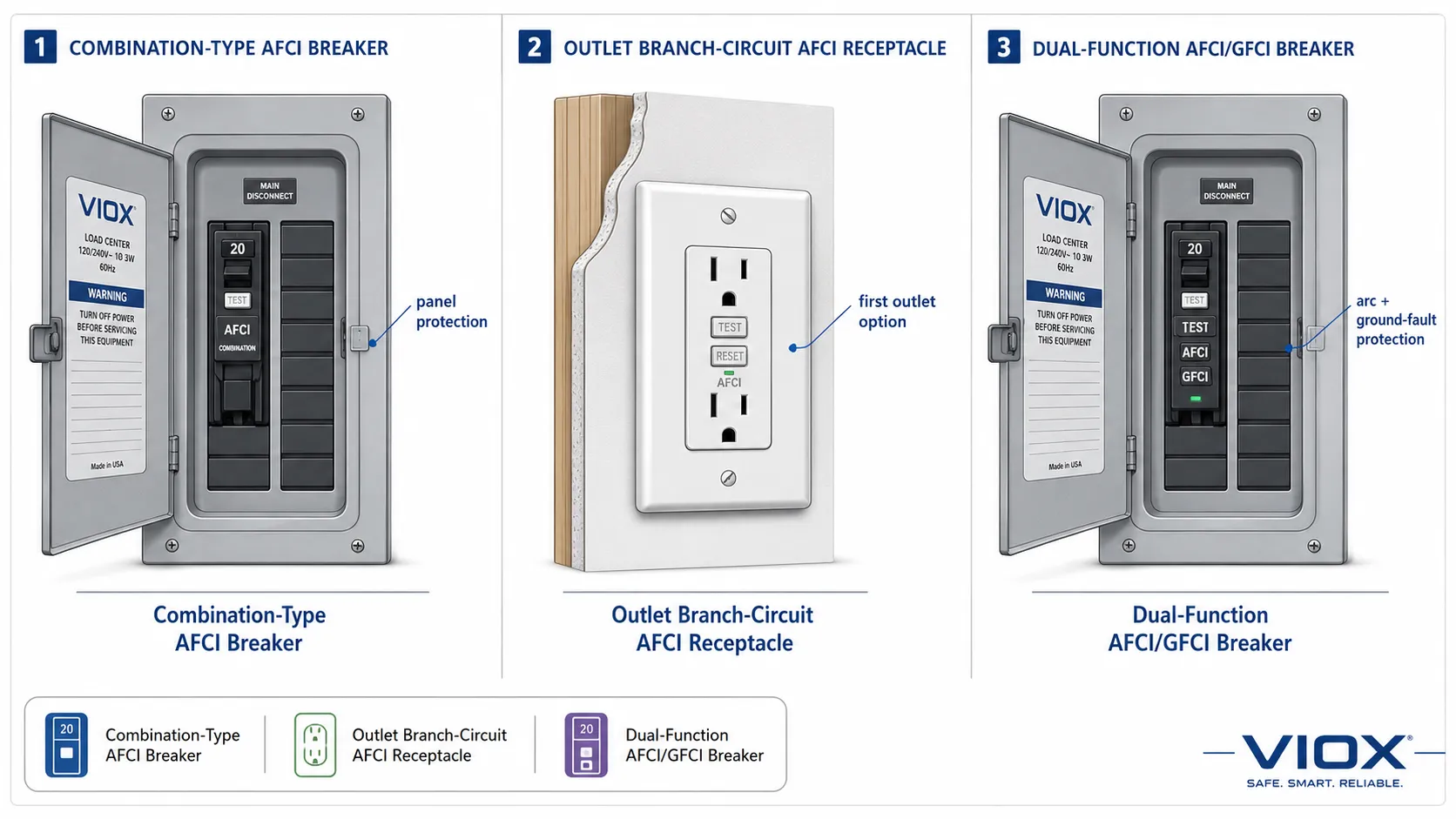
For electrical contractors, the practical question is not only “which room?” It is also “where does the protected portion of the circuit begin?”
Existing Homes, Remodels, and Panel Upgrades
AFCI requirements are most straightforward in new construction. Existing homes are more complicated.
In many jurisdictions, existing circuits are not automatically required to be upgraded simply because the code has changed. But AFCI protection may be triggered when a branch circuit is extended, modified, replaced, or substantially renovated. Local adoption and inspection practice matter a lot here.
Common work that may trigger an AFCI discussion includes:
- adding receptacles in a bedroom, living room, kitchen, or hallway
- extending a branch circuit during remodeling
- replacing a panel where AFCI breakers are available and required by the AHJ
- converting unfinished space into a finished living area
- adding a home office, media room, or finished basement bedroom
If the project involves permitting, the local inspector’s interpretation controls. This is not the place to guess from a national article.
Common AFCI Selection and Installation Mistakes
| Mistake | Why it causes problems | Better practice |
|---|---|---|
| Assuming only bedrooms need AFCI | Modern NEC-style coverage extends to many living areas | Use a room-by-room and circuit-by-circuit checklist |
| Thinking “outlet” means only receptacle | Lighting outlets, fans, smoke alarms, and devices can also be included | Review all outlets and devices supplied by the branch circuit |
| Using GFCI instead of AFCI | GFCI protects against shock, not hazardous series/parallel arcing | Use AFCI where arc-fault protection is required |
| Ignoring GFCI when AFCI is installed | AFCI does not replace shock protection in wet/damp locations | Use dual-function or coordinated AFCI/GFCI protection where required |
| Installing an AFCI receptacle at the wrong box | Downstream coverage may not protect the full required circuit | Identify and mark the first outlet box when required |
| Sharing neutrals incorrectly | Multiwire branch circuits and shared neutrals can cause tripping or unsafe wiring | Use listed devices and wiring methods intended for shared-neutral circuits |
| Treating nuisance trips as “bad breakers” only | Trips may reveal damaged cords, loose terminals, or incompatible equipment | Troubleshoot loads, wiring, and connections before replacing devices |
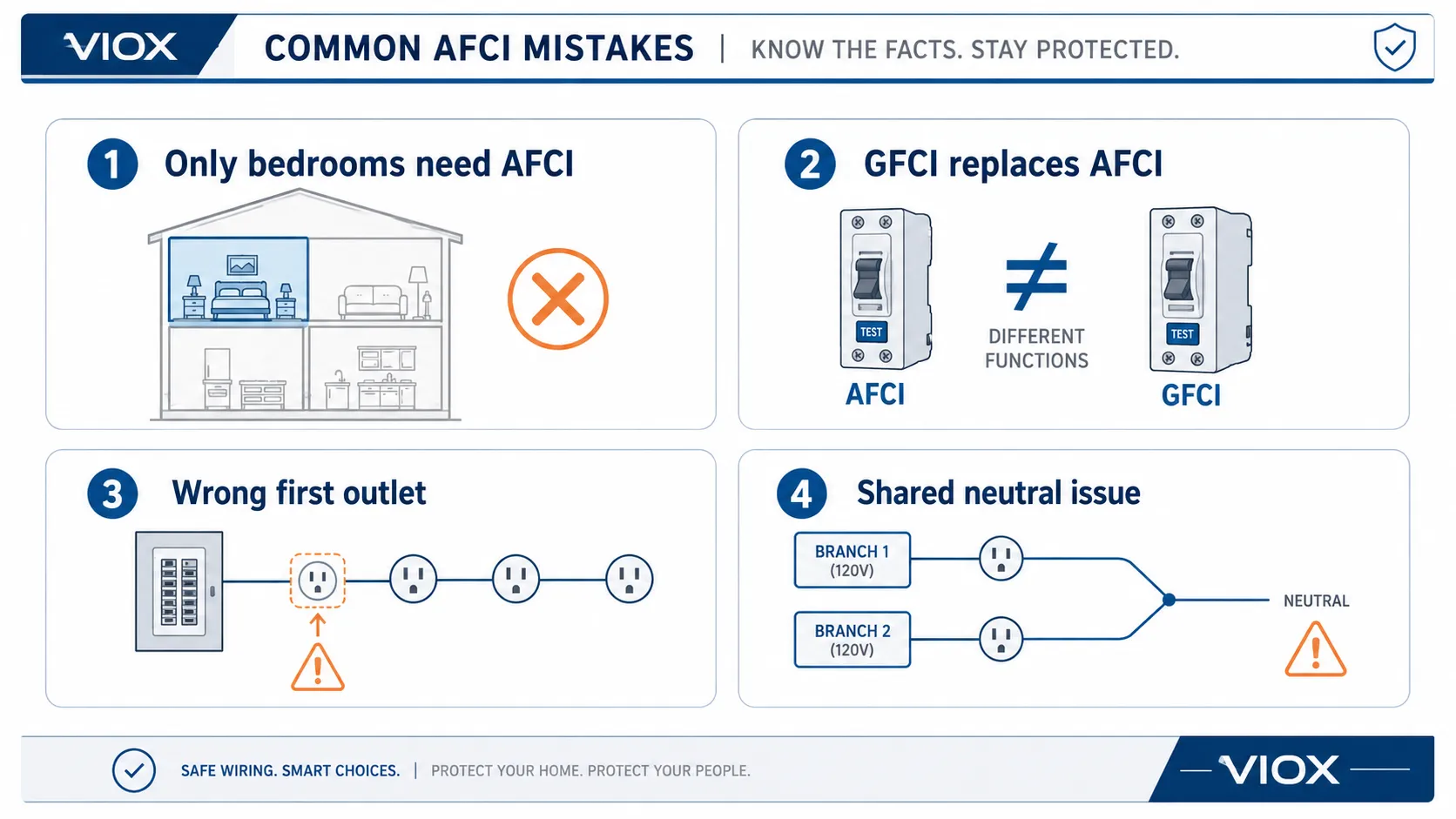
A Practical Field Checklist Before You Choose AFCI Protection
Before selecting an AFCI breaker or receptacle, confirm:
- Is the circuit 120V, single-phase, 15A or 20A?
- Which rooms or areas does the circuit supply?
- Does it supply receptacles, lights, fans, smoke alarms, or other devices?
- Is the space a bedroom, kitchen, living area, hallway, closet, laundry area, or similar habitable area?
- Does the circuit also need GFCI protection?
- Is the panel listed for the AFCI breaker model being considered?
- Is the circuit a multiwire branch circuit or shared-neutral circuit?
- Is this new work, an extension, a replacement, or an existing untouched circuit?
- What NEC edition and amendments has the local jurisdiction adopted?
- Has the AHJ approved the selected protection method?
Final Answer
For most NEC-style U.S. residential projects, AFCI protection is expected on 120V, single-phase, 15A and 20A branch circuits supplying outlets or devices in bedrooms, living rooms, family rooms, dining rooms, kitchens, hallways, closets, laundry areas, sunrooms, recreation rooms, dens, libraries, and similar habitable areas.
Do not decide only by room name. AFCI requirements depend on the circuit rating, supplied outlets or devices, wiring changes, local code adoption, and whether GFCI protection is also required. In kitchens and laundry areas especially, the correct answer is often not AFCI or GFCI, but both.
FAQ
Do bedrooms require AFCI protection?
Yes. Bedrooms are one of the clearest AFCI-required areas in modern U.S. residential wiring practice. The requirement can apply to receptacles, lighting outlets, smoke alarms, and other devices supplied by covered branch circuits.
Do kitchens require AFCI protection?
In NEC-style modern residential wiring, kitchen 120V, 15A and 20A branch circuits supplying outlets or devices are generally part of the AFCI coverage list. Many kitchen circuits may also require GFCI protection, so dual protection is often needed.
Do bathrooms require AFCI breakers?
Bathrooms are mainly associated with GFCI protection. AFCI may still apply in special cases, such as local amendments or circuits that also supply AFCI-covered areas. Always check the complete circuit and local AHJ requirements.
Do garages require AFCI protection?
Garages are usually discussed as GFCI locations rather than standard AFCI rooms. However, local amendments or shared circuit routing can change the answer.
Does AFCI replace GFCI?
No. AFCI protection targets hazardous arcing and fire risk. GFCI protection targets shock risk from ground-fault current. Some circuits need both.
Are AFCI breakers required in older homes?
Existing untouched circuits are not always automatically required to be upgraded. But AFCI protection may be required when circuits are extended, modified, replaced, or included in permitted remodeling work. Local code adoption controls.
Can I use an AFCI receptacle instead of an AFCI breaker?
Sometimes. AFCI receptacles can be used in certain approved layouts, often at the first outlet on a branch circuit. The installation must match the device listing, wiring method, and local code.
Why does my AFCI breaker keep tripping?
Possible causes include damaged cords, loose wiring connections, shared-neutral wiring errors, incompatible equipment, moisture, or a real arc fault. Do not keep resetting the breaker without troubleshooting the circuit.