VIOX Electric
Language

What Is an RCCB? Working Principle, Types & Benefits

What Is an RCCB? Working Principle, Types & Benefits

執筆者:

カテゴリ:

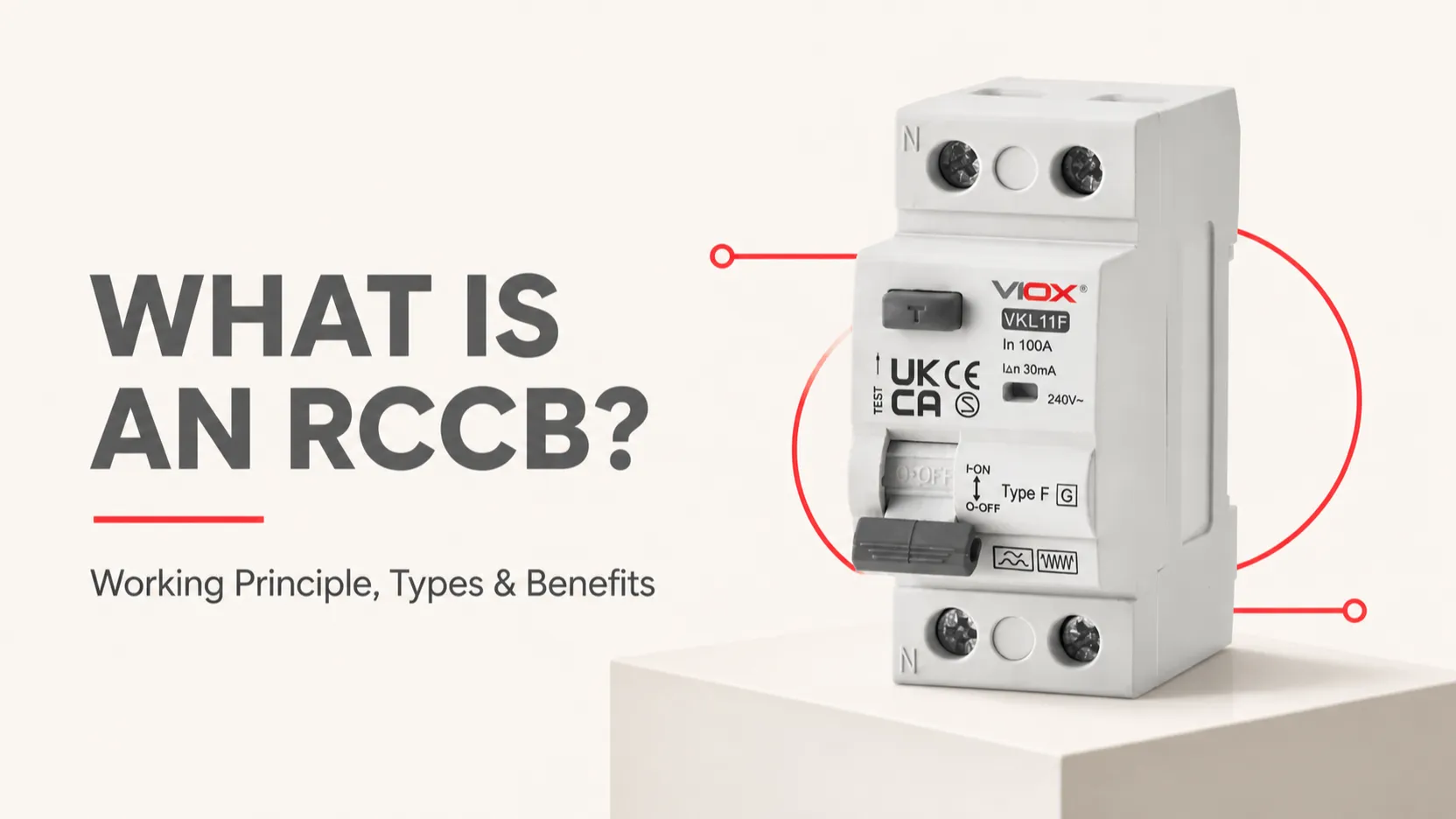
アン RCCB(残留電流サーキットブレーカー) is a protective device that disconnects a circuit when it detects residual current—the imbalance between the currents flowing through all live conductors it monitors. Its main role is to reduce the risk associated with earth-leakage and residual-current faults.

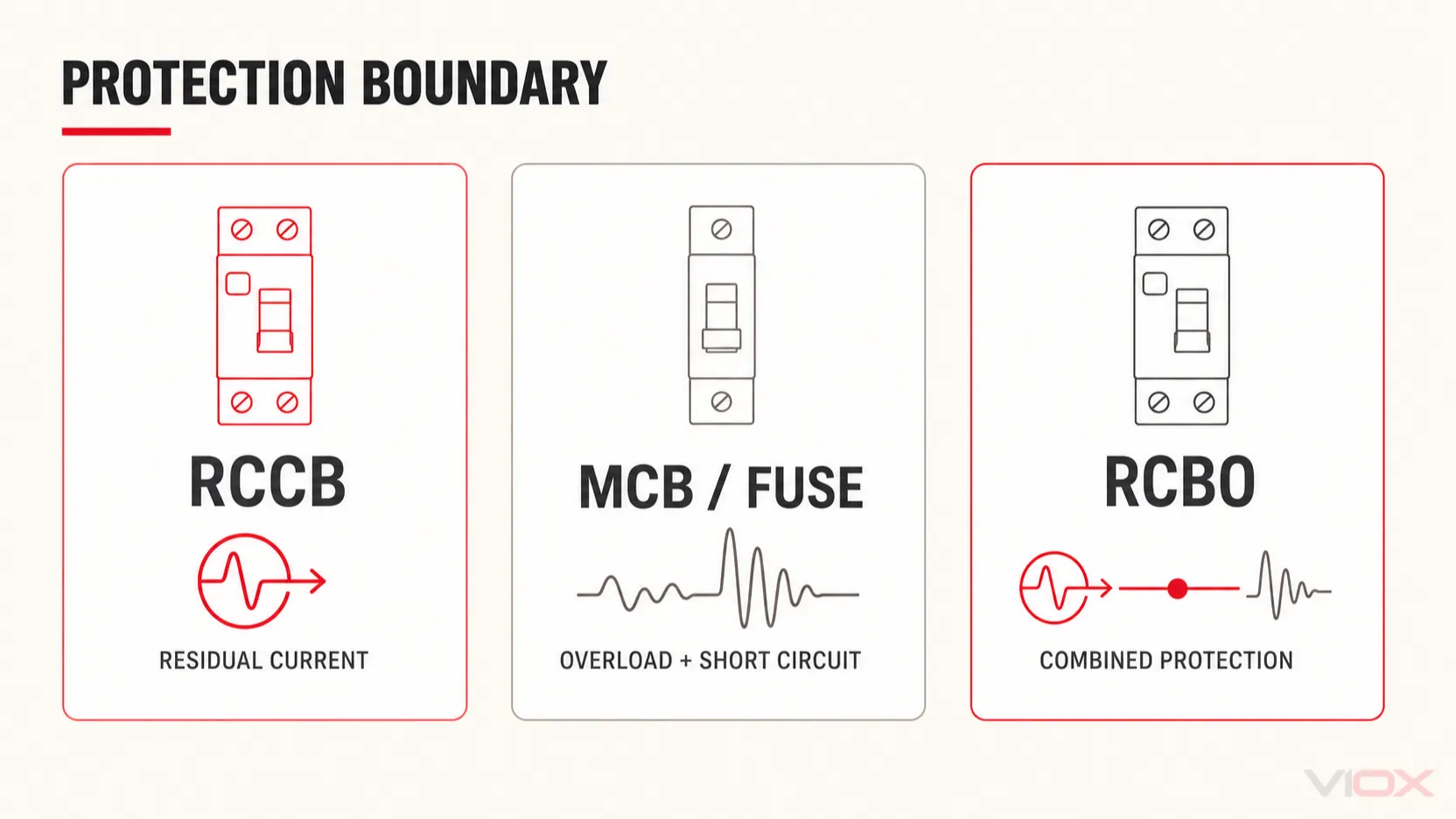
The most important boundary is this: an RCCB does not provide integral overload or short-circuit protection. Under IEC terminology, it is a residual current operated circuit-breaker 一体型過電流保護なし。. It must therefore be coordinated with a suitable fuse, MCB, or other overcurrent protective device. When residual-current and overcurrent protection are combined in one device, that device is normally an RCBO.

If you only need the acronym expansion, see 電気におけるRCCBの正式名称. This hub explains the device, its operating principle, types, benefits, limits, and the decisions that determine correct selection.

RCCB at a Glance

質問 短い回答
What does an RCCB detect? Residual current caused by current leaving the intended circuit path
What does it compare? The vector sum of currents through all monitored live conductors
What does it disconnect? All required live conductors of the protected circuit
Does it protect against overload or short circuits? No—a separate overcurrent protective device is required
Main waveform types Type AC, Type A, Type F, and Type B
Common pole configurations 2-pole and 4-pole
Key markings 定格電流 and rated residual operating current IΔn
Main product standard IEC 61008-1 within its stated scope

RCCBの仕組み

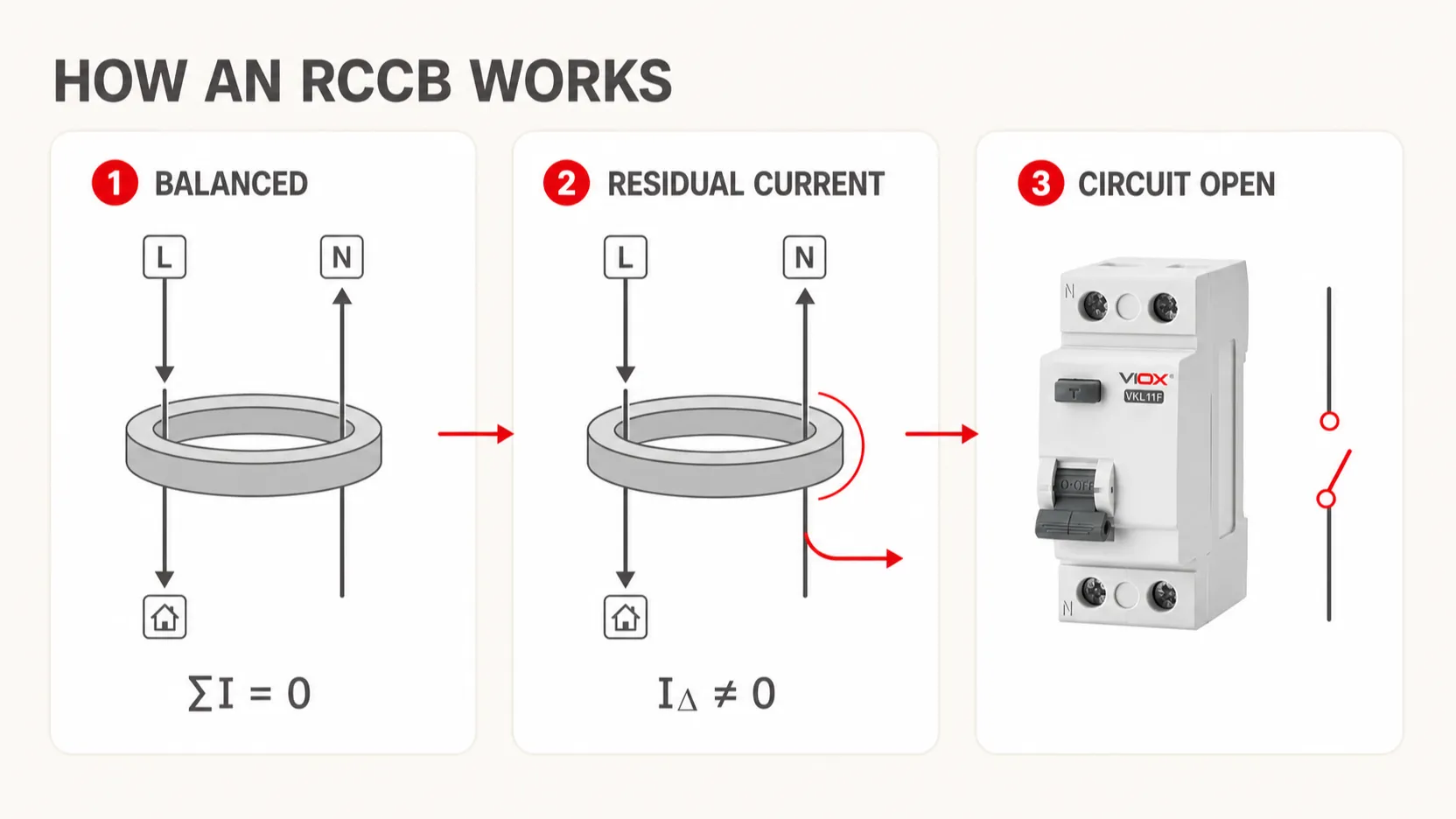
The RCCB working principle is based on current balance. In a healthy circuit, the vector sum of the current flowing through all live conductors that pass through the sensing core is approximately zero.

For a simple single-phase circuit:

Iline − Ineutral ≈ 0

For a three-phase circuit, the RCCB evaluates the vector sum of the phase currents and the neutral current when a neutral is present. The protective earth conductor does not pass through the sensing core.

1. The RCCB monitors all live conductors

The phase conductor or conductors—and the neutral where used—pass through a core-balance current transformer. Their magnetic effects cancel when the outgoing and returning currents balance.

2. A leakage path creates residual current

If current leaves the intended path through damaged insulation, exposed conductive parts, earth, or another unintended route, not all of it returns through the monitored conductors. The vector sum is no longer zero.

Residual current is related to leakage current, but the terms should not be treated as exact synonyms in every measurement context. See 漏れ電流 対 残留電流 対 地絡電流」 for the detailed terminology.

3. The sensing transformer produces a trip signal

The residual magnetic flux in the core produces a secondary signal. When the device’s operating conditions are met, the release mechanism unlatches.

4. The contacts open the circuit

The RCCB opens the required live conductors and isolates the protected circuit. It remains open until the fault is investigated and the device is reset.

The test button creates an internal test condition to check the device’s operating mechanism. It does not replace installation testing or prove the quality of the earthing system.

RCCB working principle showing balanced current, residual current, and circuit opening

The RCCB Protection Boundary Map

An RCCB should be selected by the fault it is intended to detect—not by the assumption that every device called a “breaker” provides the same protection.

Electrical condition Will an RCCB normally detect it? What else is required?
Current leaking from a live conductor to earth or another unintended path Yes, when the residual current matches the device’s detection and operating characteristics Correct RCCB type, sensitivity, installation, and earthing/bonding design
Insulation fault producing residual current Yes, within the device’s operating scope Fault location and repair after disconnection
Overload with balanced outgoing and returning current No MCB, fuse, MCCB, or other overcurrent protection
線間-中性線間の短絡 No, if the currents remain balanced through the sensing core Short-circuit protective device
Line-to-line short circuit No, if the vector sum remains balanced Short-circuit protective device
Series arc without current leaking outside the intended path 必ずしもそうとは限りません Appropriate arc-fault protection where required
Direct contact between line and neutral Not necessarily; equal current may still leave and return through the monitored conductors Basic protection, safe design, and other applicable protective measures

This boundary is why an RCCB complements an MCB rather than automatically replacing it. For a deeper comparison, read RCCBとMCB:感電保護にはMCBの代わりにRCCBを使用する理由.

RCCB, MCB or fuse, and RCBO protection functions compared

Types of RCCB by Residual-Current Waveform

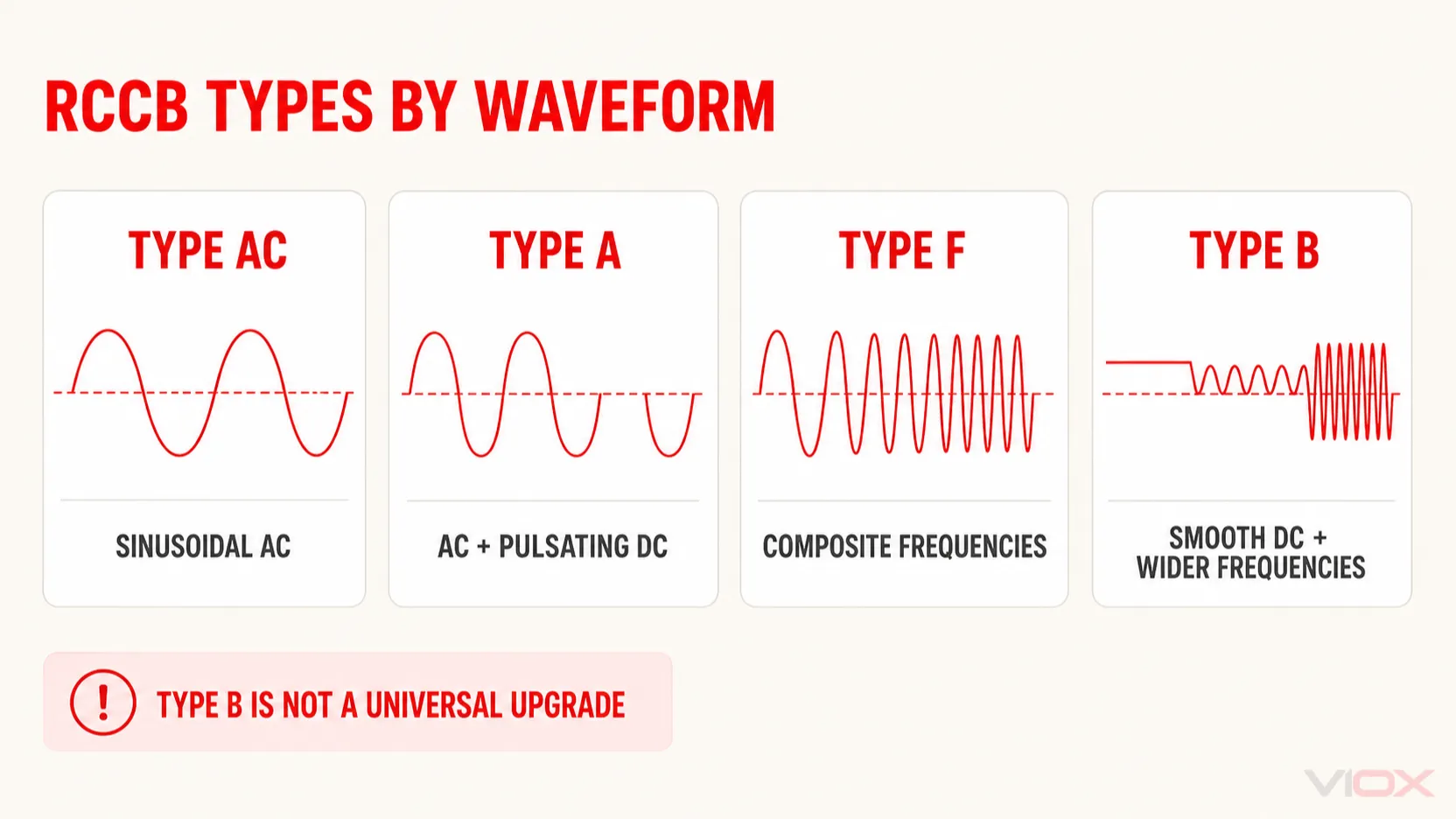
Modern electronic loads can produce residual currents that are not pure 50/60 Hz sine waves. The RCCB type must match the residual-current waveform that the load or power-conversion equipment can create.

一般的なRCCB波形の種類 Residual-current capability, simplified Typical load context 選定の境界線
タイプAC Sinusoidal alternating residual current Basic AC loads where permitted May be restricted by local rules and may not be suitable for modern electronic loads
タイプA Type AC capability plus pulsating DC residual current Many single-phase electronic loads and appliances Does not provide the smooth-DC capability of Type B
タイプF Type A capability plus specified composite-frequency residual currents Certain single-phase variable-speed or inverter-driven loads Check the equipment manufacturer’s required RCD type and frequency behavior
タイプB Type F capability plus smooth DC and a wider range of residual-current frequencies Three-phase converters and some VFD, PV, UPS, EV, and medical applications Check the application-specific rules and equipment instructions

These categories are simplified waveform classifications—not sensitivity values or MCB trip curves. “Type B RCCB” and “B-curve MCB” describe different characteristics. Type B is not a universal “best” option: final selection still depends on equipment instructions, national rules, upstream coordination, and any required DC detection arrangement.

The appropriate type cannot be selected from the building label alone. A home, commercial panel, or factory can contain several load technologies that require different residual-current responses. ABB’s RCD selection guidance and Schneider’s Electrical Installation Guide both emphasize matching the device type to the possible residual-current waveform.

Type AC, Type A, Type F, and Type B RCCB waveform capabilities

Other Ways RCCBs Are Classified

By pole configuration

  • 2-pole RCCB: commonly used for single-phase circuits where phase and neutral must be monitored and switched.
  • 4-pole RCCB: commonly used for three-phase circuits with three phase conductors and a neutral.

The exact conductor arrangement and switching requirements depend on the system and applicable installation rules. Do not use the pole count as a substitute for checking the wiring diagram and product instructions.

By rated residual operating current

そのマーキングは IΔn identifies the rated residual operating current. Values such as 30 mA, 100 mA, and 300 mA serve different protection and coordination objectives and are not interchangeable. Select the value from the applicable rules and circuit design; use the dedicated 30 mA vs 100 mA vs 300 mA RCCB sensitivity guide for the detailed boundaries.

By time characteristic

RCCBs may have an instantaneous or delayed operating characteristic. Selective, time-delayed devices can support upstream/downstream discrimination when used in a properly coordinated design. A higher IΔn alone does not guarantee selectivity.

How to Read RCCB Ratings and Markings

Two current markings are commonly confused:

表示 意味 What it does not mean
指定された条件下でRCCBが流すことができる定格電流 40 A, 63 A, 100 A It is not an overload trip setting
IΔn 定格感度電流 30 mA, 100 mA, 300 mA It is not the load-current rating

A 63 A, 30 mA RCCB is therefore rated to carry 63 A under its declared conditions and has a rated residual operating current of 30 mA. These markings describe separate characteristics and must be evaluated independently.

Other selection markings may include:

  • rated voltage and frequency;
  • 極数;
  • 残留電流波形タイプ;
  • 瞬時または選択的時限特性;
  • making and breaking capacity;
  • conditional short-circuit current information and required backup protection;
  • product standard and model-specific approval markings.

The applicable product documentation must be checked as a complete set. For the standards boundary, see the IEC 61008-1 RCCB要件ガイド.

What Are the Benefits of an RCCB?

Reduces risk from qualifying residual-current faults

An RCCB can disconnect a circuit when a qualifying current imbalance indicates current flowing outside the intended path. This provides a layer of protection that an ordinary overcurrent device may not provide.

Supports additional protection against electric shock

Where required by the applicable installation rules, a correctly selected RCCB can provide additional protection against certain electric-shock conditions. It does not make contact with live conductors safe and does not replace basic protection.

Can reduce earth-fault fire risk

Residual-current protection can disconnect faults that may be too small to operate an overcurrent device but can still create thermal risk. The protection objective, sensitivity, time characteristic, and wiring system must be selected for the actual installation.

Provides automatic isolation and a manual test function

The device automatically opens the circuit when its operating conditions are met. The built-in test button provides a convenient functional check of the RCCB mechanism according to the manufacturer’s instructions.

Supports several distribution architectures

RCCBs are available with different pole arrangements, residual-current sensitivities, waveform types, and time characteristics. They can be coordinated with downstream MCBs or used in designs where residual-current protection is grouped at a distribution level.

RCCB Limitations You Must Not Ignore

An RCCB is an important protective device, but it is not complete protection by itself.

  • It may not operate for a line-to-neutral contact when current remains balanced.
  • It cannot compensate for the wrong residual-current waveform type.
  • It does not replace insulation, enclosures, protective earthing, bonding, or safe work procedures.
  • One RCCB protecting many circuits can disconnect all of them when one downstream residual fault occurs.
  • Normal leakage from multiple electronic loads can accumulate and contribute to unwanted tripping.
  • A test-button operation does not prove the complete installation is safe.

These limits should be stated as clearly as the benefits. They determine whether an RCCB, an RCCB plus MCBs, or individual RCBOs provide the most appropriate architecture.

RCCB vs MCB vs RCBO vs ELCB

装置 主な機能 残留電流保護 Integral overload/short-circuit protection Main decision question
RCCB Detect residual current and disconnect あり No Can residual-current protection be coordinated with a separate overcurrent device?
MCB Protect against overload and short circuit No あり Does the circuit need overcurrent protection without an integrated residual-current function?
アールシーボ Combine residual-current and overcurrent protection あり あり Should each circuit have combined, independent protection?
Voltage-operated ELCB Detect voltage on a protected earth arrangement Different, older operating principle No Is an older voltage-operated device being identified or replaced?

For distribution-board architecture, compare RCBOとRCCB+MCBの比較. For terminology and older protection methods, see the difference between RCCB and ELCB.

Where Are RCCBs Used?

RCCBs are used in residential, commercial, and industrial distribution systems, including distribution boards, groups of final circuits, and locations where installation rules require residual-current protection. They may also protect circuits supplying electronic or inverter-based equipment such as HVAC drives, UPS systems, PV equipment, or EV chargers.

The application name alone does not determine the correct device. The earthing arrangement, protection objective, possible residual-current waveform, equipment instructions, and local rules still control selection.

How to Choose an RCCB: Five Dimensions

Use this hub as an orientation framework. Complete the detailed selection on the linked specialist pages and the manufacturer’s product documentation.

1. 保護目的を定義する

Determine whether the RCCB is intended for additional protection, fault protection, fire-risk protection, upstream residual-current protection, or a coordinated combination. Check the applicable installation standard before choosing a product rating.

2. Select IΔn from the required protection function

Choose the rated residual operating current from the circuit requirement—not merely from the premises type. Review the RCCB sensitivity selection guide for the boundaries between 30 mA, 100 mA, and 300 mA applications.

3. Match the waveform type to the load

Identify rectifiers, switching power supplies, frequency converters, inverters, EV chargers, PV equipment, UPS systems, and other loads that can change the residual-current waveform. Select Type AC, A, F, or B only after considering the possible fault current and equipment instructions.

4. Check rated current, poles, and system conditions

確認する , rated voltage, frequency, pole configuration, conductor arrangement, ambient and enclosure conditions, and any derating instructions. The RCCB rated current must be coordinated with the circuit design and upstream protection.

5. Coordinate overcurrent, short-circuit, and residual-current protection

Confirm the external overload and short-circuit protective device, conditional short-circuit capability, and upstream/downstream selectivity. If independent combined protection is required for each final circuit, assess an RCBO rather than forcing one RCCB to serve every architecture.

Once these five dimensions are known, compare them with the available 要求の厳しいB2Bアプリケーション向けに設計されたVIOX RCCB製品群をご覧ください。 and request model-specific documentation for the intended market.

RCCB Testing and Maintenance

Operate the test button as required by the manufacturer and applicable local rules; failure to trip requires investigation by a qualified person. Because the button checks only an internal operating path, it does not replace installation inspection or instrument testing. See RCCBの機能を確認する方法 for intervals, test procedures, and fault diagnosis.

RCCB Standards: Product Rules vs Installation Rules

IEC 61008-1:2024 provides the general rules for RCCBs within its scope. The applicable IEC 61008 Part 2 depends on the RCCB classification and design. By comparison, IEC 61009-1:2024 covers RCBOs within its scope.

Product standards define and test the device; national wiring rules, system conditions, and equipment instructions determine where and how it may be used. Verify the applicable national adoption and model certification for the target market. For more detail, see the IEC 61008-1 RCCB要件ガイド.

よくある質問

What is the full form of RCCB?

RCCBの正式名称 漏電遮断器. See the focused RCCB full form explanation for terminology details.

What is the main function of an RCCB?

Its main function is to detect residual current—a current imbalance through the monitored live conductors—and disconnect the circuit when its operating conditions are met.

Does an RCCB protect against overload and short circuit?

No. An RCCB has no integral overcurrent protection. It must be coordinated with a suitable fuse, MCB, or other overcurrent protective device, or replaced by an appropriate RCBO when combined protection is required.

RCDとRCCBの違いは何ですか?

RCD means Residual Current Device and is the broad family term. An RCCB is one specific circuit-breaker form within that family.

What is the difference between Type A and Type B RCCB?

Type A detects sinusoidal AC and specified pulsating DC residual currents. Type B adds capability for smooth DC and a wider range of waveforms and frequencies, but it is not a universal upgrade. Equipment instructions, national rules, coordination, and any required DC detection arrangement determine the final choice.

What does 30 mA mean on an RCCB?

It normally identifies the rated residual operating current IΔn. It is not the load-current rating, not the trip time, and not a statement that 30 mA through the body is safe.

Can an RCCB work without an earth wire?

An RCCB measures the current balance in the live conductors; the protective earth conductor is not used as a sensing conductor through its core. However, this does not make protective earthing optional. Earthing and bonding must still comply with the applicable installation rules and system design.

結論

An RCCB detects residual current and disconnects the protected circuit, helping reduce risk from qualifying leakage and earth-fault conditions.

Correct RCCB selection requires five separate decisions—protection objective, IΔn, residual-current waveform type, electrical ratings and poles, and coordination with other protective devices. Treating those decisions separately produces a safer and more defensible design than choosing an RCCB by building type or headline rating alone.

製品評価については、以下を確認してください。 VIOX RCCB range only after the required protection function and market documentation have been defined.

技術資料