

Nesta página
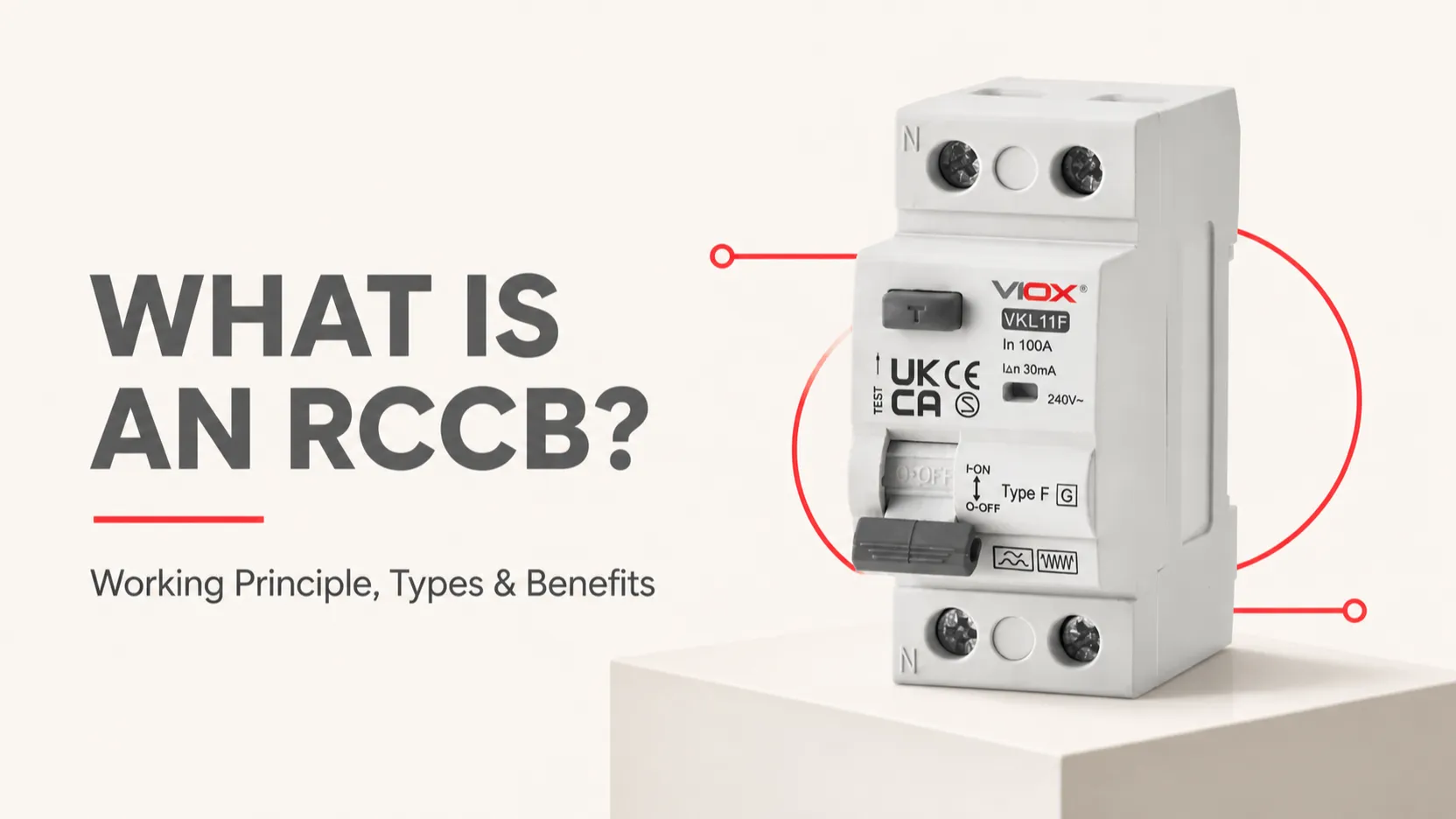
Um RCCB (Disjuntor de corrente residual) é um dispositivo de proteção que desliga um circuito quando detecta corrente residual — o desequilíbrio entre as correntes que fluem através de todos os condutores vivos que monitoriza. A sua principal função é reduzir o risco associado a fugas para a terra e falhas de corrente residual.
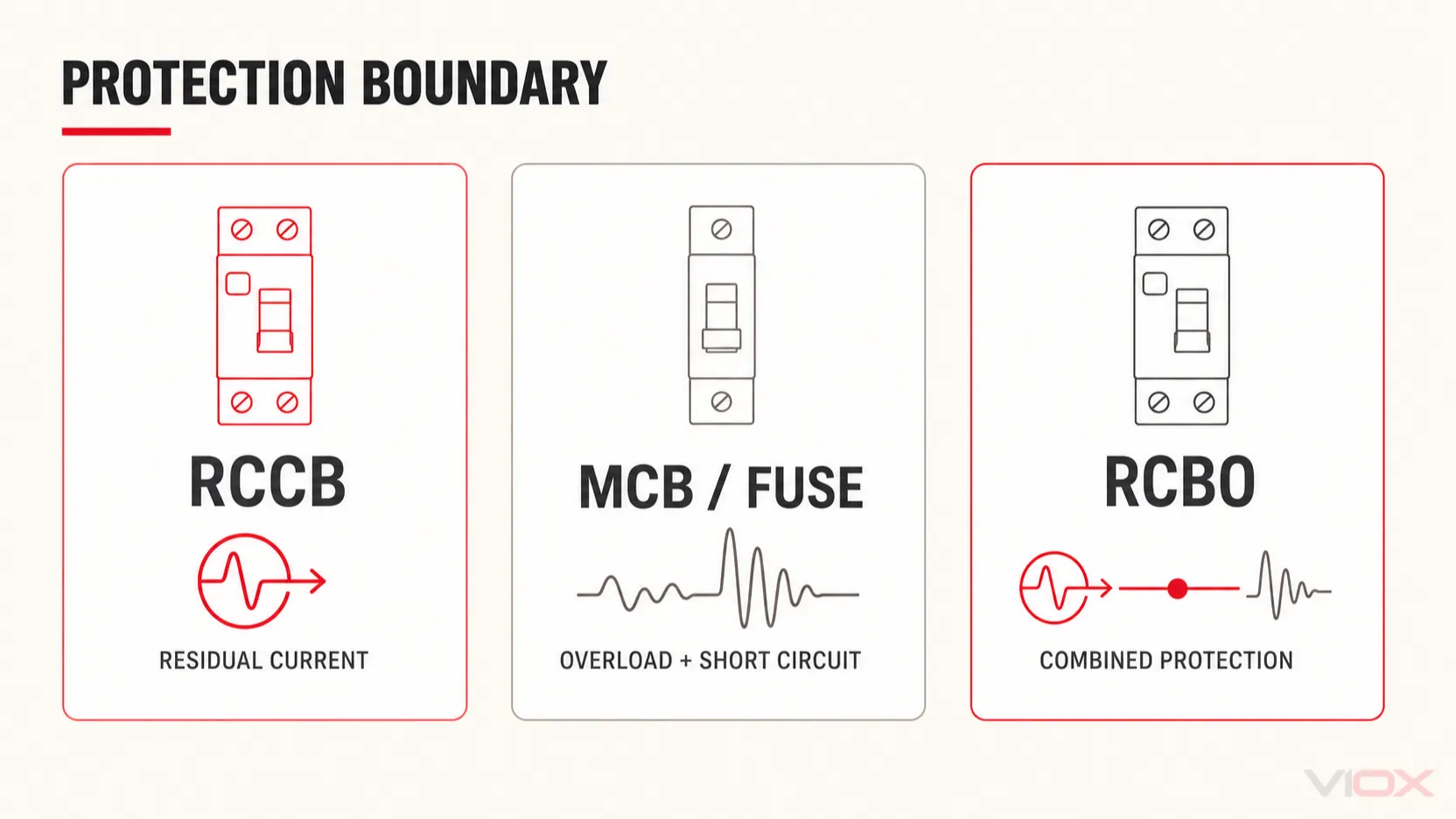
O limite mais importante é este: um RCCB não oferece proteção integral contra sobrecarga ou curto-circuito. De acordo com a terminologia IEC, é um disjuntor operado por corrente residual sem proteção integral contra sobrecorrente. Deve, portanto, ser coordenado com um fusível, MCB ou outro dispositivo de proteção contra sobrecorrente adequado. Quando a proteção contra corrente residual e sobrecorrente é combinada num único dispositivo, esse dispositivo é normalmente um RCBO.
Se precisa apenas da expansão da sigla, veja RCCB Full Form in Electrical. Este centro de informações explica o dispositivo, o seu princípio de funcionamento, tipos, benefícios, limites e as decisões que determinam a seleção correta.
RCCB em resumo
| Errada | Resposta curta |
|---|---|
| O que um RCCB deteta? | Corrente residual causada por corrente que abandona o caminho do circuito pretendido |
| O que é que ele compara? | A soma vetorial das correntes através de todos os condutores vivos monitorizados |
| O que é que ele desliga? | Todos os condutores vivos necessários do circuito protegido |
| Protege contra sobrecarga ou curto-circuitos? | Não—é necessário um dispositivo de proteção contra sobrecorrente separado |
| Principais tipos de forma de onda | Tipo AC, Tipo A, Tipo F e Tipo B |
| Configurações comuns de polos | Bipolar e tetrapolar |
| Marcações principais | Corrente nominal Em e corrente residual nominal de operação IΔn |
| Norma principal do produto | IEC 61008-1 dentro do seu âmbito declarado |
Como funciona um RCCB?
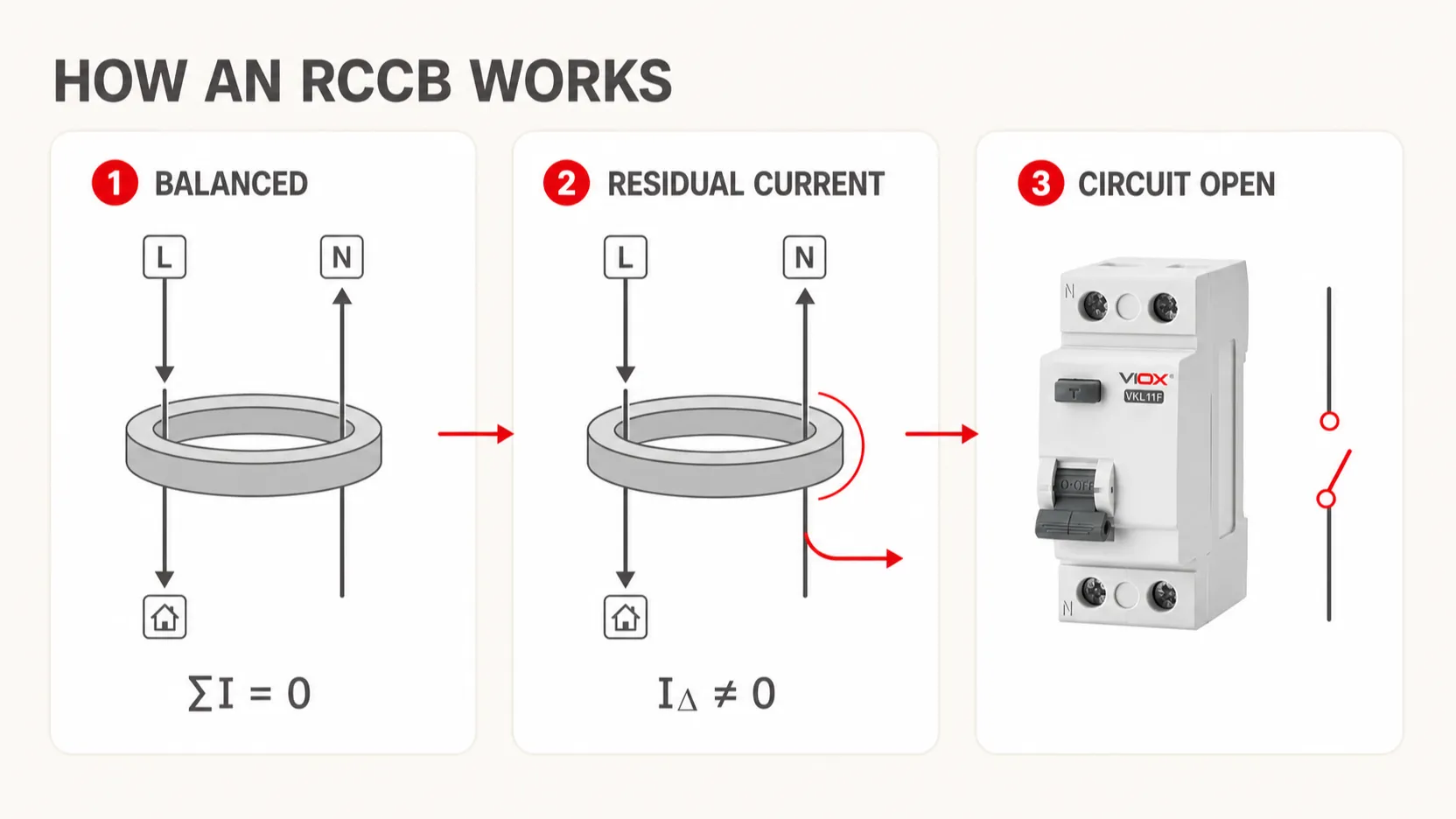
O princípio de funcionamento do RCCB baseia-se no equilíbrio de corrente. Num circuito saudável, a soma vetorial da corrente que flui através de todos os condutores vivos que passam pelo núcleo de deteção é aproximadamente zero.
Para um circuito monofásico simples:
Ilinha − Ineutro ≈ 0Para um circuito trifásico, o RCCB avalia a soma vetorial das correntes de fase e da corrente de neutro, quando este está presente. O condutor de proteção (terra) não passa pelo núcleo de deteção.
1. O RCCB monitoriza todos os condutores vivos
O condutor ou condutores de fase — e o neutro, quando utilizado — passam através de um transformador de corrente de núcleo balanceado. Os seus efeitos magnéticos anulam-se quando as correntes de ida e retorno estão equilibradas.
2. Um caminho de fuga cria uma corrente residual
Se a corrente sair do caminho pretendido através de isolamento danificado, partes condutoras expostas, terra ou outra rota não intencional, nem toda ela retorna através dos condutores monitorados. A soma vetorial deixa de ser zero.
A corrente residual está relacionada com a corrente de fuga, mas os termos não devem ser tratados como sinônimos exatos em todos os contextos de medição. Consulte corrente de fuga vs. corrente residual vs. corrente de terra para a terminologia detalhada.
3. O transformador sensor produz um sinal de disparo
O fluxo magnético residual no núcleo produz um sinal secundário. Quando as condições de operação do dispositivo são atendidas, o mecanismo de liberação é destravado.
4. Os contatos abrem o circuito
O RCCB abre os condutores energizados necessários e isola o circuito protegido. Ele permanece aberto até que a falha seja investigada e o dispositivo seja reiniciado.
O botão de teste cria uma condição de teste interna para verificar o mecanismo de operação do dispositivo. Ele não substitui o teste de instalação nem comprova a qualidade do sistema de aterramento.
Mapa de Limites de Proteção do RCCB
Um RCCB deve ser selecionado pela falha que se destina a detectar — e não pela suposição de que todo dispositivo chamado “disjuntor” oferece a mesma proteção.
| Condição elétrica | Um RCCB detectará isso normalmente? | O que mais é necessário? |
|---|---|---|
| Corrente de fuga de um condutor energizado para a terra ou outro caminho não intencional | Sim, quando a corrente residual corresponde às características de detecção e operação do dispositivo | Tipo de RCCB, sensibilidade, instalação e projeto de aterramento/equipotencialização corretos |
| Falha de isolamento que produz corrente residual | Sim, dentro do escopo de operação do dispositivo | Localização e reparo da falha após a desconexão |
| Sobrecarga com corrente de saída e retorno equilibrada | Nenhum | Disjuntor miniatura (MCB), fusível, disjuntor em caixa moldada (MCCB) ou outra proteção contra sobrecorrente |
| Curto-circuito fase-neutro | Não, se as correntes permanecerem equilibradas através do núcleo de detecção | Dispositivo de proteção contra curto-circuito |
| Curto-circuito entre fases | Não, se a soma vetorial permanecer equilibrada | Dispositivo de proteção contra curto-circuito |
| Arco em série sem fuga de corrente para fora do caminho pretendido | Não necessariamente | Proteção adequada contra falhas de arco onde exigido |
| Contato direto entre fase e neutro | Não necessariamente; a corrente igual ainda pode sair e retornar através dos condutores monitorados | Proteção básica, projeto seguro e outras medidas de proteção aplicáveis |
Este limite é a razão pela qual um IDR complementa um disjuntor (MCB) em vez de substituí-lo automaticamente. Para uma comparação mais aprofundada, leia RCCB vs MCB: Por que usar RCCB em vez de MCB para proteção contra choques?.
Tipos de IDR por forma de onda da corrente residual
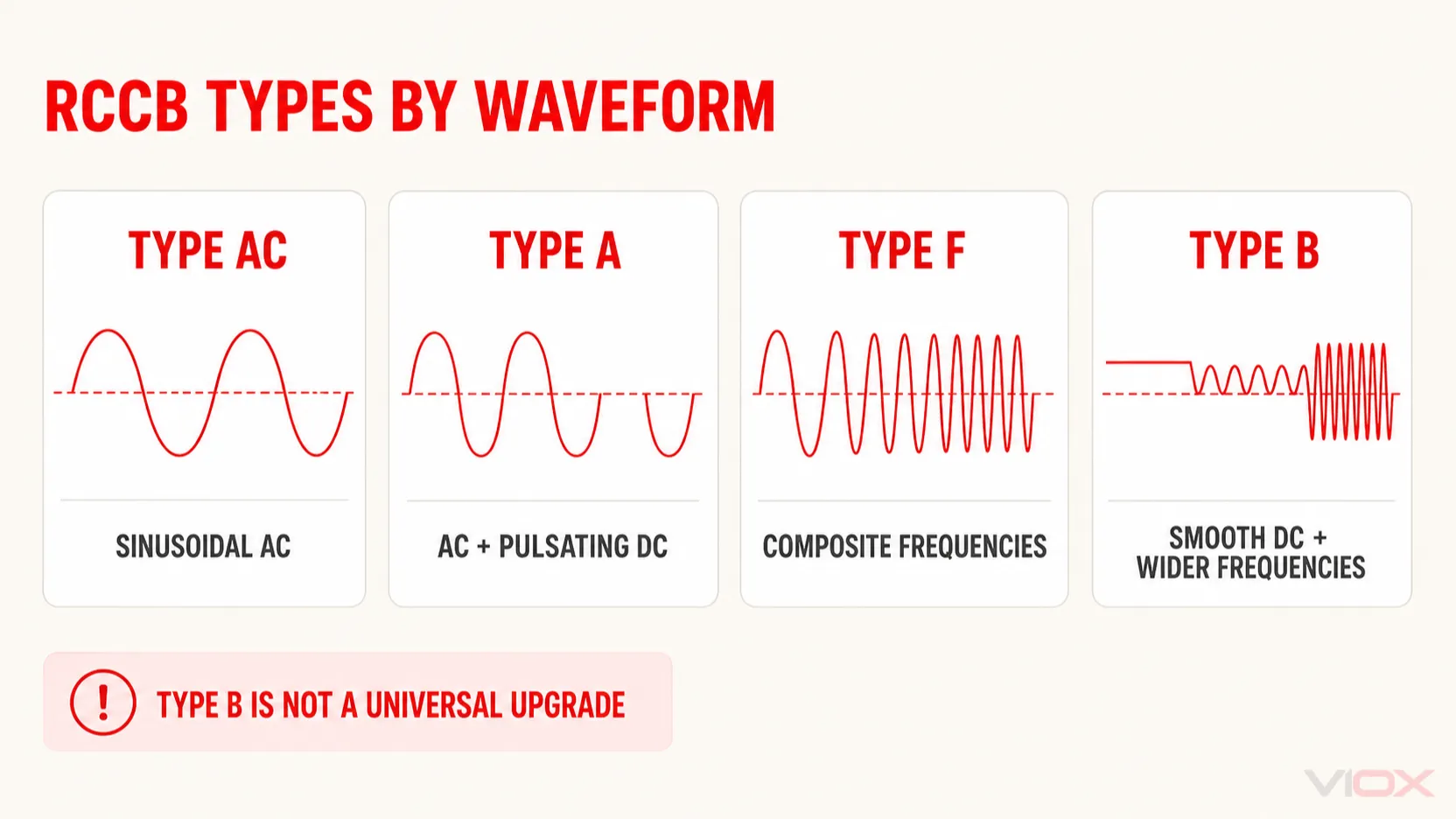
As cargas eletrónicas modernas podem produzir correntes residuais que não são ondas sinusoidais puras de 50/60 Hz. O tipo de RCCB deve corresponder à forma de onda da corrente residual que a carga ou o equipamento de conversão de potência pode criar.
| Tipo de RCCB | Capacidade de corrente residual, simplificada | Contexto típico de carga | Limite de seleção |
|---|---|---|---|
| Tipo AC | Corrente residual alternada sinusoidal | Cargas AC básicas onde permitido | Pode ser restringido por normas locais e pode não ser adequado para cargas eletrónicas modernas |
| Tipo A | Capacidade do tipo AC mais corrente residual DC pulsante | Muitas cargas e aparelhos eletrónicos monofásicos | Não oferece a capacidade de corrente contínua (DC) suave do Tipo B |
| Tipo F | Capacidade do Tipo A acrescida de correntes residuais de frequência composta especificadas | Determinadas cargas monofásicas de velocidade variável ou acionadas por inversor | Verifique o tipo de DDR e o comportamento de frequência exigidos pelo fabricante do equipamento |
| Tipo B | Capacidade do Tipo F acrescida de corrente contínua (DC) suave e uma gama mais ampla de frequências de corrente residual | Conversores trifásicos e algumas aplicações de VFD, fotovoltaicos (PV), UPS, veículos elétricos (EV) e aplicações médicas | Verifique as normas específicas da aplicação e as instruções do equipamento |
Estas categorias são classificações simplificadas de forma de onda — não são valores de sensibilidade nem curvas de disparo de disjuntores (MCB). “DDR Tipo B” e “MCB curva B” descrevem características diferentes. O Tipo B não é uma opção “melhor” universal: a seleção final ainda depende das instruções do equipamento, das normas nacionais, da coordenação a montante e de qualquer dispositivo de detecção de corrente contínua (DC) necessário.
O tipo apropriado não pode ser selecionado apenas pela etiqueta do edifício. Uma residência, um painel comercial ou uma fábrica podem conter diversas tecnologias de carga que exigem diferentes respostas a correntes residuais. O guia de seleção de DDR da ABB e o Guia de Instalações Elétricas da Schneider enfatizam a correspondência do tipo de dispositivo com a possível forma de onda da corrente residual.
Outras formas de classificação dos RCCBs
Por configuração de polos
- RCCB de 2 polos: comumente usado para circuitos monofásicos onde a fase e o neutro devem ser monitorados e seccionados.
- RCCB de 4 polos: comumente usado para circuitos trifásicos com três condutores de fase e um neutro.
O arranjo exato dos condutores e os requisitos de seccionamento dependem do sistema e das normas de instalação aplicáveis. Não utilize a contagem de polos como substituto para a verificação do diagrama de fiação e das instruções do produto.
Pela corrente residual nominal de operação
A marcação IΔn identifica a corrente residual nominal de operação. Valores como 30 mA, 100 mA e 300 mA atendem a diferentes objetivos de proteção e coordenação e não são intercambiáveis. Selecione o valor de acordo com as normas aplicáveis e o projeto do circuito; utilize o Guia de sensibilidade de RCCB: 30 mA vs 100 mA vs 300 mA para os limites detalhados.
Pela característica de tempo
Os RCCBs podem ter uma característica de operação instantânea ou retardada. Dispositivos seletivos com retardo de tempo podem suportar a discriminação a montante/a jusante quando utilizados em um projeto devidamente coordenado. Um valor mais alto IΔn por si só não garante a seletividade.
Como ler as classificações e marcações de um RCCB
Duas marcações de corrente são frequentemente confundidas:
| Marcação | Significado | Exemplo | O que isso não significa |
|---|---|---|---|
Em |
Corrente nominal que o RCCB pode transportar sob condições especificadas | 40 A, 63 A, 100 A | Não é um ajuste de disparo por sobrecarga |
IΔn |
Corrente residual nominal de funcionamento | 30 mA, 100 mA, 300 mA | Não é a corrente nominal de carga |
Um RCCB de 63 A, 30 mA é, portanto, classificado para conduzir 63 A sob suas condições declaradas e possui uma corrente residual nominal de operação de 30 mA. Estas marcações descrevem características distintas e devem ser avaliadas independentemente.
Outras marcações de seleção podem incluir:
- tensão e frequência nominais;
- número de polos;
- tipo de forma de onda da corrente residual;
- característica de tempo instantânea ou seletiva;
- capacidade de ligação e corte;
- informações sobre corrente de curto-circuito condicional e proteção de retaguarda necessária;
- norma do produto e marcações de aprovação específicas do modelo.
A documentação do produto aplicável deve ser verificada como um conjunto completo. Para o limite das normas, consulte o guia de requisitos para RCCB IEC 61008-1.
Quais são os benefícios de um RCCB?
Reduz o risco de falhas por corrente residual qualificáveis
Um RCCB pode desconectar um circuito quando um desequilíbrio de corrente qualificado indica que a corrente está fluindo fora do caminho pretendido. Isso fornece uma camada de proteção que um dispositivo de sobrecorrente comum pode não oferecer.
Suporta proteção adicional contra choque elétrico
Onde exigido pelas normas de instalação aplicáveis, um RCCB selecionado corretamente pode fornecer proteção adicional contra certas condições de choque elétrico. Ele não torna o contato com condutores energizados seguro e não substitui a proteção básica.
Pode reduzir o risco de incêndio por falta à terra
A proteção por corrente residual pode desconectar falhas que podem ser pequenas demais para acionar um dispositivo de sobrecorrente, mas que ainda podem criar risco térmico. O objetivo da proteção, a sensibilidade, a característica de tempo e o sistema de fiação devem ser selecionados para a instalação específica.
Fornece isolamento automático e uma função de teste manual
O dispositivo abre o circuito automaticamente quando suas condições de operação são atendidas. O botão de teste integrado fornece uma verificação funcional conveniente do mecanismo do RCCB de acordo com as instruções do fabricante.
Suporta diversas arquiteturas de distribuição
Os RCCBs estão disponíveis com diferentes configurações de polos, sensibilidades de corrente residual, tipos de forma de onda e características de tempo. Eles podem ser coordenados com MCBs a jusante ou utilizados em projetos onde a proteção contra corrente residual é agrupada ao nível da distribuição.
Limitações do RCCB que você não deve ignorar
Um RCCB é um dispositivo de proteção importante, mas não constitui uma proteção completa por si só.
- Ele pode não operar em caso de contato fase-neutro quando a corrente permanece equilibrada.
- Ele não pode compensar um tipo de forma de onda de corrente residual incorreto.
- Ele não substitui o isolamento, invólucros, aterramento de proteção, equipotencialização ou procedimentos de trabalho seguros.
- Um único RCCB protegendo vários circuitos pode desconectar todos eles quando ocorre uma falha residual a jusante.
- A fuga normal de múltiplas cargas eletrônicas pode acumular-se e contribuir para disparos indesejados.
- O acionamento do botão de teste não comprova que a instalação completa está segura.
Estes limites devem ser declarados tão claramente quanto os benefícios. Eles determinam se um IDR, um IDR com disjuntores (MCBs) ou disjuntores diferenciais (RCBOs) individuais fornecem a arquitetura mais apropriada.
IDR vs Disjuntor (MCB) vs Disjuntor Diferencial (RCBO) vs DDR
| Dispositivo | Função principal | Proteção contra corrente residual | Proteção integral contra sobrecarga/curto-circuito | Pergunta principal de decisão |
|---|---|---|---|---|
| RCCB | Detectar corrente residual e seccionar | Sim | Nenhum | A proteção contra corrente residual pode ser coordenada com um dispositivo de sobrecorrente separado? |
| MCB | Proteger contra sobrecarga e curto-circuito | Nenhum | Sim | O circuito necessita de proteção contra sobrecorrente sem uma função de corrente residual integrada? |
| RCBO | Combinar proteção contra corrente residual e sobrecorrente | Sim | Sim | Cada circuito deve ter proteção combinada e independente? |
| Disjuntor diferencial operado por tensão (ELCB) | Detetar tensão num esquema de ligação à terra protegido | Princípio de funcionamento diferente e mais antigo | Nenhum | Está a ser identificado ou substituído um dispositivo mais antigo operado por tensão? |
Para a arquitetura de quadros de distribuição, comparar RCBO vs RCCB + MCB. Para terminologia e métodos de proteção mais antigos, consulte a diferença entre RCCB e ELCB.
Onde são utilizados os RCCBs?
Os RCCBs são utilizados em sistemas de distribuição residenciais, comerciais e industriais, incluindo quadros de distribuição, grupos de circuitos finais e locais onde as normas de instalação exigem proteção contra corrente residual. Eles também podem proteger circuitos que alimentam equipamentos eletrônicos ou baseados em inversores, como acionamentos de HVAC, sistemas de UPS, equipamentos fotovoltaicos ou carregadores de veículos elétricos.
O nome da aplicação por si só não determina o dispositivo correto. O esquema de aterramento, o objetivo da proteção, a possível forma de onda da corrente residual, as instruções do equipamento e as normas locais ainda controlam a seleção.
Como escolher um RCCB: Cinco dimensões
Utilize este centro como uma estrutura de orientação. Conclua a seleção detalhada nas páginas especializadas vinculadas e na documentação do produto do fabricante.
1. Defina o objetivo da proteção
Determine se o RCCB destina-se a proteção adicional, proteção contra falhas, proteção contra risco de incêndio, proteção contra corrente residual a montante ou uma combinação coordenada. Verifique a norma de instalação aplicável antes de escolher a classificação do produto.
Selecione IΔn a partir da função de proteção necessária
Escolha a corrente residual nominal de operação de acordo com os requisitos do circuito — não apenas com base no tipo de instalação. Consulte o guia de seleção de sensibilidade do IDR (RCCB) para os limites entre as aplicações de 30 mA, 100 mA e 300 mA.
3. Combine o tipo de forma de onda com a carga
Identifique retificadores, fontes de alimentação chaveadas, conversores de frequência, inversores, carregadores de veículos elétricos, equipamentos fotovoltaicos, sistemas UPS e outras cargas que possam alterar a forma de onda da corrente residual. Selecione o tipo AC, A, F ou B apenas após considerar a possível corrente de falta e as instruções do equipamento.
4. Verifique a corrente nominal, os polos e as condições do sistema
Confirmar Em, tensão nominal, frequência, configuração de polos, disposição dos condutores, condições ambientais e de invólucro, e quaisquer instruções de redução de potência (derating). A corrente nominal do IDR (RCCB) deve ser coordenada com o projeto do circuito e a proteção a montante.
5. Coordenar a proteção contra sobrecorrente, curto-circuito e corrente residual.
Confirmar o dispositivo de proteção contra sobrecarga e curto-circuito externo, a capacidade de curto-circuito condicional e a seletividade a montante/a jusante. Se for necessária uma proteção combinada independente para cada circuito final, avalie um disjuntor diferencial residual (RCBO) em vez de forçar um único IDR (RCCB) a atender toda a arquitetura.
Uma vez conhecidas estas cinco dimensões, compare-as com as disponíveis gama de produtos VIOX RCCB e solicite a documentação específica do modelo para o mercado pretendido.
Teste e Manutenção do IDR (RCCB)
Acione o botão de teste conforme exigido pelo fabricante e pelas normas locais aplicáveis; a falha no disparo requer investigação por um profissional qualificado. Como o botão verifica apenas um caminho de operação interno, ele não substitui a inspeção da instalação ou o teste com instrumentos. Consulte Como Verificar a Funcionalidade do RCCB para intervalos, procedimentos de teste e diagnóstico de falhas.
Normas de RCCB: Regras de Produto vs. Regras de Instalação
IEC 61008-1:2024 fornece as regras gerais para RCCBs dentro do seu escopo. A Parte 2 da IEC 61008 aplicável depende da classificação e do design do RCCB. Em comparação, IEC 61009-1:2024 abrange RCBOs dentro do seu escopo.
As normas de produto definem e testam o dispositivo; as regras nacionais de instalação elétrica, as condições do sistema e as instruções do equipamento determinam onde e como ele pode ser usado. Verifique a adoção nacional aplicável e a certificação de modelo para o mercado-alvo. Para mais detalhes, consulte o guia de requisitos para RCCB IEC 61008-1.
Perguntas Frequentes
Qual é a forma completa de RCCB?
RCCB significa Disjuntor de Corrente Residual. Veja o focado Explicação do significado completo de RCCB para detalhes de terminologia.
Qual é a função principal de um RCCB?
A sua função principal é detectar corrente residual — um desequilíbrio de corrente através dos condutores vivos monitorizados — e desligar o circuito quando as suas condições de operação são atingidas.
Um RCCB protege contra sobrecarga e curto-circuito?
Não. Um RCCB não possui proteção integral contra sobrecorrente. Deve ser coordenado com um fusível, MCB ou outro dispositivo de proteção contra sobrecorrente adequado, ou substituído por um RCBO apropriado quando for necessária proteção combinada.
Qual é a diferença entre RCD e RCCB?
RCD significa Dispositivo de Corrente Residual (Residual Current Device) e é o termo genérico da família. Um RCCB é uma forma específica de disjuntor dentro dessa família.
Qual é a diferença entre um RCCB Tipo A e Tipo B?
O Tipo A detecta correntes residuais CA sinusoidais e CC pulsantes especificadas. O Tipo B adiciona capacidade para CC suave e uma gama mais ampla de formas de onda e frequências, mas não é uma atualização universal. As instruções do equipamento, as normas nacionais, a coordenação e qualquer disposição de detecção de CC necessária determinam a escolha final.
O que significa 30 mA em um IDR (RCCB)?
Normalmente identifica a corrente residual nominal de operação. IΔn. Não é a corrente nominal de carga, nem o tempo de disparo, e não é uma afirmação de que 30 mA através do corpo seja seguro.
Um IDR (RCCB) pode funcionar sem um fio terra?
Um IDR mede o equilíbrio de corrente nos condutores vivos; o condutor de proteção (terra) não é usado como condutor de detecção através do seu núcleo. No entanto, isso não torna o aterramento de proteção opcional. O aterramento e a equipotencialização devem continuar a cumprir as regras de instalação e o projeto do sistema aplicáveis.
Conclusão
Um IDR detecta a corrente residual e desconecta o circuito protegido, ajudando a reduzir o risco de fugas de corrente e condições de falha à terra.
A seleção correta de um IDR requer cinco decisões separadas: objetivo da proteção, IΔn, tipo de forma de onda da corrente residual, classificações elétricas e polos, e coordenação com outros dispositivos de proteção. Tratar essas decisões separadamente produz um projeto mais seguro e defensável do que escolher um IDR apenas pelo tipo de edifício ou pela classificação principal.
Para avaliação do produto, revise o Gama de RCCB VIOX apenas após a definição da função de proteção necessária e da documentação de mercado.