

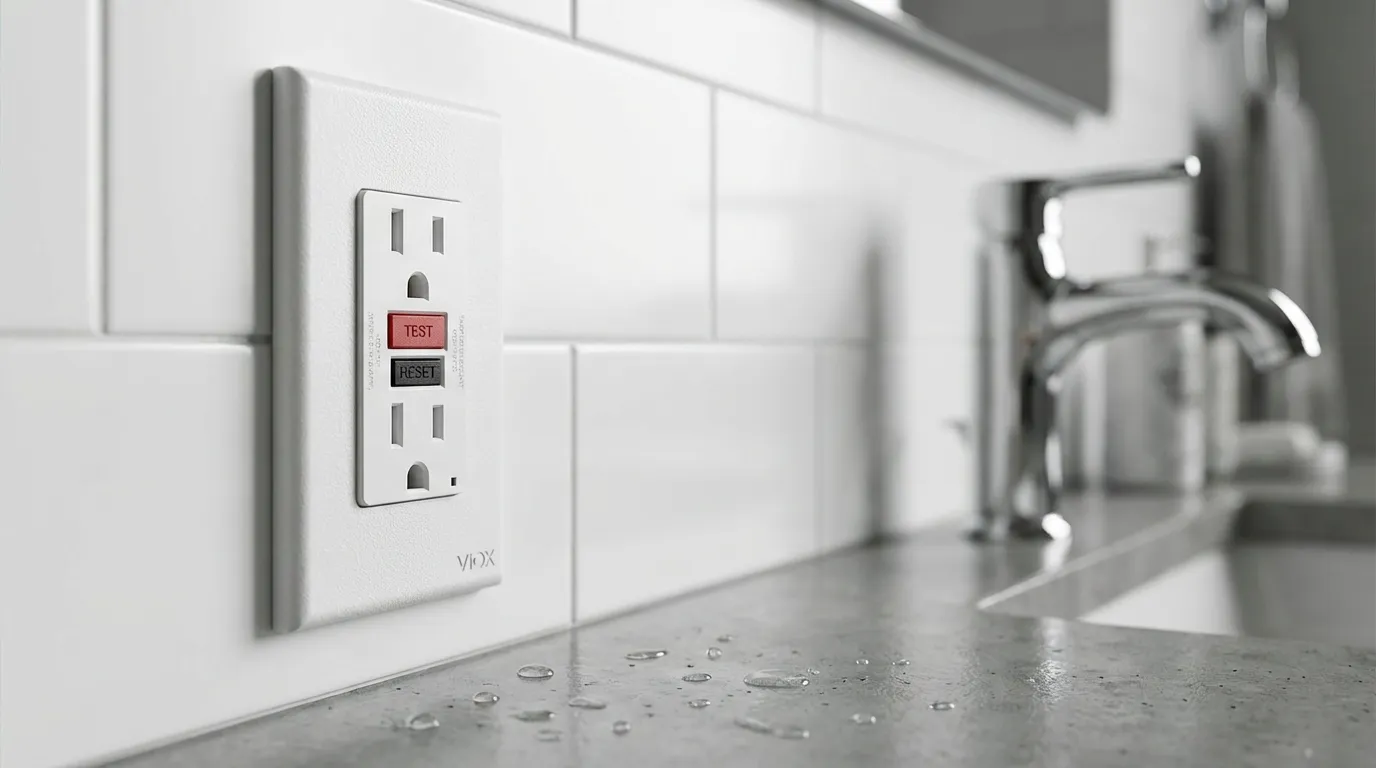
GFCI (Ground Fault Circuit Interrupter) and AFCI (Arc Fault Circuit Interrupter) are both essential electrical safety devices, but they protect against different types of electrical hazards. GFCIs prevent electrical shock by detecting ground faults in as little as 4-6 milliamps and tripping within 1/40th of a second, while AFCIs prevent electrical fires by detecting dangerous electrical arcs using advanced microprocessor technology. Modern electrical codes now require both protections in overlapping areas, making dual-function GFCI/AFCI breakers increasingly essential for comprehensive home safety.
Key Takeaways
- GFCI devices protect people from electrical shock by detecting ground faults (current leakage), while AFCI devices protect property from electrical fires by detecting dangerous arcing conditions
- Dual-function breakers combining GFCI and AFCI protection are now the most cost-effective solution for areas requiring both protections under NEC 2023 requirements
- GFCIs are mandatory in wet locations (bathrooms, kitchens, outdoors, garages) per NEC 210.8, while AFCIs are required in living spaces (bedrooms, living rooms, family rooms) per NEC 210.12
- Monthly testing of both GFCI and AFCI devices is critical—devices that fail testing or are over 10-15 years old should be replaced immediately
- Nuisance tripping in AFCI devices has significantly decreased with newer combination models, but incompatible electronics and wiring issues remain common causes
- According to the U. S. Consumer Product Safety Commission, AFCIs could prevent over 50% of home electrical fires, which cause approximately $1.3 billion in property damage annually
What Are GFCI and AFCI Circuit Breakers?
GFCI (Ground Fault Circuit Interrupter) Definition
A GFCI is an electrical safety device designed to protect people from electrical shock caused by ground faults. It continuously monitors the electrical current flowing through the hot and neutral wires, immediately shutting off power when it detects even tiny differences that indicate current is flowing to ground through an unintended path—such as through a person’s body.
GFCIs have been saving lives since their introduction in the 1970s. The technology works by comparing the current in the hot wire to the current in the neutral wire. Under normal conditions, these should be equal. When someone touches a faulty appliance or tool, current flows through their body to ground, creating an imbalance that the GFCI detects instantly. This life-saving response time of 1/40th of a second (25-30 milliseconds) is fast enough to prevent fatal electrocution in most scenarios.
AFCI (Arc Fault Circuit Interrupter) Definition
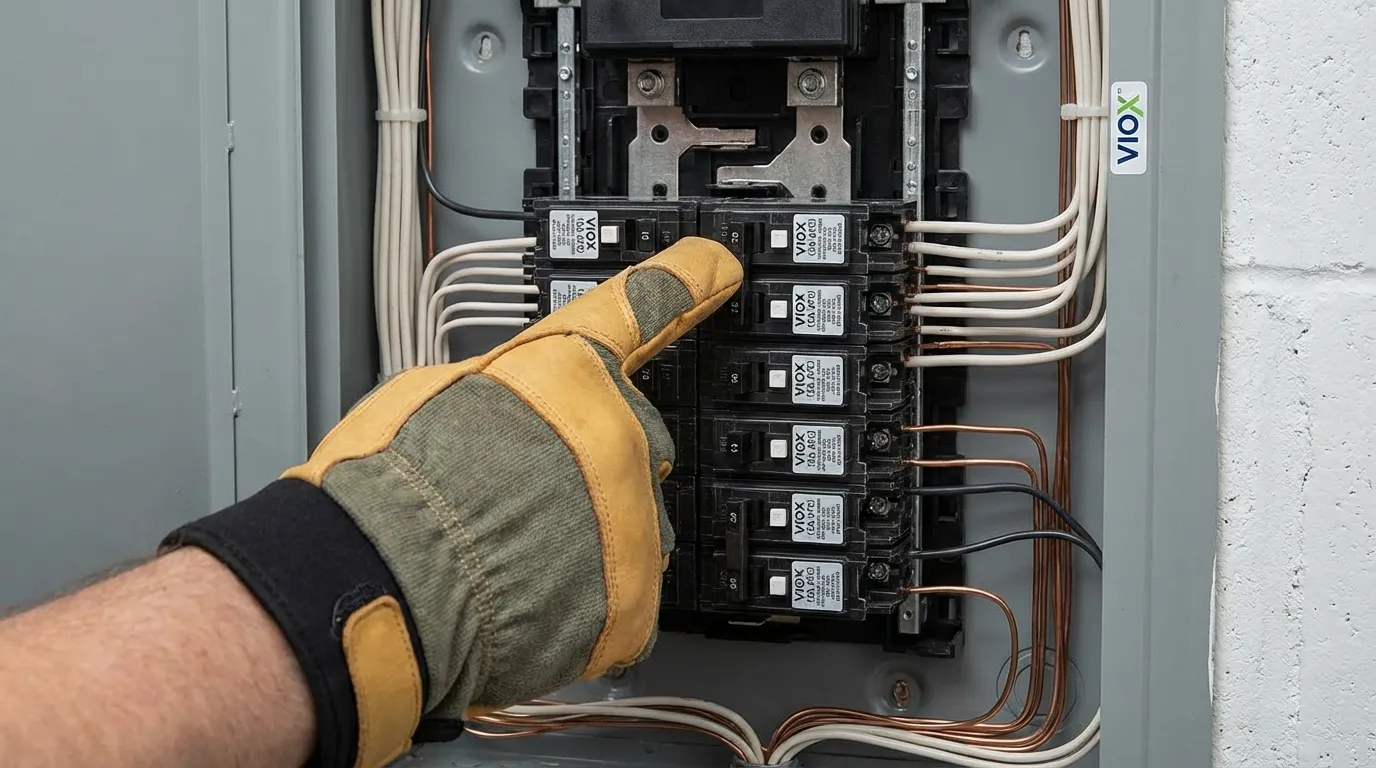
An AFCI is an electrical safety device designed to prevent electrical fires by detecting dangerous electrical arcs in wiring systems. It uses advanced electronics and microprocessors to distinguish between normal electrical arcs (like when you unplug an appliance or flip a switch) and potentially dangerous arcs that can cause fires, automatically shutting off power when hazardous conditions are detected.
Electrical arcing occurs when current jumps across a gap in damaged, deteriorated, or improperly installed wiring. These arcs can reach temperatures exceeding 10,000°F—hot enough to ignite surrounding materials like wood framing and insulation. According to the U. S. Fire Administration, electrical failures or malfunctions are the second leading cause of home fires, accounting for an estimated 24,000 fires annually. AFCIs address this critical safety gap by providing protection that traditional circuit breakers cannot offer.
Key Differences Between GFCI and AFCI
Here is a comprehensive table showing the primary differences between GFCI and AFCI circuit breakers:
| Feature | GFCI | AFCI |
|---|---|---|
| Primary Protection | Electrical shock prevention | Electrical fire prevention |
| Detects | Ground faults (4-6 milliamps) | Dangerous electrical arcs |
| Response Time | 1/40th of a second (25-30 ms) | Milliseconds |
| Technology | Current differential sensing | Microprocessor-based arc detection |
| Required Locations | Bathrooms, kitchens, outdoors, garages, crawl spaces, basements | Bedrooms, living areas, family rooms, dining rooms, hallways |
| NEC Code Section | Article 210.8 | Article 210.12 |
| Installation Cost | $15-45 per outlet/breaker | $45-75 per breaker |
| Dual Function Cost | N/A | $50-85 per breaker |
| Lifespan | 10-15 years | 10-20 years |
| Testing Frequency | Monthly (required) | Monthly (required) |
| False Trip Rate | Low | Moderate (significantly improved in newer models) |
| First Required by NEC | 1971 (specific locations) | 1999 (bedrooms only) |
| Protection Level | Personnel safety | Property protection |
When and Where to Use GFCI vs AFCI
GFCI Required Locations (NEC 210.8)
⚠️ SAFETY REQUIREMENT: GFCIs are mandatory in these locations per National Electrical Code:
Residential (Dwelling Units):
- Bathrooms – All 125-volt, 15- and 20-ampere receptacles
- Kitchens – All receptacles serving countertop surfaces and within 6 feet of sinks
- Outdoors – All receptacles accessible from grade level
- Garages and accessory buildings – All receptacles (except dedicated appliances in non-accessible locations)
- Crawl spaces – All 125-volt, 15- and 20-ampere receptacles
- Unfinished basements – All receptacles (with exceptions for dedicated appliances)
- Laundry areas – Receptacles within 6 feet of sinks
- Utility rooms – Receptacles within 6 feet of sinks
- Wet bars – All receptacles within 6 feet of the sink
- Boathouses – All receptacles
NEC 2023 Updates:
The 2023 NEC expanded GFCI requirements significantly, now mandating protection for all 125-volt through 250-volt receptacles in many locations, including dishwashers, disposals, and other fixed appliances in kitchens and similar areas.
AFCI Required Locations (NEC 210.12)
🔥 FIRE PREVENTION REQUIREMENT: AFCIs are mandatory in these locations:
Residential (Dwelling Units):
- Bedrooms – All 120-volt, 15- and 20-ampere branch circuits
- Living rooms – All circuits supplying outlets or devices
- Family rooms – All circuits supplying outlets or devices
- Dining rooms – All circuits supplying outlets or devices
- Hallways – All circuits supplying outlets or devices
- Closets – All circuits supplying outlets or devices
- Sunrooms – All circuits supplying outlets or devices
- Recreation rooms – All circuits supplying outlets or devices
- Libraries and dens – All circuits supplying outlets or devices
NEC 2023 Expansion:
The 2023 code cycle further expanded AFCI requirements to include sleeping quarters in fire stations, police stations, ambulance stations, and similar facilities, recognizing the critical importance of fire prevention in these essential service buildings.
Locations Requiring BOTH GFCI and AFCI Protection
💡 DUAL PROTECTION ZONES: Some circuits require both types of protection:
- Kitchen receptacles (GFCI for shock + AFCI for fire prevention)
- Laundry areas (GFCI for wet locations + AFCI for living space protection)
- Basement living spaces (GFCI for damp locations + AFCI for habitable areas)
- Garage receptacles on bedroom circuits (when circuits extend from bedrooms)
EXPERT TIP: For areas requiring both protections, use dual-function GFCI/AFCI circuit breakers rather than combining separate devices. Dual-function breakers cost only $5-15 more than AFCI-only breakers but eliminate the complexity and potential compatibility issues of using an AFCI breaker with GFCI receptacles.
How GFCI and AFCI Work: Technical Breakdown
GFCI Operation Mechanism
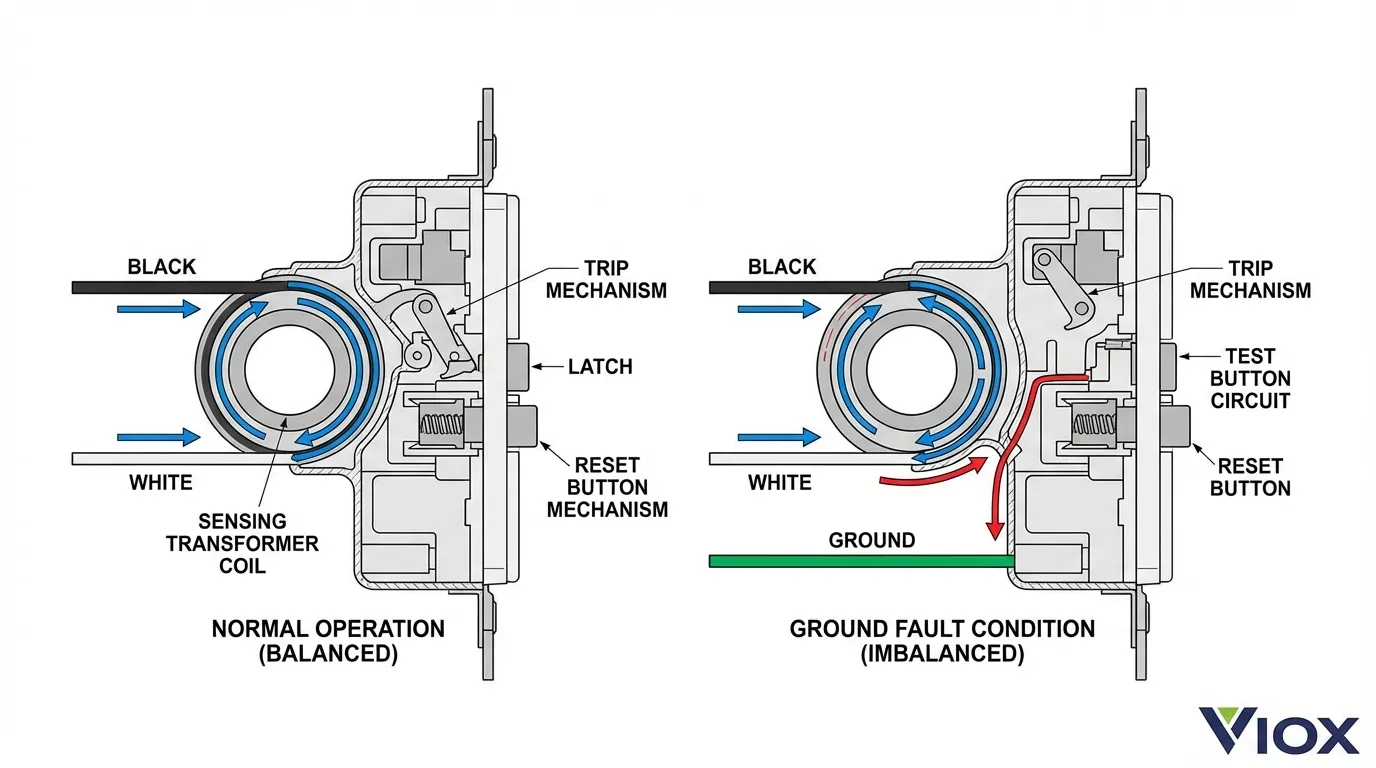
GFCIs work by continuously comparing the current flowing through the hot (line) wire to the current returning through the neutral wire. Under normal conditions, these currents should be nearly identical. When a ground fault occurs:
- Current Imbalance Detection – Current flows through an unintended path (like through a person touching a faulty appliance)
- Differential Sensing – The GFCI’s sensing transformer detects this imbalance (as little as 4-6 milliamps)
- Rapid Response – The device trips within 1/40th of a second (25-30 milliseconds)
- Power Interruption – Power is immediately cut to prevent electrical shock
Technical Specifications:
- Trip threshold: 4-6 mA ±1 mA
- Trip time: 25-30 milliseconds at rated current
- Operating voltage: Typically 120V or 240V
- Reset mechanism: Manual push-button reset required
The 4-6 milliamp threshold is carefully calibrated. Studies show that currents above 10 mA can cause muscle contractions that prevent a person from releasing the electrical source (called “let-go threshold”), while currents above 30 mA can cause respiratory paralysis. The GFCI’s 4-6 mA threshold provides a critical safety margin.
AFCI Operation Mechanism
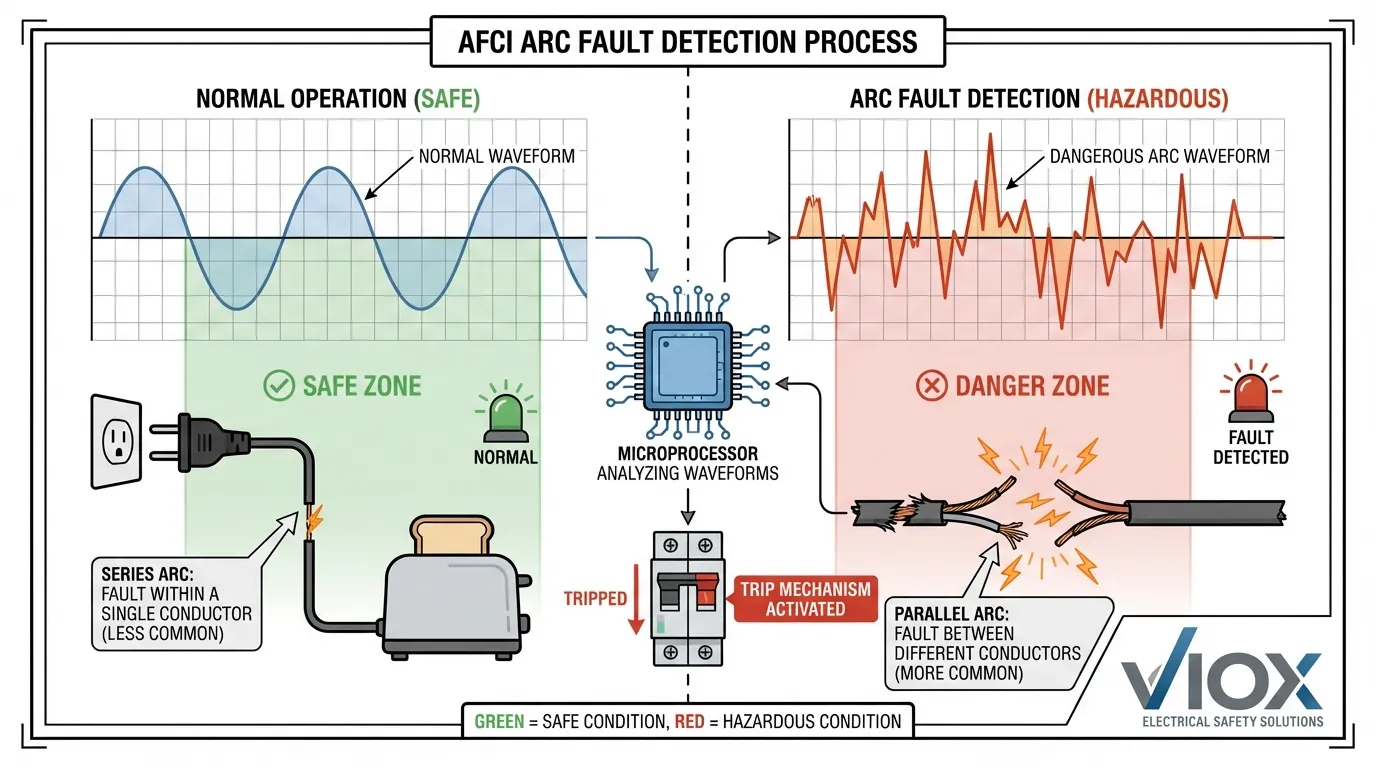
AFCIs use sophisticated electronic circuits and microprocessors to analyze electrical waveforms and detect dangerous arcing conditions:
- Continuous Monitoring – Advanced microprocessors monitor electrical signatures in real-time
- Arc Signature Analysis – The device distinguishes between normal arcs (appliance operation, switch contacts) and dangerous arcs (damaged wiring, loose connections)
- Hazard Detection – When hazardous arcing is detected, the AFCI trips within milliseconds
- Circuit Interruption – Power is cut to prevent electrical fires
🔧 TECHNICAL NOTE: Modern combination AFCIs can detect:
- Series arcs – Arcing along a single wire (e.g., damaged insulation)
- Parallel arcs – Arcing between hot and neutral or hot and ground wires
- Ground arcs – Arcing between hot wire and ground
- Combination arcs – Multiple arc types occurring simultaneously
The technology filters out normal operational arcs while detecting dangerous arcing patterns. This includes analyzing arc duration, frequency, current signature, and repetition patterns to minimize nuisance tripping while maintaining safety.
Types of GFCI and AFCI Devices
GFCI Device Types
| Type | Application | Installation Location | Cost Range | Advantages |
|---|---|---|---|---|
| GFCI Outlet | Individual outlet protection | Replaces standard outlet | $15-30 | Protects downstream outlets, easy to test |
| GFCI Circuit Breaker | Entire circuit protection | Main electrical panel | $45-75 | Whole-circuit protection, tamper-resistant |
| Portable GFCI | Temporary protection | Plugs into existing outlet | $25-50 | Portable, no installation required |
| GFCI Extension Cord | Outdoor/temporary use | Integrated into cord | $30-60 | Convenient for outdoor tools |
AFCI Device Types
| Type | Arc Fault Detection | Application | Code Compliance | Notes |
|---|---|---|---|---|
| Branch/Feeder AFCI | Series arcs only | Older technology | Not NEC compliant for new installs | Phased out after 2008 |
| Combination AFCI | Series and parallel arcs | Current standard | Required for new installations | Industry standard since 2008 |
| Outlet Branch Circuit AFCI | Series and parallel arcs | Outlet-level protection | Alternative to circuit breaker | Used in remodeling situations |
| Dual-Function AFCI/GFCI | All arc types + ground faults | Areas requiring both protections | Compliant for both NEC 210.8 & 210.12 | Most cost-effective solution |
Important Distinction: The term “combination” on an AFCI breaker refers to its ability to detect both series and parallel arc faults—it does NOT mean the breaker includes GFCI protection. Only breakers specifically labeled “Dual Function” or “AFCI/GFCI” provide both types of protection.
Dual-Function GFCI/AFCI Breakers: The Modern Solution
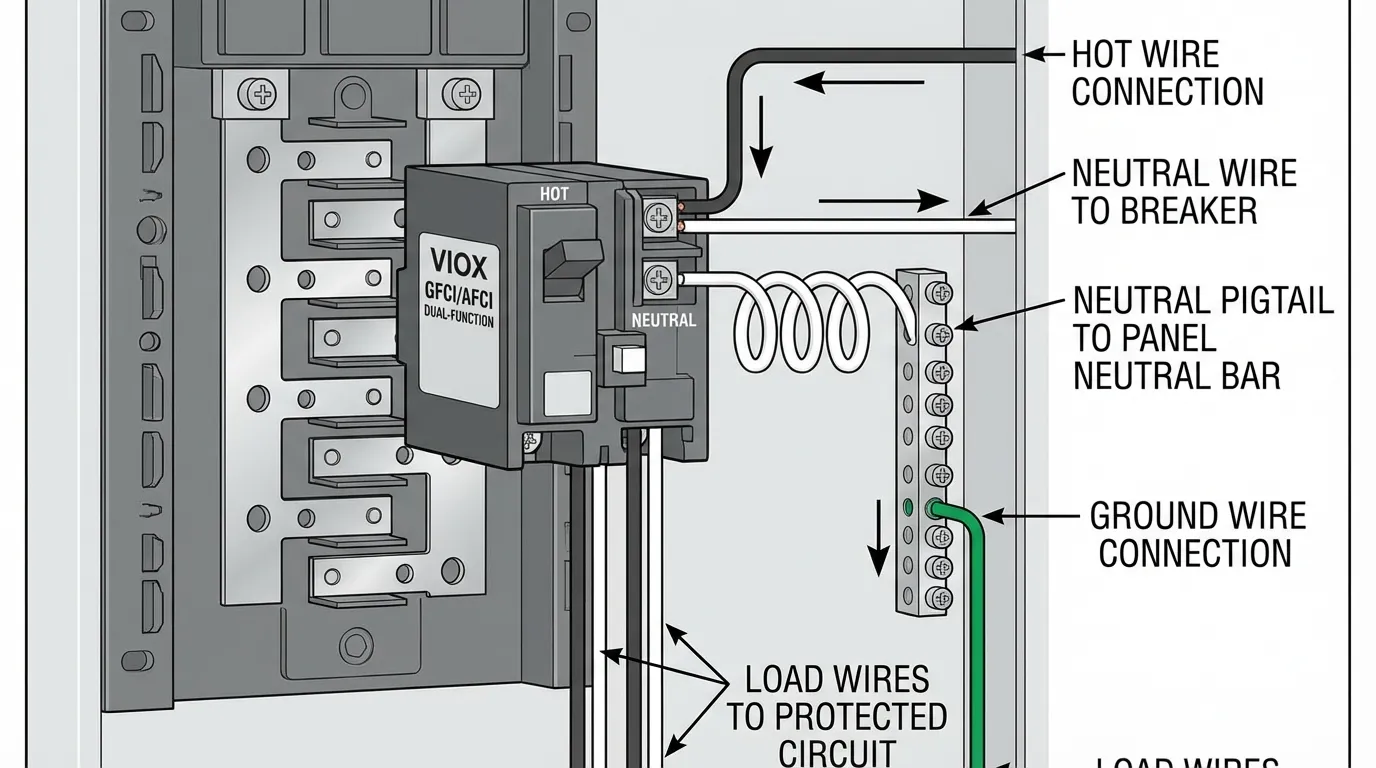
Why Dual-Function Breakers Are Gaining Popularity
As NEC requirements have expanded, many circuits now need both GFCI and AFCI protection. Dual-function breakers offer several advantages:
Cost Efficiency:
- Dual-function breaker: $50-85
- AFCI breaker + GFCI outlet: $60-105
- Savings: $10-20 per circuit plus reduced installation time
Space Savings:
- Occupies single breaker slot in panel
- Eliminates need for GFCI outlets in multiple locations
- Simplifies panel organization
Reliability Benefits:
- Single point of protection reduces failure points
- Easier troubleshooting when trips occur
- Consistent protection across entire circuit
Code Compliance:
- Meets both NEC 210.8 (GFCI) and 210.12 (AFCI) requirements
- Ideal for kitchen circuits, laundry areas, and basement living spaces
- Simplifies inspection and approval process
When to Use Dual-Function vs Separate Devices
Use Dual-Function Breakers When:
- Installing new circuits in kitchens, laundry rooms, or basement living areas
- Upgrading older panels to meet current code
- Protecting appliances like dishwashers, disposals, and washing machines
- Simplifying protection in areas with both requirements
Use Separate GFCI Outlets on AFCI Circuits When:
- Remodeling existing circuits (more cost-effective)
- Need point-of-use GFCI protection for specific outlets
- Panel space is limited and AFCI breaker is already installed
- Troubleshooting nuisance tripping (easier to isolate issues)
Installation and Safety Considerations
Professional Installation Requirements
⚠️ SAFETY WARNING: GFCI and AFCI installation should be performed by licensed electricians. Working with electrical panels and circuits carries serious risks of electrocution, fire, and code violations. Improper installation can create hazards worse than having no protection at all.
Why Professional Installation Matters:
- Proper neutral wire separation (critical for AFCI operation)
- Correct load calculations to prevent overloading
- Compliance with local electrical codes and amendments
- Proper testing and verification of operation
- Documentation for insurance and resale purposes
Common Installation Mistakes to Avoid
AFCI Installation Errors:
- Shared neutral wires – Multi-wire circuits require special handling
- Incorrect neutral connections – Must use dedicated neutral terminal
- Mixing old and new wiring – Can cause nuisance tripping
- Incompatible devices – Not all breakers fit all panels
GFCI Installation Errors:
- Reversed line/load connections – Prevents proper protection
- Shared neutral with non-GFCI circuits – Causes immediate tripping
- Bootleg grounds – Dangerous practice that defeats GFCI protection
- Missing weatherproof covers – Required for outdoor installations
Step-by-Step GFCI Testing Process
Monthly Testing Protocol:
- Visual Inspection – Check for physical damage, discoloration, or burning smell
- Press TEST Button – Device should trip immediately (click sound, power cuts off)
- Verify Power Loss – Use voltage tester or plug in lamp to confirm no power
- Press RESET Button – Device should reset with audible click
- Verify Power Restoration – Confirm power returns to outlets
- Document Results – Keep testing log with date and results
Failure Indicators:
- TEST button doesn’t trip the device
- RESET button won’t stay engaged
- Partial power (some outlets work, others don’t)
- Visible damage or burning smell
- Device is over 10-15 years old
Step-by-Step AFCI Testing Process
Monthly Testing Protocol:
- Locate AFCI Breaker – Identify breaker in main panel (labeled “AFCI” or “Combination AFCI”)
- Press TEST Button – Breaker handle should trip to middle position
- Verify Circuit De-energization – Confirm power is off to all outlets on circuit
- Reset Breaker – Push handle firmly to OFF position, then to ON position
- Verify Restoration – Check that power returns to all outlets
- Monitor for Nuisance Trips – Note any unexpected trips for troubleshooting
🔧 EXPERT TIP: Keep a testing log for GFCI and AFCI devices. Replace any device that fails to test properly or is over 10-15 years old. Many modern devices include self-test features, but manual monthly testing remains the gold standard for safety verification.
Troubleshooting Common GFCI and AFCI Issues
GFCI Troubleshooting Guide
Problem: GFCI Won’t Reset
Possible Causes:
- Active ground fault on the circuit
- Damaged GFCI device
- Moisture in outlet box
- Worn internal components
Solutions:
- Unplug all devices from GFCI and downstream outlets
- Attempt reset with no load connected
- If successful, plug in devices one at a time to identify faulty equipment
- If unsuccessful, check for moisture in box and allow to dry
- Replace GFCI if over 10 years old or if problem persists
Problem: GFCI Trips Frequently
Possible Causes:
- Faulty appliance or tool creating ground fault
- Moisture in wiring or connections
- Damaged wiring insulation
- Cumulative leakage current from multiple devices
- Normal end-of-life degradation
Solutions:
- Identify pattern (specific appliance, weather-related, time-based)
- Test appliances individually on different circuit
- Inspect for moisture in outdoor boxes or damp locations
- Check age of GFCI (replace if 10+ years old)
- Consider installing dedicated circuits for high-leakage devices
AFCI Troubleshooting Guide
Problem: AFCI Trips Frequently (Nuisance Tripping)
Possible Causes:
- Incompatible electronic devices (vacuum cleaners, treadmills, fluorescent lights, older TVs)
- Improper neutral wire connections
- Mixed old and new wiring on same circuit
- Loose wire connections creating intermittent arcing
- Defective AFCI breaker
Solutions:
- Identify the trigger – Note what device/activity causes trips
- Check device compatibility – Some older electronics create arc-like signatures
- Inspect wiring connections – Verify all connections are tight and proper
- Verify neutral separation – Ensure neutral wires aren’t shared with other circuits
- Update AFCI breaker – Newer models have improved filtering to reduce false trips
- Consider firmware updates – Some smart breakers can be updated to improve performance
Problem: AFCI Won’t Reset After Trip
Possible Causes:
- Active arc fault condition still present
- Damaged wiring requiring repair
- Defective AFCI breaker
- Incompatible multi-wire circuit configuration
Solutions:
- Inspect circuit for visible damage (burned outlets, damaged cords)
- Disconnect all devices and attempt reset
- If successful, reconnect devices one at a time
- Check for loose connections in outlets and junction boxes
- Verify proper installation (dedicated neutral, correct wiring)
- Replace breaker if defective (test with known-good breaker if possible)
🔥 FIRE SAFETY NOTE: According to research by the Consumer Product Safety Commission, AFCIs could prevent over 50% of electrical fires in homes. While nuisance tripping can be frustrating, never bypass or disable AFCI protection. Instead, work with a qualified electrician to identify and resolve the root cause while maintaining essential fire protection.
Cost Analysis and ROI
GFCI Cost Breakdown
| Installation Type | Material Cost | Labor Cost | Total Investment | Annual Safety Value |
|---|---|---|---|---|
| Single GFCI Outlet | $15-30 | $75-125 | $90-155 | Priceless shock prevention |
| GFCI Circuit Breaker | $45-75 | $100-175 | $145-250 | Whole circuit protection |
| Multiple Outlets (3-5) | $60-150 | $200-400 | $260-550 | Comprehensive safety |
| Whole House GFCI Upgrade | $300-600 | $800-1,500 | $1,100-2,100 | Maximum personnel protection |
AFCI Cost Breakdown
| Installation Type | Material Cost | Labor Cost | Total Investment | Fire Prevention Value |
|---|---|---|---|---|
| Single AFCI Breaker | $45-75 | $100-150 | $145-225 | $50,000+ property protection |
| Bedroom Circuits (3-4) | $180-300 | $300-500 | $480-800 | Complete bedroom safety |
| Whole House AFCI | $500-1,200 | $800-1,500 | $1,300-2,700 | Maximum fire prevention |
| Dual-Function Breakers | $50-85 each | $100-150 each | $150-235 each | Combined shock & fire protection |
Return on Investment Analysis
Insurance Benefits:
- Many insurance companies offer 5-10% discounts for comprehensive GFCI/AFCI protection
- Average annual savings: $50-150 on homeowner’s insurance
- Payback period: 3-5 years for whole-house upgrades
Property Value Impact:
- Modern electrical safety features increase home value
- Required for code compliance in most jurisdictions
- Elimates buyer concerns during home inspections
- Estimated value increase: $1,000-3,000 for comprehensive protection
Risk Mitigation:
- Average cost of electrical fire: $50,000-100,000
- Average cost of electrical shock injury: $10,000-50,000 (medical expenses)
- AFCI protection could prevent 50% of electrical fires
- GFCI protection prevents an estimated 70% of electrocution deaths
💰 INSURANCE CONSIDERATION: Many insurance companies offer discounts for homes with comprehensive GFCI and AFCI protection, often offsetting installation costs within 3-5 years. Additionally, some insurers may reduce premiums or provide better coverage terms for homes meeting current electrical safety standards.
Code Compliance and Inspection Requirements
National Electrical Code (NEC) Requirements
Current Code Standards (NEC 2023):
GFCI Requirements (NEC 210.8):
- Expanded to cover 125-250V receptacles in many locations
- Added requirements for fixed appliances in kitchens
- Clarified distance measurements from sinks (shortest path, not through doorways)
- Enhanced outdoor and garage requirements
AFCI Requirements (NEC 210.12):
- Expanded to all 15A and 20A, 120V branch circuits in dwelling unit areas
- Added sleeping quarters in fire stations and similar facilities
- Clarified requirements for circuit extensions and modifications
- Enhanced protection for all habitable spaces
Dual Protection Requirements:
- Kitchen receptacles now require both GFCI and AFCI
- Laundry areas need both protections
- Basement living spaces require both
- Dishwashers, disposals, and similar appliances need both
Local Code Variations
Important Considerations:
- Local jurisdictions may adopt different NEC editions (2017, 2020, 2023)
- Some areas have amendments that exceed NEC requirements
- Coastal and high-humidity regions often have stricter GFCI requirements
- Always verify local requirements before starting work
Common Local Amendments:
- Earlier adoption of new safety requirements
- Additional locations requiring protection
- Specific product listing requirements
- Enhanced testing and documentation requirements
📋 COMPLIANCE NOTE: Local electrical codes may have additional or modified requirements beyond the NEC. Always verify local code requirements before installation and obtain proper permits for electrical work. Failure to comply can result in failed inspections, insurance issues, and safety hazards.
Professional Recommendations and Expert Tips
Selection Criteria for GFCI Devices
🏆 EXPERT RECOMMENDATION: Choose GFCI devices based on these factors:
- UL Listed Certification – Ensures device meets safety standards (UL 943 for GFCIs)
- Weather Resistance – WR-rated devices for outdoor applications (required by NEC)
- Tamper Resistance – TR-rated outlets for child safety (required in most dwelling units)
- LED Indicators – Visual status monitoring for easy verification
- Self-Test Capability – Automatic monitoring reduces maintenance burden
- Manufacturer Reputation – Choose established brands with proven reliability
- Warranty Coverage – Look for 5-10 year warranties
Recommended Features for Specific Applications:
- Bathrooms: Tamper-resistant, self-test, LED indicator
- Kitchens: Weather-resistant (near sinks), 20A rating, self-test
- Outdoors: Weather-resistant, in-use covers, lockable
- Garages: Weather-resistant, 20A rating, multiple outlets
Selection Criteria for AFCI Devices
🔥 FIRE PREVENTION PRIORITY: Select AFCI devices considering:
- Combination Type – Required for new installations (detects series and parallel arcs)
- Manufacturer Reputation – Choose brands with low nuisance trip rates
- Panel Compatibility – Verify breaker fits your specific panel brand/model
- Dual-Function Option – Consider for areas requiring both GFCI and AFCI
- Firmware Updates – Some smart breakers offer updates to improve performance
- False Trip History – Research user reviews for reliability
- Warranty Coverage – Look for 10+ year warranties
Brand Considerations:
- Major manufacturers have significantly improved AFCI technology since 2008
- Newer models have much lower nuisance trip rates
- Some brands offer diagnostic features to identify trip causes
- Smart breakers can provide remote monitoring and alerts
Maintenance and Replacement Guidelines
When to Replace GFCI and AFCI Devices
Replacement Indicators:
Immediate Replacement Required:
- Device fails monthly test
- Visible damage, burning, or discoloration
- Device won’t reset after trip
- Frequent nuisance tripping without identifiable cause
- Melted or corroded terminals
- Device is over 15 years old
Consider Replacement:
- Device is 10-15 years old (approaching end of life)
- Moving to home with older devices
- Upgrading to self-test models
- Adding dual-function capability
- Improving nuisance trip performance
Upgrade Opportunities:
- Replace standard breakers with AFCI protection during panel upgrades
- Add GFCI protection to older homes during remodeling
- Upgrade to dual-function breakers when both protections needed
- Install smart breakers for remote monitoring
Professional Maintenance Schedule
| Maintenance Task | Frequency | Performed By | Importance | Notes |
|---|---|---|---|---|
| Monthly Testing | Monthly | Homeowner | Critical | Press TEST button on all devices |
| Visual Inspection | Quarterly | Homeowner | Important | Check for damage, discoloration |
| Professional Inspection | Annually | Licensed Electrician | Essential | Comprehensive system evaluation |
| Load Analysis | Every 5 years | Licensed Electrician | Recommended | Verify circuits not overloaded |
| Panel Evaluation | Every 10 years | Licensed Electrician | Important | Assess need for upgrades |
| Device Replacement | 10-15 years | Licensed Electrician | Critical | Proactive replacement program |
🔧 MAINTENANCE TIP: Create a simple testing log using a calendar or smartphone app. Set monthly reminders to test all GFCI and AFCI devices. Document the date, location, and results. This log can be valuable for insurance purposes and helps identify devices that may be failing.
Advanced Topics: Nuisance Tripping Solutions
Understanding AFCI Nuisance Tripping
Nuisance tripping—when an AFCI trips without an actual hazard—has been the primary complaint about AFCI technology. However, significant improvements have been made:
Historical Context:
- Early AFCIs (1999-2008): High nuisance trip rates
- Combination AFCIs (2008-2014): Improved but still problematic
- Modern AFCIs (2014-present): Significantly reduced false trips
- Smart AFCIs (2020+): Firmware updates and diagnostic capabilities
Common Nuisance Trip Causes:
- Incompatible Devices (40% of cases)
- Vacuum cleaners with universal motors
- Treadmills and exercise equipment
- Fluorescent lights and older dimmers
- Some power tools and appliances
- Wiring Issues (35% of cases)
- Shared neutral wires between circuits
- Loose connections creating intermittent contact
- Mixed old and new wiring
- Improper neutral-ground bonding
- Installation Errors (20% of cases)
- Incorrect neutral wire connections
- Multi-wire circuit incompatibility
- Wrong breaker type for application
- Panel compatibility issues
- Device Defects (5% of cases)
- Manufacturing defects
- Age-related degradation
- Firmware issues in older smart breakers
Systematic Troubleshooting Approach
Step 1: Document the Pattern
- When does tripping occur? (time of day, weather, specific activities)
- What devices are in use when trips happen?
- How frequently does tripping occur?
- Is it a new installation or existing circuit?
Step 2: Isolate the Cause
- Unplug all devices from the circuit
- Reset the AFCI breaker
- Reconnect devices one at a time
- Identify which device triggers the trip
Step 3: Verify Installation
- Check neutral wire connections (must be dedicated to that circuit)
- Verify no shared neutrals with other circuits
- Inspect all connections for tightness
- Confirm proper breaker installation
Step 4: Test Solutions
- Try device on different circuit (confirms device vs. wiring issue)
- Update to newer AFCI breaker model
- Separate incompatible devices to different circuits
- Consider dedicated circuits for problematic equipment
Step 5: Professional Evaluation
- If problem persists, hire licensed electrician
- May need circuit rewiring or panel upgrade
- Could require dedicated neutral runs
- Might benefit from smart breaker with diagnostics
Frequently Asked Questions
Can I install GFCI and AFCI devices myself?
While GFCI outlets can often be installed by experienced DIYers with proper safety precautions, AFCI circuit breakers and any work in electrical panels should only be performed by licensed electricians. Improper installation can create serious safety hazards, code violations, and void insurance coverage. Additionally, many jurisdictions require permits and inspections for circuit breaker installations. The risk of electrocution, fire, or creating hazards worse than the original problem makes professional installation the only safe choice for panel work.
Do I need both GFCI and AFCI protection in the same circuit?
Yes, many locations now require both types of protection under NEC 2023. Kitchens, laundry areas, and basement living spaces are common examples where both protections are mandatory. The most cost-effective solution is using dual-function GFCI/AFCI circuit breakers, which provide both protections in a single device. Alternatively, you can install GFCI receptacles on circuits protected by AFCI breakers, though this is typically more expensive and complex. Never assume one type of protection covers both hazards—GFCIs protect people from shock, while AFCIs protect property from fires.
Why does my AFCI breaker trip when I use certain appliances?
AFCI breakers can experience nuisance tripping with certain devices that create electrical signatures similar to dangerous arcs. Common culprits include vacuum cleaners with universal motors, treadmills, fluorescent lights, older dimmer switches, and some power tools. This doesn’t mean your AFCI is defective—it’s attempting to protect you. Newer combination AFCI breakers (post-2014) have significantly improved filtering to reduce false trips while maintaining safety. Solutions include: updating to a newer AFCI model, installing the problematic device on a dedicated circuit, or consulting an electrician to verify proper installation and wiring.
How often should I test GFCI and AFCI devices?
Test both GFCI and AFCI devices monthly using their built-in test buttons. This ensures they’re functioning properly and will protect you when needed. Monthly testing is recommended by manufacturers, electrical safety organizations, and the National Electrical Code. Additionally, test devices after electrical storms, after any electrical work in your home, and before using outdoor outlets seasonally. Keep a testing log with dates and results. If any device fails to test properly (won’t trip when TEST is pressed, or won’t reset), replace it immediately regardless of age.
What’s the difference between GFCI outlets and GFCI circuit breakers?
GFCI outlets protect only the specific outlet where they’re installed plus any outlets downstream (connected to the LOAD terminals), while GFCI circuit breakers protect the entire circuit from the electrical panel. Circuit breakers offer broader protection and are tamper-resistant since they’re in the panel, but they’re more expensive ($45-75 vs. $15-30 for outlets) and require professional installation. GFCI outlets are ideal for point-of-use protection in accessible locations, while GFCI breakers are better for protecting multiple outlets, inaccessible locations, or hardwired appliances. For comprehensive protection, many electricians use a combination approach.
Can I use extension cords with GFCI and AFCI protection?
GFCI extension cords and portable GFCI devices are available and excellent for temporary outdoor use, construction sites, or adding protection to older homes. However, permanent installations should use properly installed GFCI outlets or circuit breakers rather than relying on extension cords. AFCI protection typically occurs at the circuit breaker level, not through extension cords, because the technology requires monitoring the entire circuit from the panel. Never use extension cords as permanent wiring solutions, and ensure any GFCI extension cords are rated for their intended use (indoor vs. outdoor, amperage rating).
Do GFCI and AFCI devices work during power outages?
No, these devices require power to function. During outages, they cannot provide protection, but they will automatically resume protection when power is restored. This is an important safety consideration—if you’re using a generator during an outage, ensure your generator system includes proper GFCI protection for personnel safety. Portable generators should have built-in GFCI protection or use GFCI-protected extension cords. When power returns after an outage, test your GFCI and AFCI devices to ensure they’re functioning properly, as power surges during restoration can occasionally damage electronic components.
How long do GFCI and AFCI devices last?
Quality GFCI devices typically last 10-15 years with proper maintenance, while AFCI devices may last 10-20 years. However, lifespan varies based on usage, environmental conditions, and quality. Devices in harsh environments (outdoor, high humidity, frequent use) may fail sooner. Replace any device that fails testing or shows signs of wear regardless of age. Many modern devices include self-test features that automatically verify functionality, but manual monthly testing remains essential. Proactive replacement at 10-15 years is recommended even if devices still test properly, as internal components degrade over time.
What is a dual-function breaker and when should I use one?
A dual-function breaker combines both GFCI and AFCI protection in a single circuit breaker, meeting both NEC 210.8 (GFCI) and 210.12 (AFCI) requirements. These breakers cost $50-85, only slightly more than AFCI-only breakers ($45-75), making them highly cost-effective for circuits requiring both protections. Use dual-function breakers for kitchen circuits, laundry areas, basement living spaces, and any location where both shock and fire protection are required. They save panel space, simplify installation, reduce troubleshooting complexity, and ensure comprehensive protection. They’re becoming the standard choice for new construction and major renovations.
Can old wiring cause AFCI breakers to trip?
Yes, old wiring is a common cause of AFCI nuisance tripping. Deteriorated insulation, loose connections, oxidized terminals, and damaged conductors can all create electrical signatures that AFCIs interpret as dangerous arcs. While this may seem like nuisance tripping, it’s actually the AFCI detecting real problems in your wiring that could eventually cause fires. If AFCI breakers trip frequently on older circuits, have a licensed electrician inspect the wiring. You may need circuit rewiring, connection tightening, or outlet replacement. Don’t disable AFCI protection—address the underlying wiring issues to gain both safety and reliability.
Conclusion: Making the Right Choice for Electrical Safety
GFCI and AFCI protection are both essential components of modern electrical safety systems, each addressing distinct but equally critical hazards. GFCIs prevent potentially fatal electrical shock by detecting ground faults in milliseconds, while AFCIs prevent electrical fires by identifying dangerous arcing conditions before they ignite surrounding materials. Together, these technologies could prevent thousands of deaths, injuries, and billions in property damage annually.
Understanding their differences, proper applications, and installation requirements ensures your electrical system meets current safety standards and provides maximum protection for your family and property. The evolution of electrical codes reflects decades of research and real-world data showing the life-saving value of these devices.
Key Implementation Strategies:
- Prioritize Life Safety – Install GFCI protection in all required wet locations first
- Address Fire Prevention – Add AFCI protection to all living spaces and bedrooms
- Use Dual-Function Breakers – Most cost-effective for areas requiring both protections
- Test Monthly – Regular testing ensures devices function when needed
- Replace Proactively – Don’t wait for failure; replace devices at 10-15 years
- Document Everything – Keep testing logs and installation records
- Stay Current – Update older homes to meet current safety standards
🏠 FINAL RECOMMENDATION: Consult with a licensed electrician to evaluate your current electrical system and develop a comprehensive plan for GFCI and AFCI protection that meets local codes and provides maximum safety for your specific needs. This investment in electrical safety protects lives, prevents property damage, may reduce insurance costs, and increases home value.
For complex electrical work, renovations, or when in doubt about code requirements, always hire qualified professionals to ensure safe, compliant installations that protect lives and property for decades to come.
Related Resources:
- Learn about circuit breaker types and applications
- Understand how to reset a circuit breaker safely
- Explore circuit breaker ratings for proper selection
- Discover RCBO vs AFDD differences for international applications
- Review standard breaker sizes for your home

