

در این صفحه
پاسخ سریع
Surge protection for a battery energy storage system (BESS) should cover three layers: the DC side between battery cabinets and the power conversion system, the AC side connected to the grid or load distribution, and the communication/signal lines used by the battery management system, SCADA, Ethernet, RS485, and auxiliary controls.
A BESS is not protected by installing one SPD at one panel. It needs a coordinated protection architecture: DC SPDs at battery and inverter interfaces, AC SPDs at grid and distribution points, and signal SPDs wherever control or communication cables enter or leave cabinets.
Why BESS Surge Protection Is Different
Battery energy storage systems combine high DC voltage, power electronics, distributed cabinets, long cable runs, communication networks, and grid connection equipment in one installation. That creates more surge entry points than a typical low-voltage distribution board.
Surges can enter or be generated through:
- lightning-induced transients on outdoor DC and AC cables
- grid-side switching events and transformer energization
- inverter and power conversion system switching
- contactor and DC breaker operation inside battery circuits
- long communication cables between battery racks, BMS, PCS, EMS, and SCADA
- differences in earth potential between cabinets, containers, buildings, and external equipment
The practical risk is not only physical damage. A surge can also disturb the battery management system (BMS), trigger a protective shutdown, corrupt communication, damage monitoring ports, or take the energy storage system offline even when the battery modules themselves are not visibly damaged.
For the broader device fundamentals, see VIOX’s guide on what a surge protective device is. This article focuses specifically on BESS system-level placement and selection.
BESS Surge Protection Architecture
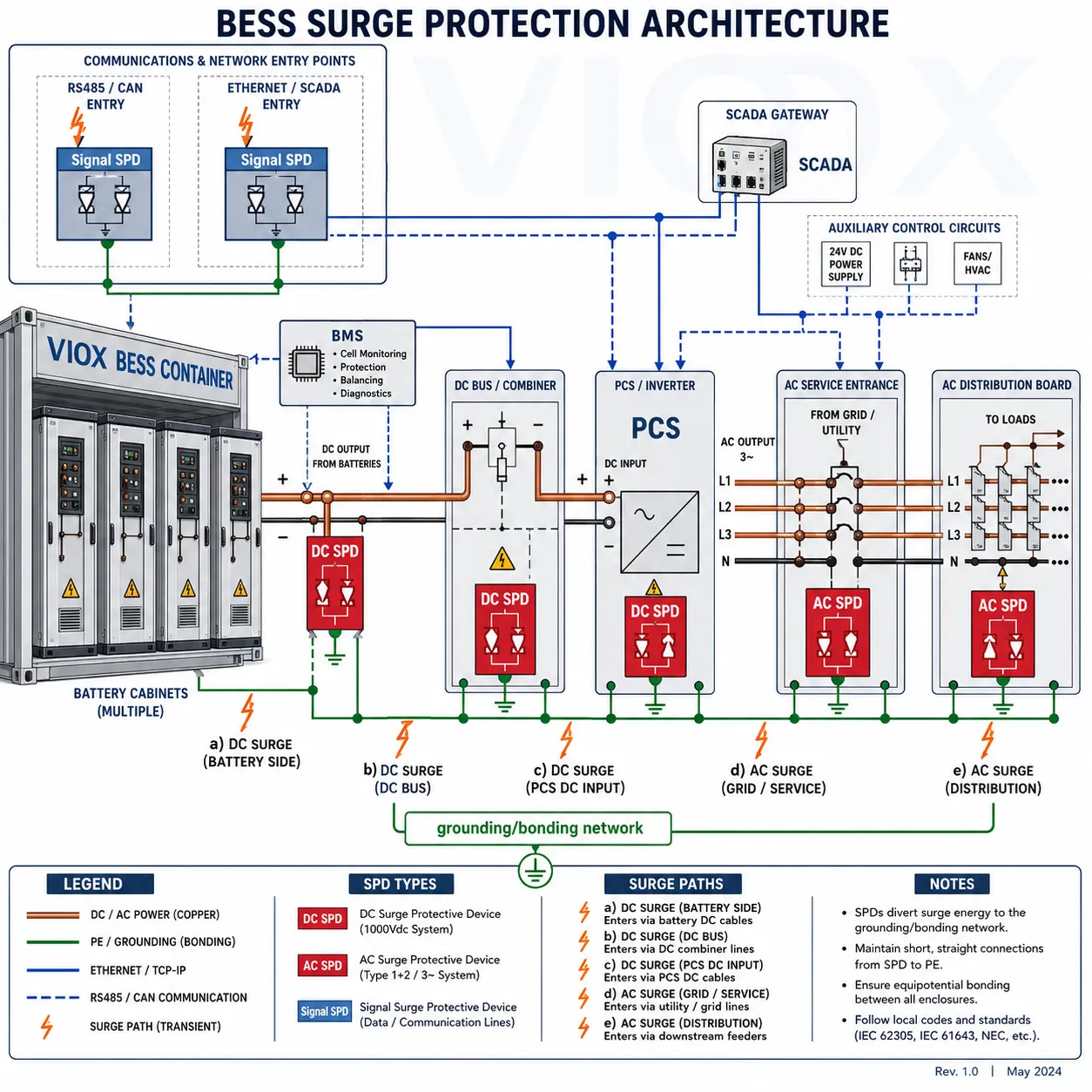
| BESS layer | What needs protection | Typical SPD category | Main selection concern |
|---|---|---|---|
| Battery cabinet DC output | Battery strings, DC output terminals, BMS electronics near the cabinet | دی سی SPD | Maximum DC voltage, grounding arrangement, short-circuit current, cabinet location |
| DC bus / DC combiner | DC collection point between battery cabinets and PCS/inverter | دی سی SPD | 1000 V or 1500 V DC class, fault current, protection mode, coordination |
| Inverter / PCS DC input | Power conversion electronics and DC input terminals | دی سی SPD | DC voltage, Up, connection mode, manufacturer warranty/installation requirements |
| PCS / inverter AC output | AC output terminals and downstream AC circuits | AC SPD | IEC 61643-11 or UL 1449, Type 1/2/3, Uc/MCOV, Up/VPR, SCCR |
| AC service entrance / grid connection | Point of common coupling, transformer secondary, main LV switchboard | AC SPD | Lightning exposure, overhead/underground supply, Type 1 or Type 1+2 requirement |
| AC distribution board | Auxiliary power, HVAC, lighting, controls, monitoring panels | AC SPD | Distribution-level Type 2 protection and coordination with upstream SPD |
| BMS / RS485 / CAN / dry contacts | Battery communication and alarm lines | Signal SPD | Operating voltage, data rate, capacitance, common-mode protection |
| Ethernet / SCADA / EMS | Monitoring and remote communication links | Network SPD | Ethernet speed, PoE if present, shield bonding, cabinet-to-cabinet routing |
The correct design is layered. Power SPDs protect energy paths. Signal SPDs protect communication paths. Neither one replaces the other.
Standards: IEC 61643-41, IEC 61643-31, IEC 61643-11, and IEC 61643-21
The standard depends on where the SPD is installed.
| SPD location | Primary standard direction | Important note |
|---|---|---|
| General DC BESS circuits | IEC 61643-41:2025 برای برقگیرهای (SPD) متصل به سیستمهای برق فشار ضعیف DC تا ۱۵۰۰ ولت DC | این مرجع دقیقتری برای باسبارهای DC در سیستمهای ذخیرهسازی انرژی باتری (BESS) و سایر سیستمهای برق فشار ضعیف DC است |
| مدارهای DC متصل به فتوولتائیک (PV) | استاندارد IEC 61643-31:2018 برای برقگیرهای (SPD) در سمت DC تاسیسات فتوولتائیک تا ۱۵۰۰ ولت DC | در مواردی استفاده شود که سیستم ذخیرهسازی مستقیماً با معماری DC فتوولتائیک کوپل شده است یا برقگیر (SPD) به عنوان حفاظت سمت DC فتوولتائیک مشخص شده باشد |
| سمت فشار ضعیف AC | استاندارد IEC 61643-11:2025 for SPDs connected to AC low-voltage power systems | Applies to AC distribution, inverter AC output, and grid-side AC protection in IEC markets |
| Signal and communication lines | کمیسیون مستقل انتخابات ۶۱۶۴۳-۲۱ family for telecommunications and signalling networks | Relevant for BMS communication, RS485, Ethernet, alarm circuits, and control interfaces |
| North American projects | استاندارد UL 1449 for power SPDs, plus interface-specific signal protection requirements | Check local codes, product listing, SCCR, and system integration requirements |
This distinction matters. IEC 61643-31 is specifically for photovoltaic DC installations. It is not the most precise blanket reference for every BESS DC bus. For a non-PV BESS DC power circuit, IEC 61643-41:2025 is the more directly aligned DC SPD standard direction. If the BESS is PV-coupled, hybrid, or shares PV DC architecture, IEC 61643-31 may still be relevant depending on the product and system design.
For standards comparison, see Surge Protection Standards: IEC 61643 vs UL 1449 vs GB 18802.
DC-Side Surge Protection for BESS
The DC side is often the most demanding part of BESS surge protection because the voltage may be high, the available fault current can be significant, and the system may run continuously.
1000 V and 1500 V DC Systems
Commercial and utility-scale BESS installations commonly use high-voltage DC buses. The SPD must match the maximum continuous operating voltage of the system.
فرض نکنید:
- a 1000 V DC SPD is suitable for a 1500 V DC BESS
- a PV SPD is automatically suitable for every battery DC system
- an AC SPD with a high kA rating can be used on the DC side
- یک ولتاژ نامی برای تمامی آرایشهای اتصال به زمین اعمال میشود
بررسی صحیح به شرح زیر است:
مقدار Uc / MCOV باید از حداکثر ولتاژ مستقیم (DC) مداومی که ممکن است در تمامی شرایط عملیاتی مورد انتظار در حالت حفاظتی SPD ظاهر شود، بیشتر باشد.
برای تفسیر ولتاژ نامی، به بخش زیر مراجعه کنید Uc و Up در یک SPD به چه معنا هستند؟.
اتصال به زمین DC و حالت حفاظتی
سیستمهای DC در سامانههای ذخیرهسازی انرژی باتری (BESS) میتوانند به صورت شناور، دارای مرجع امپدانسی، زمینشده از قطب منفی، زمینشده از قطب مثبت، یا پیکربندیشده بر اساس استراتژی پایش عایقی خاص سازنده (OEM) باشند. حالت اتصال SPD باید با آن معماری مطابقت داشته باشد.
| آرایش DC | منطق حفاظتی معمول SPD | هشدار انتخاب |
|---|---|---|
| باس DC شناور | بسته به طراحی، حفاظت ممکن است از DC+ به PE و از DC- به PE اعمال شود | پایش عایقی و نشتی/ظرفیت خازنی مجاز را بررسی کنید |
| باس DC با زمین منفی | حالت حفاظت متفاوت است زیرا یکی از قطبها از قبل مرجعگذاری شده است | نمودار SPD سیستم شناور را کورکورانه کپی نکنید |
| باس DC با زمین مثبت | Similar caution as negative-grounded systems, with opposite reference | Confirm polarity and manufacturer wiring diagram |
| PV-coupled DC architecture | PV-rated SPD may be required at PV combiner/inverter interfaces | Verify Ucpv, polarity, and IEC 61643-31 applicability |
| Containerized BESS with separated cabinets | Multiple protection points may be needed because cable runs act as coupling paths | Review cabinet spacing, cable routing, bonding, and lightning exposure |
If the system is solar-plus-storage, VIOX’s DC surge protection device guide is a useful supporting reference.
DC Installation Positions
| موقعیت | چرا مهم است | Typical selection focus |
|---|---|---|
| Battery cabinet DC output | Protects cabinet-side electronics and DC output terminals from incoming transients | DC voltage class, connection mode, short lead length, cabinet bonding |
| DC combiner or bus cabinet | Protects the common DC collection point between battery racks and PCS | Surge current level, SCCR, backup protection, coordination |
| PCS / inverter DC input | Protects power conversion electronics from transients on the DC cable run | Up, Uc, DC polarity, manufacturer installation requirements |
Do not set a universal rule such as “one SPD is always enough” or “two SPDs are always required.” The right number depends on cable length, cabinet separation, lightning risk, site layout, bonding system, and manufacturer instructions.
AC-Side Surge Protection for BESS
The AC side connects the BESS to the facility, transformer, microgrid, generator, or utility grid. Surges can arrive from the grid or be generated by switching operations inside the installation.
AC Service Entrance or Point of Common Coupling
At the grid connection or main low-voltage switchboard, use an AC SPD selected according to the site exposure and system voltage. In sites with overhead supply, external lightning protection systems, or high lightning exposure, Type 1 or Type 1+2 protection may be required. In lower-exposure underground-fed installations, Type 2 may be the practical distribution-level choice, subject to risk assessment and local code.
AC Distribution Board and Auxiliary Circuits
BESS containers and rooms often have auxiliary loads: HVAC, fire detection, lighting, monitoring, control power, heaters, fans, and communication power supplies. These circuits can be damaged or disrupted by AC-side transients even if the main PCS survives.
Type 2 SPDs are commonly used at distribution boards and auxiliary panels, but exact Imax/In values are project-dependent. A value such as 40 kA may be a common comparison point in some markets, but it should not be treated as a universal rule.
PCS / Inverter AC Output
The power conversion system’s AC terminals may need local protection depending on distance from the upstream SPD, cable routing, coordination, and manufacturer requirements.
For SPD type selection, see دستگاه محافظ ولتاژ نوع ۱ در مقابل نوع ۲ در مقابل نوع ۳.
Signal and Communication Surge Protection
Many BESS failures are not power-terminal failures. They are communication failures.
The BMS, energy management system (EMS), PCS controller, SCADA gateway, fire alarm interface, and remote monitoring equipment all depend on low-voltage signal paths. These lines may run between cabinets, containers, buildings, and outdoor equipment, making them vulnerable to common-mode surges.
BMS Communication Lines
BMS networks may use RS485, CAN, Ethernet, or proprietary communication. A signal SPD must match:
- nominal signal voltage
- maximum continuous operating voltage
- data rate
- line capacitance
- number of conductors or pairs
- روش اتصال شیلد (shield bonding)
- الزامات حفاظت در حالت مشترک (common-mode) و حالت تفاضلی (differential-mode)
یک برقگیر (SPD) با ظرفیت خازنی بالا میتواند کیفیت ارتباطات را کاهش دهد. برقگیری با ولتاژ کاری نامناسب ممکن است با تأخیر عمل کرده (clamp) یا در سیگنالهای عادی تداخل ایجاد کند.
لینکهای اترنت، اسکادا (SCADA) و سیستم مدیریت انرژی (EMS)
لینکهای اترنت نیازمند برقگیرهای شبکهای هستند که بر اساس نرخ داده مورد نیاز، نوع شیلد و وضعیت PoE (در صورت کاربرد) انتخاب شده باشند. اگر کابل اترنت از کانتینر BESS خارج شود یا بین سازههایی با سیستم اتصال زمین (bonding) مجزا کشیده شود، حفاظت باید در هر دو انتهای مسیر کابل در معرض خطر بررسی گردد.
خطوط آلارم، کنتاکتهای خشک (Dry Contact) و خطوط کنترل کمکی
کنتاکتهای خشک و مدارهای ورودی/خروجی دیجیتال اغلب به دلیل انتقال انرژی پایین نادیده گرفته میشوند. اما یک نوسان ولتاژ (surge) روی این هادیها میتواند وارد کارت ورودی کنترلر شده و باعث عملکرد کاذب یا خرابی سختافزاری شود.
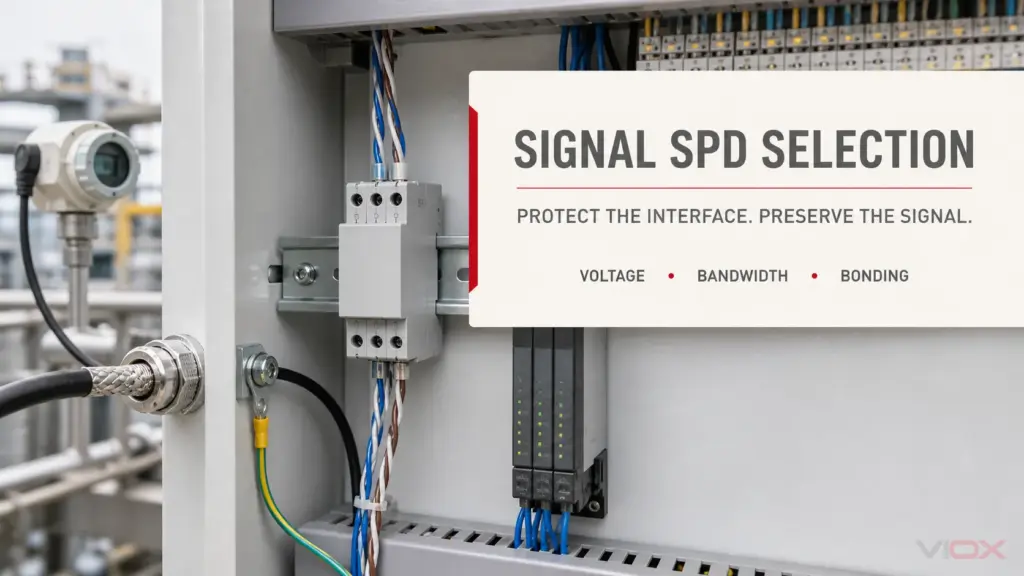
برای جزئیات انتخاب سیگنال، از VIOX استفاده کنید. Signal Surge Protector Selection Guide.
Key Ratings for BESS SPDs
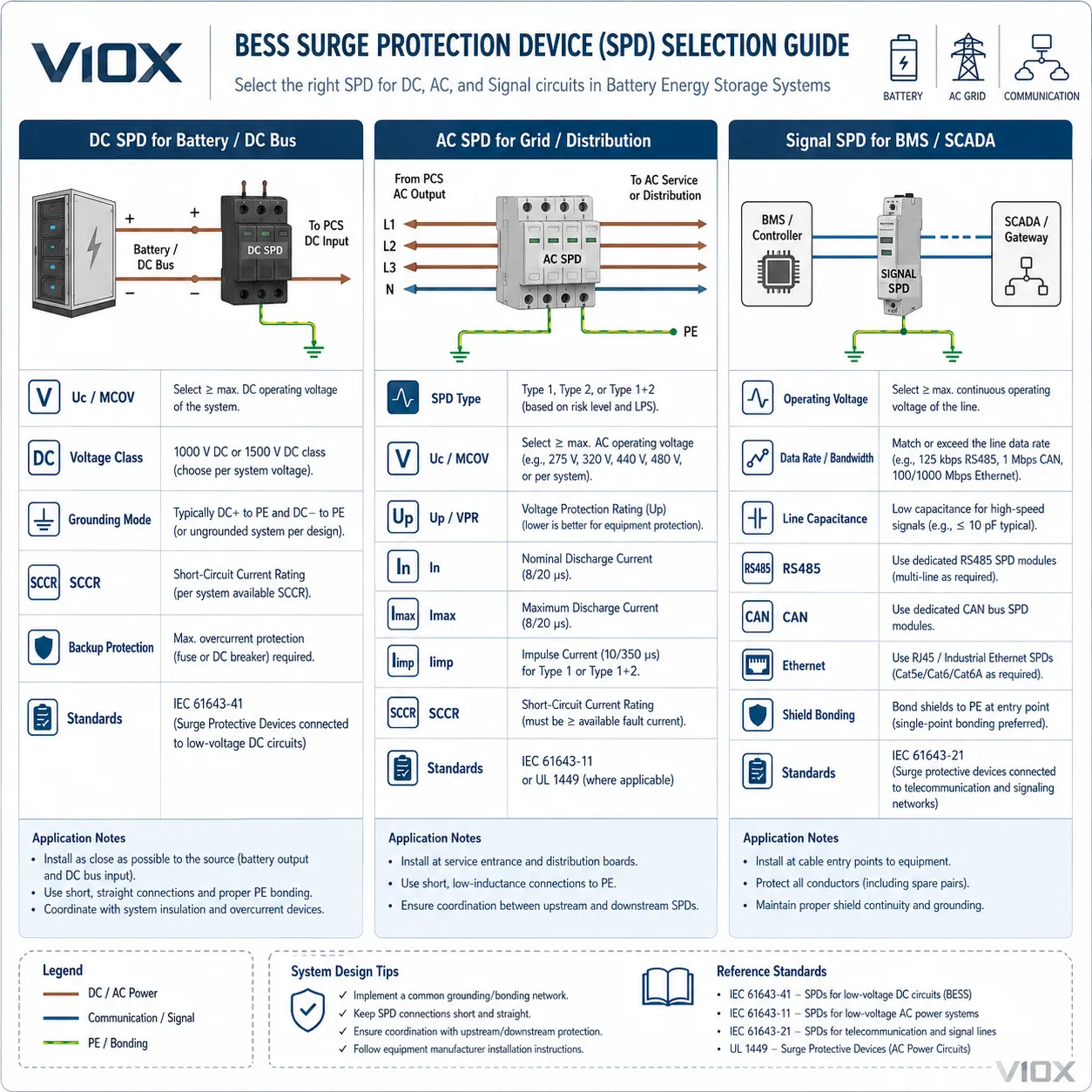
| رتبهبندی | Where it matters | چه چیزی را بررسی کنیم |
|---|---|---|
| Uc / MCOV | AC, DC, signal | Must match the real continuous voltage across the SPD mode |
| یو پی وی سی | PV-coupled DC side | Must exceed maximum PV string voltage where PV standard applies |
| Up / VPR | All protected equipment | Must be low enough for equipment withstand, including installation lead voltage |
| در | Type 2 repeated surge duty | Compare within same standard, type, and voltage class |
| آیمکس | Maximum 8/20 us current capability | Useful, but not a life-expectancy rating |
| آیمپ | Type 1 lightning-current duty | Relevant where direct lightning current or LPS risk exists |
| SCCR / short-circuit rating | Power SPDs | Must match available fault current and backup protection |
| فیوز یا کلید پشتیبان | Power SPDs | Follow manufacturer coordination table |
| Signal bandwidth / capacitance | BMS, Ethernet, RS485 | Must not disrupt communication |
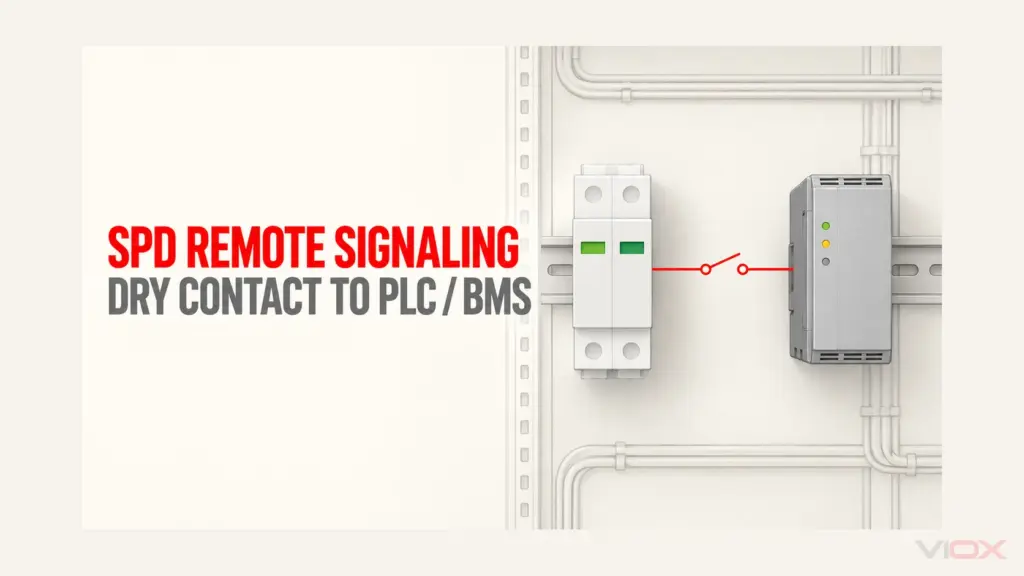
| سیگنالدهی از راه دور | BESS O&M | Helps detect failed SPD modules before the next surge event |
For current-rating interpretation, see رتبهبندی Imax در مقابل In برای دستگاههای محافظت در برابر نوسانات برق. For MOV aging and end-of-life behavior, see ZnO MOV Explained.
BESS SPD Selection by Installation Position
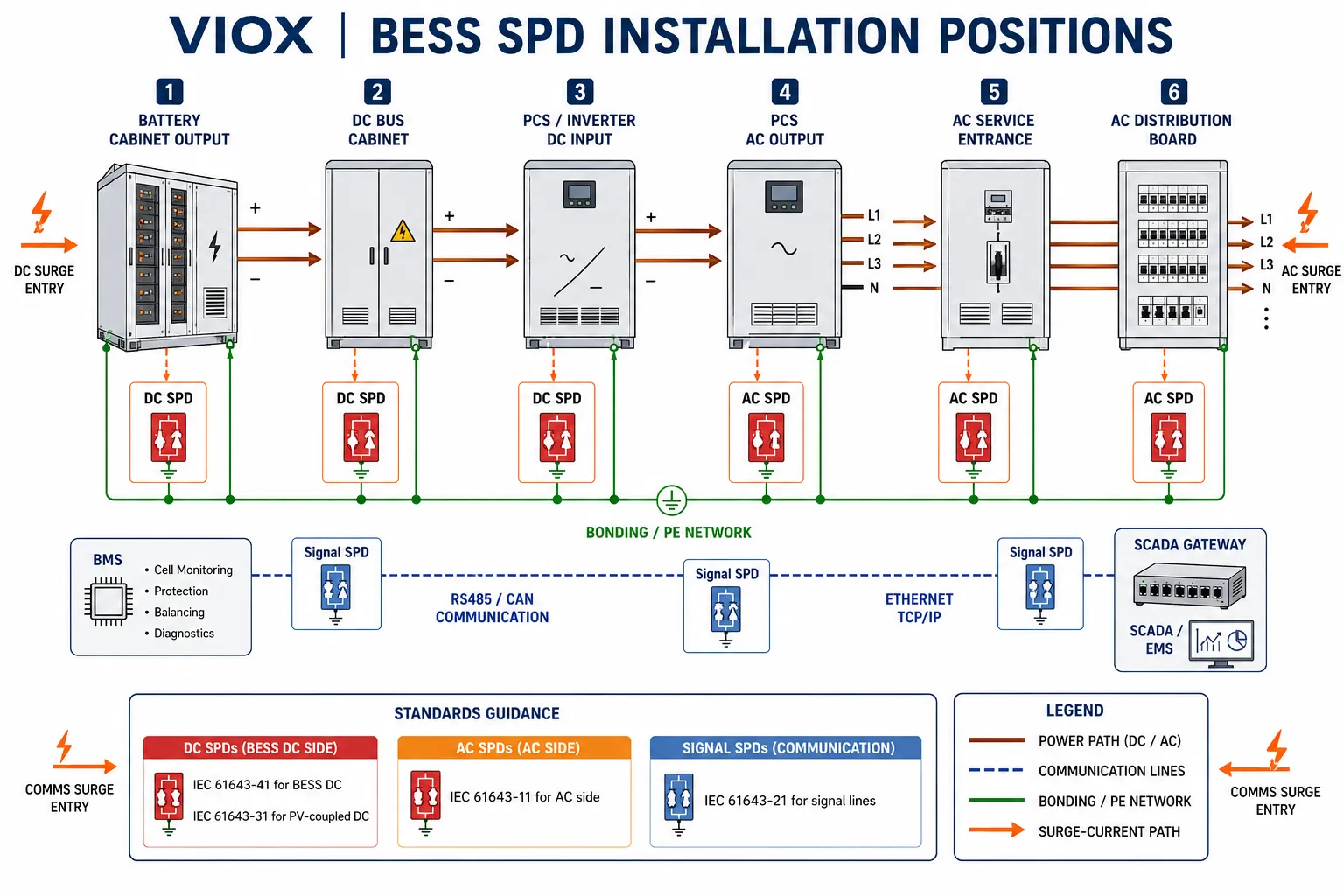
| موقعیت نصب | SPD type direction | Standard direction | Main checks |
|---|---|---|---|
| Battery cabinet DC output | دی سی SPD | IEC 61643-41 for BESS-only DC; IEC 61643-31 if PV DC side applies | Uc/MCOV, grounding mode, SCCR, backup protection, short lead length |
| DC combiner / DC bus cabinet | دی سی SPD | IEC 61643-41 or project-specific DC SPD basis | 1000/1500 V DC class, fault current, coordination, enclosure bonding |
| PCS / inverter DC input | دی سی SPD | IEC 61643-41 or IEC 61643-31 depending on architecture | Up, Uc, polarity, manufacturer instructions |
| AC service entrance / PCC | Type 1, Type 2, or Type 1+2 AC SPD | IEC 61643-11 or UL 1449 | Supply type, lightning exposure, Uc, Up, Iimp/In/Imax, SCCR |
| AC distribution board | Type 2 AC SPD | IEC 61643-11 or UL 1449 | Distribution voltage, auxiliary loads, coordination, remote indication |
| PCS AC output | Type 2 or coordinated local AC SPD | IEC 61643-11 or UL 1449 | Distance from upstream SPD, cable routing, PCS manual |
| BMS RS485 / CAN lines | Signal SPD | IEC 61643-21 family | Signal voltage, capacitance, data rate, shield bonding |
| Ethernet / SCADA / EMS | Network SPD | IEC 61643-21 family or interface-specific standard | Ethernet speed, PoE, shielded/unshielded cable, cabinet-to-cabinet exposure |
SPD + DC Protection + Grounding: The System View
BESS surge protection is not a standalone accessory. It must work with the rest of the protection architecture.
A robust design reviews:
- DC fuses or DC circuit breakers for overcurrent and short-circuit protection
- DC disconnects or isolators for maintenance isolation
- grounding and bonding layout
- equipotential bonding between cabinets and containers
- cable routing and separation
- SPD backup protection
- signal and communication line protection
- remote monitoring of SPD status
- maintenance and replacement access
For adjacent DC protection, see VIOX’s guide to DC circuit breakers for solar, battery, and EV systems and the comparison of DC circuit breaker vs fuse.
Common BESS Surge Protection Mistakes
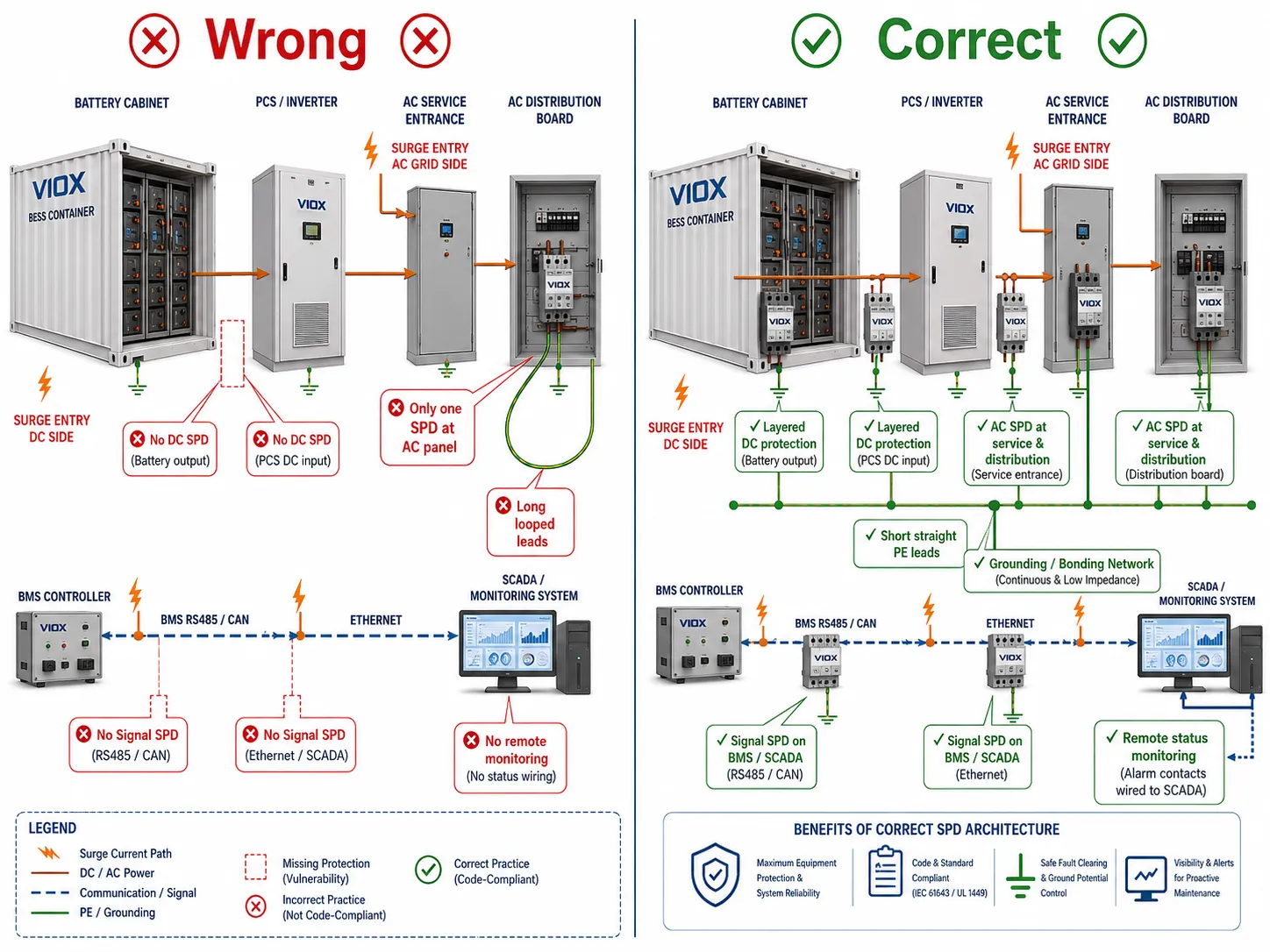
| اشتباه | ریسک | Better practice |
|---|---|---|
| Installing only one SPD | DC, AC, or signal paths remain exposed | Protect by system layer: DC, AC, and communication |
| Using PV DC SPD automatically for all BESS DC buses | Standard or fault assumptions may not match | Use IEC 61643-41 for BESS-only DC, IEC 61643-31 where PV DC applies |
| Choosing by Imax only | Voltage protection, SCCR, grounding, and installation may be wrong | Check Uc, Up, In/Imax/Iimp, SCCR, backup protection, and mode |
| Ignoring BMS signal lines | Communication failure or false shutdown | Protect RS485, CAN, Ethernet, dry contacts, and exposed control lines |
| Ignoring grounding mode | SPD may be connected in the wrong mode | Confirm floating, grounded, impedance-referenced, or PV-coupled architecture |
| Long SPD leads | Actual let-through voltage rises above expected Up | Keep SPD connections short and direct |
| No remote indication | Failed SPD modules remain unnoticed | Use visual and remote signaling for critical BESS installations |
| No coordination with DC breakers or fuses | Fault behavior may be unsafe or non-selective | Follow SPD manufacturer backup protection and system protection study |
سوالات متداول
Does a BESS need surge protection on both DC and AC sides?
Yes, in most engineered systems both sides should be reviewed. The DC side protects battery and PCS interfaces, while the AC side protects grid connection, distribution, auxiliary circuits, and PCS AC terminals. Signal lines should also be reviewed separately.
What standard applies to DC SPDs for BESS?
For BESS-only DC low-voltage power systems, IEC 61643-41:2025 is the most directly aligned IEC standard direction. For PV-coupled DC-side protection, IEC 61643-31 may apply. Always verify the product standard, system architecture, and manufacturer documentation.
Can I use a PV SPD on a BESS DC bus?
Only if the SPD is rated and approved by the manufacturer for that BESS DC application. PV SPDs are designed for photovoltaic DC conditions. A BESS-only DC bus may require a DC SPD evaluated under a different standard basis such as IEC 61643-41.
Is a 40 kA SPD enough for BESS?
There is no universal kA value. A rating such as 40 kA may be a common starting point for some Type 2 SPD comparisons, but the correct selection depends on lightning exposure, SPD type, voltage class, grounding, cable length, installation location, and risk assessment.
Where should SPDs be installed in a BESS?
Typical review points include battery cabinet DC output, DC combiner or DC bus cabinet, PCS/inverter DC input, AC service entrance, AC distribution board, PCS AC output, RS485/CAN BMS communication lines, Ethernet/SCADA links, and auxiliary control circuits.
Do BMS communication lines really need surge protection?
Often yes, especially where communication cables run between cabinets, containers, buildings, or outdoor equipment. A signal surge can trip or damage the BMS even if the power circuit is protected.
What matters most when selecting signal SPDs for BESS?
Match the SPD to the signal voltage, data rate, capacitance limit, number of wires, grounding method, shield bonding, and interface type. A power SPD cannot protect a communication port.
Does surge protection replace DC fuses or DC breakers?
No. SPDs limit transient overvoltage. DC fuses and DC circuit breakers handle overcurrent and short-circuit protection. A BESS protection design usually needs both.
نتيجه گيری
BESS surge protection is a system design task, not a single-product selection. The DC side, AC side, and communication network all create surge entry paths, and each layer needs a suitable SPD type, voltage rating, protection level, grounding arrangement, and installation method.
For VIOX customers, the practical design logic is:
- use DC SPDs for battery and PCS DC interfaces
- از برقگیرهای (SPD) جریان متناوب (AC) برای شبکه، خروجی AC اینورتر و تابلوهای توزیع استفاده کنید.
- از برقگیرهای سیگنال برای سیستمهای مدیریت ساختمان (BMS)، RS485، اترنت، اسکادا (SCADA) و خطوط کنترلی استفاده کنید.
- برقگیرها را با کلیدهای محافظ DC، فیوزها، سیستم زمین (ارتینگ)، همبندی و پایش نگهداری هماهنگ کنید.
اگر در حال گذار از مرحله طراحی سیستم به انتخاب محصول هستید، با ... شروع کنید. VIOX SPD product page هر مدل را با ولتاژ دقیق سیستم ذخیرهسازی انرژی باتری (BESS)، جریان خطا، استاندارد، رابط ارتباطی و موقعیت نصب مطابقت دهید.
Sources Reviewed
- استاندارد IEC 61643-41:2025 – برقگیرهای متصل به سیستمهای قدرت جریان مستقیم (DC) ولتاژ پایین
- IEC 61643-31:2018 – برقگیرها (SPD) برای تاسیسات فتوولتائیک
- استاندارد IEC 61643-21:2000+A1:2008+A2:2012 – برقگیرهای مورد استفاده در شبکههای مخابراتی و سیگنالینگ
- استاندارد IEC 61643-11:2025 – برقگیرهای متصل به سیستمهای قدرت جریان متناوب (AC) ولتاژ پایین