Auf dieser Seite
Kurze Antwort
Der Überspannungsschutz für ein Batteriespeichersystem (BESS) sollte drei Ebenenabdecken: die DC-Seite zwischen den Batterieschränken und dem Wechselrichtersystem, die AC-Seite an das Netz oder die Lastverteilung angeschlossen, und die Kommunikations-/Signalleitungen die vom Batteriemanagementsystem, SCADA, Ethernet, RS485 und Hilfssteuerungen verwendet werden.
Ein BESS ist nicht durch die Installation eines einzigen Überspannungsschutzgeräts (SPD) an einem Schaltschrank geschützt. Es erfordert eine koordinierte Schutzarchitektur: DC-SPDs an Batterie- und Wechselrichterschnittstellen, AC-SPDs an Netz- und Verteilungspunkten sowie Signal-SPDs überall dort, wo Steuer- oder Kommunikationskabel in Schränke eingeführt oder aus diesen herausgeführt werden.
Warum der Überspannungsschutz bei BESS anders ist
Batteriespeichersysteme kombinieren hohe DC-Spannungen, Leistungselektronik, verteilte Schaltschränke, lange Kabelwege, Kommunikationsnetzwerke und Netzanschlussgeräte in einer einzigen Anlage. Dies schafft mehr Eintrittspunkte für Überspannungen als bei einer typischen Niederspannungsverteilung.
Überspannungen können durch Folgendes eindringen oder entstehen:
- blitzinduzierte Transienten auf externen DC- und AC-Kabeln
- netzseitige Schaltvorgänge und Transformator-Einschaltvorgänge
- Schaltvorgänge von Wechselrichtern und Leistungsumwandlungssystemen
- Betrieb von Schützen und DC-Leistungsschaltern in Batteriestromkreisen
- lange Kommunikationskabel zwischen Batterie-Racks, BMS, PCS, EMS und SCADA
- Erdpotenzialunterschiede zwischen Schaltschränken, Containern, Gebäuden und externen Anlagen
Das praktische Risiko besteht nicht nur in physischen Schäden. Ein Überspannungsereignis kann zudem das Batteriemanagementsystem (BMS) stören, eine Schutzabschaltung auslösen, die Kommunikation beeinträchtigen, Überwachungsanschlüsse beschädigen oder das Energiespeichersystem offline schalten, selbst wenn die Batteriemodule selbst keine sichtbaren Schäden aufweisen.
Für die grundlegenden Gerätekonzepte siehe den Leitfaden von VIOX zu was ein Überspannungsschutzgerät ist. Dieser Artikel konzentriert sich speziell auf die Platzierung und Auswahl von BESS auf Systemebene.
BESS-Überspannungsschutzarchitektur
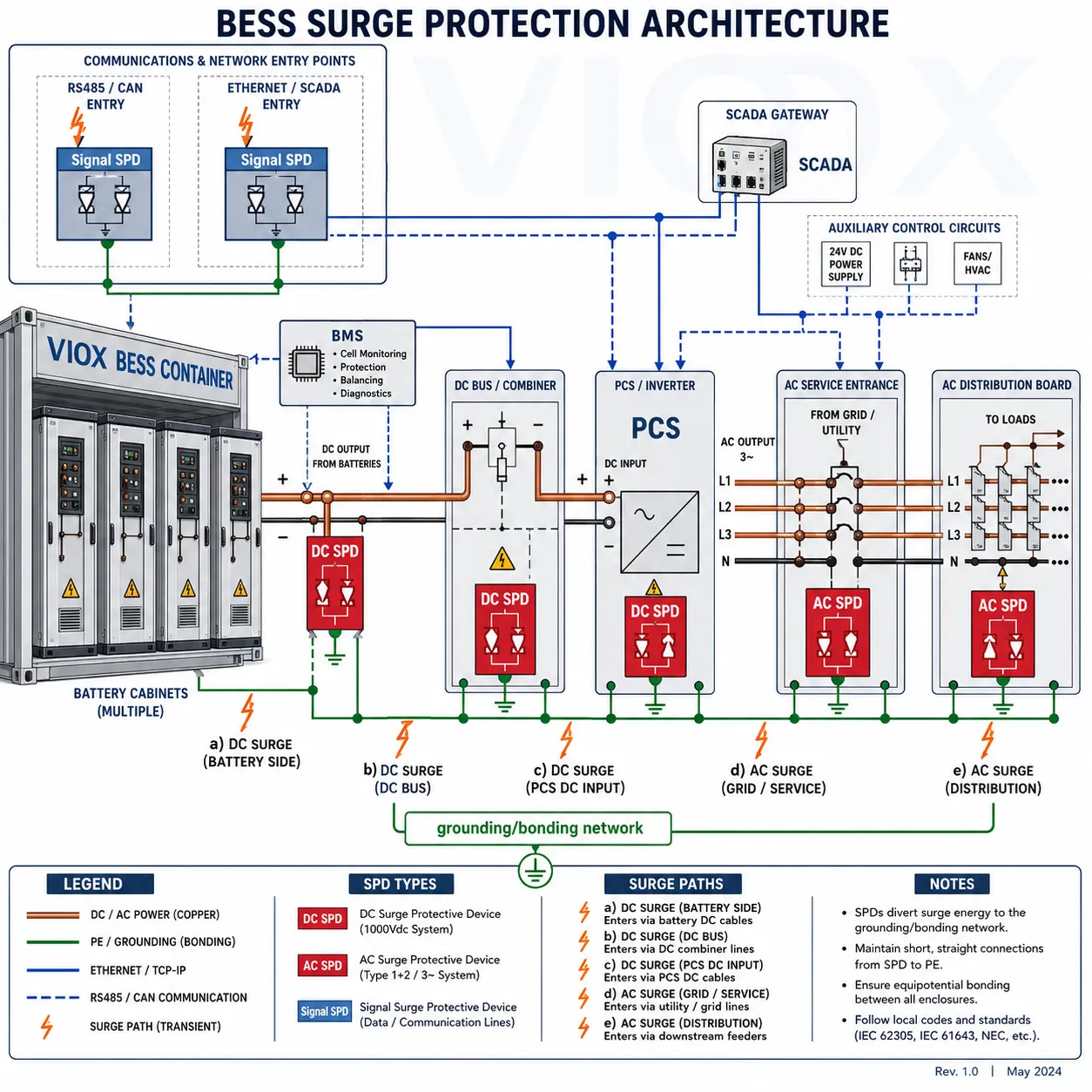
| BESS-Ebene | Was geschützt werden muss | Typische SPD-Kategorie | Hauptaspekt bei der Auswahl |
|---|---|---|---|
| DC-Ausgang des Batterieschranks | Batteriestränge, DC-Ausgangsklemmen, BMS-Elektronik in Schranknähe | DC SPD | Maximale DC-Spannung, Erdungskonzept, Kurzschlussstrom, Schrankstandort |
| DC-Sammelschiene / DC-Kombinierer | DC-Sammelpunkt zwischen Batterieschränken und PCS/Wechselrichter | DC SPD | 1000 V oder 1500 V DC-Klasse, Fehlerstrom, Schutzart, Koordination |
| Wechselrichter / PCS DC-Eingang | Leistungselektronik und DC-Eingangsklemmen | DC SPD | DC-Spannung, Up, Anschlussart, Herstellergarantie/Installationsanforderungen |
| PCS / Wechselrichter AC-Ausgang | AC-Ausgangsklemmen und nachgeschaltete AC-Stromkreise | AC SPD | IEC 61643-11 oder UL 1449, Typ 1/2/3, Uc/MCOV, Up/VPR, SCCR |
| AC-Netzeinspeisung / Netzanschluss | Verknüpfungspunkt, Transformator-Sekundärseite, Hauptniederspannungsschaltanlage | AC SPD | Blitzgefährdung, Freileitungs-/Erdkabelversorgung, Anforderung Typ 1 oder Typ 1+2 |
| AC-Verteiler | Hilfsstromversorgung, HLK, Beleuchtung, Steuerungen, Überwachungstafeln | AC SPD | Schutz Typ 2 auf Verteilungsebene und Koordination mit vorgeschaltetem SPD |
| BMS / RS485 / CAN / potenzialfreie Kontakte | Batteriekommunikations- und Alarmleitungen | Signal-Überspannungsschutzgerät (SPD) | Betriebsspannung, Datenrate, Kapazität, Gleichtaktschutz |
| Ethernet / SCADA / EMS | Überwachungs- und Fernkommunikationsverbindungen | Netzwerk-SPD | Ethernet-Geschwindigkeit, PoE falls vorhanden, Schirmanschluss, Schrank-zu-Schrank-Verkabelung |
Das korrekte Design ist schichtweise aufgebaut. Leistungs-Überspannungsschutzgeräte (SPDs) schützen Energiepfade. Signal-Überspannungsschutzgeräte schützen Kommunikationspfade. Keines ersetzt das andere.
Normen: IEC 61643-41, IEC 61643-31, IEC 61643-11 und IEC 61643-21
Die Norm hängt vom Installationsort des SPD ab.
| SPD-Standort | Primäre Normausrichtung | Wichtiger Hinweis |
|---|---|---|
| Allgemeine DC-BESS-Stromkreise | IEC 61643-41:2025 für Überspannungsschutzgeräte (SPDs), die an DC-Niederspannungsstromversorgungssysteme bis 1500 V DC angeschlossen sind | Dies ist die genauere Referenz für reine BESS-DC-Sammelschienen und andere DC-Niederspannungsstromversorgungssysteme |
| PV-gekoppelte DC-Stromkreise | IEC 61643-31:2018 für Überspannungsschutzgeräte (SPDs) auf der DC-Seite von Photovoltaikanlagen bis 1500 V DC | Verwendung, wenn das Speichersystem direkt mit der PV-DC-Architektur gekoppelt ist oder das SPD als Schutz für die PV-DC-Seite spezifiziert ist |
| AC-Niederspannungsseite | IEC 61643-11:2025 für Überspannungsschutzgeräte (SPD) in AC-Niederspannungsnetzen | Gilt für AC-Verteilungen, AC-Wechselrichterausgänge und netzseitigen AC-Schutz in IEC-Märkten |
| Signal- und Kommunikationsleitungen | IEC 61643-21 Produktfamilie für Telekommunikations- und Signalnetzwerke | Relevant für BMS-Kommunikation, RS485, Ethernet, Alarmstromkreise und Steuerschnittstellen |
| Nordamerikanische Projekte | UL 1449 für Leistungs-SPDs sowie schnittstellenspezifische Anforderungen an den Signalschutz | Lokale Vorschriften, Produktzulassungen, SCCR und Anforderungen an die Systemintegration prüfen |
Diese Unterscheidung ist wichtig. Die IEC 61643-31 ist spezifisch für Photovoltaik-Gleichstrominstallationen ausgelegt. Sie ist nicht die präziseste allgemeine Referenz für jeden BESS-Gleichstrombus. Für einen BESS-Gleichstromkreis ohne PV-Bezug ist die IEC 61643-41:2025 die direkter ausgerichtete Norm für DC-Überspannungsschutzgeräte (SPD). Wenn das BESS PV-gekoppelt oder hybrid ist oder eine PV-Gleichstromarchitektur nutzt, kann die IEC 61643-31 je nach Produkt- und Systemdesign weiterhin relevant sein.
Für einen Normenvergleich siehe Überspannungsschutz-Normen: IEC 61643 vs. UL 1449 vs. GB 18802.
DC-seitiger Überspannungsschutz für BESS
Die Gleichstromseite ist oft der anspruchsvollste Teil des BESS-Überspannungsschutzes, da die Spannung hoch sein kann, der verfügbare Fehlerstrom erheblich sein kann und das System kontinuierlich betrieben wird.
1000 V und 1500 V DC-Systeme
Kommerzielle und industrielle BESS-Installationen verwenden üblicherweise Hochspannungs-Gleichstrombusse. Das SPD muss auf die maximale Dauerspannung des Systems abgestimmt sein.
Gehen Sie nicht davon aus:
- ein 1000 V DC-SPD ist für ein 1500 V DC-BESS geeignet
- ein PV-SPD ist automatisch für jedes Batterie-Gleichstromsystem geeignet
- ein AC-SPD mit hoher kA-Bemessung kann auf der Gleichstromseite verwendet werden
- Eine Nennspannung gilt für alle Erdungskonfigurationen
Die korrekte Prüfung lautet:
Uc / MCOV muss die maximale kontinuierliche Gleichspannung überschreiten, die unter allen zu erwartenden Betriebsbedingungen am SPD-Schutzmodus anliegen kann.
Zur Interpretation der Nennspannung siehe Was bedeuten Uc und Up bei einem SPD?.
DC-Erdung und Schutzmodus
BESS-Gleichstromsysteme können erdfrei, impedanzreferenziert, negativ geerdet, positiv geerdet oder gemäß einer OEM-spezifischen Isolationsüberwachungsstrategie konfiguriert sein. Der SPD-Anschlussmodus muss dieser Architektur entsprechen.
| DC-Anordnung | Typische SPD-Schutzlogik | Auswahlwarnung |
|---|---|---|
| Potenzialfreier DC-Zwischenkreis | Der Schutz kann je nach Auslegung zwischen DC+ gegen PE und DC- gegen PE erfolgen | Isolationsüberwachung sowie zulässige Ableitströme/Kapazitäten prüfen |
| Negativ geerdeter DC-Zwischenkreis | Der Schutzmodus unterscheidet sich, da ein Pol bereits ein Bezugspotenzial hat | Schaltpläne für SPD in IT-Systemen nicht blind übernehmen |
| Positiv geerdeter DC-Zwischenkreis | Ähnliche Vorsichtsmaßnahmen wie bei negativ geerdeten Systemen, jedoch mit umgekehrtem Bezugspotenzial | Polarität und Schaltplan des Herstellers überprüfen |
| PV-gekoppelte DC-Architektur | PV-geeigneter SPD an den Schnittstellen von PV-Generatoranschlusskasten/Wechselrichter möglicherweise erforderlich | Ucpv, Polarität und Anwendbarkeit der IEC 61643-31 verifizieren |
| Container-BESS mit getrennten Schaltschränken | Mehrere Schutzpunkte können erforderlich sein, da Kabelwege als Kopplungspfade fungieren | Schrankabstände, Kabelführung, Potenzialausgleich und Blitzexponierung überprüfen |
Wenn es sich um ein Solar-plus-Speicher-System handelt, ist VIOX’s für DC-Überspannungsschutzgeräte eine nützliche Referenz.
DC-Installationspositionen
| Position | Warum es wichtig ist | Typischer Auswahlfokus |
|---|---|---|
| DC-Ausgang des Batterieschranks | Schützt die schrankseitige Elektronik und die DC-Ausgangsklemmen vor eingehenden Transienten | DC-Spannungsklasse, Anschlussart, kurze Leitungslänge, Schrankerdung |
| DC-Kombinierer- oder Sammelschienenschrank | Schützt den gemeinsamen DC-Sammelpunkt zwischen Batterie-Racks und PCS | Stoßstrompegel, SCCR, Vorsicherung, Koordination |
| PCS / Wechselrichter DC-Eingang | Schützt die Leistungselektronik vor Transienten auf der DC-Leitung | Up, Uc, DC-Polarität, Installationsvorgaben des Herstellers |
Stellen Sie keine allgemeingültige Regel auf, wie “ein SPD reicht immer aus” oder “zwei SPDs sind immer erforderlich”. Die richtige Anzahl hängt von der Leitungslänge, der Schranktrennung, dem Blitzrisiko, dem Anlagenlayout, dem Erdungssystem und den Herstelleranweisungen ab.
AC-seitiger Überspannungsschutz für BESS
Die AC-Seite verbindet das BESS mit der Anlage, dem Transformator, dem Microgrid, dem Generator oder dem Versorgungsnetz. Überspannungen können aus dem Netz eindringen oder durch Schaltvorgänge innerhalb der Installation entstehen.
AC-Hauseinführung oder Punkt der gemeinsamen Einspeisung (PCC)
Verwenden Sie am Netzanschlusspunkt oder in der Niederspannungs-Hauptverteilung einen AC-Überspannungsableiter (SPD), der entsprechend der Standortbelastung und der Systemspannung ausgewählt wurde. An Standorten mit Freileitungsversorgung, externen Blitzschutzsystemen oder hoher Blitzgefährdung kann ein Schutz vom Typ 1 oder Typ 1+2 erforderlich sein. Bei erdverkabelten Anlagen mit geringerer Gefährdung kann ein Typ 2 die zweckmäßige Wahl für die Verteilungsebene sein, vorbehaltlich einer Risikobewertung und lokaler Vorschriften.
AC-Verteiler und Hilfsstromkreise
BESS-Container und -Räume verfügen häufig über Hilfslasten: HLK, Brandmeldeanlagen, Beleuchtung, Überwachung, Steuerstromversorgung, Heizungen, Lüfter und Kommunikationsnetzteile. Diese Stromkreise können durch transiente Überspannungen auf der AC-Seite beschädigt oder gestört werden, selbst wenn das Haupt-PCS unbeschadet bleibt.
Typ 2-Überspannungsableiter werden üblicherweise in Verteilern und Hilfsschalttafeln eingesetzt, wobei die genauen Imax/In-Werte projektabhängig sind. Ein Wert von 40 kA mag in einigen Märkten als gängiger Vergleichswert dienen, sollte jedoch nicht als allgemeingültige Regel betrachtet werden.
PCS / AC-Ausgang des Wechselrichters
Die AC-Anschlüsse des Leistungsumwandlungssystems (PCS) erfordern möglicherweise einen lokalen Schutz, abhängig vom Abstand zum vorgeschalteten Überspannungsableiter, der Leitungsführung, der Koordination und den Anforderungen des Herstellers.
Zur Auswahl des SPD-Typs siehe Überspannungsschutzgerät Typ 1 vs. Typ 2 vs. Typ 3.
Überspannungsschutz für Signal- und Kommunikationsleitungen
Viele BESS-Ausfälle sind keine Ausfälle der Leistungsklemmen, sondern Kommunikationsfehler.
Das BMS, das Energiemanagementsystem (EMS), der PCS-Controller, das SCADA-Gateway, die Brandmeldeschnittstelle und die Fernüberwachungsgeräte sind alle auf Niederspannungs-Signalwege angewiesen. Diese Leitungen können zwischen Schaltschränken, Containern, Gebäuden und Außengeräten verlaufen, wodurch sie anfällig für Gleichtakt-Überspannungen sind.
BMS-Kommunikationsleitungen
BMS-Netzwerke können RS485, CAN, Ethernet oder proprietäre Kommunikationsprotokolle verwenden. Ein Signal-Überspannungsschutzgerät (SPD) muss auf Folgendes abgestimmt sein:
- Nennsignalspannung
- maximale Dauerspannung
- Datenrate
- Leitungskapazität
- Anzahl der Leiter oder Adernpaare
- Schirmanschlussmethode
- Anforderungen an den Gleichtakt- und Gegentaktschutz
Ein SPD mit hoher Kapazität kann die Kommunikation beeinträchtigen. Ein SPD mit falscher Betriebsspannung löst möglicherweise zu spät aus oder stört normale Signale.
Ethernet-, SCADA- und EMS-Verbindungen
Für Ethernet-Verbindungen müssen Netzwerk-SPDs ausgewählt werden, die für die erforderliche Datenrate, den Schirmtyp und gegebenenfalls den PoE-Status geeignet sind. Wenn ein Ethernet-Kabel einen BESS-Container verlässt oder zwischen getrennt geerdeten Strukturen verläuft, sollte der Schutz an beiden Enden der exponierten Kabelführung überprüft werden.
Alarm-, potenzialfreie Kontakt- und Hilfssteuerleitungen
Potenzialfreie Kontakte und digitale E/A-Schaltkreise werden oft übersehen, da sie nur eine geringe Energie führen. Ein Überspannungsimpuls auf diesen Leitern kann jedoch in eine Steuerungseingangskarte gelangen und eine Fehlauslösung oder einen Hardwaredefekt verursachen.
Für Details zur Signalauswahl verwenden Sie bitte VIOX’s Auswahlhilfe für Signal-Überspannungsschutzgeräte.
Wichtige Kenndaten für BESS-Überspannungsschutzgeräte (SPD)
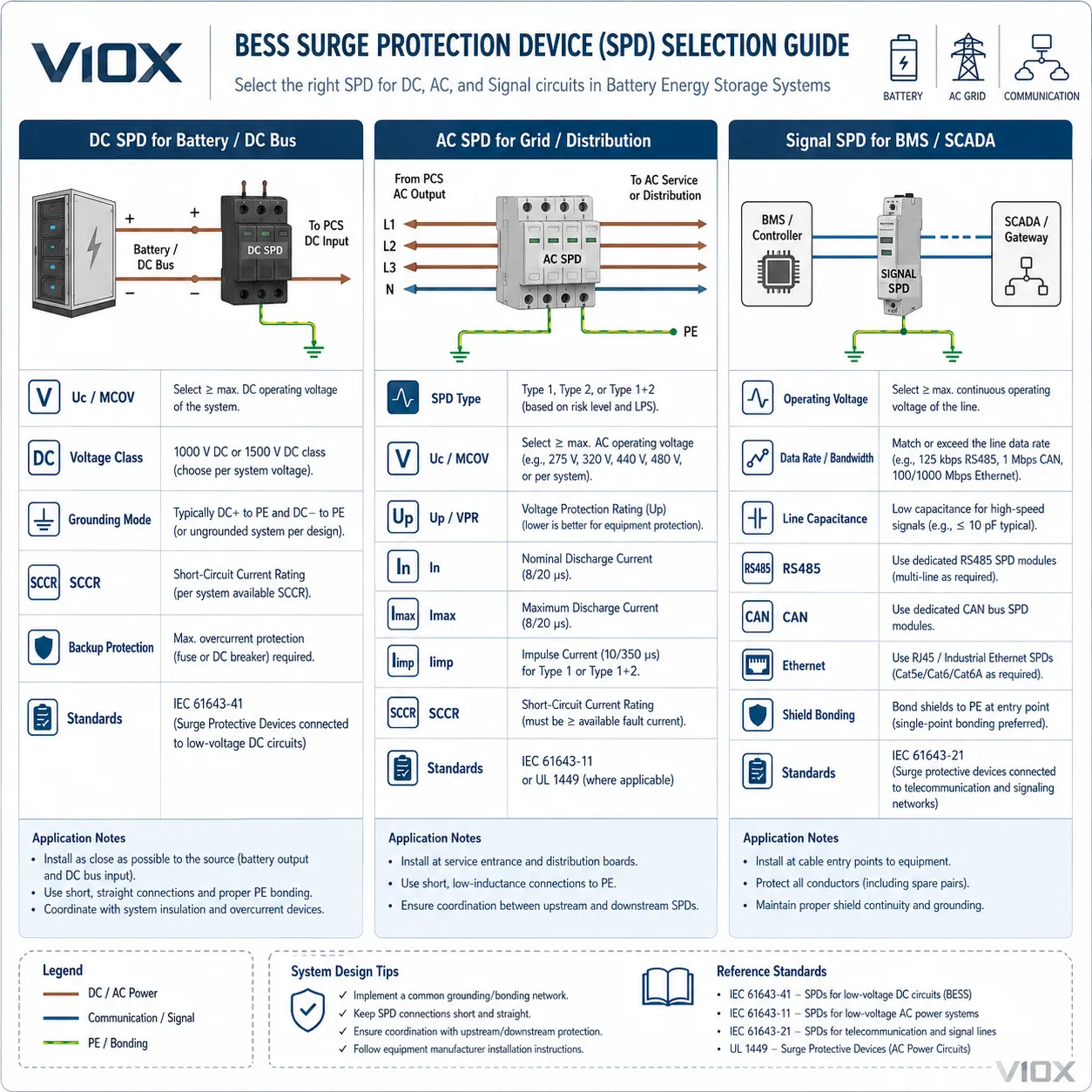
| Bewertung | Einsatzbereiche | Was ist zu überprüfen? |
|---|---|---|
| Uc / MCOV (Maximale Dauerspannung) | AC, DC, Signal | Muss der tatsächlichen Dauerspannung über dem SPD-Modus entsprechen |
| Ucpv | PV-gekoppelte DC-Seite | Muss die maximale PV-Stringspannung überschreiten, sofern die PV-Norm Anwendung findet |
| Up / VPR | Alle geschützten Betriebsmittel | Muss niedrig genug für die Spannungsfestigkeit der Betriebsmittel sein, einschließlich der Leitungsinduktivität der Installation |
| Unter | Typ 2 wiederholte Stoßstrombelastung | Vergleich innerhalb derselben Norm, desselben Typs und derselben Spannungsklasse |
| Imax | Maximale 8/20 µs Stromtragfähigkeit | Nützlich, aber keine Angabe zur Lebensdauer |
| Iimp | Typ 1 Blitzstrombelastung | Relevant, wo ein Risiko durch direkten Blitzeinschlag oder ein Blitzschutzsystem (LPS) besteht |
| SCCR / Kurzschlussfestigkeit | Überspannungsschutzgeräte (SPD) für die Stromversorgung | Muss auf den verfügbaren Kurzschlussstrom und den Vorsicherungsschutz abgestimmt sein |
| Vorsicherung / Leitungsschutzschalter | Überspannungsschutzgeräte (SPD) für die Stromversorgung | Hersteller-Koordinierungstabelle beachten |
| Signalbandbreite / Kapazität | BMS, Ethernet, RS485 | Darf die Kommunikation nicht beeinträchtigen |
| Fernsignalisierung | BESS Betrieb und Wartung (O&M) | Hilft bei der Erkennung defekter SPD-Module vor dem nächsten Überspannungsereignis |
Zur Interpretation der Nennstromstärke siehe Imax-vs Bewertungen für Surge Schutz Geräte. Zum Alterungsverhalten und Lebensdauerende von MOV siehe ZnO-MOV erklärt.
Auswahl von BESS-Überspannungsschutzgeräten (SPD) nach Installationsort
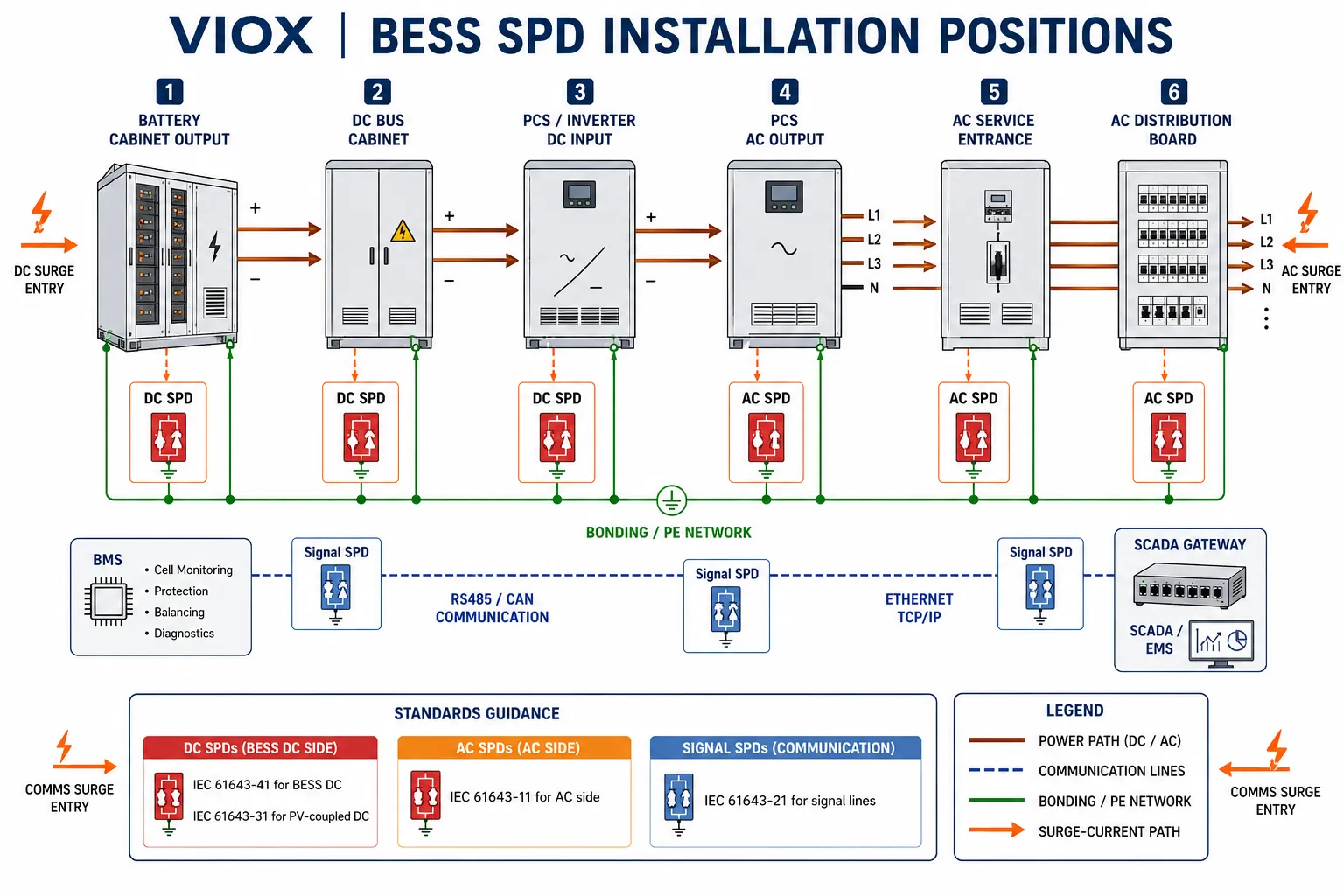
| Einbaulage | SPD-Typ-Ausrichtung | Standardausrichtung | Hauptprüfungen |
|---|---|---|---|
| DC-Ausgang des Batterieschranks | DC SPD | IEC 61643-41 für reine BESS-DC-Anwendungen; IEC 61643-31, falls die PV-DC-Seite zutrifft | Uc/MCOV, Erdungssystem, SCCR, Vorsicherung, kurze Leitungslängen |
| DC-Kombinierer / DC-Sammelschrank | DC SPD | IEC 61643-41 oder projektspezifische DC-SPD-Grundlage | 1000/1500 V DC-Klasse, Fehlerstrom, Koordination, Gehäuseerdung |
| PCS / Wechselrichter DC-Eingang | DC SPD | IEC 61643-41 oder IEC 61643-31 je nach Architektur | Up, Uc, Polarität, Herstellerangaben |
| AC-Hauseinführung / PCC (Netzanschlusspunkt) | Typ 1, Typ 2 oder Typ 1+2 AC-SPD | IEC 61643-11 oder UL 1449 | Netzform, Blitzgefährdung, Uc, Up, Iimp/In/Imax, SCCR |
| AC-Verteiler | Typ 2 AC-Überspannungsschutzgerät (SPD) | IEC 61643-11 oder UL 1449 | Netzspannung, Hilfslasten, Koordination, Fernmeldekontakt |
| PCS AC-Ausgang | Typ 2 oder koordiniertes lokales AC-Überspannungsschutzgerät (SPD) | IEC 61643-11 oder UL 1449 | Abstand zum vorgeschalteten SPD, Leitungsführung, PCS-Handbuch |
| BMS RS485 / CAN-Leitungen | Signal-Überspannungsschutzgerät (SPD) | IEC 61643-21 Produktfamilie | Signalspannung, Kapazität, Datenrate, Schirmanschluss |
| Ethernet / SCADA / EMS | Netzwerk-SPD | IEC 61643-21 Produktfamilie oder schnittstellenspezifische Norm | Ethernet-Geschwindigkeit, PoE, geschirmtes/ungeschirmtes Kabel, Exponierung zwischen Schaltschränken |
SPD + DC-Schutz + Erdung: Die Systembetrachtung
Der Überspannungsschutz für BESS ist kein eigenständiges Zubehör. Er muss mit dem restlichen Schutzkonzept zusammenwirken.
Eine robuste Designprüfung umfasst:
- DC-Sicherungen oder DC-Leistungsschalter für den Überstrom- und Kurzschlussschutz
- DC-Trennschalter oder Lasttrennschalter zur Wartungsfreischaltung
- Erdungs- und Potenzialausgleichsplan
- Potenzialausgleich zwischen Schaltschränken und Containern
- Leitungsführung und -trennung
- Vorsicherung für Überspannungsschutzgeräte (SPD)
- Schutz von Signal- und Kommunikationsleitungen
- Fernüberwachung des SPD-Status
- Zugang für Wartung und Austausch
Für benachbarten DC-Schutz siehe den Leitfaden von VIOX zu DC-Leistungsschalter für Solar-, Batterie- und EV-Systeme und den Vergleich von DC-Leitungsschutzschalter vs. Sicherung.
Häufige Fehler beim Überspannungsschutz von BESS
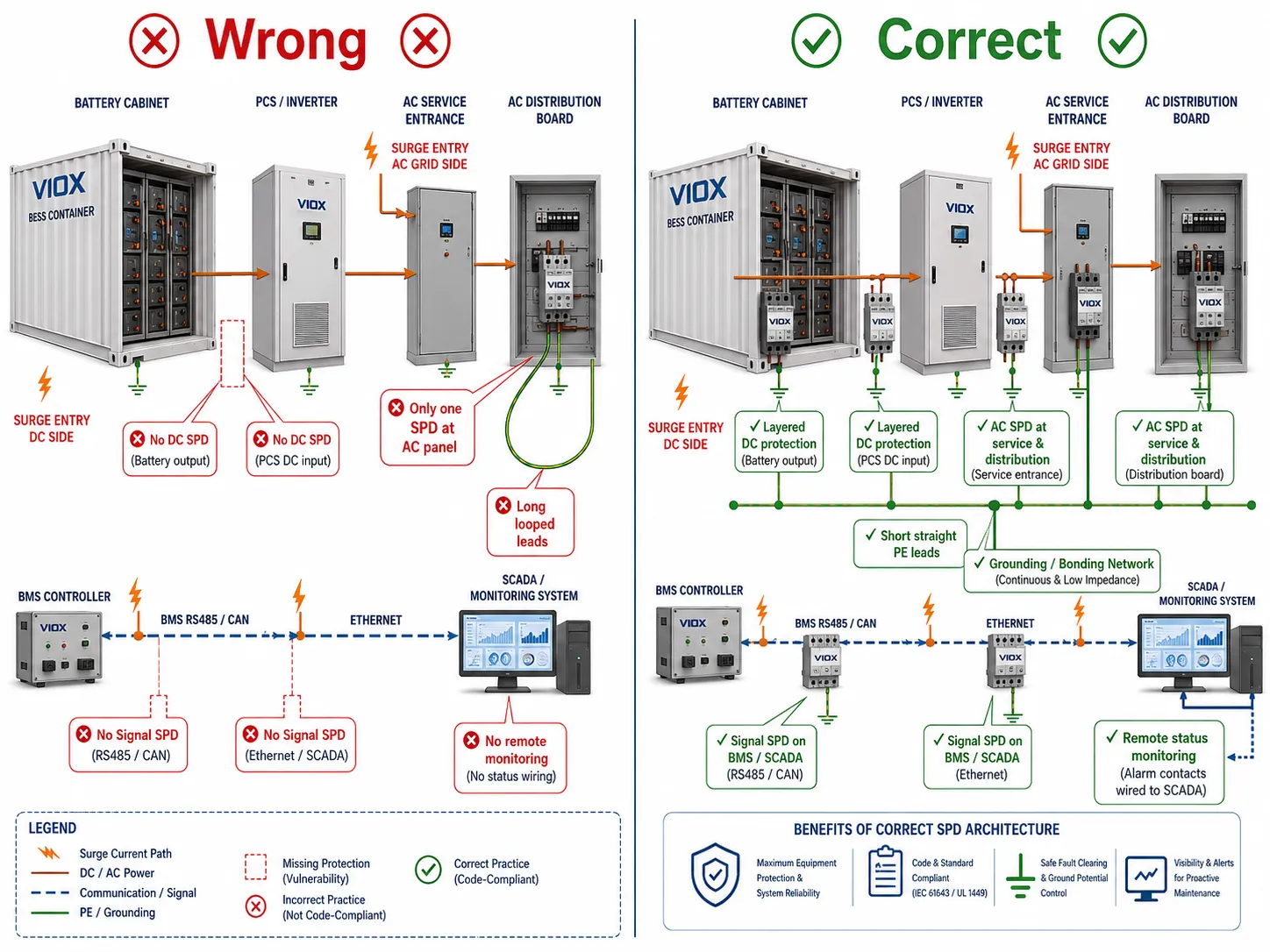
| Fehler | Risiko | Bessere Vorgehensweise |
|---|---|---|
| Installation von nur einem Überspannungsableiter (SPD) | DC-, AC- oder Signalpfade bleiben ungeschützt | Schutz nach Systemebene: DC, AC und Kommunikation |
| Automatischer Einsatz von PV-DC-Überspannungsschutzgeräten (SPD) für alle BESS-DC-Sammelschienen | Standard- oder Fehlerannahmen könnten nicht übereinstimmen | Verwendung von IEC 61643-41 für reine BESS-DC-Systeme, IEC 61643-31 bei PV-DC-Anwendung |
| Auswahl ausschließlich nach Imax | Spannungsschutz, SCCR, Erdung und Installation könnten fehlerhaft sein | Überprüfung von Uc, Up, In/Imax/Iimp, SCCR, Vorsicherung und Schutzmodus |
| Vernachlässigung der BMS-Signalleitungen | Kommunikationsfehler oder fehlerhafte Abschaltung | Schutz von RS485, CAN, Ethernet, potenzialfreien Kontakten und freiliegenden Steuerleitungen |
| Ignorieren des Erdungsmodus | SPD möglicherweise im falschen Modus angeschlossen | Überprüfung der Architektur auf potenzialfrei, geerdet, impedanzreferenziert oder PV-gekoppelt |
| Zu lange SPD-Anschlussleitungen | Tatsächliche Durchlassspannung steigt über den erwarteten Up-Wert | SPD-Anschlüsse kurz und direkt halten |
| Keine Fernanzeige | Defekte SPD-Module bleiben unbemerkt | Verwenden Sie visuelle und fernmeldetechnische Anzeigen für kritische BESS-Installationen |
| Keine Koordination mit DC-Leistungsschaltern oder Sicherungen | Das Fehlerverhalten kann unsicher oder nicht selektiv sein | Befolgen Sie die Vorgaben des SPD-Herstellers zum Vorsicherungsschutz und zur Systemschutzstudie |
FAQ
Benötigt ein BESS einen Überspannungsschutz sowohl auf der DC- als auch auf der AC-Seite?
Ja, bei den meisten technisch ausgelegten Systemen sollten beide Seiten überprüft werden. Die DC-Seite schützt die Batterie- und PCS-Schnittstellen, während die AC-Seite den Netzanschluss, die Verteilung, die Hilfsstromkreise und die AC-Anschlüsse des PCS schützt. Signalleitungen sollten ebenfalls separat geprüft werden.
Welche Norm gilt für DC-SPDs bei BESS?
Für reine BESS-Niederspannungs-Gleichstromsysteme ist die IEC 61643-41:2025 die am direktesten ausgerichtete IEC-Norm. Für den DC-seitigen Schutz bei PV-Kopplung kann die IEC 61643-31 Anwendung finden. Überprüfen Sie stets die Produktnorm, die Systemarchitektur und die Herstellerdokumentation.
Kann ich einen PV-Überspannungsschutz (SPD) an einem BESS-DC-Bus verwenden?
Nur, wenn der SPD für diese BESS-DC-Anwendung vom Hersteller spezifiziert und zugelassen ist. PV-SPDs sind für die Bedingungen von Photovoltaik-Gleichstrom ausgelegt. Ein reiner BESS-DC-Bus erfordert möglicherweise einen DC-SPD, der auf einer anderen normativen Grundlage, wie z. B. IEC 61643-41, bewertet wurde.
Reicht ein 40-kA-SPD für ein BESS aus?
Es gibt keinen universellen kA-Wert. Ein Nennwert von 40 kA mag ein gängiger Ausgangspunkt für Vergleiche von Typ-2-SPDs sein, aber die korrekte Auswahl hängt von der Blitzgefährdung, dem SPD-Typ, der Spannungsklasse, der Erdung, der Leitungslänge, dem Installationsort und der Risikobewertung ab.
Wo sollten SPDs in einem BESS installiert werden?
Typische Prüfpunkte umfassen den DC-Ausgang des Batterieschranks, den DC-Kombinierer oder DC-Verteilerschrank, den DC-Eingang des PCS/Wechselrichters, den AC-Netzanschluss, die AC-Verteilerplatine, den AC-Ausgang des PCS, die RS485/CAN-BMS-Kommunikationsleitungen, Ethernet/SCADA-Verbindungen sowie Hilfssteuerstromkreise.
Benötigen BMS-Kommunikationsleitungen wirklich einen Überspannungsschutz?
Oftmals ja, insbesondere wenn Kommunikationskabel zwischen Schaltschränken, Containern, Gebäuden oder Außenanlagen verlegt werden. Ein Signalüberspannungsimpuls kann das BMS auslösen oder beschädigen, selbst wenn der Stromkreis geschützt ist.
Worauf kommt es bei der Auswahl von Signal-Überspannungsschutzgeräten (SPD) für BESS am meisten an?
Stimmen Sie das SPD auf Signalspannung, Datenrate, Kapazitätsgrenze, Aderanzahl, Erdungsmethode, Schirmanschluss und Schnittstellentyp ab. Ein SPD für die Stromversorgung kann keinen Kommunikationsanschluss schützen.
Ersetzt ein Überspannungsschutz DC-Sicherungen oder DC-Leistungsschalter?
Nein. SPDs begrenzen transiente Überspannungen. DC-Sicherungen und DC-Leistungsschalter dienen dem Überstrom- und Kurzschlussschutz. Ein Schutzkonzept für BESS erfordert in der Regel beides.
Fazit
Der Überspannungsschutz für BESS ist eine Systemdesignaufgabe und keine Auswahl eines einzelnen Produkts. Die DC-Seite, die AC-Seite und das Kommunikationsnetzwerk bilden jeweils Eintrittspfade für Überspannungen. Jede Ebene erfordert einen geeigneten SPD-Typ, eine entsprechende Nennspannung, ein Schutzniveau, eine Erdungsanordnung und eine Installationsmethode.
Für VIOX-Kunden lautet die praktische Designlogik:
- Verwenden Sie DC-SPDs für die DC-Schnittstellen von Batterie und PCS.
- Verwenden Sie AC-Überspannungsschutzgeräte (SPDs) für das Stromnetz, den AC-Ausgang des Wechselrichters und die Verteilerschränke.
- Verwenden Sie Signal-SPDs für BMS, RS485, Ethernet, SCADA und Steuerleitungen.
- Stimmen Sie die SPDs mit DC-Leistungsschaltern, Sicherungen, Erdung, Potenzialausgleich und Wartungsüberwachung ab.
Wenn Sie vom Systemdesign zur Produktauswahl übergehen, beginnen Sie mit der VIOX SPD-Produktseite und überprüfen Sie jedes Modell anhand der exakten BESS-Spannung, des Fehlerstroms, der Norm, der Kommunikationsschnittstelle und der Einbauposition.
Geprüfte Quellen
- IEC 61643-41:2025 – Überspannungsschutzgeräte für den Einsatz in Gleichstrom-Niederspannungsnetzen
- IEC 61643-31:2018 – Überspannungsschutzgeräte für Photovoltaik-Anlagen
- IEC 61643-21:2000+A1:2008+A2:2012 – Überspannungsschutzgeräte für Telekommunikations- und Signalnetzwerke
- IEC 61643-11:2025 – Überspannungsschutzgeräte für den Einsatz in Wechselstrom-Niederspannungsnetzen