

در این صفحه
The Core Problem: DC Current Has No Natural Zero Crossing
DC contactors need special arc-extinction design because DC current has no natural zero crossing. In an alternating current (AC) circuit, the current naturally passes through zero twice per cycle: 100 times per second at 50 Hz or 120 times per second at 60 Hz. That zero-current moment helps an AC arc collapse.
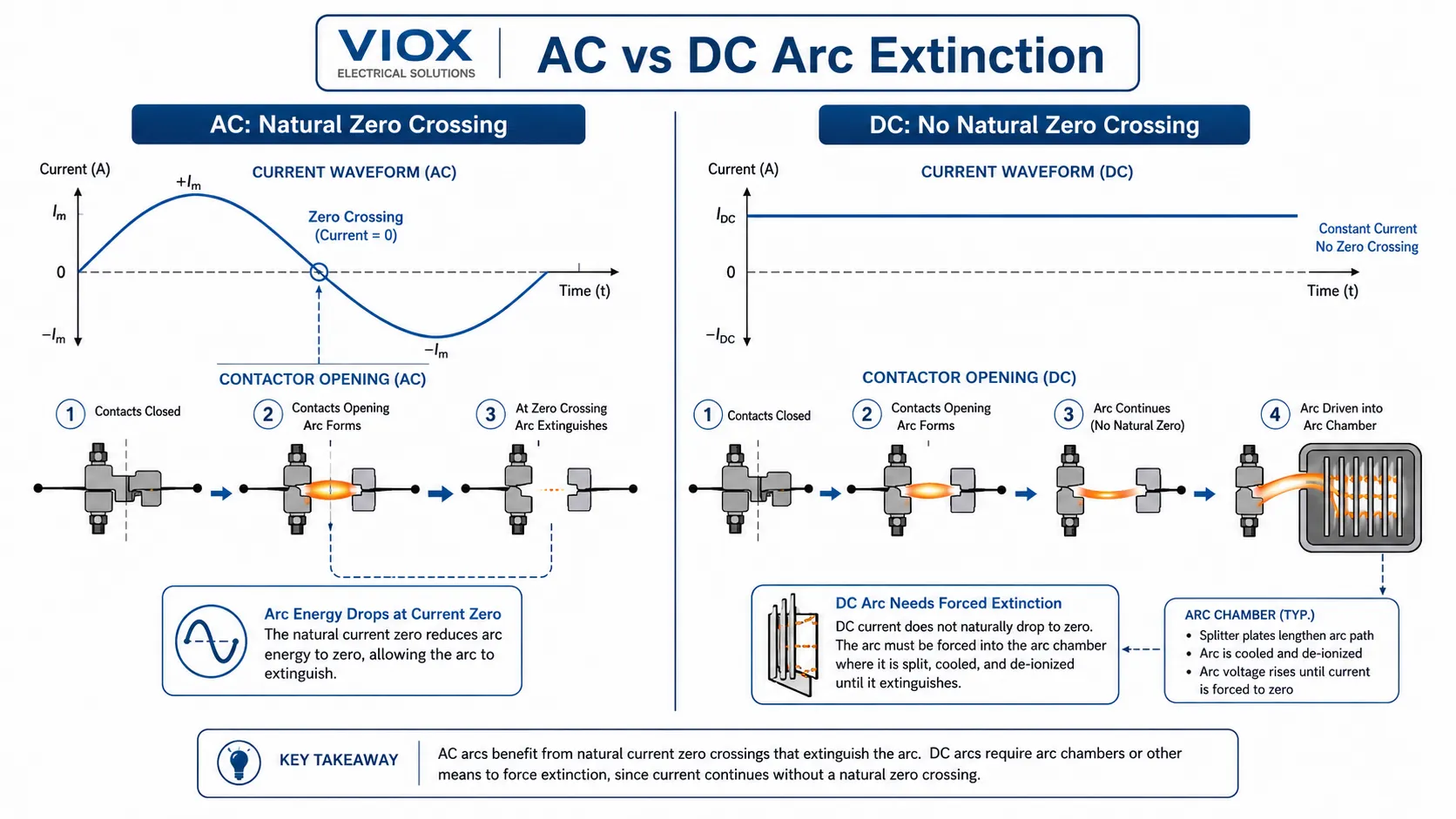
In a direct current (DC) circuit, current flows in one direction continuously. When the contactor opens under load, the arc between the contacts does not get a natural zero-current window. If the contactor does not force the arc to stretch, cool, split, or move into an arc chamber, the arc can keep burning until it damages the contacts, welds them closed, or destroys the device.
That is why a real DC contactor is not just an AC contactor with a DC coil. It may need:
- larger contact separation
- stronger arc chutes or arc chambers
- magnetic blowout magnets or coils
- gas-filled, vacuum-sealed, or hermetically sealed contact chambers
- arc-resistant contact materials
- correct polarity orientation where the design is polarized
- utilization-category ratings that match the actual DC load
The practical rule is simple:
Use a DC-rated contactor for DC load switching, and choose it by voltage, current, utilization category, polarity, load inductance, fault strategy, and switching duty – not by amp rating alone.
For a broader device background, VIOX’s guide on what is a contactor explains the basic switching role. If you are comparing contactor types, the companion article on AC vs DC contactors covers the wider difference between both families.
نکات کلیدی
- AC switching benefits from natural current zero crossings; DC switching does not.
- A DC arc can remain energized as long as the source can supply enough voltage and current.
- Magnetic blowout uses a magnetic field to drive the arc away from the contacts and into an arc chamber.
- Some DC contactors are polarized. Connecting the load current in the wrong direction can reduce the effect of the internal blowout magnets.
- DC utilization categories such as DC-1, DC-3، و DC-5 matter because resistive loads, shunt motors, and series motors do not stress the contactor in the same way.
- A contactor is not a short-circuit protective device by itself. It must be coordinated with fuses, DC circuit breakers, or other protective devices.
- The most dangerous selection mistake is replacing a DC contactor with an AC contactor because the voltage and current numbers look similar.
Why Zero Crossing Makes AC Switching Easier
An electrical arc forms when contacts separate while current is still flowing. As the contact gap opens, voltage stress across the gap can ionize the air or gas between the contacts. Once that gap becomes conductive, current continues through a hot plasma path: the arc.
In AC systems, the current waveform naturally crosses zero every half-cycle. At 50 Hz, that happens 100 times per second. At 60 Hz, it happens 120 times per second. When the current reaches zero, the energy feeding the arc momentarily disappears. If the contact gap, dielectric recovery, and arc chamber are adequate, the arc does not reignite after the zero crossing.
This does not mean AC contactors are simple or risk-free. AC contactors still need proper contact design, arc chutes, utilization-category ratings, and short-circuit coordination. But AC gives the contactor a natural extinguishing opportunity.
DC does not.
Why DC Arcs Are Harder to Extinguish
In a DC circuit, current does not reverse direction and does not naturally pass through zero. Once a DC arc forms, the source continues to push current through the arc path. To extinguish it, the contactor must force the arc voltage to rise above what the circuit can sustain.
In practical terms, the device must make the arc harder to keep alive by:
- increasing arc length
- moving the arc away from the contact surface
- cooling the arc
- splitting the arc into smaller segments
- forcing the arc into deionizing plates or chambers
- using a gas-filled, hydrogen-mixture, or vacuum-sealed environment to improve dielectric recovery and reduce arc persistence
- opening the contacts fast enough to avoid prolonged contact erosion
That is the real reason DC contactors are often larger, more expensive, and more specialized than comparable AC contactors. The extra structure is not cosmetic; it is the equipment required to survive DC load breaking.
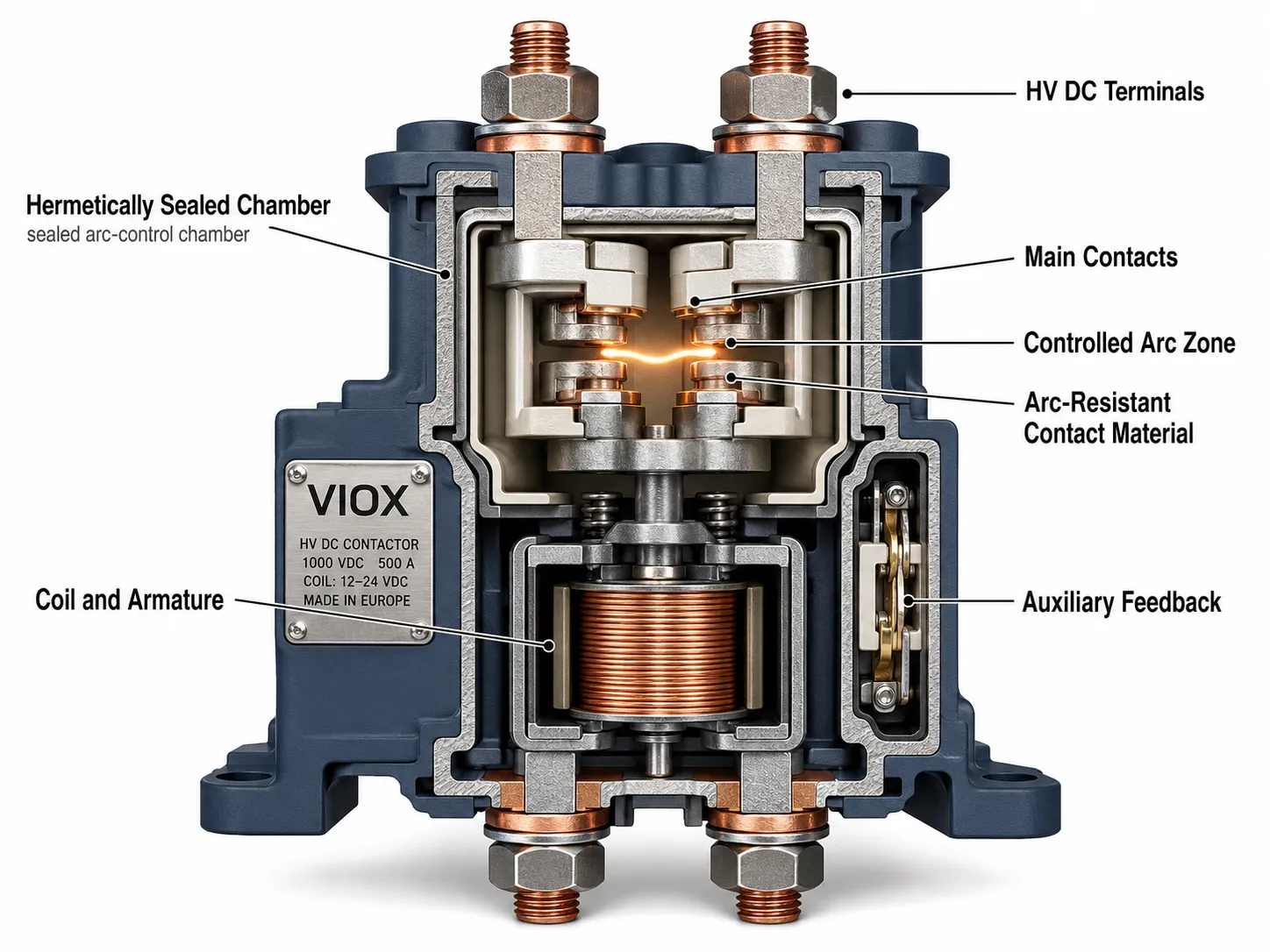
In high-voltage EV and battery energy storage applications, this is why many DC contactors use sealed arc chambers rather than open-air contact systems. Depending on the product family, manufacturers may use gas-filled chambers, hydrogen-based gas mixtures, or vacuum interrupter-style construction to improve arc control and dielectric recovery. The exact medium is product-specific, so it should be verified from the contactor datasheet rather than assumed from appearance.
در هنگام باز شدن کنتاکتور DC چه اتفاقی میافتد
هنگامی که یک کنتاکتور DC تحت بار باز میشود، این فرآیند به سرعت رخ میدهد، اما ترتیب مراحل اهمیت دارد:
- بوبین بیبرق میشود. آرمیچر بسته به میزان سرکوب بوبین، نیروی فنر و فروپاشی مغناطیسی، شروع به رها شدن میکند.
- کنتاکتها شروع به جدا شدن میکنند. جریان سعی میکند به عبور از سطح مقطع در حال کاهش کنتاکت ادامه دهد.
- گرمایش موضعی در نقاط تماس میکروسکوپی رخ میدهد. سطوح کنتاکت هرگز کاملاً صاف نیستند، بنابراین جریان در نقاط برجسته کوچک متمرکز میشود.
- Ionization starts in the gap. Metal vapor and ionized gas create a conductive path.
- A DC arc forms. Without a zero crossing, current continues through the plasma path.
- The arc-control system takes over. Magnetic blowout, arc runners, arc chutes, gas filling, or vacuum design must move and extinguish the arc.
- Dielectric recovery must hold. After extinction, the open gap must withstand system voltage and transients without restriking.
TE Connectivity’s contact arcing application note describes how microscopic high spots on contacts heat intensely and how severe arcing can contribute to material transfer and welding. That is especially important in DC because material transfer tends to occur consistently in one direction rather than alternating as it would in random AC switching.
Magnetic Blowout: The Core Arc-Control Method in Many DC Contactors
Magnetic blowout is one of the most common DC arc-extinction methods.
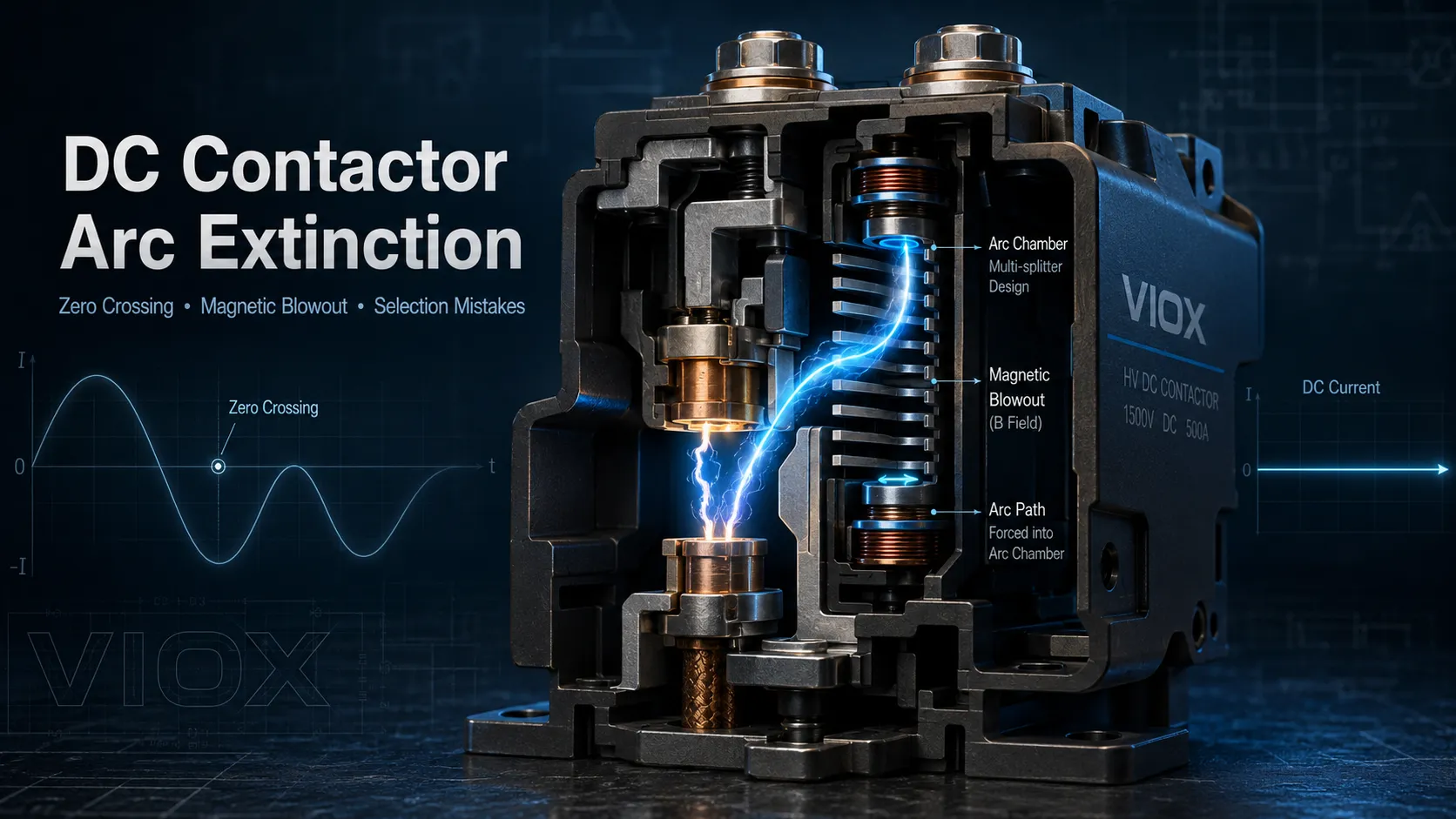
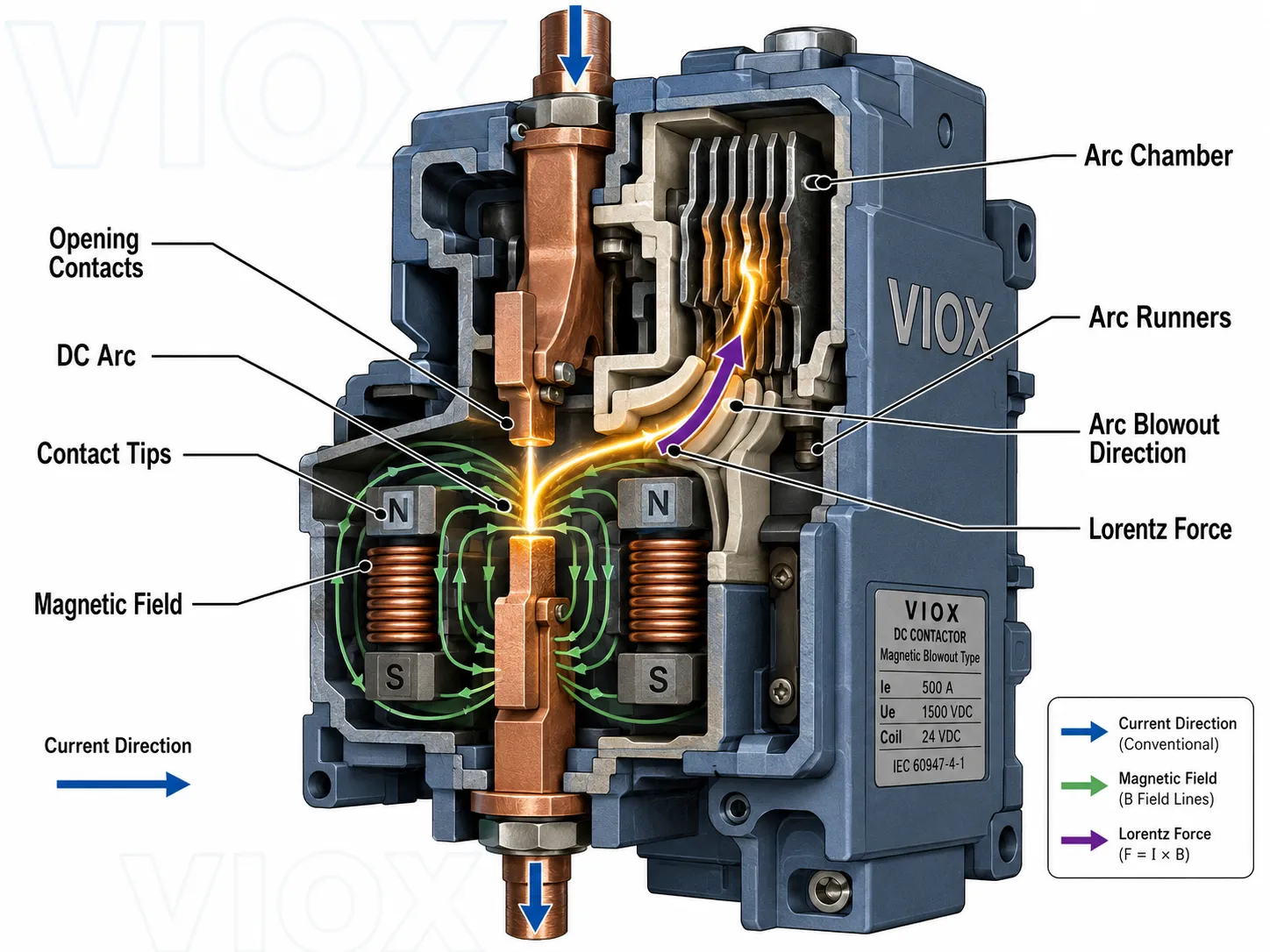
The principle is based on the Lorentz force: a current-carrying arc in a magnetic field experiences a force. In a DC contactor, permanent magnets or blowout coils create a magnetic field near the contacts. When an arc forms, the magnetic field pushes the arc away from the contact surface and toward the arc chute or arc chamber.
The goal is not merely to “move” the arc. The goal is to:
- pull the arc off the contact tips
- stretch the arc path
- increase arc voltage
- push the arc into cooling/deionizing structures
- reduce contact erosion
- prevent sustained burning between the main contacts
This is why the arc chamber and the magnetic system must work together. A magnet without a proper arc path is incomplete; an arc chute without effective arc movement may not receive the arc quickly enough.
A useful figure for this section is a cutaway view of a DC contactor showing the arc between opening contacts, the magnetic field direction, the Lorentz-force direction, and the arc being pushed into the arc chamber. That one diagram usually explains magnetic blowout faster than several paragraphs of text.
Why DC Contactor Polarity Matters
Some DC contactors are polarized. Their main power terminals may be marked with + و -, and the current must flow in the intended direction for maximum breaking capability.
Sensata/Gigavac’s application note explains the issue clearly: many contactors can carry current in either direction when closed, but switching or opening current is different. Internal blowout magnets may be optimized for a specific direction of current flow. If installed incorrectly, the arc may be pushed away from the intended chamber or the blowout effect may be reduced.
This distinction is critical:
| اصطلاح | معنی | چرا مهم است |
|---|---|---|
| Can carry bidirectional current | The closed contacts can conduct current in either direction | This does not automatically mean the device can interrupt current both ways |
| Polarized contactor | Terminals must be connected according to marked polarity | Wrong current direction can reduce arc-extinction performance |
| Bidirectional switching contactor | Designed to interrupt current in both directions | Needed for some battery, regenerative, and bidirectional energy systems |
In battery energy storage systems (BESS), electric vehicles, solar storage, and DC fast-charging systems, current direction may not always be simple. Charging, discharging, regenerative operation, precharge paths, and fault paths must all be considered. If the current can reverse under normal or abnormal conditions, verify whether the contactor is truly rated for bidirectional switching.
For adjacent protection architecture, VIOX’s guide to DC circuit breakers for solar, battery, and EV systems مطالعه بعدی مفیدی است.
کنتاکتور DC در مقابل کنتاکتور AC: واقعاً چه چیزی تغییر میکند؟
| عامل انتخاب | کنتاکتور AC | کنتاکتور DC |
|---|---|---|
| کمک به خاموش کردن قوس الکتریکی از طریق شکل موج | عبور طبیعی جریان از صفر به خاموش شدن قوس کمک میکند | عدم وجود عبور طبیعی از صفر؛ قوس باید به اجبار خاموش شود |
| طراحی محفظه قوس | معمولاً برای همان کلاس توان ظاهری، سادهتر است | چالشبرانگیزتر؛ ممکن است به دمنده مغناطیسی یا محفظه مهر و موم شده نیاز داشته باشد |
| فاصله کنتاکتها | طراحیشده بر اساس وظیفه کلیدزنی جریان متناوب (AC) و دستهبندی بهرهبرداری | اغلب نیازمند عایقبندی موثرتر جریان مستقیم (DC) و کنترل مسیر قوس الکتریکی است |
| حساسیت به پلاریته (قطبیت) | کنتاکتهای اصلی معمولاً برای جریان متناوب (AC) نسبت به پلاریته حساس نیستند | برخی از کنتاکتورهای جریان مستقیم (DC) پلاریزه هستند |
| الگوی فرسایش کنتاکت | انتقال مواد میتواند در عملکرد تصادفی جریان متناوب (AC) به تعادل برسد | انتقال مواد میتواند جهتدار و شدیدتر باشد |
| Load category importance | AC-1, AC-3, AC-4, etc. | DC-1, DC-3, DC-5, and manufacturer-specific DC ratings |
| Common misuse | Undersized for motor duty or high switching frequency | AC contactor used on DC load, wrong polarity, wrong DC category |
The important engineering point is that same voltage and same current do not mean same switching duty. A contactor rated for 250 VAC at a certain current may have a much lower or completely different DC breaking rating. Always read the DC line of the datasheet.
DC Utilization Categories: DC-1, DC-3, and DC-5
IEC 60947-4-1 and UL 60947-4-1 define contactor and motor-starter requirements. Schneider Electric’s technical documentation summarizes the DC utilization categories this way:
| دسته بندی | Typical load | Selection implication |
|---|---|---|
| DC-1 | بارهای DC غیر القایی یا کمی القایی | Easier than motor duty; still requires DC-rated breaking |
| DC-3 | Shunt motors: starting, plugging, inching, dynamic braking | More severe due to motor energy and switching conditions |
| DC-5 | Series motors: starting, plugging, inching, dynamic braking | Severe DC motor duty; do not substitute from DC-1 ratings |
This matters because a DC contactor’s amp rating is not a universal number. A device may carry a certain continuous current, but its ability to break that current depends on:
- DC voltage
- load inductance
- current level
- time constant
- دسته بهره برداری
- contact arrangement
- number of poles in series, where applicable
- فرکانس سوئیچینگ
- دمای محیط
- polarity
- expected fault conditions
If the datasheet gives different ratings for DC-1 and DC-3, use the category that matches the load. Do not select from the most generous column.
Where Special DC Contactors Are Used
سیستمهای ذخیره انرژی باتری
Battery systems use DC contactors for pack isolation, precharge, main positive/negative switching, emergency disconnect paths, and service isolation logic. The challenge is that battery packs can deliver very high fault current, and the system may include large capacitors in inverters or power conversion systems.
A main DC contactor in a BESS should be selected together with:
- precharge circuit design
- fuse or DC breaker coordination
- short-circuit current capability of the battery
- bidirectional current behavior
- insulation monitoring and fault detection
- thermal management inside the battery enclosure
For system-level background, see VIOX’s battery energy storage systems guide.
Electric Vehicles and DC Fast Charging
کنتاکتورهای شارژ EV و DC ممکن است مدارهای باتری ولتاژ بالا، خروجیهای شارژر، مسیرهای پیششارژ یا عملکردهای قفل ایمنی را قطع و وصل کنند. در این سیستمها، جوش خوردن کنتاکتور تنها یک مشکل تعمیر و نگهداری نیست، بلکه میتواند شرایط ناامنی ایجاد کند که در آن مدار پس از اینکه سیستم کنترل تصور میکند باز است، همچنان برقدار باقی بماند.
در انتخاب باید موارد زیر بررسی شود:
- کلاس ولتاژ
- جریان عبوری مداوم
- جریان قطع
- استراتژی تحمل جریان اتصال کوتاه یا خطا
- نیاز به سوئیچینگ دوطرفه
- روش اکونومایزر بوبین یا روش سرکوب بوبین
- auxiliary contact feedback for weld detection
- environmental sealing and vibration suitability
Solar PV and DC Distribution
In solar and DC distribution systems, the source may remain energized whenever light is available or whenever storage is connected. DC contactors used in these systems must be matched to the actual PV or battery-side DC voltage and the load-breaking requirement.
Do not confuse a DC contactor with a DC isolator or DC circuit breaker. A contactor provides controlled switching. A سوئیچ جداکننده DC provides manual isolation. A قطع کننده مدار DC provides overcurrent interruption. In real DC systems, these devices often work together rather than replacing one another.
DC Motor and Industrial Control
DC motor loads can be difficult because the motor and circuit inductance store energy. Operations such as plugging, inching, jogging, and dynamic braking are more severe than simple resistive switching. That is why DC-3 and DC-5 categories exist.
For motor-control architecture, VIOX’s contactor vs motor starter و types of motor starters selection guide help place the contactor inside the wider starter system.
The Selection Checks That Matter Most
1. Rated operational voltage must be DC-rated
Check the ولتاژ نامی DC, ، نه فقط ولتاژ نامی AC. کنتاکتوری که در جریان AC قدرتمند به نظر میرسد، ممکن است توانایی قطع بسیار پایینتری در جریان DC داشته باشد.
استاندارد IEC 60947-4-1 برای کنتاکتورها و استارترهای الکترومکانیکی در مداراتی تا سقف ۱۰۰۰ ولت AC یا ۱۵۰۰ ولت DC کاربرد دارد, ، اما این بدان معنا نیست که هر کنتاکتوری تحت این استاندارد برای تمام ولتاژهای DC مناسب است. دیتاشیت محصول، محدودیت واقعی کاربرد را تعیین میکند.
۲. جریان نامی باید با وظیفه حمل و قطع جریان مطابقت داشته باشد
جریان حمل مداوم با جریان قطع متفاوت است. یک کنتاکتور ممکن است هنگام بسته بودن، جریان بالایی را عبور دهد اما تنها برای قطع جریانهای پایینتر تحت شرایط خاص ولتاژ و بار رتبهبندی شده باشد.
همیشه تفاوت قائل شوید:
- جریان عبوری مداوم
- making current
- breaking current
- short-time withstand current
- fault current that must be cleared by an upstream protective device
3. Utilization category must match the load
Do not use a DC-1 rating for a DC motor application if the real duty is DC-3 or DC-5. Motor loads, inductive loads, and regenerative systems can impose far more severe breaking conditions than resistive DC loads.
For a deeper standards-oriented discussion, VIOX’s article on electrical standards for contactors and utilization categories is a useful supporting resource.
4. Polarity and current direction must be verified
If the contactor is polarized, wire it according to the manufacturer’s marked terminals. If the system can push current in both directions, do not assume a polarized contactor is acceptable. Select a contactor specifically rated for bidirectional switching when required.
This point is especially important in:
- battery charge/discharge circuits
- regenerative motor drives
- DC fast chargers
- bidirectional DC/DC converter systems
- storage systems connected to inverters
5. Load inductance and time constant matter
The harder the circuit tries to keep current flowing, the harder the contactor must work to extinguish the arc. Inductive loads store energy in a magnetic field. When the contacts open, that stored energy supports the arc.
The useful engineering shorthand is the L/R time constant:
$$\tau = \frac{L}{R}$$
where \(L\) is circuit inductance and \(R\) is circuit resistance. A higher \(L/R\) time constant means the current decays more slowly after the circuit is opened. Slower current decay gives the arc more time to remain energized, so the contactor must absorb and extinguish a more persistent arc.
This is why the same voltage and current can be easy in one circuit and destructive in another. A resistive load, a motor armature, a solenoid, a long cable, and a DC bus capacitor do not behave the same way. A 100 A resistive heater load and a 100 A inductive DC motor circuit can require very different contactor ratings.
6. Coil suppression must not make opening too slow
Coil suppression protects control electronics from voltage transients, but it can also slow down contactor drop-out if poorly chosen. TE Connectivity notes that suppression methods that let magnetic energy decay too slowly can retard armature motion and contribute to tack welding under some load conditions.
In practical design, do not add a random diode across a DC contactor coil without checking the manufacturer’s recommended suppression method. Slow opening can make arc duration worse.
For a related VIOX article, see how to select the right surge suppressor for contactors.
7. Short-circuit protection must be separate
A contactor is a switching device, not a complete short-circuit protective device. UL 60947-4-1 states that contactors and starters are not normally designed to interrupt short-circuit currents, and suitable short-circuit protection forms part of the installation.
That means the contactor must be coordinated with:
- فیوزهای دارای درجهبندی جریان مستقیم (DC)
- قطع کنندههای مدار DC
- تجهیزات حفاظت از باتری
- تجهیزات حفاظتی بالادست
- منطق خطای کنترلکننده
- تشخیص جوشخوردگی کنتاکتها در صورت نیاز
اگر سیستم به قطع خودکار جریان اضافه نیاز دارد، نقش کنتاکتور را با نقش حفاظتی با استفاده از راهنمای VIOX مقایسه کنید در مورد کنتاکتور در مقابل کلید اتوماتیک (Circuit Breaker).
اشتباهات رایج در انتخاب
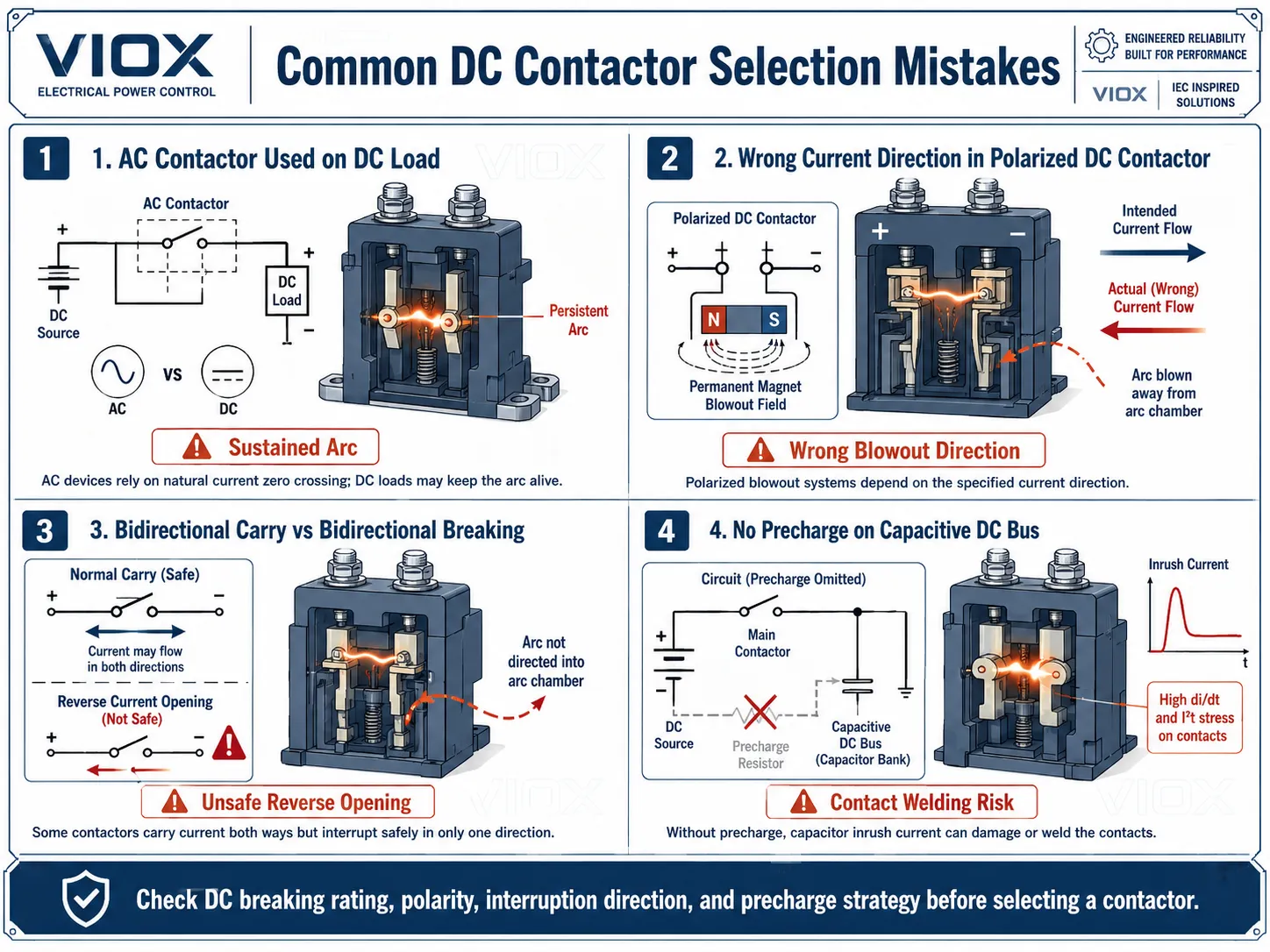
Mistake 1: Using an AC contactor on a DC load
This is the classic failure. The AC contactor may close and carry the load at first, so the mistake is not always obvious during a simple bench test. The problem appears when the device opens under DC load. Without adequate DC arc extinction, the contacts can burn, weld, or fail to interrupt the circuit.
پیامد: sustained arcing, contact welding, enclosure damage, and loss of control.
Mistake 2: Choosing by amp rating only
A buyer sees “200 A” and assumes the contactor is suitable for a 200 A DC system. But the real question is: 200 A at what DC voltage, under what utilization category, in which current direction, at what temperature, and with what breaking duty?
پیامد: a contactor that carries current normally but fails during opening.
Mistake 3: Ignoring polarity on magnetic blowout designs
If a polarized DC contactor is wired backward, it may still conduct when closed. The dangerous part is that the arc may not be driven into the intended chamber during opening.
پیامد: reduced breaking capability and shortened contact life.
Field-style pattern: in battery cabinet design reviews, this mistake often shows up when the main contactor is correctly sized for continuous current but the installation drawing reverses the current direction through a polarized contactor. The unit may pass a simple continuity test, but the first loaded opening event can push the arc away from the intended blowout path.
Mistake 4: Treating bidirectional carry as bidirectional break
Many contactors can carry current both ways when closed. That does not automatically mean they can safely interrupt current in both directions under load.
پیامد: wrong contactor in battery or regenerative applications.
Common project pattern: this mistake appears in energy storage systems where the same DC path is used for charging and discharging. The contactor conducts in both directions during normal operation, so the error stays hidden until a reverse-current opening event exposes that the device was not rated for bidirectional load breaking.
Mistake 5: Removing or modifying the arc chamber
The arc chamber is not a decorative cover. It is part of the contactor’s safety function. Removing, drilling, trimming, or contaminating it changes how the arc is guided and extinguished.
پیامد: contact erosion, flashover, and failure during load breaking.
Mistake 6: Using coil suppression that slows drop-out too much
A simple flyback diode may protect the controller output but slow contact separation. For some applications, that slower opening can increase the risk of tack welding.
پیامد: delayed opening, contact bounce issues, and intermittent welded contacts.
Mistake 7: Forgetting precharge in capacitive DC systems
In battery, inverter, and EV systems, the DC bus capacitance can create high inrush current when the main contactor closes. Without a precharge path, the contactor may experience heavy making stress.
پیامد: contact pitting, welding during closing, nuisance faults, or controller damage.
For background on startup current behavior, VIOX’s what is inrush current guide is directly relevant.
Quick Selection Checklist
Use this checklist before approving a DC contactor:
| بررسی | Question to answer | چرا مهم است |
|---|---|---|
| ولتاژ نامی DC | Is the contactor explicitly rated for the system DC voltage? | AC voltage ratings do not prove DC suitability |
| رتبه فعلی | Is the rating for carry, make, break, or short-time withstand? | These are different stresses |
| دسته بندی استفاده | Is the load DC-1, DC-3, DC-5, or manufacturer-specific? | Load type changes arc severity |
| قطبیت | Is the contactor polarized or bidirectional for breaking? | Blowout magnets may depend on current direction |
| Load inductance | What is the circuit time constant or stored energy? | Inductive loads extend arcing |
| Precharge | Is there DC bus capacitance that needs controlled charging? | Prevents closing stress and welding |
| سرکوب سیمپیچ | Is the suppression method approved by the manufacturer? | Avoids slow drop-out and tack welding |
| هماهنگی حفاظت | What clears short-circuit current? | Contactors are not normally short-circuit interrupters |
| Auxiliary feedback | Is weld detection or status feedback required? | Important in EV, ESS, and safety-critical systems |
| محیط زیست | Does sealing, vibration, temperature, and altitude fit the application? | Prevents field failure outside lab conditions |
سوالات متداول
Why is a DC arc harder to extinguish than an AC arc?
Because DC current does not naturally pass through zero. AC gives the arc a zero-current moment every half-cycle; DC keeps feeding the arc unless the device forces the arc to stretch, cool, split, or move into an arc chamber.
Can I use an AC contactor for a DC circuit?
Only if the contactor is explicitly rated by the manufacturer for that DC voltage, current, and load duty. Do not assume AC ratings apply to DC switching. In many cases, using an ordinary AC contactor on a DC load creates a serious arc and contact-welding risk.
What is magnetic blowout in a DC contactor?
Magnetic blowout uses a magnetic field to push the arc away from the main contact surface and into an arc chute or chamber. This lengthens and cools the arc so it can be extinguished without relying on natural zero crossing.
Are all DC contactors polarized?
No. Some are polarized and require current to flow through marked terminals in a specific direction for maximum breaking performance. Others are designed for bidirectional switching. Always check the datasheet; closed-contact current carrying and load-current interruption are not the same thing.
What is the difference between DC-1, DC-3, and DC-5?
DC-1 applies to non-inductive or slightly inductive DC loads. DC-3 applies to shunt-motor duties such as starting, plugging, inching, and dynamic braking. DC-5 applies to series-motor duties under similar severe control conditions. A DC-1 rating should not be used as a shortcut for motor duty.
Does a DC contactor protect against short circuits?
Not by itself. A contactor switches a circuit under control command. Short-circuit protection normally requires a properly selected fuse, DC circuit breaker, or other protective device coordinated with the contactor and system fault current.
Why do DC contactors sometimes weld closed?
Common causes include excessive making current, opening under a load beyond the contactor’s breaking rating, wrong polarity on a polarized design, inadequate precharge, slow drop-out caused by improper coil suppression, or fault current not cleared by upstream protection.
Why are DC contactors used in battery and EV systems?
They allow remote switching and isolation of high-voltage DC circuits. In battery and EV systems, contactors are commonly used for main positive/negative isolation, precharge circuits, charger connection, emergency shutdown logic, and fault isolation.