

در این صفحه
Quick Answer: Uc vs Up
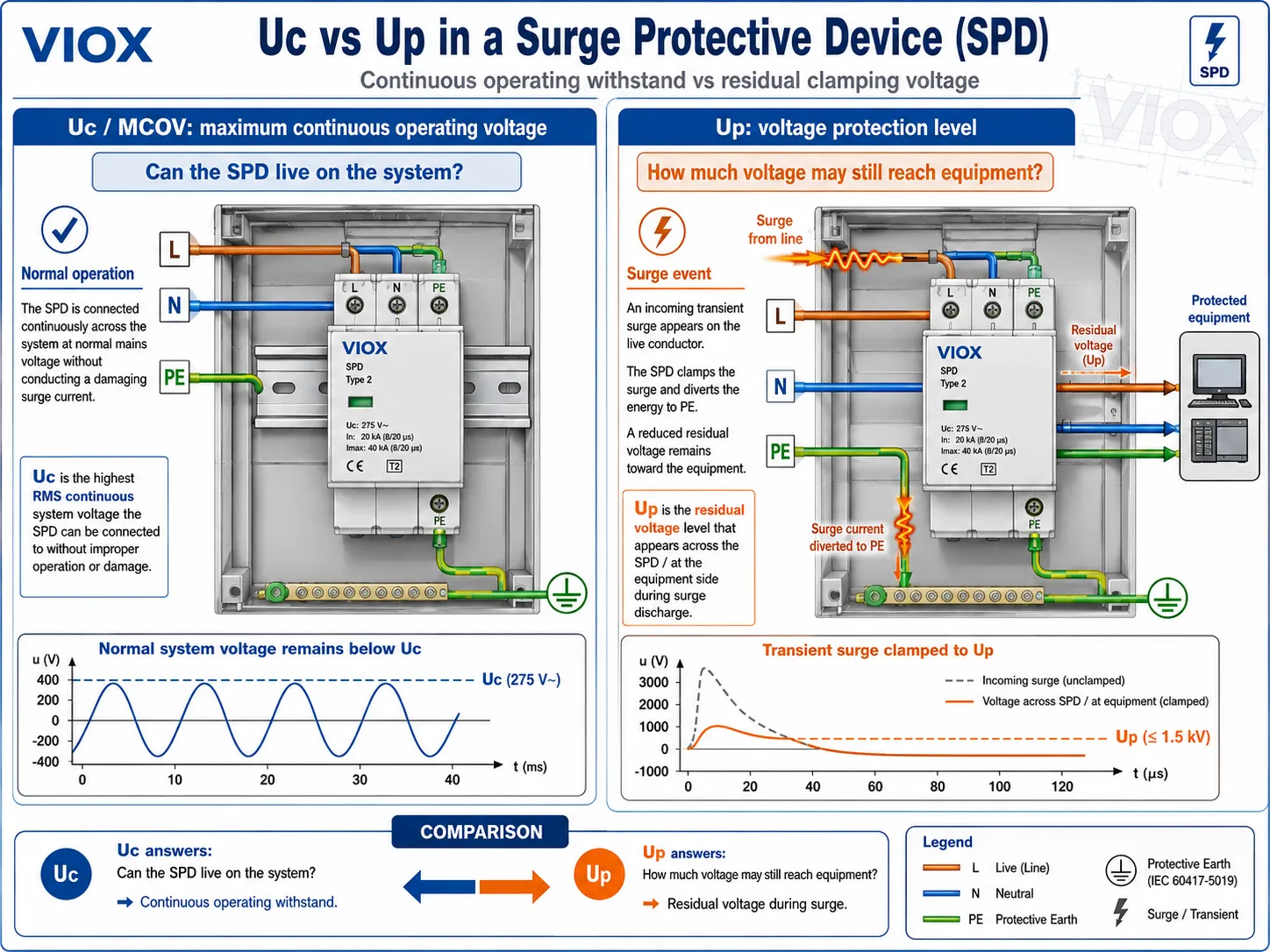
Uc and Up are two different voltage parameters on a surge protective device (SPD). Uc, also called maximum continuous operating voltage یا MCOV, is the highest voltage the SPD can withstand continuously without operating abnormally. Up, or voltage protection level, is the voltage that may still appear across the SPD terminals during a surge test.
In simple terms, Uc tells you whether the SPD can live safely on the system، در حالی که Up tells you how well it limits surge voltage for downstream equipment.
| پارامتر | Full name | آنچه به شما میگوید | Selection risk |
|---|---|---|---|
| Uc / MCOV | حداکثر ولتاژ کاری مداوم | Whether the SPD can remain connected under normal system voltage and voltage variation | Too low may cause aging, heating, or disconnection; unnecessarily high Uc may reduce protection effectiveness |
| بالا | سطح حفاظت ولتاژ | The residual voltage level during a specified surge test | Too high may expose downstream equipment to damaging voltage |
اگر ابتدا به پیشینه گستردهتری از دستگاه نیاز دارید، با دستگاه حفاظت در برابر موج چیست؟. This article focuses specifically on the two voltage parameters that buyers, panel builders, and engineers most often misread on SPD datasheets.
What Does Uc Mean on an SPD?
یوسی است. maximum continuous operating voltage of an SPD. It is the highest voltage that can be continuously applied across a specific SPD protection mode without abnormal operation.
In UL terminology, the equivalent concept is commonly called MCOV (Maximum Continuous Operating Voltage). In IEC-based datasheets, the marking is usually یوسی.
Uc answers a very practical question:
Can this SPD remain connected to this system continuously without operating, overheating, aging prematurely, or disconnecting under normal voltage conditions?
Why Uc Is Not Just the Nominal System Voltage
An electrical system marked as 230 V, 400 V, 480 V, 690 V, or 1000 V DC does not stay at exactly that value in real operation. The SPD must tolerate:
- normal supply voltage variation
- temporary overvoltage (TOV) conditions
- line-to-earth and line-to-neutral voltage differences
- neutral behavior in TN, TT, and IT systems
- DC open-circuit voltage in PV systems
- manufacturer-defined voltage and protection mode limits
This is why an SPD is not selected by nominal voltage alone. It is selected by matching Uc to the real maximum continuous voltage that can appear across each protection mode.
What Happens If Uc Is Too Low?
If Uc is too low for the actual system, the SPD may conduct during normal operation or during normal voltage variation. That can cause:
- unnecessary thermal stress
- accelerated MOV aging
- nuisance end-of-life indication
- module disconnection
- backup protection operation in severe cases
In practical terms, a too-low Uc makes the SPD behave as if ordinary system voltage is already a problem.
What Happens If Uc Is Too High?
Higher Uc is not automatically safer. If Uc is unnecessarily high, the SPD may have a higher voltage protection level and may provide less effective limitation for sensitive equipment.
The correct approach is not "choose the highest Uc available." It is:
choose the lowest Uc that is still suitable for the system voltage, earthing arrangement, temporary overvoltage behavior, protection mode, and manufacturer data.
Some designs apply additional margin for voltage fluctuation or temporary overvoltage, but the correct Uc must be selected according to the real system and the SPD datasheet. Avoid using a universal formula such as
Uc = 1.3 x Unبه عنوان جایگزینی برای بررسی مهندسی.
Up در یک SPD به چه معناست؟
بالا است. voltage protection level یک SPD. این مقدار نشاندهنده ولتاژی است که در طول شرایط تست نوسان مشخص، در پایانههای SPD ظاهر میشود.
به زبان ساده، Up همان let-through voltage تحت تست تعریفشده است. این پاسخ میدهد که:
هنگامی که SPD در طول یک رویداد نوسانی هدایت میکند، چه مقدار ولتاژ ممکن است همچنان به تجهیزات پاییندست برسد؟
یک SPD ولتاژ را به صفر نمیرساند. بلکه نوسان را به یک سطح باقیمانده پایینتر محدود میکند. آن سطح باقیمانده همان چیزی است که Up به توصیف آن کمک میکند.
Why Lower Up Is Usually Better, But Not Always Enough
A lower Up value generally means better voltage limitation, but only when compared under the same:
- نوع SPD
- استاندارد
- ولتاژ نامی
- test waveform
- discharge current condition
- protection mode
- روش نصب
Comparing Up values across different SPD types or standards can be misleading. A Type 1 SPD designed for lightning-current duty and a Type 2 SPD designed for distribution-level protection may not be directly comparable just because both datasheets show a Up value.
Up Must Be Read With Installation Lead Length
The Up value is measured at the SPD terminals under standard test conditions. In a real panel, the protected equipment sees:
SPD terminal voltage + voltage added by connection leads and wiring layout
Long, looped, or poorly routed SPD conductors add inductive voltage during a surge. This can make the actual let-through voltage higher than the datasheet Up value suggests.
That is why installation quality is part of voltage protection. For the field checklist, see SPD Installation Mistakes and How to Fix Them.
Uc vs Up Comparison Table
| نقطه مقایسه | Uc / MCOV | بالا |
|---|---|---|
| Full name | حداکثر ولتاژ کاری مداوم | سطح حفاظت ولتاژ |
| Main question answered | Can the SPD stay connected safely under normal system voltage? | How much voltage may remain during a surge test? |
| When it matters | Before the surge event, during continuous operation | During the surge event |
| Wrong low value risk | Heating, aging, nuisance disconnection, unsafe operation | Not usually selected "too low," but must match device type and system |
| Wrong high value risk | Weaker voltage limitation for sensitive equipment | Equipment may still see damaging voltage |
| پارامترهای مرتبط | Ucpv برای سیستمهای خورشیدی DC؛ MCOV در اصطلاحات استاندارد UL | VPR در اصطلاحات استاندارد UL؛ ولتاژ ضربه قابل تحمل تجهیزات |
| اولویت انتخاب | ابتدا بررسی شود زیرا تعیینکننده سازگاری سیستم است | پس از Uc بررسی شود زیرا تعیینکننده کیفیت حفاظت است |
| اشتباه رایج | انتخاب صرفاً بر اساس ولتاژ نامی | مقایسه مقادیر در شرایط تست متفاوت |
The two parameters work together. Uc must be high enough for the system; Up must be low enough for the equipment. If either side is wrong, the SPD selection is weak.
Why Uc Must Match the System Voltage
Uc is system-dependent. The same SPD may be suitable in one power system and unsuitable in another, even if both systems have similar nominal voltage.
Important factors include:
- nominal AC or DC voltage
- maximum expected continuous voltage
- ولتاژ فاز به نول و فاز به زمین
- رفتار اضافه ولتاژ موقت
- earthing arrangement
- حالت حفاظتی برقگیر (SPD)
- درجهبندی اختصاصی برای جریان متناوب (AC)، جریان مستقیم (DC) یا سیستمهای فتوولتائیک (PV)
- پیکربندی سیمکشی مجاز توسط سازنده
برای برقگیرهای فشار ضعیف AC، استاندارد IEC 61643-11 استاندارد اصلی محصول در IEC است. برای برقگیرهای سمت DC در سیستمهای فتوولتائیک، استاندارد IEC 61643-31 چارچوب مرتبط در IEC میباشد. در پروژههای آمریکای شمالی، ممکن است اصطلاحات UL 1449 مانند MCOV و VPR مشاهده شود.
برای اطلاع از زمینه استانداردها، مراجعه کنید به Surge Protection Standards: IEC 61643 vs UL 1449 vs GB 18802.
چرا سطح حفاظتی ولتاژ (Up) باید با سطح تحمل تجهیزات مطابقت داشته باشد
Up should be lower than the impulse withstand level of the protected equipment, with margin for installation lead voltage and coordination. The exact margin depends on the standard, equipment category, project requirements, and the protection strategy.
Avoid treating a simple formula such as
Up <= 0.8 x Uwas a universal rule. It may be used as a design principle in some contexts, but real selection should account for:
- equipment impulse withstand voltage
- overvoltage category
- distance between SPD and equipment
- lead length and routing
- upstream/downstream SPD coordination
- Type 1, Type 2, or Type 3 SPD role
- test condition behind the published Up value
For sensitive electronics, control panels, PLC systems, IT equipment, and EV charging electronics, Up often becomes the parameter that determines whether the protection is genuinely useful, not just installed.
How Earthing Systems Affect Uc Selection
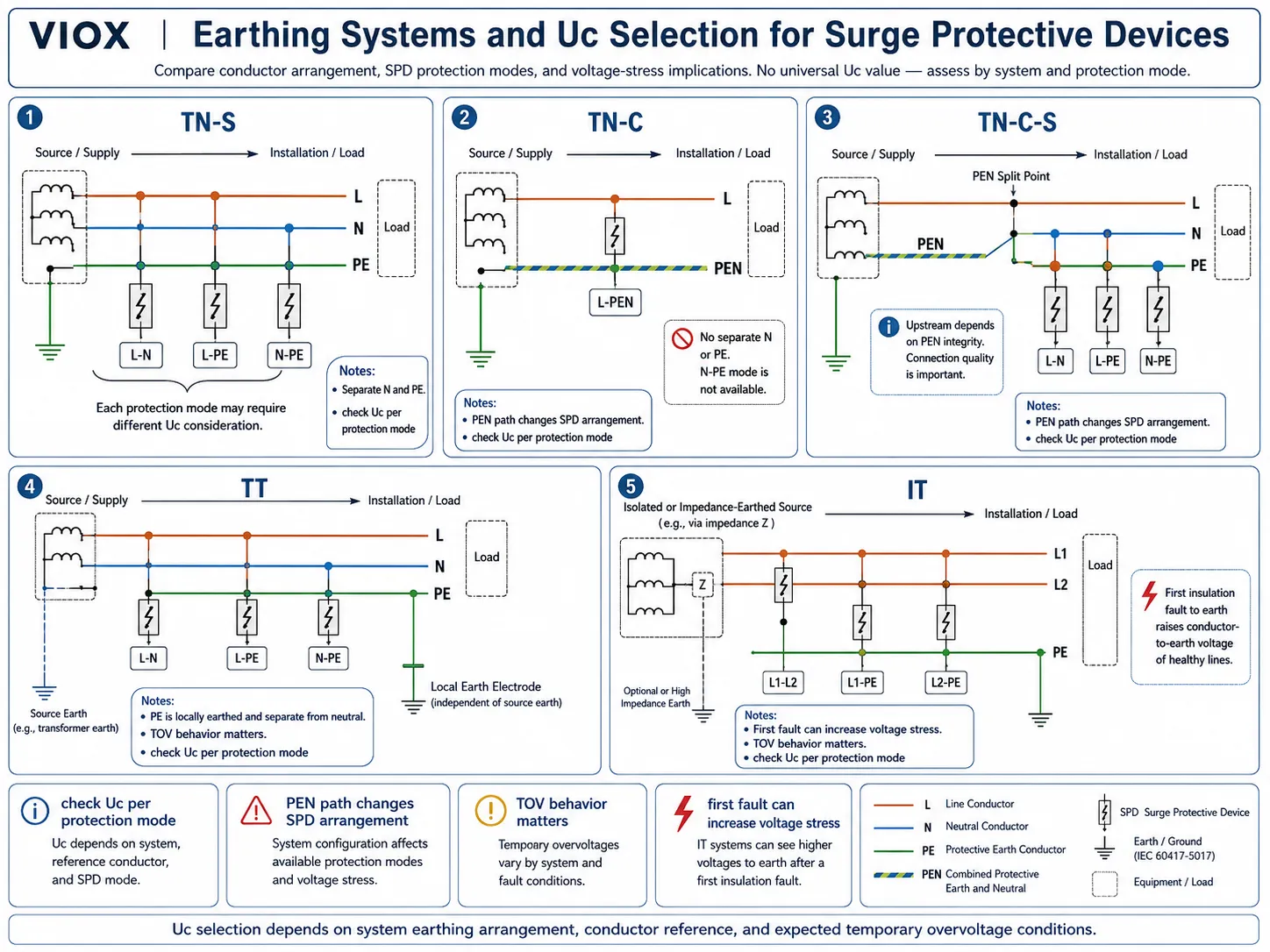
Earthing arrangement affects which conductors may experience voltage stress and which protection modes are required. This is one of the most common places where SPD voltage selection goes wrong.
| سیستم | Why it matters for Uc | نکته انتخاب |
|---|---|---|
| TN-S | فاز، نول و ارت حفاظتی از هم جدا هستند؛ میتوان از حالتهای حفاظتی L-PE و N-PE استفاده کرد | مقدار Uc را برای هر حالت حفاظتی بررسی کنید، نه فقط ولتاژ سیستم فاز به نول |
| TN-C | نول و ارت حفاظتی در بخشی یا تمام سیستم به صورت PEN ترکیب شدهاند | بدون بررسی دقیق نقطه سیمکشی و آرایش مجاز SPD، آن را مشابه سیستم TN-S در نظر نگیرید |
| TN-C-S | هادی PEN در یک نقطه مشخص به N و PE تفکیک میشود | نقطه انتقال اهمیت دارد؛ نمودار سیمکشی SPD برای آن محل را تایید کنید |
| TT | امپدانس الکترود زمین محلی و رفتار نول نسبت به زمین میتواند بر تنش اضافه ولتاژ تاثیر بگذارد | N-PE path and Uc must be selected carefully; TOV behavior is especially important |
| فناوری اطلاعات | First fault condition can raise voltage stress on healthy conductors | Higher Uc may be required depending on system design and insulation monitoring strategy |
| PV DC | String voltage changes with temperature and open-circuit voltage | Use Ucpv and a DC/PV-rated SPD, not an AC-only Uc value |
This table is a selection guide, not a replacement for local code, project design, or manufacturer wiring instructions.
AC SPD vs DC SPD vs PV SPD Voltage Parameters
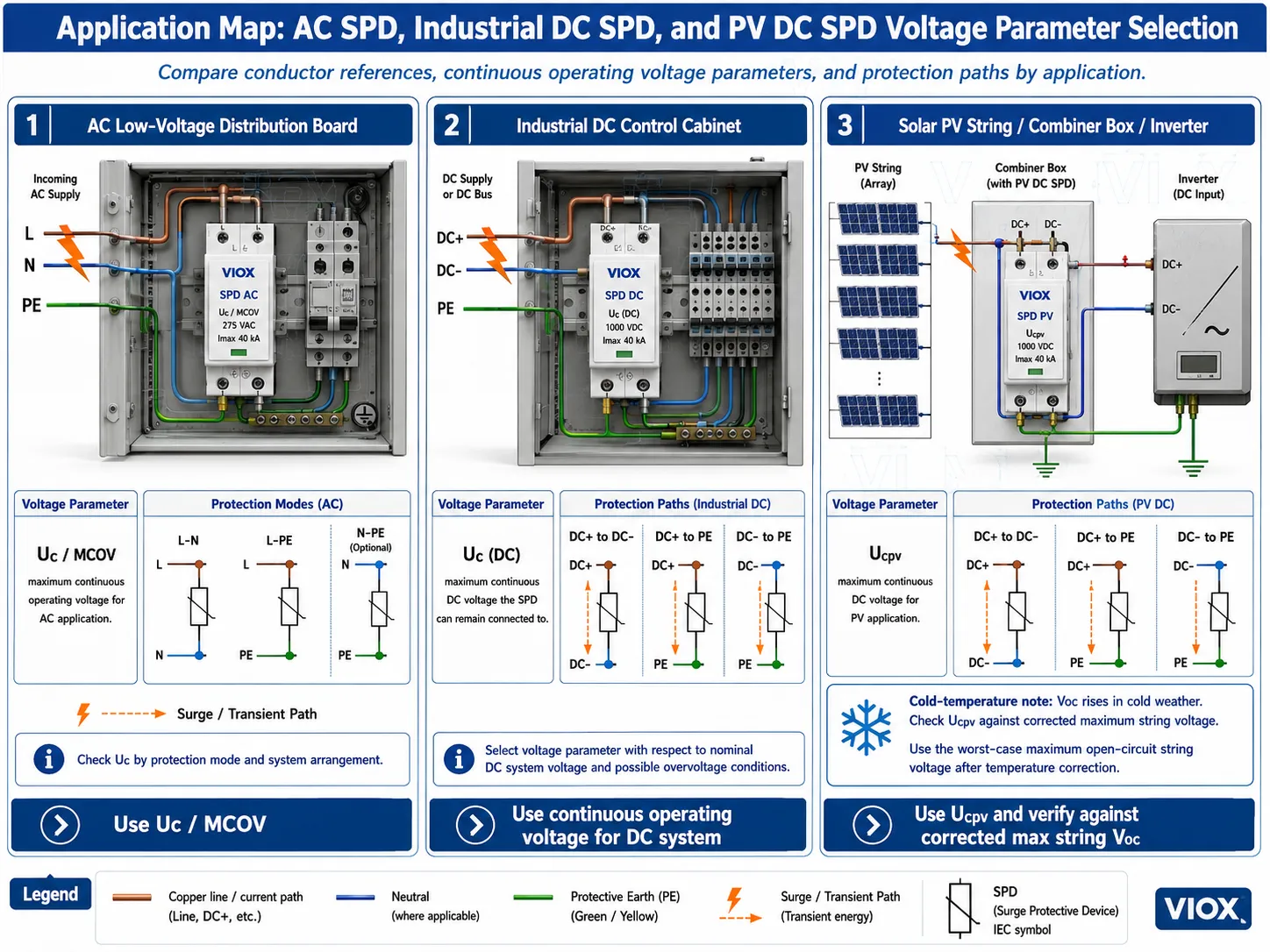
AC, DC, and PV SPDs use similar ideas, but the voltage parameters are not interchangeable.
| SPD application | Voltage parameter to check | Main selection issue |
|---|---|---|
| AC low-voltage SPD | Uc or MCOV | Must match line-to-neutral, line-to-earth, line-to-line, and earthing arrangement |
| PV DC SPD | Ucpv or maximum continuous PV voltage rating | Must exceed the maximum PV string voltage, including cold-temperature open-circuit voltage |
| Industrial DC SPD | DC continuous operating voltage | Must match polarity, fault behavior, and system insulation arrangement |
| Signal SPD | Maximum operating voltage for the signal interface | Must not disturb communication, bandwidth, or measurement accuracy |
For solar systems, nominal DC voltage is not enough. PV string open-circuit voltage increases in cold conditions, so Ucpv must be selected against the maximum corrected voltage, not just the inverter’s nominal DC range.
For the broader application boundary, see the DC Surge Protection Devices Guide.
How Uc, Up, In, Imax, and Iimp Fit Together
Uc and Up are voltage parameters, but they should not be read alone. A complete SPD label also includes current and application ratings.
| رتبهبندی | آنچه به شما میگوید | Selection role |
|---|---|---|
| Uc / MCOV | Maximum continuous voltage | Confirms the SPD can live on the system |
| Up / VPR | Residual voltage during test | Confirms protection quality for downstream equipment |
| در | جریان تخلیه اسمی | Indicates repeated surge-duty capability |
| آیمکس | حداکثر جریان تخلیه | Indicates maximum 8/20 us surge-current capability |
| آیمپ | Impulse current | Indicates Type 1 lightning-current duty, commonly associated with 10/350 us waveform |
| SCCR | جریان اتصال کوتاه نامی (Short-circuit current rating) | Confirms suitability for available fault current at the installation point |
Do not choose an SPD only by Imax. A high Imax value with the wrong Uc or high Up can still be a poor selection.
For current-rating interpretation, use رتبهبندی Imax در مقابل In برای دستگاههای محافظت در برابر نوسانات برق. For type selection, use دستگاه محافظ ولتاژ نوع ۱ در مقابل نوع ۲ در مقابل نوع ۳.
Common Uc and Up Selection Mistakes
| اشتباه | نتیجه | رویکرد بهتر |
|---|---|---|
| Choosing SPD only by Imax | Voltage protection may still be poor | Check Uc, Up, In/Imax/Iimp, type, and installation location together |
| Selecting Uc too close to nominal voltage | Heating, aging, nuisance disconnection, or premature end-of-life indication | Allow for normal voltage variation and TOV conditions |
| Selecting Uc unnecessarily high | Higher residual voltage and weaker protection for sensitive equipment | Use the lowest suitable Uc confirmed by system and manufacturer data |
| Comparing Up across different test conditions | Misleading product comparison | Compare Up only under the same standard, type, voltage class, and test context |
| Ignoring lead length | Real let-through voltage becomes higher than datasheet Up suggests | Keep SPD conductors short, straight, and correctly routed |
| Using AC SPD on PV DC system | Unsafe or non-compliant selection | Use PV/DC-rated SPD with correct Ucpv |
| Ignoring earthing system | Wrong protection mode or wrong voltage stress assumption | Confirm TN, TT, IT, PV, and protection-mode requirements before selecting Uc |
How to Read Uc and Up on an SPD Datasheet
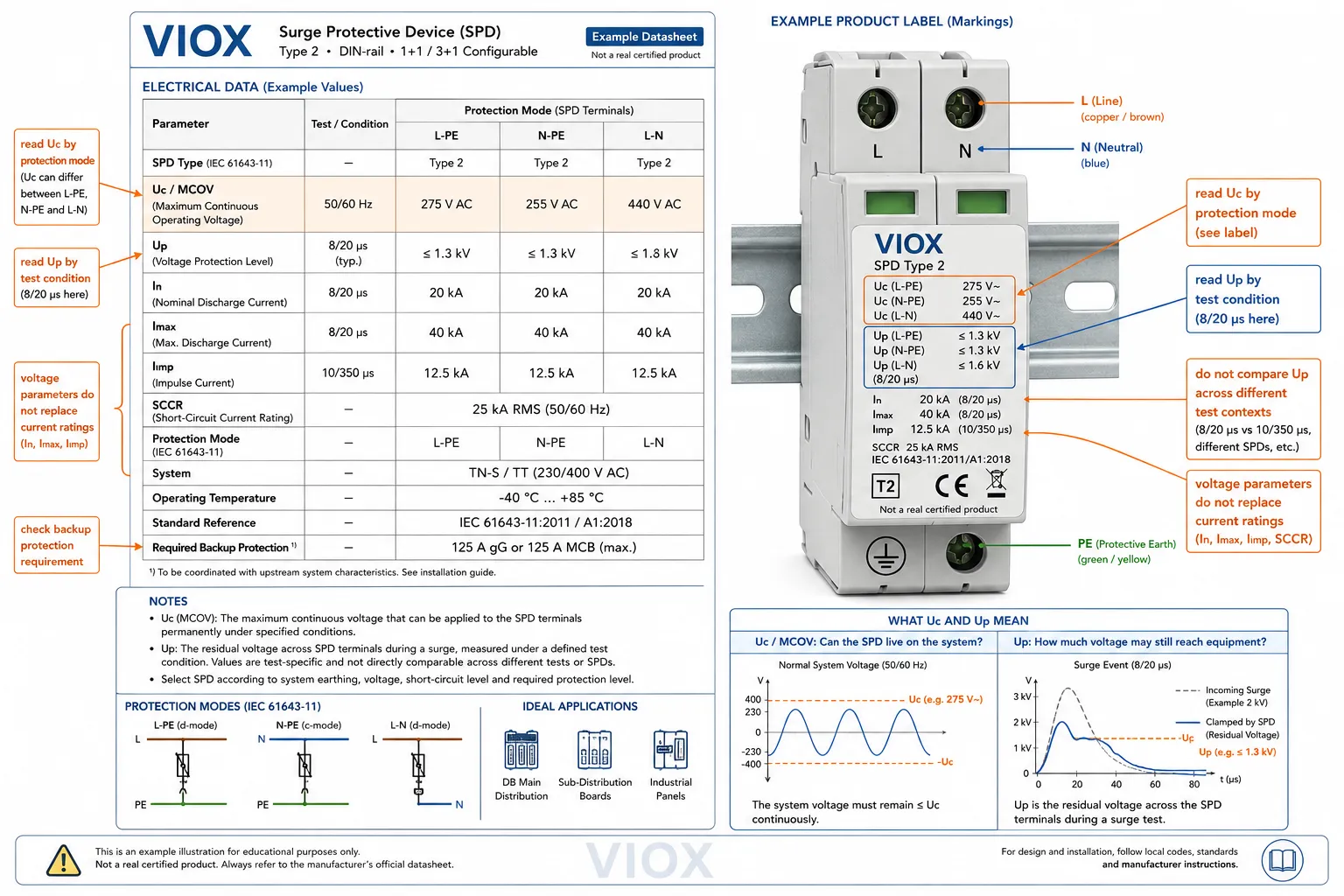
When reviewing an SPD datasheet, do not read the front label as a collection of independent numbers. Read it as a protection design.
Use this sequence:
- Identify the SPD application. AC, DC, PV, signal, Type 1, Type 2, Type 3, or Type 1+2.
- Confirm the standard. IEC 61643-11 for AC low-voltage SPDs, IEC 61643-31 for PV DC-side SPDs, UL 1449 for North American SPD applications, or another local standard where required.
- Read Uc or MCOV by protection mode. Check whether the listed value applies to L-N, L-PE, N-PE, L-L, DC+/DC-, or DC-to-PE.
- Read Up by test condition. Confirm the SPD type, waveform, discharge current, and voltage class behind the published Up value.
- Compare Up with equipment withstand level. Include margin for lead length and coordination.
- Check In, Imax, Iimp, and SCCR. Voltage parameters do not replace surge-current and short-circuit checks.
- Confirm backup protection. Follow the manufacturer’s fuse or breaker requirement.
- Check installation diagram. The same SPD module may have different allowed wiring configurations depending on system type.
If you are moving from parameter reading to product evaluation, review the VIOX SPD product page and verify the exact model’s Uc, Up, In, Imax, Iimp, SCCR, protection mode, and installation instructions against the real project.
سوالات متداول
What does Uc mean on an SPD?
Uc means maximum continuous operating voltage. It is the highest voltage that can be continuously applied across the SPD’s protection mode without abnormal operation. In UL terminology, the similar parameter is MCOV.
What does Up mean on an SPD?
Up means voltage protection level. It is the residual voltage that appears across the SPD terminals during a specified surge test. In practical terms, it describes the let-through voltage that downstream equipment may still see.
Is lower Up always better?
Lower Up generally means better voltage limitation, but only when comparing SPDs under the same standard, type, voltage rating, waveform, and test condition. Installation lead length and coordination also affect the real voltage seen by equipment.
What happens if Uc is too low?
If Uc is too low, the SPD may conduct during normal voltage variation or temporary overvoltage. This can accelerate aging, cause heating, trigger end-of-life indication, or disconnect the protection module.
What happens if Uc is too high?
If Uc is unnecessarily high, the SPD may provide less effective voltage limitation and may have a higher Up value. Higher Uc should be used only when required by system voltage, earthing arrangement, TOV behavior, or manufacturer guidance.
Is Uc the same as MCOV?
They are closely related terms from different standard contexts. Uc is commonly used in IEC-based SPD datasheets. MCOV, maximum continuous operating voltage, is commonly used in UL-based terminology.
How do I choose Uc for a TT or IT system?
For TT systems, pay close attention to N-PE behavior, temporary overvoltage, and the protection mode. For IT systems, the first fault condition can raise voltage stress on healthy conductors, so Uc selection may need additional margin. In both cases, use the project earthing design and manufacturer data rather than a generic voltage table alone.
Can I compare Up values from different SPD types?
Only with caution. Up values are meaningful when the standard, SPD type, voltage rating, waveform, discharge current, and test context are comparable. Comparing a Type 1 SPD and Type 2 SPD only by Up can lead to a wrong conclusion.
What is Ucpv on a DC solar SPD?
Ucpv is the maximum continuous operating voltage rating for a PV DC SPD. It must be selected against the maximum PV string open-circuit voltage, including cold-temperature correction, not just the nominal PV system voltage.
Should I choose an SPD by Uc and Up only?
No. Uc and Up are critical voltage parameters, but a complete SPD selection also checks Type 1/2/3, In, Imax, Iimp, SCCR, backup protection, earthing system, installation location, lead length, and applicable standard.