

در این صفحه
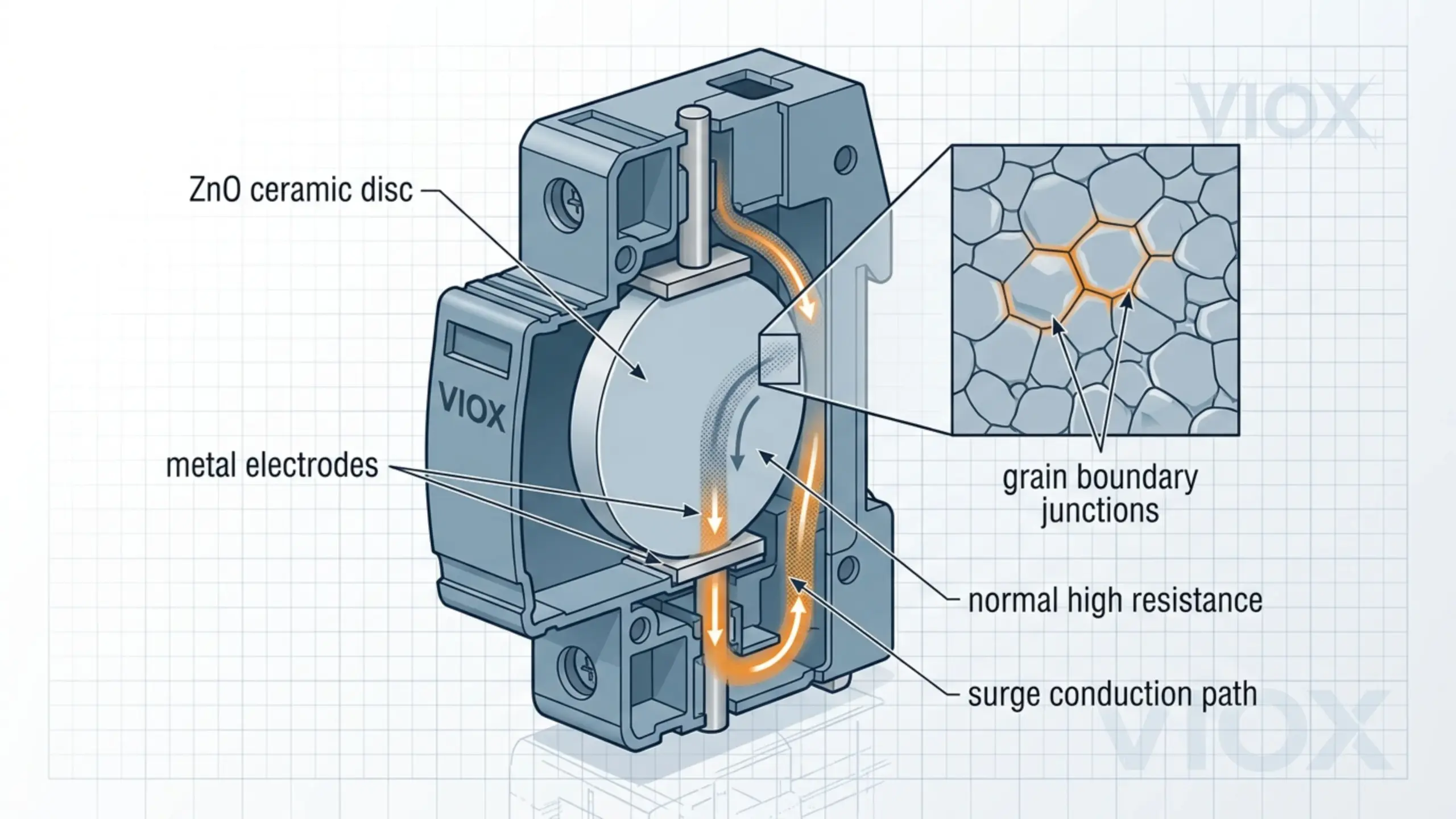
الف ZnO MOV is a zinc oxide metal oxide varistor, a voltage-dependent ceramic component used inside many low-voltage surge protective devices (SPDs). Under normal voltage, it behaves like a very high-resistance part and allows only tiny leakage current. During a surge, its resistance drops sharply, so it can divert surge current and limit the voltage seen by downstream equipment.
In practical SPD design, the MOV is the part that performs most of the voltage-clamping work. The SPD around it adds terminals, housing, thermal disconnectors, status indication, coordination features, and certification-ready construction.
The important engineering point is this: an MOV is not a simple resistor, fuse, or switch. It is a nonlinear ceramic surge-clamping element. Its material behavior explains many SPD ratings, including Uc or MCOV, Up, In, Imax, leakage current, thermal disconnection, and end-of-life indication.
If you need the broader SPD background first, start with What Is a Surge Protection Device? یا فرم کامل SPD در برق. This article focuses specifically on the ZnO MOV inside the SPD.
نکات کلیدی
- ZnO MOV stands for zinc oxide metal oxide varistor.
- It is the most common voltage-clamping element in many AC and DC power SPDs, especially Type 2 and Type 3 low-voltage devices.
- A ZnO MOV has a highly nonlinear voltage-current curve: high impedance at normal voltage, low impedance during surge voltage.
- MOVs do not “absorb all surge energy” in a simple way. They mainly create a low-impedance diversion path and clamp the voltage to a safer level.
- MOVs age under repeated surges, temporary overvoltage, heat, and excessive leakage current.
- A properly designed SPD includes thermal disconnection and status indication because a degraded MOV can overheat or fail.
- Not every SPD uses only MOV technology. Spark gaps, gas discharge tubes, and TVS diodes are also used depending on SPD type, voltage system, and application.
What Is a ZnO MOV?
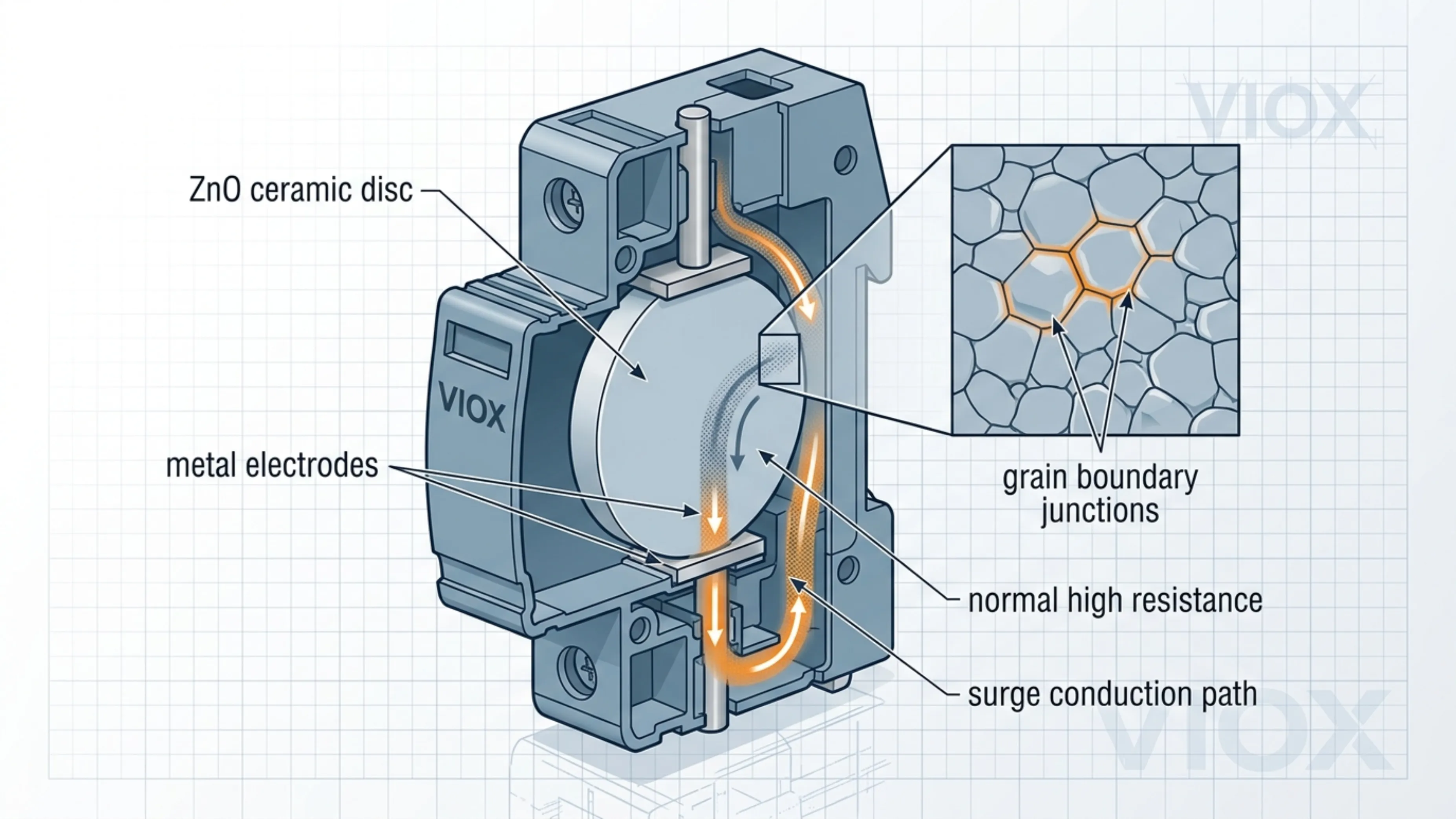
A ZnO MOV is a ceramic varistor made primarily from zinc oxide grains with small amounts of other metal oxides added during manufacturing. The word واریستور means voltage-dependent resistor. Its resistance changes with applied voltage.
At normal system voltage, the MOV stays in a high-resistance state. It does not carry meaningful load current. When the voltage rises above its designed knee region, the MOV rapidly changes into a conductive state. This allows surge current to flow through the MOV path instead of forcing the full transient voltage into sensitive equipment.
In a simplified way, the MOV behavior can be described as:
$I = k \cdot V^{\alpha}$
کجا:
- $I$ is current through the MOV
- $V$ is voltage across the MOV
- $k$ is a device-dependent constant
- $\alpha$ is the nonlinear coefficient
The exact constants depend on MOV material, disc size, formulation, electrode design, and manufacturing process. The useful field takeaway is simpler: افزایش جزئی ولتاژ فراتر از نقطه زانو میتواند منجر به افزایش بسیار زیاد جریان شود.
این رفتار غیرخطی تند، دلیل اصلی کاربرد گسترده وریستورهای اکسید روی (ZnO MOV) در برقگیرها (SPD) است.
چرا از اکسید روی استفاده میشود
سرامیکهای اکسید روی به این دلیل استفاده میشوند که ساختارهای مرزدانهای میکروسکوپی تشکیل میدهند که مانند میلیونها اتصال غیرخطی کوچک به صورت سری و موازی عمل میکنند. این مرزدانهها دلیلی هستند که MOV میتواند در ولتاژ عادی تقریباً غیررسانا باقی بماند اما در شرایط اضافه ولتاژ (سرج)، رسانا شود.
از دیدگاه طراح SPD، وریستورهای اکسید روی چندین مزیت ارائه میدهند:
- رفتار سریع در محدودسازی ولتاژ (Clamping)
- قابلیت تحمل جریان سرج بالا نسبت به اندازه
- ساختار فشرده و کمحجم
- suitability for AC and DC power circuits when correctly rated
- relatively low cost compared with more complex protection structures
- easy integration into modular Type 2 and Type 3 SPD cartridges
This is why MOV technology dominates many low-voltage power SPD designs. It is not because MOVs are perfect. It is because they offer a strong balance of clamping performance, energy handling, size, and cost for many real power-distribution applications.
How a ZnO MOV Works Inside an SPD
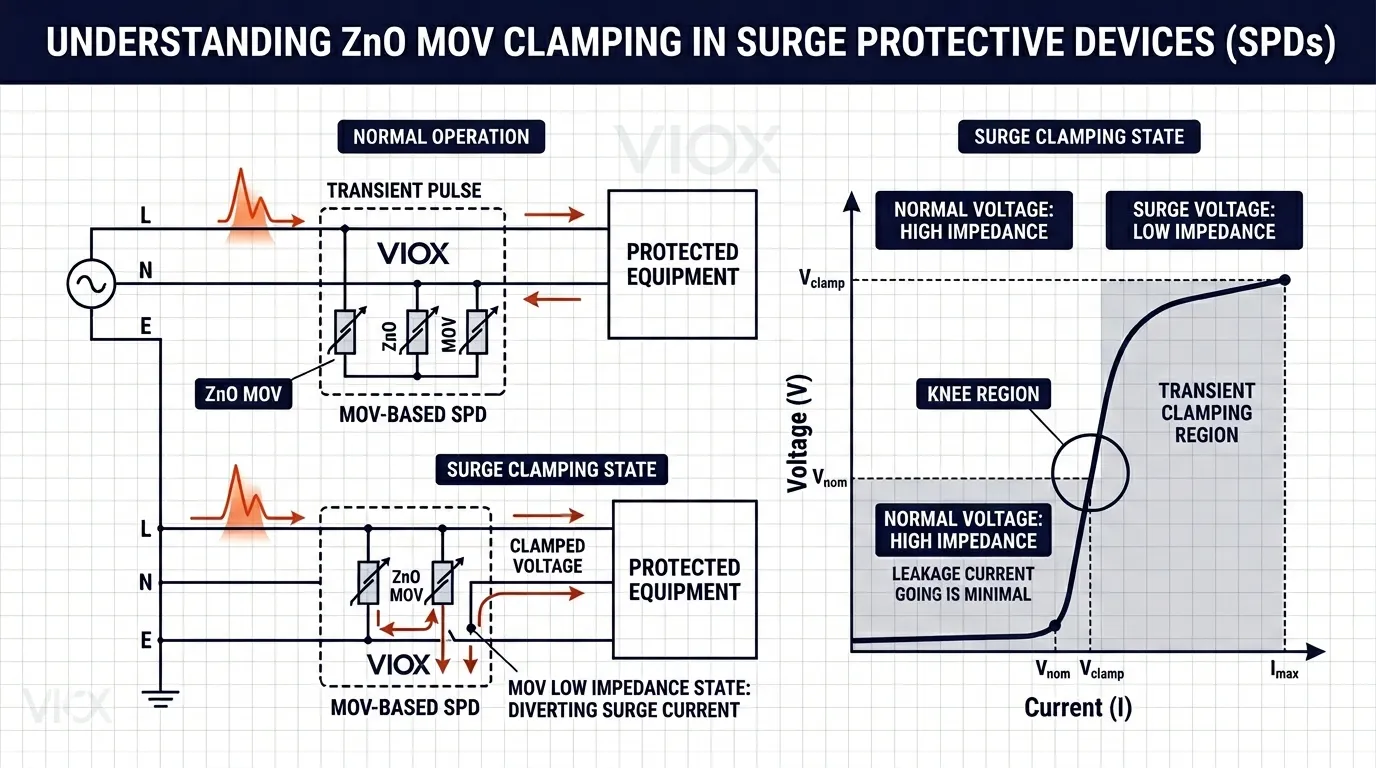
In a typical power SPD, the MOV is connected between conductors that need surge-voltage limitation. Common arrangements include:
- line to neutral
- line to earth
- neutral to earth
- positive to negative in DC systems
- positive or negative to earth in some DC architectures
During normal operation, the SPD is passive. The MOV sees system voltage but remains in its high-impedance region. During a transient surge, voltage rises quickly. Once it crosses the MOV’s conduction region, the MOV starts carrying surge current. This diverts part of the surge energy away from downstream equipment and limits the voltage across the protected side.
The SPD does not make surge voltage disappear. It limits it to a level determined by:
- MOV material and size
- MOV voltage rating
- surge current magnitude
- circuit impedance
- lead length and installation layout
- SPD internal design
- upstream and downstream coordination
- grounding and bonding quality
This is why the same MOV concept can produce very different field results depending on the whole SPD design and installation. For installation-related performance issues, see SPD Installation Mistakes and How to Fix Them و Panel Surge Protector Earth Ground Problem.
MOV Behavior: Normal Voltage vs Surge Voltage
| Operating condition | MOV behavior | Practical meaning in an SPD |
|---|---|---|
| Normal system voltage | High resistance, very low leakage current | SPD remains passive and does not affect the load |
| Slight overvoltage | Leakage current may rise | Long exposure can heat and age the MOV |
| Surge transient | Resistance drops sharply | MOV conducts surge current and clamps voltage |
| Excessive or repeated stress | Leakage increases and material degrades | SPD may show end-of-life status or disconnect |
| Severe failure condition | MOV may overheat or short before disconnector operates | Thermal protection and enclosure design become critical |
The middle rows matter most. MOV failure is often not caused by one dramatic lightning event alone. Many MOVs degrade through cumulative stress: repeated smaller surges, temporary overvoltage, poor grounding, high ambient temperature, and operation close to the voltage limit.
For a dedicated lifespan discussion, see Surge Protective Device Lifespan and MOV Aging Guide.
How ZnO MOVs Relate to SPD Ratings
Most important SPD ratings can be understood through MOV behavior.
Uc or MCOV: The Voltage the MOV Must Survive Continuously
Uc, also called maximum continuous operating voltage (MCOV) in many markets, is the maximum voltage the SPD can withstand continuously without entering destructive conduction.
If Uc is too low, the MOV may conduct during normal voltage fluctuations or temporary overvoltage. That increases leakage current and heat, which accelerates aging.
If Uc is too high, the SPD may clamp at a higher voltage than the protected equipment can tolerate.
This is the first selection boundary. Do not choose an SPD only by kA rating if Uc does not match the actual system voltage, earthing arrangement, and expected voltage tolerance.
For a deeper rating guide, see MCOV in SPD: Maximum Continuous Operating Voltage Guide و Uc و Up در یک SPD به چه معنا هستند؟.
Up: ولتاژی که در هنگام نوسان برق عبور میکند
Up سطح حفاظت ولتاژ است. از نظر عملی، این مقدار نشاندهنده ولتاژ محدودی است که میتواند تحت شرایط آزمون تعریفشده، در پاییندست SPD ظاهر شود.
انتخاب MOV تأثیر زیادی بر Up دارد. ولتاژ پایینتر MOV میتواند عملکرد کلمپینگ (محدودسازی) را بهبود بخشد، اما تنها در صورتی که همچنان برای عملکرد مداوم و ایمن به اندازه کافی بالا باشد. ولتاژ بالاتر MOV ممکن است در شرایط عادی عملکرد پایدارتری داشته باشد، اما اجازه عبور ولتاژ بیشتری را میدهد.
این هسته اصلی موازنه در طراحی است:
Uc باید برای سیستم واقعی به اندازه کافی بالا باشد. Up باید برای تجهیزات محافظتشده به اندازه کافی پایین باشد.
In و Imax: مسیر MOV چه مقدار جریان نوسانی را میتواند تحمل کند
In جریان تخلیه اسمی است. Imax حداکثر جریان تخلیه تحت شکل موج آزمون تعریفشده است. این رتبهبندیها به شدت به اندازه دیسک MOV، ساختار، چیدمان موازی، طراحی حرارتی و استاندارد آزمون SPD بستگی دارند.
Do not compare MOV-based SPDs by headline kA alone. A kA rating only has meaning when the waveform, test sequence, standard, and protection mode are understood.
For the rating boundary, see رتبهبندی Imax در مقابل In برای دستگاههای محافظت در برابر نوسانات برق و راهنمای اندازه گیری رتبه بندی SPD kA.
Leakage Current: The Early Warning Signal
A healthy MOV has very low leakage at normal operating voltage. As it ages, leakage current can increase. Higher leakage creates more heat. More heat accelerates degradation. This can become a thermal runaway path if the SPD does not disconnect safely.
That is why quality SPDs include thermal disconnectors, visual indicators, and sometimes remote signal contacts. The indicator does not make the MOV stronger. It tells maintenance staff when the protective element has reached a failed or disconnected state.
What Is Inside an MOV-Based SPD?
The MOV is the core protective element, but it is not the whole SPD.
A practical MOV-based SPD may include:
- one or more ZnO MOV discs
- thermal disconnector or fuse element
- پرچم وضعیت مکانیکی
- remote signalling contact
- pluggable cartridge body
- terminals and busbar connection structure
- housing with flame-retardant material
- arc and heat containment features
- coordination components depending on product design
The difference between a loose MOV component and a certified SPD is exactly this system design. A bare MOV soldered onto a board can clamp transients, but a panel-mounted SPD must safely handle surge current, thermal aging, end-of-life disconnection, short-circuit conditions, touch safety, installation environment, and standard testing.
For full device-level protection concepts, see How Surge Protective Devices Divert and Limit Transient Voltages.
MOV vs Spark Gap vs GDT vs TVS Diode
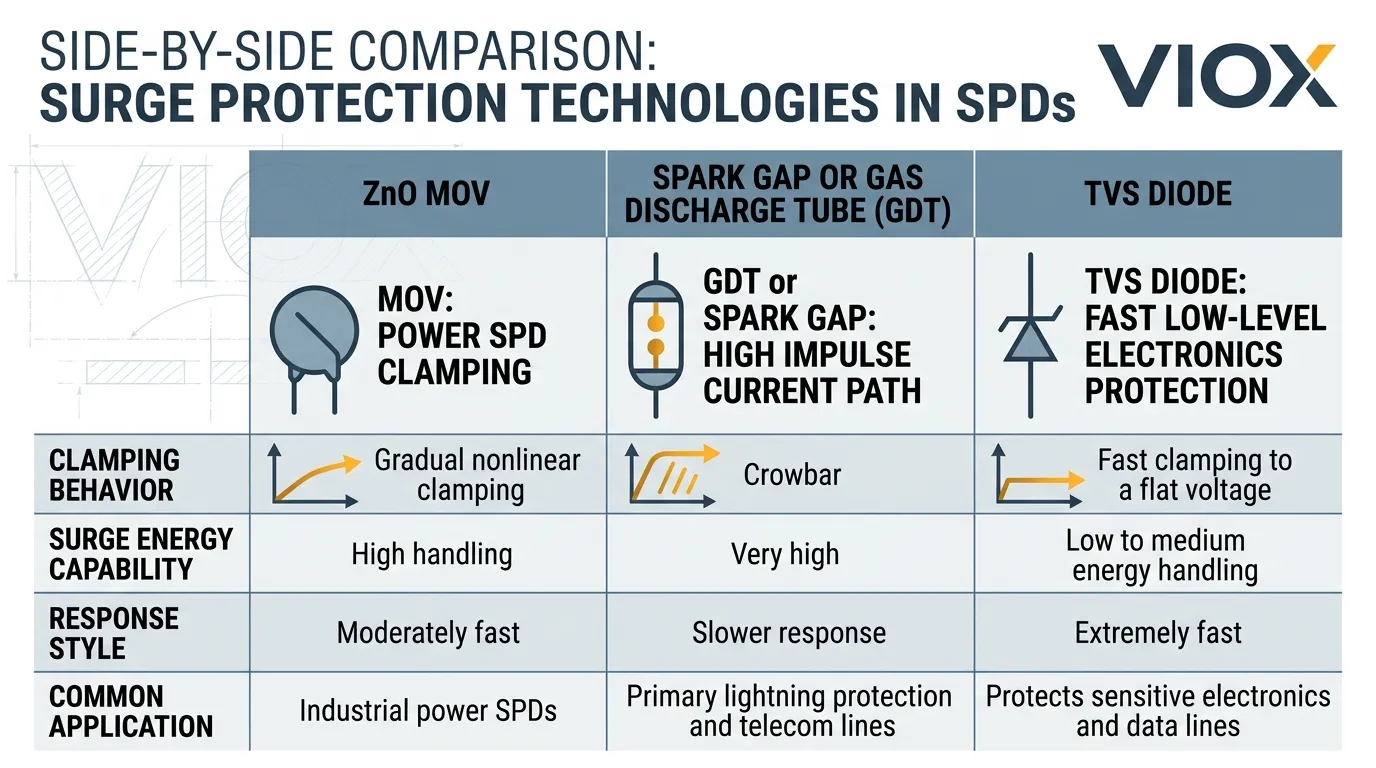
MOV technology is common, but it is not the only surge protection technology.
| فناوری | Main strength | محدودیت اصلی | Common use |
|---|---|---|---|
| ZnO MOV | Good balance of clamping, surge current capacity, cost, and size | Ages with repeated stress and needs thermal protection | AC/DC power SPDs, Type 2 and Type 3 devices |
| Spark gap | High impulse current capability and low leakage | Higher sparkover behavior and more complex coordination | Type 1 SPDs and lightning-current discharge paths |
| Gas discharge tube (GDT) | High surge capability and low capacitance | Slower response than semiconductor devices and higher sparkover voltage | N-PE paths, telecom, signal and hybrid SPDs |
| TVS diode | Very fast and low clamping voltage | Lower surge energy capacity than large MOV/GDT elements | Signal/data lines and electronics-level protection |
Many SPDs use hybrid designs. For example, a power SPD may use MOV blocks with thermal disconnectors, while a signal SPD may use GDT plus TVS stages. A PV SPD may use MOV technology designed for DC system behavior. The correct technology depends on where the SPD is installed and what it is protecting.
For signal and control wiring, see Signal Surge Protector Selection Guide. For SPD type selection, see دستگاه محافظ ولتاژ نوع ۱ در مقابل نوع ۲ در مقابل نوع ۳.
Why MOVs Age
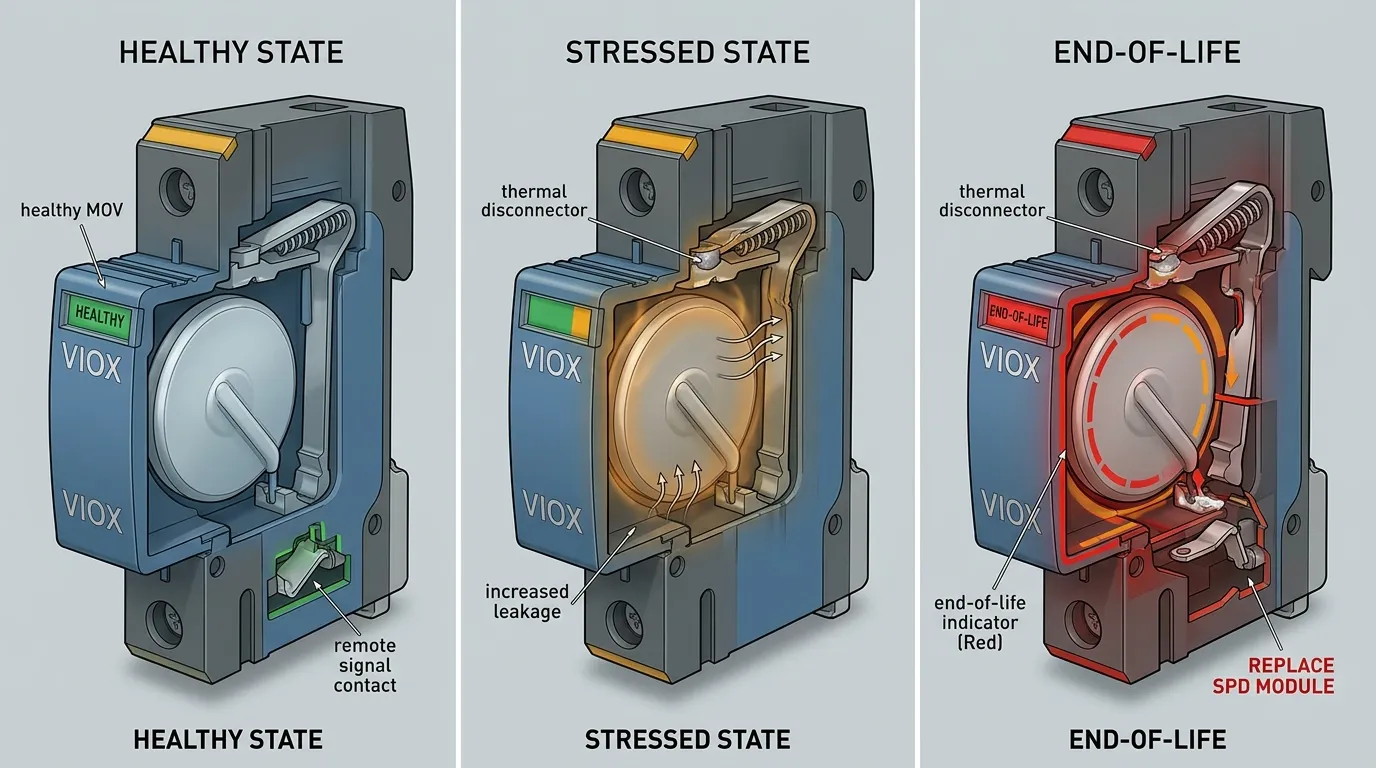
MOV aging is one of the most misunderstood SPD topics.
An MOV does not have a simple “used once and dead” rule. Some surges may be well within the MOV’s capability. Others may consume a significant part of its life. Repeated stress can gradually shift the MOV’s electrical characteristics.
Main aging drivers include:
- repeated surge current events
- temporary overvoltage above the intended continuous operating range
- high ambient temperature inside electrical panels
- poor grounding or long SPD connection leads
- incorrect Uc or MCOV selection
- operation in systems with unstable neutral or abnormal voltage rise
- excessive leakage current after earlier damage
The practical result is usually rising leakage current and heat. Once the MOV enters a degraded state, the SPD’s thermal disconnector should separate the MOV from the circuit before unsafe overheating develops.
This is why an SPD status window matters. A green indicator generally means the protection module is still connected. A red indicator generally means the module has disconnected and must be replaced. Always follow the specific manufacturer’s indication method.
MOV Failure Modes in Real Installations
Failure mode 1: Open circuit after thermal disconnection
This is the intended safe end-of-life mode in many modular SPDs. The MOV or its protection path becomes unsafe, so the thermal disconnector opens. The load still has power, but surge protection is reduced or lost.
Field risk: the system appears to operate normally, but the next surge may reach equipment with little or no SPD protection.
Failure mode 2: Increased leakage and heating
Before full disconnection, a damaged MOV may show increased leakage current and temperature rise.
Field risk: progressive heating can damage the module, discolor terminals, or create thermal stress inside the enclosure.
Failure mode 3: Short-circuit stress
Under severe overvoltage or surge stress, an MOV can fail toward a low-impedance state before the internal or external protective mechanism clears the condition.
Field risk: this is why SPD backup protection, thermal disconnectors, short-circuit current rating, and installation instructions must be followed.
Failure mode 4: Underspecified MOV array
If a low-quality SPD uses inadequate MOV sizing or poor current sharing between parallel MOVs, one element may be overstressed.
Field risk: the SPD may pass initial inspection but have weak real surge endurance.
Selection Lessons for SPD Buyers
When you understand the MOV, SPD selection becomes more disciplined.
1. Start with system voltage, not kA
The MOV must survive the actual continuous voltage of the system. Select Uc or MCOV based on the system voltage, earthing arrangement, voltage tolerance, and possible temporary overvoltage.
2. Check Up against equipment withstand level
The SPD must limit voltage low enough to protect downstream equipment. A large kA rating does not help if the voltage protection level is too high.
3. Compare In and Imax only under the same test context
Surge current numbers depend on waveform and standard. Compare like with like.
4. Look for thermal disconnection and status indication
Because MOVs age, the SPD should have a safe end-of-life mechanism. In panel applications, remote indication may be useful for maintenance teams.
5. Verify standards, not just component claims
A component-level MOV rating is not the same as an SPD product certification. For low-voltage power SPDs, the common standards framework includes IEC 61643-11 and UL 1449 depending on market.
For a standards overview, see Surge Protection Standards: IEC 61643 vs UL 1449 vs GB 18802 و TVSS در مقابل SPD: راهنمای استانداردهای UL 1449.
اشتباهات رایج
Mistake 1: Thinking MOVs absorb all surge energy
MOVs mainly clamp voltage and divert surge current. The installation’s grounding, bonding, conductor length, upstream system impedance, and SPD coordination all affect the final protection level.
Mistake 2: Choosing an SPD only by Imax
Imax is important, but it is not the first selection parameter. Uc, Up, In, system type, SPD type, backup protection, and installation location all matter.
Mistake 3: Ignoring MOV aging
An SPD is not a permanent fit-and-forget device. MOV-based SPDs can degrade under repeated stress. Visual inspection and replacement after end-of-life indication are part of responsible maintenance.
Mistake 4: Treating all MOV-based SPDs as equal
Two SPDs may both use ZnO MOVs but differ greatly in MOV size, parallel structure, thermal design, housing safety, terminals, status indication, and certification.
Mistake 5: Using an AC SPD on a DC system without verification
DC systems have different fault behavior and no natural current zero-crossing. A MOV element may be voltage-dependent, but the complete SPD must be designed and certified for the target AC or DC application.
Mistake 6: Ignoring installation lead length
Even a good MOV-based SPD cannot overcome poor installation. Long leads add inductive voltage during fast transients and raise the effective let-through voltage.
Where ZnO MOVs Are Used
ZnO MOVs appear in many protection products, including:
- Type 2 AC distribution SPDs
- Type 3 point-of-use SPDs
- DC SPDs for photovoltaic and battery systems when designed for DC use
- surge modules inside industrial control cabinets
- appliance and electronics surge suppression circuits
- hybrid SPDs combined with GDTs or spark gaps
They are less dominant in very high-speed data line protection, where capacitance and signal integrity matter more. In those circuits, TVS diodes, GDTs, or hybrid low-capacitance designs are more common.
If you are moving from component understanding to product evaluation, start with the VIOX SPD product page and verify the SPD type, Uc, Up, In, Imax, standards, pole configuration, and installation requirement against the real system.
سوالات متداول
What does ZnO MOV mean?
ZnO MOV means zinc oxide metal oxide varistor. It is a voltage-dependent ceramic component used to clamp surge voltage in many surge protective devices.
Is an MOV the same as an SPD?
No. The MOV is a component inside many SPDs. The SPD is the complete protective device, including housing, terminals, thermal disconnection, status indication, coordination features, and product-level certification.
Why are MOVs used in most power SPDs?
MOVs offer a practical balance of fast clamping behavior, surge current capability, compact size, and cost. That makes them suitable for many low-voltage AC and DC power surge protection applications.
Do MOVs wear out?
Yes. MOVs can age under repeated surge stress, temporary overvoltage, heat, and rising leakage current. A quality SPD should include end-of-life disconnection and status indication.
What happens when an MOV fails?
Depending on the fault condition and SPD design, a degraded MOV may disconnect through a thermal mechanism, show increased leakage and heating, or fail under severe stress. This is why thermal protection and backup protection are essential.
Is a higher kA MOV always better?
No. Surge current rating matters, but the SPD must also match system voltage, voltage protection level, SPD type, installation location, standard, and coordination requirements.
Can a ZnO MOV be used on DC circuits?
MOV technology can be used in DC SPDs, but the complete SPD must be designed and rated for DC operation. Do not use an AC-only SPD on a DC system unless the datasheet explicitly allows it.
Why does an SPD have a red or green indicator?
The indicator shows whether the protection module is still connected or has reached end of life, depending on the manufacturer’s design. In MOV-based SPDs, the indicator often reflects the state of the thermal disconnector.