

در این صفحه
Short Answer: Imax and In Do Different Jobs
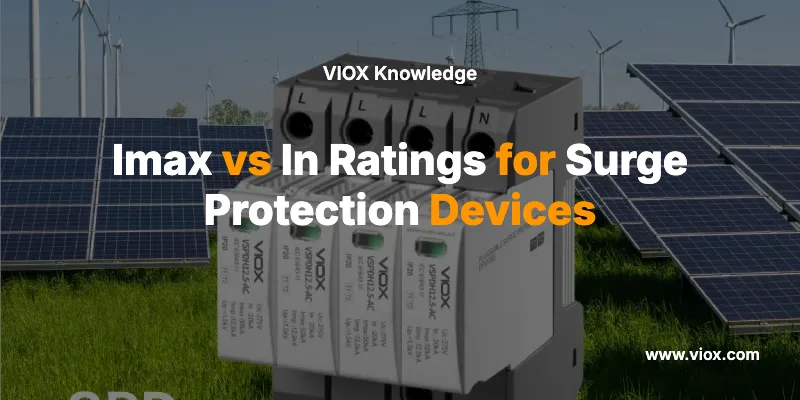
در یک دستگاه حفاظت از ولتاژهای ناگهانی (SPD), در و آیمکس are both surge-current ratings, but they do not mean the same thing.
در, or nominal discharge current, describes the SPD’s ability to handle a defined repeated surge-current duty. It is the better indicator of normal surge durability under standardized testing.
آیمکس, or maximum discharge current, describes the highest 8/20 us surge current value the SPD can discharge under specified test conditions. It is more about upper surge capability than everyday life expectancy.
The practical rule:
Use In to judge repeated surge-duty capability. Use Imax to judge maximum single-event surge-current capacity. Do not select an SPD by Imax alone.
If you are new to the device category, start with VIOX’s broader guide on what is a surge protection device. This article focuses specifically on how to read the rating label.
The Four SPD Ratings Buyers Should Read Together
Imax and In are important, but they are not the only ratings that determine whether an SPD fits a real system. At minimum, read یوسی, بالا, در، و آیمکس together.
| رتبهبندی | معنی | چرا مهم است؟ |
|---|---|---|
| یوسی | حداکثر ولتاژ کاری مداوم | Must match the real system voltage |
| بالا | سطح حفاظت ولتاژ | Determines let-through voltage |
| در | جریان تخلیه اسمی | Shows repeated surge duty capability |
| آیمکس | حداکثر جریان تخلیه | Shows one-time high surge capability |
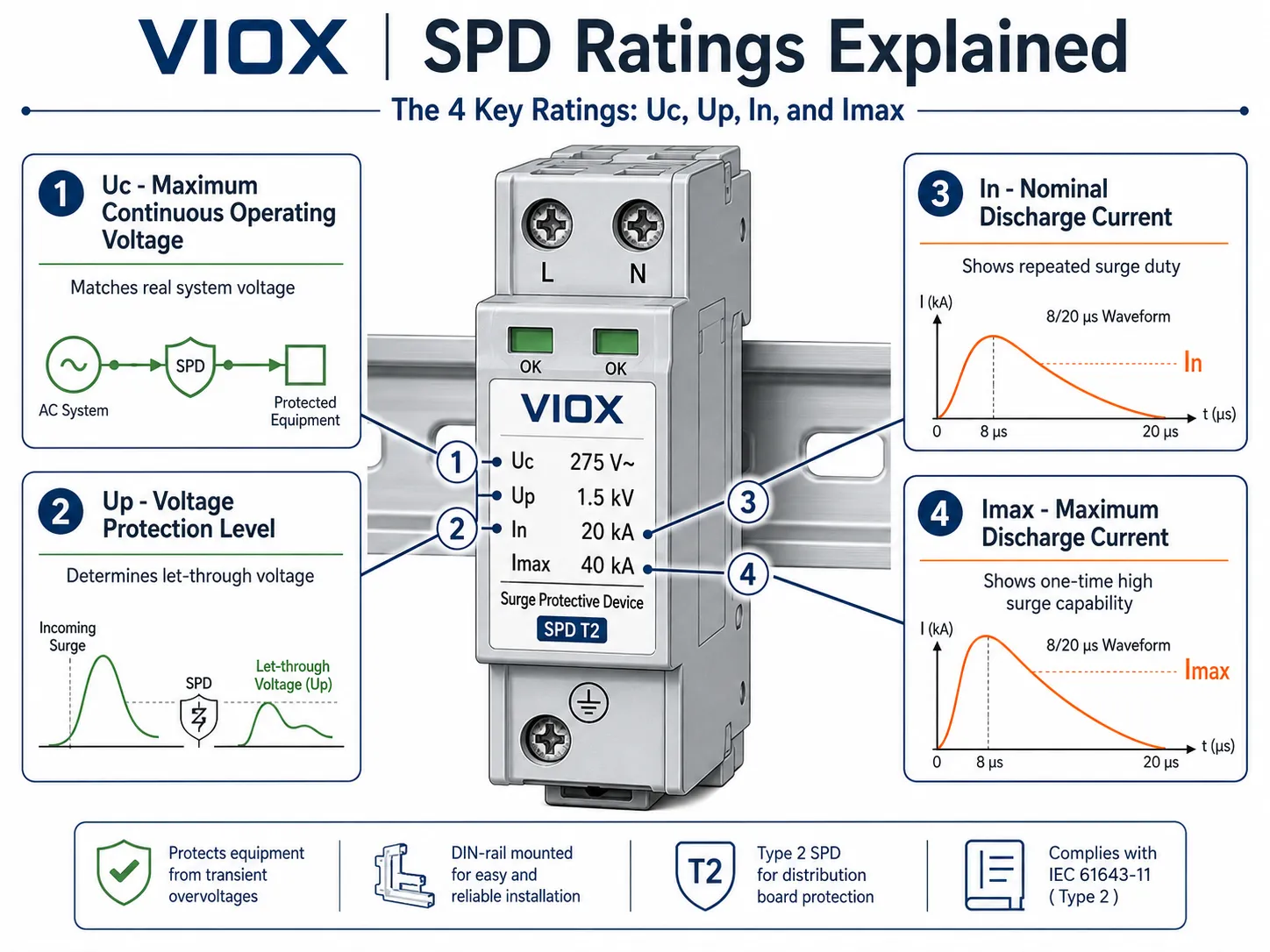
This table is the safest way to avoid the most common SPD selection error: choosing the device with the biggest kA number while ignoring whether its voltage rating and protection level are appropriate.
VIOX already has a dedicated explanation of what Uc and Up mean on an SPD. This article keeps those voltage parameters inside the Imax/In discussion so the existing page becomes more complete without needing a new URL.
What Is In in an SPD?
در است. "kA" مخفف nominal discharge current. It is a standardized surge-current rating used to describe the current that an SPD can discharge under defined test conditions, commonly using the 8/20 us current waveform for low-voltage power SPDs.
In practical terms, In tells you how robust the SPD is under repeated surge exposure. A higher In rating generally indicates stronger repeated-duty capability, assuming the products are being compared under the same standard, SPD type, voltage rating, and technology.
What In does tell you
In helps answer:
- How much surge current can this SPD handle under nominal test duty?
- Is this device suitable for repeated surge exposure at this installation point?
- How does this SPD compare with another device in the same product class?
What In does not tell you
In does not tell you:
- the correct system voltage
- the let-through voltage to downstream equipment
- the maximum single surge the device can survive
- whether the SPD is Type 1, Type 2, or Type 3
- whether the device is suitable for AC, DC, or PV application
به همین دلیل است که In باید همراه با Uc، Up، Imax، نوع SPD و استاندارد محصول مربوطه خوانده شود.
Imax در یک SPD چیست؟
آیمکس است. "kA" مخفف حداکثر جریان تخلیه. این مقدار، حداکثر مقدار پیک یک جریان تخلیه 8/20 میکروثانیه است که SPD میتواند تحت شرایط آزمون مشخصشده تحمل کند.
Imax مفید است زیرا ظرفیت بالای جریان ضربهای دستگاه را نشان میدهد. با این حال، نباید به عنوان یک رتبه عملیاتی عادی یا وظیفه تکراری در نظر گرفته شود. این مقدار با “جریانی که SPD هر بار هنگام وقوع صاعقه دریافت میکند” متفاوت است.”
Imax چه چیزی را به شما میگوید
Imax به پاسخگویی به موارد زیر کمک میکند:
- بالاترین سطح استاندارد جریان ضربهای 8/20 میکروثانیه که این SPD برای تخلیه آن رتبهبندی شده است، چقدر است؟
- آیا SPD برای سطح مواجهه مورد انتظار، فضای کافی (Headroom) دارد؟
- ظرفیت حداکثر جریان ضربهای در مقایسه با سایر SPDهای نوع 2 مشابه چگونه است؟
آنچه Imax به شما نمیگوید
Imax به شما نمیگوید:
- طول عمر SPD چقدر خواهد بود
- آیا این دستگاه به اندازه کافی از تجهیزات الکترونیکی حساس محافظت میکند یا خیر
- whether the SPD is coordinated with upstream or downstream protection
- whether the installation lead length is acceptable
- whether the voltage protection level is low enough
A high Imax value can look impressive on a datasheet, but a high Imax with the wrong Uc or a poor Up value can still be the wrong selection.
Imax vs In: The Core Difference
| نقطه مقایسه | In – Nominal discharge current | Imax – Maximum discharge current |
|---|---|---|
| هدف اصلی | Repeated surge-duty capability | Maximum 8/20 us surge-current capability |
| Selection role | Long-term robustness and normal surge exposure | High-surge headroom |
| Typical waveform context | 8/20 us current waveform | 8/20 us current waveform |
| Best used for | Comparing durability within the same SPD class | Checking maximum surge-current margin |
| اشتباه رایج | Treating In as the absolute maximum | Treating Imax as the only rating that matters |
| What to check next | Uc, Up, SPD type, system earthing, installation point | In, Up, Uc, coordination, backup protection |
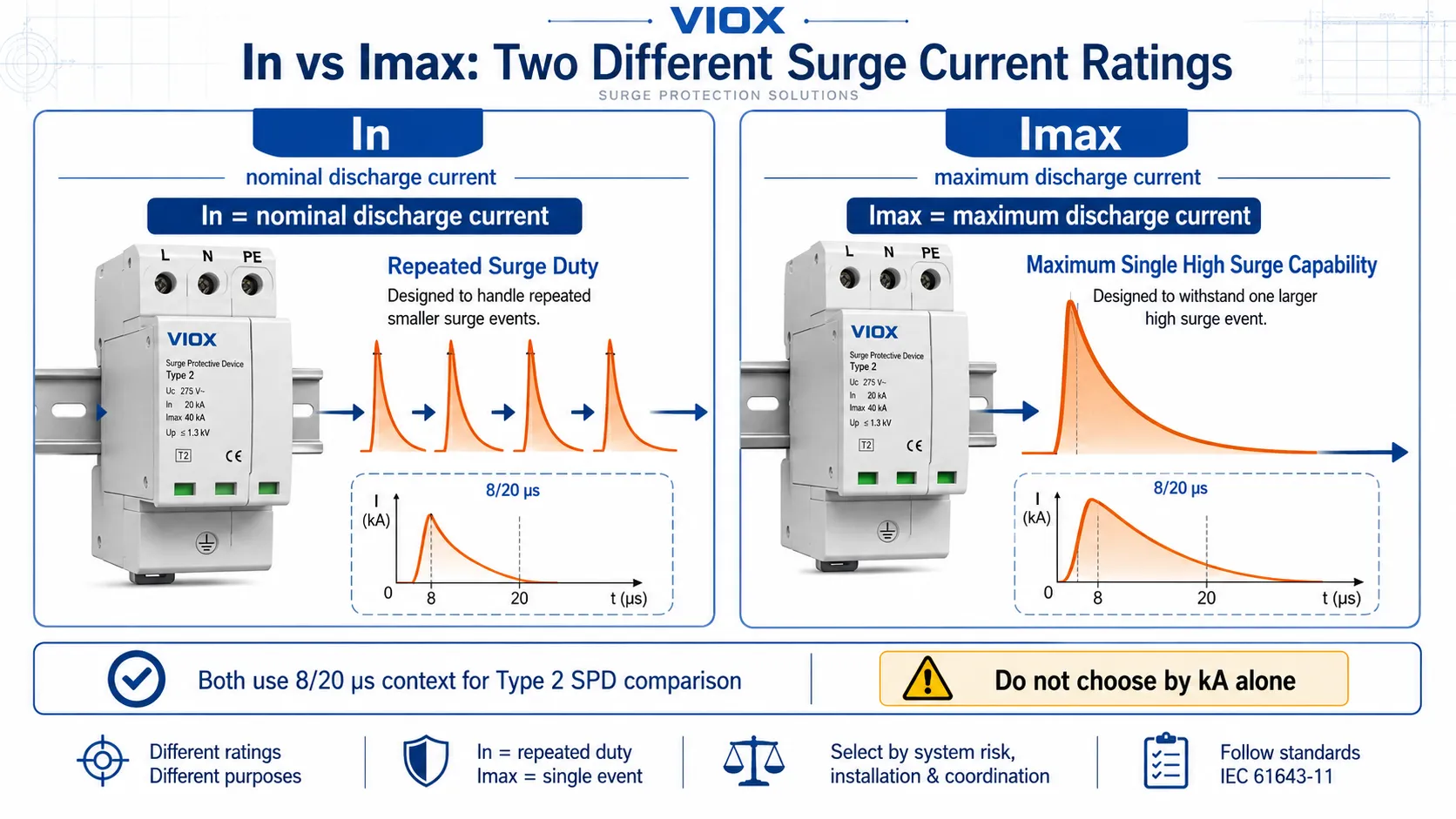
The most balanced selection is not always the device with the largest Imax. For many panel and distribution applications, a well-matched SPD with appropriate Uc, low enough Up, suitable In, correct Type, and short lead length will outperform a poorly installed device with a bigger headline Imax value.
Where Uc Fits Into the Imax vs In Decision
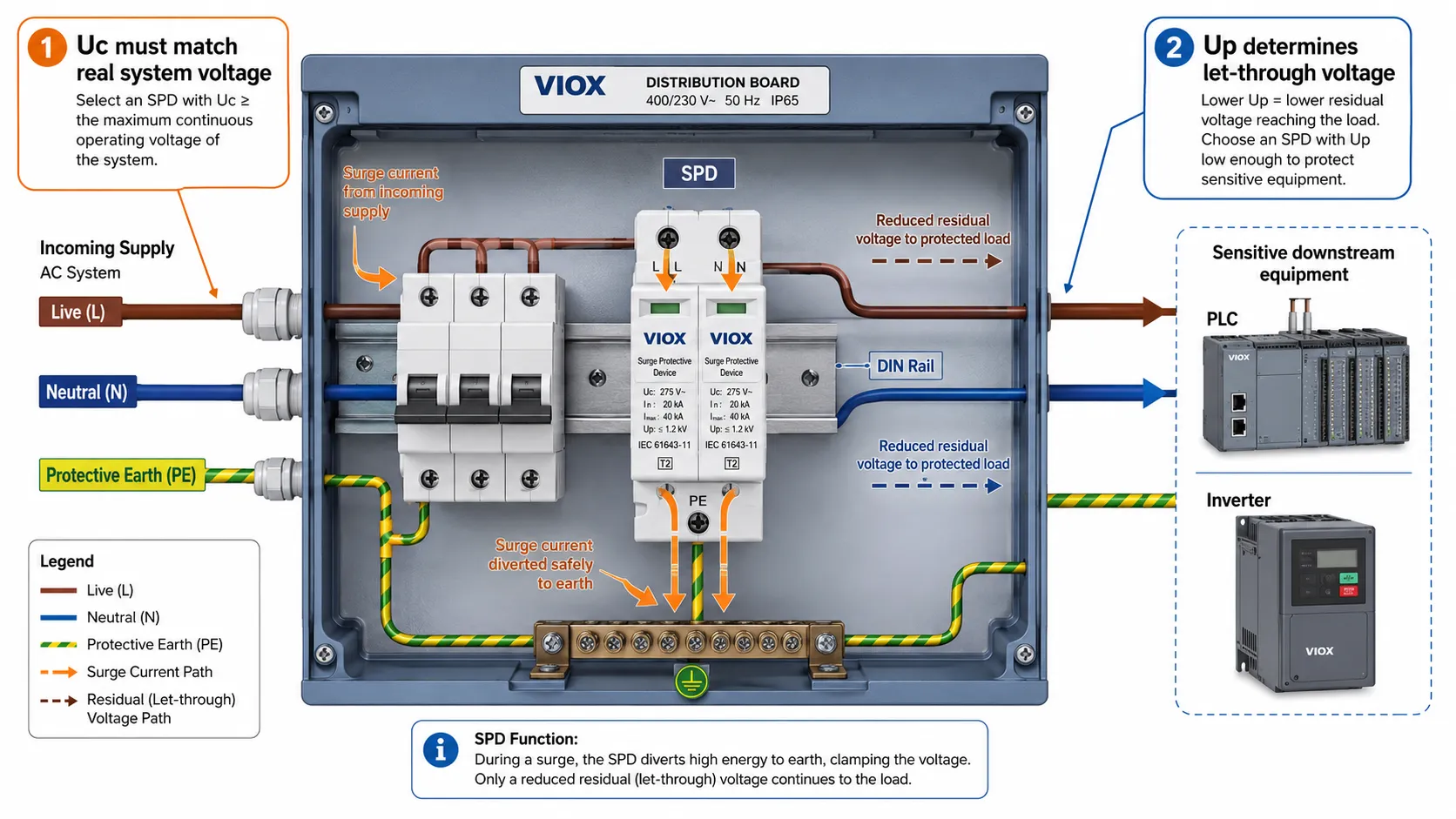
یوسی, or maximum continuous operating voltage, is the highest voltage the SPD can continuously withstand between its terminals without operating abnormally.
This rating must match the real electrical system, not just the marketing name of the system. For example:
- AC systems require the correct Uc for the line-to-neutral, line-to-earth, or line-to-line arrangement depending on SPD mode.
- TT, TN-S, TN-C-S, and IT earthing systems can require different SPD arrangements.
- PV DC systems require Ucpv or the relevant DC continuous operating voltage rating matched to the maximum PV string voltage.
If Uc is too low, the SPD may operate or degrade during normal voltage conditions or temporary overvoltage events. If Uc is too high, the SPD may not clamp early enough to provide the desired protection level.
This is why Uc is the first voltage check before comparing In and Imax.
Where Up Fits Into the Imax vs In Decision
بالا, or voltage protection level, is the voltage that appears across the SPD terminals during the specified surge test condition. In practical language, it is the let-through voltage the protected equipment may still see.
This matters because an SPD does not make the surge disappear. It diverts surge current and limits voltage. The downstream equipment is still exposed to a remaining voltage level.
A lower Up value generally means better voltage limitation, but only when compared under the same standard, test condition, SPD type, system voltage, and installation method. In real panels, lead length and grounding layout can add additional voltage on top of the SPD’s tested Up.
For sensitive equipment, Up should be checked against the equipment’s impulse withstand capability and the protection coordination strategy. For a broader installation view, see VIOX’s guide on how surge protective devices differ from other electrical surge protection methods.
چرا انتخاب تنها بر اساس کیلوآمپر (kA) پرخطر است
بسیاری از خریداران، برقگیرها (SPD) را تنها با یک عدد جریان مقایسه میکنند:
“این یکی ۴۰ کیلوآمپر است. آن یکی ۶۰ کیلوآمپر. پس دستگاه ۶۰ کیلوآمپری باید بهتر باشد.”
این میانبر پرخطر است، زیرا سایر مشخصات روی برچسب را نادیده میگیرد.
دو برقگیر نوع ۲ (Type 2) را برای یک ولتاژ سیستم یکسان در نظر بگیرید:
| اس پی دی | یوسی | بالا | در | آیمکس | انتخاب بهتر؟ |
|---|---|---|---|---|---|
| برقگیر A | مناسب برای سیستم | Lower Up | Strong In | Moderate Imax | Often stronger for equipment protection |
| SPD B | مناسب برای سیستم | Higher Up | Lower In | Higher Imax | May have bigger surge-current headline but weaker protection fit |
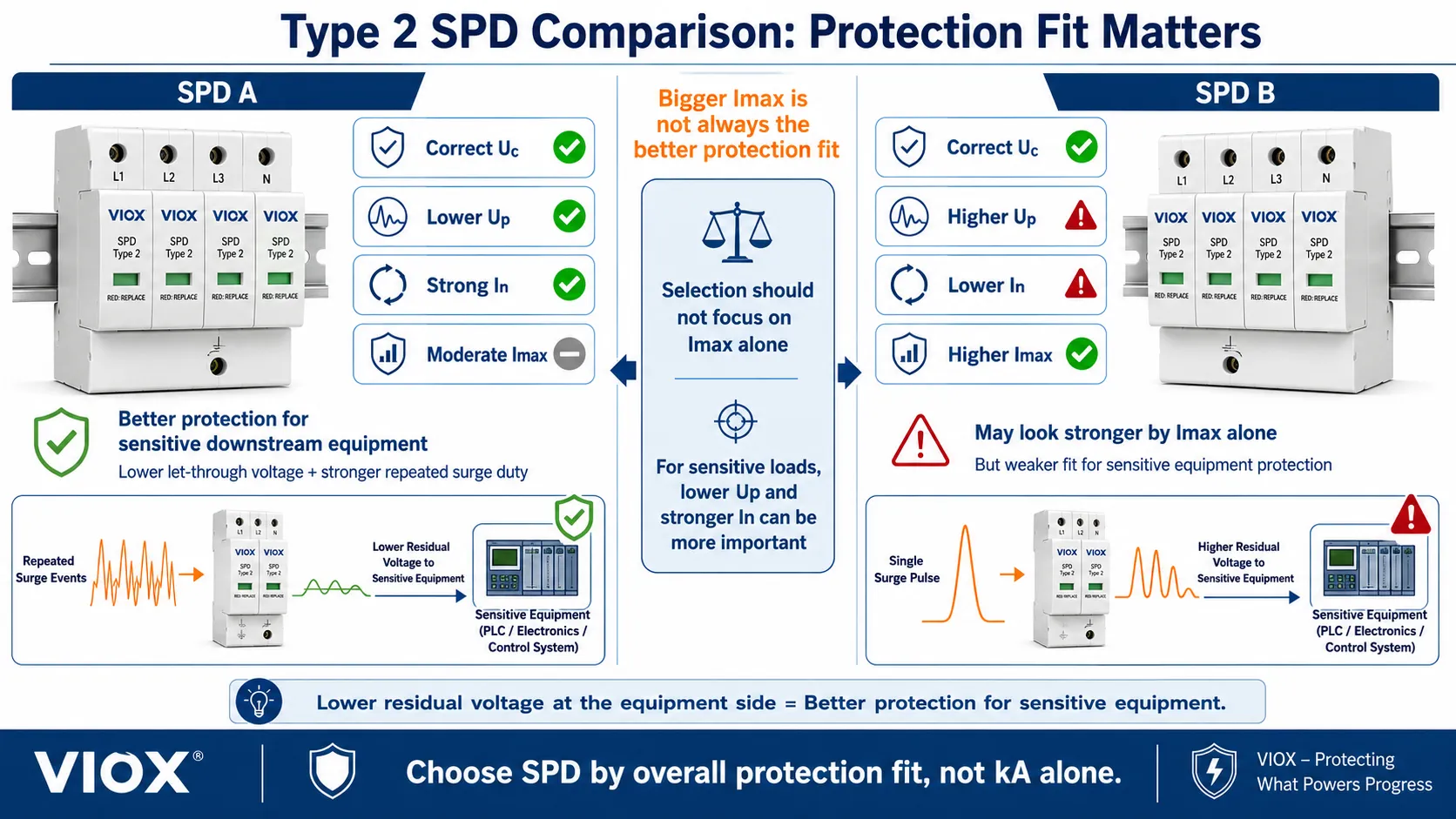
The better choice depends on the complete protection objective. If the equipment is sensitive, Up may matter more than chasing the largest Imax. If the site has frequent surge exposure, In may be more important than a very high one-time maximum rating. If the system voltage does not match Uc, neither device is acceptable.
SPD Type Matters: Type 1, Type 2, and Type 3
The role of In and Imax also depends on SPD type.
| نوع SPD | Typical installation role | Main rating focus |
|---|---|---|
| نوع ۱ | Service entrance or lightning-current exposure zone | Impulse current capability, often expressed as Iimp under IEC practice |
| نوع ۲ | Distribution boards and sub-distribution panels | In and Imax are commonly compared |
| نوع ۳ | Point-of-use or equipment-level protection | Up, coordination distance, and equipment compatibility are critical |
For Type 1 SPDs, do not reduce the selection only to Imax. In IEC practice, آیمپ with the 10/350 us waveform is a key lightning-current parameter. For Type 2 SPDs, In and Imax are more commonly used in buyer comparisons. For Type 3 SPDs, voltage protection and coordination become especially important.
For a deeper type comparison, see دستگاه محافظ ولتاژ نوع ۱ در مقابل نوع ۲ در مقابل نوع ۳.
AC, DC, and PV SPDs: Do Not Mix the Standards
The same label logic applies across SPDs, but the applicable standard and voltage system must be correct.
- AC low-voltage SPDs are commonly evaluated under IEC 61643-11 or UL 1449 depending on market.
- PV DC-side SPDs are evaluated under IEC 61643-31 in IEC markets, with PV systems up to 1500 V DC covered by that standard’s scope.
- North American SPDs often use UL 1449 terminology and rating systems, including MCOV and VPR, which should not be confused one-to-one with IEC labels without checking the datasheet.
If the project is solar, EV, or industrial DC, review the actual DC rating. Do not use an AC SPD simply because the Imax number looks strong. VIOX’s DC surge protection device guide covers that application boundary in more detail.
How to Read an SPD Label in the Right Order
Use this sequence when comparing SPDs:
- Confirm the SPD type and standard. Type 1, Type 2, Type 3, IEC, UL, AC, DC, or PV application.
- Check Uc or MCOV. The SPD must tolerate the real continuous system voltage.
- Check Up or VPR. The let-through voltage must be suitable for the equipment being protected.
- Check In. This shows repeated surge-duty capability under the relevant test condition.
- Check Imax. This shows maximum 8/20 us discharge-current capability.
- Check Iimp if Type 1 lightning-current exposure is relevant.
- Check backup protection and short-circuit current rating.
- Check installation details. Lead length, grounding, bonding, panel location, and protection coordination affect real performance.
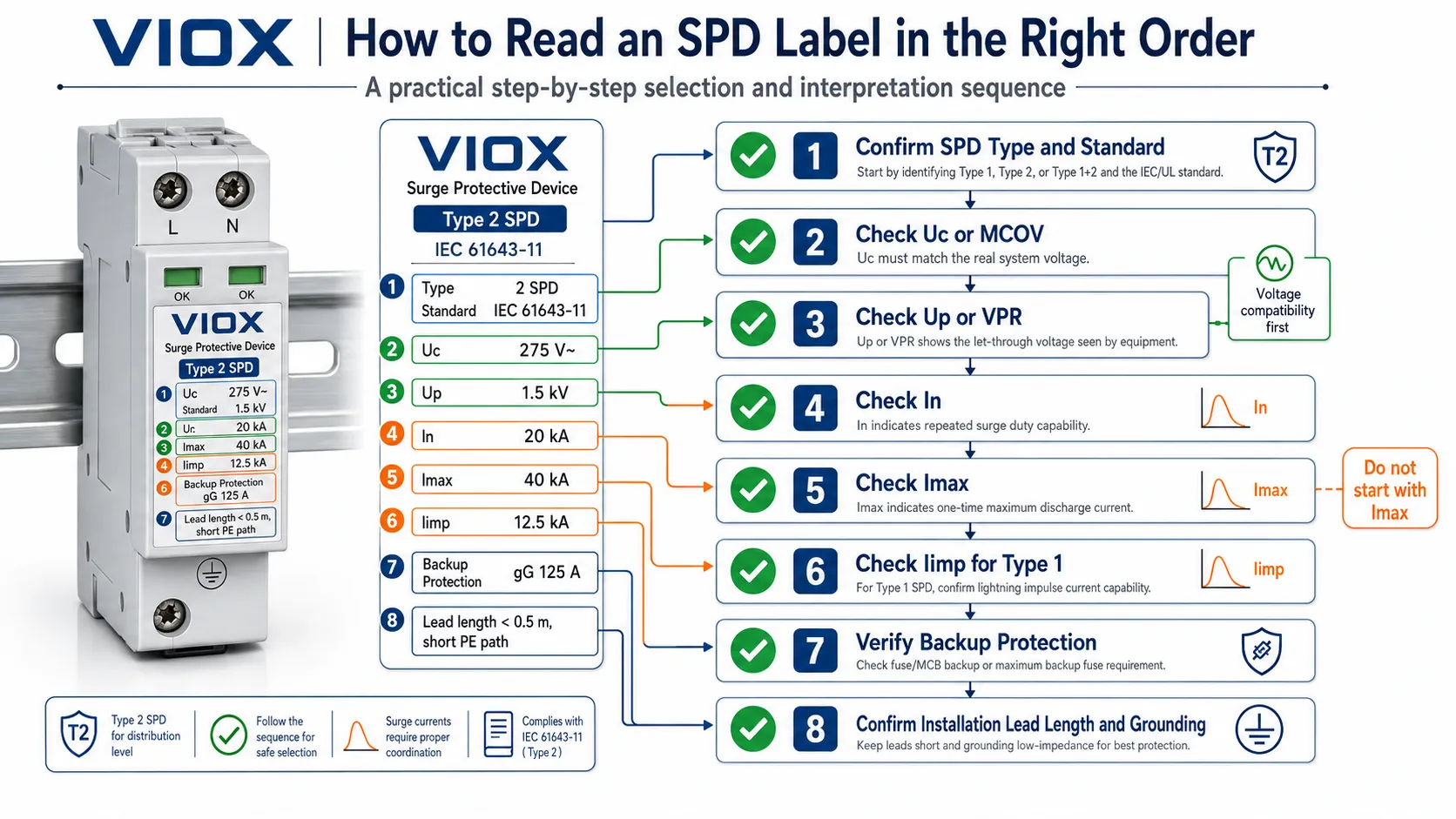
This sequence prevents the common error of starting with Imax and forgetting the voltage side of the protection problem.
Common Mistakes When Comparing Imax and In
Mistake 1: Choosing the largest Imax without checking Uc
If Uc does not match the system, the SPD is not suitable. A high Imax value does not fix a wrong continuous operating voltage.
Mistake 2: Treating Imax as a life expectancy rating
Imax is not the normal repeated-duty value. In is more useful when comparing repeated surge endurance within the same class of SPD.
Mistake 3: Ignoring Up
An SPD can have high current-handling capability but still let through too much voltage for sensitive downstream equipment. Up is the protection-quality parameter buyers often overlook.
Mistake 4: Comparing AC and PV SPDs by the same kA number
PV systems have different DC voltage behavior, polarity considerations, and standards. For PV DC-side SPDs, check the relevant DC and PV markings.
Mistake 5: Assuming installation does not affect protection
Long leads, poor grounding, and bad routing add voltage during a surge event. A good Up rating on the datasheet can be undermined by poor installation practice.
Mistake 6: Forgetting end-of-life indication
SPDs degrade after surge events. Status indication, remote signaling, and replaceable modules matter in maintainable panel designs. For MOV-based SPD aging, see ZnO MOV Explained.
چک لیست انتخاب عملی
Before approving an SPD, confirm:
- the SPD type matches the installation point
- Uc or MCOV matches the real system voltage and earthing arrangement
- Up or VPR is low enough for the protected equipment
- In is appropriate for expected repeated surge exposure
- Imax حاشیه جریان ضربهای کافی ۸/۲۰ میکروثانیه را فراهم میکند
- Iimp در مواردی که عملکرد جریان صاعقه نوع ۱ مورد نیاز است، بررسی میشود
- کاربرد AC، DC یا PV به وضوح مشخص شده است
- حفاظت در برابر جریان اضافه پشتیبان طبق دستورالعمل سازنده انجام میشود
- نرخ جریان اتصال کوتاه برای محل نصب مناسب است
- طول هادی و مسیر اتصال به زمین به درستی طراحی شدهاند
- نشانگر وضعیت یا سیگنالدهی از راه دور در مواردی که دسترسی برای تعمیر و نگهداری اهمیت دارد، گنجانده شده است
اگر در حال گذار از تفسیر نرخها به ارزیابی محصول هستید، موارد زیر را بررسی کنید VIOX SPD product range and verify each model against the system voltage, SPD type, standard, and installation point.
سوالات متداول
What is the difference between Imax and In in an SPD?
In is the nominal discharge current and indicates repeated surge-duty capability under standardized conditions. Imax is the maximum discharge current and indicates the highest 8/20 us surge-current level the SPD can handle under specified test conditions.
Is higher Imax always better?
Not by itself. A higher Imax gives more maximum surge-current headroom, but the SPD must also have correct Uc, suitable Up, appropriate In, correct type, and proper installation.
Is In more important than Imax?
For repeated surge exposure, In is often more meaningful. For maximum surge-current headroom, Imax matters. Neither should be read alone.
What does Uc mean on an SPD?
Uc is the maximum continuous operating voltage. It tells you the highest voltage the SPD can continuously withstand without abnormal operation. It must match the real system voltage and earthing arrangement.
What does Up mean on an SPD?
Up is the voltage protection level. It represents the voltage that remains across the SPD during the specified surge test. In practical terms, it is the let-through voltage that downstream equipment may still experience.
Should I choose SPD by kA rating only?
No. The kA rating only describes surge-current capability. SPD selection also depends on Uc, Up, SPD type, standard, system voltage, earthing system, backup protection, short-circuit rating, and installation lead length.
Is Imax the same as Iimp?
No. Imax is normally associated with the 8/20 us discharge-current waveform. Iimp is impulse current, typically associated with the 10/350 us waveform for Type 1 lightning-current duty under IEC practice.
Do AC and DC SPDs use the same ratings?
Some rating names are similar, but the application standards and voltage behavior differ. AC SPDs, PV DC SPDs, and North American UL 1449 SPDs must be checked against their own datasheets and applicable standards.
نکتهی اصلی
Imax and In are both important SPD current ratings, but they answer different questions. In tells you about repeated surge-duty capability. Imax tells you about maximum 8/20 us surge-current capability.
For real selection, do not stop there. Read یوسی, بالا, در، و آیمکس together. Uc confirms that the SPD can live on the system continuously. Up shows how much voltage may still reach the equipment. In shows repeated surge robustness. Imax shows maximum surge-current headroom.
That four-rating view makes the existing Imax vs In page stronger, more accurate, and more useful for both engineers and buyers.
Sources Reviewed
- IEC 61643-11:2025 – Low-voltage surge protective devices for AC low-voltage power systems
- IEC 61643-31:2018 – برقگیرها (SPD) برای تاسیسات فتوولتائیک
- UL 1449 Ed. 5-2021 – تجهیزات حفاظت در برابر ولتاژهای ضربه (Surge)
- موسسه حفاظت در برابر ولتاژ ضربه NEMA – مروری بر استاندارد UL 1449
- VIOX – مفاهیم Uc و Up در برقگیرها (SPD) چیست؟
- VIOX – استانداردهای حفاظت در برابر ولتاژ ضربه: مقایسه IEC 61643 با UL 1449 و GB 18802