

On this page
Short Answer
A definite purpose contactor is an application-specific North American contactor class, commonly used for heating, ventilation and air conditioning (HVAC) compressors, refrigeration equipment and pump or heating loads. “Definite purpose” is not merely a marketing phrase. Its ratings typically use FLA, LRA and RES, with horsepower ratings where declared, rather than relying on an IEC AC-3 operational-current rating alone. Certification must be verified for the exact device and intended application.
The practical difference is the language of selection: a DP label separates running motor current, locked-rotor duty and resistive duty. Matching one ampere number to an IEC or NEMA catalog entry does not establish a suitable replacement.
What Makes the Purpose “Definite”?
The manufacturer designs and evaluates the contactor for defined loads and operating conditions. An original equipment manufacturer (OEM) can select it around a known compressor, supply voltage, starting demand and switching duty, rather than buying a general-purpose device for many possible industrial jobs.
UL’s industrial-control equipment overview explicitly includes definite purpose controllers. This supports the category’s technical status; it does not certify every product advertised as DP. The actual model still needs its applicable certification record, ratings and conditions of use.
Also distinguish UL Listed equipment from UL Recognized components. Neither status follows automatically from the words “definite purpose.” For example, Schneider Electric documents different recognition/listing arrangements within its 8910 range. An OEM component approval is not unrestricted permission to substitute it into any panel.
This article focuses on interpreting those limits. For the basic device definition and switching function, see What Is a Contactor?.
Read the Ratings as Separate Questions
FLA: the first motor-current check
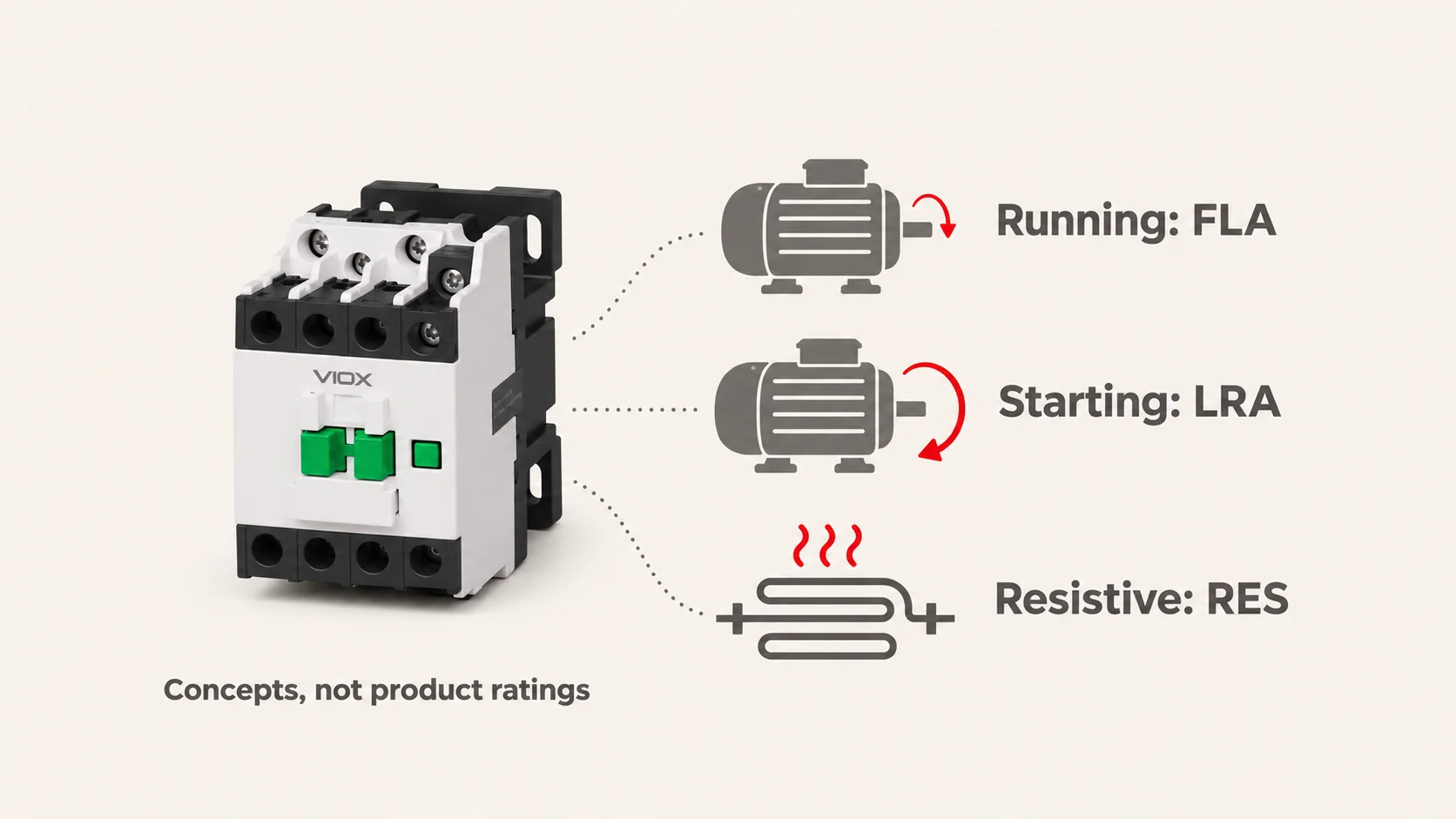
FLA means full-load amperes. On a DP contactor, it identifies the declared running-load current capability for the specified motor duty. It is the first current-rating check, not the only acceptance criterion.
Compare the contactor’s rating with the equipment manufacturer’s required contactor duty and the load information specified for that equipment. Compressor documentation may use rated-load amperes, or RLA, and may distinguish that value from measured operating current. Do not substitute a clamp-meter reading taken on a mild day for the OEM’s required rating.
A contactor marked with a higher resistive current but insufficient motor FLA has not passed this check. Neither has a device whose FLA is adequate but whose voltage-specific starting duty is too low. The contactor also does not provide overload or short-circuit protection merely because it carries a motor-current rating.
LRA: starting duty has its own limit
LRA means locked-rotor amperes: the motor current associated with a rotor that is not turning under the specified conditions. It is relevant to starting and abnormal stalled conditions, but it is not a permissible continuous operating current.
The motor’s LRA describes demand; the contactor’s LRA rating describes its declared capability. Check the applicable voltage and the manufacturer’s making/breaking-duty conditions. An LRA figure is also not a short-circuit interrupting rating.
Copeland’s explanation of general-purpose and DP contactors highlights that DP inrush capability commonly changes with system voltage. Consequently, do not carry a low-voltage LRA number across to a higher-voltage application.
There is no safe universal multiplier that turns every FLA label into its LRA rating. Read the published table. A particular catalog may show a consistent relationship across several sizes, but another construction, pole arrangement or voltage column can differ. The worked example below demonstrates the relationship within one documented family without making it an industry-wide rule.
RES: a different load, not spare motor capacity
RES means resistive-load amperes. It describes the declared duty for loads such as resistance heating, within the manufacturer’s conditions.
A resistive circuit generally imposes a different switching burden from a motor circuit, including different current phase relationships and starting behavior. That is why the same contactor can carry a higher RES rating than its motor FLA rating. It does not mean the contactor has hidden motor capacity available whenever the larger figure is convenient.
Use RES for the load type and voltage covered by that declaration. Do not apply it to a compressor, transformer or another load simply because its measured running current is low. Likewise, “resistive” is not a blanket authorization for every heating assembly: its actual switching conditions still matter.
HP: read voltage and phase together
HP means horsepower, a motor application rating. A useful label or catalog associates it with voltage and whether the motor is single-phase or three-phase. A bare HP number is incomplete selection information.
Do not derive an approved HP rating by converting electrical watts into mechanical horsepower. That calculation cannot recreate the manufacturer’s evaluated starting and switching duty. If the HP column is blank, a rating has not been established by that table; borrowing the adjacent phase or voltage entry is not acceptable.
Current classes, poles and the coil
Public DP catalogs include familiar 25, 30, 40, 50 and 60 A FLA classes. These are catalog choices, not a standardized promise that every manufacturer supplies identical performance at those numbers. Verify the complete row, terminal arrangement and ordering suffix.
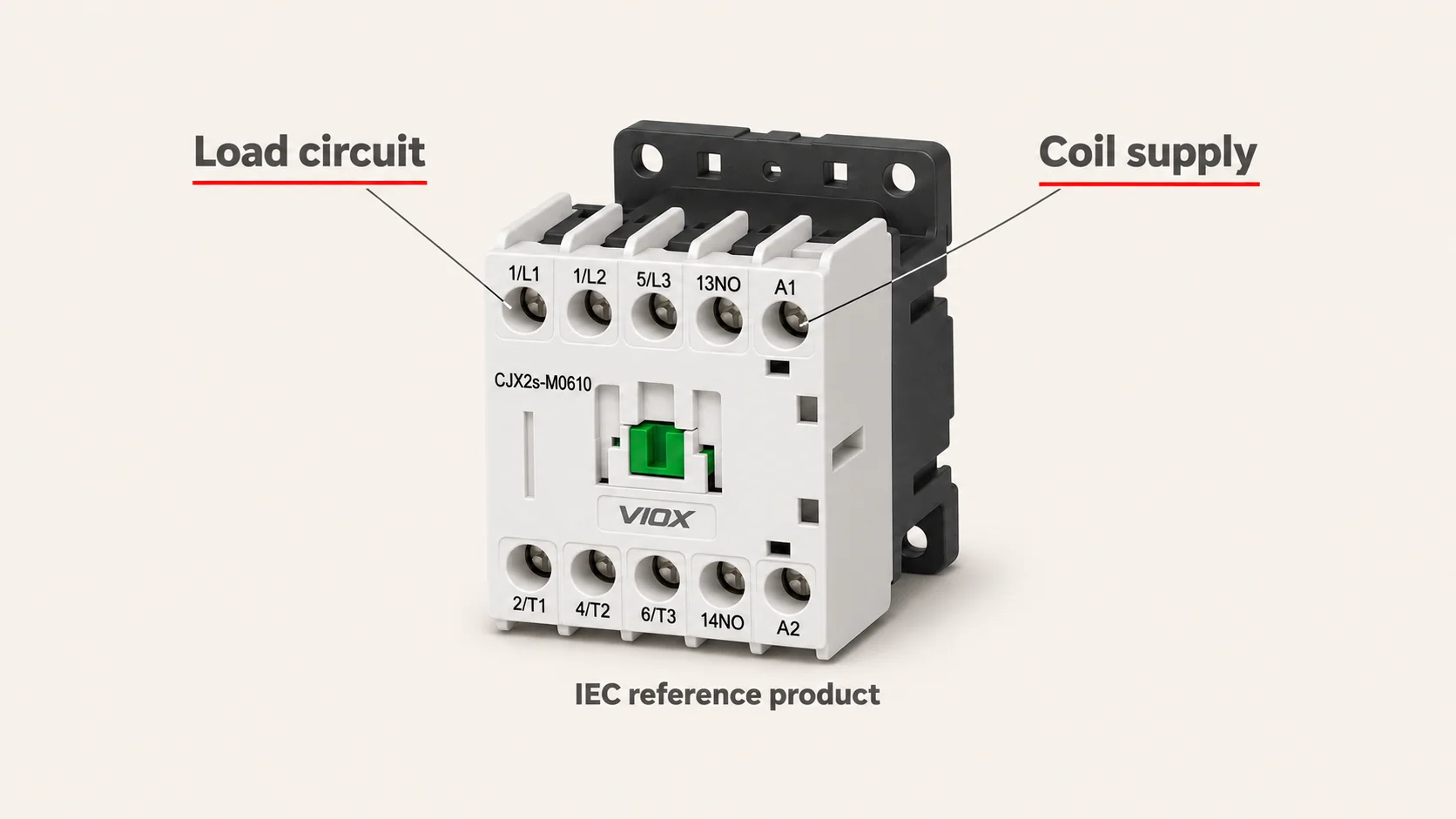
The coil voltage belongs to the control circuit; the contact voltage belongs to the switched circuit. They can be different. Match AC or DC coil supply, nominal voltage and frequency where applicable. Confirm control-circuit capacity from the exact coil data rather than assuming a physically similar coil draws the same power.
Pole configuration is another independent field. Record the original circuit arrangement and the manufacturer’s drawing. For the distinction between switched poles and a fixed shunt, and the related replacement decision, use Understanding 1 Pole vs 2 Pole AC Contactors.
Worked Example: One Real Eaton Catalog Entry
The following is a reading exercise from Eaton CA08100006E, June 2021, pages V5-T4-9 and V5-T4-10, not a reconstructed label or a current replacement recommendation. The three-pole entry is C25DNF340_, completed by a coil suffix.
| Published field | Value in this entry |
|---|---|
| Inductive full-load current | 40 A |
| Resistive current per pole | 50 A |
| LRA at 115 / 230 / 460 / 575 V | 240 / 240 / 200 / 160 A |
| Three-phase HP at 230 / 460 / 575 V | 10 / 20 / 20 HP |
| Coil suffix T | 24 V AC, 50/60 Hz |
Source: Eaton’s original C25 selection and coil tables. The completed ordering designation using that suffix is C25DNF340T.
The motor, resistive and starting-duty fields are separate limits. Higher line voltage does not preserve the same LRA capability. For this row, LRA is six times FLA at 230 V, five times at 460 V and four times at 575 V. Those calculated ratios belong to this entry, not every DP contactor. Verify current documentation before procurement.
DP vs IEC AC-3 vs NEMA General Purpose
These labels describe different selection frameworks. The comparison below stays centered on the question a DP buyer faces: what additional evidence is needed when the alternative uses another framework?
| Selection issue | Definite purpose | IEC contactor, AC-3 duty | NEMA general-purpose contactor |
|---|---|---|---|
| Main rating language | FLA, voltage-specific LRA, RES; HP if declared | Rated operational current Ie and voltage for the declared utilization category | NEMA size, motor HP and applicable current ratings |
| Selection starting point | Defined equipment load and OEM requirements | Actual load duty and published category rating | Appropriate size and published motor-duty limits |
| Design emphasis | Optimization for the intended equipment and duty | Selection close to specified utilization and operating conditions | Broader general-purpose motor-control application envelope |
| Size/cost logic | Application-specific construction can reduce material and features | Compact application matching is also possible; not necessarily larger than DP | Broader capability and service features can increase size and purchase cost |
| Evidence needed for substitution | Full original duty and certification requirements | Appropriate North American approvals and ratings, not AC-3 amperes alone | Relevant current, starting duty, coil and equipment acceptance, not size alone |
For utilization-category definitions, use AC1, AC2, AC3 and AC4 Contactors Explained.
Why there is no direct conversion table
The same numerical current can be tied to different voltages, load characteristics, switching duties and evaluation conditions. An AC-3 Ie figure does not supply missing DP locked-rotor data. A DP resistive rating does not establish AC-3 motor capability. A NEMA size does not identify the correct control coil or prove acceptance inside a particular refrigeration unit.
A manufacturer may publish multiple rating systems for one product. Those declarations provide evidence for that exact device; they do not create a universal cross-reference between product families. Start from the equipment requirement and check the candidate’s documented ratings, rather than translating the largest number on its label.
Smaller and cheaper does not mean interchangeable
DP construction can be optimized around a known job and required duty rather than maximum flexibility. A reduced accessory ecosystem or a narrower application envelope can make economic sense in OEM equipment. That is a design tradeoff, not proof of poor quality or a guaranteed price advantage over every IEC contactor.
For electrical endurance, Eaton states a minimum 200,000 operations for its standard C25 line (cited catalog, V5-T4-8). This is not a universal DP lifespan or service-year prediction. Compare the declared load, duty and test conditions across products.
A2L Refrigerants Add an Ignition-Source Check
A2L refrigerants are mildly flammable; suitable electrical switching components must be considered within the equipment’s ignition-risk assessment. A contactor can meet its current and coil requirements while still lacking the evidence required for that refrigerant application.
The transition is real, but a single deadline does not describe every North American system. The EPA Technology Transitions Program applies restrictions by sector and subsector. Environmental refrigerant restrictions and electrical component safety are related procurement inputs, not the same approval.
Contacts can arc while switching. Designs may address ignition risk through evaluated enclosure openings, flame-arrest construction, sealing or other approved measures. A plastic cover is not proof of a sealed or A2L-qualified contactor. Nor does “sealed coil” establish that the contact chamber prevents ignition.
UL’s A2L component-category guidance explains a component-certification route for this application. Obtain the exact model’s evidence and conditions of acceptability, then confirm the equipment manufacturer’s approved use. Do not assume ordinary contactor certification, an IP claim or a generic “HVAC” description supplies that evidence.
Public manufacturer records show the distinction:
- LOVATO’s announcement identifies BG, BF and DPBF families for A2L applications.
- Carlo Gavazzi’s GDPH announcement describes an A2L-certified DP family.
- Rockwell’s published UL certificate covers identified magnetic motor controllers and flame arrest-protected components. Read its model addendum rather than extending coverage to every Rockwell contactor.
These examples establish available documented approaches, not approval of an unspecified substitute. The Rockwell certificate is dated October 17, 2024; its coverage is defined by the listed models and conditions. Check accessories and revisions as well as the main device.
Replacement Verification Checklist
Before inspecting inside equipment, disconnect the relevant supplies, apply the site’s lockout/tagout (LOTO) procedure and verify absence of voltage using the approved method. A released contactor is not an isolator. Qualified personnel must account for control supplies, stored energy and other possible sources.
This checklist stops at verification; it is not a removal, wiring or installation procedure.
| Check | What must agree with the equipment requirement |
|---|---|
| FLA | Adequate declared motor running duty under the applicable conditions |
| LRA | Adequate capability in the correct line-voltage column |
| RES | Appropriate rating if resistance loads are actually switched |
| HP at voltage and phase | Explicit motor rating where required; no borrowed table entries |
| Poles and contact arrangement | OEM-approved diagram and switching behavior |
| Coil | AC/DC, voltage, frequency and control-circuit compatibility |
| Certification and refrigerant | Exact device status, A2L evidence where applicable and equipment acceptance |
| Physical and protection interfaces | Terminals, conductor acceptance, enclosure, accessories and required protective coordination |
Record the original part number and proposed substitute, with the supporting documents beside each. Escalate missing ratings or conflicting data to the equipment manufacturer; a higher ampere number alone does not close the gap. Tightening torque and conductor limits must come from the exact manufacturer’s instructions.
If the concern is whether the existing device works, use How to Test a Contactor. For symptoms and fault isolation, use the contactor troubleshooting guide.
FAQ
What does “definite purpose” mean on a contactor?
It identifies a contactor intended for defined applications and duties, commonly HVAC and refrigeration equipment. The term does not by itself establish a particular UL status, refrigerant suitability or universal replacement compatibility. Verify the actual model documentation.
What do FLA, LRA and RES mean on the rating label?
FLA is full-load amperes for the declared motor running duty. LRA is locked-rotor amperes for the stated starting/locked-rotor capability and voltage. RES is the resistive-load current rating. They describe different duties and cannot be substituted for one another.
Can I replace a definite purpose contactor with an IEC AC-3 contactor, or the other way round?
Only when the candidate’s documented duty, voltage, starting capability, coil, poles, certifications and equipment approval satisfy the original requirements. Matching DP FLA to AC-3 Ie is insufficient. A manufacturer-declared cross-rating or approved replacement is stronger evidence than a generic conversion chart.
Why are definite purpose contactors smaller and cheaper than general purpose ones?
Application-specific construction can avoid features or operating margins unnecessary for a defined OEM duty. However, size and price vary by product and volume, and compact IEC designs also exist. Lower cost does not prove equal suitability or an inferior device.
Do A2L refrigerants change which contactor I need?
They can. The equipment’s ignition-source requirements may require a specifically evaluated contactor and accessory arrangement. Correct current and coil ratings remain necessary, but an ordinary DP label or cover does not prove A2L suitability. Follow the equipment manufacturer’s approved parts and supporting certification.
VIOX Products as an IEC Comparison Context
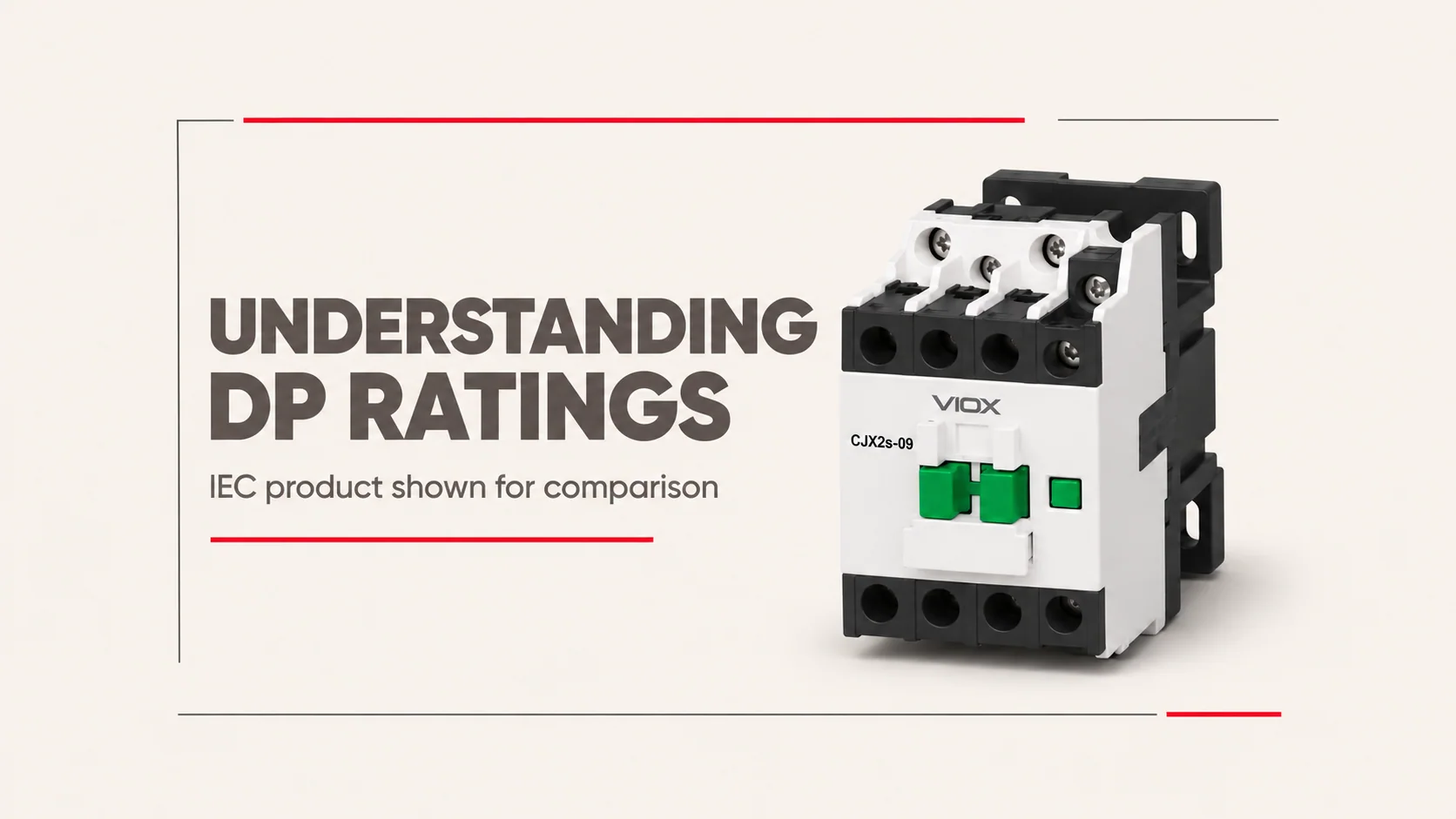
The VIOX AC contactor range presents model-specific AC-3 and coil information for comparison. Its published IEC-oriented products should be assessed using their own documentation. The product images accompanying this article identify that range; they do not establish UL definite purpose certification, DP FLA/LRA values or A2L approval for those VIOX devices.