এই পৃষ্ঠায়
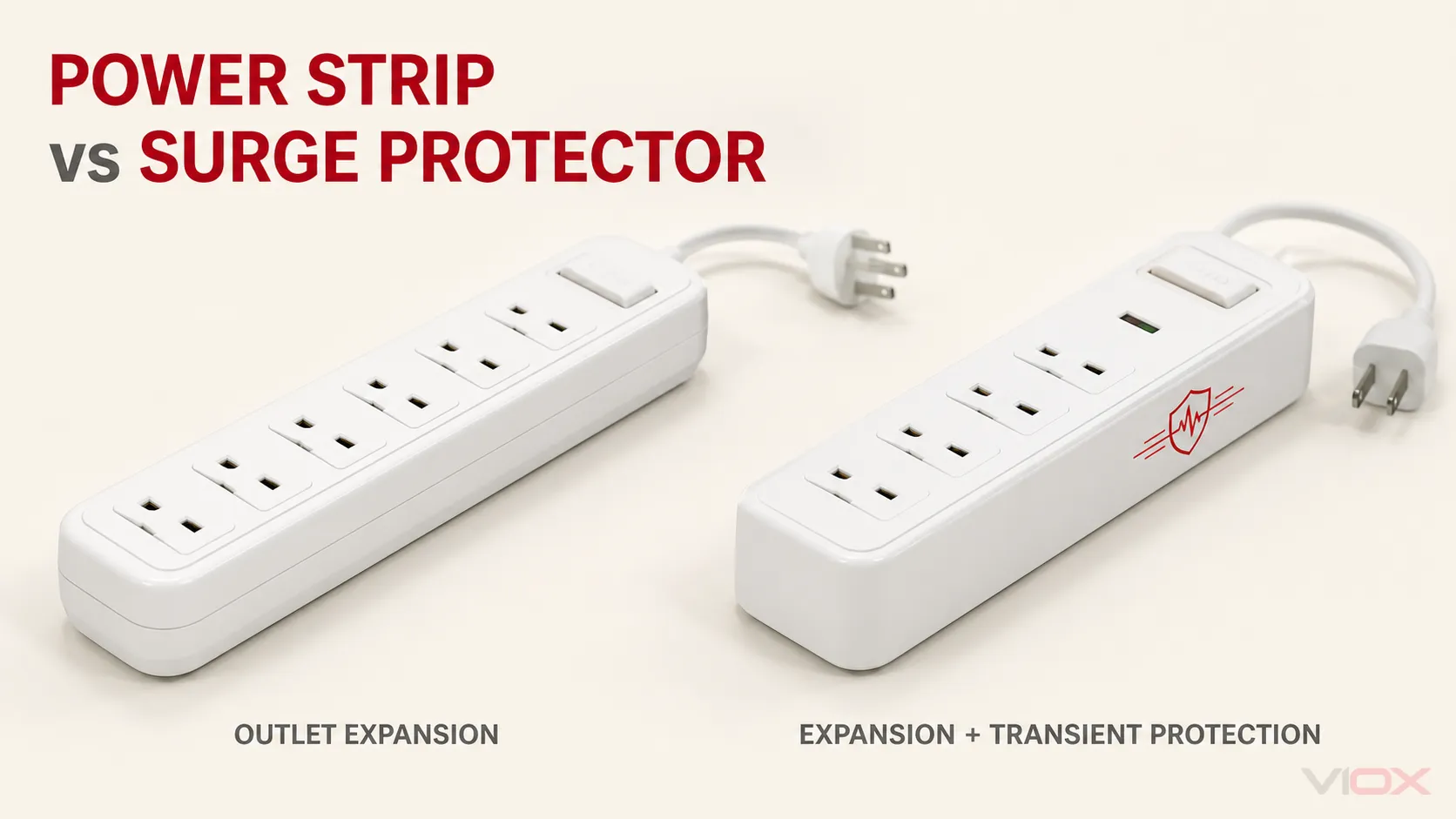
A power strip and a plug-in surge protector may look almost identical, but they do different jobs. A plain power strip expands one receptacle into several outlets. A surge-protector strip also contains a surge protective device (SPD) intended to limit transient overvoltage for the equipment connected through it.
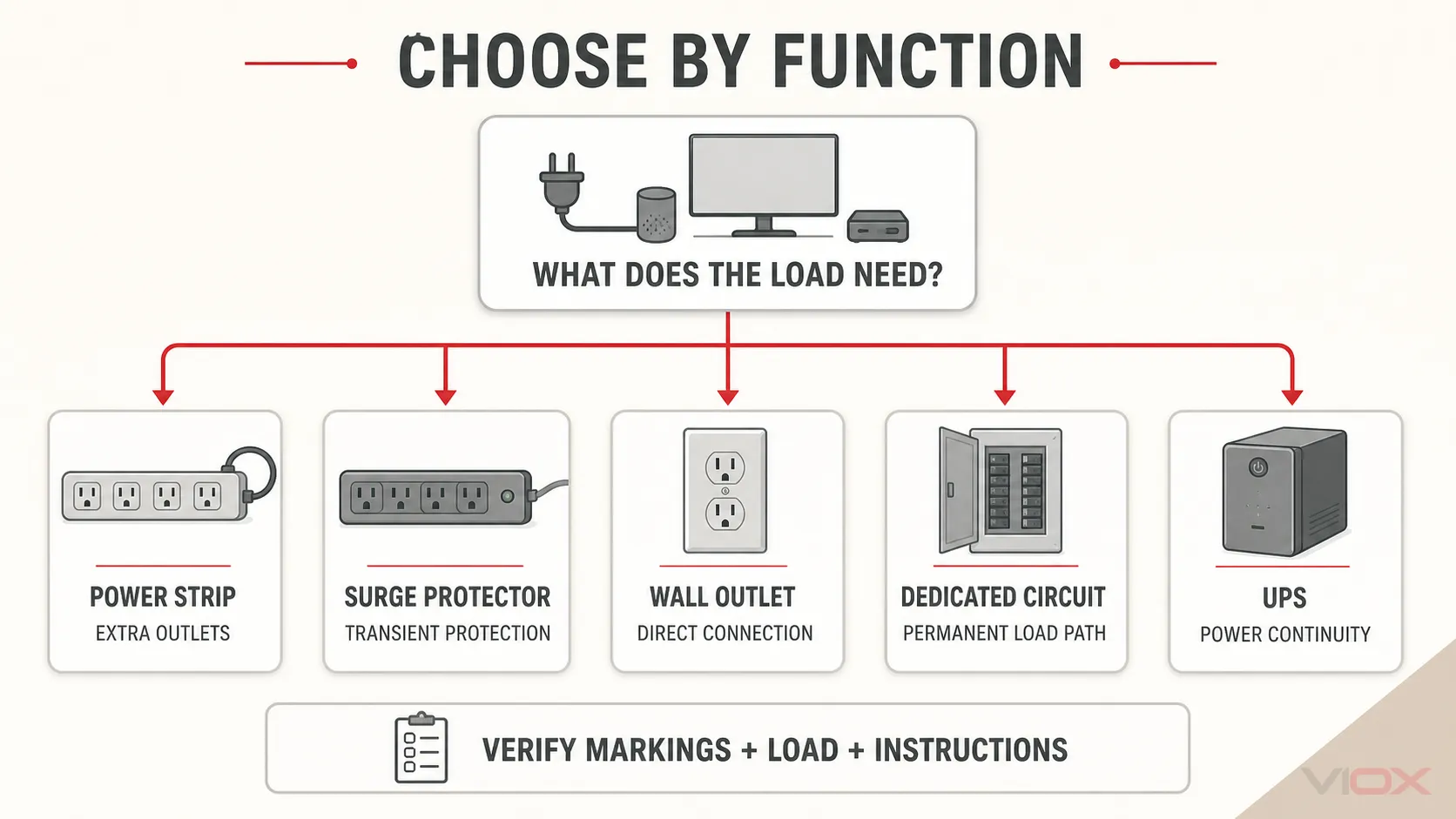
The surge-protection function does not increase the strip’s current capacity, make every appliance suitable for strip use, provide battery backup, or correct sustained high or low voltage. The safe choice depends on five questions: what function is needed, what the product is marked for, how much current the load draws, how the load behaves, and what the appliance instructions require.
| If the load needs… | শুরু করুন... | কেন |
|---|---|---|
| Extra outlets for permitted low-demand equipment | A certified plain power strip | Outlet expansion is the only required function |
| Extra outlets plus transient-voltage protection | A certified plug-in surge protector | It adds an SPD function for connected equipment |
| Direct connection required by the appliance or safety guidance | A suitable wall receptacle | The strip is not an approved part of that load path |
| A permanent or high-demand supply arrangement | A correctly designed dedicated circuit | The need is branch-circuit capacity and installation design, not more strip outlets |
| Ride-through during outages or time to shut down equipment | An appropriately selected uninterruptible power supply (UPS) | A UPS addresses continuity; a surge protector alone does not |
The final authority is the marking and instructions for both the strip and the connected equipment, together with the rules applicable in the installation’s market.
Power Strip vs Surge Protector: The Functional Difference
UL Solutions describes a power strip as a multi-outlet product that extends a branch-circuit receptacle. Some include an overcurrent device, switch, timer, filter, USB supply, or other functions. Those features do not automatically mean that surge protection is present.
A plug-in surge protector combines outlet distribution with components that limit transient voltage. In the North American UL framework, a relocatable power tap that includes an SPD requires additional evaluation under UL 1449. Other markets use their own product standards, certification systems, plugs, voltages, and installation rules.
| সিদ্ধান্তের কারণ | Plain power strip | Plug-in surge protector |
|---|---|---|
| প্রধান কাজ | Provides additional outlets | Provides additional outlets and transient surge protection |
| Protects against overload? | Only if the product includes a suitable internal overcurrent device | Only if the product includes a suitable internal overcurrent device |
| Protects against surges? | No, unless specifically marked and certified for that function | Yes, within its declared protection scope and condition |
| Protects against outages? | না | না |
| Regulates sustained high or low voltage? | না | না |
| Makes high-demand loads safe on a strip? | না | না |
| Protects equipment not connected through it? | না | না |
| Controlling evidence | Product marking, certification and instructions | The same evidence plus surge-protection declarations and status information |
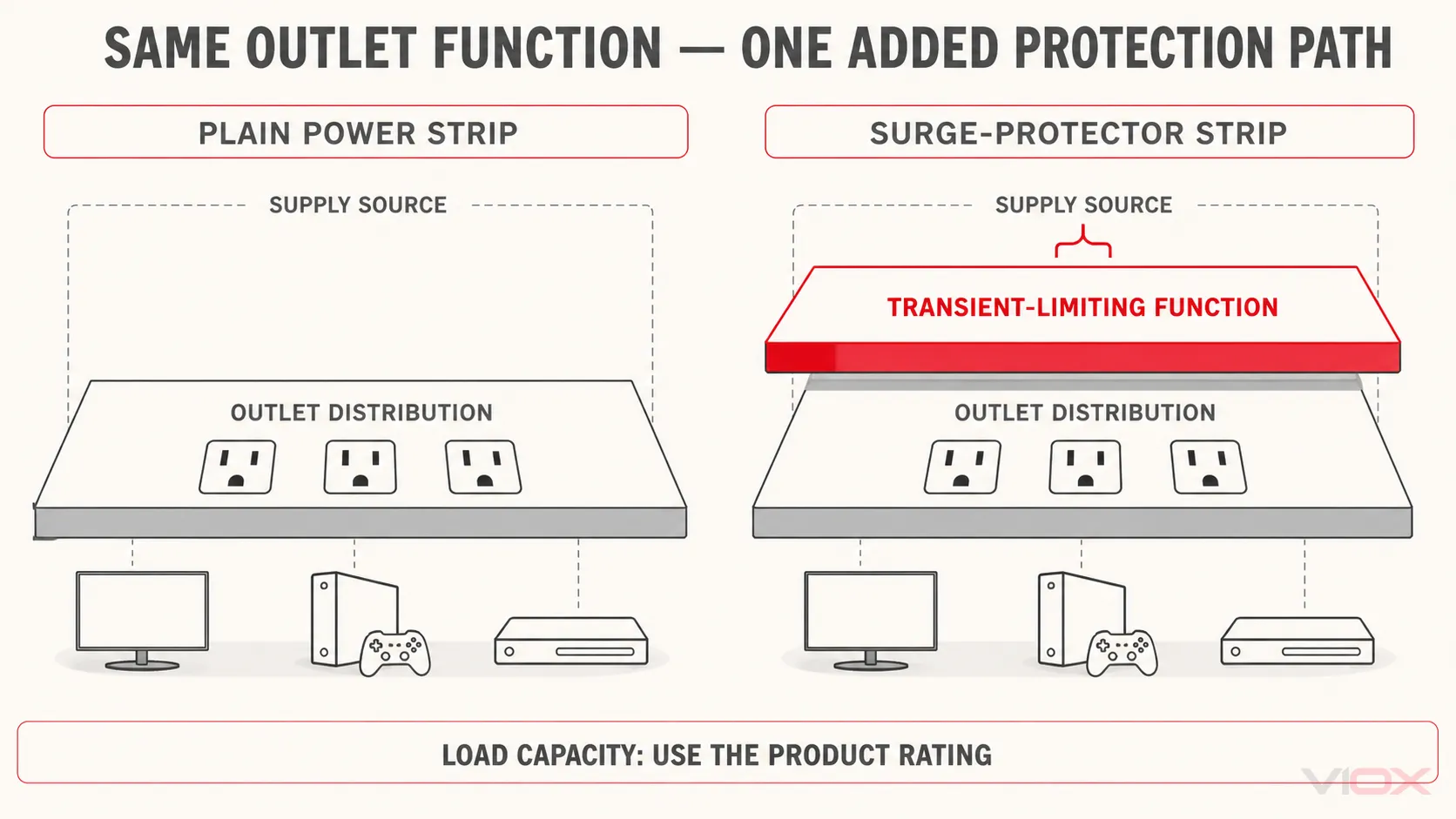
Therefore, a surge protector is not simply a “safer power strip.” It is a power-distribution product with an additional protection function. Both products still require correct loading, ventilation, condition, location and use.
For the broader operating boundary of an SPD, see সার্জ প্রোটেকটিভ ডিভাইস কী কাজ করে.
How to Tell Whether a Power Strip Has Surge Protection
Do not decide from appearance, outlet count, a switch, or a generic illuminated light. A plain strip and surge-protector strip can use the same enclosure.
Check the following in order:
- Product identity: Look for wording such as “surge protector,” “surge protective device,” or the applicable certified product category—not only “power strip,” “power tap,” or “extension outlet.”
- Certification for the target market: Verify the certification mark and product record applicable where the device is used. In the North American framework, a relocatable power tap and its SPD function have separate applicable requirements.
- Electrical rating: Confirm voltage, frequency, current or power rating, plug type, grounding arrangement and indoor/outdoor limitations.
- Surge-protection declaration: Review the protection data required by the applicable standard and supplied by the manufacturer. Do not use the number of outlets or the enclosure size as a proxy.
- অবস্থা নির্দেশ: Identify which indicator, if any, represents protection status. A power light may only show that the outlet strip is energized.
- Instructions: Check permitted loads, prohibited connections, mounting, ventilation, replacement conditions and environmental restrictions.
If the documentation establishes only that the product distributes power, treat it as a power strip—not as a surge protector.
Use the Load to Choose the Supply Option
The correct choice is not based only on total watts. Load behavior and product instructions matter.
| Load or requirement | Main questions | সম্ভাব্য শুরুর বিন্দু |
|---|---|---|
| Computer, monitor, router or audiovisual equipment | Is transient protection needed? Is brief power loss acceptable? Are power and data interfaces both exposed? | Plug-in surge protector; UPS if continuity is also required |
| Multiple permitted low-demand office devices | Does the combined load remain within the strip and circuit ratings? | Plain strip or surge-protector strip, depending on protection need |
| স্পেস হিটার | Do the product and fire-safety instructions require direct wall connection? | Direct wall receptacle; U.S. Fire Administration guidance says not to use an extension cord or power strip |
| Major appliance such as a refrigerator, stove, washer or dryer | Do the appliance instructions require a direct receptacle or dedicated circuit? What are starting-current and circuit requirements? | Direct wall receptacle or dedicated circuit as specified |
| Heat-producing kitchen appliance | What do the appliance instructions say? Is it the only heat-producing load on the outlet? Is the receptacle and circuit suitable? | Usually direct wall connection where required by the appliance or applicable safety guidance |
| Equipment that must remain operating during an outage | What runtime, output waveform and power capacity are required? | Properly selected UPS; this is a separate sizing task |
| Hardwired or building-wide equipment | Is protection needed across circuits or at a panel boundary? | Evaluate a panel-mounted SPD separately; a plug-in strip cannot protect hardwired loads |
If a device has a motor, compressor, heater, large power supply or high starting current, do not infer suitability from average wattage alone. Compare the appliance nameplate and instructions with the strip’s complete rating and permitted-use statement.
What Should Never Be Plugged Into a Surge Protector or Power Strip?
There is no responsible universal list covering every strip, voltage system and appliance model. The controlling rule is simpler:
Do not connect a load when the strip’s marking or instructions, the appliance instructions, or the applicable safety rules require direct connection or prohibit that use.
The following categories commonly trigger a direct-wall or dedicated-circuit decision:
- Space heaters: U.S. Fire Administration guidance specifically instructs users to connect portable space heaters directly to wall outlets and never to a power strip or extension cord.
- Major appliances: U.S. Fire Administration guidance advises direct wall connection for major appliances such as refrigerators, stoves, washers and dryers.
- Heat-producing appliances: Coffee makers, microwaves, toasters, hair dryers, electric skillets and similar loads can draw substantial current. Follow the appliance instructions and avoid combining heat-producing loads on one outlet or strip.
- Motor or compressor loads: Starting current and repeated cycling may create demands not apparent from normal running power. Use the prescribed receptacle and circuit.
- Equipment requiring a dedicated circuit: A strip cannot substitute for the circuit required by the equipment, installation design or local rules.
- Medical, life-safety or critical equipment: Use only the specifically approved distribution and backup arrangement for the environment. A general consumer strip is not automatically suitable.
Adding surge protection does not change these load boundaries. A high-demand appliance that is unsuitable for a plain strip does not become suitable because the strip also contains an SPD.
Can Kitchen Appliances Be Plugged Into a Surge Protector?
Answer this from the appliance and strip documentation, not from the word “kitchen.” A low-power electronic device and a heat-producing appliance present different loading conditions even when both sit on the same countertop.
Use this check:
- Does the appliance manual require a wall outlet or dedicated circuit?
- Is it a heat-producing, motor-driven or compressor load?
- Does its nameplate current, including relevant starting behavior, fit the strip and branch-circuit ratings?
- Will another heat-producing or high-demand appliance share the same strip or outlet?
- Is the strip approved for the location, including moisture, heat, grease and mechanical exposure?
- Can the plug fit fully and remain secure without adapters?
If any answer is unknown, direct wall connection according to the appliance instructions is the safer default until the installation is verified. Never place a strip where water, steam, cooking heat or physical damage can reach it unless the product is specifically rated for that environment.
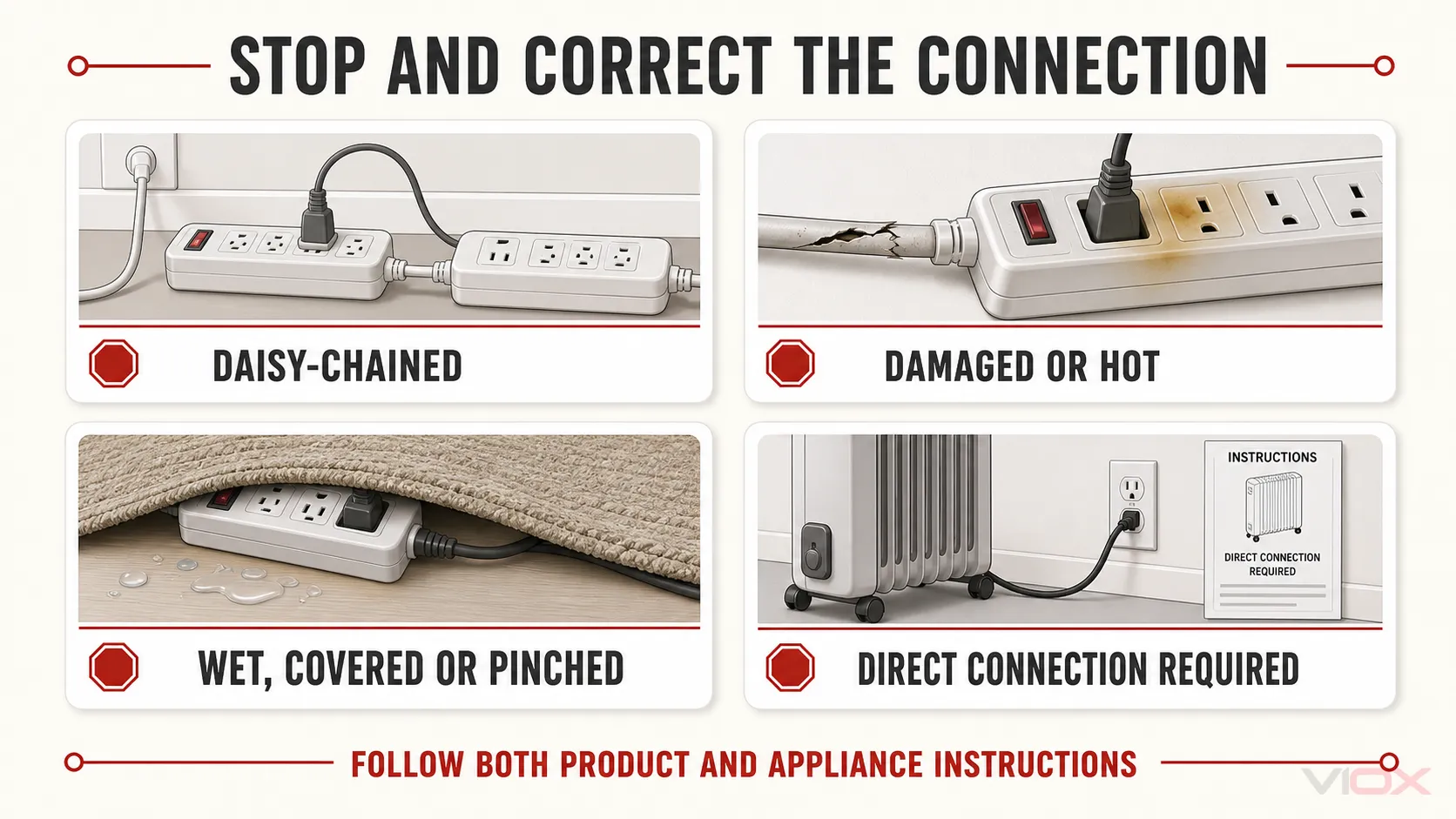
Seven Stop Conditions
Stop using or do not install a power strip or plug-in surge protector when any of these conditions applies:
- It is daisy-chained. Do not plug one strip into another. U.S. OSHA guidance notes that listed relocatable power taps are intended for direct connection to a permanently installed branch-circuit receptacle, not series connection to another tap or extension cord.
- The cord, plug or enclosure is damaged. Frayed insulation, cracked housing, exposed conductors, bent blades, burn marks or melted plastic require removal from service.
- A plug is loose or the receptacle is discolored or hot. Disconnect safely and have the receptacle or equipment assessed. Do not rely on the strip’s breaker to correct a poor connection.
- The product is overloaded or repeatedly trips. Reduce the load and investigate the reason. Do not repeatedly reset an overcurrent device without correcting the condition.
- The appliance requires direct connection. A strip cannot override the appliance instructions or an installation requirement.
- The strip is covered, pinched, wet or exposed to an unsuitable environment. Do not run cords under rugs, trap them in doors or furniture, block heat dissipation, or use an indoor product in a wet or outdoor location.
- It is being used as permanent wiring. Frequent dependence on multiple strips may indicate that additional fixed receptacles or circuits are needed.
Which Is Safer: a Power Strip or a Surge Protector?
Neither label proves that the product is safer in every situation.
A correctly certified and correctly used surge-protector strip adds protection against declared transient events. That can reduce surge stress on connected electronics. It does not, however, increase conductor size, outlet contact quality, load capacity, environmental rating or branch-circuit capacity.
A plain power strip can be appropriate when the only job is supplying several permitted low-demand loads. It should not be presented as surge protection. In both cases, safety depends on:
- certification and markings appropriate to the market;
- compatibility with the supply voltage and grounding arrangement;
- load within the declared rating;
- direct connection as required;
- intact plugs, cords, contacts and enclosure;
- suitable location and ventilation;
- use according to both product and appliance instructions.
The safer product is the one that provides the required function এবং is approved for the actual load and installation.
Is It Safe to Leave a Surge Protector Plugged In?
Leaving a serviceable plug-in surge protector connected is not automatically unsafe when the product is intended for that use, the load is permitted, ventilation is adequate and there are no signs of damage or overheating. Do not turn that general statement into permission to leave heat-producing appliances energized or unattended; their own instructions control.
Inspect the strip periodically as part of normal equipment checks and after a known damaging event when the manufacturer calls for it. Replace or remove it when the model-defined protection indicator shows a failed state, when its internal overcurrent device will not reset normally, or when physical damage or abnormal heating is present. Do not apply one fixed age to every product. For condition-based replacement, use the dedicated surge protector lifespan guide.
If severe weather or another condition leads the applicable safety authority or equipment manufacturer to recommend disconnection, remember that switching the strip off is not necessarily the same as unplugging equipment from every conductive path.
Does a Surge Protector Use Electricity When It Is Turned Off?
There is no universal answer. It depends on the internal circuit.
A simple mechanical switch may disconnect the strip’s load outlets, while indicator lamps, USB power supplies, wireless controls, monitoring electronics or filters may be connected differently. An OFF position also does not prove that every conductor is isolated or that the surge-protection components are disconnected.
For a specific product:
- check the circuit description or standby-power declaration;
- confirm what the switch actually controls;
- use an appropriate plug-in energy meter if measurement is needed and safe;
- unplug the strip when complete physical disconnection is required and the product instructions permit that action.
Do not infer standby consumption from the words “power strip” or “surge protector” alone.
When a Surge Protector Is Not the Right Solution
A plug-in surge protector is not the complete solution when the real requirement is:
- power during an outage: evaluate a UPS;
- response to sustained overvoltage or undervoltage: evaluate the appropriate monitoring or disconnection function; see ভোল্টেজ প্রোটেক্টর বনাম সার্জ প্রোটেক্টর;
- more permanent outlets or circuit capacity: install suitable fixed wiring or a dedicated circuit;
- protection for hardwired loads or several circuits: মূল্যায়ন করুন whole-house or panel SPD protection;
- protection for coaxial, Ethernet, telephone, antenna or control lines: select protection for the relevant interface;
- direct lightning protection: use the applicable structural lightning-protection, bonding, earthing and coordinated SPD design rather than relying on a plug-in strip alone.
These functions can be complementary. “Better than a surge protector” is not a meaningful engineering choice until the missing function is identified.
সচরাচর জিজ্ঞাস্য
What should you never plug into a surge protector?
Never connect a load that the strip, appliance instructions or applicable rules require to be connected directly to a wall receptacle or dedicated circuit. Space heaters and major appliances are common direct-wall examples in U.S. fire-safety guidance. Never daisy-chain strips or use a damaged, overheating or unsuitable product.
Which is safer, a power strip or a surge protector?
A surge protector adds transient protection, but neither product is safe when overloaded, damaged, incorrectly connected or used outside its instructions. Choose a certified product with the required function and a rating suitable for the load.
Is it safe to leave a surge protector plugged in all the time?
It can remain connected when designed for that use, correctly loaded, ventilated and serviceable. Do not leave prohibited or heat-producing loads unattended, and follow the product’s inspection and disconnection instructions.
Does a surge protector still use electricity when switched off?
Possibly. Indicator, USB, smart-control or monitoring circuits may consume power depending on the internal design. The OFF switch does not have one universal circuit function across products.
When should you not use a surge protector?
Do not use one when the equipment requires direct wall or dedicated-circuit connection, the product is damaged or overheating, the environment is outside its rating, the arrangement requires daisy-chaining, or the real problem is outage ride-through or sustained voltage variation.
Can kitchen appliances be plugged into a surge protector?
Only when both the appliance and strip instructions permit it and the complete load is within the product and circuit ratings. Heat-producing and major appliances commonly require direct wall connection; do not assume a surge-protector strip increases allowable load.
How can you tell a power strip from a surge protector?
Check the product identity, applicable certification record, surge-protection declarations and model-defined protection indicator. Appearance, outlet count and a generic power light are not proof.
Final Five-Question Rule
Before connecting any load, answer:
- Do I need outlet expansion, surge protection, continuity, voltage monitoring or additional circuit capacity?
- Is the product certified and marked for that function in this market?
- Do the strip and appliance instructions permit this exact connection?
- Are the load, inrush, duty and environment within the declared limits?
- Is the product directly connected, undamaged, ventilated and free from stop conditions?
If all five answers are clear, select the appropriate power strip, plug-in surge protector, wall receptacle, dedicated circuit or UPS. If the protection requirement extends to distribution panels, hardwired machinery, solar systems or industrial control equipment, move to model-level VIOX SPD product evaluation rather than treating a consumer strip as the system solution.
Technical and Safety References
- UL Solutions — Guide to Power Strips and Surge Protectors
- UL Solutions — Power Strips Testing and Certification
- OSHA — Compliance Requirements for Relocatable Power Taps
- U.S. Fire Administration — Appliance and Electrical Fire Safety
- U.S. Fire Administration — Space Heater Safety Tips
- Electrical Safety Foundation International — Surge Protection and Home Safety
This article provides general product-selection and safe-use boundaries. Always follow the markings and instructions for the exact strip, appliance and installation, together with requirements adopted in the local market.