If you are searching for ATS Full Form, the direct answer is simple:
ATS Full Form means Automatic Transfer Switch.
In electrical systems, an ATS is a switching device that automatically transfers a load from one power source to another when the normal source fails or becomes unacceptable. In most practical cases, that means transferring from utility power to generator backup power, then switching back when the main source returns.
That short answer matters, but it is only the first step. Readers searching for ATS Full Form usually also want to know what the device actually does, where it is used, and how it differs from related terms such as MTS (Manual Transfer Switch) and STS (Static Transfer Switch).
What Is the ATS Full Form in Electrical?
In electrical systems, ATS Full Form stands for Automatic Transfer Switch.
An ATS is used to change the source supplying a load without requiring a person to move the switch manually. It monitors source conditions and initiates transfer logic when the programmed criteria are met.
Quick answer table
| Term | Meaning |
|---|---|
| ATS Full Form | Automatic Transfer Switch |
| Main purpose | Transfer load from one power source to another automatically |
| Typical source arrangement | Utility to generator, utility to backup source, or source A to source B |
| Typical applications | Generator systems, critical backup power, commercial buildings, industrial power systems |
So if the only question is “what is ATS Full Form,” the answer is Automatic Transfer Switch. But if the reader is dealing with backup power design or sourcing, the more useful question is what role the ATS plays inside the system.
What Does an ATS Do?
An ATS does not create power. It manages which source supplies the load.
In a typical backup power system, the ATS:
- monitors the normal power source
- detects when that source is lost or unacceptable
- transfers the load to a backup source when conditions are met
- transfers back when the normal source returns and stabilizes
This is why an ATS is a key component in:
- generator-backed buildings
- critical commercial loads
- industrial continuity systems
- backup power systems where fast source restoration matters
The ATS is therefore not the same thing as a generator, inverter, or UPS. It is the switching device that decides which source feeds the load.
How Does an ATS Work?
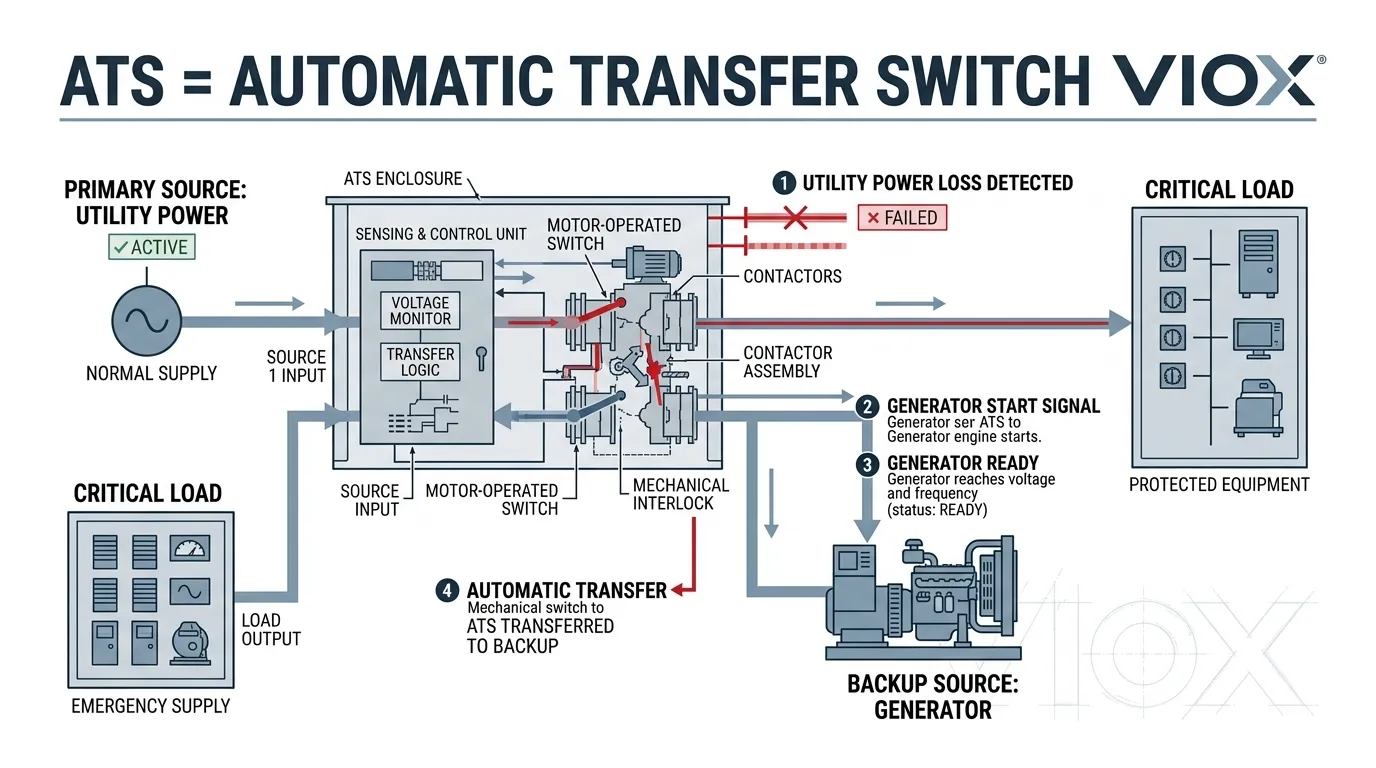
To understand ATS Full Form properly, it helps to understand the basic switching logic.
An ATS typically monitors voltage and source availability on the preferred supply. If the preferred source fails or drops outside acceptable conditions, the transfer logic initiates the switch to the alternate source. Once the preferred source returns and remains stable, the ATS can transfer the load back according to its control sequence.
Basic ATS operating logic
| Condition | ATS response |
|---|---|
| Normal source healthy | Load stays on the preferred source |
| Normal source fails | ATS initiates transfer to the alternate source |
| Backup source becomes available | ATS connects load to backup source if transfer conditions are satisfied |
| Normal source returns and stabilizes | ATS transfers back based on programmed logic |
The exact transfer sequence depends on the ATS class, transition type, control logic, and system design. But the basic function remains the same: automatic source transfer.
ATS vs MTS vs STS
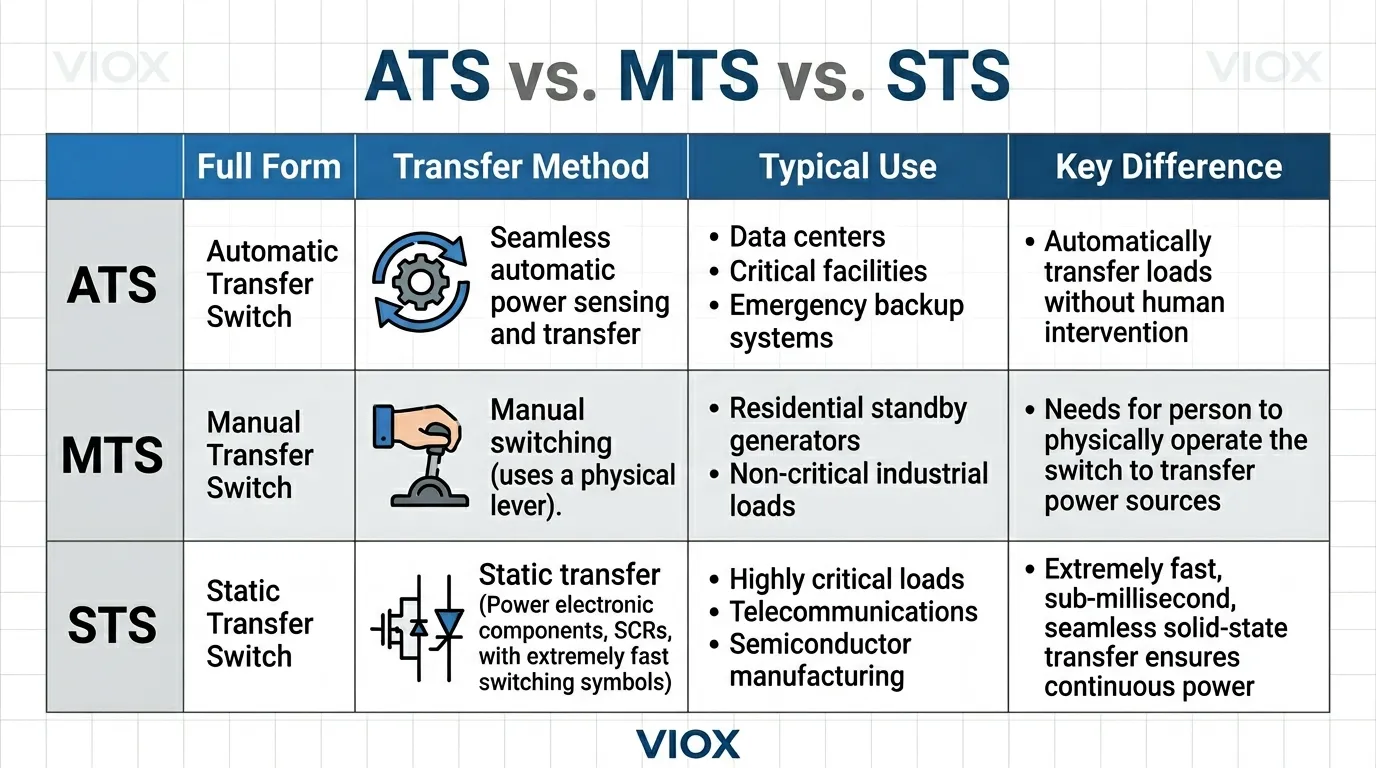
This is where many acronym pages stay too shallow. In practice, readers searching ATS Full Form often need help distinguishing ATS from other transfer terms.
ATS
ATS means Automatic Transfer Switch. It performs source transfer automatically according to its control logic.
MTS
MTS means Manual Transfer Switch. It performs the same general source-selection role, but the operator must initiate the switch manually.
STS
STS means Static Transfer Switch. It also transfers between sources, but its switching method and typical application context differ from a conventional ATS.
ATS vs MTS vs STS table
| Term | Full form | How transfer happens | Typical application note |
|---|---|---|---|
| ATS | Automatic Transfer Switch | Automatic control-driven transfer | Generator systems and automatic backup source switching |
| MTS | Manual Transfer Switch | Operator performs transfer manually | Lower-complexity backup systems or installations with on-site personnel |
| STS | Static Transfer Switch | Static or electronic switching method | Fast-transfer applications and specific critical-power systems |
This is why ATS Full Form pages should not stop at the acronym itself. The practical meaning becomes much clearer once readers see how ATS differs from manual or static transfer devices.
For a direct comparison page, VIOX already has Manual vs. Automatic Transfer Switch and Automatic Transfer Switch ATS vs Static Transfer Switch STS.
Where Are ATS Systems Used?
An ATS is used where the load should not depend on someone being present to perform source transfer manually.
Common ATS applications include:
- commercial buildings with standby generators
- industrial systems requiring backup source continuity
- telecom and infrastructure power systems
- facilities with essential loads
- dual-source power arrangements
The exact ATS type depends on:
- load criticality
- source arrangement
- transition requirements
- control logic
- system architecture
That is why, after learning the full form, many readers move immediately into ATS selection and system design questions.
What Should You Check After Learning the ATS Full Form?
Once the acronym is clear, the next practical questions are usually:
- Is the transfer automatic or manual?
- Is the ATS open transition or closed transition?
- Is the ATS PC class or CB class?
- Is the system single phase or three phase?
- What load and source arrangement does the switch need to handle?
Those are the real specification questions behind the acronym.
The strongest follow-up pages already on VIOX are:
- Manual vs. Automatic Transfer Switch
- Open vs. Closed Transition ATS Selection Guide
- PC Class vs CB Class ATS Selection Guide
- Single Phase vs Three Phase ATS Selection Guide
- ATS Troubleshooting: Generator Won’t Transfer
FAQ
What is the ATS Full Form?
The ATS Full Form is Automatic Transfer Switch.
What is ATS Full Form in electrical systems?
In electrical systems, ATS Full Form means Automatic Transfer Switch, a device used to transfer a load automatically from one power source to another.
What does an ATS do?
An ATS monitors source conditions and switches the load between available power sources automatically when the programmed transfer conditions are met.
Is ATS the same as a generator?
No. A generator produces backup power. An ATS switches the load between the normal source and the backup source.
What is the difference between ATS and MTS?
An ATS transfers automatically, while an MTS requires a person to perform the transfer manually.
What is the difference between ATS and STS?
Both transfer between sources, but an STS uses a different switching approach and is often discussed in faster-transfer or more specialized critical-power applications.
Where is an ATS used?
ATS units are commonly used in generator-backed buildings, industrial systems, telecom infrastructure, essential-load systems, and other backup power applications where automatic source transfer is needed.