

On this page
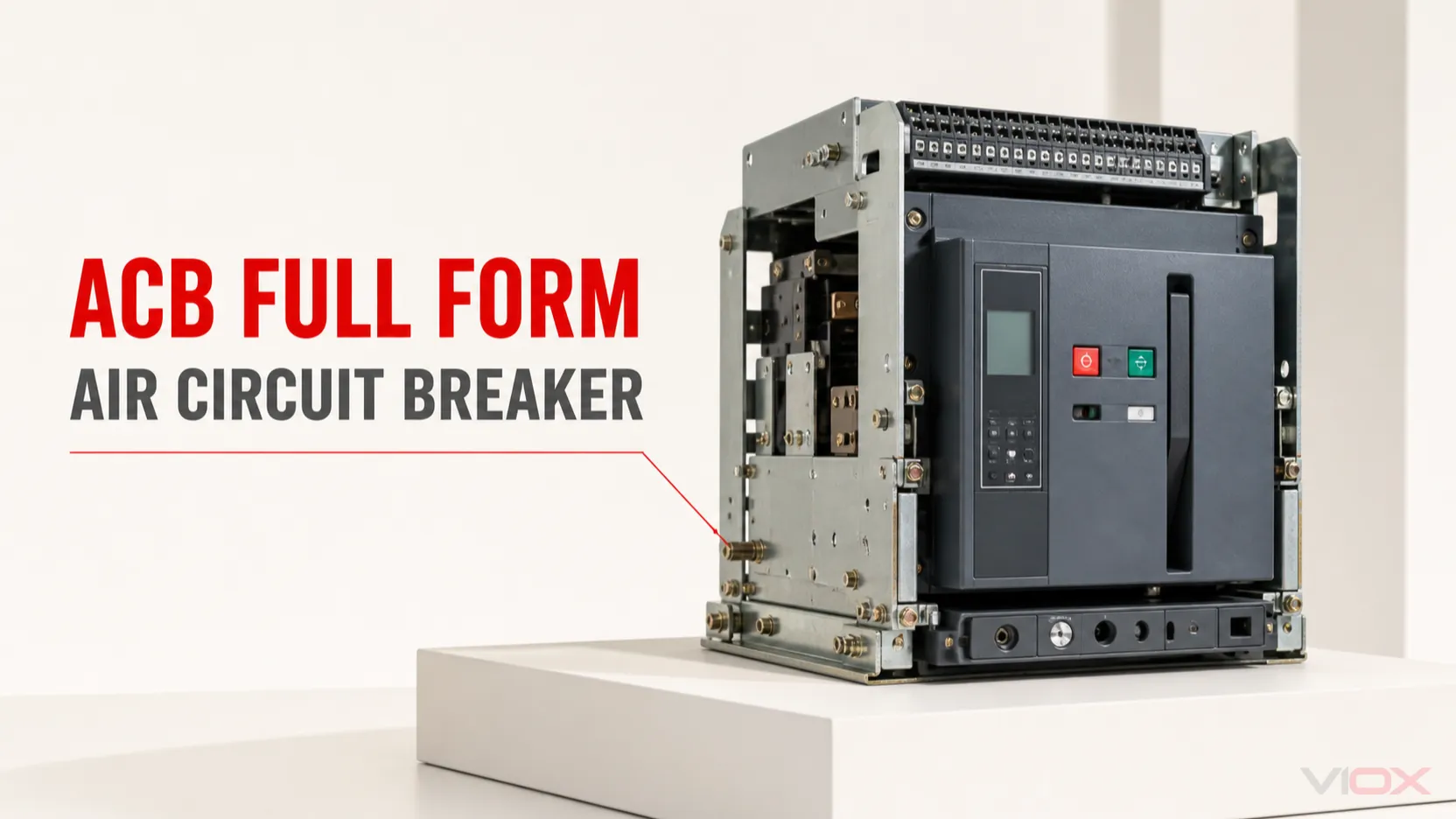
ACB stands for Air Circuit Breaker. In electrical systems, an ACB is a low-voltage power circuit breaker used in switchboards and switchgear to switch and protect high-current circuits against overload and short-circuit conditions.
In an electrical panel, an ACB is commonly installed as a main incomer, bus coupler or high-current feeder breaker. The name comes from the way it interrupts current: its contacts separate and the resulting arc is extinguished in air.
Meaning note: ACB has other meanings in banking, medicine and sports. This article covers the electrical meaning: Air Circuit Breaker.
ACB Full Form at a Glance
| Item | Answer |
|---|---|
| ACB full form | Air Circuit Breaker |
| Device category | Low-voltage power circuit breaker |
| Main function | Circuit switching and protection against overcurrent and short circuits |
| Arc-extinguishing medium | Air |
| Typical panel position | Main incomer, bus coupler or high-current feeder |
| Common construction | Fixed or draw-out |
| Protection control | Mechanical or electronic trip unit, depending on the product |
An ACB combines switching, isolation and protective functions in one device. Its exact protection functions, ratings and accessories depend on the selected model and trip unit.
What Does an ACB Do in an Electrical Panel?
When someone asks for the “ACB panel full form,” the answer is still Air Circuit Breaker. The word “panel” describes where the breaker is installed, not a different type of ACB.
An ACB usually has one of three roles in a low-voltage distribution assembly:
- Main incomer: connects the transformer, generator or other source to the main busbar.
- Bus coupler: connects or separates two busbar sections according to the system operating plan.
- High-current feeder: protects and switches a large outgoing distribution circuit.
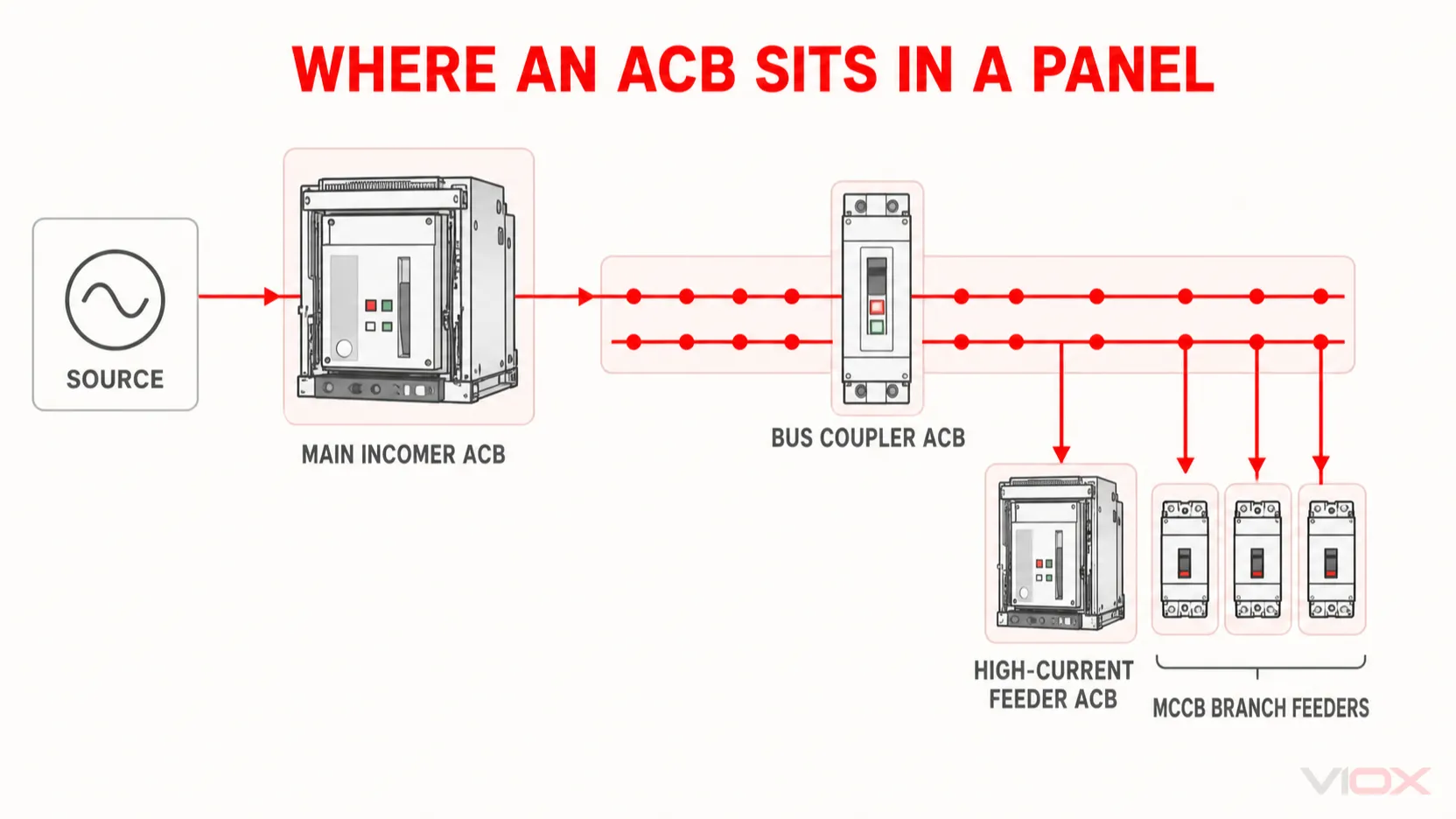
Smaller outgoing circuits are often protected by MCCBs or MCBs. This arrangement is not universal; the final breaker hierarchy must follow the project design, prospective fault current, coordination study and applicable requirements.
How Does an Air Circuit Breaker Work?
An ACB continuously carries current while closed. When its trip unit detects a condition that meets the configured operating characteristic, the breaker releases its operating mechanism and opens the contacts.
The interruption sequence is:
- The trip unit detects an overload or short-circuit condition.
- The operating mechanism releases and separates the contacts.
- An electrical arc forms as the current path opens.
- The arc moves into the arc chute, where it is divided, cooled and extinguished in air.
- The open breaker isolates the affected circuit.
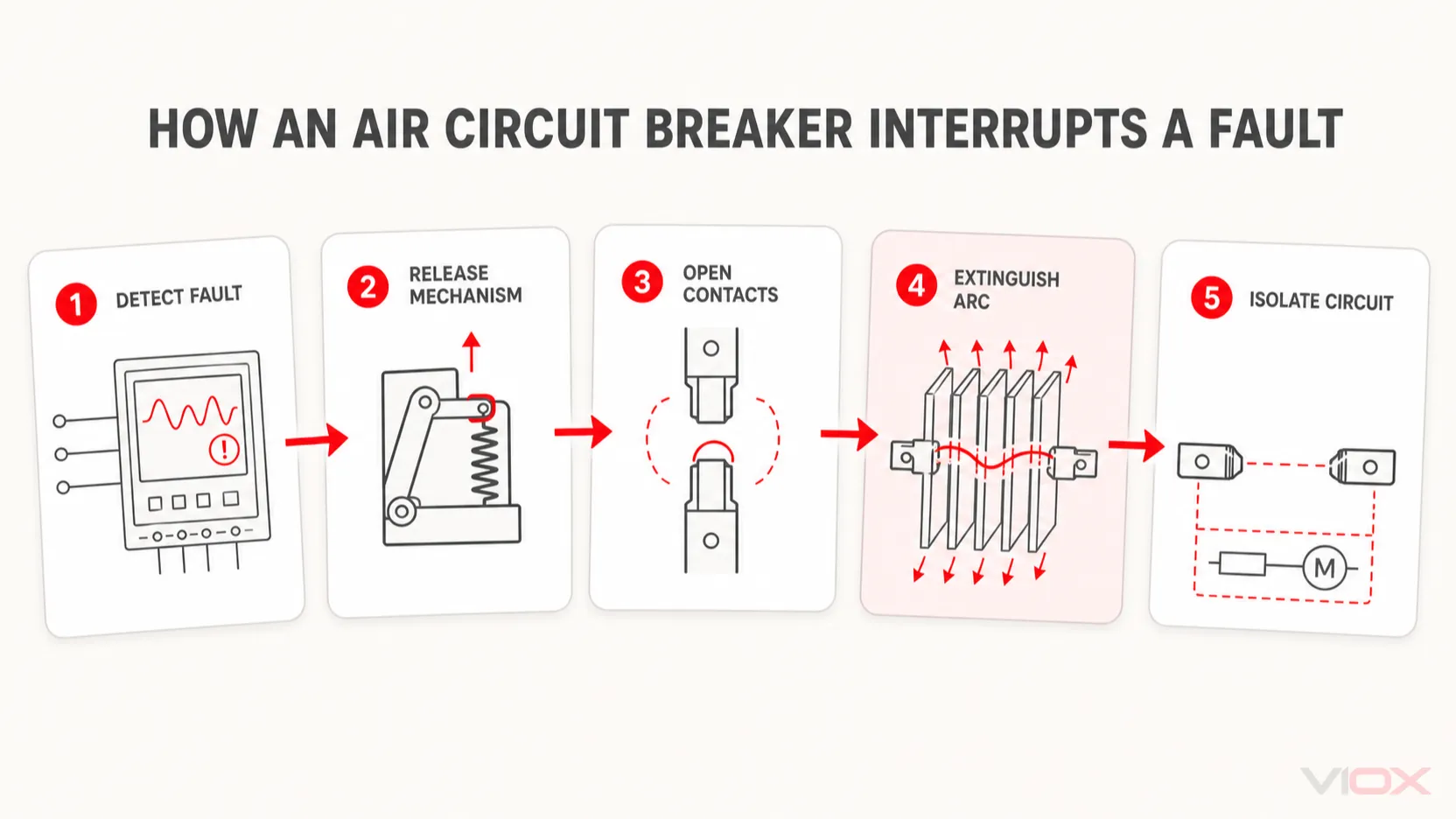
The trip response depends on the installed trip unit and its settings. Protection coordination should therefore be based on the manufacturer’s time-current data and a system study, not on the letters “ACB” alone.
Main Parts of an ACB
Although construction varies by manufacturer and frame size, an ACB normally includes:
- Main contacts to carry current during normal operation;
- Arcing contacts and arc chutes to control the arc during interruption;
- Operating mechanism to close, hold and open the breaker;
- Trip unit to monitor current and initiate tripping;
- Terminals or primary disconnects to connect the breaker to the power circuit; and
- Auxiliary contacts and accessories for status, remote operation or control integration when specified.
A draw-out ACB also uses a cradle and disconnecting contacts so the breaker can move between connected, test and disconnected positions according to its design.
Fixed vs Draw-Out ACB
| Construction | Main characteristic | Typical consideration |
|---|---|---|
| Fixed ACB | Breaker is mounted directly in the assembly | Simpler arrangement, but removal normally requires more isolation and disconnection work |
| Draw-out ACB | Breaker moves in and out of a dedicated cradle | Easier testing, replacement and service access, with a larger and more complex assembly |
The choice is usually driven by continuity requirements, maintenance strategy, available space, switchboard design and project cost. Neither construction is automatically better for every installation.
ACB vs MCCB: What Is the Basic Difference?
Both devices can provide overcurrent protection, but they are built for different distribution roles.
| Comparison | ACB | MCCB |
|---|---|---|
| Full form | Air Circuit Breaker | Molded Case Circuit Breaker |
| Construction | Open-frame power circuit breaker | Breaker enclosed in a molded insulating case |
| Common role | Main incomer, bus coupler and high-current feeder | Feeder, branch and equipment circuit protection |
| Installation | Low-voltage switchgear or switchboard assembly | Distribution board, panel or equipment enclosure |
| Service form | Commonly available in fixed and draw-out designs | Commonly fixed; some ranges offer plug-in or withdrawable arrangements |
| Selection basis | System voltage, current, interruption, withstand, coordination and control requirements | System voltage, current, interruption, trip and installation requirements |
Do not select between an ACB and MCCB by current rating alone. Confirm the required breaking capacity, short-time withstand performance, selectivity, operating duty, mounting system and manufacturer’s published ratings.
Where Are ACBs Used?
ACBs are commonly found in:
- main low-voltage switchboards;
- industrial power-distribution systems;
- commercial buildings and data centres;
- generator and critical-power systems; and
- large facilities that require coordinated main and feeder protection.
ACBs are generally associated with low-voltage power distribution. Medium-voltage switchgear commonly uses other interruption technologies, such as vacuum circuit breakers. IEC 60947-2 applies to circuit breakers for circuits not exceeding 1,000 V AC or 1,500 V DC, but an individual product’s suitability must always be confirmed from its documentation and applicable market requirements.
For a deeper technical treatment, see the complete guide to air circuit breakers.
ACB Selection Checklist
Before specifying an ACB, confirm:
- system voltage and frequency;
- required continuous current and frame size;
- prospective short-circuit current and breaking capacity;
- short-time withstand and selective-coordination requirements;
- number of poles and neutral arrangement;
- trip-unit functions and setting ranges;
- fixed or draw-out construction;
- manual, motorized or remote operating requirements;
- auxiliary contacts, releases and communication options;
- switchboard integration and environmental conditions; and
- applicable product standards, local rules and manufacturer instructions.
The checklist defines the information needed for selection; it does not replace a protection study or manufacturer verification.
Frequently Asked Questions
What is the full form of ACB?
The full form of ACB in electrical engineering is Air Circuit Breaker.
What is ACB full form in an electrical panel?
ACB still means Air Circuit Breaker. In a panel, it is commonly used as a main incomer, bus coupler or high-current feeder breaker.
Is an ACB a low-voltage or high-voltage breaker?
The modern power-distribution ACB discussed here is a low-voltage circuit breaker. Always verify the rated operational voltage of the specific product rather than relying on the device name alone.
Why is it called an air circuit breaker?
It is called an air circuit breaker because the arc formed when the contacts open is controlled and extinguished in air, typically with the help of an arc chute.
What faults does an ACB protect against?
An ACB can provide overload and short-circuit protection when equipped and configured with the appropriate trip unit. Additional functions depend on the trip unit, accessories and system design.
What is the difference between an ACB and an MCCB?
An ACB is an open-frame power breaker commonly used in main low-voltage distribution, while an MCCB is enclosed in a molded case and is widely used for feeder, branch and equipment protection. The correct choice depends on system requirements, not the acronym alone.
Explore VIOX Air Circuit Breakers
Review the VIOX Air Circuit Breaker product range or contact VIOX with the system voltage, continuous current, prospective fault current, pole configuration, mounting type and target market for model-selection support.