

On this page
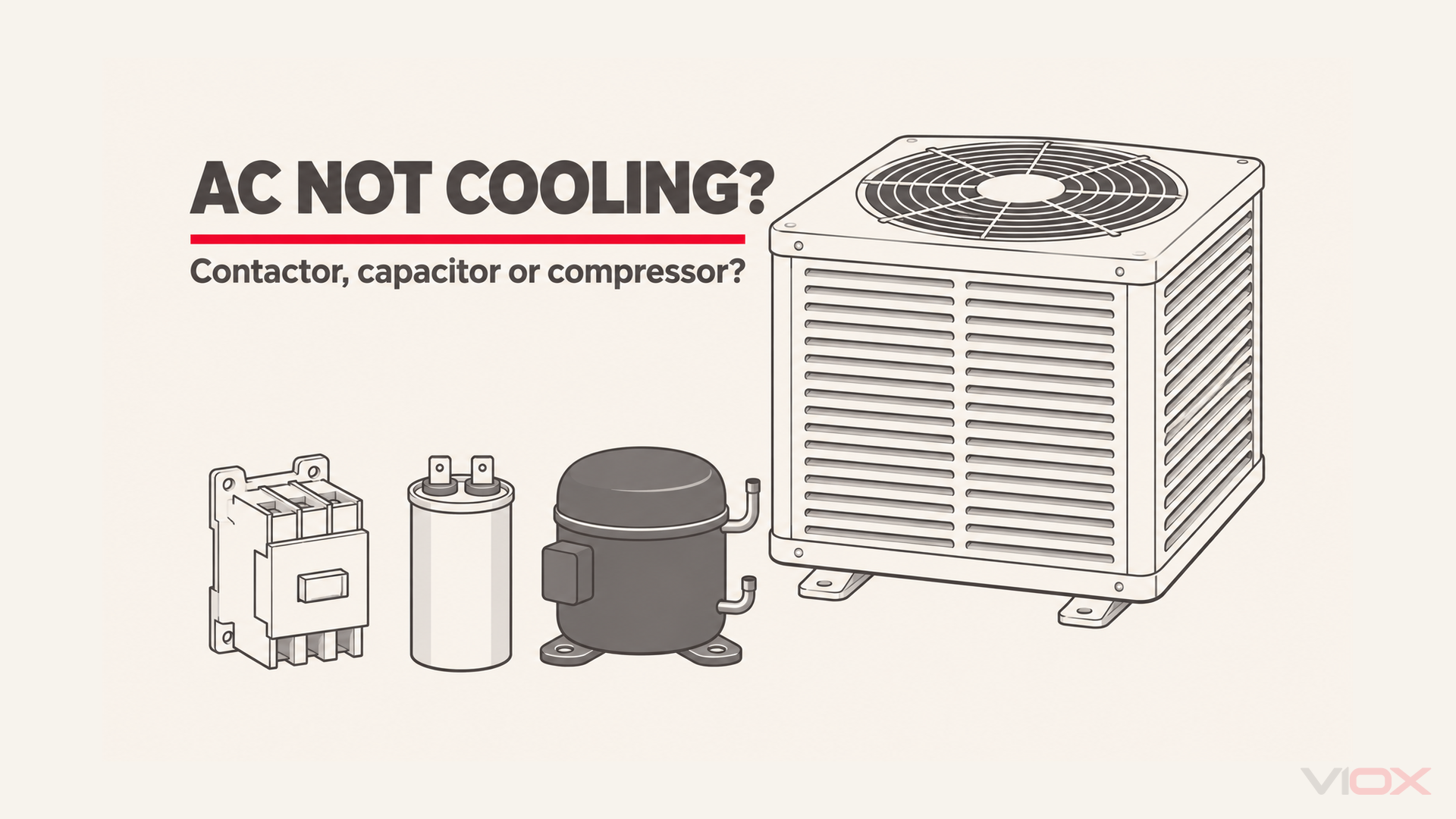
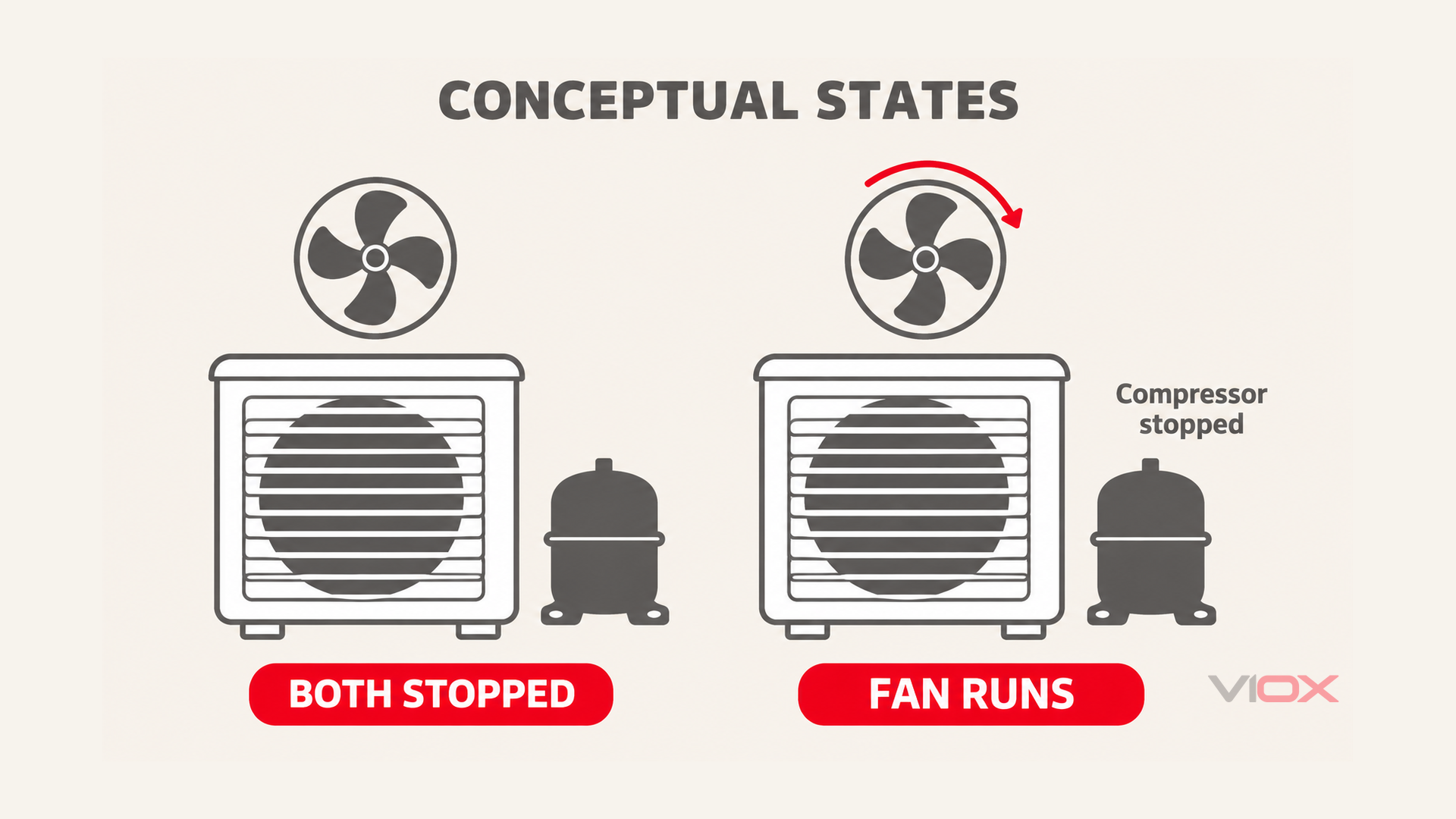
When the entire outdoor unit is inactive, start with the supply and contactor/control path. When the outdoor fan runs but the compressor does not, prioritize the run-capacitor and compressor branch after verifying power delivery. A hum, a click, or repeated stopping cannot identify a failed part by itself. The decisive question is where the operating sequence breaks: the command, the switched supply, the motor-support circuit, or the compressor’s operation.
This guide covers conventional, fixed-speed, single-phase central air conditioners that use a contactor and motor run capacitor. Inverter-driven compressors, electronically controlled fan motors and three-phase equipment require their own manufacturer diagnostic procedures. Use the unit’s wiring diagram to establish which components it actually contains.
Observe From Outside; Leave Internal Tests to a Technician
With the enclosure closed, record the thermostat’s cooling demand or delay message, whether the outdoor fan turns, whether the unit attempts to start, and what stops first. The indoor blower running does not establish that the outdoor equipment is operating.
Do not remove covers, push a contactor closed, jump a safety switch, or spin a fan with a tool. If a start attempt clearly fails, a breaker trips, or a burning smell develops, turn cooling off at the thermostat and request service. Leave a tripped breaker off; do not reset it to repeat the fault. Keep clear of moving parts and hot surfaces. Turning cooling off is an operating command, not electrical isolation.
Internal inspection and measurements belong to a qualified HVAC/electrical professional. Before handling or disconnecting a capacitor for testing, that professional must isolate all applicable supplies, prevent re-energization, verify absence of supply voltage, discharge the capacitor using the manufacturer-approved procedure/tool, and verify discharge with a suitably rated meter. Only then may the isolated capacitance test proceed. Never use capacitance mode on an energized or charged capacitor. Turning the thermostat off, or waiting without checking, does not establish that it is discharged. Do not short its terminals with a screwdriver. Trane’s capacitor safety guidance, p. 11 explains why stored energy and failed bleeder circuits require verification.
Any necessary energized measurements require a qualified professional’s safe working procedure and appropriate instruments. Compressor-body and refrigerant-side diagnosis require a licensed HVAC technician, the correct instruments and the unit manufacturer’s service information. This guide does not provide compressor replacement instructions.
Symptom-Routing Matrix: Which Branch Comes First?
“First” below means the next branch to verify, not a confirmed defective component or a recommendation to buy a part. The technician checks the actual circuit; the property owner supplies observations. These three components are not an exhaustive fault list: controls, wiring, protective devices and the fan circuit can produce similar symptoms.
| Outdoor-unit symptom | First branch to check | Evidence that separates the possibilities | Interpretation and next action | Safety boundary |
|---|---|---|---|---|
| Completely inactive: neither fan nor compressor runs | Contactor/control and incoming supply first | Establish whether cooling is being requested and permitted, incoming supply is correct, and the contactor is commanded and transferring power. | With no command, trace the control/permissive path; a safety interruption may be responding to a compressor or system fault. With correct supply and command but failed switching, investigate the contactor. A silent unit alone does not condemn the compressor. | Leave panels closed. Do not force the contactor or bypass the device withholding the command. |
| Fan runs, compressor does not | Run capacitor and compressor branch, after power delivery is verified | A technician verifies the required supply at the compressor during a permitted start attempt, then tests the applicable capacitor section after isolation, discharge and verification. Compare the result with its specified value and tolerance. | Missing supply keeps the switching/wiring path in scope. With correct supply, an out-of-spec compressor capacitor section supports that fault. An acceptable capacitor reading still requires checks of connections, fitted start components and overload status before condemning the compressor. | No live capacitance tests or fan-assist tricks. Compressor tests require a licensed technician. Do not repeatedly attempt a failed start. |
| Hums but does not start | Identify the stalled motor first. For a non-starting compressor with verified supply, check its run-capacitor/start circuit before an internal compressor diagnosis. | A technician identifies the sound source and establishes which motor actually operates. If supply to the non-starting motor is missing or unsuitable, return to the supply/switching path. | A contactor sound routes to the specialist guide below. A stopped compressor follows the compressor no-start branch. If the compressor runs but the fan is stalled, check the fan circuit and its capacitor section, if fitted; this does not establish compressor failure. | Turn cooling off if either motor fails to start. Do not assist the fan, touch the compressor, or repeat the attempt for demonstration. |
| One click, then stops or goes silent | Contactor/control if it releases; capacitor/compressor branch only after its supply is verified. | Identify what clicked, whether the compressor ever started, and whether the command, contactor state or compressor supply changed first. A closed contactor alone does not prove usable supply. | If the command disappears, establish why, including any safety trip. If it remains but switching fails, investigate the contactor path. With correct compressor supply, never-started points to the no-start branch; started-then-stopped requires protective/system diagnosis. | Do not defeat protection to keep it running. Leave a tripped breaker off and request service. |
| Frequent starts and stops | Control/contactor path if command or switching changes; compressor/system branch if the compressor stops despite verified supply. | First distinguish normal thermostat satisfaction from fault cycling. Compare demand, contactor state, compressor supply and actual compressor operation during the same event; check available fault history. | Command removal may be a response to a system fault, not a failed control. If the compressor alone stops despite correct supply, check motor support and protective/system conditions. A capacitor requires supporting test evidence; a closed contactor is not proof of good power delivery. | Turn cooling off during abnormal repeated stops or failed starts. Do not alter delay settings or bypass a safety to make it run. |
The distinction between a completely inactive unit and a running fan with a stopped compressor also appears in Copeland’s EAC troubleshooting table, printed p. 22. That refrigeration-unit manual supports the fault categories; its pressures, waiting periods and component specifications are not universal residential AC limits.
For sound originating at the contactor, continue with Contactor Troubleshooting: Buzzing, Chattering & Coil Failure.
What Evidence Actually Separates the Three Components?
Contactor: Did the Command Become Usable Power?
A contactor is the electrically operated switch in this sequence; the contactor overview explains its general function. Hearing it click establishes neither sound power contacts nor correct supply at the compressor.
Ask the technician to distinguish missing command, failure to operate despite the correct command, and failure to deliver the required supply despite operation. A missing command can be a legitimate response to a system fault; it does not prove a defective thermostat or controller. If incoming supply is unsuitable, replacing the contactor will not correct it. If the contactor output is correct but supply at the compressor is not, investigate the intervening circuit. Only verified supply at the compressor during the failed attempt moves the diagnostic focus to its support circuit and the compressor itself.
For rating interpretation, use Why Does My Contactor Say 24V and 600V?. For an actual replacement decision, use Single-Pole vs Double-Pole Contactors: HVAC Replacement.
Run Capacitor: Has the Relevant Motor-Support Section Failed?
A run capacitor participates in motor operation continuously; it is different from an intermittent-duty start capacitor. Copeland bulletin AE10-1272 R3 distinguishes those duties. Do not assume every AC has the same starting arrangement.
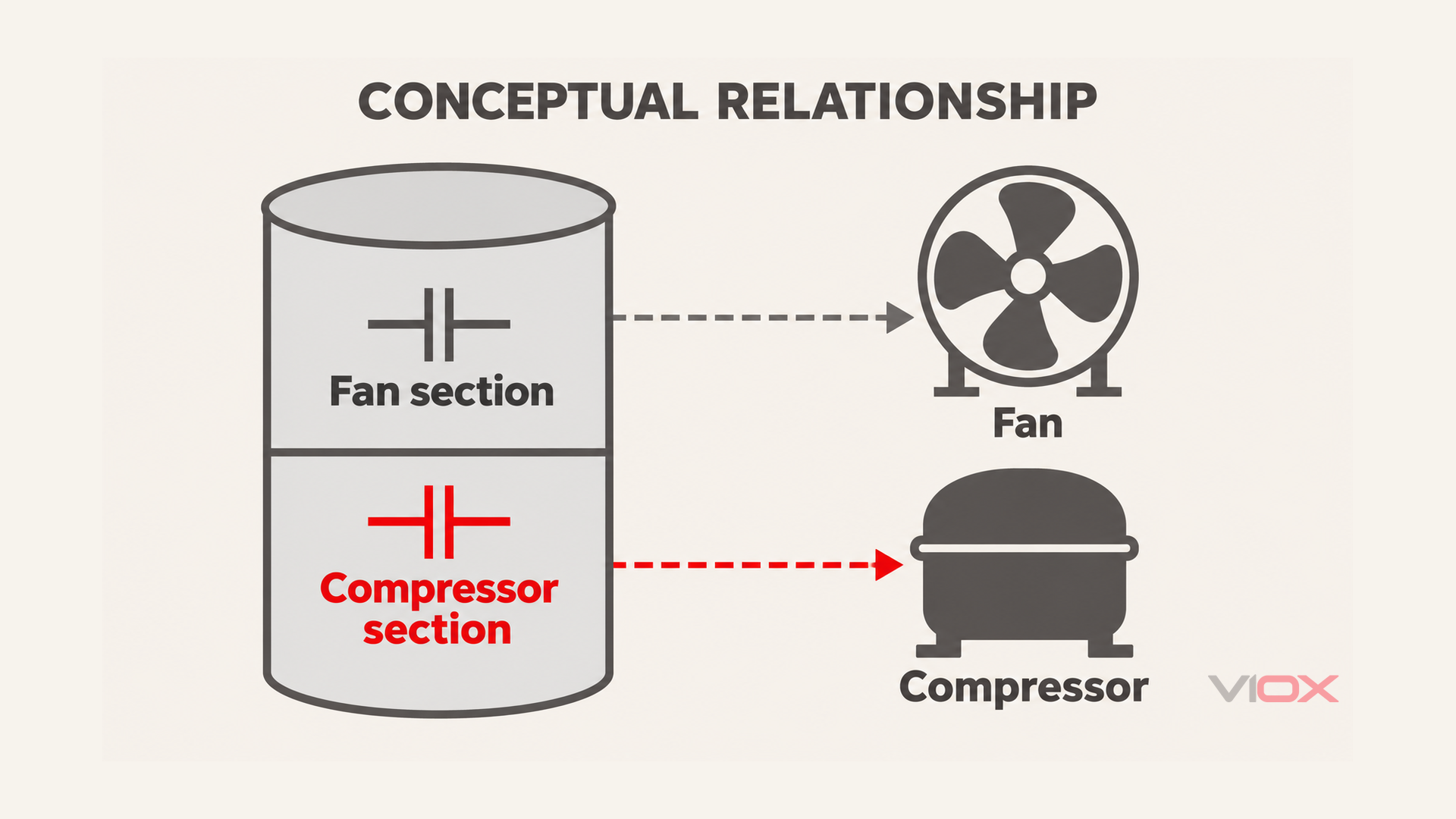
Some units use a dual run capacitor with separate fan and compressor capacitance sections in one can. The Totaline manufacturer catalogue lists such paired ratings and device-specific tolerances. A working fan therefore does not prove the compressor’s capacitor section is healthy.
The useful evidence is a recorded capacitance result for the correct section, compared with that exact component’s marked value, tolerance and equipment requirements. The technician performs this test only after isolation, discharge and verification, with the section disconnected as required by the service procedure. A normal-looking can does not substitute for that result. An in-tolerance reading is one finding, not proof that the complete start/run circuit or compressor is healthy; any remaining no-start requires the manufacturer’s further diagnostic checks.
Compressor: Has the Technician Ruled Out Its Supply and Support Circuit?
“Compressor will not start” describes an outcome. It does not prove an internal failure. Copeland’s AC-specific CoreSense bulletin AE8-1385 R2 identifies failed run capacitors, low supply voltage and compressor mechanical problems as different possible explanations for a locked-rotor condition. Its diagnostic codes apply only to the covered equipment.
Before accepting a compressor-failure diagnosis, ask for the supporting findings: supply during the attempted start, capacitor/start-circuit results where applicable, protective-device status, and manufacturer-directed compressor electrical tests. Depending on the suspected fault, a licensed technician may need winding/insulation measurements, current measurements and refrigerant pressure/temperature evidence. Do not apply a universal resistance, current or pressure cutoff from an unrelated model.
An open overload is a protective state requiring explanation. A compressor that operates electrically may also need a separate assessment of its pumping performance. Neither a hot shell nor a stopped motor is sufficient evidence to authorize replacement. Do not touch the shell to assess temperature or attempt to open the refrigerant circuit.
What If It Starts but Still Does Not Cool?
Once both outdoor motors operate, continue the system diagnosis rather than cycling through replacement parts. Airflow, heat-exchanger condition and refrigerant-circuit faults can also produce poor cooling. Carrier’s 38AUM service-analysis table, p. 39 separates no-start, cycling and continuous-operation problems; it is a model-family reference, not a charging procedure for your unit.
For frequent cycling, the relevant VIOX follow-on topic is HVAC time delay relay and compressor protection. Any timing function or setting must follow the actual equipment manufacturer’s documentation. Adding a timer does not establish why the system stopped cooling.
What to Give the Service Technician
Record the equipment model, displayed fault or delay message, whether the indoor blower and outdoor fan run, whether the compressor ever starts, and the sequence leading to shutdown. A short recording made from a safe distance can preserve an intermittent event; do not restart a failing unit to obtain one.
If a part has already been changed, include the original complaint, replacement part identification and any measured results. Ask the service report to state what failed, what evidence confirmed it, and what was checked upstream and downstream. That is more useful than “it sounded like the compressor.”
FAQ
Contactor or compressor — how do I tell?
Ask where power delivery failed. Correct incoming supply and command with failed contactor switching support a contactor-path fault. Correct contactor output but unsuitable supply at the compressor points to the intervening circuit. With correct supply at the compressor during the failed attempt, a technician must still rule out capacitor/start-circuit and protective conditions before confirming an internal compressor fault.
I replaced the contactor and it still won’t cool — what now?
Have a qualified technician verify the replacement and its connections against the equipment documentation, then identify which matrix row still applies. If the fan runs but the compressor does not, request capacitor and compressor-branch findings. If both run, request a cooling-system assessment. A new contactor does not establish that power delivery or the rest of the system is correct.
Can a bad capacitor stop the contactor from pulling in?
A motor run capacitor normally belongs to the motor circuit, not the contactor coil circuit, so its failure does not ordinarily prevent initial pull-in directly. A resulting fault can, however, cause a controller or safety device to withhold a later command. The technician must use the actual wiring diagram and fault history to distinguish those situations; a start relay is also a different component from the main contactor.