

On this page
Direct Answer: Why Is My Circuit Breaker Orange?
It’s 2 AM. Half your house goes dark. You grab a flashlight, open the electrical panel, and one breaker has orange showing: maybe a small window, a flashing LED, or a faint glow. The question is simple: is this normal, or is it dangerous?
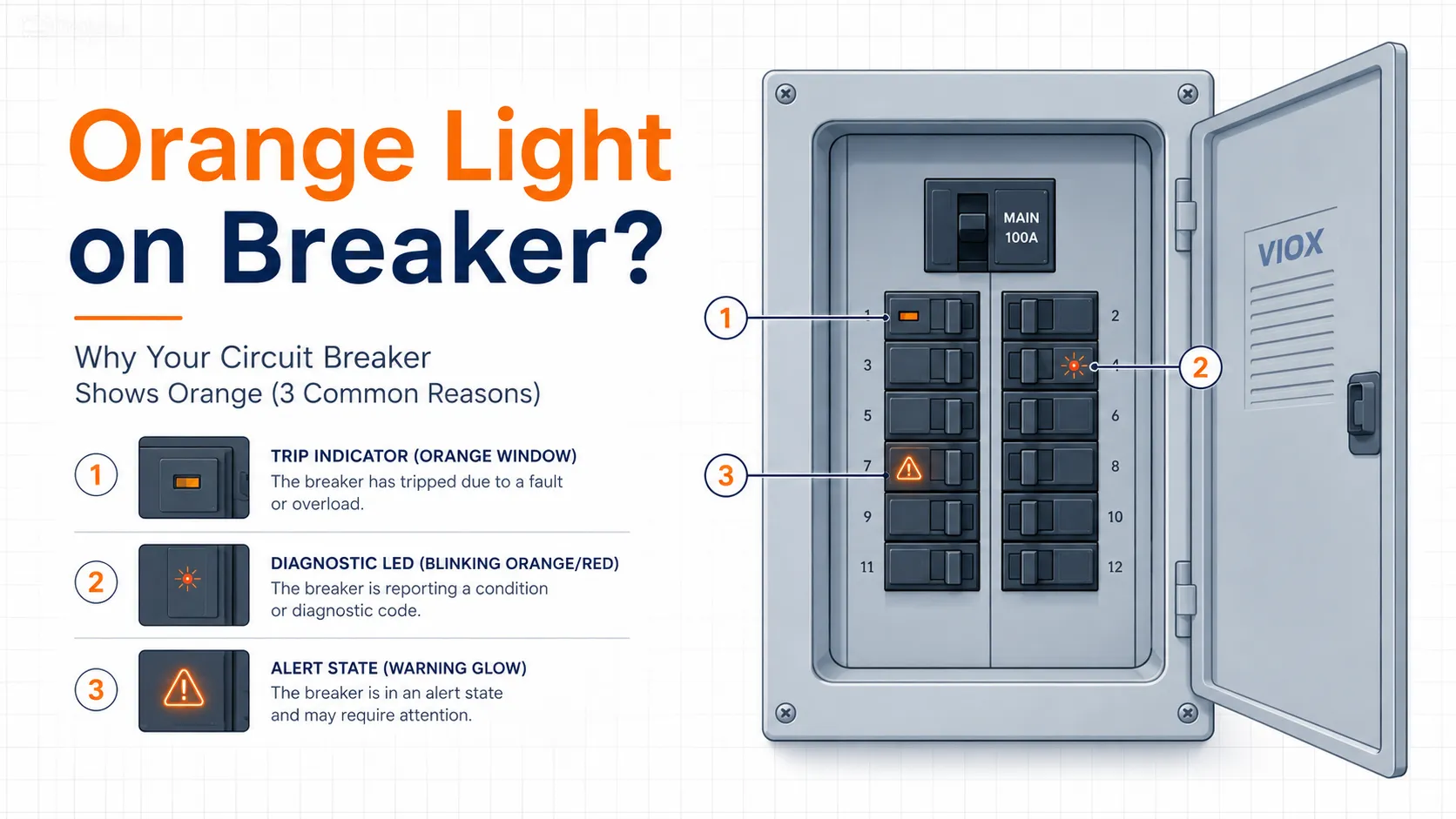
A circuit breaker can show orange for three very different reasons: a mechanical trip indicator, a diagnostic LED on an AFCI/GFCI breaker, or an actual orange glow from heat or arcing. A trip indicator or diagnostic LED means the breaker is giving information. A glowing breaker, burning smell, buzzing, heat, or repeated trip means stop resetting it and call a licensed electrician.
If the breaker is orange but power is still off, it may not be fully reset, may still detect a fault, or may have failed internally. Do not keep forcing the breaker ON if it trips again, feels warm, smells burnt, or shows a flickering glow.
Orange on a Breaker: Three Meanings You Must Separate
| Orange Appearance | What It Usually Means | Urgency |
|---|---|---|
| Orange/red flag in a small window | Mechanical trip indicator | Reset once if there are no danger signs |
| Blinking orange/red LED | AFCI/GFCI diagnostic or fault code | Check the breaker label or manual; call an electrician if repeated |
| Faint orange glow inside breaker or panel | Heat, arcing, loose connection, or internal failure | Stop and call an electrician immediately |
Type #1: Orange Trip Indicator Window
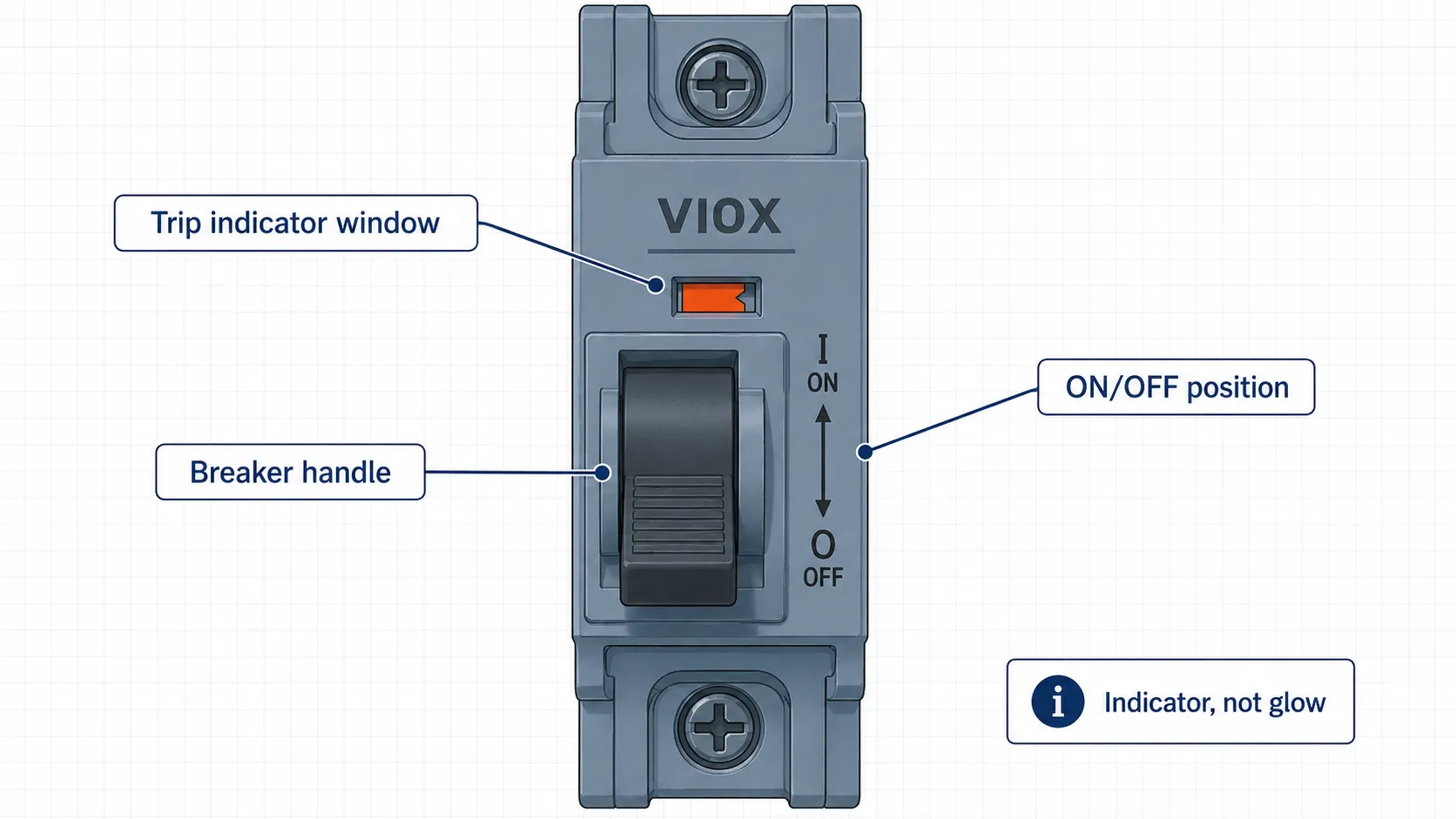
Many modern breakers include a colored trip indicator. Depending on the brand, this may appear red, orange, or reddish-orange when the breaker has tripped.
This indicator is usually not a light. It is often a mechanical flag visible through a small window. It helps users identify which breaker opened during an overload, short circuit, ground fault, or arc fault.
For example, some Square D QO breakers are known for a visible trip indication feature often referred to as Visi-Trip. On breakers with this type of indicator, the colored window is meant to help identify a tripped breaker faster. It does not automatically mean the breaker is burning or glowing.
If the orange or red indicator appears after a known overload, the normal reset sequence is:
- Move the breaker handle fully to the OFF position.
- Wait briefly and make sure there is no heat, burning smell, buzzing, or visible damage.
- Move the breaker handle back to ON.
- If it trips again, stop resetting it and investigate the circuit.
A breaker that trips repeatedly is not the problem by itself. It is usually warning that the circuit has too much load, a fault, a damaged appliance, a wiring problem, or a failing breaker.
For a broader explanation of circuit overloads, see VIOX’s guide to what circuit overload means.
Type #2: AFCI/GFCI Diagnostic LED
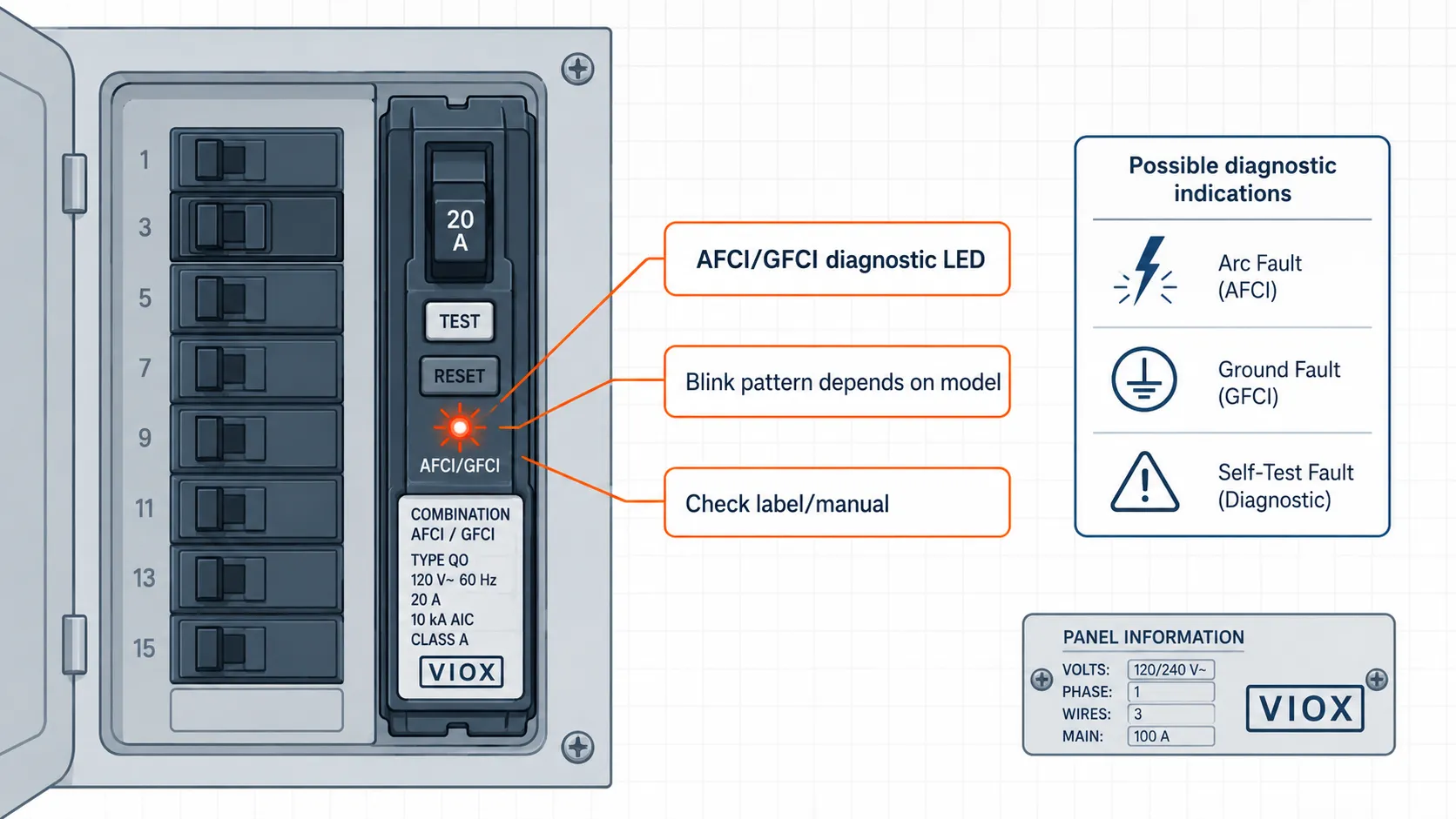
AFCI and GFCI breakers may use LED indicators to show diagnostic information. Depending on the manufacturer, a red or orange blinking light may indicate:
- ground fault
- arc fault
- overload or short-circuit trip memory
- self-test failure
- wiring problem
- end-of-life or internal failure condition
Do not interpret all blinking red or orange lights the same way. One brand’s blink pattern may mean something different from another brand’s pattern.
This is common enough that brand-specific searches such as “Eaton GFCI breaker flashing red” or “Eaton GFCI breaker blinking red” appear frequently. Siemens, Square D, Eaton, and other breaker families may use different diagnostic behavior depending on product generation and model. The blink pattern matters more than the color alone.
If your search is about a red/orange light on an AFCI or GFCI breaker, check the exact breaker label, model instructions, or manufacturer troubleshooting guide. If the breaker repeatedly trips, will not reset, or controls an important circuit, call a licensed electrician.
Type #3: Orange Glow from Heat or Arcing
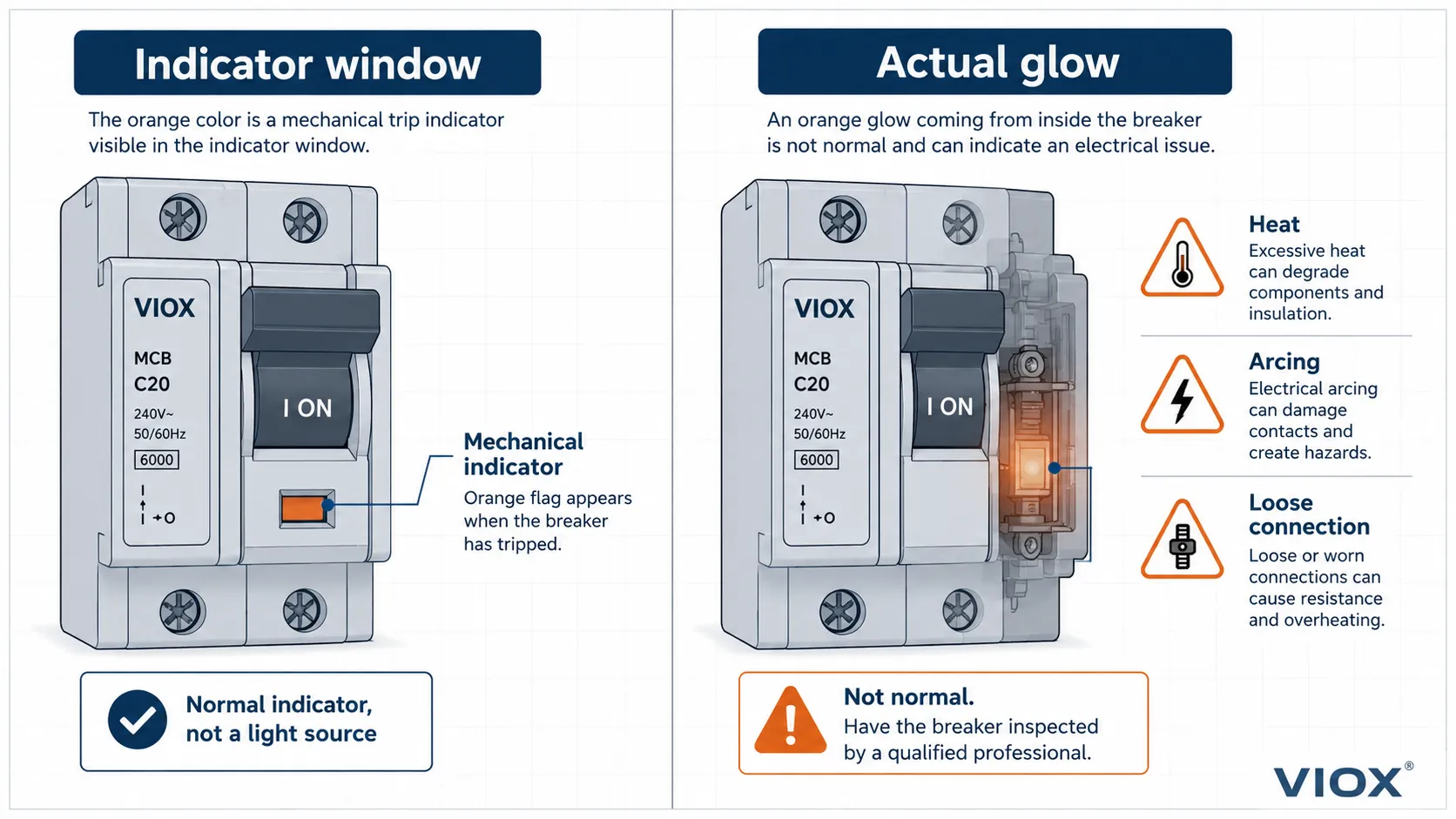
An orange trip flag is different from an orange glow. A glow inside the breaker or panel is more serious.
Possible causes include:
- loose terminal connection
- arcing inside the breaker
- damaged breaker contacts
- overheated conductor
- failing bus connection
- breaker not seated correctly
Do not keep switching a glowing breaker. Do not remove the panel cover unless you are qualified to work inside energized electrical equipment. A glow, buzzing sound, heat, or burning smell should be inspected by a licensed electrician.
Circuit Breaker Orange but Not Tripped: What Does It Mean?
If the circuit breaker looks orange but the handle is not clearly in the tripped position, several things may be happening.
| Possible Cause | How It Looks | What It Means |
|---|---|---|
| Trip indicator flag | Orange/red visible in a window | Breaker may have tripped even if handle position is subtle |
| AFCI/GFCI diagnostic LED | Blinking or steady colored light | Breaker is showing a fault code or self-test status |
| Handle between ON and OFF | Slightly loose or middle position | Breaker is tripped and needs full OFF reset |
| Internal glow | Light appears inside body or panel | Possible heat, arcing, or failed connection |
| Cosmetic handle color | Breaker toggle is manufactured in orange | Not a fault by itself |
The key question is whether the orange is a printed color, a mechanical indicator, an LED, or an actual glow. A printed or mechanical indicator is usually informational. A glow, flicker, heat, or smell is a warning.
Breaker Stays Orange After Reset
If the breaker stays orange after reset, do not assume the reset worked.
Common explanations include:
- the handle was not moved fully to OFF before turning ON
- the circuit still has a fault
- an appliance connected to the circuit is causing the trip
- an AFCI/GFCI breaker is showing diagnostic memory
- the breaker mechanism is worn or damaged
- the breaker is not seated or connected correctly
Try only one normal reset if there are no warning signs. If the breaker trips again, stays orange, or will not hold ON, stop. Repeatedly resetting a breaker can worsen damage if the circuit has a real fault.
Breaker Handle Positions: ON, OFF, and Tripped
Circuit breaker handles can be confusing because the tripped position may not be exactly centered.
| Handle Position | Meaning |
|---|---|
| Fully ON | Circuit is closed and should be energized |
| Fully OFF | Circuit is open intentionally |
| Middle or loose position | Breaker may be tripped |
| ON position but no power | Breaker may have failed, connection may be loose, or issue may be upstream |
Some breakers show an orange or red indicator even when the handle does not look dramatically different. That is why the full OFF-then-ON reset motion matters.
How to Reset a Tripped Breaker Safely
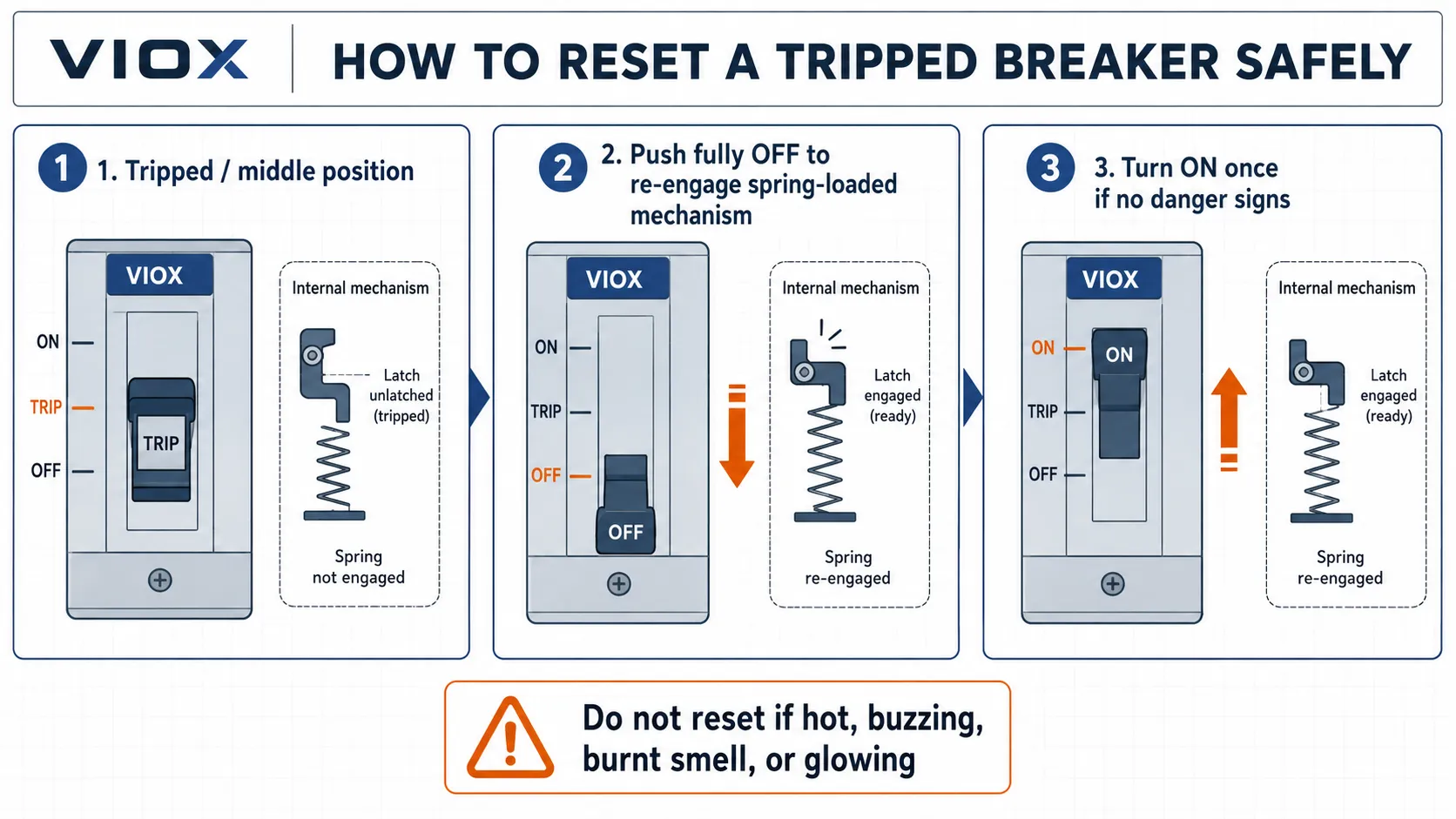
Only reset a breaker if there are no danger signs.
Do not reset if you notice:
- burning smell
- heat at the breaker or panel
- buzzing, crackling, or popping
- visible scorch marks
- orange glow or sparks
- breaker trips immediately again
- water near the panel
If there are no danger signs:
- Turn off or unplug some loads on that circuit.
- Push the breaker handle fully to OFF.
- Push it back firmly to ON.
- If power returns and the breaker stays on, monitor the circuit.
- If it trips again, stop resetting and identify the load or call an electrician.
The reason for the full OFF-then-ON motion is mechanical. Most breaker mechanisms are spring-loaded; pushing the handle fully to OFF helps re-engage the internal latch and spring mechanism before the breaker can close again. If you only nudge the handle toward ON, the breaker may still be in the tripped state.
For general breaker reset basics, see VIOX’s guide on how many watts a 20 amp circuit breaker can handle, which explains why overloads can trip a breaker even when nothing looks visibly wrong.
Power Out in Part of the House but Breaker Not Tripped
If part of the house has no power but no breaker appears tripped, the orange indicator may not be the only clue.
Possible causes include:
- breaker handle appears ON but internal mechanism failed
- tripped GFCI outlet upstream
- loose neutral connection
- loose breaker connection
- failed receptacle or splice
- utility or service issue affecting one leg
- subpanel feeder problem
This condition should be taken seriously if multiple rooms, half the house, or large appliances are affected. If normal breaker reset and GFCI reset do not restore power, call a qualified electrician.
When to Stop and Call an Electrician
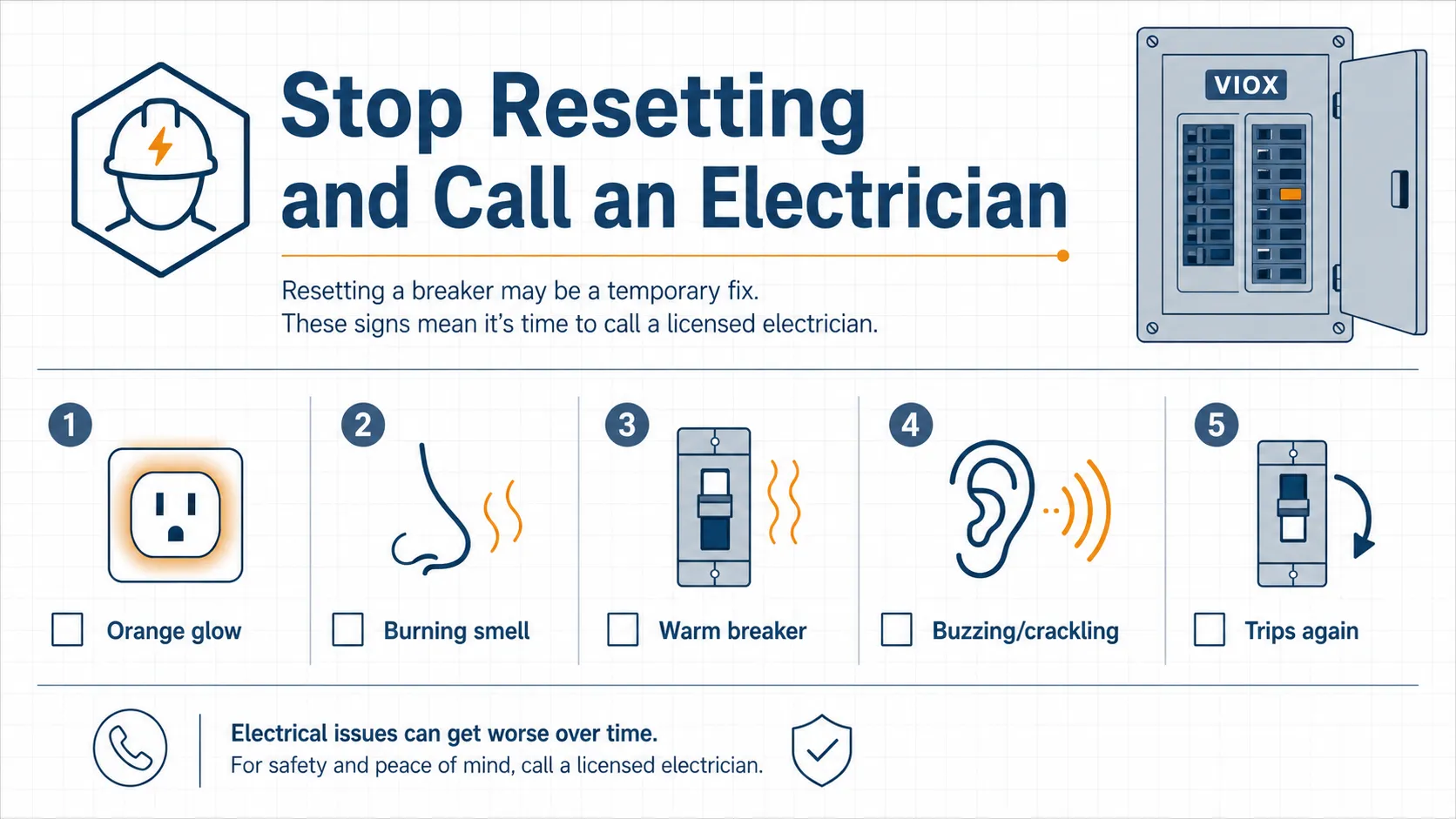
Call an electrician if:
- orange glow appears inside the breaker or panel
- breaker is warm or smells burnt
- breaker trips immediately after reset
- breaker stays orange after reset
- panel makes buzzing or crackling sounds
- lights flicker when loads turn on
- power is out in part of the house but breakers look normal
- AFCI/GFCI diagnostic light keeps blinking
- the panel is old, damaged, wet, or unlabeled
Electrical panels are not the place for trial-and-error troubleshooting. A breaker is a protective device; if it keeps warning you, the circuit needs diagnosis.
Common Mistakes
Mistake 1: Treating Every Orange Mark as a Light
Many orange or red “lights” are actually mechanical trip indicators. Look carefully before assuming the breaker has an LED.
Mistake 2: Resetting Again and Again
A breaker that trips repeatedly is doing its job. Repeated resets can make a fault worse.
Mistake 3: Ignoring Heat or Smell
Heat, burning smell, buzzing, or glow should be treated as a serious warning.
Mistake 4: Assuming the Breaker Is Bad
Sometimes the breaker is bad, but the circuit load, appliance, outlet, wire, or connection may be the real problem.
Mistake 5: Mixing Up AFCI/GFCI Fault Codes
Different manufacturers use different LED codes. Do not assume one blink pattern applies to all breakers.
FAQ
Why is there an orange light on my breaker?
It may be a trip indicator, an AFCI/GFCI diagnostic LED, or a warning glow. A mechanical indicator is usually normal after a trip; a glow, heat, smell, or repeated trip needs professional inspection.
Is an orange breaker dangerous?
An orange flag is not necessarily dangerous. An orange glow, hot breaker, burning smell, buzzing, or breaker that will not reset can be dangerous and should be checked by an electrician.
Why is my circuit breaker orange but not tripped?
The orange color may be a diagnostic LED, a trip indicator window, a cosmetic handle color, or a sign that the breaker is partly tripped. If power is out, move the handle fully OFF, then ON once. If it does not hold, stop.
Why does my breaker stay orange after reset?
It may not be fully reset, the circuit may still have a fault, the breaker may be showing diagnostic memory, or the breaker may be damaged. If it stays orange or trips again, have it inspected.
What does a red or orange indicator on a breaker mean?
It usually means the breaker has tripped or is showing a diagnostic condition. On AFCI/GFCI breakers, the meaning depends on the brand and blink pattern.
What does a blinking red light on an Eaton GFCI breaker mean?
The meaning depends on the exact Eaton breaker model and blink pattern. Check the breaker label or manufacturer instructions. If it repeatedly trips, will not reset, or controls an important circuit, call an electrician.
Can I reset a breaker with an orange indicator?
You can perform one normal reset if there is no heat, smell, buzzing, damage, water, or repeated tripping. Move it fully OFF, then ON. If it trips again, stop.
Why is power out in part of my house but no breaker is tripped?
Possible causes include a failed breaker, loose connection, tripped GFCI outlet, loose neutral, or upstream service issue. If resetting breakers and GFCIs does not restore power, call an electrician.
Conclusion
An orange mark on a breaker is not always an emergency. It may simply be a trip indicator showing which breaker opened. But an orange glow, blinking diagnostic light, repeated trip, hot breaker, or breaker that stays orange after reset should not be ignored.
The safest approach is simple: identify whether the orange is a flag, LED, handle color, or glow; perform only one normal reset if there are no warning signs; and call a licensed electrician if the breaker trips again, feels hot, smells burnt, or controls a circuit that will not restore power.