

On this page
Direct Answer: What Is a Dual Power Automatic Transfer Switch?
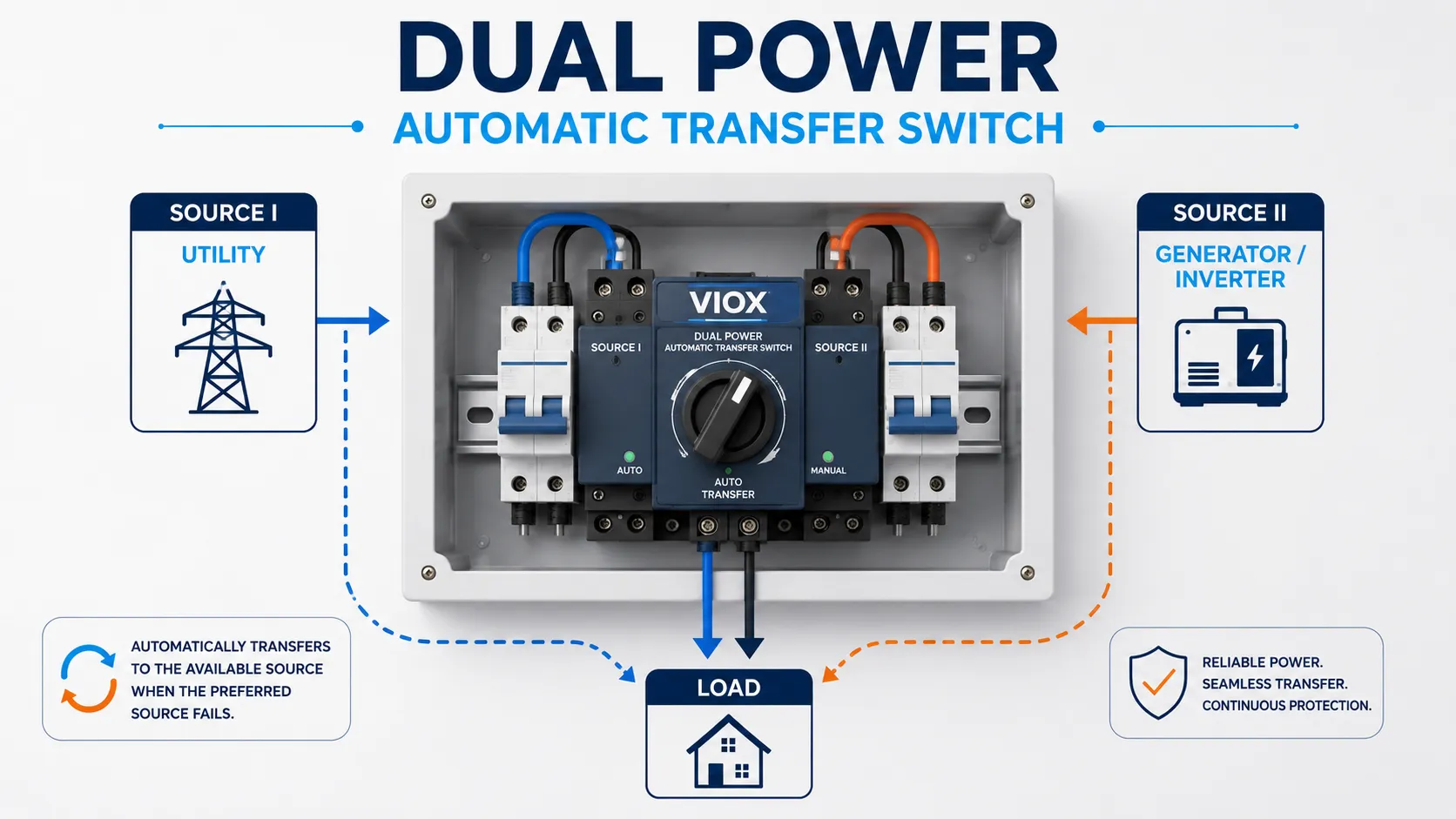
A dual power automatic transfer switch is an automatic switching device that transfers a load between two power sources. It is also called a dual power ATS, dual source ATS, dual power transfer switch, or automatic changeover switch.
In a typical installation, the two sources may be:
- utility power and generator power
- utility power and battery inverter output
- utility power and PV inverter AC output
- two independent grid supplies
- main supply and UPS-backed supply
The switch monitors source voltage, phase condition, and source availability. When the normal source fails or falls outside the acceptable operating range, the ATS transfers the load to the backup source. When the normal source returns and stabilizes, the ATS can transfer the load back according to its programmed logic.
For buyers comparing products, VIOX’s ATS product page is the core product category for automatic source transfer solutions.
Dual Power ATS Meaning at a Glance
| Term | Practical Meaning |
|---|---|
| Dual power automatic transfer switch | Automatic switch for two power sources |
| Dual power ATS | Short name for dual power automatic transfer switch |
| Dual source ATS | Emphasizes two incoming supplies |
| Automatic changeover switch | Common commercial term for automatic source switching |
| Double power automatic transfer switch | Alternative translation often used in supplier listings |
| 2P ATS | Single-phase line and neutral transfer |
| 3P ATS | Three-phase three-wire transfer where neutral is not used |
| 4P ATS | Three-phase plus neutral transfer |
| PC class ATS | Switch-based transfer device, requires upstream short-circuit protection |
| CB class ATS | Breaker-based ATS design with circuit-breaker mechanism |
Dual Power ATS vs Standard ATS: Is There a Difference?
In many supplier catalogs, “dual power ATS” and “automatic transfer switch” mean the same basic device: an ATS that switches between two sources. The phrase dual power simply makes the two-source design explicit.
However, the term is often used for compact DIN-rail, molded-case, or motorized changeover devices in residential, commercial, telecom, generator, and light industrial systems. So the buyer should not stop at the name. The important specification details are:
- number of poles
- rated current
- rated voltage
- transfer class
- transition type
- source type
- control voltage
- short-circuit coordination
- neutral switching requirement
- wiring terminal arrangement
If you need the basic acronym meaning first, see VIOX’s guide to ATS full form in electrical systems.
How Does a Dual Power Automatic Transfer Switch Work?
A dual power ATS works by monitoring two incoming sources and connecting the load to only one acceptable source at a time.
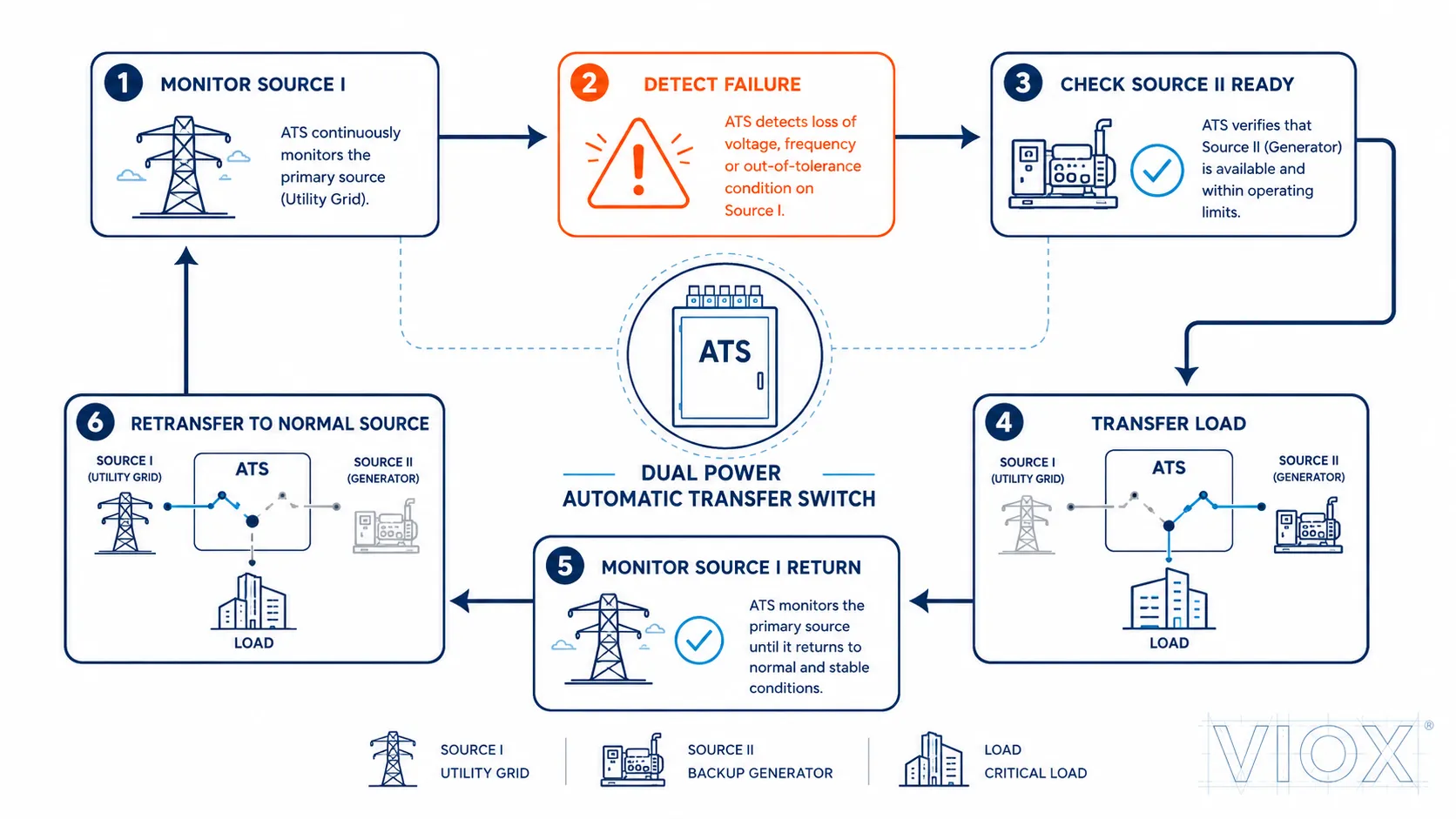
The typical transfer logic is:
| Step | What the Dual Power ATS Does | Why It Matters |
|---|---|---|
| 1 | Monitors Source I and Source II | Detects undervoltage, loss of phase, or source failure |
| 2 | Keeps load on preferred source | Normal operation uses the primary supply |
| 3 | Detects source abnormality | Prevents the load from staying on failed or unstable power |
| 4 | Confirms alternate source is available | Avoids transferring to a dead or unstable source |
| 5 | Opens the normal source path | Prevents two sources from being connected together |
| 6 | Closes the backup source path | Restores supply to the load |
| 7 | Monitors normal source return | Prepares retransfer after stable recovery |
| 8 | Transfers back if programmed | Returns the system to normal operation |
This operating sequence is covered in more detail in VIOX’s guide to how an automatic transfer switch works.
Common Dual Power Source Combinations
The phrase dual power does not mean the two sources are always grid and generator. The correct ATS depends on what the two sources actually are.
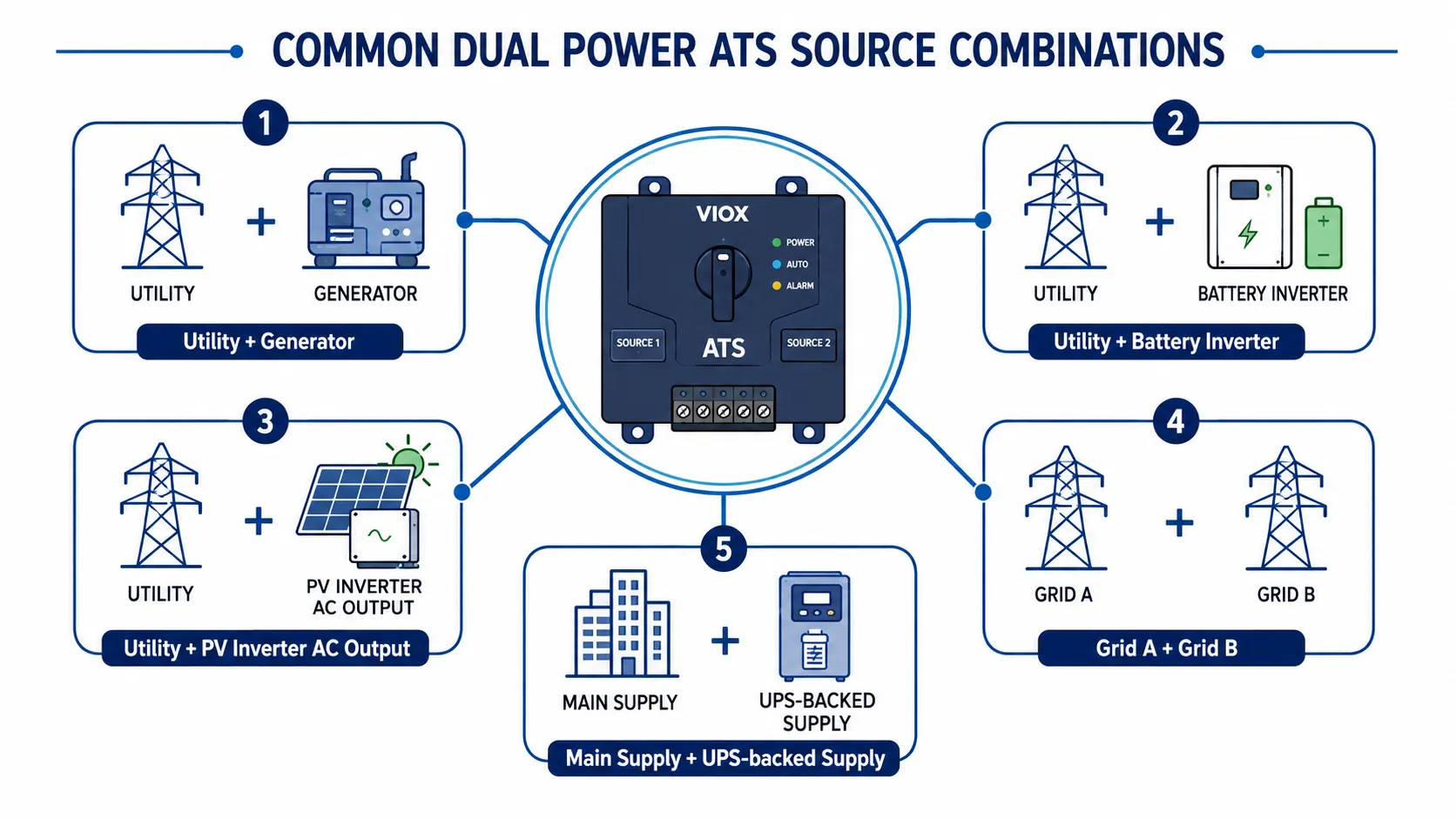
| Source 1 | Source 2 | Common Use |
|---|---|---|
| Utility grid | Diesel or gas generator | Building backup power, pump stations, commercial standby |
| Utility grid | Battery inverter AC output | Residential backup, telecom, small commercial backup |
| Utility grid | PV inverter AC output | Solar-assisted backup or source priority switching |
| Grid A | Grid B | Redundant utility supply, critical facilities |
| Main supply | UPS-backed supply | IT rooms, control systems, communications |
| Generator A | Generator B | Redundant generator systems |
For critical loads that require very fast transfer between two live sources, a conventional mechanical ATS may not be enough. In that case, compare ATS with static transfer switching using VIOX’s ATS vs STS guide.
Main Types of Dual Power Automatic Transfer Switch
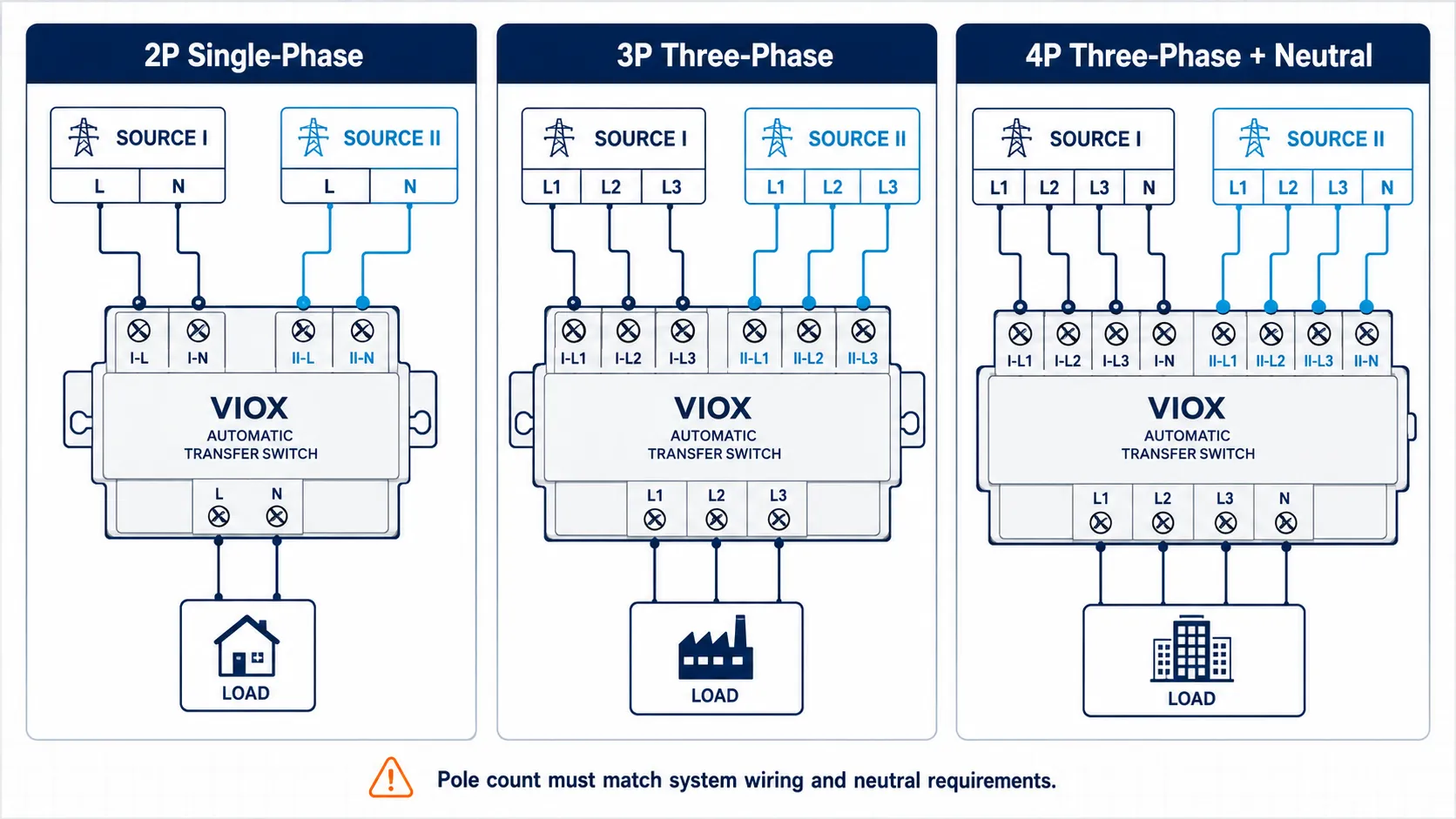
2P Dual Power ATS
A 2-pole automatic transfer switch is commonly used for single-phase systems where line and neutral must be transferred. It is often found in small residential, light commercial, telecom, and inverter backup systems.
Use 2P only when the power system and load are truly single-phase and the neutral switching arrangement matches local code and equipment instructions.
3P Dual Power ATS
A 3-pole ATS may be used for three-phase three-wire systems where no neutral conductor is required by the load or distribution system.
Do not use 3P if the load requires neutral switching or if the system design requires neutral isolation. In those cases, 4P is usually the correct direction.
4P Dual Power ATS
A 4-pole ATS transfers three phases plus neutral. It is commonly used in three-phase four-wire systems where neutral switching is required or specified.
Neutral switching can be important for grounding systems, generator neutral arrangements, leakage current behavior, and compliance with local wiring rules.
PC Class Dual Power ATS
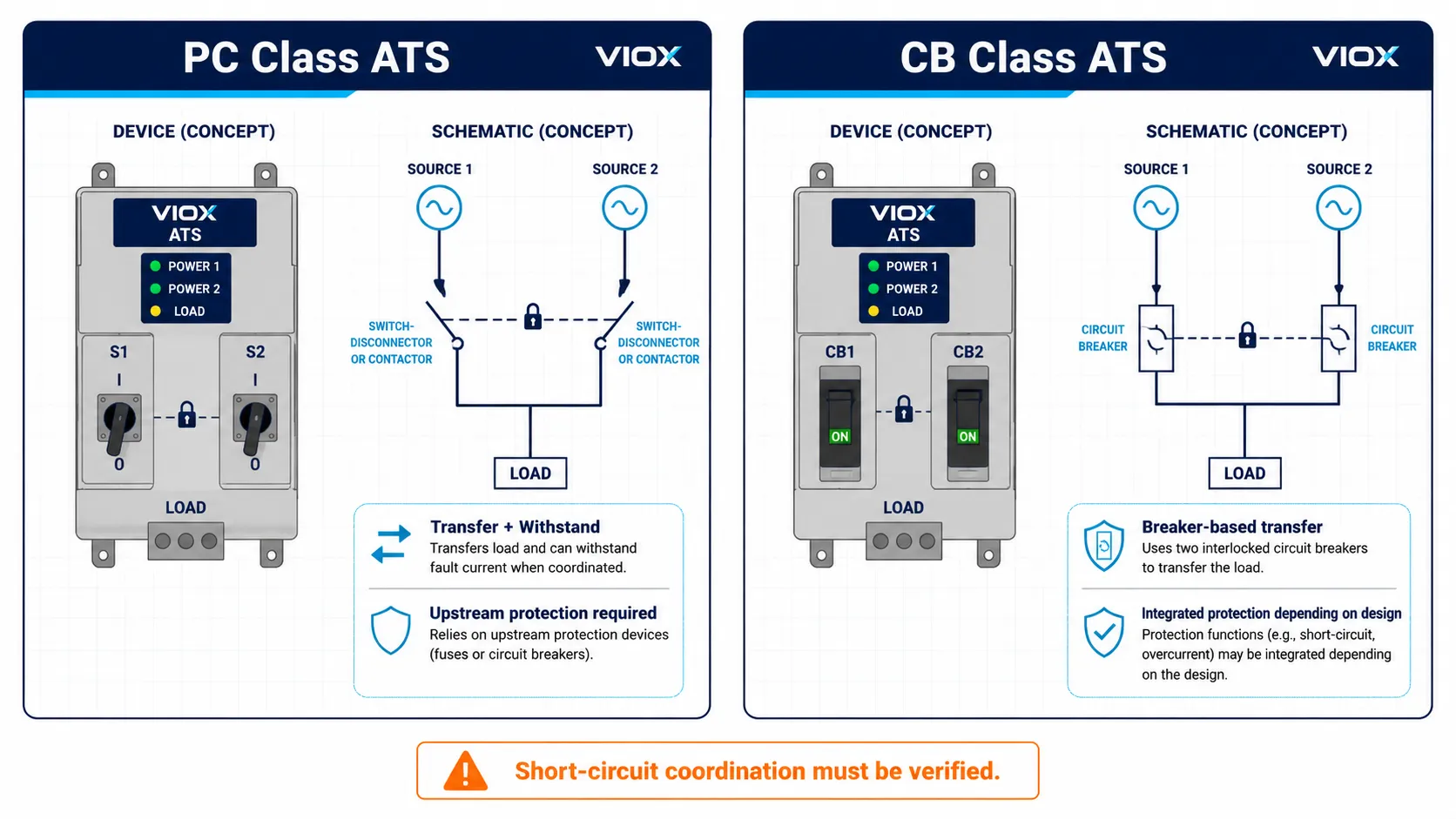
PC class ATS devices are switch-based transfer devices. They are designed to transfer load current and withstand short-circuit current within their rating, but they do not normally interrupt downstream short-circuit current by themselves.
That means upstream protection is critical. If a downstream fault occurs, the upstream MCB, MCCB, or fuse must clear it before the ATS contacts are damaged.
For the detailed difference, see VIOX’s PC class vs CB class ATS selection guide.
CB Class Dual Power ATS
CB class ATS designs use circuit-breaker mechanisms or breaker-based transfer units. They may provide integrated overcurrent protection and fault interruption depending on the product design and ratings.
CB class is often considered when the ATS is installed at a main incoming point, in a larger distribution panel, or where the transfer device must also serve a breaker function.
Dual Motor Automatic Transfer Switch
Some molded-case ATS designs use motor-driven mechanisms to operate two switching units with mechanical and electrical interlocking. This is sometimes described in search terms as a molded case dual motor ATS.
The key points to check are not just the motor mechanism, but also:
- interlock design
- transfer time
- rated current
- rated voltage
- short-circuit rating
- upstream protection requirements
- controller function
- manual operation method
Open Transition, Closed Transition, and Delayed Transition
Most compact dual power ATS products are open-transition devices. They disconnect from one source before connecting to the other. This prevents accidental paralleling of two unsynchronized sources.
| Transition Type | How It Works | Typical Use |
|---|---|---|
| Open transition | Breaks one source before making the other | Most generator, inverter, and general dual-source systems |
| Delayed transition | Adds an intentional off delay between sources | Motor loads, transformer loads, residual voltage decay |
| Closed transition | Momentarily parallels two acceptable synchronized sources | Specialized systems where source synchronization is controlled |
Do not assume a dual power ATS provides no-break transfer. If the load cannot tolerate interruption, the system may need UPS support, STS, or a different power architecture.
For deeper transfer-mode selection, see VIOX’s article on open vs closed transition ATS.
How to Choose a Dual Power Automatic Transfer Switch
| Selection Item | What to Check | Common Mistake |
|---|---|---|
| Number of poles | 2P, 3P, or 4P | Buying 2P for a three-phase system |
| Rated current | Load current and future expansion | Selecting only by generator size |
| Rated voltage | 220V, 230V, 240V, 400V, 415V, or other system voltage | Ignoring control voltage and system voltage difference |
| Source type | Grid, generator, inverter, PV AC output, UPS | Assuming every ATS works with every source |
| ATS class | PC class or CB class | Treating PC class as a circuit breaker |
| Transition type | Open, delayed, or closed | Expecting zero interruption from open transition |
| Short-circuit coordination | Upstream breaker/fuse and ATS SCCR/WCR | Installing ATS without proper protection coordination |
| Neutral switching | 2P or 4P where neutral transfer is required | Leaving neutral connected when it should transfer |
| Controller function | Under/overvoltage, phase loss, delay, generator start | Buying a switch body without needed control logic |
| Manual operation | Manual handle, emergency operation, lockout | Forgetting maintenance and emergency use |
Dual Power ATS Wiring and Terminal Basics
A dual power automatic transfer switch usually has:
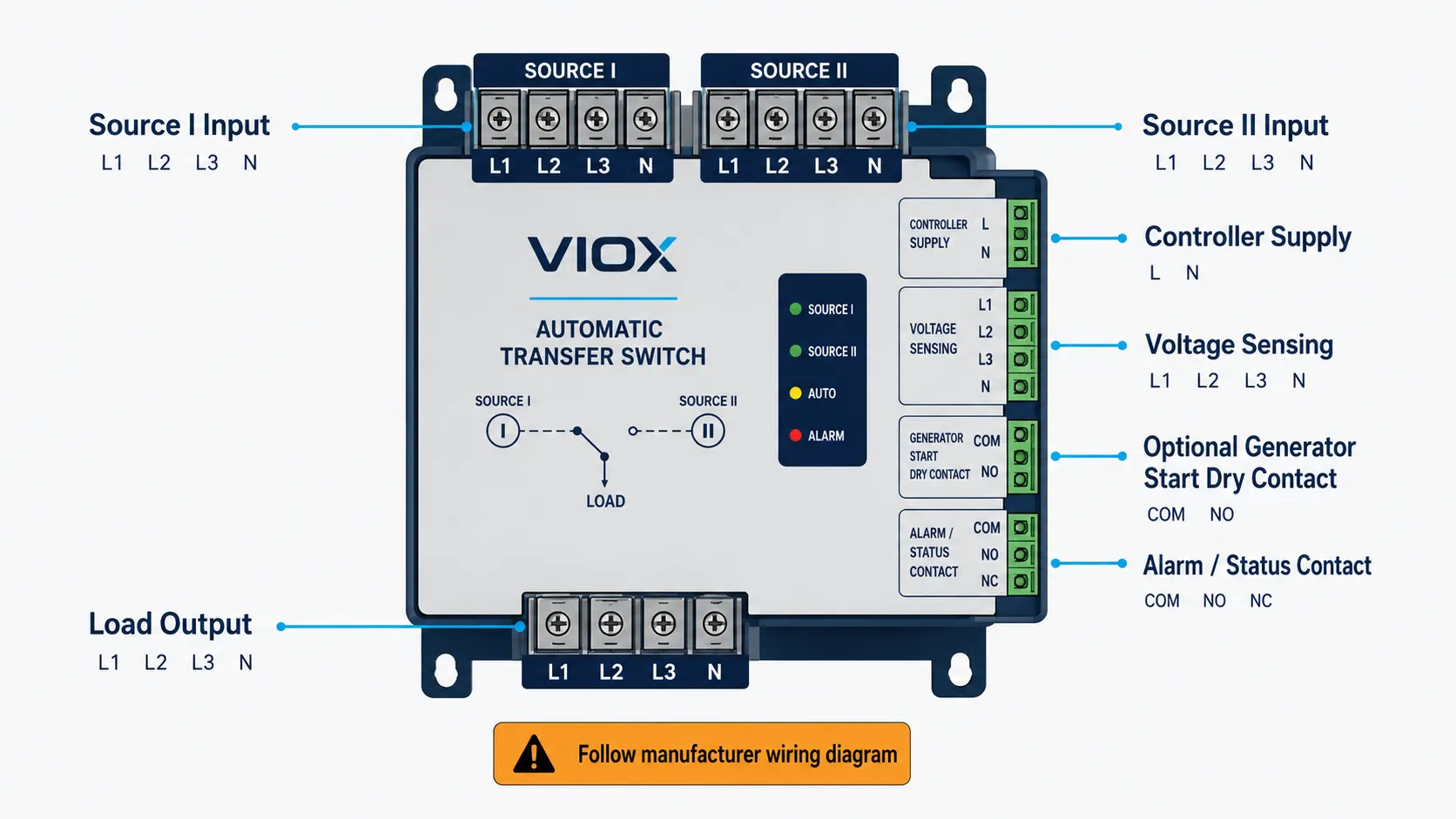
- Source I input terminals
- Source II input terminals
- load output terminals
- controller supply terminals
- voltage sensing terminals
- optional generator start contacts
- optional alarm or status contacts
The exact terminal naming depends on the product. Common labels include:
| Label | Meaning |
|---|---|
| I / Source I | Normal or preferred source |
| II / Source II | Backup or alternate source |
| Load / Output | Terminals feeding the load |
| N | Neutral terminal where applicable |
| L1/L2/L3 | Three-phase line terminals |
| Auto / Manual | Operating mode selection |
| Gen Start | Dry contact for generator start signal |
Always follow the manufacturer wiring diagram. A dual power ATS is not just a double-throw switch; the controller, interlock, sensing circuit, and power terminals must all match the system design.
Dual Power ATS for Generator Backup
Generator backup is one of the most common dual power ATS applications. The ATS monitors utility power, sends a start signal to the generator if required, waits for stable generator voltage, and then transfers the load.
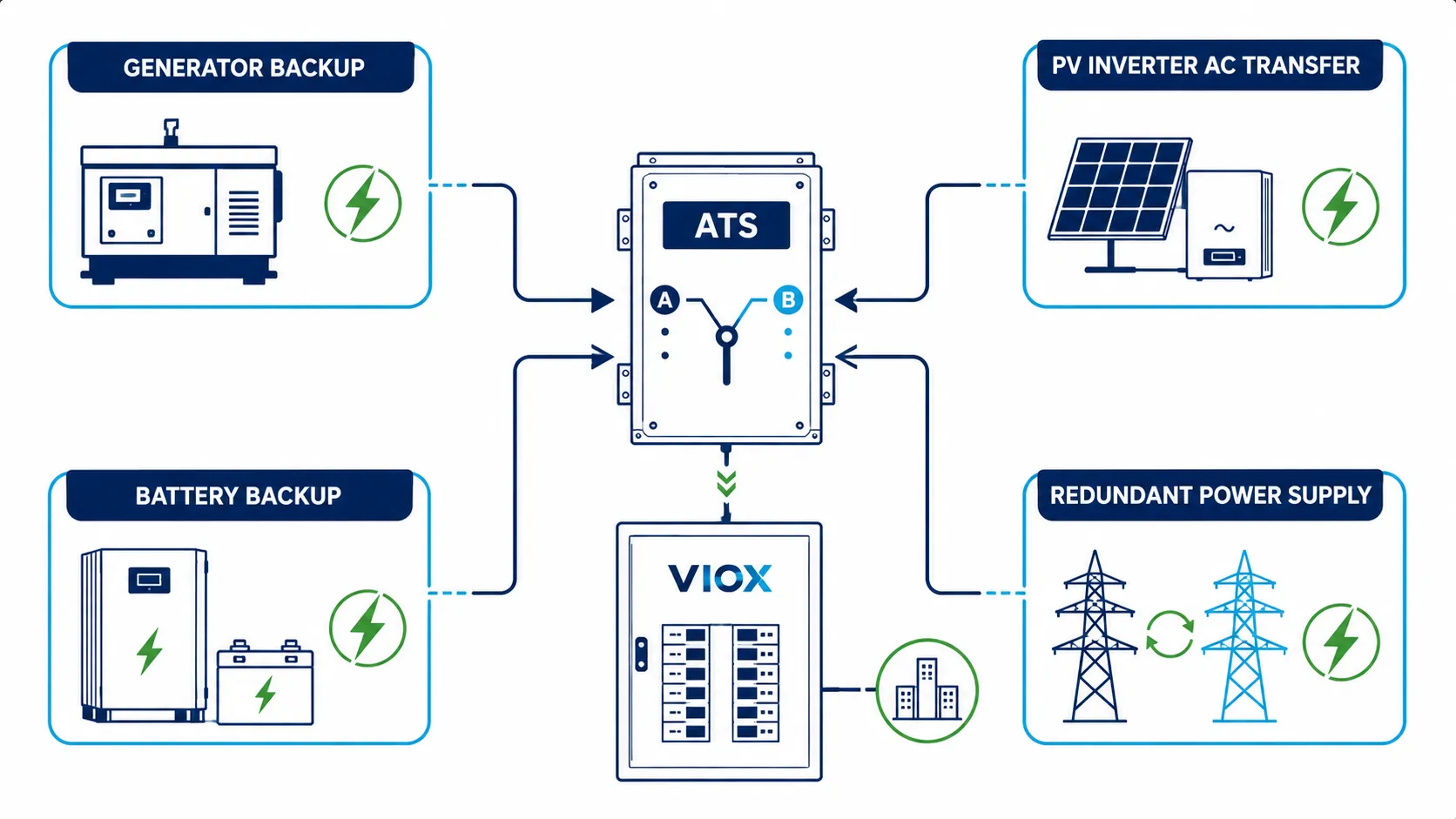
Important checks include:
- generator start signal compatibility
- generator warm-up delay
- retransfer delay
- neutral bonding arrangement
- generator voltage and frequency stability
- load starting current
- ATS short-circuit rating
Do not compare ATS switching time alone when a generator is involved. Generator start and stabilization often dominate total outage time. For timing details, see VIOX’s ATS switching time guide.
Dual Power ATS for PV, Battery, and Inverter Systems
Searches such as “PV dual power ATS factory” and “automatic transfer switch for battery backup” show that many users are applying ATS devices to solar and energy storage systems.
This can work, but the source behavior is different from a generator:
- Inverter output may have current limits.
- Some inverters are not designed to be paralleled.
- Neutral bonding may change between grid and backup mode.
- Transfer delay may affect sensitive loads.
- Some systems require an inverter-approved transfer device.
- DC-side switching is not the same as AC-side ATS switching.
If the ATS is on the AC side of an inverter or PV backup system, check the inverter manual before selecting the ATS. Do not assume every generator ATS is suitable for inverter backup.
Dual Power ATS for Redundant Power Systems
Some users search for automatic redundant power switching, redundant power transfer switch, or high availability transfer switch. These searches usually come from telecom, data center, security, control, or network equipment applications.
A dual power ATS can provide automatic source selection, but it is not always the best device for very sensitive loads. Use this rule:
| Load Requirement | Better Direction |
|---|---|
| Short interruption is acceptable | Mechanical dual power ATS |
| Load needs ride-through during switching | UPS plus ATS or UPS-backed architecture |
| Load requires very fast transfer between two live AC sources | Static transfer switch |
| Source is generator backup | ATS is usually the normal solution |
| Source is inverter backup | ATS may work if inverter manual allows it |
Common Selection Mistakes
Mistake 1: Treating Dual Power ATS as Short-Circuit Protection
Many PC class dual power ATS devices can transfer load current, but they are not circuit breakers. They need correctly coordinated upstream protection.
Mistake 2: Choosing by Ampere Rating Only
A 100A ATS is not automatically suitable for every 100A load. You still need to check voltage, pole count, transfer class, short-circuit rating, load type, and source type.
Mistake 3: Ignoring Neutral Switching
Neutral transfer can be critical in generator and inverter systems. Incorrect neutral switching can cause nuisance tripping, grounding problems, or unsafe operation.
Mistake 4: Expecting No-Break Transfer
Most dual power ATS devices create a short interruption during transfer. If the load cannot tolerate interruption, use UPS, STS, or a suitable critical-power architecture.
Mistake 5: Using a Generator ATS for PV or Battery Backup Without Checking
Inverters and PV systems may have different output behavior from generators. Always check source compatibility.
Mistake 6: Forgetting Controller Power and Sensing Voltage
The ATS controller must be compatible with the system voltage and sensing arrangement. A mismatch can cause failure to transfer, chatter, or incorrect source detection.
FAQ
What is a dual power automatic transfer switch?
A dual power automatic transfer switch is an ATS that automatically transfers a load between two power sources, such as utility and generator, utility and inverter, or two grid supplies.
Is a dual power ATS the same as an automatic transfer switch?
In most practical cases, yes. The term dual power ATS emphasizes that the switch has two source inputs. However, the exact product type can vary by pole count, class, transition type, and controller function.
What is the difference between dual power ATS and automatic changeover switch?
The terms are often used interchangeably. An automatic changeover switch changes the supply automatically between two sources. A dual power ATS is a more specific power-transfer device with automatic control logic.
What is a 2 pole automatic transfer switch used for?
A 2P ATS is usually used for single-phase systems where line and neutral are transferred. It is common in small backup systems, telecom panels, and inverter backup circuits.
Do I need 3P or 4P ATS for three-phase power?
Use 3P only when the system is three-phase three-wire and no neutral transfer is required. Use 4P when the system includes neutral and the neutral must be switched.
Can a dual power ATS switch between generator and utility?
Yes. This is one of the most common applications. The ATS can monitor utility failure, start the generator if supported, and transfer the load after the generator output is stable.
Can a dual power ATS be used with solar PV?
It may be used on the AC side of some PV or inverter systems, but only if the inverter design and wiring rules allow it. DC PV string switching is a different application and should not be handled by an AC ATS.
Does a dual power ATS provide overload protection?
Not always. PC class ATS devices generally require upstream overcurrent protection. CB class ATS designs may include breaker-based protection depending on the product.
Is dual power ATS suitable for data centers?
It depends on the load. A mechanical ATS may be suitable for backup distribution, but sensitive IT loads usually require UPS support or static transfer switching.
What should I check before buying a dual power ATS?
Check pole count, rated current, rated voltage, source type, PC/CB class, transition type, short-circuit rating, neutral switching, controller voltage, and manufacturer wiring diagram.
Conclusion
A dual power automatic transfer switch is a two-source automatic switching device used for backup power, redundant supply, generator systems, inverter backup, PV AC output transfer, and industrial source changeover.
To choose the right model, do not rely only on the phrase “dual power.” Confirm:
- 2P, 3P, or 4P configuration
- rated current and voltage
- source combination
- PC class or CB class
- open, delayed, or closed transition
- neutral switching requirement
- upstream protection coordination
- controller and sensing voltage
- wiring diagram compatibility
The correct ATS is not just the one that fits the current rating. It is the one that fits the complete source-transfer system.