

On this page
What Is the Difference Between Voltage and Current?
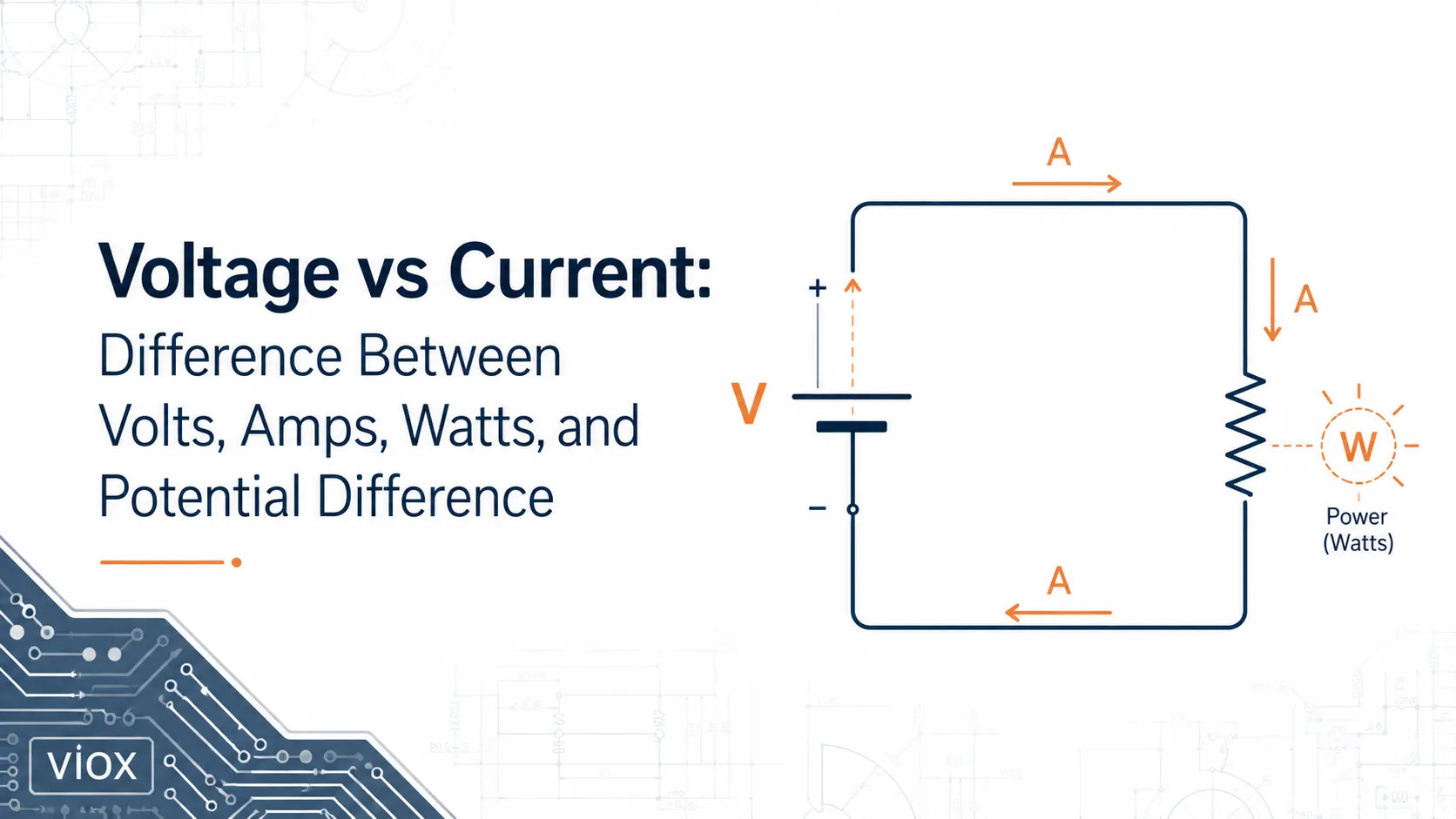
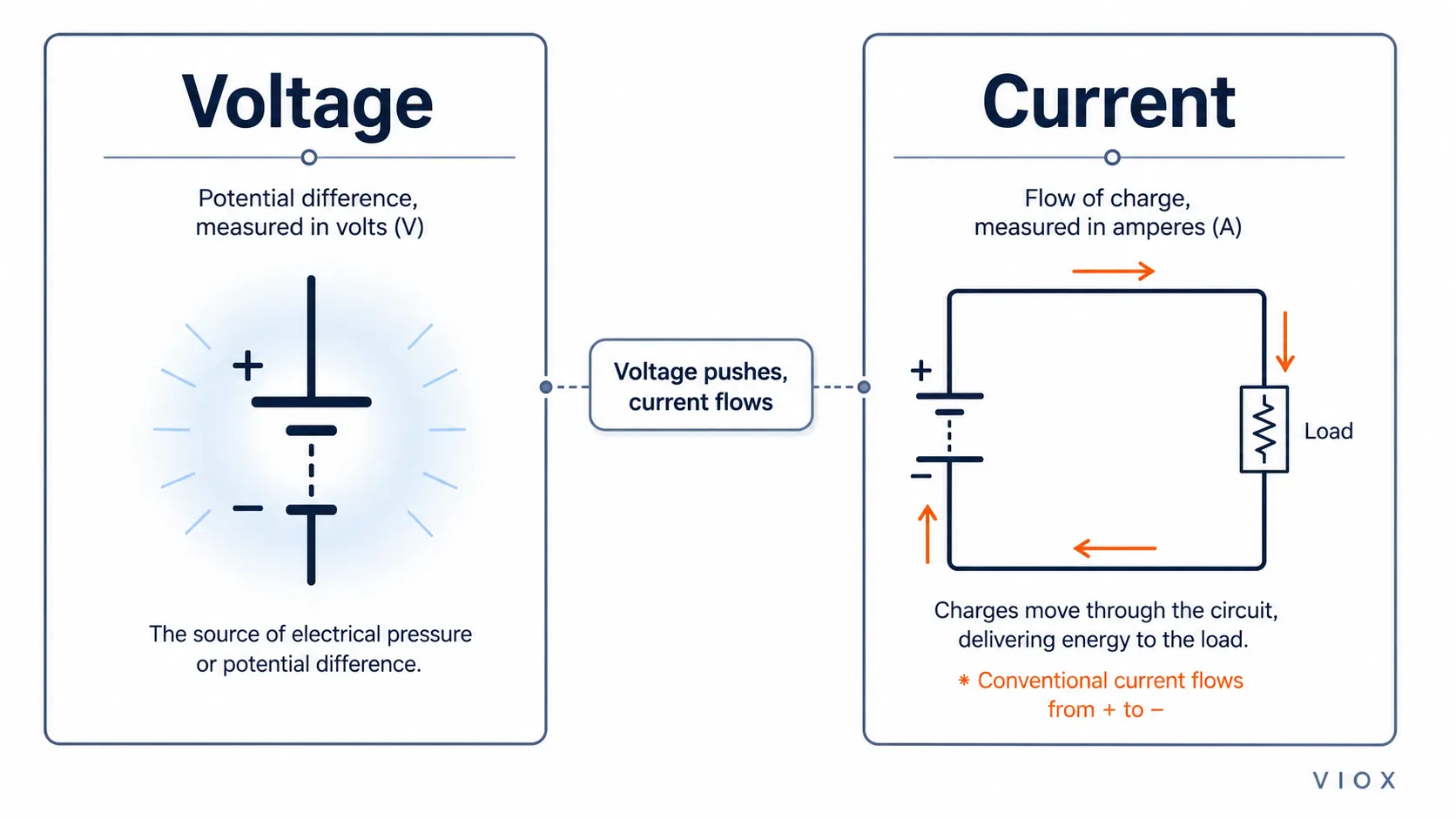
Voltage is electrical potential difference, measured in volts (V). Current is the flow of electric charge, measured in amperes (A). Voltage pushes current through a circuit, while current describes how much charge is flowing. They are related by Ohm’s law: I = V / R.
The simplest way to remember the difference is:
- Voltage is the push.
- Current is the flow.
- Resistance limits the flow.
- Power is the rate of electrical energy being used.
This distinction matters in real electrical work. A circuit may have voltage present but almost no current flowing if the circuit is open. A circuit may also draw too much current if the load resistance is too low, which can overheat wires, trip a breaker, or damage equipment.
Voltage vs Current at a Glance
| Term | Symbol | Unit | What It Means | Simple Role |
|---|---|---|---|---|
| Voltage | V | Volt (V) | Electrical potential difference between two points | Pushes current |
| Current | I | Ampere (A) | Flow rate of electric charge | Shows how much charge is moving |
| Resistance | R | Ohm (Ω) | Opposition to current flow | Limits current |
| Power | P | Watt (W) | Rate of electrical energy use | Shows work or heat produced |
In practical terms, voltage and current must be considered together. A 230 V circuit and a 24 V control circuit behave very differently, but both can be unsafe if the available current, installation condition, and protection device are not suitable.
What Is Voltage?
Voltage is the electrical potential difference between two points in a circuit. It is measured in volts (V).
If you think of electricity like water flow, voltage is similar to pressure. Higher pressure can push more water through a pipe. Higher voltage can push more current through a circuit, if the circuit path allows it.
Examples:
- A battery has voltage between its positive and negative terminals.
- A wall outlet has voltage between live and neutral.
- A power supply has output voltage between its terminals.
- A voltage drop appears across a resistor, cable, terminal, or load when current flows.
Voltage is always measured between two points, not “through” one point.
What Is Current?
Current is the flow of electric charge through a conductor or load. It is measured in amperes (A), often shortened to amps.
Current flows only when there is a complete circuit and a driving voltage. If a switch is open, voltage may still be present on one side of the switch, but current does not flow through the load.
Examples:
- A lamp draws current when it is switched on.
- A motor draws current while running.
- A heater draws current and converts electrical energy into heat.
- A fault can cause excessive current, which should be interrupted by a fuse, MCB, MCCB, or other protective device.
For circuit protection, current is usually the key value. Overload and short-circuit protection devices are selected according to current, cable capacity, fault level, and application. For a deeper protection example, see VIOX’s guide to miniature circuit breakers.
What Is Potential Difference?
Potential difference is another way to describe voltage. It means the difference in electric potential energy per unit charge between two points.
In everyday electrical work:
Potential difference = voltage.
For example, if a power supply provides 24 V DC, that means there is a 24-volt potential difference between its positive and negative terminals. If a home outlet is rated at 230 V AC, that means there is a nominal 230-volt potential difference between live and neutral.
Potential difference is important because current does not flow just because one point has “electricity.” Current flows when there is a closed path and a voltage difference that drives charge through that path.
Is Current Measured in Volts?
No. Current is measured in amperes (A), not volts.
Volts and amps measure different things:
| Question | Correct Answer |
|---|---|
| Is voltage measured in amps? | No, voltage is measured in volts |
| Is current measured in volts? | No, current is measured in amperes |
| What measures electrical pressure? | Voltage |
| What measures electrical flow? | Current |
| What measures power use? | Watts |
This is a common beginner mistake. Saying “current is 230 volts” is incorrect. The correct statement would be “the voltage is 230 V” or “the current is 10 A,” depending on what is being measured.
How to Calculate Current
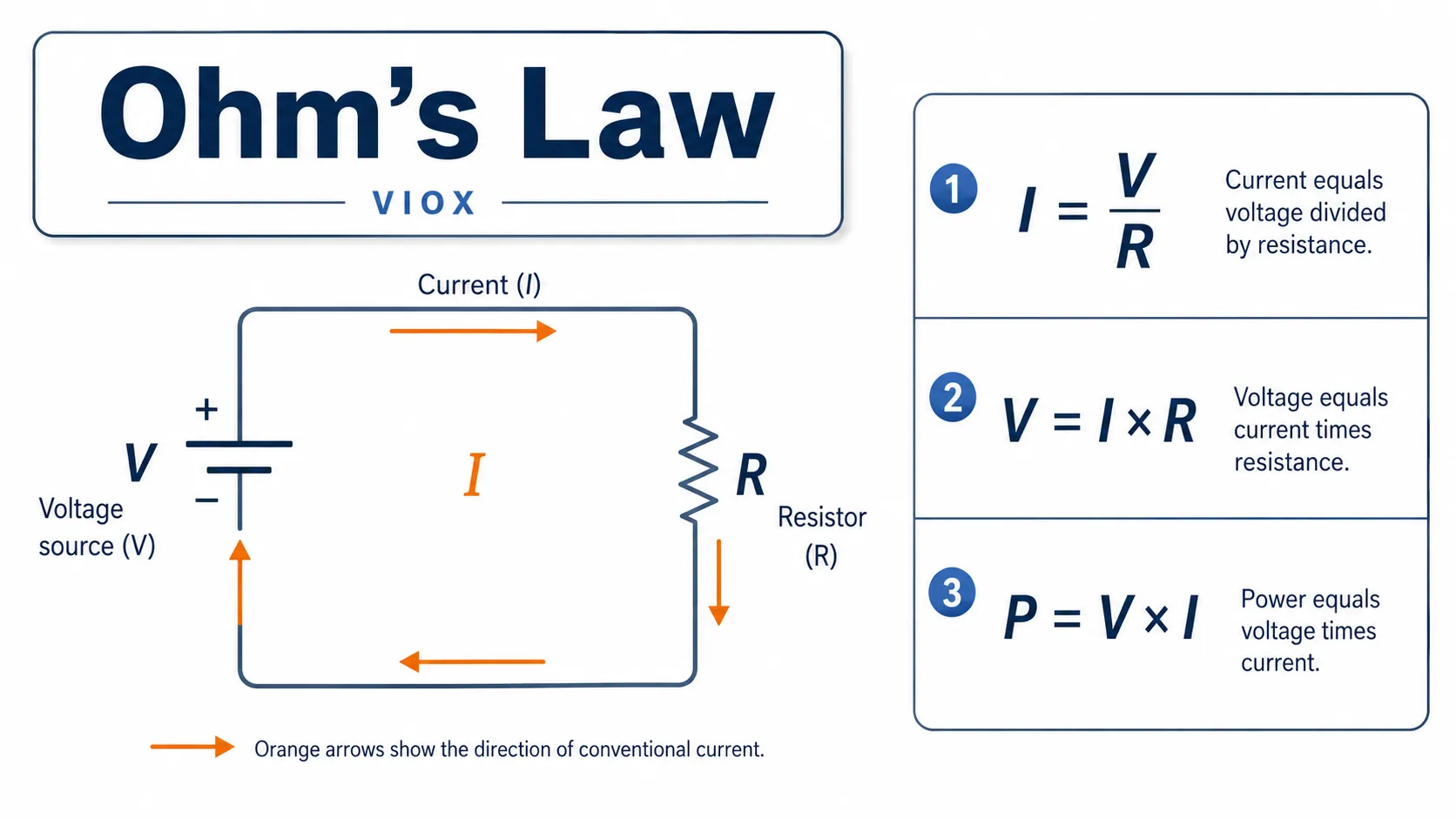
The most common formula for calculating current is Ohm’s law:
I = V / RWhere:
I= current in amperes (A)V= voltage in volts (V)R= resistance in ohms (Ω)
Example:
V = 24 V
R = 12 Ω
I = V / R = 24 / 12 = 2 A
So the current is 2 amps.
You can also calculate current from power:
I = P / VWhere:
I= current in amperes (A)P= power in watts (W)V= voltage in volts (V)
Example:
P = 1000 W
V = 230 V
I = P / V = 1000 / 230 ≈ 4.35 A
For AC circuits with motors, transformers, or industrial loads, real current calculation may also involve power factor, phase count, efficiency, and starting current. For deeper formulas, see VIOX’s guide to low-voltage electrical formulas for panel design and maintenance.
Voltage, Current, Resistance, and Power Relationship
Voltage, current, resistance, and power are connected. You should not treat them as isolated values.
| Formula | Meaning |
|---|---|
I = V / R |
Current increases when voltage increases or resistance decreases |
V = I × R |
Voltage drop increases when current or resistance increases |
P = V × I |
Power increases when voltage or current increases |
P = I² × R |
Heat loss rises sharply as current increases |
The last formula is especially important in electrical panels. A loose terminal, oxidized contact, undersized conductor, or poor crimp can add resistance. When current flows through that resistance, heat is produced. This is one reason terminal overheating and hot spots are serious maintenance issues.
For related field troubleshooting, see VIOX’s guide to terminal block overheating in control panels.
Volts vs Amps vs Watts
Volts, amps, and watts are related but not interchangeable.
| Term | Unit | Measures | Example Question |
|---|---|---|---|
| Voltage | V | Electrical pressure or potential difference | What voltage is the circuit? |
| Current | A | Flow of charge | How many amps does the load draw? |
| Power | W | Rate of energy use | How many watts does the device consume? |
The basic power formula is:
P = V × IFor example:
V = 120 V
I = 10 A
P = 120 × 10 = 1200 W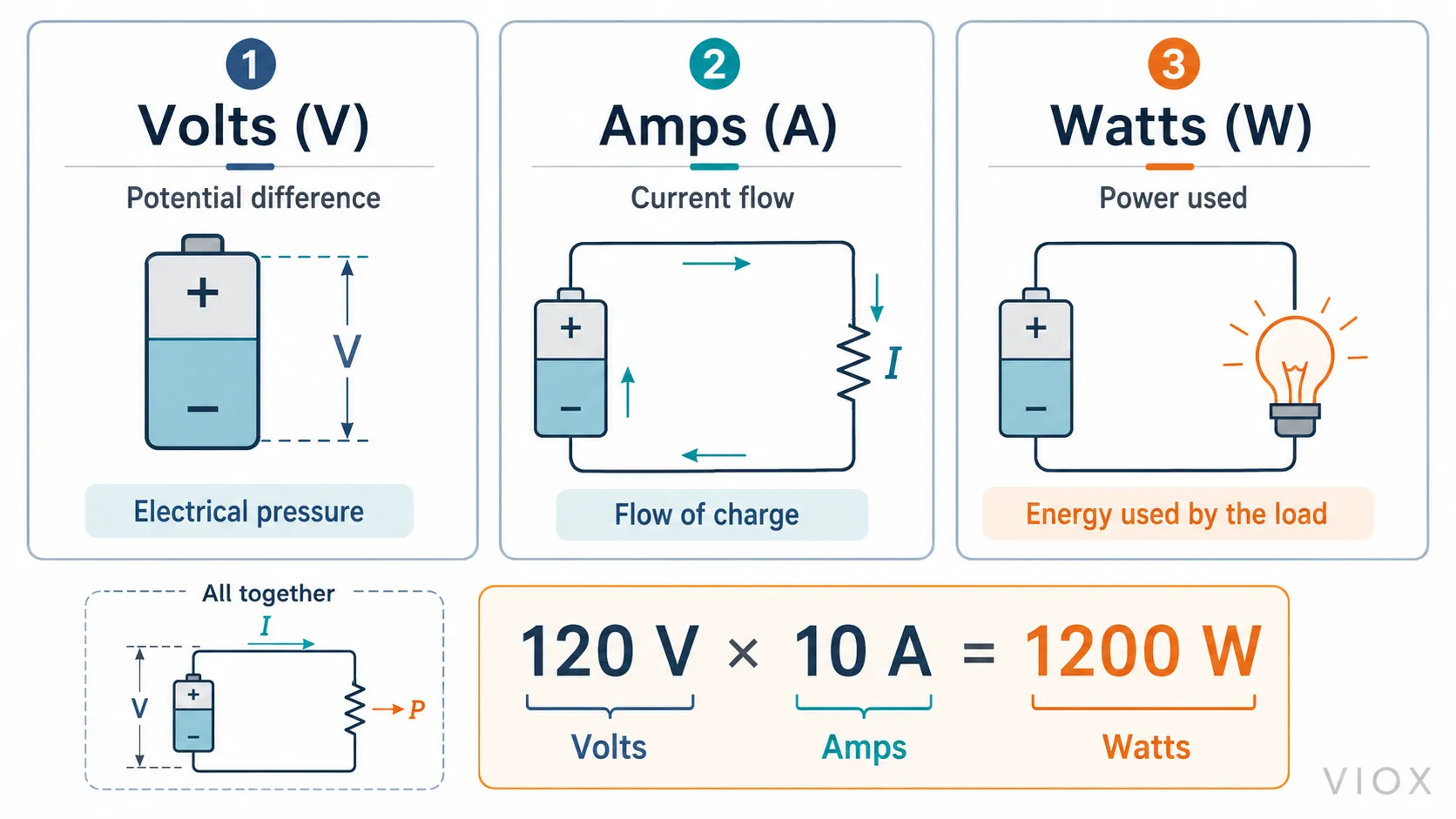
So the load uses 1200 watts.
This is why a higher-voltage system can deliver the same power with lower current. Lower current can reduce voltage drop and heating losses, but the system must still be designed according to insulation, protection, and safety requirements.
For a related power and energy distinction, see kW vs kWh.
How to Check Voltage with a Multimeter
To check voltage with a multimeter, you measure across two points.
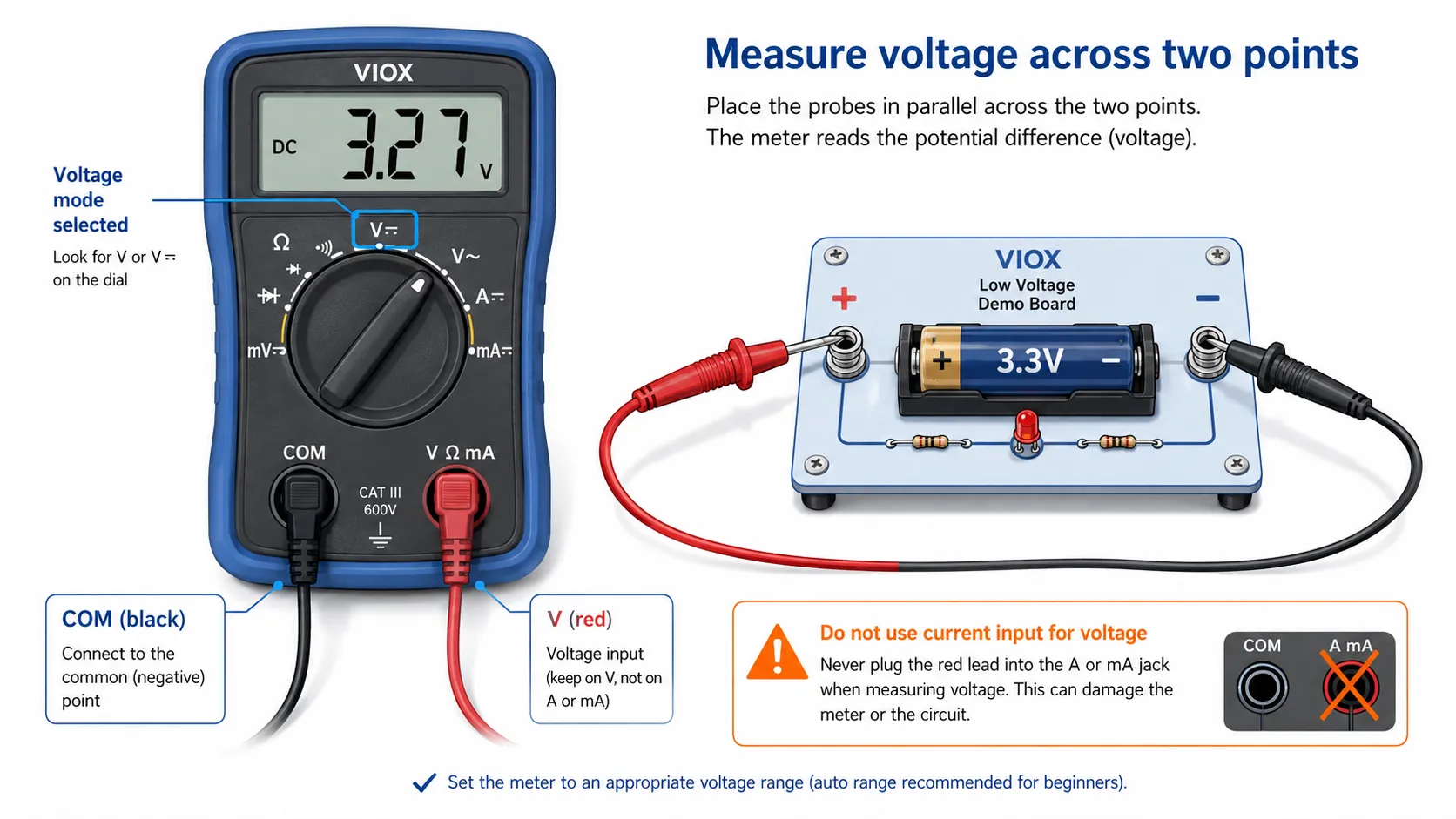
Basic process:
- Select the correct voltage mode: AC voltage (
V~) or DC voltage (V⎓). - Choose a range higher than the expected voltage if the meter is not auto-ranging.
- Insert the black probe into the COM jack.
- Insert the red probe into the voltage input jack.
- Place the probes across the two points being measured.
- Read the voltage displayed on the meter.
Important safety notes:
- Do not measure voltage with the meter set to current mode.
- Do not move the red probe to the current input jack when measuring voltage.
- Use a meter and probes rated for the circuit category and voltage.
- For mains panels, distribution boards, or industrial equipment, testing should be performed by qualified personnel.
Voltage measurement is different from current measurement. Voltage is measured in parallel across two points. Current is usually measured in series with a load or with a clamp meter around a conductor, depending on the circuit and instrument.
Current vs Voltage in Circuit Protection
Voltage and current both matter for selecting electrical components.
| Device or Component | Voltage Concern | Current Concern |
|---|---|---|
| MCB / MCCB | Must be rated for system voltage | Must match load current, cable capacity, and fault level |
| Fuse | Must be rated for AC or DC voltage | Must clear overload or short-circuit current safely |
| Contactor | Contact voltage rating must match circuit | Rated operational current depends on load category |
| Cable | Insulation voltage must be suitable | Conductor size must carry current safely |
| SPD | Continuous operating voltage must match system | Discharge current rating must match surge duty |
| Terminal block | Voltage rating must suit spacing and insulation | Current rating and conductor fit must match load |
This is why selecting a device only by current or only by voltage can be dangerous. A breaker marked for a certain current may not be suitable for a different voltage or for DC use. A switch rated for AC may not safely interrupt DC because DC arcs behave differently.
Common Mistakes About Voltage and Current
Mistake 1: Saying current is measured in volts
Current is measured in amps. Voltage is measured in volts.
Mistake 2: Thinking voltage alone tells you power
Voltage alone does not tell you how much power a load uses. Power depends on both voltage and current.
Mistake 3: Measuring current like voltage
Voltage is measured across two points. Current measurement requires the correct meter mode and method. Using the wrong meter input can damage the meter or create a safety hazard.
Mistake 4: Ignoring resistance in heating problems
Small increases in contact resistance can cause serious heating when current is high. This is why loose terminals and poor crimps are common failure points.
Mistake 5: Assuming AC and DC ratings are interchangeable
They are not. AC and DC circuits have different switching and arc behavior. Always check whether a device is rated for the actual AC or DC system.
Quick Reference
| Question | Short Answer |
|---|---|
| What is voltage? | Potential difference measured in volts |
| What is current? | Flow of electric charge measured in amps |
| Is current measured in volts? | No, current is measured in amperes |
| What is potential difference? | Another term for voltage |
| How do you calculate current? | I = V / R or I = P / V |
| What is power? | Energy use rate measured in watts |
| How do you check voltage? | Use a multimeter in voltage mode across two points |
FAQ
What is the difference between voltage and current?
Voltage is the electrical potential difference that pushes charge through a circuit. Current is the flow of charge through the circuit. Voltage is measured in volts, while current is measured in amperes.
What is potential difference?
Potential difference is the voltage between two points. It describes how much electrical potential energy difference exists per unit charge.
Is current measured in volts?
No. Current is measured in amperes, or amps. Voltage is measured in volts.
How do you calculate current?
Use I = V / R when voltage and resistance are known. Use I = P / V when power and voltage are known. AC motor and industrial load calculations may also require power factor and efficiency.
What is the difference between volts and watts?
Volts measure electrical potential difference. Watts measure power, or the rate of energy use. They are related by the formula P = V × I.
How do you check voltage with a multimeter?
Set the multimeter to the correct AC or DC voltage mode, place the probes across the two points being measured, and read the display. Use properly rated test equipment and qualified personnel for mains or industrial circuits.
Conclusion
Voltage and current are closely related, but they are not the same. Voltage is the potential difference that pushes charge. Current is the amount of charge flowing. Resistance limits that flow, and power describes how much electrical energy is being used.
For basic learning, remember this simple chain:
Voltage pushes. Current flows. Resistance limits. Power is used.For practical electrical work, always check both voltage and current ratings. A component must match the real circuit voltage, expected load current, fault conditions, and AC or DC application. That distinction is what turns a basic concept into a real safety and selection decision.