

On this page
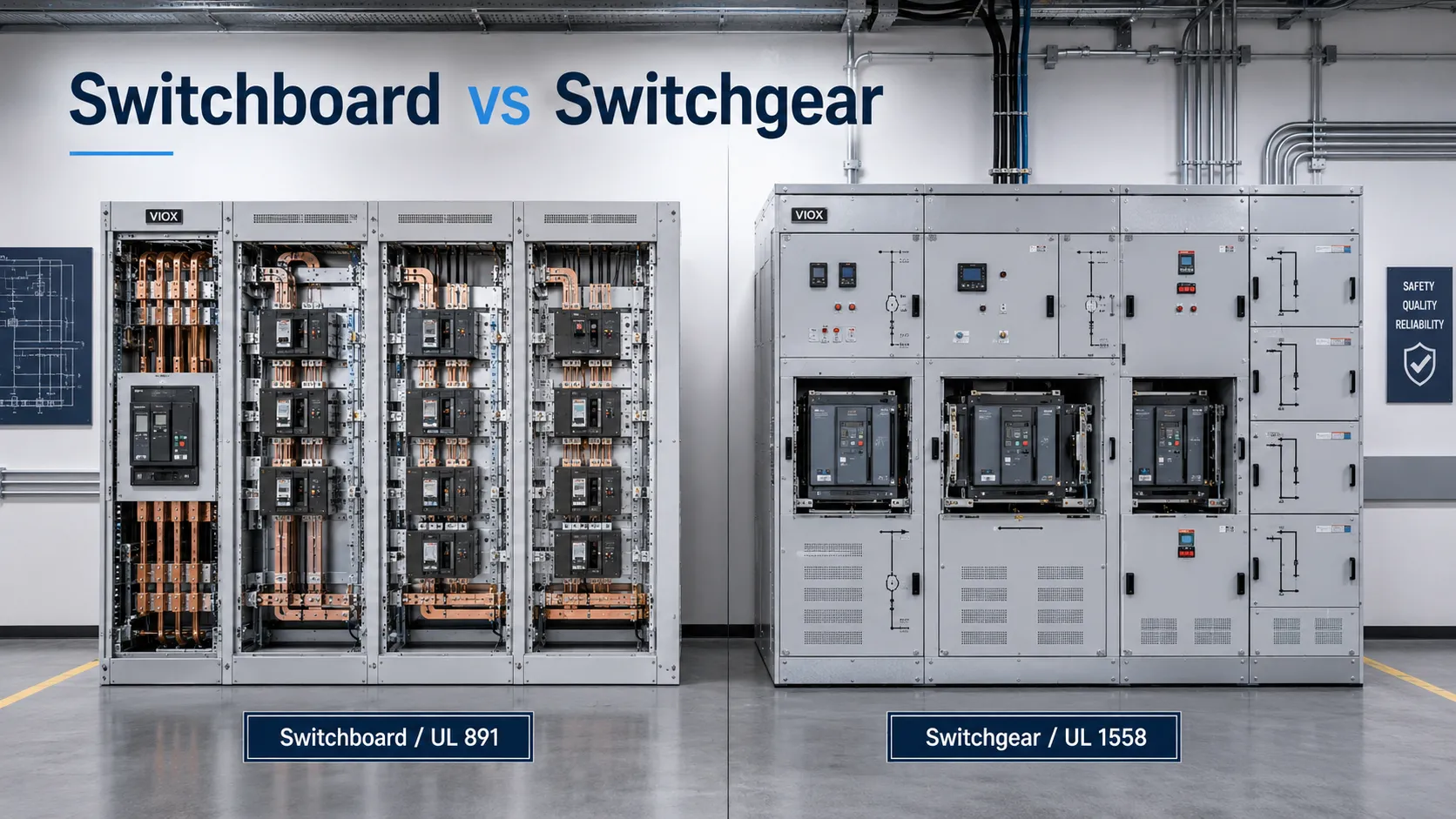
The difference between a switchboard and switchgear is not just the voltage rating. In low-voltage electrical distribution, a switchboard is typically a cost-effective distribution assembly built around fixed or front-accessible protective devices. Switchgear is typically a more compartmentalized metal-enclosed assembly designed for higher maintainability, selective coordination, and critical power systems.
In North American practice, the standards distinction is often the clearest way to understand the difference: switchboards are commonly associated with UL 891, while low-voltage metal-enclosed power circuit breaker switchgear is associated with UL 1558. The exact product design still depends on the manufacturer, project specification, and authority having jurisdiction, but the UL 891 vs UL 1558 boundary is a useful starting point for engineers and buyers.
If you only need economical power distribution in a commercial building, a switchboard may be the right choice. If the project needs draw-out power circuit breakers, stronger compartmentalization, serviceability, and high uptime, switchgear is usually the better fit.
Quick Answer: Switchboard vs Switchgear
| Feature | Switchboard | Switchgear |
|---|---|---|
| Main role | Power distribution | Power distribution, protection, control, and maintainability |
| Common North American standard | UL 891 | UL 1558 |
| Typical breaker style | Fixed-mounted MCCB, insulated-case breaker, fusible switch, or molded-case devices | Draw-out low-voltage power circuit breakers or air circuit breakers |
| Construction | Generally less compartmentalized, often front accessible | More compartmentalized metal-enclosed construction |
| Maintenance approach | May require larger shutdown scope depending on design | Designed for easier breaker withdrawal and service access |
| Typical cost | Lower | Higher |
| Typical footprint | More compact for many distribution applications | Larger and heavier |
| Best suited for | Commercial buildings, light industrial distribution, utility rooms | Data centers, hospitals, process plants, critical facilities |
| Main decision driver | Cost-effective distribution | Uptime, selective coordination, serviceability, and fault containment |
What Is a Switchboard?
A switchboard is a low-voltage electrical distribution assembly used to receive incoming power and distribute it to feeders, branch circuits, panels, transformers, motor control equipment, or other downstream loads.
Switchboards are common in commercial buildings, schools, retail centers, warehouses, light industrial facilities, and general power distribution rooms. They are often chosen when the project needs reliable distribution at a reasonable cost and does not require the highest level of compartmentalization or draw-out breaker serviceability.
Typical switchboard characteristics include:
- service entrance or main distribution use
- front-accessible sections
- molded-case circuit breakers (MCCBs), insulated-case breakers, fusible switches, or similar devices
- busbar-based distribution
- metering and surge protection options
- lower cost compared with switchgear for many applications
- simpler construction and smaller footprint in many designs
Switchboards are not “low-quality switchgear.” They are a different assembly type optimized for different needs. A properly specified switchboard can be the correct and economical choice for many commercial and industrial installations.
What Is Switchgear?
Switchgear is an electrical assembly that combines switching, protection, control, and isolation functions. In low-voltage applications, the term often refers to metal-enclosed low-voltage power circuit breaker switchgear, especially in North American projects.
Switchgear is used where power distribution must support higher maintainability, selective coordination, safer service access, and critical uptime. Compared with a typical switchboard, switchgear usually has a more robust and compartmentalized construction.
Typical low-voltage switchgear characteristics include:
- metal-enclosed construction
- separate compartments for breakers, bus, cable, and controls depending on design
- draw-out low-voltage power circuit breakers or air circuit breakers
- advanced protection and metering options
- better access for inspection, testing, and breaker replacement
- higher cost and larger footprint
- common use in critical power systems
Switchgear is commonly used in data centers, hospitals, airports, large industrial plants, critical manufacturing, utility substations, and facilities where power interruption carries a high cost.
UL 891 vs UL 1558: Why the Standard Matters
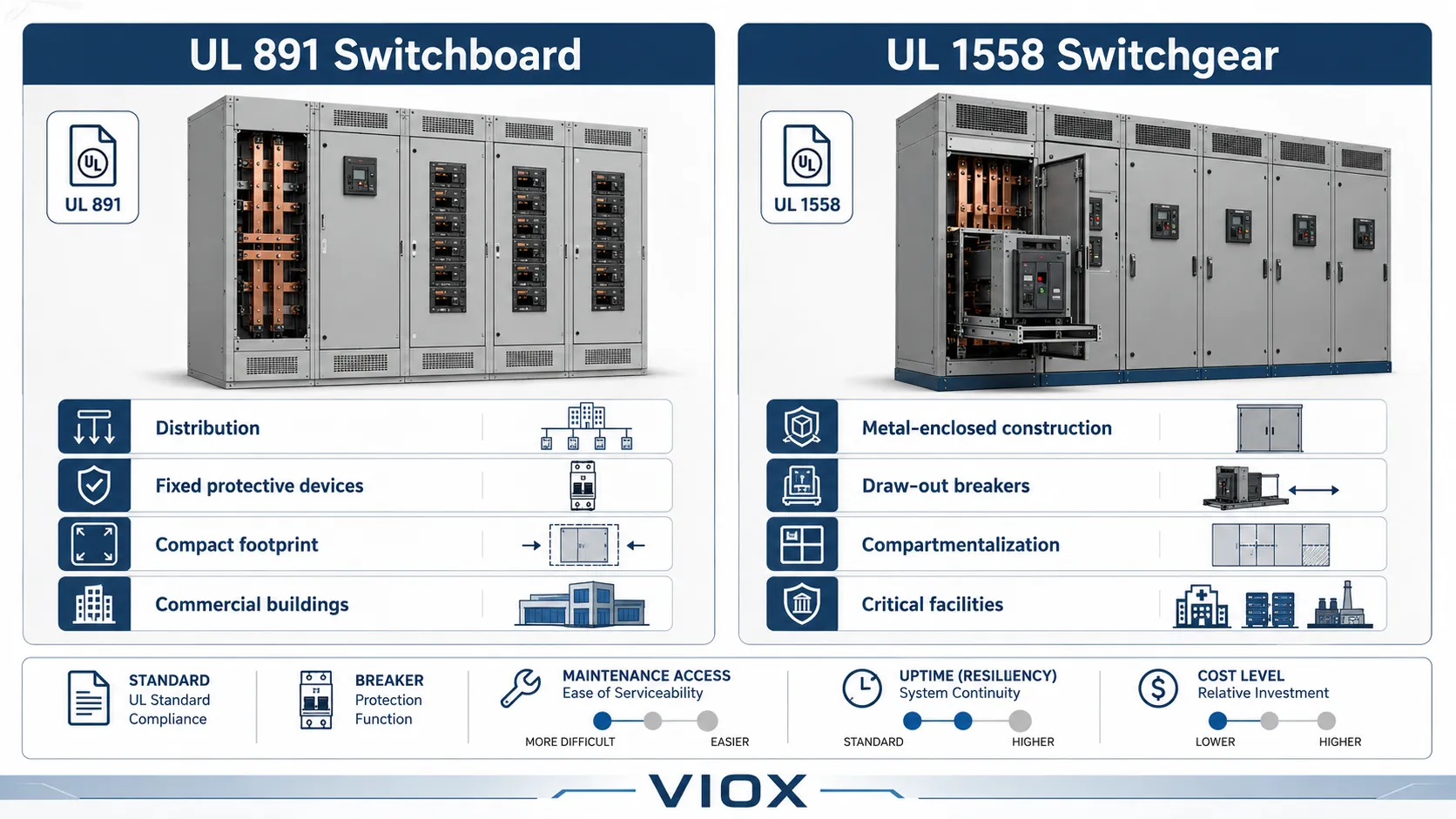
The query UL 891 vs UL 1558 is one of the most important ways to understand switchboard vs switchgear in the North American market.
| Standard | Common Equipment Category | What It Indicates |
|---|---|---|
| UL 891 | Switchboards | Low-voltage switchboards for distribution applications |
| UL 1558 | Metal-enclosed low-voltage power circuit breaker switchgear | Switchgear built around low-voltage power circuit breakers with more robust construction and serviceability expectations |
The standard does not replace engineering review, but it provides a strong signal about intended construction and application. If a project specification asks for UL 1558 switchgear, substituting a UL 891 switchboard is usually not a simple cost-saving change. It may affect breaker type, compartmentalization, maintenance strategy, selective coordination, and approval.
Practical Difference
UL 891 switchboards are typically selected for distribution efficiency and cost control. UL 1558 switchgear is typically selected when the facility needs the serviceability and protection architecture associated with low-voltage power circuit breaker assemblies.
For buyers, the key question is not “which one is better?” The better question is: Does the project need switchboard distribution, or does it require switchgear-level construction and maintainability?
Construction Differences
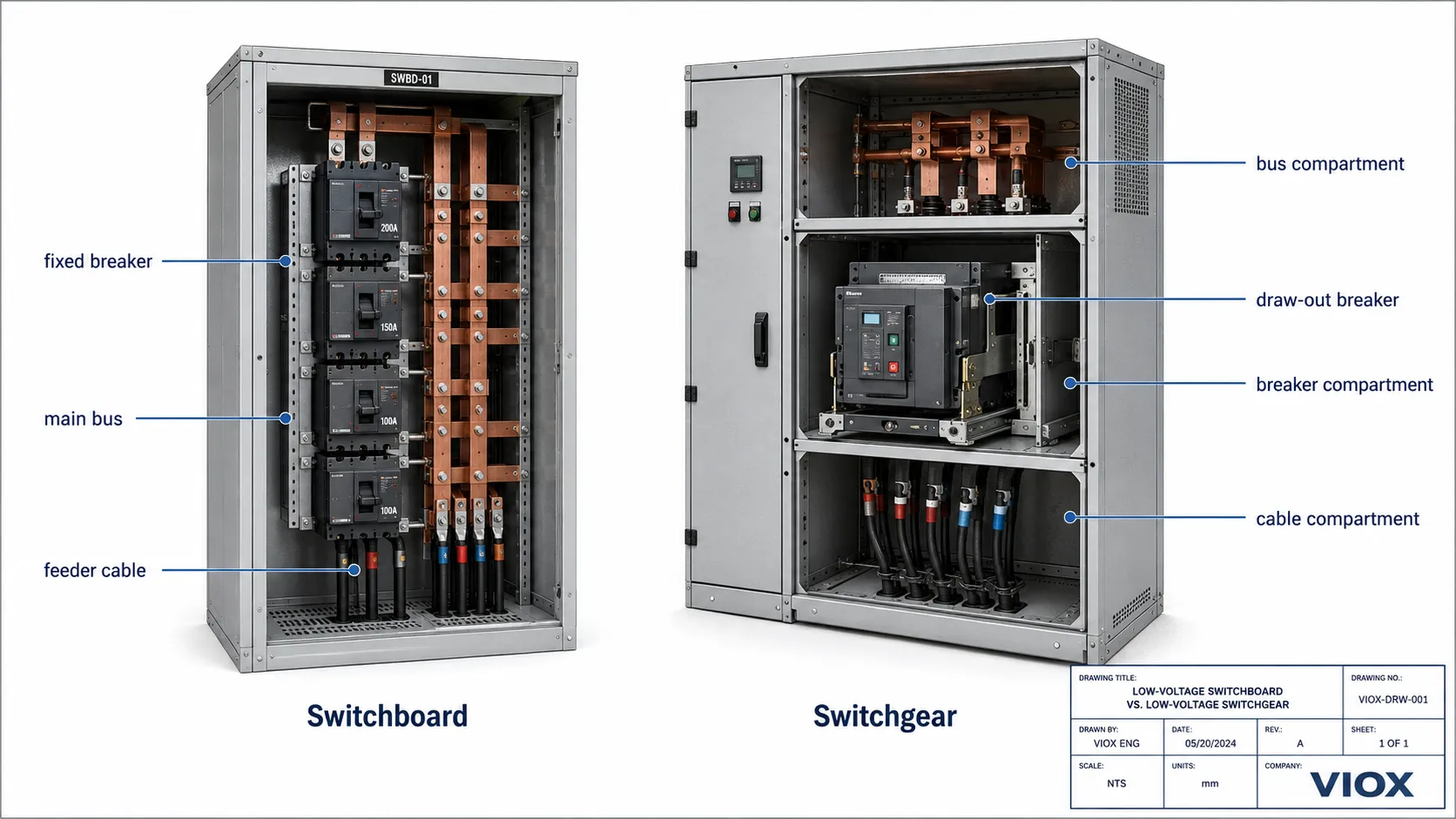
The physical construction is one of the clearest differences between switchboards and switchgear.
Switchboard Construction
Switchboards are generally less compartmentalized than switchgear. Sections may share bus areas and wiring spaces depending on the design. Devices are often fixed-mounted or front-accessible. This makes switchboards efficient and practical for many distribution applications.
Switchgear Construction
Switchgear is generally more compartmentalized. Breakers, bus, cable, and control areas may be separated to reduce exposure and improve maintainability. The exact arrangement depends on the manufacturer and design, but the construction philosophy is more service-oriented than a basic switchboard.
This difference matters most during maintenance, troubleshooting, testing, and future modifications. In critical facilities, the ability to isolate and service parts of the assembly can be more important than the initial equipment cost.
Internal Components That Decide Real-World Reliability
The cabinet label is only part of the story. Inside a switchboard or switchgear lineup, long-term reliability depends heavily on the quality and coordination of the internal components: circuit breakers, busbars, insulating supports, terminals, metering devices, surge protection, and control wiring.
For a switchboard, the molded-case circuit breaker (MCCB) or insulated-case breaker is often the component that determines practical fault-clearing capability and downstream protection quality. Buyers should not only ask whether the assembly is a switchboard; they should also verify the breaker family, interrupting rating, trip unit type, terminal temperature rise performance, and whether the breaker is suitable for the available fault current at that installation.
The busbar system is just as important. Copper or aluminum busbars, contact surfaces, insulation supports, phase spacing, joint pressure, and heat dissipation all influence temperature rise and service life. A low-cost enclosure with weak busbar supports or poor joint workmanship can become a maintenance problem even if the one-line diagram looks correct.
For component-level selection, VIOX resources on molded case circuit breakers, circuit breaker busbars, and terminal blocks are useful when evaluating what goes inside the assembly, not only the assembly name printed on the specification.
Fixed Breakers vs Draw-Out Breakers
Breaker mounting is another major difference.
| Breaker Arrangement | Common in Switchboards | Common in Switchgear | Practical Meaning |
|---|---|---|---|
| Fixed-mounted breaker | Yes | Less typical for low-voltage power switchgear | Lower cost, simpler construction, more shutdown impact during replacement |
| Draw-out breaker | Less common | Yes | Easier removal, inspection, testing, and replacement when the system is designed for it |
| Front-accessible devices | Common | Common, with more service-oriented design | Affects maintenance time and safety procedures |
Draw-out construction can reduce maintenance impact, but it does not eliminate electrical safety procedures. Any inspection, racking, testing, or maintenance must follow the manufacturer’s instructions, site procedures, applicable codes, and qualified-person requirements.
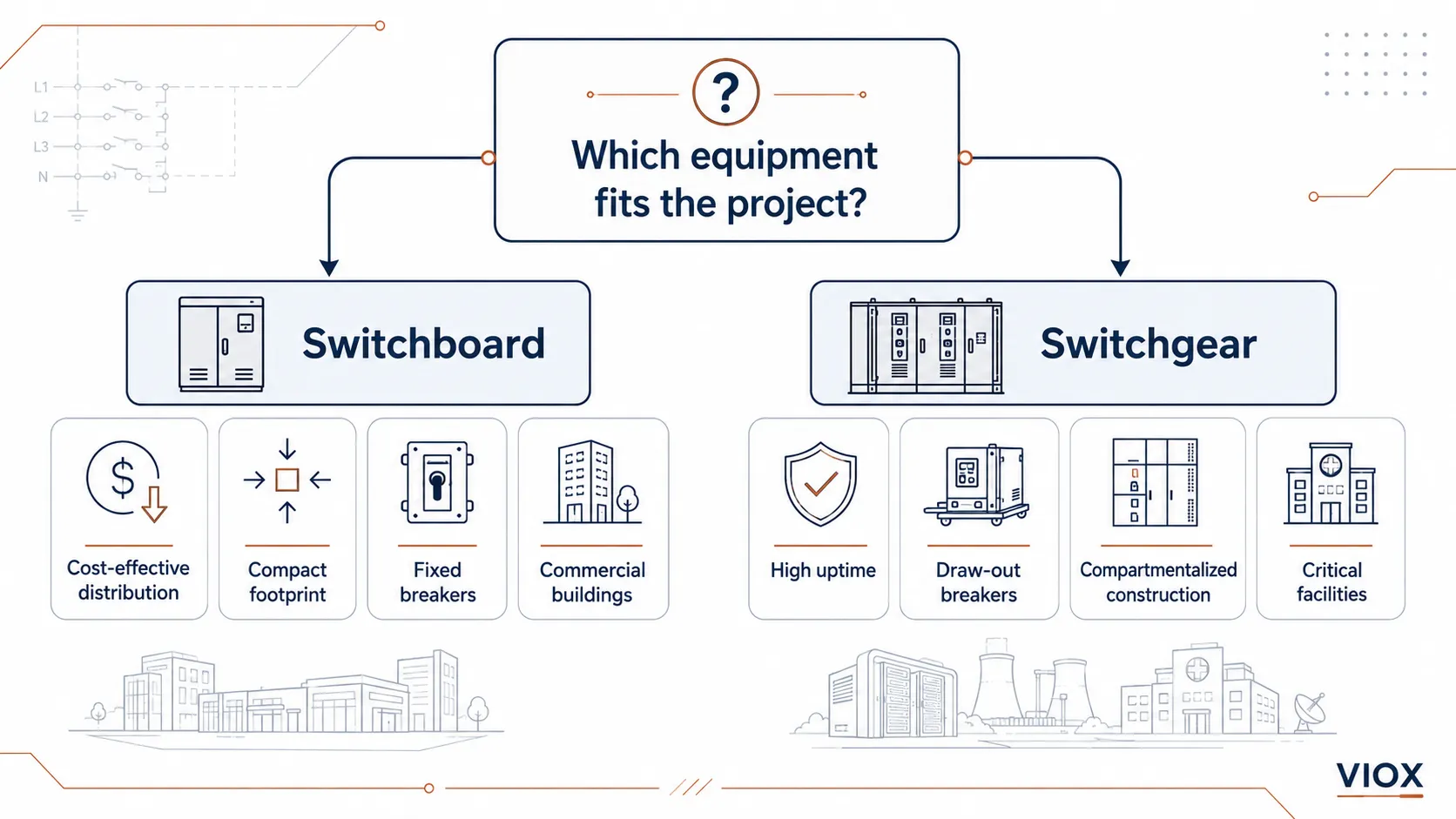
Switchboard vs Switchgear: Application Decision Table
| Application Requirement | Better Fit | Why |
|---|---|---|
| General commercial distribution | Switchboard | Cost-effective and compact for normal building distribution |
| Light industrial feeder distribution | Switchboard | Practical when draw-out power breakers are not required |
| Data center main distribution | Switchgear | Uptime, maintenance, and selective coordination often justify higher cost |
| Hospital or critical facility | Switchgear | Serviceability and power continuity are usually more important |
| Process plant with expensive downtime | Switchgear | Easier maintenance and protection coordination can reduce operational risk |
| Small building service entrance | Switchboard | Switchgear is often excessive unless specified |
| High short-circuit coordination study requirement | Often switchgear | Low-voltage power breakers and trip systems may offer stronger coordination options |
| Project specification requires UL 1558 | Switchgear | UL 891 substitution may not meet the specification |
| Budget-sensitive distribution | Switchboard | Lower cost and smaller footprint in many cases |
Cost, Footprint, and Maintenance Tradeoffs
Switchboards are usually less expensive and more compact. They can be the right answer when the project needs dependable distribution but does not require high levels of service compartmentalization or draw-out breaker maintenance.
Switchgear usually costs more because it is built for a different level of construction and serviceability. It may require more floor space, stronger room planning, heavier handling, and more detailed coordination during design.
The real comparison is not only purchase price. A critical facility should compare:
- initial equipment cost
- installation cost
- floor space
- maintenance access
- spare breaker strategy
- downtime cost
- selective coordination needs
- future expansion
- safety procedures
- project specification requirements
For a small commercial building, switchgear may be unnecessary. For a data center or hospital, the cost difference may be justified by uptime and maintainability.
Protection and Selective Coordination
Both switchboards and switchgear can include overcurrent protection. The difference is the level of protection architecture and service flexibility.
Switchboards often use molded-case or insulated-case breakers. These can be suitable for many distribution systems. Switchgear often uses low-voltage power circuit breakers with advanced trip units and draw-out construction. These features can support more sophisticated coordination, testing, and service strategies.
Selective coordination matters when an upstream breaker should remain closed while a downstream breaker clears a fault. This is especially important in hospitals, data centers, industrial processes, emergency systems, and other critical loads.
Do not assume the word “switchgear” automatically means the system is selectively coordinated. Coordination depends on the full electrical design, breaker settings, time-current curves, available fault current, and coordination study.
Engineering Insight: In real projects, the painful mistake is often not choosing the wrong cabinet name. It is choosing a distribution assembly without checking how the breakers coordinate during a downstream fault. If the main breaker trips before the feeder breaker, the facility may lose an entire section of power for a fault that should have been isolated locally. For critical nodes, verify the breaker trip units, time-current curves, available fault current, and coordination study before approving the equipment.
Component Quality Checklist Inside the Assembly
For OEMs, panel builders, and sourcing teams, the internal component list deserves the same attention as the switchboard or switchgear label.
| Internal Component | What to Check | Why It Matters |
|---|---|---|
| Main breaker | Interrupting rating, trip unit, fixed vs draw-out design | Determines fault clearing, maintainability, and coordination options |
| Feeder breakers | MCCB, insulated-case breaker, or power circuit breaker type | Affects downstream protection and replacement strategy |
| Busbar system | Material, cross-section, joint design, plating, insulation supports | Influences temperature rise, fault withstand, and long-term reliability |
| Insulators and supports | Mechanical strength, spacing, heat resistance, creepage/clearance design | Helps maintain phase separation and mechanical stability |
| Terminals and lugs | Conductor range, contact pressure, cable access, heat rise behavior | Poor terminations are a common source of overheating |
| SPD and metering | Surge protection, monitoring, communication, power quality requirements | Supports equipment protection and system visibility |
| Control wiring | Labeling, routing, terminal separation, service access | Improves maintenance and reduces wiring errors |
This is where a component manufacturer can add real value. A good switchboard or switchgear design depends on reliable low-voltage protection devices, stable busbar connections, and clean termination systems. The enclosure matters, but the internal electrical path decides how the assembly behaves under load and fault conditions.
When to Choose a Switchboard
A switchboard is usually the practical choice when the project needs reliable low-voltage distribution but does not require draw-out breaker serviceability or switchgear-level compartmentalization. It is often the better commercial decision when space, cost, and simple distribution are the main constraints.
Typical switchboard applications include:
- commercial building distribution
- service entrance equipment
- utility room distribution
- feeder distribution to panels or transformers
- budget-sensitive projects
- applications where fixed-mounted devices are acceptable
- projects specified under UL 891
- facilities where planned shutdowns are acceptable for major service
Switchboards are often the right choice for offices, schools, stores, warehouses, residential buildings, and light industrial facilities. The key is to verify that the internal breakers, busbars, and terminations are still suitable for the available fault current and load profile.
When to Choose Switchgear
Switchgear becomes more attractive when the cost of downtime is higher than the added cost of the equipment. If maintenance access, breaker replacement strategy, selective coordination, and critical load continuity are central to the design, switchgear usually deserves serious consideration.
Typical switchgear drivers include:
- project specification requires UL 1558
- critical uptime requirements
- draw-out breaker maintenance strategy
- advanced protection and metering
- stronger selective coordination requirements
- large industrial or institutional power systems
- facilities where downtime is extremely costly
- environments where breaker testing and replacement access matter
Switchgear is often selected for data centers, hospitals, airports, heavy industrial plants, process facilities, large campuses, and mission-critical electrical rooms. It is not chosen because it sounds more advanced; it is chosen because the facility needs the maintenance and protection architecture it provides.
Common Mistakes
Mistake 1: Choosing by Voltage Alone
Low-voltage switchboards and low-voltage switchgear may operate in similar voltage ranges. The real difference is construction, standard, breaker type, serviceability, and application.
Mistake 2: Treating UL 891 and UL 1558 as Interchangeable
UL 891 and UL 1558 point to different equipment categories. If a specification calls for UL 1558 switchgear, a UL 891 switchboard is not automatically an acceptable substitute.
Mistake 3: Buying Switchgear When a Switchboard Is Enough
Switchgear can be overkill for ordinary distribution. If uptime, draw-out breakers, and higher serviceability are not required, a switchboard may deliver the needed function at lower cost and with less space.
Mistake 4: Buying a Switchboard When Maintenance Access Is Critical
If a facility cannot tolerate long outages for breaker replacement or maintenance, switchgear may be worth the additional investment.
Mistake 5: Assuming Draw-Out Means No Safety Risk
Draw-out construction improves serviceability, but it does not remove arc flash, shock, or maintenance hazards. Qualified procedures and proper personal protective equipment are still required.
Specification Checklist for Buyers
Before requesting a quotation, prepare the following information:
| Item | Why It Matters |
|---|---|
| Required standard | Determines whether UL 891 switchboard or UL 1558 switchgear is expected |
| System voltage | Confirms equipment voltage class |
| Continuous current rating | Determines bus and main device sizing |
| Available fault current | Determines short-circuit rating requirements |
| Main and feeder breaker types | Defines MCCB, insulated-case, or power circuit breaker needs |
| Fixed or draw-out construction | Affects cost, maintenance, and footprint |
| Metering and communication | Required for monitoring, building systems, or energy management |
| Selective coordination needs | Critical for hospitals, data centers, and emergency systems |
| Service entrance requirements | May affect ratings, labeling, grounding, and utility interface |
| Room space and access | Impacts lineup layout, front/rear access, and maintenance clearance |
| Future expansion | Determines spare sections, space, and bus planning |
FAQ
What is the main difference between switchboard and switchgear?
A switchboard is typically a cost-effective low-voltage distribution assembly. Switchgear is generally more robust, compartmentalized, and service-oriented, often using draw-out low-voltage power circuit breakers for critical applications.
Is switchgear the same as a switchboard?
No. They both distribute electrical power, but they differ in construction, standards, breaker type, maintainability, cost, and typical application.
What is UL 891?
UL 891 is the standard commonly associated with switchboards in the North American market. It is relevant when specifying or evaluating low-voltage switchboard assemblies.
What is UL 1558?
UL 1558 is the standard commonly associated with metal-enclosed low-voltage power circuit breaker switchgear. It is relevant for switchgear assemblies using low-voltage power circuit breakers.
Is UL 1558 better than UL 891?
Not exactly. UL 1558 and UL 891 apply to different equipment categories. UL 1558 switchgear usually offers higher maintainability and more robust construction, but it also costs more and uses more space. The better choice depends on the project requirement.
Can a switchboard replace switchgear?
Only if the project specification, engineering design, authority approval, short-circuit rating, protection requirements, and maintenance strategy allow it. If UL 1558 switchgear is required, a UL 891 switchboard is usually not a direct replacement.
Which is more expensive, switchboard or switchgear?
Switchgear is usually more expensive because of its construction, draw-out breaker design, compartmentalization, serviceability, and protection options. Switchboards are generally more economical for normal distribution.
Which is better for a data center?
Switchgear is often preferred for data centers because uptime, selective coordination, maintenance access, and serviceability are critical. The final decision depends on the electrical design and facility requirements.
Which is better for a commercial building?
A switchboard is often the better fit for standard commercial distribution because it is more compact and cost-effective. Switchgear may be selected if the building has critical power or high uptime requirements.
Conclusion
The practical difference between switchboard and switchgear is construction philosophy. A switchboard is usually the right choice for cost-effective low-voltage distribution. Switchgear is usually selected when the system needs higher maintainability, draw-out power circuit breakers, stronger compartmentalization, and critical power reliability.
For North American projects, the standards distinction is especially important: UL 891 is commonly associated with switchboards, while UL 1558 is commonly associated with metal-enclosed low-voltage power circuit breaker switchgear. Before substituting one for the other, always check the project specification, available fault current, protection requirements, maintenance strategy, and approval path.