On this page
RCBO stands for Residual Current Breaker with Overcurrent Protection. In an electrical system, an RCBO combines residual-current protection with overload and short-circuit protection in one device.
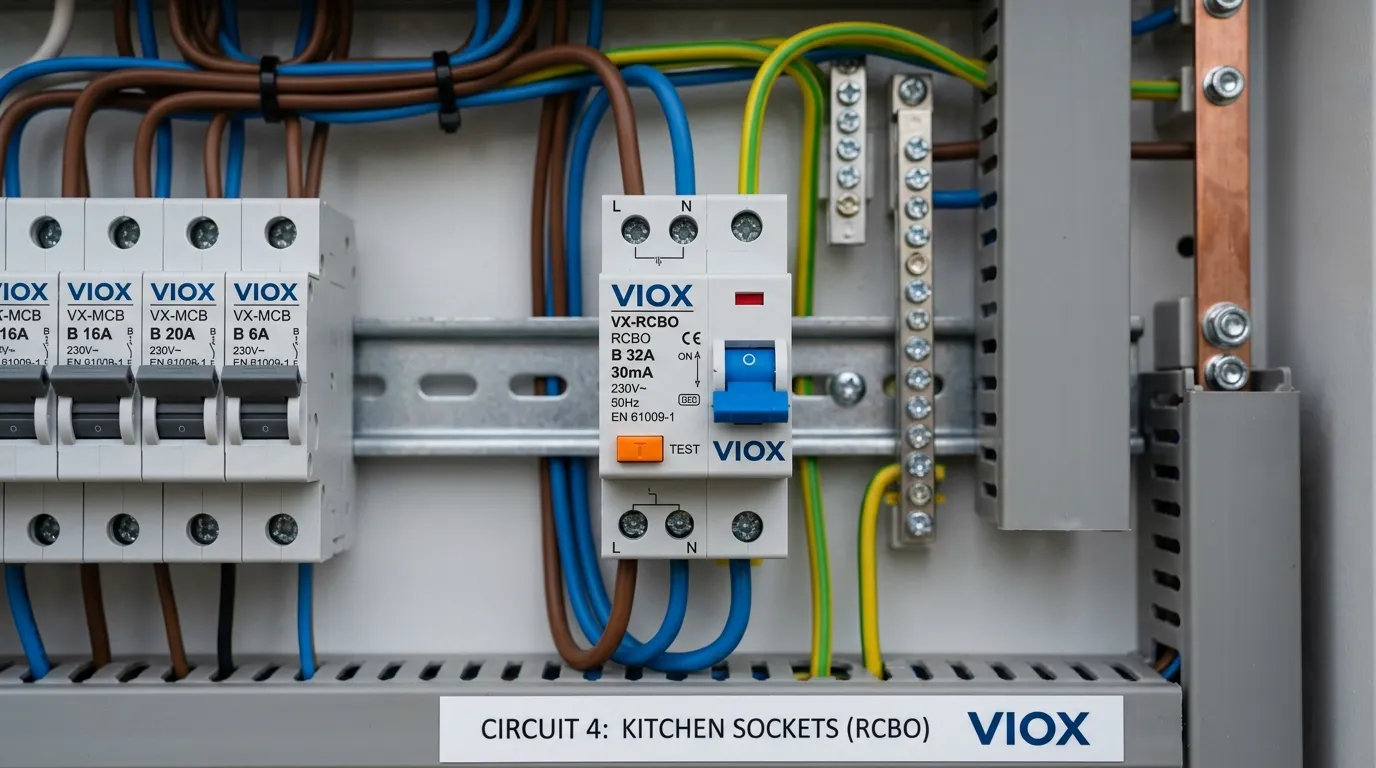
That matters because an RCBO is not just another breaker label. It is a compact protection device used when a circuit needs both leakage protection and overcurrent protection without relying on separate units for each function.
What Does RCBO Stand For?
RCBO means Residual Current Breaker with Overcurrent Protection.
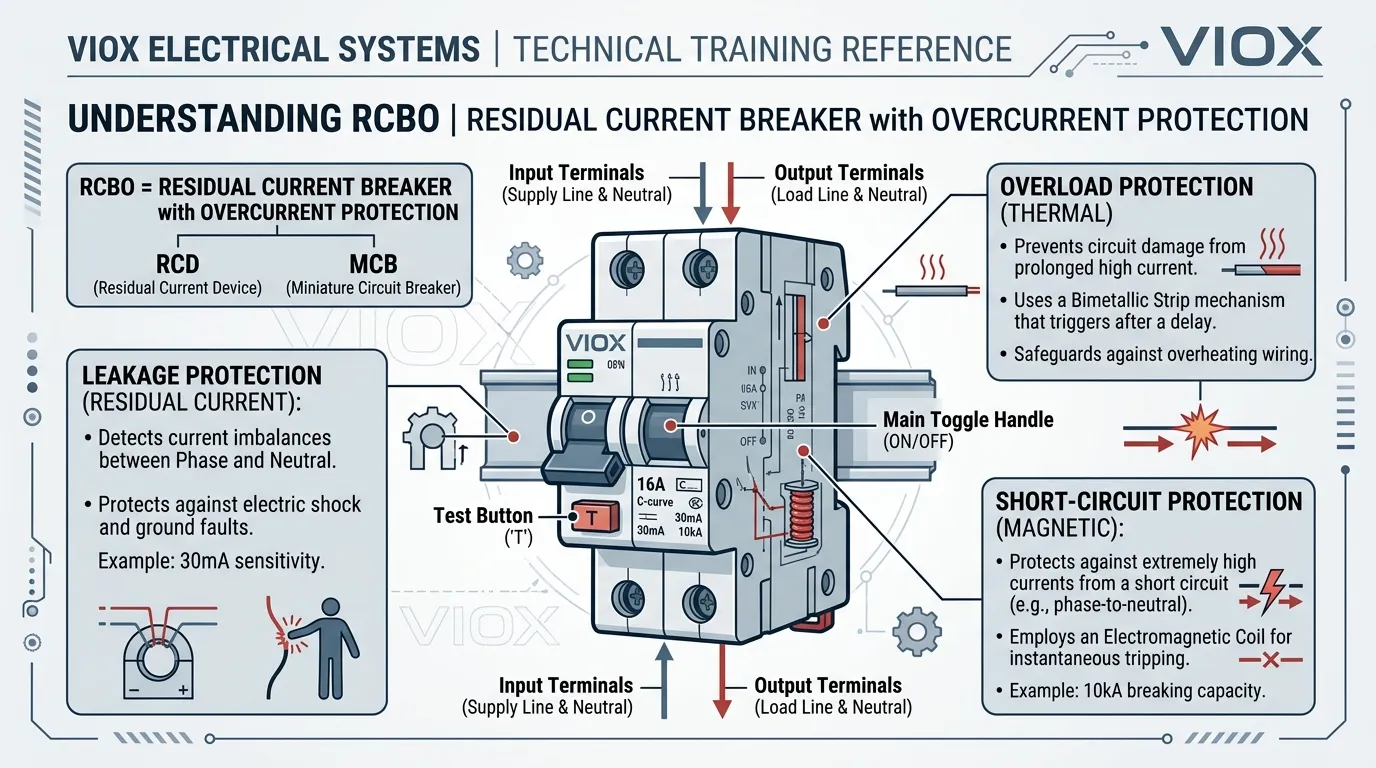
Each part of the name explains what the device does:
- Residual Current refers to leakage current or earth-fault current that should not be present in normal circuit operation.
- Breaker means the device opens the circuit when a fault condition is detected.
- Overcurrent Protection means the same unit also responds to overload and short-circuit conditions.
This is why an RCBO is commonly described as a combined protection device. It performs functions that would otherwise require a separate residual-current device and an overcurrent protective device.
If you need the broader family context, VIOX also has a comparison guide on the difference between MCB, MCCB, RCB, RCD, RCCB, and RCBO.
Quick Reference Table
| Term | Full form | Main function | Typical use |
|---|---|---|---|
| RCBO | Residual Current Breaker with Overcurrent Protection | Leakage, overload, and short-circuit protection in one device | Final circuits, distribution boards, residential and commercial installations |
| RCCB | Residual Current Circuit Breaker | Residual-current protection only | Earth-leakage protection where overcurrent protection is provided separately |
| MCB | Miniature Circuit Breaker | Overload and short-circuit protection | Branch circuits and final distribution |
| RCD | Residual Current Device | Broad category for residual-current devices | General residual-current protection terminology |
What Does an RCBO Do?
An RCBO disconnects a circuit when it detects one of these conditions:
- leakage current or residual current
- overload
- short circuit
That makes it useful where one circuit needs complete protection in a compact format. Instead of using a separate RCCB and MCB arrangement, an RCBO can provide both functions in one body.
In practical installations, this can help:
- simplify selected distribution board layouts
- give individual circuits their own protection
- reduce the chance that one fault will disconnect an entire group of circuits
An RCBO does not remove the need for correct device selection, coordination, and circuit design. The correct current rating, breaking capacity, pole format, and residual-current type still matter.
For a deeper selection discussion, see VIOX’s guide on how to choose the right RCBO.
How Does an RCBO Work?
An RCBO combines two protection mechanisms in one device.
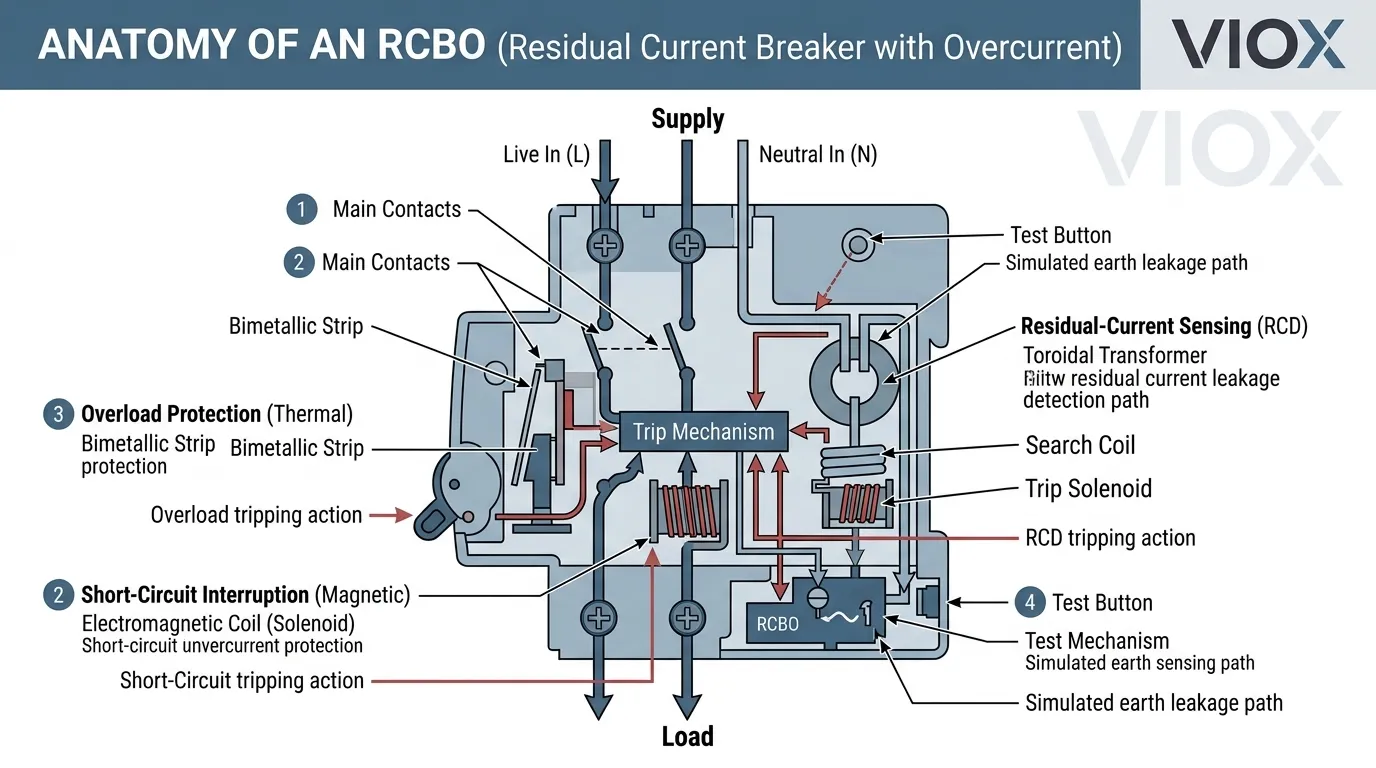
Residual-Current Protection
The device monitors the current flowing through the live and neutral conductors. Under normal conditions, the outgoing and returning current should balance. If the RCBO detects an imbalance above its set sensitivity, it interprets that as residual current and trips.
This function helps protect against earth-fault conditions and leakage-related shock risk, depending on the installation design and the selected device type.
Overcurrent Protection
Like an MCB, an RCBO also responds to:
- overload conditions
- short circuits
In many device families, overload protection is handled through a thermal element and short-circuit protection through a magnetic element. The result is a breaker that combines current imbalance detection with conventional overcurrent interruption.
Where Are RCBOs Commonly Used?
RCBOs are widely used where circuit-level protection is preferred and fault isolation matters.
Common applications include:
- residential final circuits
- commercial distribution boards
- socket outlet circuits
- lighting circuits
- dedicated equipment circuits
- installations where it is useful to isolate one faulted circuit without disconnecting multiple others
RCBOs also appear in some EV and specialty protection discussions where designers want compact combined protection. For example, VIOX has a related article on commercial EV charging protection using ACB, MCCB, and RCBO.
RCBO vs RCCB vs MCB vs RCD
This is the part that matters most after the acronym itself. These devices are related, but they are not interchangeable.
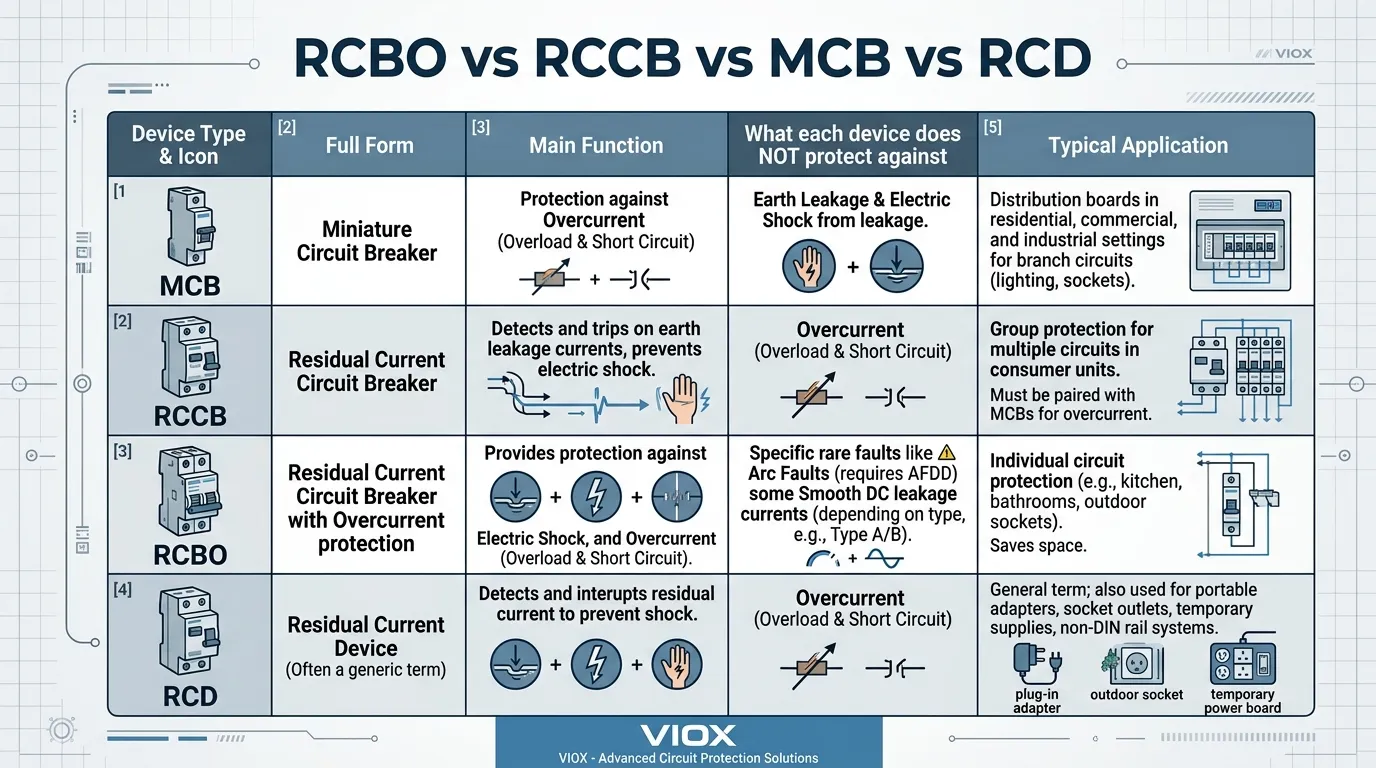
Comparison Table
| Device | Main role | What it does not do by itself | Typical reason to choose it |
|---|---|---|---|
| RCBO | Residual-current plus overload and short-circuit protection | Does not replace proper coordination or correct sizing | Combined protection for one circuit |
| RCCB | Residual-current protection | Does not provide overload or short-circuit protection by itself | Leakage protection with separate overcurrent protection |
| MCB | Overload and short-circuit protection | Does not provide residual-current protection | Standard circuit overcurrent protection |
| RCD | Broad category term for residual-current devices | Depends on specific device type | General terminology in standards and market use |
RCBO vs RCCB
An RCCB provides residual-current protection only. It does not provide overload or short-circuit protection on its own.
An RCBO adds overcurrent protection to that residual-current function. That is why it is often used where one circuit needs both types of protection in one device.
For a focused device comparison, see RCBO vs RCCB and MCB.
RCBO vs MCB
An MCB protects against overload and short circuit. It does not detect residual current.
An RCBO performs the same basic overcurrent protection role while also adding residual-current protection.
In simple terms:
- choose an MCB when overcurrent protection alone is the requirement
- choose an RCBO when both overcurrent and residual-current protection are required in one unit
RCBO vs RCD
RCD is often used as a broader category term. In practical use, an RCBO is one specific type of residual-current device. That is why it is more accurate to say:
RCDis the family termRCCBis residual-current protection onlyRCBOis residual-current protection plus overcurrent protection
How To Read Basic RCBO Specifications
Understanding the full form is only the first step. In real specifications, buyers and engineers also need to interpret the markings on the device.
Common RCBO specification items include:
- rated current
- residual-current sensitivity
- breaking capacity
- trip curve where applicable
- pole configuration
- voltage and frequency rating
- residual-current type
These details matter because two devices may both be called RCBOs while serving different applications.
Basic Specification Guide
| Specification item | Why it matters | Common risk if ignored |
|---|---|---|
| Rated current | Must match circuit loading and protection strategy | Oversized or undersized device selection |
| Residual-current sensitivity | Must fit the protection objective | Wrong shock or leakage protection level |
| Breaking capacity | Must suit the available fault level | Inadequate fault interruption margin |
| Pole configuration | Must match the circuit arrangement | Wrong single-phase or three-phase fit |
| Residual-current type | Must match the load characteristics | Poor compatibility with electronic loads |
If breaking capacity is the next question, VIOX also has a dedicated guide on RCBO breaking capacity selection: 6kA vs 10kA vs 16kA.
Why RCBO Type Also Matters
Not every RCBO responds to the same leakage-current waveform. In modern installations, this matters more than many short glossary pages admit.
Common RCBO type markings may include:
- Type AC for alternating residual currents in basic applications
- Type A for alternating and pulsating DC residual currents
- Type F for selected equipment with more complex waveform behavior
- Type B for applications involving smooth DC residual currents, depending on system design
This is especially important in installations with:
- electronic loads
- inverter-driven equipment
- EV charging equipment
- specialty commercial systems
The full form tells you what an RCBO is. The type marking helps determine whether a specific RCBO is suitable for the real circuit conditions.
How To Choose the Right RCBO
The selection process should go beyond the acronym and focus on the application.
Selection Table
| Selection factor | Why it matters | Typical mistake |
|---|---|---|
| Rated current | Must match circuit design | Choosing only by appliance label |
| Residual-current sensitivity | Must match the protection objective | Assuming one sensitivity fits every circuit |
| Breaking capacity | Must match available fault conditions | Ignoring fault level at the installation point |
| Pole format | Must match circuit arrangement | Choosing the wrong pole count |
| RCBO type | Must match load waveform behavior | Ignoring electronic or inverter-driven loads |
| Application fit | Residential, commercial, EV, and panel applications differ | Treating every RCBO as interchangeable |
At a practical level, selection usually starts with:
- the circuit purpose
- the required protection objective
- the installation arrangement
- the expected fault level
- the load characteristics
- applicable local or project requirements
Common Misunderstandings About RCBOs
Several misunderstandings show up repeatedly in procurement and specification work:
- assuming
RCD,RCCB, andRCBOall mean the same thing - thinking every RCBO is suitable for every modern electronic load
- choosing only by current rating and ignoring residual-current type
- assuming combined protection removes the need for proper coordination
Another common comparison is RCBO vs AFDD. These devices do not perform the same job, even though they can appear in the same protection architecture. For that question, see VIOX’s RCBO vs AFDD difference guide.
Conclusion
The RCBO full form is Residual Current Breaker with Overcurrent Protection. That definition is simple, but the device itself plays an important role in modern electrical protection because it combines leakage protection with overload and short-circuit protection in one unit.
In practice, the key next step is not memorizing the acronym. It is understanding how an RCBO differs from an RCCB, an MCB, and the broader RCD category, then selecting the correct rating and type for the circuit.
FAQ
What is the full form of RCBO in electrical?
RCBO stands for Residual Current Breaker with Overcurrent Protection.
What does an RCBO protect against?
An RCBO is designed to protect against residual-current faults, overloads, and short circuits in one device.
Is RCBO the same as RCCB?
No. An RCCB provides residual-current protection only, while an RCBO combines residual-current protection with overcurrent protection.
Is RCBO the same as MCB?
No. An MCB provides overload and short-circuit protection, but it does not provide residual-current protection.
Is RCBO a type of RCD?
Yes. In broad terminology, an RCBO is a type of residual-current device because it includes residual-current protection.
Where are RCBOs commonly used?
RCBOs are commonly used in residential and commercial final circuits, distribution boards, and applications where individual circuit protection is preferred.