2025年

How to Know *Why* a Breaker Tripped: An Engineer's Guide (Overload vs. Short Circuit)

ブレーカーが*なぜ*トリップしたのかを知る方法:エンジニアのためのガイド(過負荷対短絡)

  Your breaker trips. You go to the panel and see that “rookie” indicator: the handle is stuck in the “middle” position (neither ON nor OFF). You know that it tripped. But now you have to be a “detective.” What was the “murder weapon”? The “Slow-Cook” (Overload): A “chronic suicide.” You plugged in a 10A microwave and an 8A vacuum on the same 15A circuit. The wire “cried for help” for 5 minutes until the breaker slowly “cooked” itself and tripped. The “Violent Attack” (Short Circuit): A “sudden homicide.” A nail hit a wire in the wall. Current instantly spiked to 1,000A. The breaker “died” in 0.01 seconds to prevent […]

ブレーカーが*なぜ*トリップしたのかを知る方法:エンジニアのためのガイド(過負荷対短絡) 続きを読む »

What If You Force a Breaker "ON"? (The "Trip-Free" Safety You Don't Know You Have)

ブレーカーを強制的に「ON」にするとどうなるか?(あなたが知らない「トリップフリー」の安全性)

It’s the “Darwin Award” of electrical “hacks”: a circuit breaker keeps tripping, so a “clever” person jams a stick, a zip-tie, or even a lock on the handle to force it to stay “ON.” This sets up a terrifying thought experiment: what wins? The “Immovable Stick” or the “Unstoppable Short Circuit“? Does the breaker explode? Does the handle snap off? Does the wall instantly catch fire? The answer is… nothing. The breaker still trips. This “magic” is due to a genius piece of engineering called a “Trip-Free” mechanism. But this same safety feature also hides a deadly “plot twist.” Here is the secret you need to know. The “Aha!” Moment:

ブレーカーを強制的に「ON」にするとどうなるか?(あなたが知らない「トリップフリー」の安全性) 続きを読む »

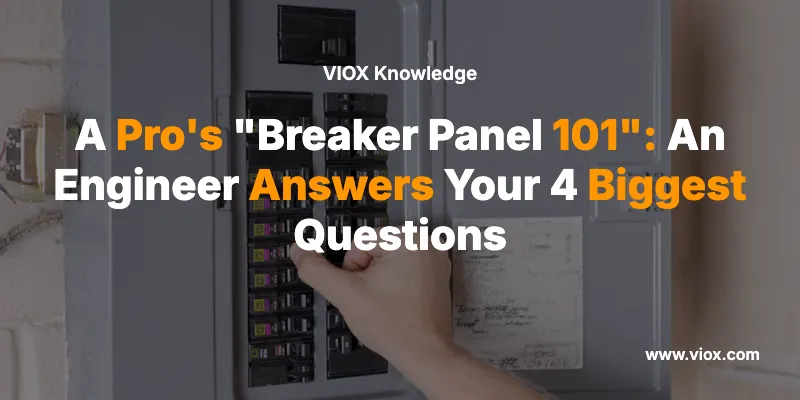
プロフェッショナルの「ブレーカーパネル入門」:エンジニアがあなたの4つの大きな疑問にお答えします

You just bought a house. You’re staring at that gray metal “mystery box” in the garage or basement. It might even be humming. You’re afraid to touch it. This is your breaker panel, the “heart” of your home’s electrical system. But for most new homeowners, it’s an unlabeled “black box.” You’re afraid you’ll break something, get shocked, or (worse) do something stupid. As a Senior Application Engineer, I design these same systems for massive factories. Let me give you the “Pro’s Guide” to those four “stupid” questions you’re afraid to ask. Let’s turn that “black box” into your “control panel.” Q1: “Can I Touch the ‘Main’ Breaker?” (And the 1

プロフェッショナルの「ブレーカーパネル入門」:エンジニアがあなたの4つの大きな疑問にお答えします 続きを読む »

How to Trace a Circuit: A Pro's Guide to "Breaker Finders" vs. "Tone Generators"

回路のトレース方法:プロによる「ブレーカーファインダー」対「トーンジェネレーター」ガイド“

You open a 20-year-old, 480V panel. It’s an “archaeology dig.” The panel schedule is a “Jackson Pollock” of faded, cryptic, or just plain wrong labels. You need to find the one breaker for “Conveyor #3” to perform LOTO (Lock-Out Tag-Out). You can’t just “start flipping them”—not unless you want to shut down the entire production line and get a very angry call from the plant manager. So, what’s the professional way to “map” this panel? How do you trace that one circuit safely? It’s not the “Brute Force” method (the “Vacuum & Yell”). It’s definitely not the “Black Magic” method (the “Suicide Short”). It’s about knowing the “Live vs. Dead”

回路のトレース方法:プロによる「ブレーカーファインダー」対「トーンジェネレーター」ガイド“ 続きを読む »

What is "Selectivity"? A Pro's Guide to Breaker Coordination (and Avoiding a "Fair Fight")

「選択性」とは何か?ブレーカー協調に関するプロのガイド(そして「フェアファイト」を避ける方法)

An apprentice engineer asks, “My utility supply is 100A. Should my factory’s main breaker also be 100A?” First, let’s gently correct the terminology, as it reveals the “Master-level” secret. A factory main isn’t an “MCB” (a Miniature Circuit Breaker, the “household” kind). It’s an “MCCB“ (a Moulded Case Circuit Breaker) or an “ACB“ (an Air Circuit Breaker). These are “industrial beasts.” But the real problem is his question. He’s proposing a “Fair Fight” (100A vs. 100A). In electrical protection, what happens in a “fair fight”? A disaster. You never want a “fair fight.” You want a “hierarchy.” The professional term for this is “Selectivity,” and here’s why it’s the most

「選択性」とは何か?ブレーカー協調に関するプロのガイド(そして「フェアファイト」を避ける方法) 続きを読む »

Switchboard vs Switchgear: The Real Difference (It's Not Just Voltage)

配電盤と開閉装置:本当の違い(電圧だけではありません)

To an apprentice, “Switchboard” and “Switchgear” sound the same: just two different words for the “big metal box with all the breakers.” To a professional, this is the difference between a House Cat and a Tiger. Confusing them can be an expensive—or even fatal—mistake. The common “rookie” answer is that “Switchgear is for high voltage, and Switchboard is for low voltage.” This is the #1 myth in power distribution. While partially true (high-voltage is always switchgear), it’s a dangerously incomplete answer because “Low Voltage Switchgear” absolutely exists. So, what’s the real difference? It’s not voltage. It’s the Design Philosophy, which is dictated by two completely different UL standards. Switchboard: Built

配電盤と開閉装置:本当の違い(電圧だけではありません) 続きを読む »

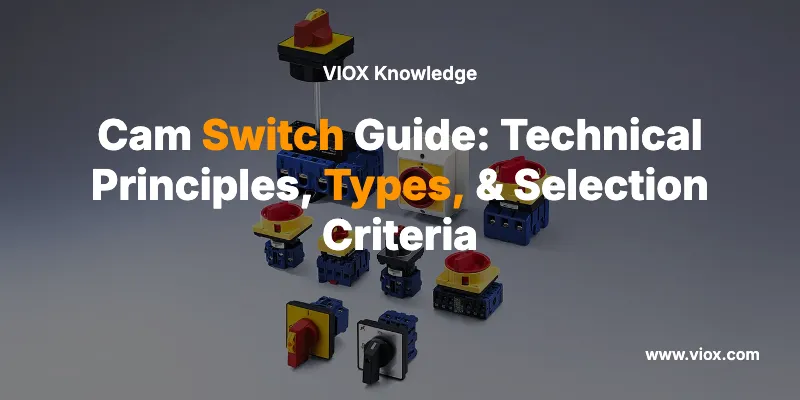
Cam Switch Guide: Technical Principles, Types, & Selection Criteria (2025)

カムスイッチガイド:技術原理、種類、選定基準(2025年)

The plant goes down at 2 AM. Again. By the time you arrive, maintenance has already ruled out the VFD, checked the contactor, verified the relay ladder. The motor’s fine. The PLC’s fine. Everything’s fine except production has been halted for three hours and your plant manager is calculating lost revenue per minute. Then someone notices the manual selector switch on the panel door—the three-position cam switch that lets operators choose between auto mode, manual jog, and motor reversing. Position 2 isn’t making contact anymore. The cam mechanism inside has worn unevenly, and now the switching sequence that worked flawlessly for five years has developed a dead spot. Cam switches

カムスイッチガイド:技術原理、種類、選定基準(2025年) 続きを読む »

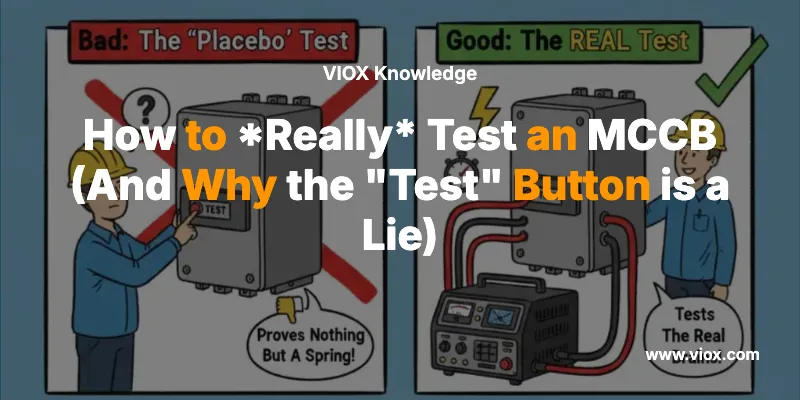
How to *Really* Test an MCCB (And Why the "Test" Button is a Lie)

MCCBを*本当に*テストする方法(そして「テスト」ボタンが嘘である理由)

You’re on-site, in front of a giant 400A MCCB (Moulded Case Circuit Breaker) that acts as the “main gate” for a critical factory line. You need to “test” it. You see the little “Push-to-Trip” (PTT) button. You press it. CLUNK. The breaker trips. Your job is done, right? You’ve “tested” the breaker? No. You’ve done nothing but test a spring. You’ve just fallen for “The ‘Placebo’ Button.” Here’s the truth about that “test” and how to really know if your breaker is a “guardian” or just a “bomb.” The “Smoke Alarm” Analogy: What That Button Actually Does The biggest “Aha!” moment in electrical safety is this: Pressing that “Test” button

MCCBを*本当に*テストする方法(そして「テスト」ボタンが嘘である理由) 続きを読む »

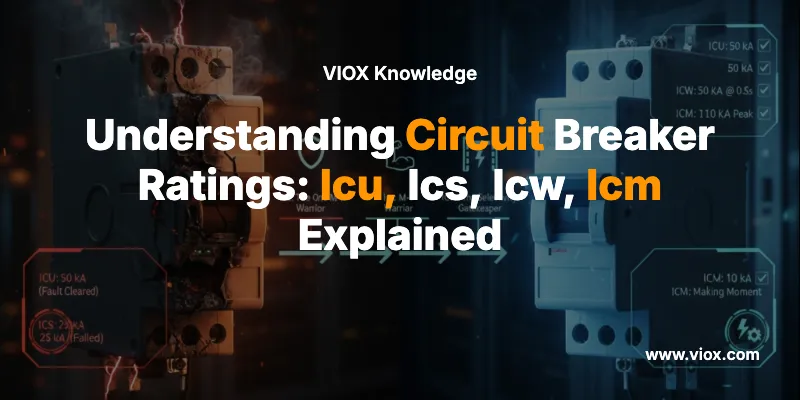
Understanding Circuit Breaker Ratings: Icu, Ics, Icw, Icm Explained

回路ブレーカーの定格を理解する:Icu、Ics、Icw、Icmについて解説

The spec sheet looked perfect. 50 kA Icu rating, well above your calculated 38 kA fault current. You signed off on the order, the breaker shipped, installation went smoothly. Three months later, a short circuit on the main distribution bus. The breaker cleared the fault in milliseconds—exactly as designed. But when your team powered back up and ran diagnostics, the breaker’s contact resistance had tripled. The arc chamber showed heat damage. What was rated for decades of service was now marginal after a single fault interruption. Production resumed, but you ordered a replacement and filed the failure report. The root cause? You’d checked Icu—the breaker’s ability to interrupt maximum fault

回路ブレーカーの定格を理解する:Icu、Ics、Icw、Icmについて解説 続きを読む »

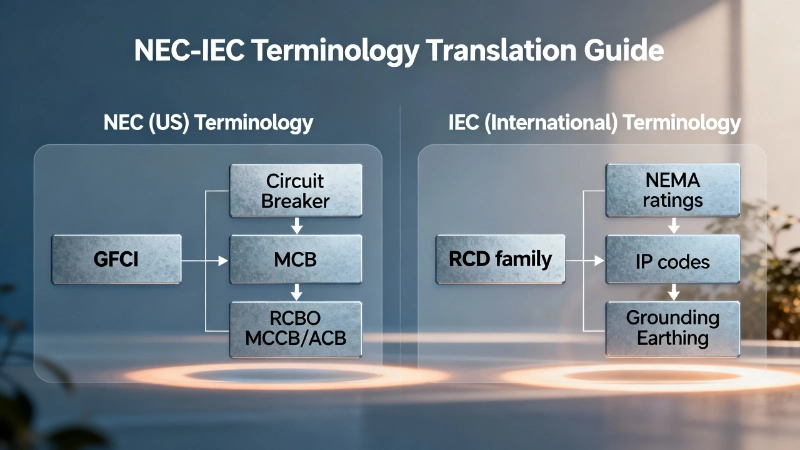
NEC-to-IEC terminology translation overview

NECとIEC:主要用語対応表

You’re halfway through the panel spec when the supplier’s email arrives: “Can you clarify—are you requesting GFCI protection per NEC or RCD protection per IEC 61009?” You stare at the screen. Aren’t they the same thing? They are. Sort of. The device does the same job—but the terminology, the standards numbering, the rating nomenclature, and even the test parameters are different. Your US-trained brain says “GFCI.” The international supplier’s datasheet says “RCBO.” The panel builder in Mexico needs both terms because they serve clients in Texas and clients in Europe. One device. Two languages. And if you mix them up on a spec sheet, you’re looking at either wrong equipment,

NECとIEC:主要用語対応表 続きを読む »

今すぐ見積もりを依頼する