

On this page
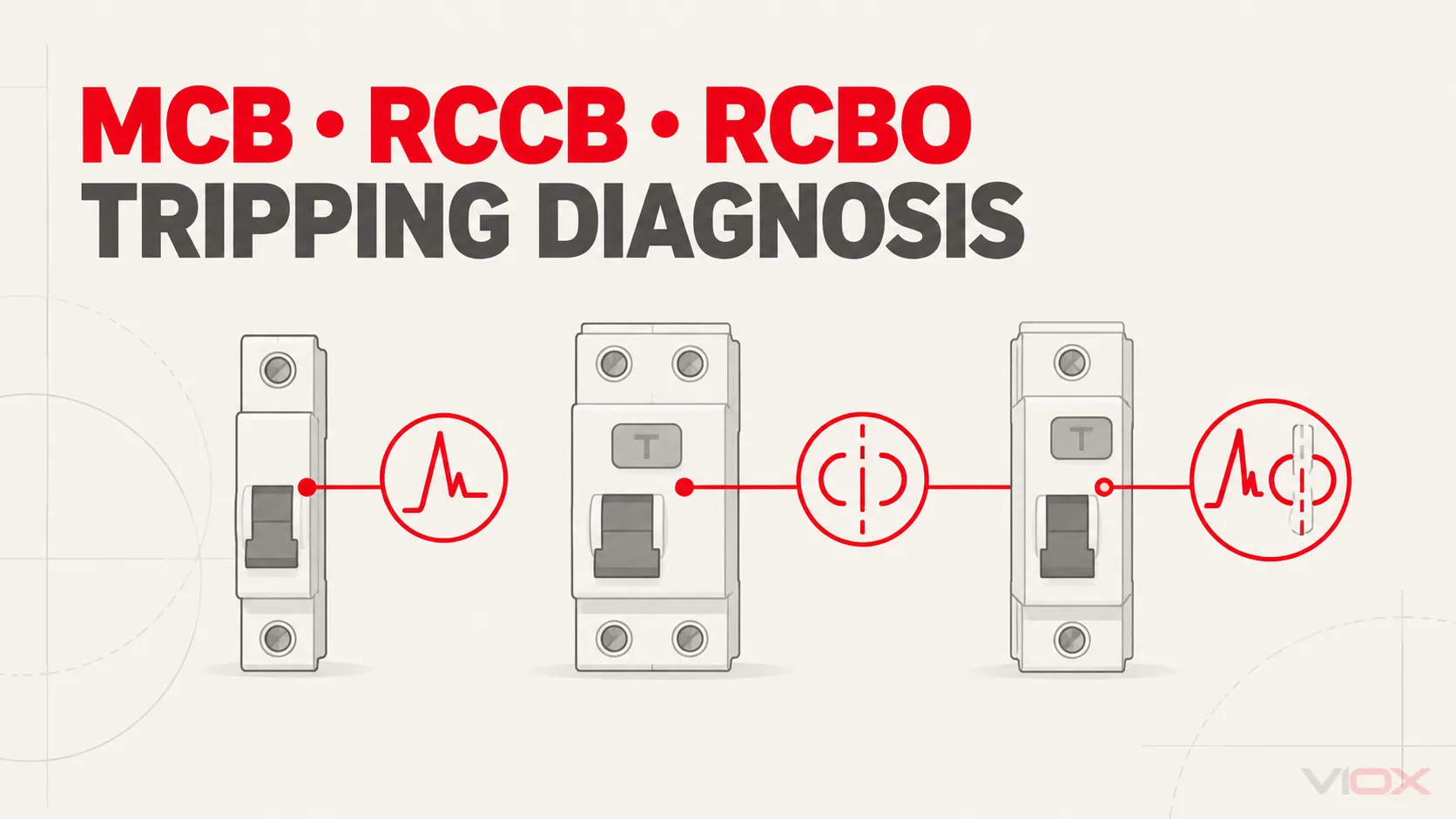
An MCB normally trips because of overcurrent, an RCCB trips because of residual-current imbalance, and an RCBO can trip for either reason. Identifying the device chooses the correct diagnostic branch. Trip timing and the affected circuits provide useful clues, but neither proves the physical fault; model-specific indication and electrical testing are needed for confirmation.
Do not keep resetting any protective device that trips repeatedly. Stop immediately if there is smoke, a burning odor, melting, discoloration, arcing, water near electrical equipment, an electric shock, or an immediate repeat trip after accessible loads have been disconnected. Keep clear of damaged equipment and arrange safe isolation by a qualified person.
Key Takeaways
- MCB trip: investigate sustained overload, short circuit, starting current, thermal conditions, and device coordination.
- RCCB trip: investigate leakage, insulation defects, moisture, neutral-to-earth faults, crossed or shared neutrals, and cumulative residual current.
- RCBO trip: either the overcurrent function or residual-current function may have operated; the handle position alone usually cannot tell you which.
- Timing is a clue, not a verdict. A delayed trip supports an overload direction, but an immediate trip can result from a short circuit, high inrush, leakage, or a wiring fault.
- The test button is not a fault locator. It checks a defined part of the residual-current trip function according to the product instructions; it does not prove that the protected circuit is free of faults or that the overcurrent function is correct.
- One safe reset attempt is the limit, not a diagnostic program. If the device trips again or the cause remains unclear, leave it off and escalate.
MCB vs RCCB vs RCBO: What a Trip Actually Tells You
The three devices may look similar on a DIN rail, but they respond to different electrical quantities. That distinction matters more than the word “breaker.”
| Device | What it monitors | What normally makes it operate | What it does not prove |
|---|---|---|---|
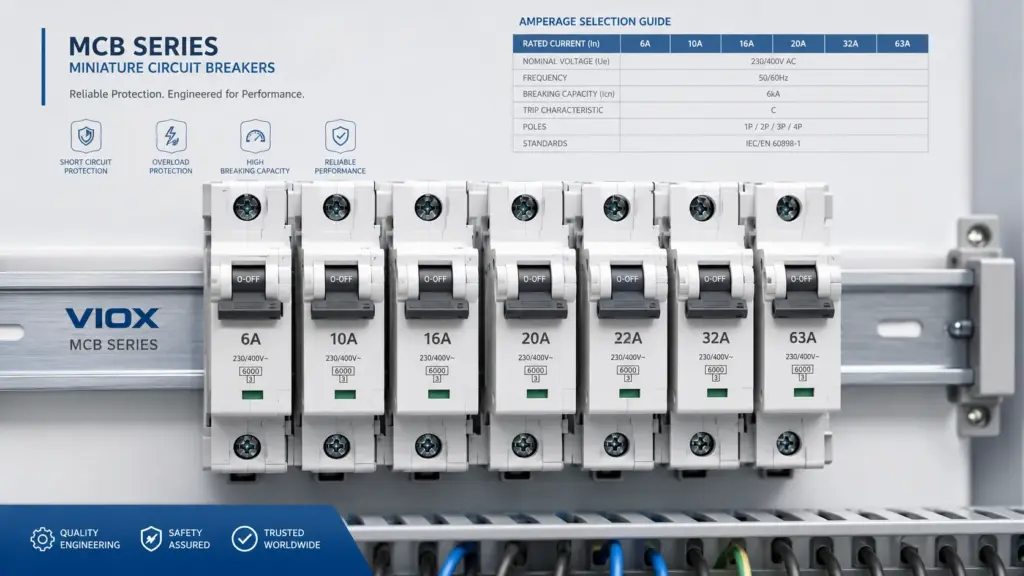
| MCB | Current through its protected pole or poles | Sustained overcurrent or current entering the instantaneous pickup region | Whether the physical cause was overload, short circuit, inrush, wiring damage, or a defective load |
| RCCB | Vector sum of current in all monitored live conductors | Residual-current imbalance caused by current returning outside the monitored path | Which appliance, cable, neutral connection, or environmental condition produced the imbalance |
| RCBO | Both overcurrent and residual-current conditions | Either an MCB-like overcurrent event or an RCCB-like residual-current event | Which protection function operated unless the exact model provides a reliable indication or testing establishes it |
The product-standard boundary supports this distinction. IEC 60898-1 covers AC circuit-breakers for overcurrent protection in household and similar installations within its stated limits. IEC 61008-1:2024 covers RCCBs without integral overcurrent protection, while IEC 61009-1:2024 covers RCBOs with integral overcurrent protection. These are product standards, not a substitute for the wiring rules and verification requirements adopted in a particular market.
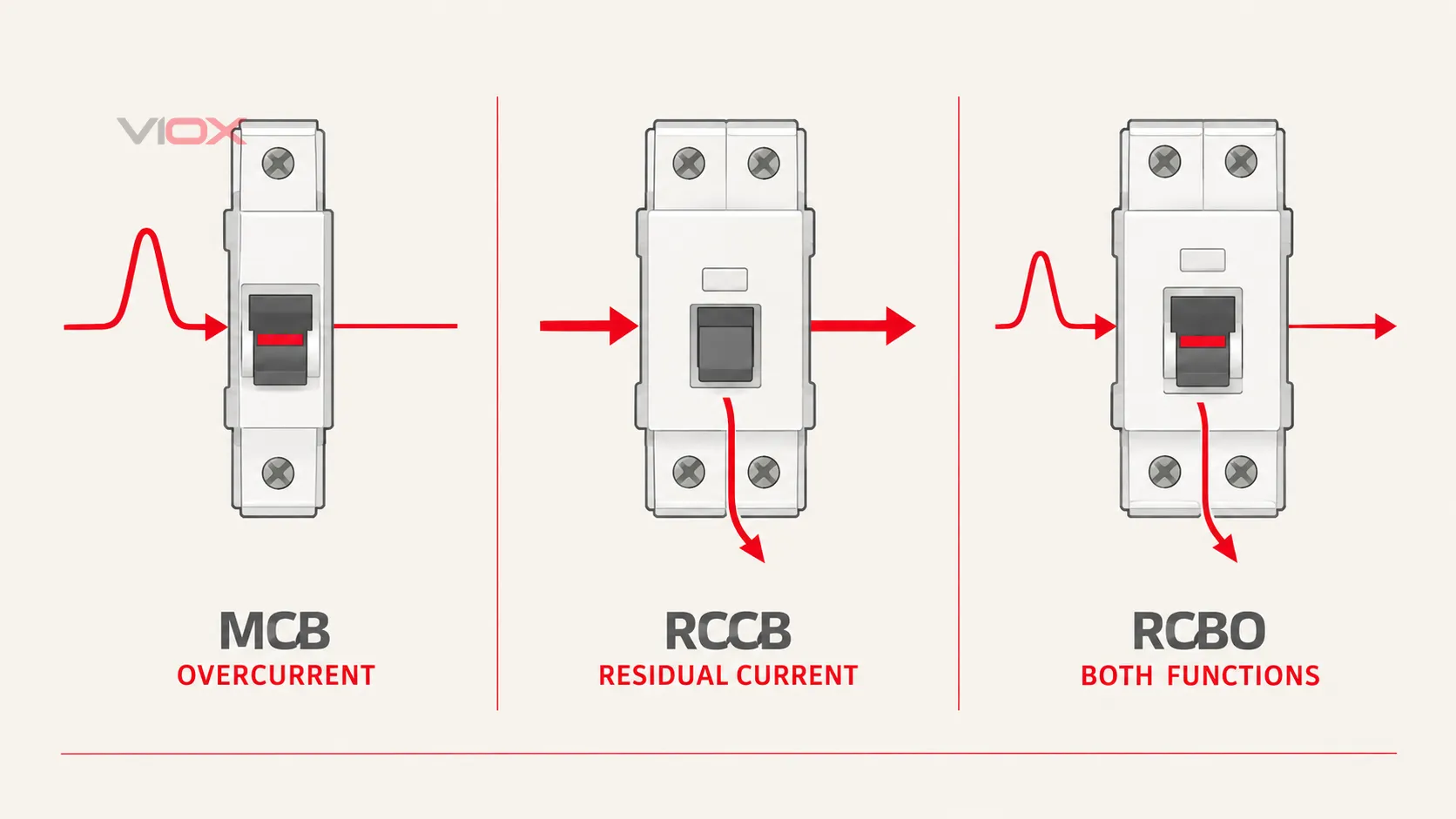
For a broader selection comparison, use the VIOX guide to MCB, RCCB and RCBO differences. This page stays focused on what to do after a trip.
First Identify Which Device Operated
Record the external markings and the affected circuit before moving any handle. Do not remove the distribution-board cover merely to identify the device.
| External evidence | Likely device | Diagnostic direction |
|---|---|---|
Rated current with an IEC-style B, C, or D characteristic; normally no residual-current test button or IΔn marking |
MCB | Follow the overcurrent branch |
Test button and residual-current marking such as IΔn; no MCB trip-characteristic marking |
RCCB | Follow the residual-current branch |
| Test button and residual-current marking together with an overcurrent rating/characteristic | RCBO | Determine which of the two protection functions probably operated |
| Main switch or isolator markings without the relevant protection information | Switching device, not necessarily a fault-sensing breaker | Verify the product identity and installation arrangement before diagnosing |
These are typical identification clues, not a universal nameplate decoder. Always use the exact manufacturer’s documentation when markings, trip flags, LEDs, or reset sequences are involved.
The outage pattern also helps locate the protection level:
- One final circuit lost while nearby circuits remain energized may point to an MCB or individual RCBO.
- A group of circuits lost while their downstream MCB handles remain on may point to a shared upstream RCCB.
- A main device operating can affect most or all of an installation, but the device must be identified before assigning a cause.
- Several individual RCBOs operating after recent board work can point toward crossed, shared, or misplaced neutrals, but that remains a testable hypothesis rather than proof.
Diagnostic Matrix: Observation, Evidence Strength, and Next Action
Use observations to choose the next check—not to declare the final cause.
| What you observe | Likely direction | Evidence strength | Safe check | Next action |
|---|---|---|---|---|
| MCB trips after several loads have operated for a period | Sustained overload, abnormal load current, or thermal influence | Moderate clue | Record the loads and elapsed time; switch off non-essential accessible loads | Qualified current measurement and comparison with the exact time-current curve |
| MCB trips immediately when one appliance or machine starts | Equipment fault, high inrush, stalled motor, or short circuit | Moderate clue | Stop using and disconnect the implicated plug-connected load if safe | Test the equipment and circuit; do not solve it by installing a larger MCB |
| RCCB trips when one plug-in appliance is connected | Leakage or insulation fault associated with that appliance | Strong association, not proof of the failed component | Unplug and remove the appliance from service | Appliance inspection and insulation/leakage testing |
| RCCB trips with accessible appliances unplugged | Fixed wiring, hard-wired equipment, moisture, or neutral fault | High-risk clue | Leave the affected supply off | Qualified circuit isolation and testing |
| RCCB trips when another circuit is switched | Crossed, borrowed, shared, or neutral-to-earth path | Strong wiring clue | Record both circuit labels and the switching sequence | Neutral-path verification by a qualified electrician |
| RCBO trips after sustained heavy loading | Overcurrent branch is plausible | Moderate clue | Record load combination and elapsed time; check any model-specific trip indicator | Measure running current and inspect the residual-current branch if indication is absent or inconclusive |
| RCBO trips immediately when a load is energized | Short circuit, inrush, equipment leakage, N–E fault, or wiring error | Inconclusive but urgent | Isolate the implicated accessible load and stop after one recurrence | Use model indication plus current, insulation, and residual-current tests |
| Trip correlates with rain, condensation, cleaning, or outdoor equipment | Moisture-related insulation leakage is plausible | Moderate to strong contextual clue | Keep wet or damaged equipment out of service; do not open energized enclosures | Locate moisture ingress and verify insulation before restoration |
| Device trips again with no identified cause | Persistent fault or unresolved protection mismatch | Stop condition | Do not reset again | Leave it off and arrange qualified investigation |
Device-First Diagnostic Workflow
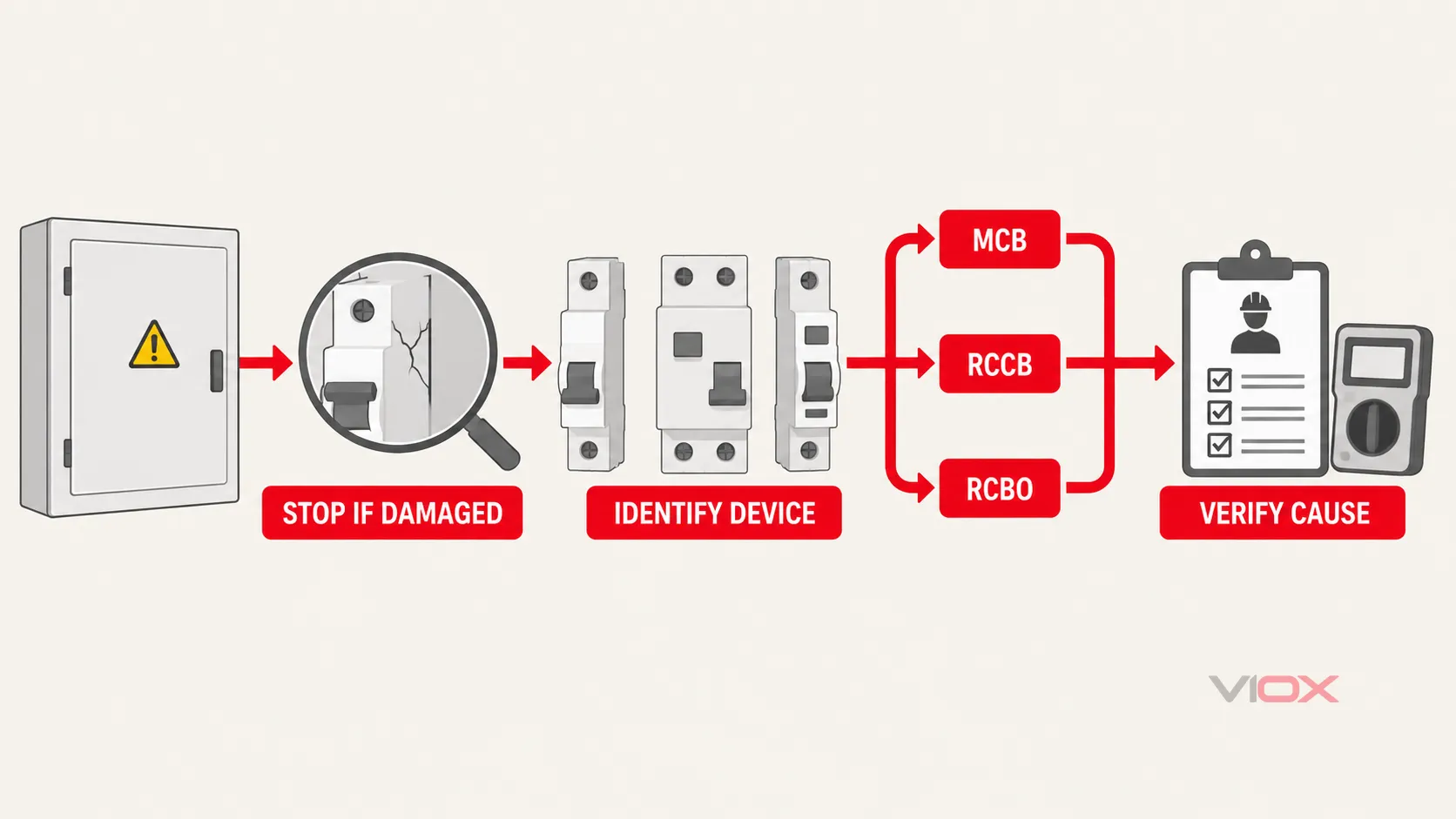
Step 1: Screen for immediate danger
Do not touch or reclose equipment with smoke, odor, visible heat damage, arcing sounds, water exposure, exposed conductors, a damaged enclosure, or evidence of electric shock. If the distribution board itself appears damaged, keep clear and follow local emergency procedures.
Step 2: Preserve the event information
Before changing anything, record:
- which device moved and its visible markings;
- whether a trip flag, LED, display, or event log is present;
- which circuits or loads lost power;
- what equipment was running or starting;
- whether the event was immediate, delayed, intermittent, or weather-related;
- whether electrical work, an added appliance, or a system change preceded it.
This record is often more useful than repeated attempts to recreate the fault.
Step 3: Identify the protection branch
- If it is an MCB, begin with current, inrush, short-circuit, and thermal conditions.
- If it is an RCCB, begin with residual-current paths, insulation, moisture, connected equipment, and neutral arrangement.
- If it is an RCBO, do not choose a branch until you have checked the exact model’s trip indication and the event pattern. If the device provides no reliable function indication, both branches remain open.
Step 4: Remove only safely accessible loads
Switch off or unplug accessible loads using their normal controls. Do not open a panel, disconnect fixed wiring, touch a wet or damaged plug, or move a suspect appliance to another circuit merely to see whether another device trips.
Step 5: Reset only when permitted and visibly safe
Follow the device instructions. Many breaker mechanisms require the handle to be moved fully to OFF before returning to ON. If the device trips again, will not reset normally, or the cause is still unclear, leave it off. Electrical Safety Foundation International guidance likewise treats repeated trips as a condition requiring investigation rather than continued resetting.
MCB Branch: Overload, Inrush, or Persistent Fault?
An MCB trip confirms that its overcurrent mechanism reached an operating condition. It does not label the root cause.
Delayed operation supports an overload direction
A trip after several minutes of sustained loading is consistent with thermal operation. The stronger questions are:
- What current was flowing before the trip?
- Was a motor, heater, compressor, or power supply drawing more than expected?
- Was the enclosure already warm or densely loaded?
- Does the measured current intersect the exact product’s time-current band?
Ambient temperature, adjacent loaded devices, prior loading, connection condition, and the product characteristic can all influence the observed time. There is no universal “ten-minute fault.”
Immediate operation is urgent but not automatically a short circuit
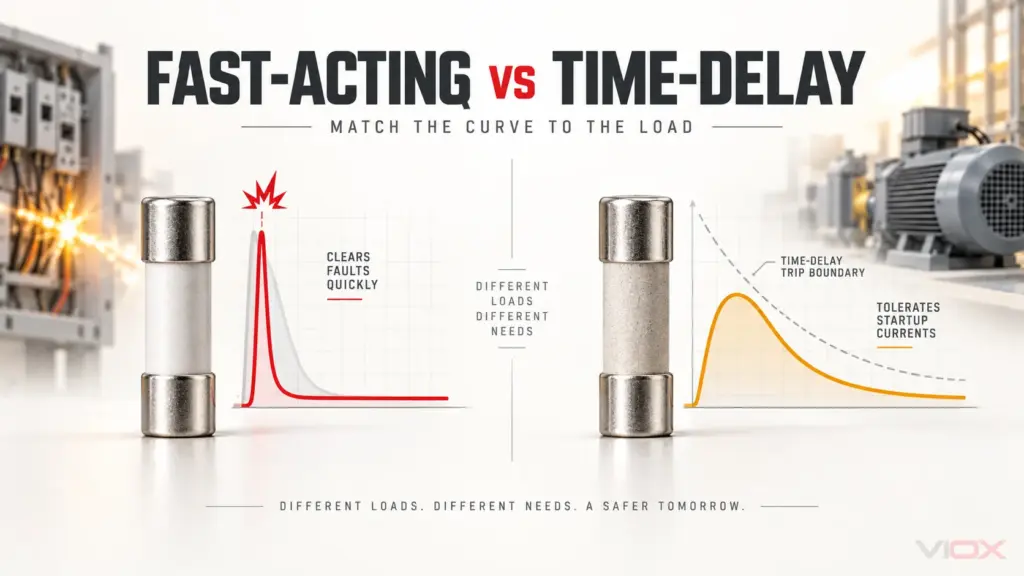
Very rapid operation is consistent with current entering an instantaneous pickup region. A line-to-neutral or phase-to-phase short circuit is one possibility, but so are excessive motor starting current, transformer magnetizing current, a failed power supply, a stalled machine, damaged wiring, or an unsuitable protective-device characteristic.
Do not change from B to C or D, or increase the current rating, from timing alone. Curve and rating changes affect conductor protection, fault disconnection, and coordination. The separate MCB trip-curve guide explains how to read the time-current evidence; the MCB repeated-trip guide covers the complete MCB workflow.
RCCB Branch: One Appliance, One Circuit, or the Installation?
An RCCB compares current in the live conductors passing through its sensing system. If current returns through an unintended path, the vector sum is no longer balanced and the device can operate. Because an RCCB does not include integral overcurrent protection, its trip does not mean that the circuit used too many amperes.
The trip follows one accessible appliance
Remove that appliance from service. Moisture, damaged insulation, a failed heating element, cable damage, or an internal filter condition may be involved. The association narrows the search, but product testing is still needed before the appliance returns to service.
The trip remains after accessible appliances are unplugged
The investigation moves toward fixed wiring, hard-wired equipment, outdoor circuits, hidden moisture, neutral-to-earth contact, or an installation error. Turning off a single-pole downstream MCB may not disconnect the associated neutral, so the way an RCCB behaves with MCBs off does not by itself eliminate a neutral fault.
Another circuit or switch triggers the trip
Suspect the current-return architecture. A crossed, borrowed, or shared neutral can make current leave through conductors monitored by one RCD and return outside that same sensing path. A neutral-to-earth connection can also divert return current through protective earth. The VIOX guide to shared and borrowed neutrals explains this fault family in depth.
Several healthy electronic loads appear to contribute
Normal standing leakage from multiple loads can accumulate, but “nuisance tripping” should not become a diagnosis by assumption. Measure the relevant leakage/residual current, verify the circuit arrangement and connected equipment, and rule out an actual insulation or neutral fault. The complete RCCB tripping diagnostic owns this deeper task.
RCBO Branch: Two Protection Functions, One Handle
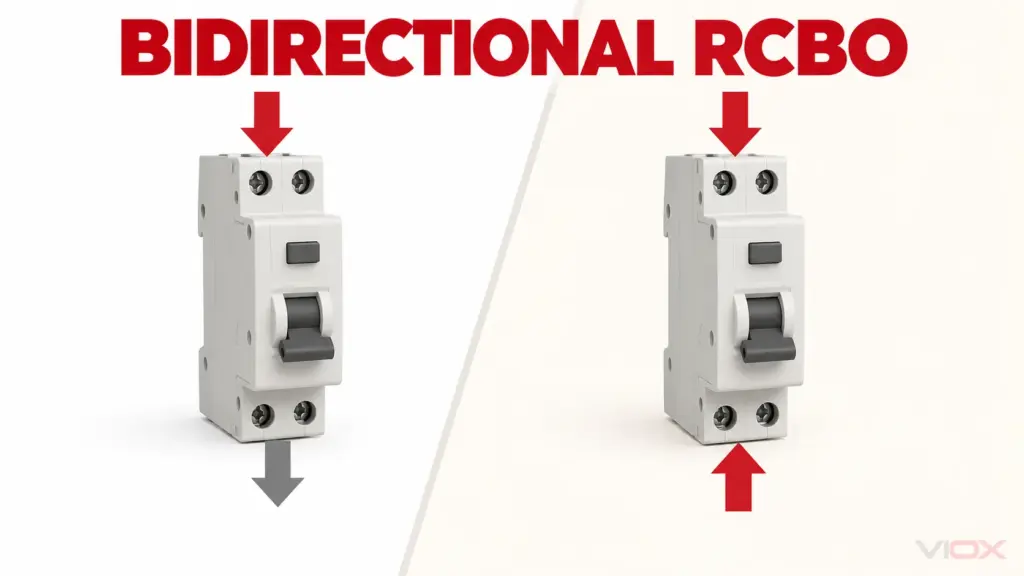
An RCBO combines the overcurrent function of an MCB with the residual-current function of an RCCB. That improves circuit-level fault isolation, but it creates a diagnostic question: which protection function operated?
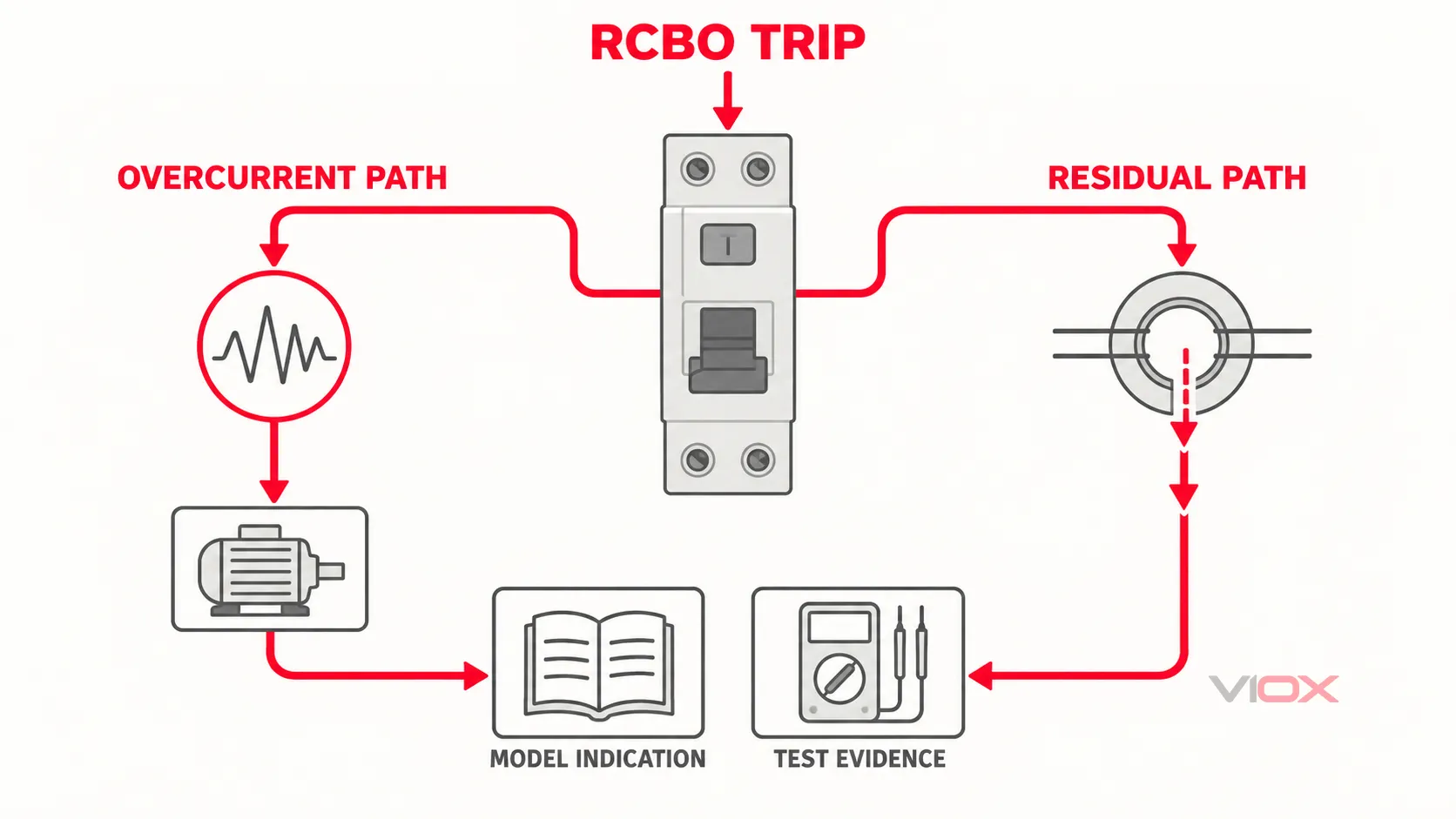
Use evidence in this order:
- Model-specific trip indication. Some RCBOs provide a flag, window, light, or documented reset behavior associated with the operated function. Interpret it only through the exact model instructions.
- Event pattern. Sustained high current supports the overcurrent branch; moisture, a particular appliance, or a neutral interaction supports the residual-current branch. These remain clues.
- Load-current evidence. Running and starting current compared with the device’s characteristic can support or reject the overcurrent hypothesis.
- Insulation and residual-current evidence. Insulation testing, leakage-current measurement, neutral-path checks, and an appropriate RCD test can evaluate the residual-current branch.
- Circuit and device condition. Damaged wiring, incorrect neutral routing, loose or heat-damaged connections, environmental contamination, and a defective protective device must be considered according to the evidence.
Do not assume an immediate RCBO trip is residual current or a short circuit. Both functions can operate rapidly under the right conditions, and some loads produce both high starting current and transient leakage behavior.
What Timing and Outage Scope Can—and Cannot—Prove
| Observation | Reasonable inference | Boundary |
|---|---|---|
| Trip after sustained loading | Thermal overcurrent becomes more plausible | Does not identify the abnormal load or exclude thermal influence from the installation |
| Immediate trip on energization | A severe or fast-operating condition exists | Does not separate short circuit, inrush, residual current, or wiring error |
| One branch circuit loses power | A branch device probably operated | Device markings still determine whether it was MCB or RCBO |
| Several MCB-fed circuits lose power together | An upstream shared device may have operated | Does not prove leakage until that device is identified as an RCCB/RCD |
| Trip during wet weather | Moisture-related leakage becomes plausible | Correlation alone does not locate the ingress point |
| The handle stays on after pressing TEST | The prescribed residual-current test did not produce the expected operation | Follow the exact manufacturer action; it does not diagnose the external circuit or overcurrent function |
The principle is simple: device identity tells you what quantity was monitored; event pattern tells you where to look; measurements and inspection establish why it happened.
What a Qualified Electrician Should Verify
The test sequence depends on the device, installation, and event. It may include:
| Verification | Diagnostic value |
|---|---|
| Device identification and manufacturer trip indication | Establishes the protection functions available and any retained trip-cause evidence |
| Operating and starting-current measurement | Tests overload, inrush, stalled-load, and abnormal-equipment hypotheses |
| Review of the exact time-current characteristic | Compares measured current and duration with the device’s declared behavior |
| Inspection of conductors, terminations, busbar interfaces, and protective-device seating | Finds damage, contamination, loose or overheated connections, and installation defects |
| Insulation-resistance and circuit tests under safe isolation | Evaluates wiring and equipment insulation without relying on trip timing |
| Neutral continuity and separation checks | Finds crossed, borrowed, shared, misplaced, or neutral-to-earth paths |
| Leakage or residual-current measurement | Quantifies current imbalance and cumulative contribution instead of labelling it “nuisance” by guesswork |
| RCD/RCBO operating test with suitable equipment | Verifies the residual-current protective measure under the applicable procedure |
| Rating, fault-level, conductor, and coordination review | Confirms that the protective device remains suitable for the circuit rather than merely resetting successfully |
IEC 60364-6 addresses initial and periodic verification of low-voltage installations. IEC 61557-6:2019 specifies requirements for equipment used to test the effectiveness of RCD protective measures in TT, TN, and IT systems; it does not turn a product test button into a complete installation verification method. Apply the edition and national rules adopted for the installation.
Build a Useful Fault Record
Provide the following information instead of only reporting “the breaker tripped”:
- photograph or written record of the device markings;
- device type, pole arrangement, current rating, trip characteristic,
IΔn, and residual-current type where visible; - exact circuits and loads affected;
- trip flag, LED, window, display, or event-log state before reset;
- loads operating or starting and the elapsed time;
- recent rain, condensation, cleaning, construction, maintenance, or board modification;
- whether one accessible appliance consistently triggers the event;
- whether the device tripped again after accessible loads were removed;
- any heat, odor, discoloration, sound, shock, or mechanical damage.
This record reduces guesswork and helps the electrician select the correct tests before disturbing evidence.
Do Not Use These Shortcuts
- Do not repeatedly reclose a device that trips immediately or without a confirmed cause.
- Do not hold a handle in the ON position or bypass any protection.
- Do not install a higher-current MCB or RCBO simply to prevent operation.
- Do not raise the residual-current rating or change RCD type to conceal leakage.
- Do not change B, C, or D characteristic without verifying conductor protection, fault current, inrush, and required disconnection.
- Do not disconnect neutrals at random to “find” a fault.
- Do not move a suspect appliance to another circuit to see whether it trips another device.
- Do not assume a successful reset proves the circuit is safe.
- Do not treat the TEST button as proof that the whole circuit, wiring, or overcurrent mechanism is healthy.
Technical Sources
- IEC 60898-1:2015+AMD1:2019 — AC circuit-breakers for overcurrent protection in household and similar installations
- IEC 61008-1:2024 — RCCBs without integral overcurrent protection
- IEC 61009-1:2024 — RCBOs with integral overcurrent protection
- IEC 60364-6:2016 — Verification of low-voltage electrical installations
- IEC 61557-6:2019 — Test equipment for RCD protective measures
- Electrical Safety Foundation International — Understanding Your Home Electrical System
- Electrical Safety Foundation International — Fuse and Breaker Breakdown
After the fault is identified and the circuit requirements are documented, compare the relevant VIOX MCB, RCCB, and RCBO product families. Product evaluation must follow the circuit design, available fault current, residual-current requirements, applicable installation rules, and exact model documentation—not the trip symptom alone.
This article is a diagnostic framework, not permission for energized work. Isolation, inspection, testing, repair, replacement, and re-energization must follow applicable rules, site procedures, and qualified electrical review.