

On this page
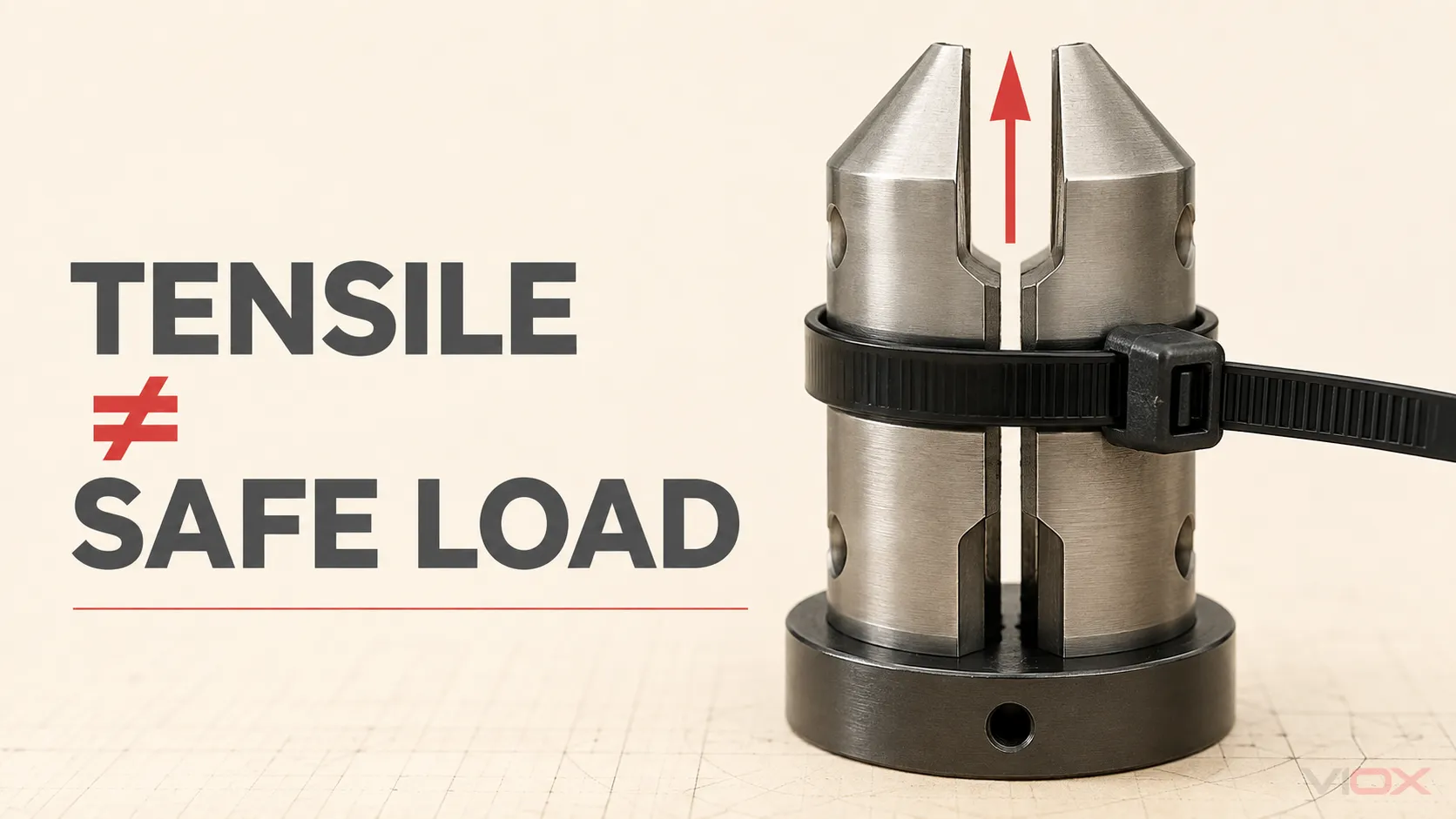
There is no universal safe weight that a heavy-duty zip tie can hold. The value printed on a datasheet is usually a minimum loop tensile strength measured under controlled test conditions. It is useful for comparing products, but it is not automatically a safe working load for hanging equipment, supporting a cable run, or restraining a moving object.
For an installed support decision, verify the exact tie, the fixing device or anchor, the load direction, installation method, temperature, ultraviolet (UV) exposure, chemicals, vibration, and the consequences of failure. If the manufacturer does not declare a working load for the complete arrangement, do not create one by applying an arbitrary safety factor to a generic tensile value.
Key takeaways
- Minimum loop tensile strength is a controlled failure-test value, not a universal safe suspended-load rating.
- Newtons and pounds-force describe force. Converting force to an equivalent static mass does not validate an installation.
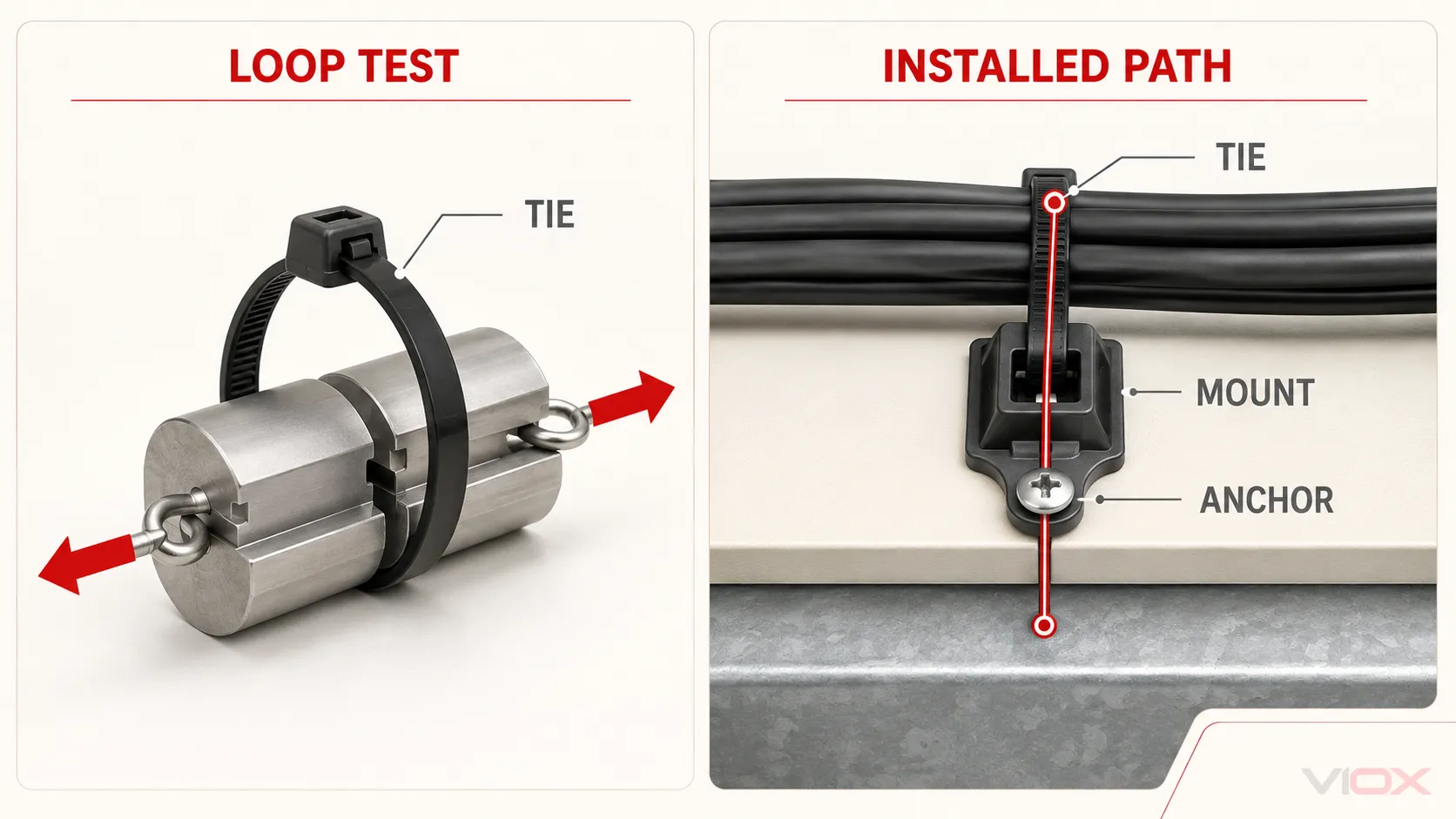
- The tie, locking head, mount, anchor, surface, and supported item form one load path. The weakest element controls the result.
- Two or more ties do not provide a guaranteed additive capacity unless the load-sharing arrangement has been designed and verified.
- Do not use cable ties as lifting gear, fall protection, personnel protection, or an improvised support where failure could injure someone.
What the tensile rating tells you
Cable-tie strength is normally evaluated with the tie closed around a specified test fixture and loaded until it fails or unlocks. The result is commonly reported as minimum loop tensile strength in newtons (N) or pounds-force (lbf).
The exact conditioning, fixture, installation tool, and test speed matter. HellermannTyton’s technical explanation, for example, describes a tie installed on a split mandrel and then loaded by opening that mandrel at a defined speed. That controlled test is valuable because it makes products comparable under a declared method. It does not reproduce every field installation.
The current edition of IEC 62275 covers metallic, non-metallic, and composite cable ties and associated fixing devices used to manage or secure wiring systems in electrical installations. Its public scope also notes that additional requirements can apply when these products are used to support wiring systems.
| Evidence item | What it can establish | What it does not establish by itself |
|---|---|---|
| Minimum loop tensile strength | A declared minimum force under a specified loop-test method | Safe hanging mass, fatigue life, shock resistance, or mount capacity |
| Tie material and dimensions | Product identity and variables that influence performance | Suitability for a temperature, UV, chemical, or fire condition without declarations |
| Fixing-device rating | Capacity of a mount under stated conditions and direction | Capacity of the tie, anchor, substrate, or complete installed path |
| Installation instructions | Correct tool, tension, orientation, and inspection method | Performance outside the stated product and environment |
| Complete-system approval or engineering verification | Suitability for the defined load path and conditions | Suitability for a different arrangement or consequence class |
Why pounds on the package are not a safe hanging weight
A pound-force rating describes force. A kilogram is a unit of mass. Under standard Earth gravity, a simple conversion is:
Equivalent static mass (kg) ≈ force (N) ÷ 9.81 m/s²For example, 225 N corresponds to approximately 22.9 kg of static mass under this unit conversion. That calculation only changes units. It does not account for the tie head, fixing mount, bend radius, installation damage, vibration, shock, aging, environment, or the required margin between test failure and service load.
This is the central distinction:
- Test force answers: under the stated test method, what minimum loop force was declared?
- Installed capacity answers: can the complete assembly support this particular load, in this direction and environment, for the required service condition?
The second question requires more evidence than the first.
The weakest element controls the installed load
An installed cable-tie support is a chain:
Supported item → cable tie → locking head → fixing device → anchor → substrateA high-strength tie does not strengthen a low-rated adhesive mount, an unsuitable screw, a thin sheet edge, or a weak substrate. Likewise, a strong mount does not prevent a tie from being damaged by a sharp edge or excessive installation tension.
Check every interface:
- Tie body and head: exact part number, material, minimum loop tensile strength, and installation instructions.
- Contact geometry: edge radius, bundle shape, point loading, and whether the tie is bent or twisted.
- Fixing device: mechanical or adhesive attachment, rated direction, mounting surface, and environmental limits.
- Anchor and substrate: screw, rivet, stud, panel, masonry, or other support, verified for the actual direction of load.
- Service condition: static or dynamic loading, temperature, UV, moisture, chemicals, vibration, and inspection access.
Why multiple zip ties are not simply additive
In an ideal model, identical ties would share a perfectly centered static load equally. Real installations rarely behave that way. Small differences in length, pretension, angle, contact surface, and stiffness can cause one tie to take load before the others. Once that tie stretches, unlocks, or breaks, its load transfers suddenly to the remaining ties and can trigger progressive failure.
Do not calculate a working capacity as:
number of ties × individual tensile ratingunless the complete load-sharing arrangement and its failure mode have been validated. Adding ties may improve redundancy in a designed system, but quantity alone is not a certification or a working-load declaration.
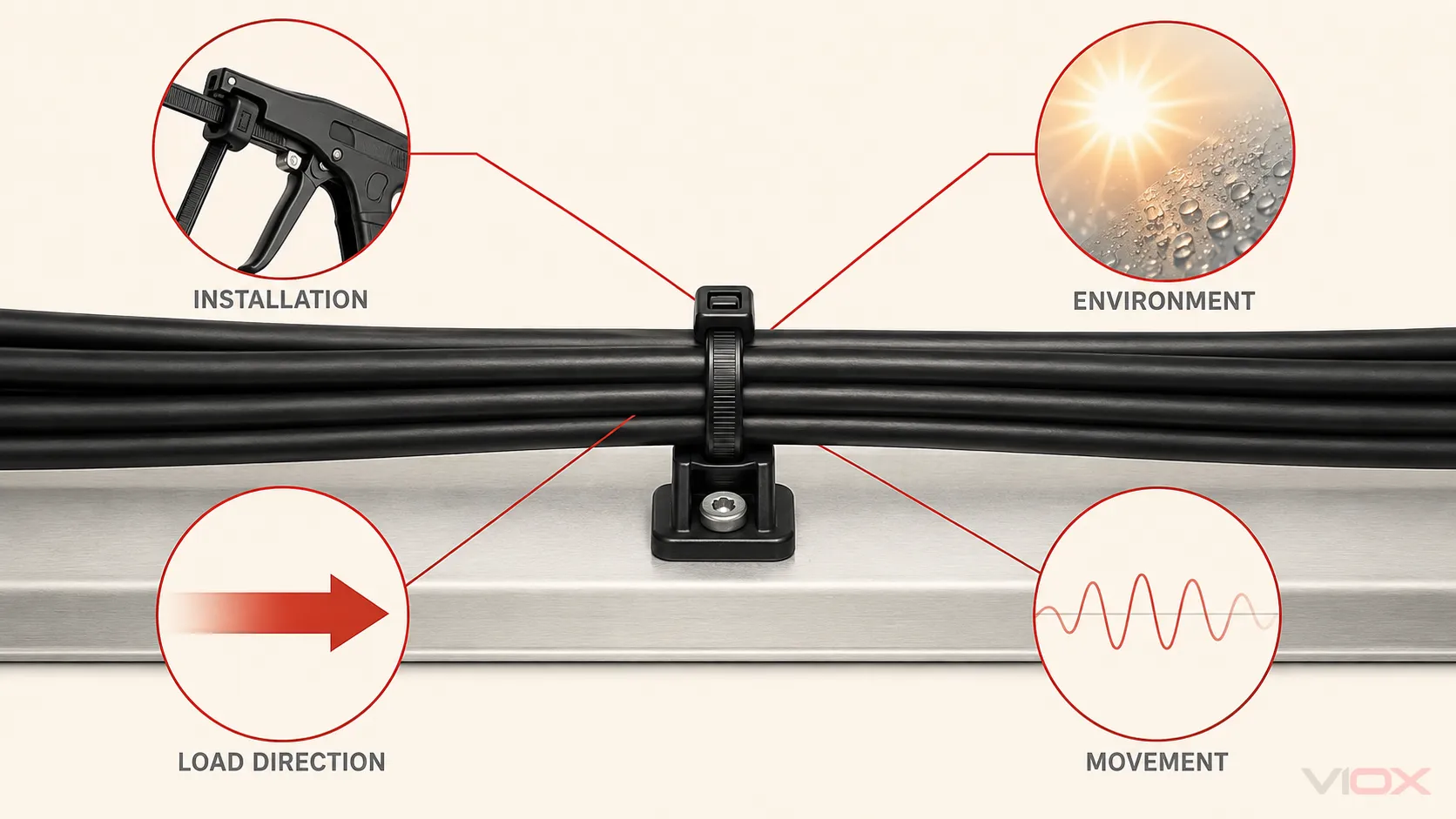
Conditions that can reduce real installation performance
Installation tension and tool condition
Over-tensioning can damage the strap, locking head, cable jacket, or insulation before the assembly enters service. Under-tensioning can allow movement, impact, or abrasion. Use the tool and setting specified for the exact tie family when controlled tension and flush cut-off are required.
Temperature and moisture
Polymer properties change with temperature and moisture conditioning. Do not transfer a room-temperature tensile value to a hot enclosure, freezer, engine compartment, or outdoor installation without the manufacturer’s applicable declarations.
UV and chemicals
Color alone does not prove an outdoor rating. Verify the exact material formulation and declared exposure performance. For a deeper explanation, see the VIOX guide to UV-resistant cable ties.
Vibration, shock, and cyclic movement
A static loop test does not establish fatigue performance under repeated movement. Machinery, vehicles, wind-exposed equipment, and moving cable carriers need application-specific restraint and support.
Edges and load direction
A narrow or sharp contact surface can create a stress concentration. Side loading, twisting, or peeling an adhesive mount can also produce a different failure mode from the declared test direction.
A practical evidence ladder
Use the following sequence before treating a cable tie as part of a support system.
| Step | Evidence to collect | Decision |
|---|---|---|
| 1. Define the task | Bundling, positioning, supporting, or restraining | If the task is lifting or safety-critical restraint, select purpose-rated hardware instead |
| 2. Quantify the load | Static force, direction, movement, shock, and consequence of failure | Do not use mass alone when dynamic forces matter |
| 3. Identify every component | Tie, mount, anchor, substrate, supported item | Reject an incomplete load path |
| 4. Obtain declarations | Exact-part datasheets and installation instructions | Do not substitute a generic strength class |
| 5. Check environment | Temperature, UV, moisture, chemicals, vibration, and service duration | Stay inside every declared boundary |
| 6. Verify installation | Tool, tension, orientation, edge protection, and inspection | Correct installation damage before service |
| 7. Confirm system suitability | Manufacturer application approval or qualified engineering review | If suitability is not established, use a purpose-rated support |
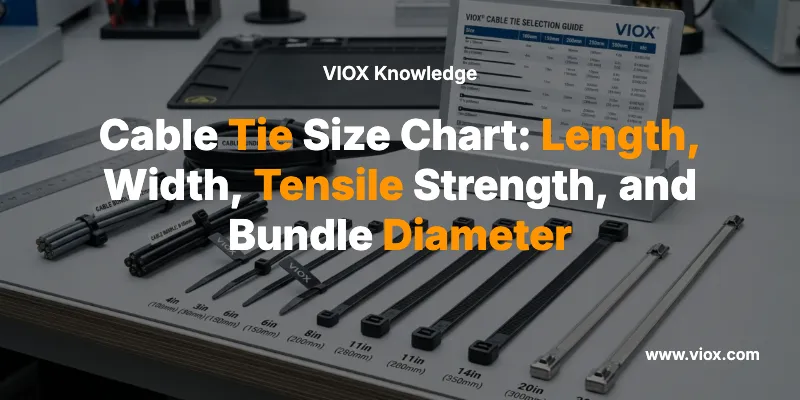
For dimensional selection after the support method has been chosen, use the Cable Tie Size Chart. That page owns length, width, bundle diameter, and dimensional lookup; it does not replace the support-capacity checks above.
When not to use cable ties as load supports
Use purpose-rated lifting, restraint, or support hardware instead of cable ties when:
- a person could be struck, trapped, or exposed to electrical or mechanical danger after failure;
- the application involves lifting, hoisting, fall arrest, climbing, towing, or vehicle safety;
- the load is overhead and no complete support rating is available;
- fire survival or circuit integrity depends on the support;
- vibration, impact, wind, or movement creates uncontrolled dynamic loading;
- the mount, anchor, or substrate has no applicable declaration;
- the installation cannot be inspected or replaced safely;
- a code, project specification, or equipment instruction requires a different support system.
If the real requirement is stronger restraint, repeated access, or a fixed mounting system, compare stronger alternatives to zip ties rather than increasing tie quantity.
What to send a supplier
A useful request for quotation (RFQ) should include:
- the exact bundling or support function;
- maximum static and dynamic forces and their directions;
- bundle diameter and contact geometry;
- indoor or outdoor environment;
- minimum and maximum service temperatures;
- UV, moisture, chemical, and vibration exposure;
- tie and fixing-device part numbers;
- required standard or project specification;
- installation tool and inspection requirements;
- certificates, test reports, and traceability documents required for approval.
VIOX can help match these inputs to available cable tie products and documentation. Final suitability must be based on the selected model and complete installation, not a generic strength label.
Frequently asked questions
How much weight can a 50 lb zip tie safely hold?
The 50 lb value normally refers to a declared loop-tensile force, not a universal safe working load. A safe installed load cannot be derived without the exact product data, fixing method, environment, load direction, and consequence of failure.
Does a wider zip tie always hold more weight?
Width often correlates with a higher tensile class within a product family, but it is not a rating by itself. Material, thickness, head design, processing, conditioning, and test method also matter. Compare exact part-number declarations.
Can stainless steel cable ties carry more load than nylon ties?
Some stainless products have higher declared loop-tensile values and different environmental capabilities, but material name alone is insufficient. Verify the exact grade, locking design, coating, dimensions, declared tests, installation tool, and fixing device. The stainless steel cable tie guide covers that selection boundary.
Can cable ties support electrical cables?
They can manage or secure wiring systems within the scope and conditions of the selected products. When they are used as supports, additional requirements may apply. Verify the tie, fixing device, installation, applicable code or project specification, and complete support path.