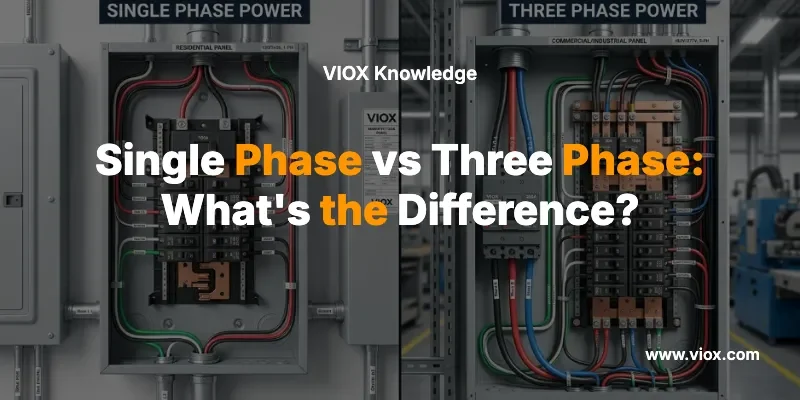
The main difference between single phase and three phase power is how electrical power is delivered and the efficiency of that delivery.
Single-phase power uses one alternating voltage waveform and is commonly used for homes and lighter loads. Three-phase power uses three alternating waveforms offset by 120 electrical degrees from one another, which makes power delivery smoother, more efficient, and more suitable for larger motors, higher loads, and commercial or industrial systems.
In practical terms, single phase is usually the standard choice for residential service, while three phase is typically preferred where equipment size, motor performance, or total load demand is significantly higher. The key engineering advantage: three-phase power can transmit three times as much power as single-phase while only requiring one additional wire, resulting in lower current per conductor and reduced infrastructure costs.
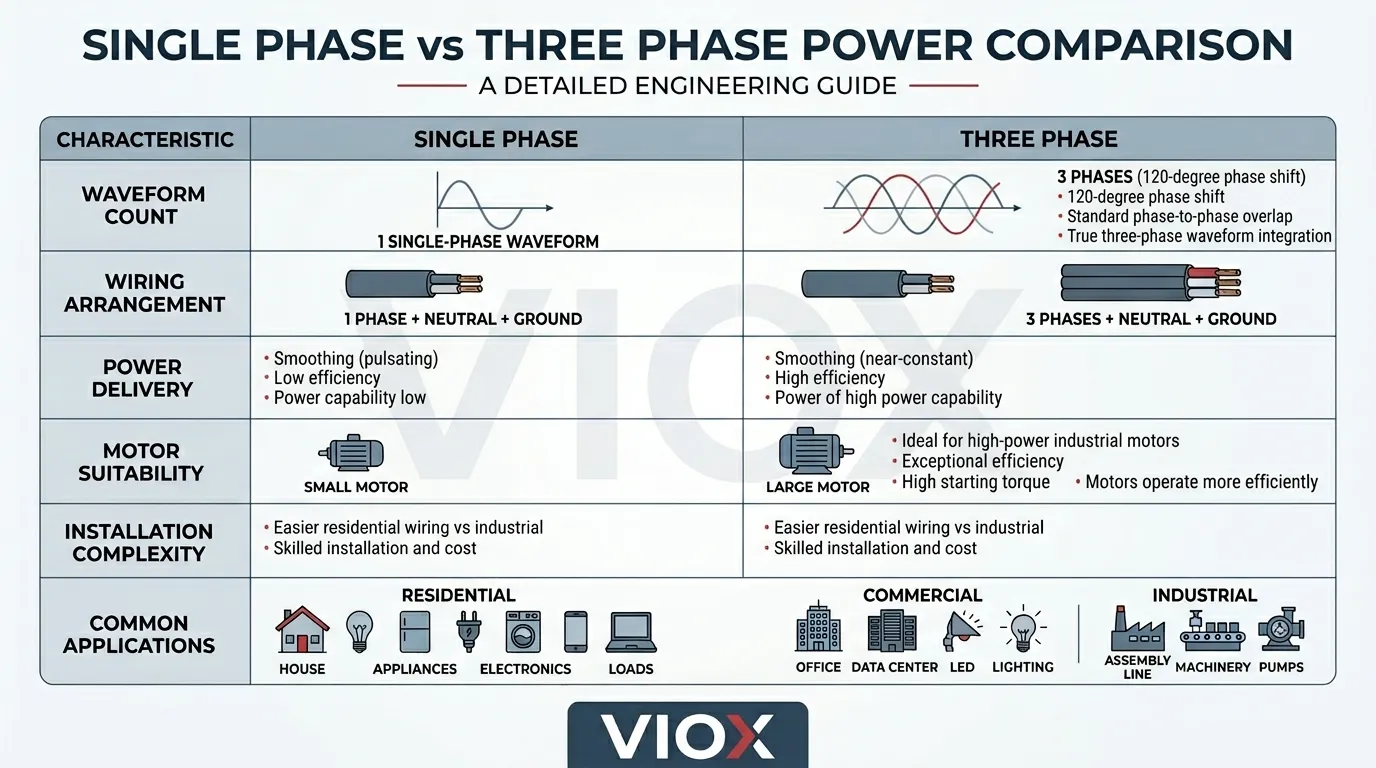
Single Phase vs Three Phase: Quick Comparison Table
| Factor | Single phase | Three phase |
|---|---|---|
| Power delivery | One AC waveform with zero-crossings twice per cycle | Three AC waveforms offset 120°, near-constant power |
| Voltage (IEC) | 230V line-to-neutral | 400V line-to-line (230V L-N available in wye) |
| Voltage (North America) | 120V (or 120/240V split-phase) | 208V or 480V line-to-line |
| Conductors | 1 live + 1 neutral + ground | 3 live + neutral (wye) or 3 live only (delta) + ground |
| Current for same power | Higher current, larger cables needed | Lower current (by factor of √3 ≈ 1.732) |
| Typical use | Homes, small offices, lighter commercial loads | Commercial buildings, industrial systems, larger motors |
| Motor performance | Requires starting capacitor, less efficient for larger loads | Self-starting, consistent torque, better for continuous duty |
| Power smoothness | Pulsating delivery with power dips to zero | Smooth and continuous power transfer |
| Efficiency | Less efficient for power transmission | More efficient—less conductor material for same power |
| System fit | Smaller loads and simpler distribution | Higher loads, larger equipment, demanding distribution |
How Single-Phase Power Works
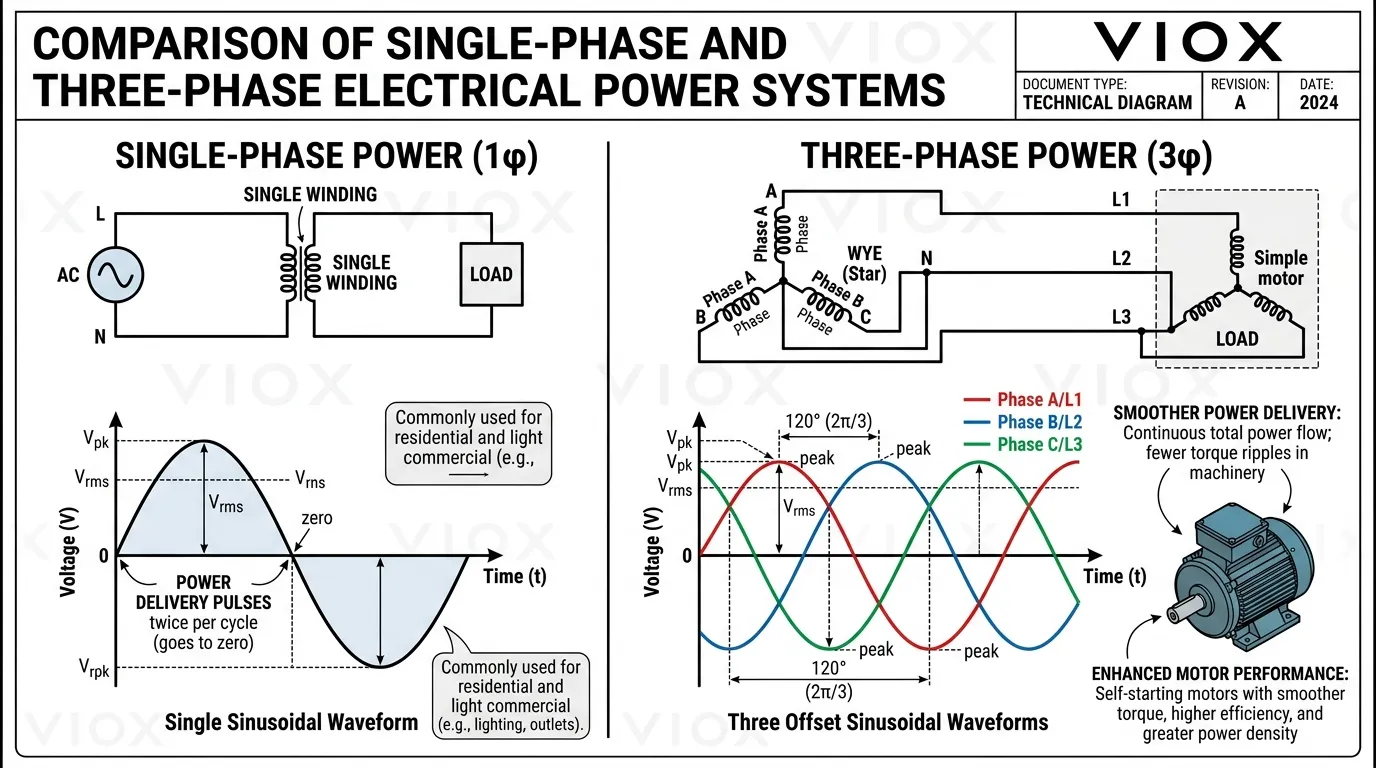
Single-phase power delivers electricity through one alternating waveform. The voltage oscillates in a sinusoidal pattern, and the power delivery drops to zero twice per AC cycle (100 times per second at 50Hz, or 120 times per second at 60Hz).
Standard single-phase voltages:
- IEC markets: 230V line-to-neutral (most of Europe, Asia, Australia, Middle East, Africa)
- North America: 120V line-to-neutral, or 120/240V split-phase for residential service
In most everyday applications, this is enough to serve lighting, plug loads, household appliances, and smaller electrical equipment.
That is why single-phase systems are common in:
- Residential homes
- Small offices and retail shops
- Light commercial spaces with modest load demand
- Portable equipment and tools
- Lighting and heating circuits
Single-phase power is attractive because the system is simpler, requires less complex wiring, and is usually more economical for installations that do not need large motor loads or high-capacity distribution.
How Three-Phase Power Works
Three-phase power uses three alternating waveforms separated by 120 electrical degrees. This arrangement gives the system a more continuous transfer of power across the cycle. When one phase waveform is at or near zero, the other two are still delivering power, resulting in near-constant power delivery with minimal ripple.
Standard three-phase voltages:
- IEC markets: 400V line-to-line (415V in some legacy systems), 230V line-to-neutral in wye configuration
- North America: 208V line-to-line (commercial), 480V line-to-line (industrial), 277V line-to-neutral in wye systems
That matters because many larger electrical loads benefit from smoother power delivery, especially:
- Motors (especially above 2.2kW / 3HP)
- Pumps and compressors
- HVAC systems and chillers
- Variable frequency drives (VFDs)
- Larger distribution boards and panelboards
- Commercial and industrial process equipment
- Data centers and server rooms
Three-phase power is not “better” in every situation. It is better when the application actually needs the advantages of higher-capacity and smoother power delivery.
Three-Phase Configurations: Wye vs Delta
Three-phase systems can be configured in two main ways:
Wye (Star) Configuration:
- Uses 4 wires: 3 live conductors + 1 neutral
- Provides both line-to-line voltage (400V) and line-to-neutral voltage (230V)
- Most common in commercial buildings where both three-phase equipment and single-phase branch circuits are needed
- Neutral carries unbalanced current
Delta Configuration:
- Uses 3 wires: 3 live conductors only, no neutral
- Provides only line-to-line voltage
- Common for purely three-phase loads like large motors
- More compact but cannot serve single-phase loads without a transformer
Why Three-Phase Is Often More Efficient for Larger Loads
When the load becomes larger, especially with motors and continuously operating equipment, three-phase systems usually perform better because power delivery is more balanced and more consistent.
The √3 Advantage: Lower Current for the Same Power
For the same delivered power (kW), three-phase systems draw significantly less current per conductor than single-phase systems. The relationship is governed by the square root of 3 (√3 ≈ 1.732).
Three-phase power formula:
$P = \sqrt{3} \times V_{L-L} \times I \times PF$
Where:
- P = Power in watts
- V_L-L = Line-to-line voltage
- I = Current per conductor
- PF = Power factor
Practical example:
- A 10kW load at unity power factor (PF = 1.0)
- Single-phase 230V: Current = 10,000W ÷ 230V = 43.5A per conductor
- Three-phase 400V: Current = 10,000W ÷ (√3 × 400V) = 14.4A per conductor
This three-fold reduction in current means:
- Smaller cable sizes required for the same power delivery
- Lower voltage drop over the same cable length
- Reduced I²R losses in conductors
- Lower installation costs for conductor material
- Better distribution density in cable trays and conduits
This is one reason three-phase systems are standard in factories, large facilities, plant rooms, and infrastructure projects, while single-phase remains the usual choice for homes.
Single Phase vs Three Phase for Motors and Equipment
This is one of the most important decision points.
| Application type | Better fit | Reason |
|---|---|---|
| Lighting, outlets, household appliances | Single phase | Adequate power, simpler wiring |
| Small shops and light commercial loads | Usually single phase | Cost-effective unless heavy equipment is planned |
| Motors under 2.2kW (3HP) | Single phase acceptable | Starting capacitor required but manageable |
| Motors 2.2kW to 7.5kW | Three phase preferred | Self-starting, better efficiency |
| Motors above 7.5kW (10HP) | Three phase required | Single-phase motors impractical at this size |
| Larger HVAC units, pumps, compressors | Three phase | Smooth operation, lower starting current |
| Variable frequency drives (VFDs) | Three phase | Natural compatibility, better control |
| Industrial motors and continuous-duty equipment | Three phase | Consistent torque, longer service life |
| Distribution systems with heavy demand | Three phase | Better load balancing, expansion capability |
Why Three-Phase Motors Don’t Need Starting Capacitors
The fundamental difference comes down to how motors create a rotating magnetic field:
Single-phase motors:
- Single alternating current creates an oscillating (not rotating) magnetic field
- Cannot self-start without external help
- Require starting capacitor, run capacitor, or auxiliary winding
- These components add cost and reduce reliability
- Practical size limit around 2.2–3.7kW
Three-phase motors:
- Three currents offset by 120° naturally create a rotating magnetic field
- Self-starting in both directions
- No capacitors needed
- More compact and reliable
- Direction reversal by simply swapping any two supply wires
- Better suited for VFD control
If the system includes significant motor loads, three-phase power usually becomes much more attractive. It supports larger equipment more naturally and is widely used where motor starting and continuous-duty performance matter.
For motor-related protection context, these VIOX guides provide the complete selection framework:
- How to Select Contactors and Circuit Breakers Based on Motor Power
- Types of Motor Starters Selection Guide
- VFD vs Soft Starter Guide
- Star Delta Starter Wiring Diagram Sizing Selection Guide
Which One Should You Choose?
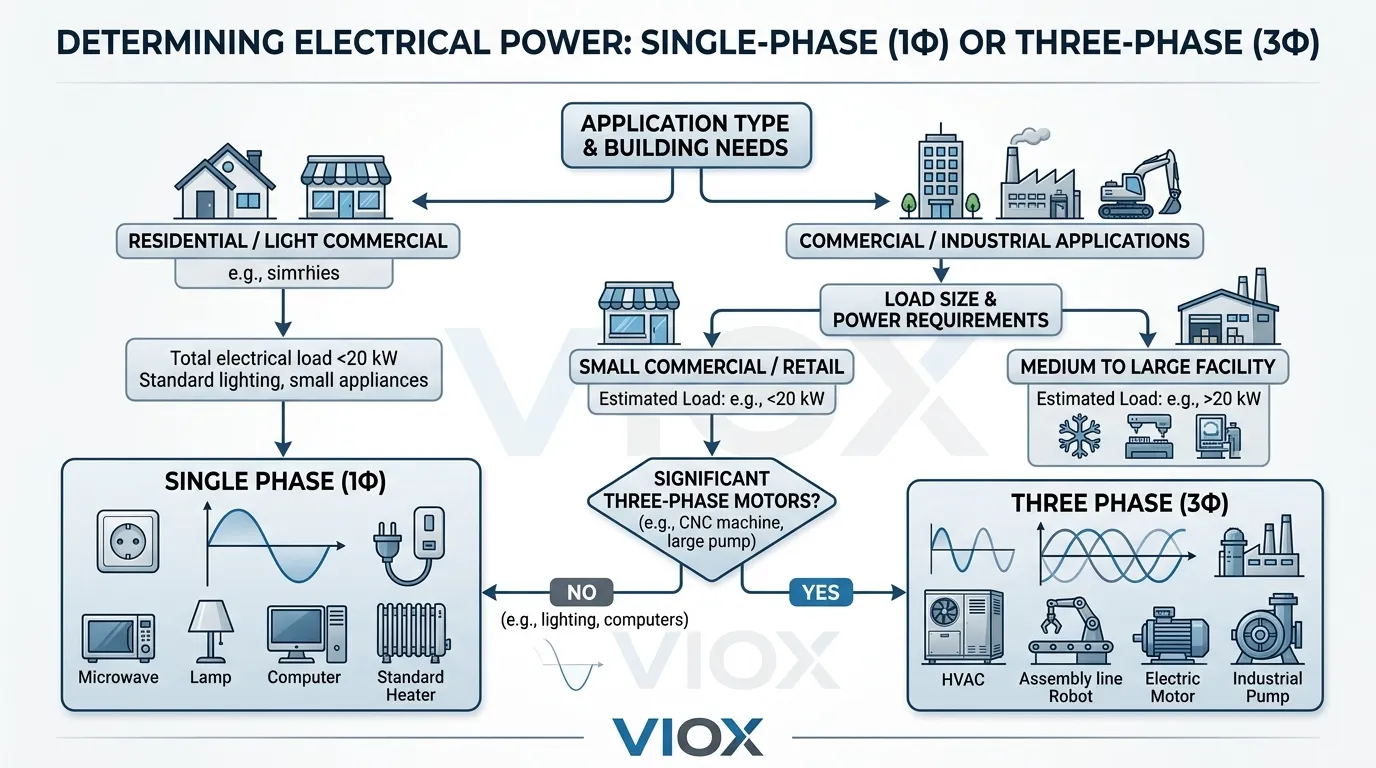
The best choice depends on the installation type, load profile, equipment plan, and available utility service.
Single phase is usually the right choice when:
- The building is residential or small commercial
- The total load is relatively light (typically under 10–15kW)
- The system does not rely on larger motors or heavy equipment
- Three-phase service is not available from the utility
- Cost and installation simplicity matter more than high-capacity expansion
- Equipment is primarily lighting, outlets, and household appliances
Three phase is usually the right choice when:
- The installation serves larger equipment or multiple motors
- The project includes industrial or heavy commercial loads
- Multiple large motors, HVAC systems, or compressors are involved
- Variable frequency drives (VFDs) will be used
- The power system must support higher and more continuous demand
- Future expansion with larger equipment is anticipated
- The facility is a factory, data center, or large commercial building
For Equipment Designers and Specifiers:
- Below 750W: Single-phase is practical and widely available
- 750W to 2.2kW: Either works; choose based on target market
- 2.2kW to 7.5kW: Three-phase preferred for better efficiency
- Above 7.5kW: Three-phase is the industry standard
For Panel Builders and Contractors:
- Always verify the available utility service before finalizing the design
- Balance loads across all three phases in three-phase installations
- Specify appropriate protection devices for the system type
- Consider future expansion requirements in the initial design
In other words, the question is not which one is universally better. The question is which one fits the load and operating environment.
Cost and Installation Tradeoffs
Single-phase systems are generally simpler to install and easier to justify in smaller buildings. The wiring is straightforward, protection devices are less complex, and electricians are universally familiar with single-phase installations.
Three-phase systems usually involve more complex distribution design, but they become easier to justify when the load profile is larger and the equipment demands are more serious.
Cost considerations:
| Factor | Single Phase | Three Phase |
|---|---|---|
| Utility connection fee | Lower | Higher (but varies by location) |
| Wiring complexity | Simpler (2-3 conductors) | More complex (4-5 conductors) |
| Protection devices | Less expensive | More expensive per device |
| Cable size for same power | Larger, more expensive | Smaller, less expensive |
| Motor equipment cost | Higher (capacitors needed) | Lower (simpler motor design) |
| Long-term efficiency | Lower (higher losses) | Higher (lower losses) |
| Expansion capability | Limited | Better |
That is why the cost discussion should always be tied to application fit:
- Single phase can be more practical for simple low-demand installations
- Three phase can be more practical for higher-demand systems even if the initial system design is more involved
The wrong comparison is “which one is cheaper in isolation?”
The better comparison is “which one supports the actual load correctly without underbuilding or overbuilding the system?”
Protection and Safety Considerations
Both single-phase and three-phase systems require appropriate circuit protection, but the selection criteria differ.
Circuit Breakers and Protection Devices
For single-phase systems:
- 1-pole or 2-pole circuit breakers depending on configuration
- Simpler protection coordination
- GFCI/RCD protection more straightforward
For three-phase systems:
- 3-pole or 4-pole circuit breakers required
- More complex protection coordination needed
- Must consider phase imbalance
- Requires proper load balancing across phases
Related VIOX protection guides:
- Single Pole vs Double Pole Breaker Guide
- MCCB vs MCB
- Circuit Breaker Ratings: Icu, Ics, Icw, Icm
- How to Select an MCCB for a Panel
Surge Protection Requirements
Both system types need surge protective devices (SPDs), but the selection differs:
Single-phase SPD:
- Typically 1-pole or 2-pole configuration
- Rated for 230V or 120V line-to-neutral
- Simpler installation
Three-phase SPD:
- Requires 3-pole or 4-pole configuration depending on earthing system
- Rated for 400V or 480V line-to-line
- Must match the wye or delta configuration
- More critical in industrial settings with sensitive equipment
For complete surge protection guidance:
Common Misunderstandings
“Three phase is always better”
Not necessarily. Three phase is better for the right application, but it adds complexity and cost where a simple single-phase system may already be sufficient. For a typical home with standard appliances, single-phase is not just adequate—it’s the optimal choice.
“Single phase cannot power meaningful equipment”
Also false. Single-phase systems are fully adequate for a huge range of residential and light commercial applications. Many commercial kitchens, small workshops, and retail spaces operate entirely on single-phase power.
“Three phase only matters in factories”
Not always. Many larger commercial buildings, HVAC systems, data centers, and infrastructure applications also rely on three-phase supply. Any facility with significant motor loads or high total demand benefits from three-phase power.
“You can just use three single-phase supplies instead of three-phase”
This misunderstands the fundamental difference. Three separate single-phase supplies do not provide the same benefits as true three-phase power. The 120° phase relationship between conductors is what creates the rotating magnetic field and efficiency advantages—you cannot replicate this with independent single-phase circuits.
“Three-phase uses three times the power”
Wrong. Three-phase delivers three times the power capacity, but only when you need it. An unloaded three-phase system uses no more power than an unloaded single-phase system. The advantage is capacity and efficiency, not consumption.
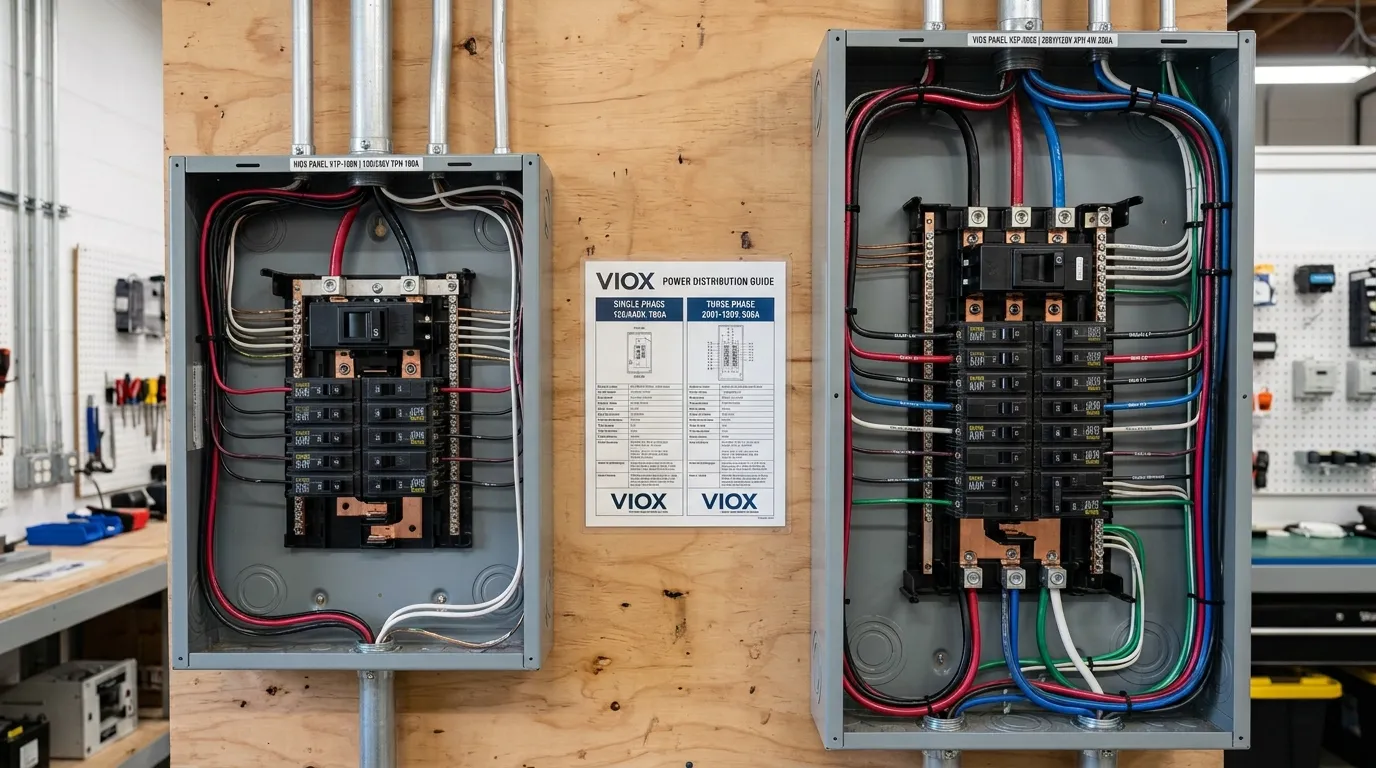
Panelboards and Distribution Equipment
The choice between single-phase and three-phase affects the entire distribution system design.
Single-Phase Panelboards
- Simpler bus bar arrangement
- Typically 120/240V split-phase in North America
- 230V in IEC markets
- Easier to balance loads (only two legs in split-phase)
- Standard for residential load centers
Three-Phase Panelboards
- More complex bus bar configuration
- Requires careful load balancing across all three phases
- Can serve both three-phase and single-phase loads
- Better suited for larger facilities
- Standard for commercial and industrial distribution boards
Related VIOX panelboard guides:
- Single Phase vs Three Phase Panelboards Guide
- Load Center vs Distribution Board
- MCB vs MLO Panelboard Selection Guide
- What is a Low Voltage Panel
Conversion Between Single-Phase and Three-Phase
Can You Convert Single-Phase to Three-Phase?
Yes, but it requires additional equipment:
Options for conversion:
- Phase converter (rotary or static)
- Generates three-phase output from single-phase input
- Less efficient than true three-phase supply
- Suitable for small workshops
- Variable frequency drive (VFD)
- Can synthesize three-phase output from single-phase input
- Limited to the motor it’s driving
- Good for individual motor applications
- Utility service upgrade
- Most reliable solution
- Requires utility company involvement
- Higher upfront cost but best long-term solution
Can You Use Three-Phase Equipment on Single-Phase?
Generally no, not without modification:
- Three-phase motors will not run on single-phase without a phase converter
- Three-phase circuit breakers can sometimes be used for single-phase (see Can You Use a 3 Phase MCCB for Single Phase?)
- Always consult equipment specifications and local codes
Related VIOX Topics
If you are comparing equipment or panel design rather than only the service type, these related guides are the most useful next reads:
Power Distribution:
- Single Phase vs Three Phase Panelboards Guide
- Low Voltage Switchgear Types: GGD, GCK, GCS, MNS, XL21 Guide
- Types of Electrical Control Panels
Circuit Protection:
- Can You Use a 3 Phase MCCB for Single Phase?
- Complete Guide to 3 Phase Isolator Switch
- Circuit Breaker vs Isolator Switch
Motor Control:
- Contactor vs Motor Starter
- Understanding 1 Pole vs 2 Pole AC Contactors
- Safety Contactor vs Standard Contactor
Automatic Transfer Switches:
- Single Phase vs Three Phase ATS Selection Guide
- What is a Dual Power Automatic Transfer Switch
- Open vs Closed Transition ATS Selection Guide
Relays and Control:
FAQ
What is the main difference between single phase and three phase?
The main difference is the number of alternating power waveforms used to deliver power. Single phase uses one waveform, while three phase uses three waveforms offset by 120 electrical degrees. This results in smoother power delivery and greater efficiency for three-phase systems.
Is three phase more efficient than single phase?
Yes, for larger loads and motor-driven equipment, three phase is significantly more efficient. It can transmit three times as much power while only requiring one additional wire, resulting in lower current per conductor and reduced losses. For homes and lighter loads, single phase is usually sufficient and more cost-effective.
Is single phase used in homes?
Yes. Single-phase power is the most common choice for residential electrical service worldwide and other lighter-load applications. In North America, this is typically 120/240V split-phase service; in most other countries, it’s 230V single-phase.
Why is three phase better for motors?
Three-phase power provides smoother and more continuous power delivery with no zero-crossings, which makes it better suited to larger motors and continuous-duty equipment. Three-phase motors are self-starting, don’t require starting capacitors, generate consistent torque, and are more efficient and reliable than single-phase motors of comparable size.
Can a house have three phase power?
In some cases, yes. But whether it is necessary depends on the building load, utility supply arrangement, and equipment requirements. Three-phase residential service is more common in areas with large homes, workshops with heavy equipment, or properties with significant HVAC demands. It typically requires a utility service upgrade and costs more than standard single-phase service.
Which is better for commercial buildings?
That depends on the load. Smaller commercial spaces (small offices, retail shops) may use single phase, while larger buildings and sites with heavier equipment (restaurants with commercial kitchens, manufacturing facilities, buildings with large HVAC systems) almost always benefit from three phase. Most commercial buildings above 5,000 square feet use three-phase service.
How much does it cost to upgrade from single phase to three phase?
Costs vary widely depending on location, distance from the transformer, and utility requirements, but typically range from $1,000 to $10,000 or more. Factors include: utility connection fees, transformer upgrades, new service panel, wiring upgrades, and permit fees. Always get quotes from both the utility company and licensed electricians.
Can you run a three-phase motor on single phase?
Not directly. A three-phase motor requires three-phase power to operate properly. However, you can use a phase converter (rotary or static) or a variable frequency drive (VFD) to generate three-phase power from a single-phase supply. These solutions work but are less efficient than true three-phase service.
What voltage is single phase and three phase?
Single phase:
- IEC markets: 230V line-to-neutral
- North America: 120V or 120/240V split-phase
Three phase:
- IEC markets: 400V line-to-line (230V line-to-neutral in wye)
- North America: 208V or 480V line-to-line (120V or 277V line-to-neutral in wye)
How do I know if I have single phase or three phase power?
Check your main circuit breaker panel:
- Single phase: 1-pole or 2-pole main breaker
- Three phase: 3-pole main breaker
You can also measure voltage between the hot conductors:
- Single phase: 240V (North America split-phase) or 0V (true single phase)
- Three phase: 208V, 400V, or 480V depending on your system
When in doubt, consult a licensed electrician.