

On this page
What Is a Surge Arrester?
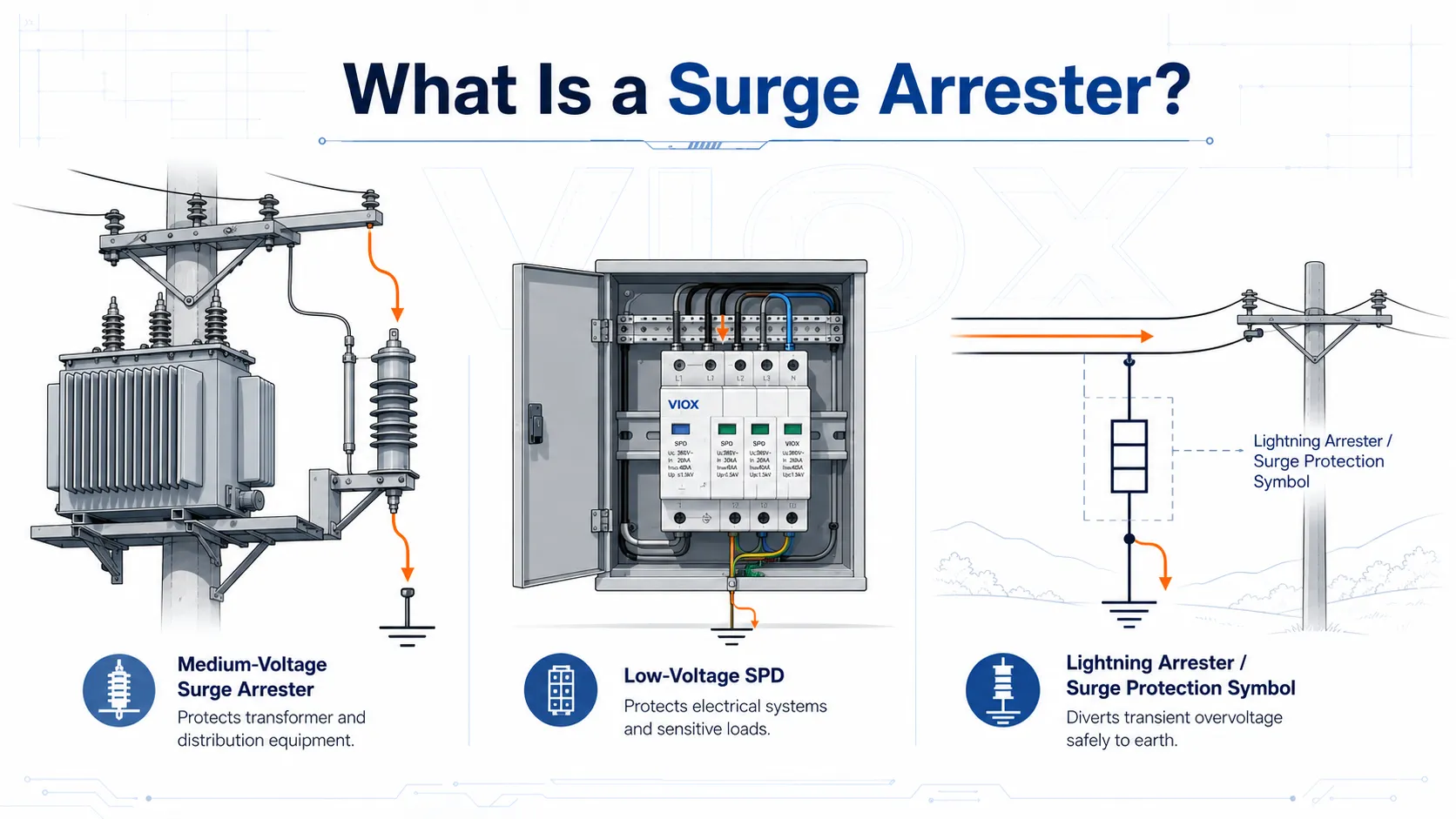
A surge arrester is an overvoltage protection device that limits transient voltage surges and diverts surge current away from protected equipment. In power distribution and utility systems, the term usually refers to medium-voltage or high-voltage arresters installed near transformers, overhead lines, substations, switchgear, and cable terminations.
In low-voltage electrical panels, the more precise term is usually surge protective device (SPD). In everyday language, people may also say surge protector, surge suppressor, surge diverter, lightning arrester, or even the alternate spelling surge arrestor. These terms overlap, but they are not always interchangeable.
The simplest distinction is this:
- Surge arrester: usually power-system overvoltage protection, often medium/high voltage.
- SPD: low-voltage surge protection for panels, equipment, PV systems, data lines, and control circuits.
- Surge protector: common user term, often for low-voltage plug-in or panel protection.
- Lightning arrester: common or older term for an arrester focused on lightning-related overvoltage, often overlapping with surge arrester.
Quick Comparison: Surge Arrester vs SPD vs Surge Protector vs Lightning Arrester
| Term | Best meaning in practice | Typical system | Typical standard context | Main job |
|---|---|---|---|---|
| Surge arrester | Overvoltage arrester for power systems | Utility lines, transformers, substations, MV switchgear | IEC 60099 series, IEEE C62.11 family | Clamp high-energy overvoltage and divert surge current to earth |
| SPD | Surge protective device for low-voltage power or signal systems | LV distribution boards, control panels, equipment, PV combiner boxes, BESS, data lines | IEC 61643 series, UL 1449 | Limit transient overvoltage at equipment and panel level |
| Surge protector | Common commercial/user term for SPD-type protection | Plug strips, whole-house protection, equipment protection | Often UL 1449 in North America for listed SPDs | Protect electronics or circuits from voltage spikes |
| Surge suppressor | General/older term, often overlaps with surge protector or SPD | Electronics, AC power, signal circuits | Product-dependent | Suppress or clamp transient voltage |
| Lightning arrester | Common/older term for an arrester associated with lightning overvoltage | Overhead lines, transformers, service entrances, substations | Often overlaps with surge arrester standards | Reduce lightning-induced overvoltage stress |
| Surge diverter | Regional/common term, often similar to surge arrester or SPD | Utility, industrial, or LV installations depending on region | Region- and product-dependent | Divert surge energy away from protected equipment |
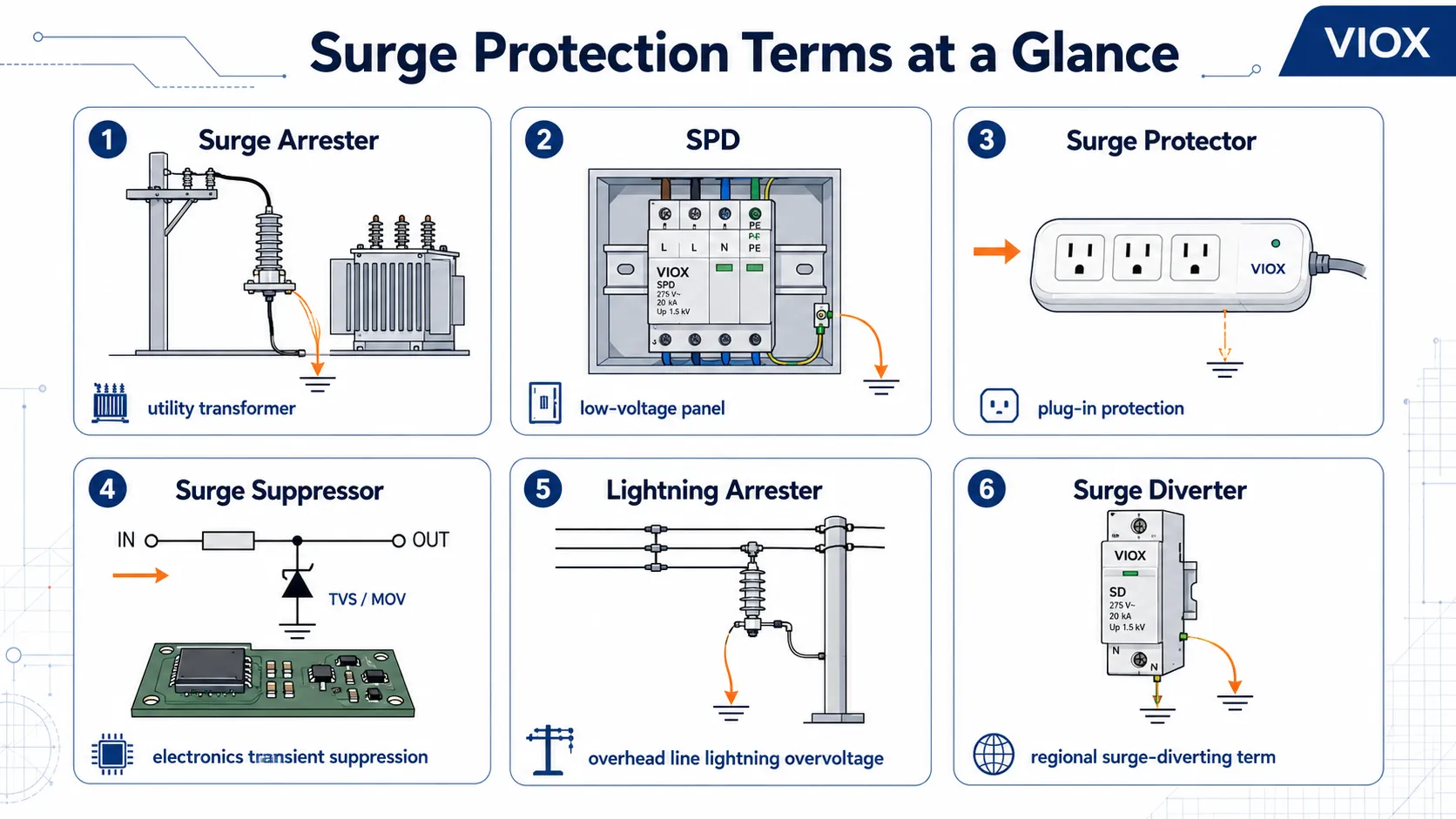
Why the Terminology Is Confusing
The confusion comes from two different worlds using similar language.
In utility and power distribution, “surge arrester” often means a device connected between a phase conductor and earth to protect insulation from lightning and switching surges. Modern power-system arresters are commonly metal-oxide, usually zinc oxide (ZnO), devices.
In low-voltage buildings and equipment, “SPD” is the more standard term. These devices are installed in distribution boards, control panels, PV combiner boxes, EV charging systems, industrial cabinets, and signal lines. They are selected by ratings such as Uc/MCOV, Up/VPR, In, Imax, Iimp, type/class, short-circuit current rating, and backup protection.
That is why a buyer searching for “surge arrester” may actually need one of three different products:
- A medium-voltage arrester for a transformer, line, or substation.
- A low-voltage SPD for a distribution board or control panel.
- A residential whole-house surge protector, which is really a low-voltage SPD.
If the application is a low-voltage panel, start with VIOX’s surge protective device overview and SPD product page.
How a Surge Arrester Works
A surge arrester remains highly resistive at normal system voltage. When a transient overvoltage rises above its operating threshold, the arrester becomes conductive and diverts surge current toward earth. After the surge passes, it returns to a high-resistance state.
Modern arresters and many SPDs rely on metal-oxide varistor (MOV) technology, especially zinc oxide (ZnO). ZnO MOVs have a strongly nonlinear voltage-current characteristic: they conduct very little current at normal voltage, but conduct heavily during a surge.
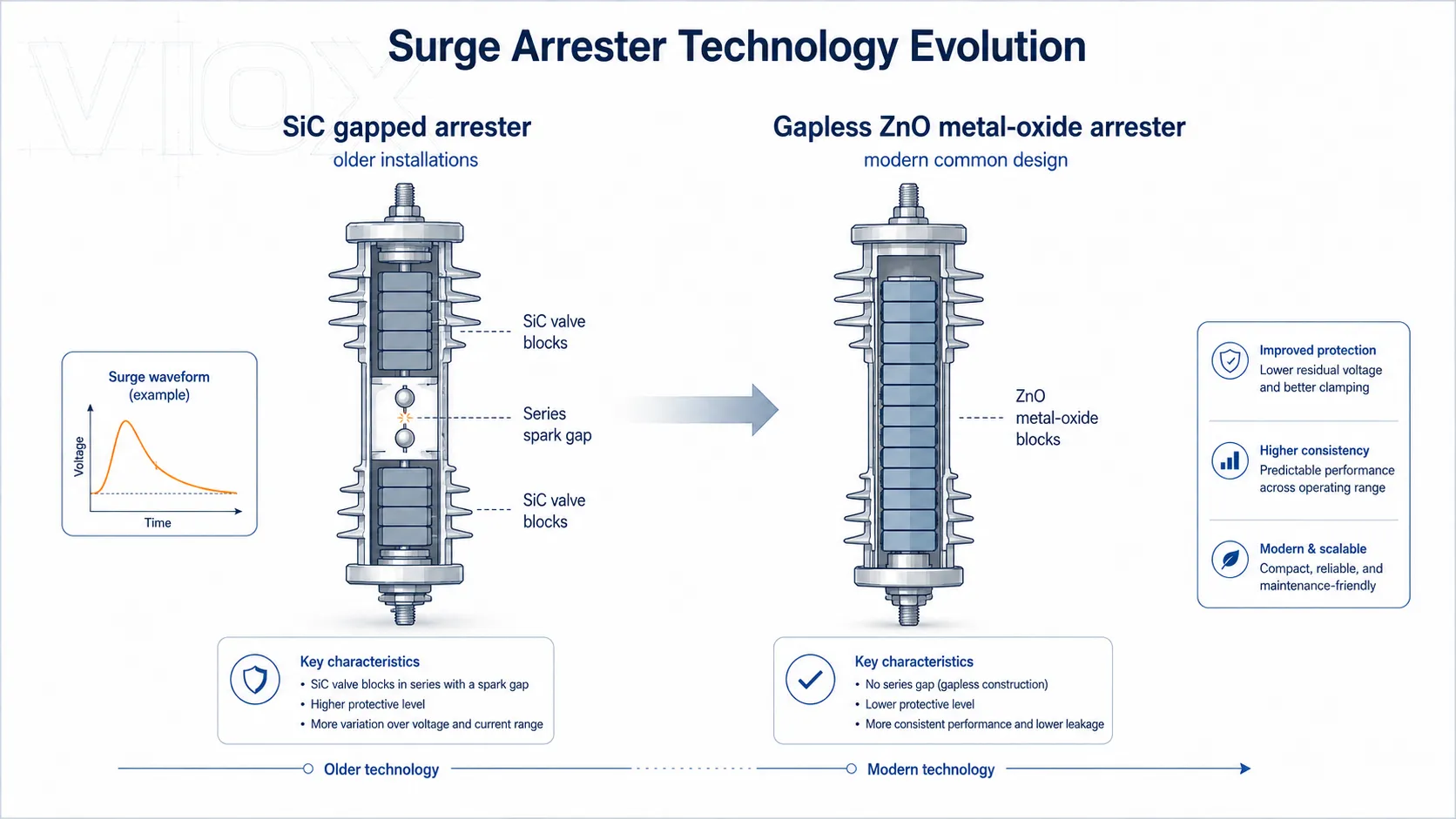
Historically, many power-system arresters used silicon-carbide (SiC) valve blocks with series spark gaps. These gapped SiC arresters helped limit overvoltage, but their spark gaps, aging behavior, and protection characteristics made insulation coordination more complex. Modern medium-voltage and high-voltage arresters are now commonly based on gapless metal-oxide technology, especially ZnO, because ZnO provides stronger nonlinear voltage-current behavior and can remain connected across the system without a series gap in many designs. Older installations may still contain SiC gapped arresters, so replacement projects should verify the arrester type before selecting a modern equivalent.
This matters because surge protection is not about carrying normal load current. It is about limiting a very fast transient that may last only microseconds.
Common surge sources include:
- nearby lightning activity
- switching of inductive loads
- capacitor bank switching
- utility switching operations
- transformer energization
- faults and clearing operations
- long cable runs exposed to induced transients
For MOV details, see VIOX’s guide to ZnO MOVs inside SPDs.
Surge Arrester vs Surge Protection Device (SPD)
The difference is mainly system level, standard context, installation point, and rating language.
| Comparison point | Surge arrester | Surge protective device (SPD) |
|---|---|---|
| Common voltage level | Medium-voltage and high-voltage power systems | Low-voltage AC/DC systems, signal and control lines |
| Typical installation | Overhead line, transformer bushing, switchgear, substation, cable termination | Distribution board, control panel, equipment input, PV combiner box, data/control cabinet |
| Typical standards | IEC 60099 series, IEEE C62.11 family | IEC 61643 series, UL 1449 |
| Typical technology | Metal-oxide arrester, often ZnO blocks | MOV, GDT, TVS, spark gap, hybrid designs |
| Main selection data | Rated voltage, continuous operating voltage, residual voltage, energy duty, arrester class | Uc/MCOV, Up/VPR, In, Imax, Iimp, Type/Class, SCCR, backup fuse/breaker |
| Main goal | Protect power-system insulation and equipment | Protect downstream low-voltage equipment and circuits |
In practical terms, do not specify a “surge arrester” for a low-voltage panel unless the manufacturer uses that term for an SPD. For IEC and UL low-voltage projects, the correct engineering term is usually SPD.
Surge Arrester vs Surge Protector
“Surge protector” is a broad user-friendly term. It can mean:
- a plug-in power strip with surge protection
- a whole-house surge protector installed at the service panel
- a panel-mounted SPD
- a small electronics protection module
A surge arrester, by contrast, usually implies utility or power-distribution equipment.
| Question | Better term |
|---|---|
| Protect a laptop, TV, or electronics from plug-in surges | Surge protector |
| Protect a residential service panel | Whole-house surge protector or Type 1/Type 2 SPD |
| Protect a low-voltage industrial panel | SPD |
| Protect a transformer or MV overhead line | Surge arrester |
| Protect a PV combiner box DC input | DC SPD or PV SPD |
This is why search queries such as “difference between surge arrester and surge protector” often mix consumer and engineering language. A surge protector is usually low-voltage equipment protection. A surge arrester is usually power-system insulation protection.
Surge Arrester vs Surge Suppressor
“Surge suppressor” is another broad term. In electronics, it may refer to a device or component that suppresses transient voltage. In power distribution, it often overlaps with surge protector or SPD.
Use this rule:
- For electrical panels and code/spec documents, use SPD.
- For utility distribution and transformers, use surge arrester.
- For consumer electronics, surge protector or surge suppressor may be acceptable, but check product ratings carefully.
Surge Arrester vs Lightning Arrester
In many practical conversations, surge arrester and lightning arrester overlap. A lightning arrester is usually a surge arrester intended to handle lightning-related overvoltage. However, “surge arrester” is the broader and more technically useful term because overvoltage can come from lightning, switching, faults, or system transients.
| Term | Practical meaning |
|---|---|
| Lightning arrester | Common term emphasizing lightning-induced overvoltage |
| Surge arrester | Broader term covering lightning and other transient overvoltages |
| SPD | Low-voltage protection term used in modern panel and equipment applications |
Do not confuse a lightning arrester with a lightning rod or air terminal. A lightning protection system intercepts and routes a direct lightning strike. A surge arrester or SPD limits transient overvoltage on electrical conductors. A complete lightning and surge protection strategy may need both.
Surge Arrester or Surge Arrestor: Which Spelling Is Correct?
The preferred technical spelling is surge arrester. The spelling surge arrestor is common in searches and informal writing, but most electrical standards, datasheets, and manufacturer documentation use arrester.
For SEO and user clarity, it is reasonable to mention both spellings:
- surge arrester: preferred technical spelling
- surge arrestor: common alternate search spelling
- surge arresters / surge arrestors: plural search variants
If you are writing a technical specification, use surge arrester.
Types of Surge Arresters
Surge arrester “types” can be classified in different ways: by voltage level, duty class, installation position, or technology. For search users, the most practical classification is application-based.
| Type | Typical application | What it protects | Notes |
|---|---|---|---|
| Distribution class arrester | Distribution lines and transformers | Distribution transformers, feeders, overhead networks | Common utility distribution protection |
| Intermediate class arrester | Applications between distribution and station duty | Transformers, substations, switchgear | Used where duty is higher than basic distribution protection |
| Station class arrester | Substations and major equipment | Power transformers, substation bus, switchgear | Higher-duty arrester category |
| Line arrester | Overhead transmission or distribution lines | Line insulation and equipment | Often used in lightning-prone routes |
| Riser pole / cable protection arrester | Overhead-to-underground cable transition | Cable terminations and connected equipment | Helps reduce surge stress at cable entry points |
| Low-voltage SPD | LV panels and equipment | Control panels, distribution boards, equipment inputs | Not usually called a traditional MV/HV arrester in IEC/UL low-voltage specs |
| Signal SPD | Data, telecom, control, sensor lines | Communication and control electronics | Selected by signal type, bandwidth, voltage, and grounding method |
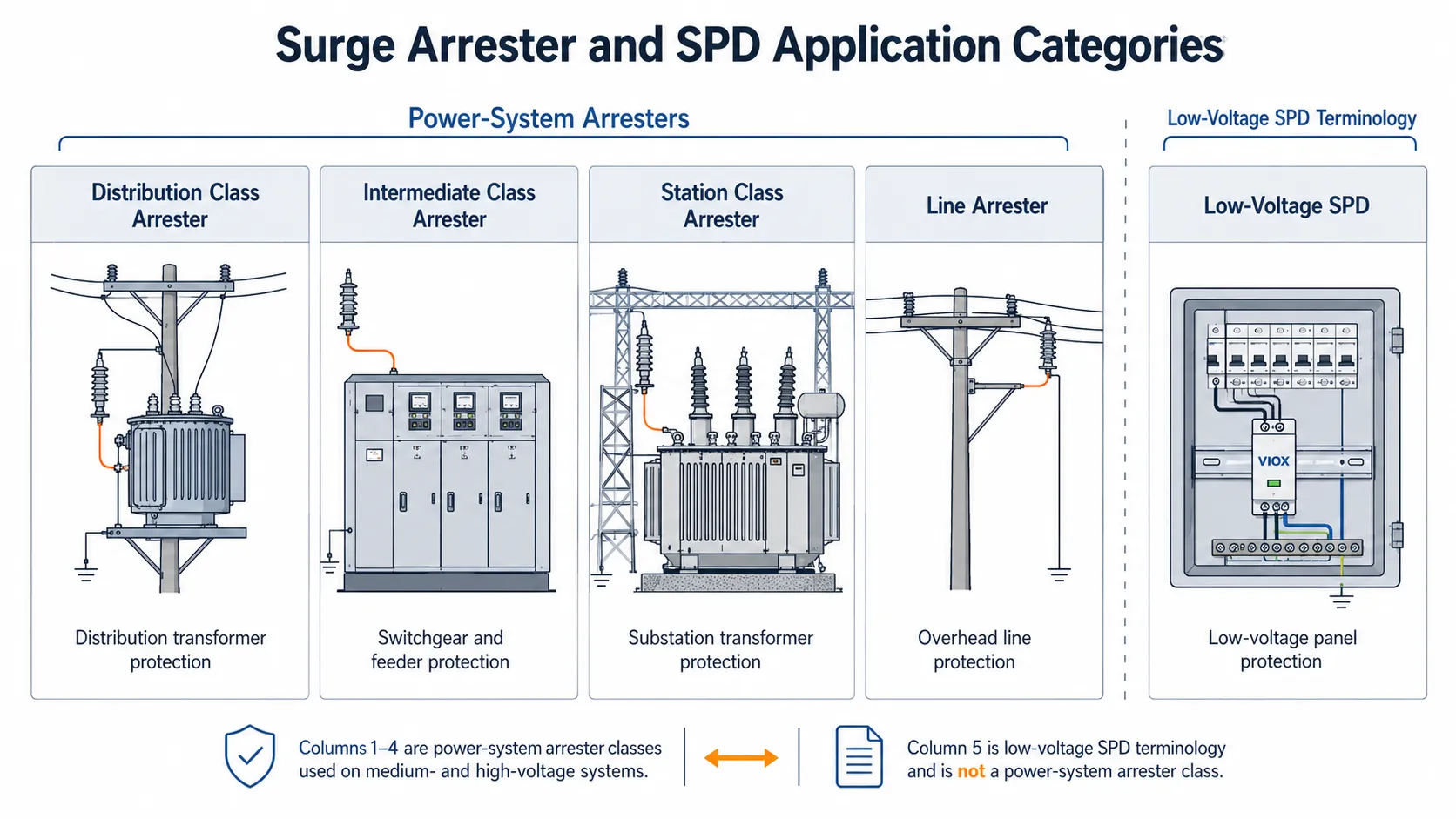
This section is where many generic articles become misleading. A low-voltage SPD and a medium-voltage station arrester both limit surges, but they are not selected from the same datasheet family.
Surge Capacitor vs Surge Arrester
A surge capacitor and a surge arrester solve related but different problems.
| Device | Main function | Typical use | Key limitation |
|---|---|---|---|
| Surge arrester | Clamps overvoltage and diverts surge current | Transformers, lines, substations, LV panels when using SPD terminology | Does not normally absorb long-duration overvoltage or continuous overcurrent |
| Surge capacitor | Reduces steep-front voltage stress by slowing voltage rise | Rotating machines, transformers, certain switching-surge applications | Does not replace an arrester for clamping high surge voltage |
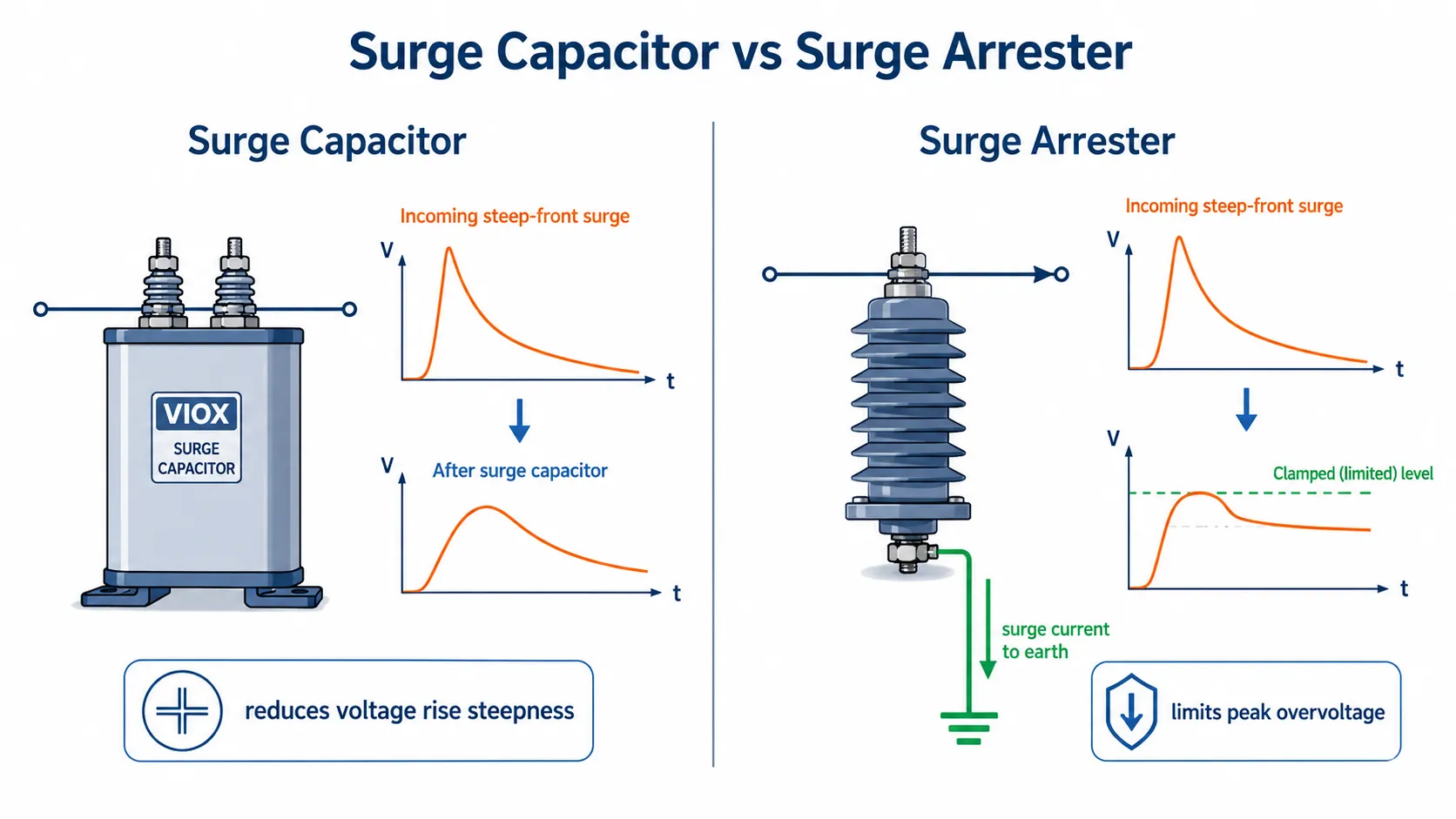
In some systems, surge capacitors and arresters are used together. The arrester limits peak overvoltage, while the capacitor helps reduce the steepness of the voltage wavefront. This is especially relevant where insulation stress and fast-front transients matter.
Surge Diverter vs Surge Arrester
“Surge diverter” is often used in some regions as another name for a device that diverts surge current away from protected equipment. In many low-voltage contexts, it may mean SPD. In utility contexts, it may overlap with surge arrester.
The safe interpretation is:
- check the voltage level
- check the product standard
- check whether it is for LV panels, signal lines, transformers, or overhead power systems
- compare ratings rather than relying on the name alone
Residential Surge Arrester: What Do People Usually Mean?
When a homeowner searches for “residential surge arrester,” they usually mean a whole-house surge protector or Type 1 / Type 2 SPD installed at the service equipment or distribution panel. It is not usually the same product as a utility distribution arrester mounted on an overhead line or transformer.
For residential and commercial low-voltage installations, focus on:
- SPD Type 1, Type 2, or Type 3
- system voltage
- nominal discharge current
- maximum discharge current
- voltage protection level or voltage protection rating
- short-circuit current rating
- backup breaker or fuse requirements
- grounding and lead length
For deeper low-voltage SPD selection, see VIOX’s guide to Type 1 vs Type 2 vs Type 3 SPDs, Imax vs In SPD ratings, and Uc and Up meanings on SPDs.
When to Use an SPD Instead of a Surge Arrester
Use an SPD when the application is low-voltage equipment protection.
| Application | Better device term |
|---|---|
| Main low-voltage distribution board | Type 1 or Type 2 SPD |
| Industrial control panel | Type 2 SPD, sometimes coordinated with upstream Type 1 |
| PV combiner box | DC SPD or PV SPD |
| Battery energy storage system | Coordinated DC, AC, and signal SPDs |
| Ethernet, RS485, signal, or control line | Signal SPD |
| Residential panel protection | Whole-house SPD |
| Transformer on MV overhead line | Surge arrester |
| Substation bus or power transformer | Station class surge arrester |
For DC and renewable systems, see VIOX’s DC surge protection device guide and BESS surge protection guide.
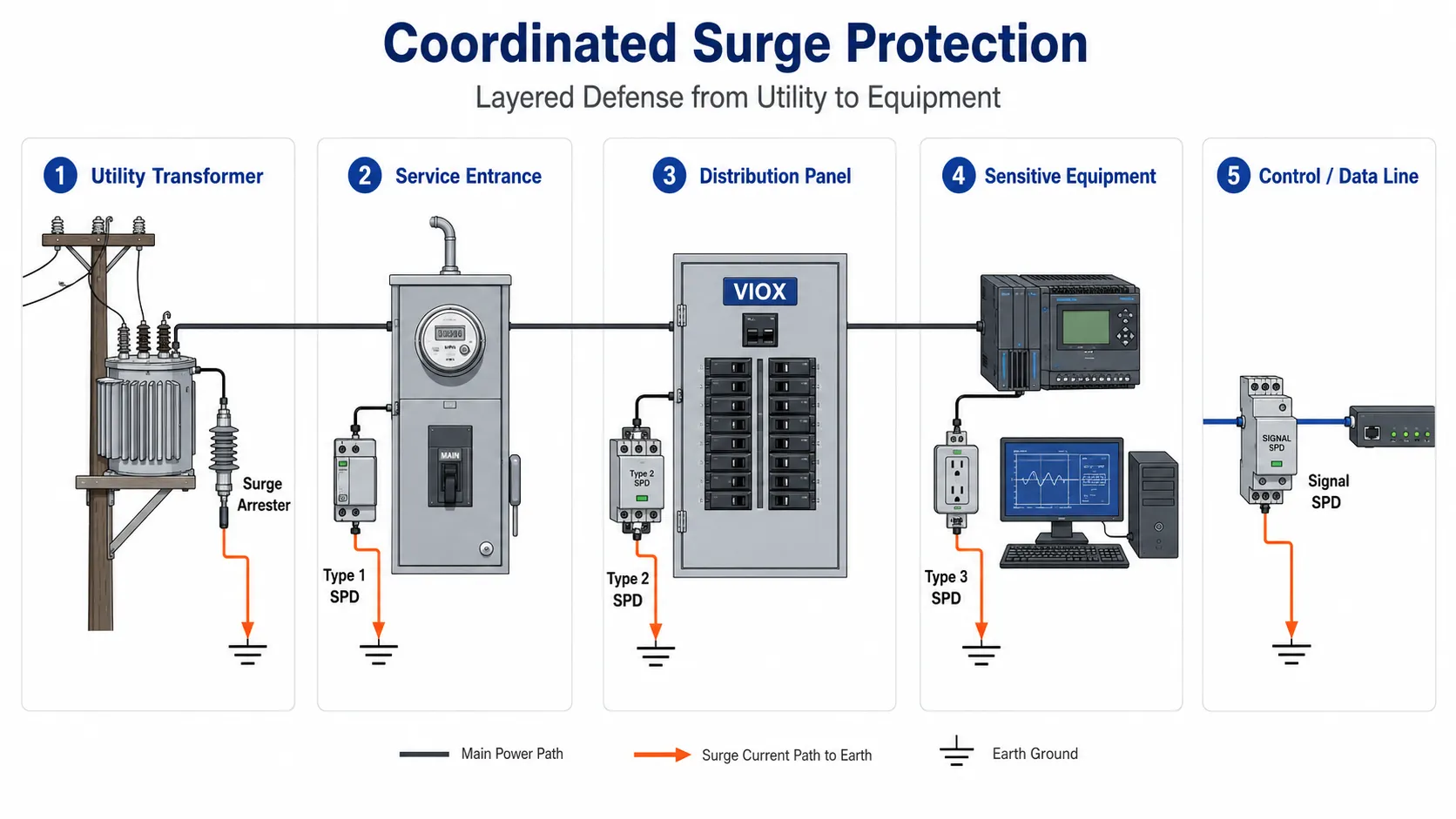
Coordinated Protection: Surge Arrester + Type 1/2/3 SPD
High-quality surge protection is layered.
A utility arrester may protect the transformer or incoming supply equipment. A Type 1 SPD may handle high-energy surge currents at the service entrance or lightning protection boundary. A Type 2 SPD may protect distribution panels. A Type 3 SPD may protect sensitive terminal equipment close to the load. Signal SPDs may protect communication and control lines.
The purpose of coordination is to prevent one device from being overloaded and to reduce the voltage stress seen by downstream equipment.
| Protection layer | Typical device | Typical location |
|---|---|---|
| Utility/power-system layer | Surge arrester | Transformer, overhead line, substation, switchgear |
| Service entrance layer | Type 1 SPD | Main incoming panel or service equipment |
| Distribution layer | Type 2 SPD | Subpanels, distribution boards, control cabinets |
| Equipment layer | Type 3 SPD or equipment-level protection | Near sensitive equipment |
| Signal/control layer | Signal SPD | Data, RS485, Ethernet, sensor, telecom lines |
For installation errors that reduce SPD performance, see VIOX’s SPD installation mistakes guide.
Common Selection Mistakes
Mistake 1: Using “surge arrester” and “SPD” as exact synonyms
They overlap in function, but not always in standard context or voltage class. In low-voltage panel specifications, SPD is usually the better term.
Mistake 2: Choosing only by kA rating
kA ratings matter, but they are not enough. For SPDs, also check Uc/MCOV, Up/VPR, In, Imax, Iimp, SCCR, backup protection, failure indication, and earthing system.
Mistake 3: Assuming a surge arrester protects against direct lightning strike damage by itself
An arrester or SPD limits transient overvoltage on conductors. Direct strike protection, bonding, earthing, external lightning protection, and coordinated SPD placement are separate parts of a full protection strategy.
Mistake 4: Ignoring the protected system voltage
A device must match the real system voltage and grounding arrangement. A low-voltage SPD cannot be substituted for a medium-voltage arrester, and a utility arrester cannot be installed like a panel SPD.
Mistake 5: Forgetting signal and communication lines
Power SPDs do not protect Ethernet, RS485, sensor, telecom, or control lines unless those lines also have suitable surge protection. Many surge failures enter through communication or control wiring.
Final Answer
A surge arrester is usually a power-system device used to protect transformers, overhead lines, substations, switchgear, and cable terminations from transient overvoltage. An SPD is the correct modern term for low-voltage surge protection in distribution boards, control panels, equipment, PV systems, EV charging, BESS, and signal lines.
A lightning arrester is often a common or older name for a surge arrester focused on lightning-related overvoltage. A surge protector or surge suppressor usually refers to low-voltage equipment protection. The best term depends on voltage level, installation point, product standard, and application.
FAQ
Is it surge arrester or surge arrestor?
The preferred technical spelling is surge arrester. Surge arrestor is a common alternate spelling in search queries, but most standards and technical datasheets use “arrester.”
Is a surge arrester the same as an SPD?
Not always. Both limit transient overvoltage, but “surge arrester” usually refers to power-system arresters, while “SPD” usually refers to low-voltage surge protective devices under IEC 61643 or UL 1449 contexts.
What is the difference between a surge arrester and a surge protector?
A surge protector is usually a low-voltage device for electronics, plug strips, whole-house protection, or panel protection. A surge arrester usually refers to utility or power-distribution overvoltage protection.
What is the difference between a surge arrester and a lightning arrester?
Lightning arrester is commonly used for arresters that protect against lightning-related overvoltage. Surge arrester is broader and can include lightning surges, switching surges, and other transient overvoltages.
What are the main types of surge arresters?
Common power-system categories include distribution class, intermediate class, station class, line arresters, and cable protection arresters. Low-voltage systems normally use SPD terminology instead.
What is the difference between a surge diverter and a surge arrester?
In many regions, surge diverter is a common term for a device that diverts surge current. It may refer to an SPD or surge arrester depending on system voltage and product context.
What is the difference between a surge capacitor and a surge arrester?
A surge arrester clamps peak overvoltage and diverts surge current. A surge capacitor helps reduce steep-front voltage stress. In some systems, both are used together.
Can an SPD replace a surge arrester?
Only if the application is low-voltage SPD protection. An LV SPD cannot replace a medium-voltage or high-voltage arrester for transformers, overhead lines, or substations.
Does a surge arrester protect against direct lightning?
It can reduce voltage stress from lightning-induced surges on conductors, but it is not a complete direct lightning protection system by itself. External lightning protection, bonding, grounding, and coordinated SPDs may also be needed.