

On this page
SPDT vs DPDT Relay: Direct Answer
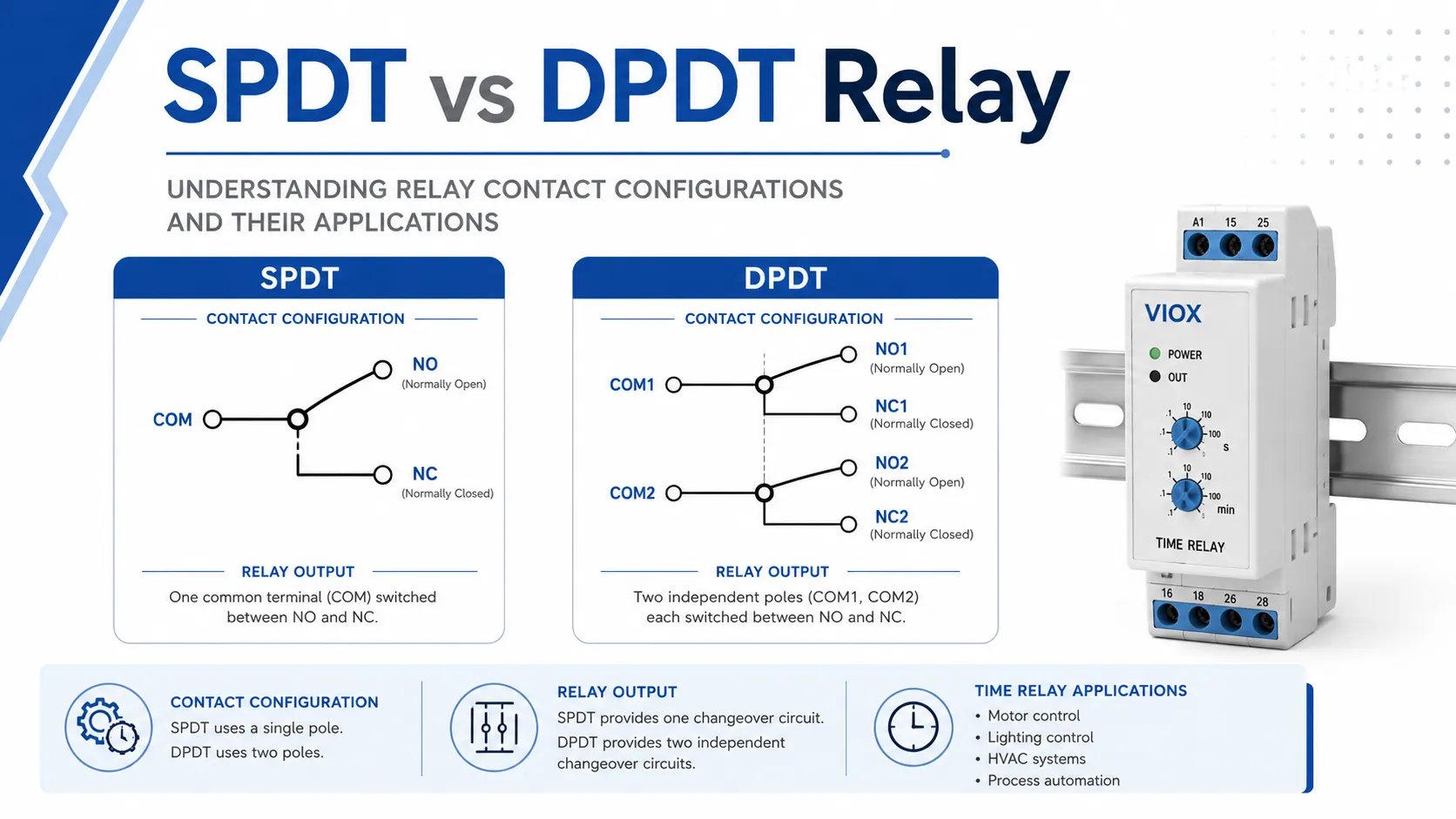
SPDT and DPDT describe relay contact configuration, not the timing function. An SPDT relay has one common terminal that switches between normally open and normally closed contacts. A DPDT relay has two SPDT contact sets operated together, allowing two separate circuits to switch at the same time.
Use SPDT when one circuit needs a changeover contact. Use DPDT when two circuits must switch together, when two isolated outputs are needed, or when the circuit requires polarity reversal or dual control.
In a time relay, SPDT or DPDT describes the output contact arrangement. The timing function decides when the contacts change state; SPDT or DPDT decides how many circuits are switched.
For product evaluation, see VIOX time relay products.
SPDT and DPDT Meaning
| Term | Full Form | What It Means |
|---|---|---|
| SPST | Single Pole Single Throw | One circuit, simple ON/OFF contact |
| SPDT | Single Pole Double Throw | One common terminal switches between NO and NC contacts |
| DPST | Double Pole Single Throw | Two circuits switched ON/OFF together |
| DPDT | Double Pole Double Throw | Two SPDT contact sets operated together |
The letters describe the contact structure:
- Pole means the number of independent circuits controlled.
- Throw means the number of output positions each pole can connect to.
- Single Pole controls one circuit.
- Double Pole controls two circuits.
- Double Throw means each pole can switch between two outputs.
So an SPDT relay controls one circuit with two possible outputs. A DPDT relay controls two circuits, and each circuit has two possible outputs.
SPDT vs DPDT Comparison Table
| Feature | SPDT Relay | DPDT Relay |
|---|---|---|
| Full form | Single Pole Double Throw | Double Pole Double Throw |
| Contact sets | One changeover contact | Two changeover contacts |
| Typical terminals | COM, NO, NC | COM1, NO1, NC1, COM2, NO2, NC2 |
| Circuits controlled | One circuit | Two independent circuits |
| Contact action | One common switches between NO and NC | Two commons switch between two NO/NC sets together |
| Electrical isolation | One switched circuit | Two isolated circuits if wired separately |
| Typical use | NO/NC selection, alarm contact, fan delay, signal switching | Polarity reversal, dual circuit control, interlock, isolated outputs |
| Time relay use | One timed output contact | Two timed output contact sets |
For a simple timing output, SPDT is often enough. For two controlled circuits, signal isolation, or polarity reversal, DPDT is usually the better fit.
What Is an SPDT Relay?
An SPDT relay has one pole and two throws. It has three output contact terminals:
- COM: common terminal
- NO: normally open contact
- NC: normally closed contact
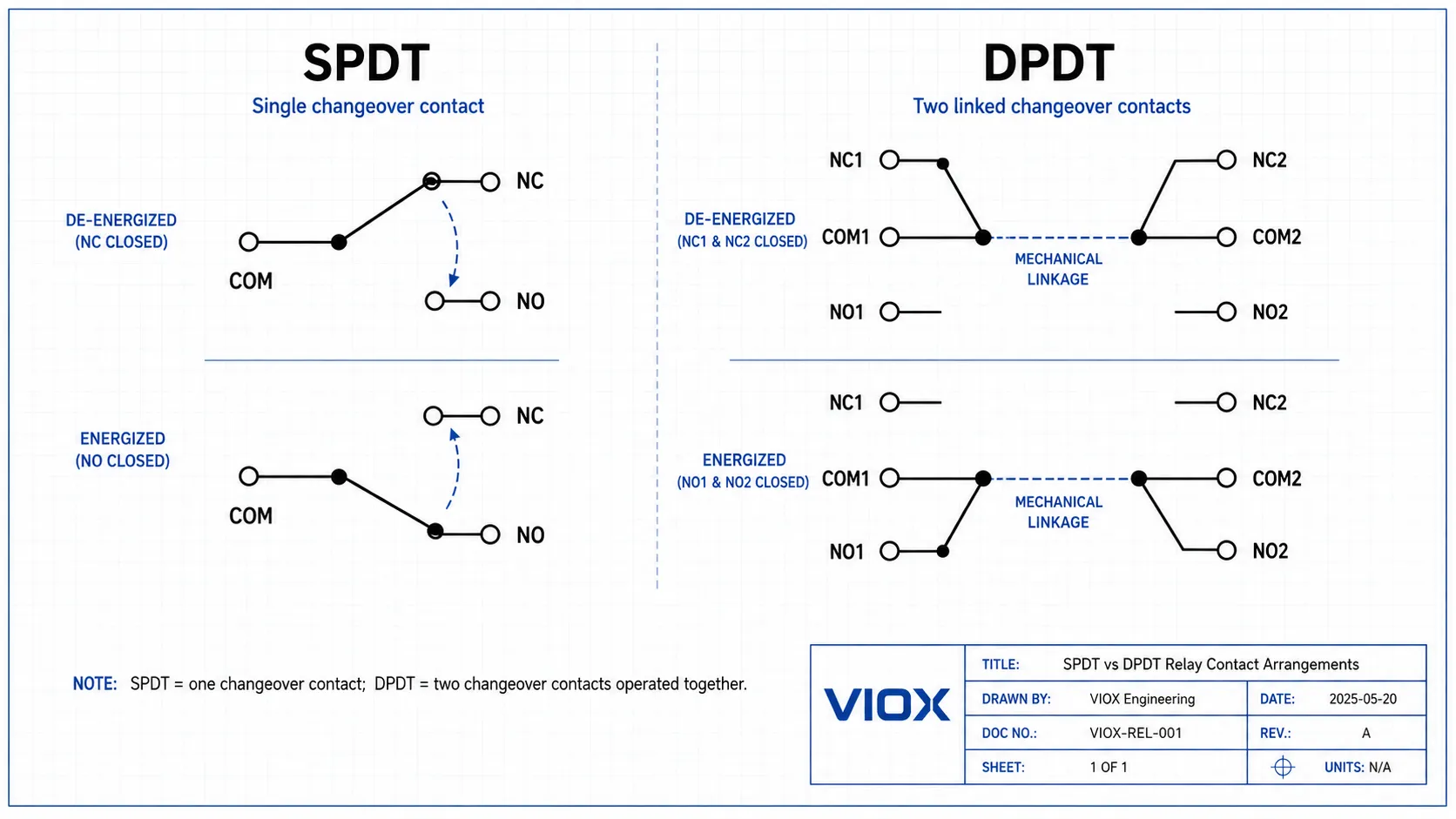
When the relay is not energized, COM is connected to NC. When the relay energizes, COM changes over and connects to NO.
That is why SPDT is also called a changeover contact or Form C contact in many relay datasheets.
SPDT Contact Logic
De-energized: COM -> NC
Energized:    COM -> NO
An SPDT time relay uses the same contact logic, but the contact changes state after a time delay, interval, repeat cycle, or other timing function.
What Is a DPDT Relay?
A DPDT relay is like two SPDT relays operated by one coil or timing mechanism. It normally has six output contact terminals:
- COM1, NO1, NC1 for pole 1
- COM2, NO2, NC2 for pole 2
Both poles switch at the same time, but the two circuits can remain electrically separate.
DPDT Contact Logic
Pole 1 de-energized: COM1 -> NC1
Pole 1 energized:    COM1 -> NO1

Pole 2 de-energized: COM2 -> NC2
Pole 2 energized:    COM2 -> NO2
This makes DPDT useful when two signals, two voltage levels, or two circuit paths must change together.
SPDT vs DPDT Schematic Symbols
For engineers searching DPDT relay schematic symbol or SPDT relay symbol, the symbol should show the number of poles and throws clearly.
| Symbol Feature | SPDT | DPDT |
|---|---|---|
| Number of moving contacts | One | Two |
| Number of commons | One COM | Two commons |
| Number of output throws | NO and NC | NO1/NC1 and NO2/NC2 |
| Drawing appearance | One changeover contact | Two mechanically linked changeover contacts |
| Common label | COM, NO, NC | COM1, NO1, NC1, COM2, NO2, NC2 |
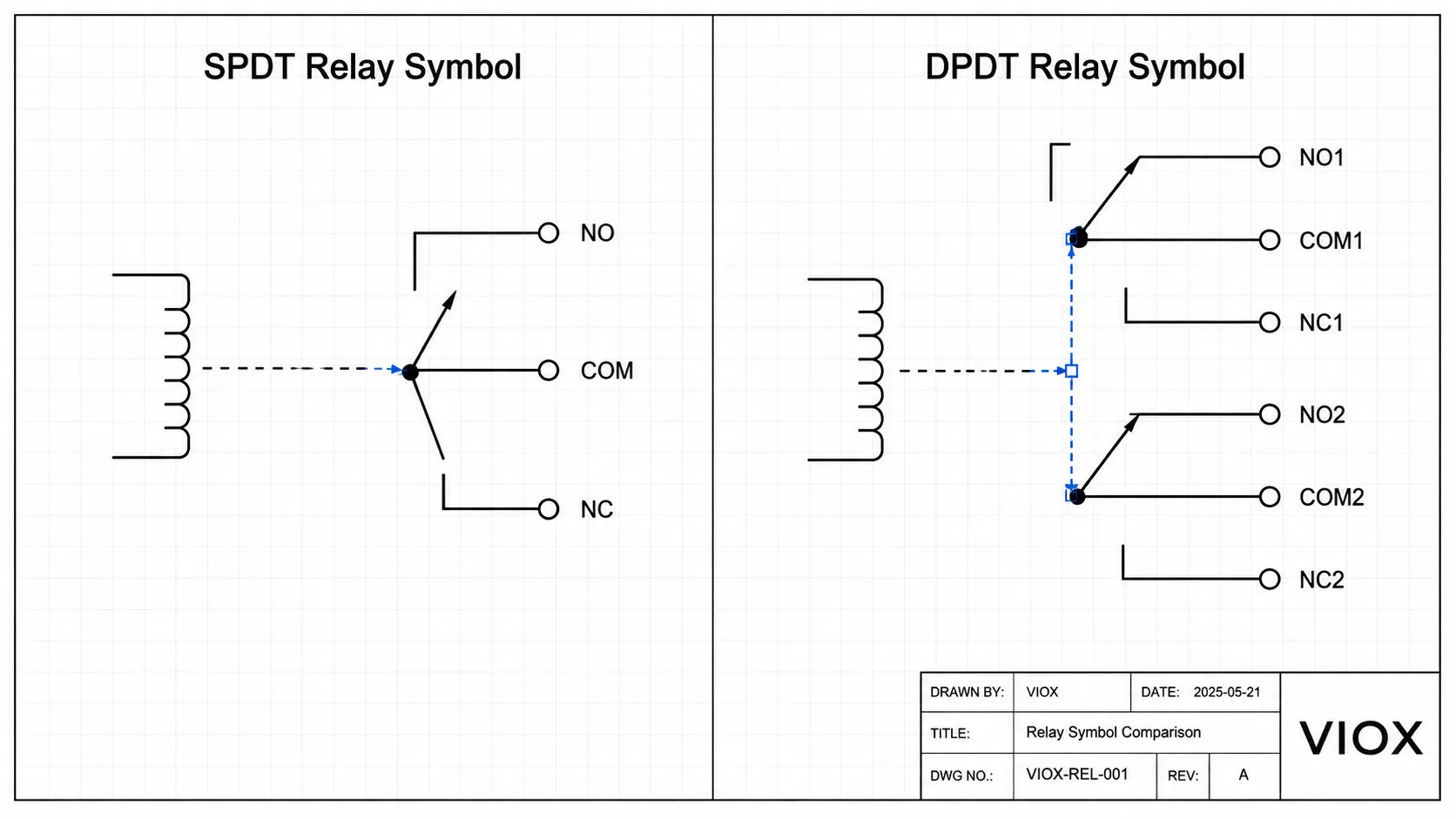
In schematic drawings, a DPDT symbol should show two mechanically linked SPDT contact sets. Do not draw DPDT as two unrelated relays unless the two poles are actually operated independently.
SPDT vs DPDT Wiring Concept
Do not start wiring from the relay name alone. Start from the contact function.
SPDT Wiring Concept
Use SPDT when one input needs to choose between two outputs.
Typical examples:
- one alarm signal changes from normal to fault
- one fan output turns on after a delay
- one control signal switches between automatic and manual logic
- one light, buzzer, or auxiliary signal changes state
DPDT Wiring Concept
Use DPDT when two contact sets must change together.
Typical examples:
- switching two independent control signals
- reversing DC polarity in a low-power control circuit
- separating two voltage systems while using one timing signal
- providing one contact for load control and another for feedback
- switching both line and neutral where the device rating and local rules allow it
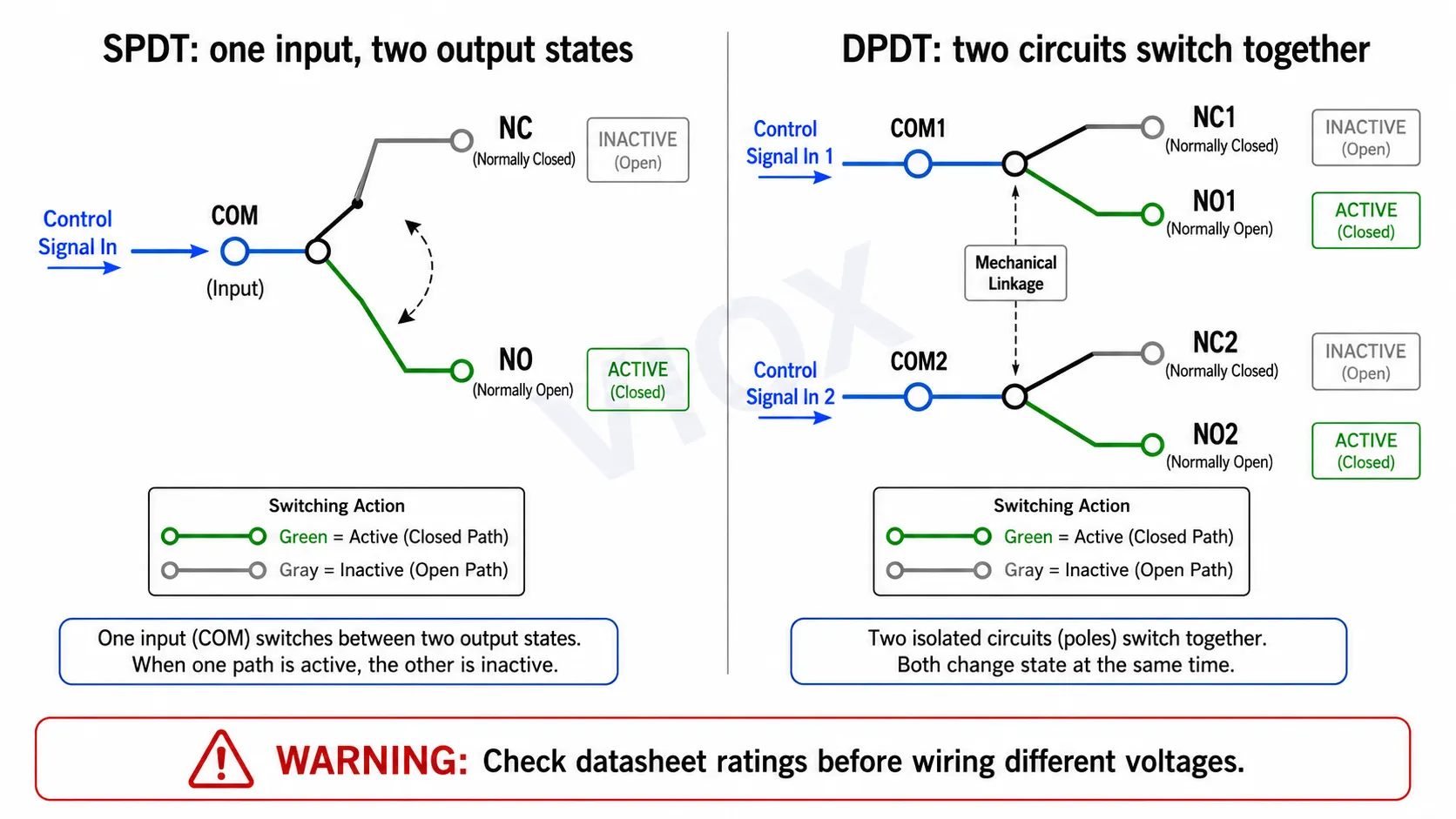
Always check the relay datasheet before wiring different voltages on separate poles. The contact spacing, insulation rating, terminal layout, and approval conditions determine what is allowed.
SPDT vs DPDT Time Relay Applications
SPDT and DPDT are especially common in time relays because timing functions often need relay output contacts.
SPDT Time Relay Applications
SPDT output is often enough for:
- on-delay fan control
- pump start delay
- alarm delay output
- lighting delay
- simple motor auxiliary control
- HVAC fan run-on logic
DPDT Time Relay Applications
DPDT output is useful when one timing event must control two outputs at the same time.
Examples include:
- one timed contact for load control and one for status feedback
- two isolated control circuits triggered by one delay
- forward/reverse interlock logic in low-power control circuits
- backup alarm and control output at the same time
- separating PLC input feedback from a field control circuit
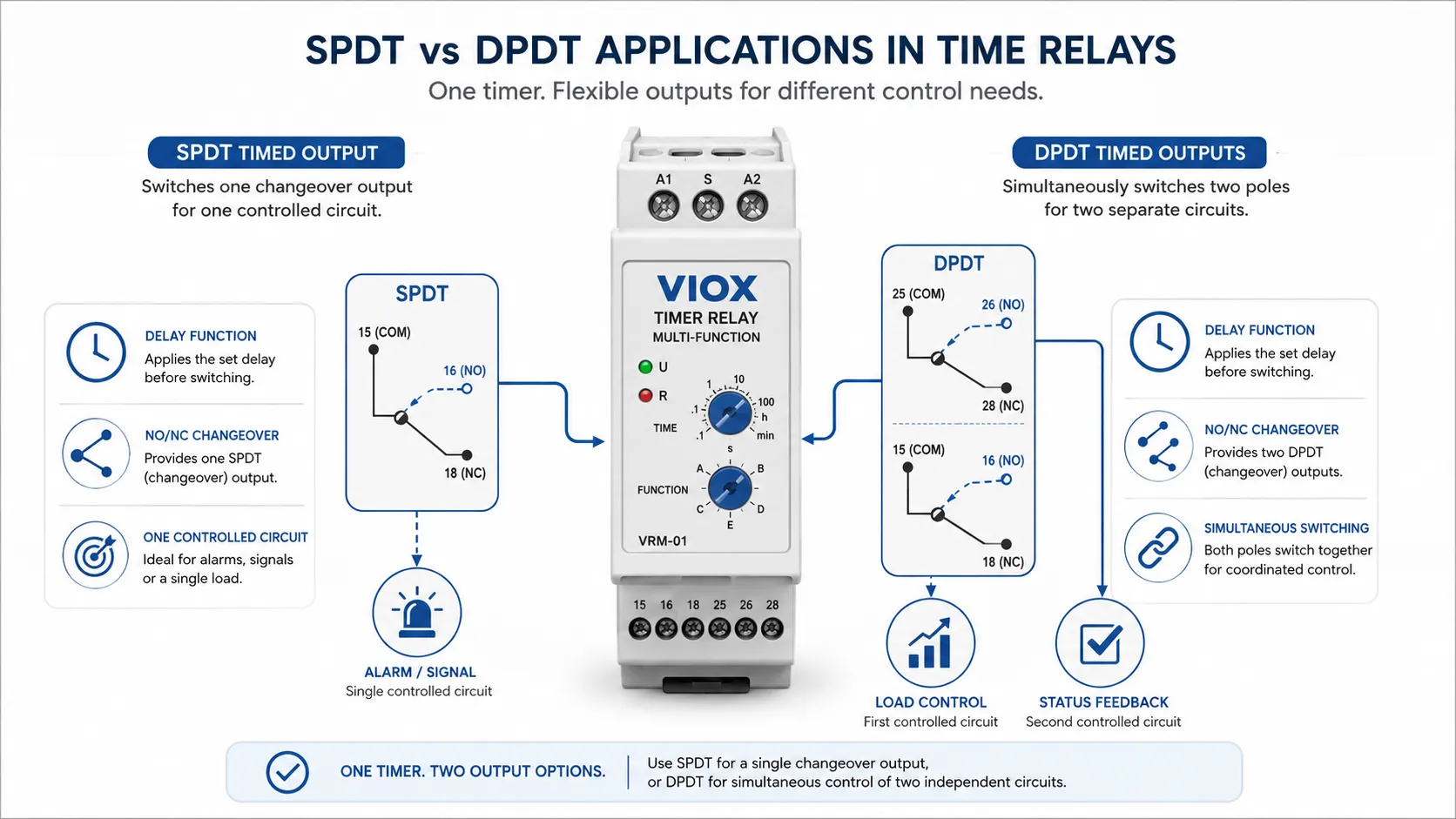
For timer relay selection, see How to Choose the Right Timer Relay.
SPST vs SPDT vs DPDT
Many users searching SPDT and DPDT also need the surrounding contact types.
| Contact Type | Full Form | Terminal Count | Function |
|---|---|---|---|
| SPST | Single Pole Single Throw | 2 | One circuit, simple ON/OFF |
| SPDT | Single Pole Double Throw | 3 | One circuit switches between NO and NC |
| DPST | Double Pole Single Throw | 4 | Two circuits switch ON/OFF together |
| DPDT | Double Pole Double Throw | 6 | Two SPDT contact sets switch together |
If you only need ON/OFF, SPST may be enough. If you need a changeover contact, use SPDT. If two changeover contacts must operate together, use DPDT.
How to Choose SPDT or DPDT
| Situation | Better Choice | Reason |
|---|---|---|
| One circuit needs NO/NC switching | SPDT | Simple changeover contact |
| Two independent circuits must switch together | DPDT | Two contact sets operate together |
| One timing signal controls one load | SPDT | Fewer terminals and simpler wiring |
| One timing signal controls load and feedback | DPDT | One pole can control the load, the other can signal status |
| Polarity reversal is required in a low-power control circuit | DPDT | Two poles can reverse connection paths |
| Panel space and cost are critical | SPDT | Usually smaller and simpler |
| Future expansion may need a second contact set | DPDT | Extra pole may be useful if supported by the design |
Do not select DPDT only because it looks more flexible. More contacts also mean more terminals, more wiring, more space, and more ways to miswire the circuit.
Common Mistakes
Mistake 1: Thinking SPDT and DPDT Describe Timing
SPDT and DPDT describe contact arrangement. They do not tell you whether the relay is on-delay, off-delay, interval, star-delta, or repeat cycle.
Mistake 2: Treating Contact Rating as Universal
A relay contact rated for a resistive load may need derating for inductive loads such as contactor coils, solenoids, and small motors. Check AC-1, AC-15, DC-13, or other contact rating categories where provided.
Mistake 3: Using One DPDT Relay as Two Unrelated Relays
The two poles of a DPDT relay operate together. They are not independently timed unless the device has separate mechanisms or separate outputs.
Mistake 4: Ignoring Isolation Limits
Two DPDT poles can control separate circuits, but the voltage difference, insulation rating, terminal spacing, and safety rules must still be checked.
Mistake 5: Confusing Relay Contact Terminals With Coil Terminals
COM, NO, and NC are output contact terminals. Coil terminals such as A1/A2 or input terminals power or trigger the relay. Mixing them up is a common wiring error.
Mistake 6: Assuming DPDT Is Always Better Than SPDT
DPDT is better only when you need two switched contact sets. For a single timed output, SPDT is simpler and easier to troubleshoot.
FAQ
What does SPDT mean on a relay?
SPDT means Single Pole Double Throw. It has one common terminal that switches between normally open and normally closed contacts.
What does DPDT mean on a relay?
DPDT means Double Pole Double Throw. It has two SPDT contact sets operated together, usually with six contact terminals.
What is the difference between SPDT and DPDT relay?
An SPDT relay switches one circuit between two outputs. A DPDT relay switches two independent circuits between two output positions at the same time.
Is DPDT just two SPDT relays?
Functionally, a DPDT relay behaves like two SPDT contact sets operated together by one coil or mechanism. The two poles are not independently controlled unless the device is specifically designed that way.
Can I use a DPDT relay instead of SPDT?
Yes, if the contact ratings, coil voltage, insulation rating, and terminal layout fit the application. You can use one pole of a DPDT relay and leave the other unused, but it may cost more and take more space.
What is a DPDT relay schematic symbol?
A DPDT relay symbol shows two changeover contact sets mechanically linked together. Each pole has a common, normally open, and normally closed contact.
What is the difference between SPST, SPDT, and DPDT?
SPST is simple ON/OFF for one circuit. SPDT is one circuit switching between two outputs. DPDT is two SPDT contact sets operated together.
Is SPDT the same as a changeover contact?
Yes, SPDT is commonly called a changeover contact because the common terminal changes from NC to NO when the relay operates.
What does 12V SPDT relay mean?
It usually means the relay coil is rated for 12V, while the contact arrangement is SPDT. The coil voltage and contact rating are separate specifications and both must be checked.
Final Advice
SPDT and DPDT are not timing functions. They are contact arrangements.
Use SPDT when one circuit needs a changeover contact. Use DPDT when two contact sets must switch together, when isolated outputs are needed, or when a control circuit requires polarity reversal or dual switching.
For time relays, first choose the timing function, then choose the output contact arrangement. A correct timer relay selection needs both: the right timing mode and the right contact configuration.