

On this page
If your RCD trips when switching off a load, a brief capacitive current to earth is one possible explanation. With double-pole switching, disconnecting neutral while line remains connected can raise the load-side neutral’s potential and produce a residual-current transient. Early neutral opening, contact arcing and limited standing-leakage margin can increase susceptibility. This is a possible explanation, not proof that the switch, appliance and installation are fault-free.
| Factor to investigate | What its absence means |
|---|---|
| Neutral is interrupted during the OFF action | This particular neutral-lift explanation becomes less applicable |
| Neutral opens before line | Early opening can strengthen the effect; it is not a universal prerequisite |
| Existing leakage leaves limited margin | More margin may help, but does not guarantee immunity to a transient |
For electricians and panel-builder technical staff: preserve protective functions throughout diagnosis. Isolate and verify dead before inspection or alteration. Any necessary operational measurements require competent personnel, suitable equipment and an appropriate safe-working procedure. Do not reproduce the symptom through exposed live switching or improvised links.
The Symptom Signature: A Trip at the OFF Transition
The useful observation is the relationship between the protective device’s operation and the switching action. A cooker may run normally and trip the residual protection when its wall switch opens. An extractor may behave normally at a selected speed yet trip during a selector movement. Neither observation identifies the cause by itself; the event needs to be described accurately before parts are replaced.
Establish whether the trip occurs as the contacts open, while the appliance is running down, or after a delay. Those are different observations. Record the switch position, appliance state and other connected loads. A report saying only “it trips when I use the oven” loses the timing information that makes this investigation useful.
Also establish what actually tripped. An RCD is a residual current device; an RCCB provides residual-current protection without integral overcurrent protection, while an RCBO combines both functions. An RCBO handle in the tripped position does not, on its own, establish which protective function operated. Use the device’s instructions and any provided indication rather than assuming every operation is residual-current related.
Intermittency does not disprove a switching explanation. The electrical state at contact separation changes with the point on the supply waveform, the load’s operating condition and the contact action. Background leakage from the remaining installation can also change. The same outward hand movement therefore need not create the same residual-current event every time.
Keep similar-looking problems in their own diagnostic routes:
- For sustained or general load-related trips, use the RCCB tripping diagnostic guide, including its leakage-measurement approach.
- For a suspected return path through another circuit, use the shared-neutral and RCD/RCBO guide.
- For protection requirements and device sensitivity, use the RCCB sensitivity selection guide.
An OFF-only pattern is a reason to examine switching behavior after the relevant checks, not permission to skip them.
The Mechanism: Why an RCD Trips When Switching Off
The load-side neutral can stop behaving like a connected neutral
Consider a simplified load supplied through a downstream double-pole switch. In normal operation, its neutral conductor is connected to supply neutral. There is capacitance between wiring or equipment and protective earth, but the voltage across a neutral-to-earth capacitance is normally relatively small in this arrangement.
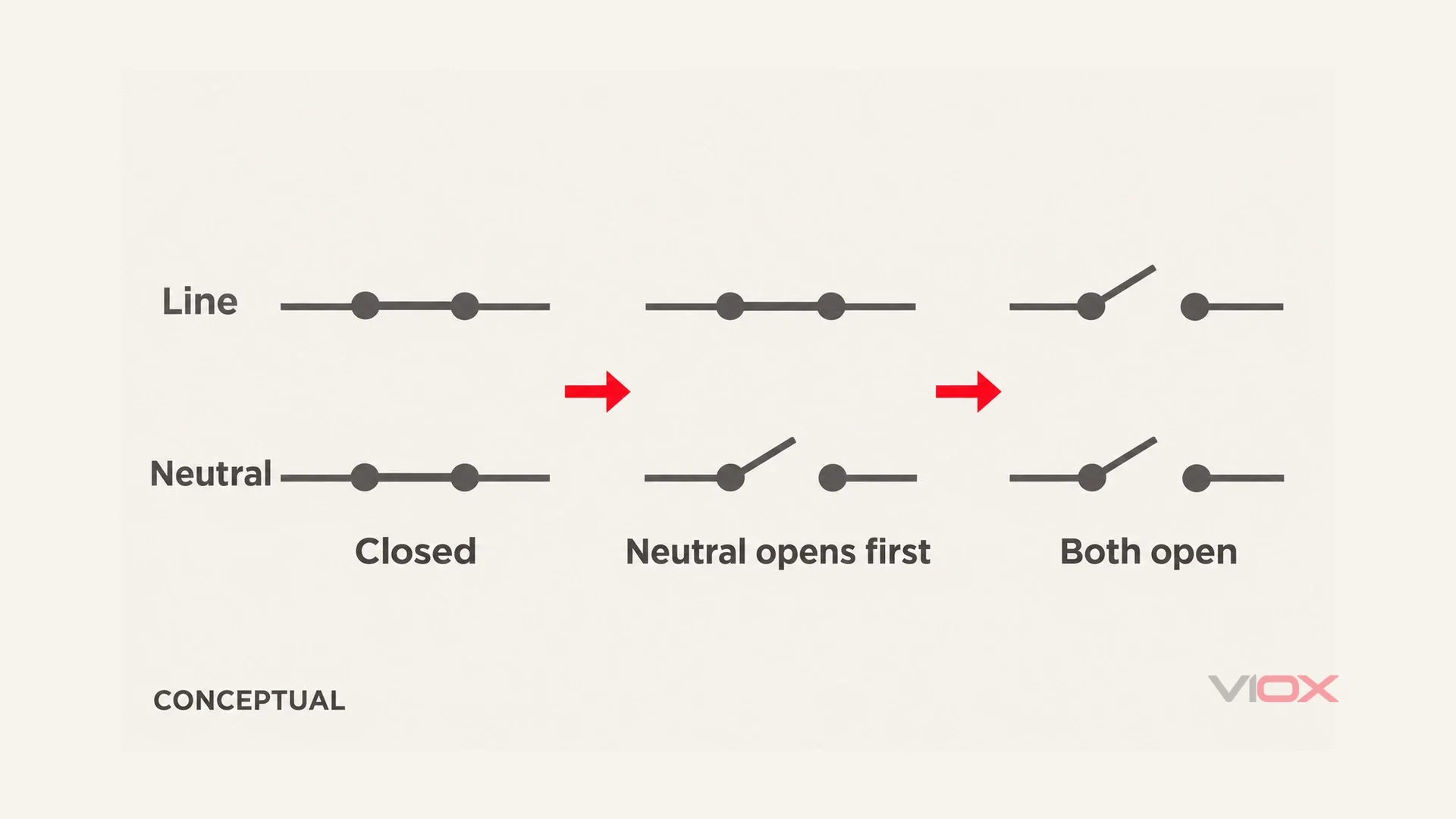
If the neutral contact opens while the line contact remains connected, the load-side neutral is no longer held at supply-neutral potential. Through the connected load, its voltage relative to earth can rise. “Neutral” still names the conductor’s circuit function; it does not guarantee that this disconnected section remains near earth potential.
This is a transition between circuit states, not necessarily a persistent wiring fault. The important question is what remains connected during the interval between the contact actions. A double-pole label tells the reader that both conductors are switched; it does not document their precise opening sequence under operating conditions.
A voltage change produces a capacitive current
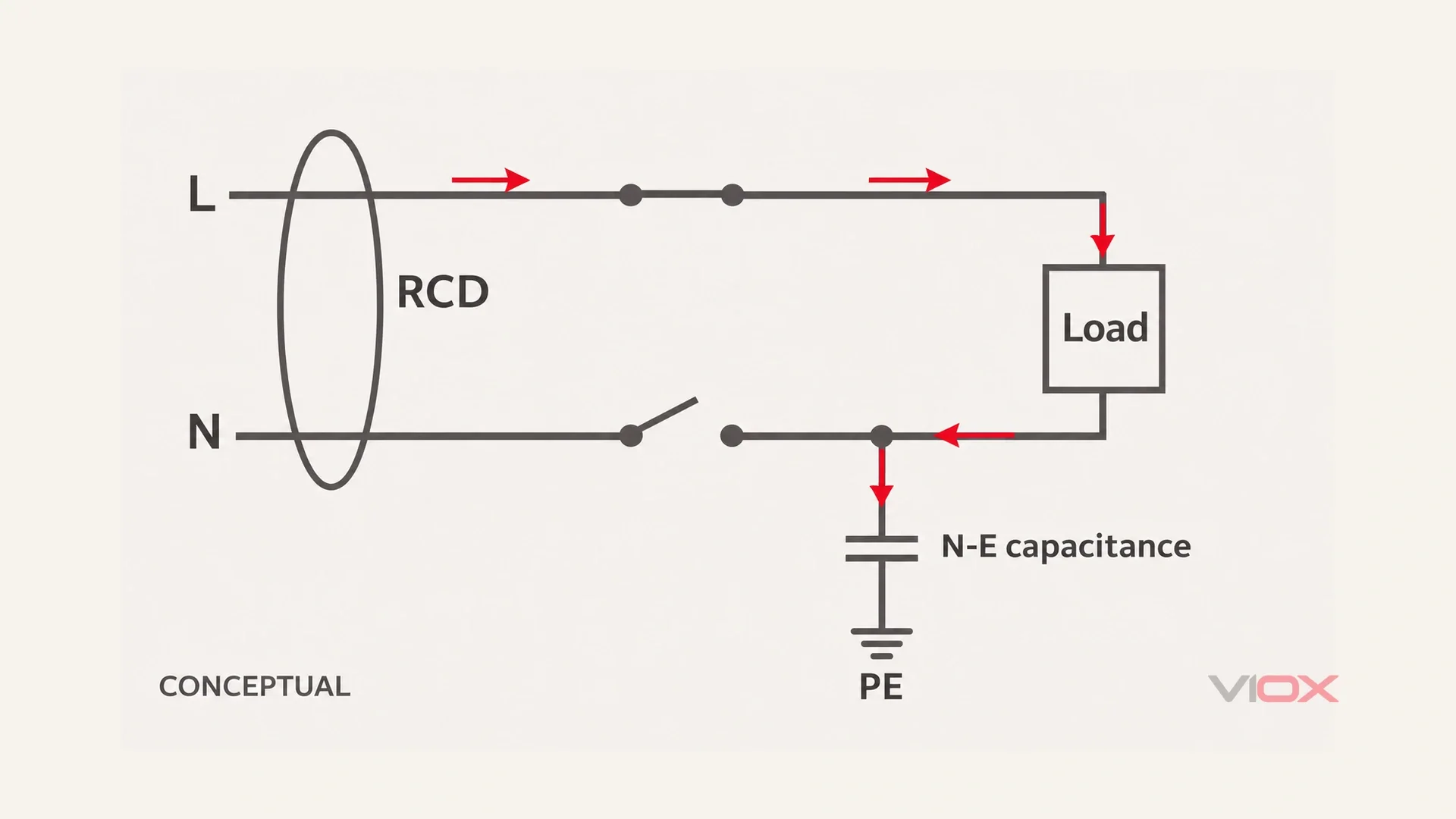
Capacitance does not require damaged insulation or a deliberate metallic connection to earth. When the voltage across it changes, charge moves. A rapid change at the load-side neutral can therefore create a brief current through the capacitance-to-earth path.
BEAMA’s RCD Handbook describes this switch-off effect in its discussion of capacitance to earth. Its relevance is the combination of capacitance and a change in voltage, rather than an assumption that a permanently low-resistance neutral-to-earth fault must exist.
In the illustrative line-fed state, current leaves through the RCD’s monitored line conductor, passes through the connected load and the capacitance-to-earth path, and is not fully returned through that same RCD’s monitored neutral. That imbalance is residual current. Protective earth is outside the residual-current sensing path; the RCD does not need a separate measurement of the earth conductor to detect the imbalance.
Contact behavior and standing leakage influence the result
Early neutral opening can increase the voltage change associated with this mechanism. Arcing and slow separation can add higher-frequency components. Existing operational leakage can reduce the remaining margin before a protective device operates. These are reasons to investigate susceptibility, not a checklist that proves or excludes the mechanism.
The distinction matters when measurements appear reassuring. Low standing leakage does not establish that every transient will be harmless. Conversely, a circuit carrying appreciable standing leakage need not trip at every switch-off. The device’s response to the actual transient, including its duration and waveform, matters alongside the steady measurement.
The IET EngX selector-switch discussion contains explanations along these lines, but the original reporter had not established whether the switches were single or double pole. That is community discussion of a plausible mechanism, not a confirmed diagnosis or an official IET installation rule.
Why switching line alone avoids this particular sequence
A single-pole switch opening line while neutral remains correctly connected does not create the same disconnected-neutral state. This explains why a different permissible switching arrangement may resolve this specific interaction.
It does not follow that all single-pole arrangements are immune to switch-off trips. The switched conductor matters. Neutral-side switching inside equipment, incorrect polarity or another operating-state problem cannot be dismissed merely because someone describes the switch as single pole. Confirm the actual arrangement rather than applying a general rule to its name.
Why Standard Tests Can Come Back Clean
Insulation resistance and operating transients answer different questions
An insulation-resistance (IR) test examines insulation under the selected test conditions. A satisfactory result is useful evidence about that test; it is not a recording of the circuit while switch contacts separate under load. A capacitive charging event is not the same phenomenon as sustained conduction through damaged insulation.
The test record should identify what was included, disconnected or excluded, the switch positions and the equipment state. “IR passed” without that context is incomplete evidence. It cannot establish the behavior of every internal switch or filter during normal use.
Nor does a satisfactory static result eliminate all intermittent faults. Moisture, temperature, vibration and operating state can affect what is present when a fault occurs. Do not reverse the logic and decide that a clean IR test proves capacitance is the cause. It leaves an explanatory gap that must be investigated.
Replacing the RCD is not a diagnosis
A new device may behave similarly because the same circuit transition still exists. Alternatively, a different response may change the symptom without explaining the original problem. Replacement alone cannot separate an unsuitable device application, a genuine device defect and an installation-generated transient.
Verification of the installed protective device remains necessary where indicated. Its identity, instructions and appropriate test results belong in the record. The point is to stop treating a repeated OFF event as automatic proof that the protective device is oversensitive or worn out.
Evidence that moves the investigation forward
| Observation or check | What it can support | What it does not prove | Next professional decision |
|---|---|---|---|
| Trip closely follows contact opening | Focus on the switching transition | Capacitance is the sole cause | Confirm the operated function and actual circuit arrangement |
| Satisfactory documented IR result | No insulation defect detected under those conditions | No operating-state or intermittent fault exists | Compare the tested state with the state at the event |
| Standing-leakage assessment | Available operating margin and contributing loads | A slow reading captured the brief transient | Decide whether transition-capable investigation is needed |
| Documented or established contact sequence | Whether the proposed neutral-lift state is possible | Its current was sufficient to operate the RCD | Relate sequence to electrical observations and device response |
| Symptom disappears after a switch change | The change affected the interaction | A particular internal defect or mechanism was proved | Document the change and verify the complete protective arrangement |
Continuity checks on an isolated device can identify its static states, but a basic beeper does not establish the sequence of closely spaced events under real switching conditions. Equally, a normal leakage indication may not capture a short event. Use methods suitable for the question, without improvising an exposed live test rig.
The ElectriciansForums oven-isolator discussion reports that changing the double-pole switch resolved the symptom. It does not report a captured capacitive transient or measured contact sequence. The useful lesson is to consider the switch interaction, not to prescribe the same replacement for every oven.
What Actually Fixes It: Evidence Before Alteration
Use the findings to choose among the following professional assessment routes. Their order is a diagnostic priority, not permission to change the installation until applicable requirements and the equipment instructions have been checked.
Assess standing leakage and operating margin
Begin with the relevant leakage evidence and the equipment connected when the event occurs. Establish whether the measured condition represents normal service, rather than an unusually quiet installation with most loads unplugged. Keep the measurement method and general fault tree in the linked diagnostic guide instead of inferring margin from the absence of previous trips.
High background leakage can make a switching event more likely to cause operation. Identifying a contributing load is still not permission to remove its protective earth or change the RCD’s role. The outcome should be an informed assessment of the installation’s margin and whether further event investigation is justified.
Assess a switch with documented contact behavior
Where the evidence supports an adverse neutral-opening sequence, obtain the proposed replacement’s exact documentation. A make-neutral-first, break-neutral-last arrangement may be relevant, but it must be established for the device and duty rather than assumed from its appearance or pole count.
Check that the replacement retains the required switching and isolation functions and is appropriate for the load. Do not label every existing double-pole switch defective simply because this interaction occurs. A product can perform its stated function while an installation-level interaction still needs attention.
Assess single-pole line switching only where permitted
Changing the switching arrangement requires a design decision. The qualification in the BEAMA wording reproduced in the EngX discussion is essential: “where such replacement is permissible and safe”. It is not a blanket authorization to stop switching neutral.
The electrician must establish whether line-only switching is acceptable for this circuit and whether any required means of isolation remains intact. An approved replacement arrangement and an improvised bridge across an existing contact are different actions. Similar immediate results do not establish equivalent safety or compliance.
Assess circuit division to restore margin
Where accumulated operational leakage is a material contributor, review whether loads should be divided differently while maintaining the required protection. Consider the installation in its normal operating states and preserve correct conductor association throughout the design.
For component documentation, the VIOX RCCB category and VIOX RCBO category identify the relevant product families. These links do not establish that any particular model will tolerate this event or that changing protection architecture will cure it.
After an approved alteration, record what changed and verify the required protective functions and operation. An isolated successful OFF action is encouraging, but it is not a substitute for the appropriate inspection and testing of the altered installation.
Do not use these shortcuts
Do not link out a neutral contact as an improvised cure. The resulting circuit may no longer have the isolation behavior expected from the switch. An OFF position is not proof that every conductor is safe to work on.
Do not remove or bypass the RCD. Suppressing the protective response does not demonstrate that the underlying condition is harmless.
Do not blindly increase the rated residual operating current. A quieter installation is not evidence that required shock or fault protection has been retained. Any change needs a valid protective-design basis, not just relief from the symptom.
FAQ
Does tripping at switch-off mean the RCD is faulty?
No. A circuit-generated transient can operate a functioning RCD. However, the symptom also does not prove the RCD is healthy. Confirm which function operated and assess the device, circuit state and switching behavior before deciding whether replacement is justified.
Why does it only trip sometimes, not at every switch-off?
The contact action, point on the supply waveform, load state and background leakage can vary. The resulting event and available margin therefore change. Intermittency is consistent with a transient explanation, but is not proof of it; intermittent faults remain possible.
Why doesn’t this happen with single-pole switching?
Opening line alone while neutral stays correctly connected avoids the particular neutral-lift sequence described here. This statement is about that arrangement and mechanism. It does not mean every single-pole switch, including one interrupting neutral inside an appliance, is immune to OFF-event trips.
Can I just fit a 100 mA RCD instead?
No. A higher rated residual operating current is not a diagnosis or a general repair. The protection required for the circuit must remain satisfied. Have the electrician establish the cause and the applicable protective requirements before considering any device change.
Is a circuit that trips at switch-off dangerous?
The trip alone cannot establish the risk. A capacitive transient can occur without insulation failure, but the same symptom can accompany a defect or reduced operating margin. Keep protection in place and have the condition investigated; do not declare it safe solely because normal operation or static tests appear satisfactory.
Treat a switching transient as a credible explanation only when the circuit arrangement and evidence support it. Early neutral opening, arcing and limited leakage margin can increase susceptibility, but they are not three indispensable conditions. Confirm the relevant evidence before altering the switch, protection or circuit division.
Sources
- BEAMA, The RCD Handbook: Guide to the Selection and Application of Residual Current Devices, March 2022, section 9.2, printed page 31: capacitance to earth and voltage changes during double-pole switch-off.
- IET EngX, “Selector switch causing RCB0 tripping”: community discussion of switch behavior and possible explanations, not an official IET installation requirement.
- ElectriciansForums, “RCD tripping when switching oven isolator off”: reported symptom and replacement outcome, not a VIOX test or a verified measurement of the proposed transient.