Selecting the correct RCBO (Residual Current Breaker with Overcurrent protection) breaking capacity is not merely a box-ticking exercise in compliance; it is a fundamental engineering decision that dictates whether a fault is safely cleared or results in catastrophic equipment failure.
In B2B electrical procurement and panel design, the breaking capacity (Icn) specification—typically 6kA, 10kA, or 16kA—is often misunderstood or overshadowed by the amperage rating. However, undersizing this parameter creates a severe safety hazard known as “over-duty,” where a short circuit delivers more energy than the device can withstand, potentially causing arc flashes, panel destruction, or fire.
This guide provides a technical framework for selecting between 5kA/6kA, 10kA, and 16kA classes, supported by IEC 61009-1 standards and practical fault current calculations.
Understanding RCBO Breaking Capacity Fundamentals
The breaking capacity (often denoted as Icn for household/similar uses under IEC 61009-1 or Icu for industrial uses under IEC 60947-2) represents the maximum prospective short-circuit current (PSCC) an RCBO can safely interrupt without being destroyed.
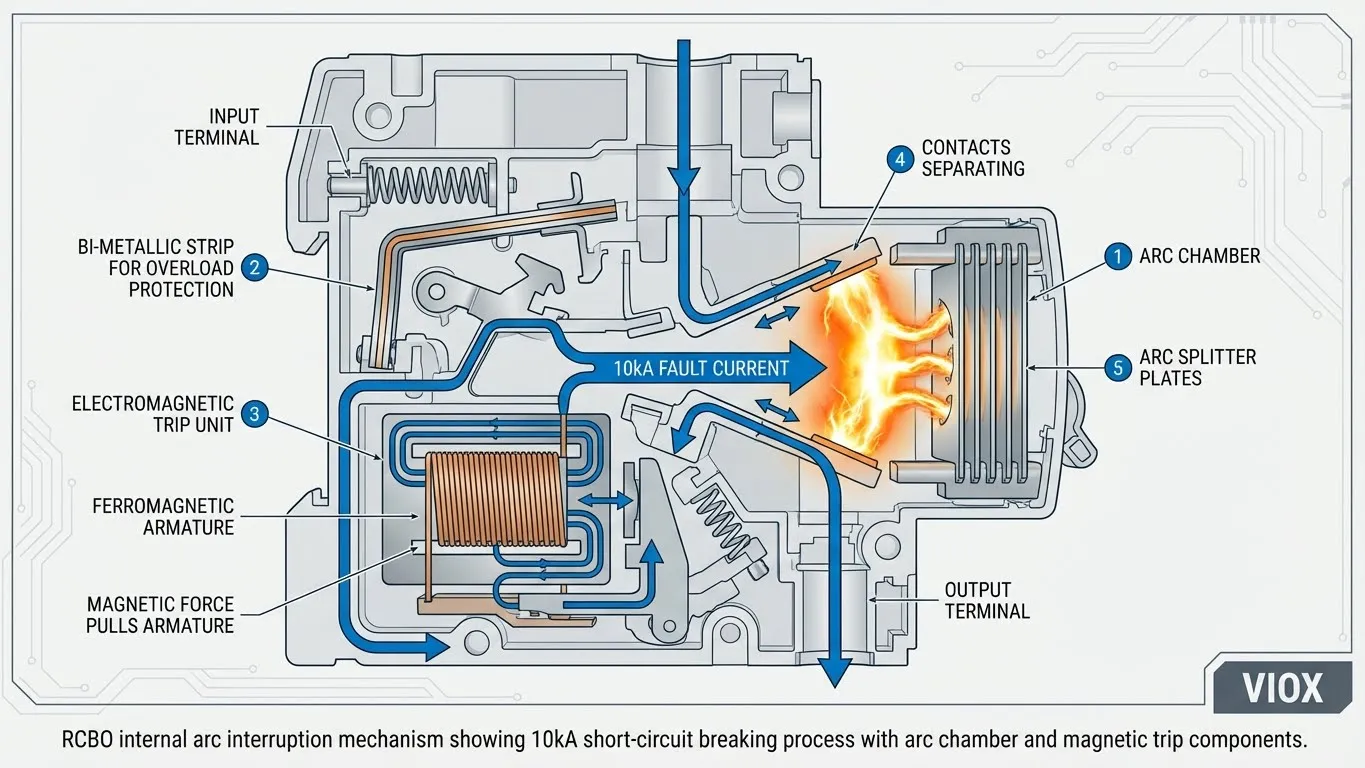
Unlike the rated current (e.g., 20A, 32A), which refers to normal operational load, the breaking capacity refers to the device’s ability to extinguish the massive energy of a dead short. During a short circuit, currents can spike from 20A to 10,000A in milliseconds. The RCBO must mechanically separate its contacts and extinguish the resulting electric arc before it bridges the gap and destroys the device.
For a deeper dive into the specific definitions of these ratings, refer to our guide on Circuit Breaker Ratings: Icu, Ics, Icw, Icm.
Icn vs. Ics: The Critical Distinction
- Icn (Rated Short-Circuit Capacity): The maximum current the breaker can interrupt safely twice (O-CO test sequence) but may not be usable afterwards.
- Ics (Service Breaking Capacity): The current the breaker can interrupt repeatedly and remain in service. For high-quality VIOX RCBOs, Ics is typically 75% or 100% of Icn, ensuring longevity even after faults.
The Three Breaking Capacity Classes Explained
While “5kA” is commonly referenced in legacy markets or specific regional standards, the modern global standard has shifted largely to 6kA as the baseline. Below is the comparative framework for the three primary tiers available in the VIOX lineup.
Comparison Matrix: 6kA vs. 10kA vs. 16kA
| Feature | 6kA (Residential Class) | 10kA (Commercial Class) | 16kA (Industrial Class) |
|---|---|---|---|
| Typical Label | 6000 | 10000 | 15000 / 16000 |
| Primary Application | Residential homes, rural installations, final circuits far from main intake. | Commercial offices, high-rise residential, EV chargers, light industrial. | Heavy industry, data centers, hospitals, main switchboards. |
| Transformer Proximity | >200m from substation or small kVA transformer. | <100m from substation or high density urban grid. | Direct feed from substation or low impedance supply. |
| IEC Standard | IEC 61009-1 (Domestic) | IEC 61009-1 / IEC 60947-2 | IEC 60947-2 |
| Cost Profile | Baseline | +25% to +40% Premium | +80% to +120% Premium |
| Arc Chute Design | Standard 5-7 plate stack | Enhanced 9-11 plate stack | Heavy-duty 13+ plate stack |
For general guidance on breaker types, see our Types of Circuit Breakers overview.
How to Calculate Required Breaking Capacity
To select the correct class, you must calculate the Prospective Short Circuit Current (PSCC) at the point of installation. Guesswork here is dangerous.
The fault current (Isc) is primarily determined by the transformer size and the impedance of the cables connecting the transformer to the RCBO.
Simplified Calculation Logic
Isc = Vphase / Ztotal
Where Ztotal includes the transformer impedance and the resistance of service cables. As cable length increases, impedance rises, and fault current drops (attenuation).
Fault Current Attenuation Example Table
| Supply Transformer | Distance to Panel | Cable Size (Copper) | Est. Fault Current | Required RCBO |
|---|---|---|---|---|
| 500 kVA (Urban) | 10 meters | 95 mm² | 14.2 kA | 16 kA |
| 500 kVA (Urban) | 50 meters | 35 mm² | 6.8 kA | 10 kA |
| 500 kVA (Urban) | 100 meters | 16 mm² | 2.9 kA | 6 kA |
| 100 kVA (Rural) | 20 meters | 25 mm² | 3.5 kA | 6 kA |
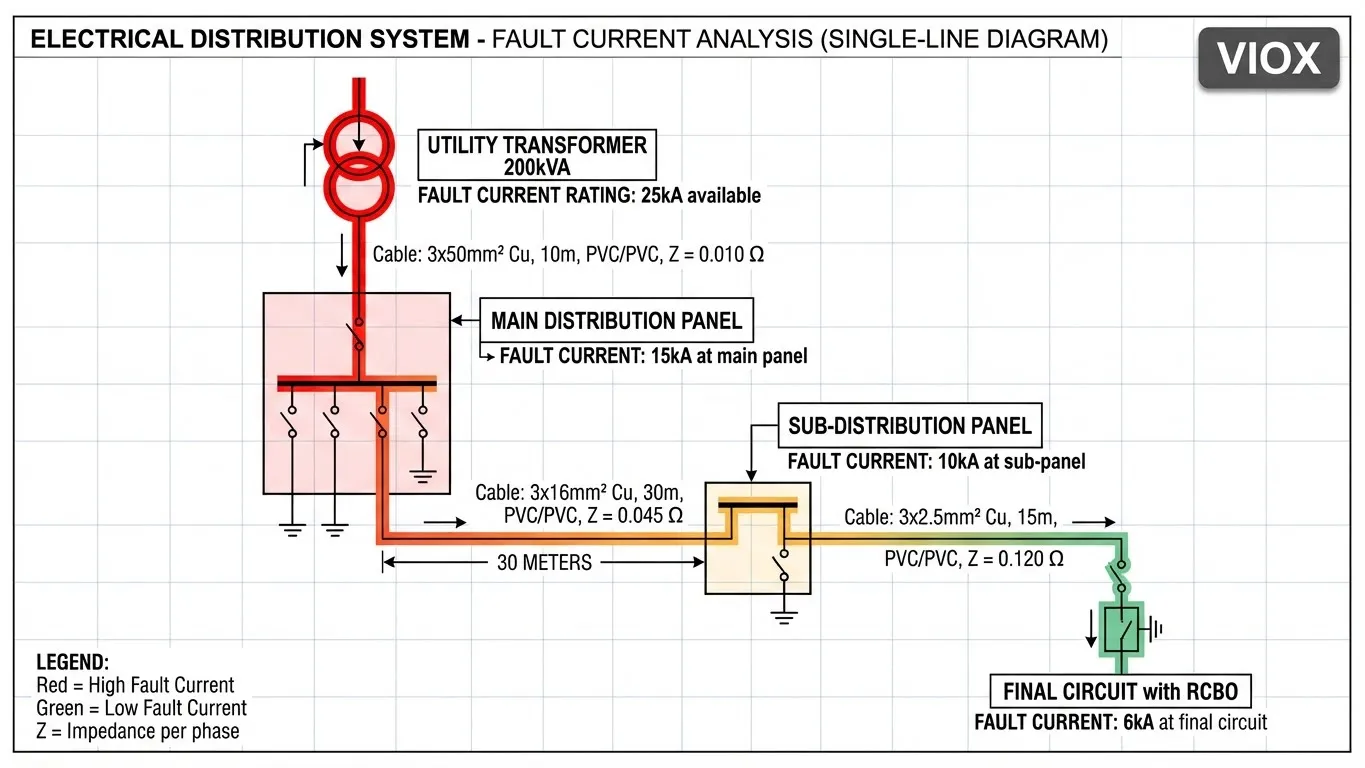
Selection Rule: Always select an RCBO with an Icn rating higher than the calculated PSCC.
- Calculated: 8.5kA → Select 10kA (6kA is unsafe).
- Calculated: 4.2kA → Select 6kA (Standard) or 10kA (for robustness).
For a detailed understanding of how these ratings interact, read Understanding the KA Rating on Circuit Breakers.
Application-Specific Selection Guide
Different environments impose different stress levels on electrical protection devices. Factors such as temperature, altitude, and grouping also play a role in overall system design.
1. Residential Installations
Recommendation: 6kA (Standard) / 10kA (Urban)
For most suburban homes, the cable impedance from the utility transformer limits fault currents to under 4kA. However, high-density apartment complexes with internal transformers often experience fault currents exceeding 6kA at the main distribution board.
2. Commercial Buildings & Offices
Recommendation: 10kA Minimum
Commercial facilities typically have larger incoming supplies and shorter cable runs to sub-panels. The 10kA rating is the industry standard for commercial RCBO vs. RCCB + MCB configurations, ensuring compliance with insurance requirements.
3. Electric Vehicle (EV) Charging
Recommendation: 10kA
EV chargers are continuous high-load devices. While the fault level depends on the grid, 10kA RCBOs offer superior thermal mass and contact durability. This is critical for preventing early failure in high-duty cycles.
- See: EV Charger RCD Selection: Type B vs. Type F vs. Type EV
- See: Commercial vs. Residential EV Charging Protection
4. Industrial & Critical Infrastructure
Recommendation: 16kA
In factories or data centers located near substations, fault currents can be massive. Using a 10kA device in a 14kA fault zone is a code violation and a severe safety risk.

Cost vs. Safety Analysis
Choosing the correct breaking capacity is an exercise in risk management. While 6kA devices are cheaper, the “savings” vanish instantly if a device fails during a fault.
| Scenario | Selection | Outcome | Financial Impact |
|---|---|---|---|
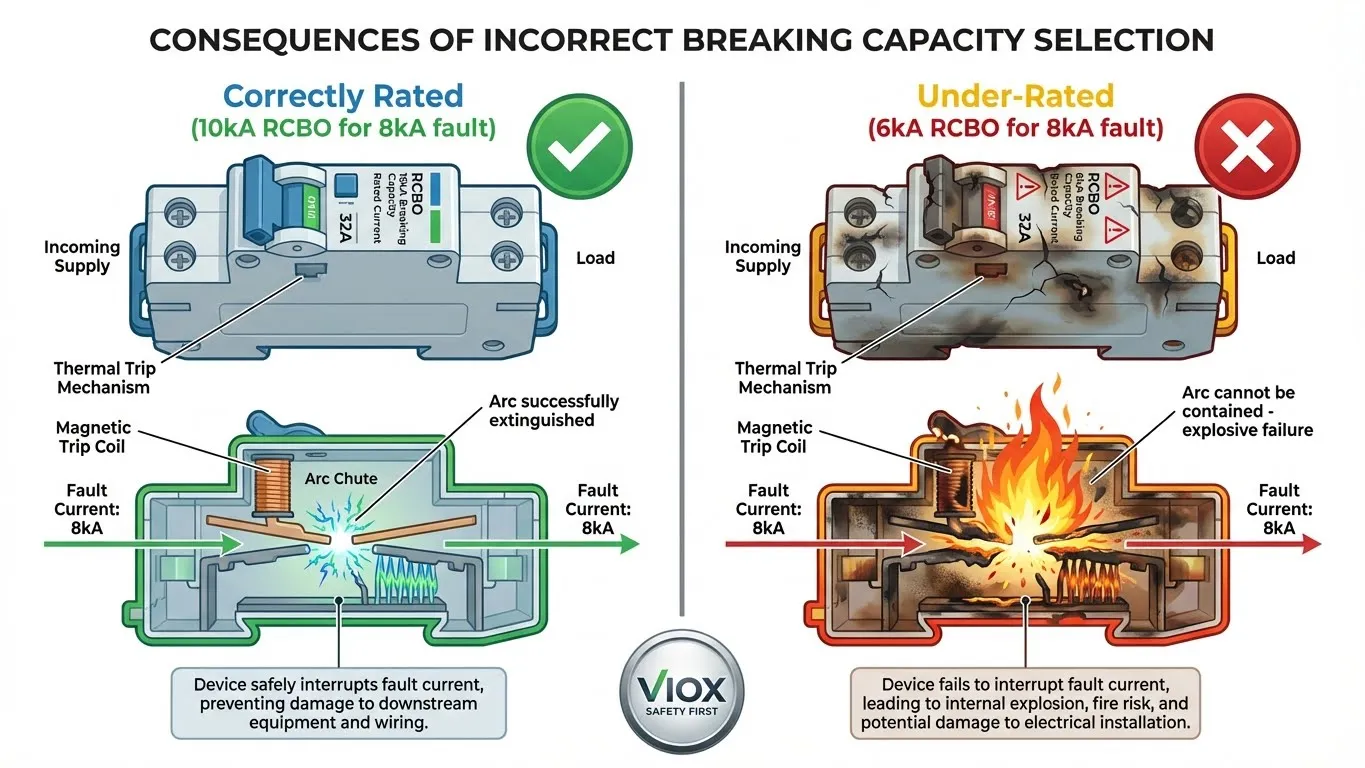
| 8kA Fault Level | 6kA RCBO | FAILURE. Contacts weld or housing ruptures. Arc escapes, damaging adjacent breakers and panel busbar. | High. Panel replacement, downtime, potential fire damage. |
| 8kA Fault Level | 10kA RCBO | SUCCESS. Fault cleared safely. Device may need inspection but panel remains intact. | Low. Reset or replace single device. Zero collateral damage. |
Investing in 10kA capacity provides a “safety buffer” even if current calculations suggest 5.5kA, accounting for potential future grid upgrades by the utility which might lower supply impedance.
Common Selection Mistakes & Best Practices
Avoid these dangerous pitfalls when specifying RCBOs:
- Mistake #1: The “Residential Default”. Assuming all homes are 6kA. Modern high-rise condos often have fault levels >6kA at the main riser.
- Mistake #2: Ignoring Utility Upgrades. A transformer upgrade by the city can lower impedance, pushing a borderline 6kA installation into the danger zone.
- Mistake #3: Mixing Capacities. Installing a 6kA RCBO in a panel rated for 10kA degrades the entire assembly’s rating unless specific series-rating tests verify cascade protection.
Best Practice Checklist:
- Obtain PSCC (Prospective Short Circuit Current) data from the utility or measure it with a loop impedance tester at the main switch.
- Apply a 1.2 safety factor (e.g., if measured 5.5kA, specify 10kA, not 6kA).
- Ensure the RCBO complies with relevant IEC standards (61009-1).
FAQ Section
Q: Can I use a 6kA RCBO if my calculated fault current is exactly 5.5kA?
Technically, yes, as it is within the 6kA limit. However, VIOX engineering recommends moving to 10kA. A margin of 0.5kA is slim, and any reduction in cable resistance or utility changes could push the fault level above the device’s rating.
Q: What is the difference between Icn and Ics?
Icn is the ultimate breaking capacity (maximum it can handle once or twice). Ics is the service breaking capacity (maximum it can handle and remain serviceable). For mission-critical applications, check the Ics rating.
Q: Do I need to upgrade RCBOs if the utility upgrades their transformer?
Yes. If the utility replaces a 200kVA transformer with a 500kVA unit, the available fault current increases significantly. You should reassess your main panel protection.
Q: Can I mix 10kA and 16kA RCBOs in the same panel?
Yes, provided the panel busbar assembly is rated for the highest fault level (16kA) and the lowest rated device (10kA) is still sufficient for the fault current at that specific point.
Q: Are higher breaking capacity RCBOs more reliable for normal operation?
Generally, yes. 10kA and 16kA devices have more robust contact mechanisms and arc chutes to handle high-energy faults. This robust construction often translates to better thermal management and longer mechanical life under normal switching.
Key Takeaways
- Safety First: Never exceed the breaking capacity. If the fault current is 8kA, a 6kA breaker is a fire hazard.
- Know Your Zone: 6kA is for standard residential; 10kA is for commercial/urban; 16kA is for industrial.
- Measure, Don’t Guess: Use cable length and transformer data to calculate PSCC.
- Future Proof: Investing in 10kA protection offers a safety buffer against grid upgrades and ensures higher durability for loads like EV chargers.
- Consult Experts: When in doubt, perform a full coordination study.
For comprehensive circuit protection solutions, explore VIOX’s full range of RCBOs and circuit protection devices.