

Direct Answer
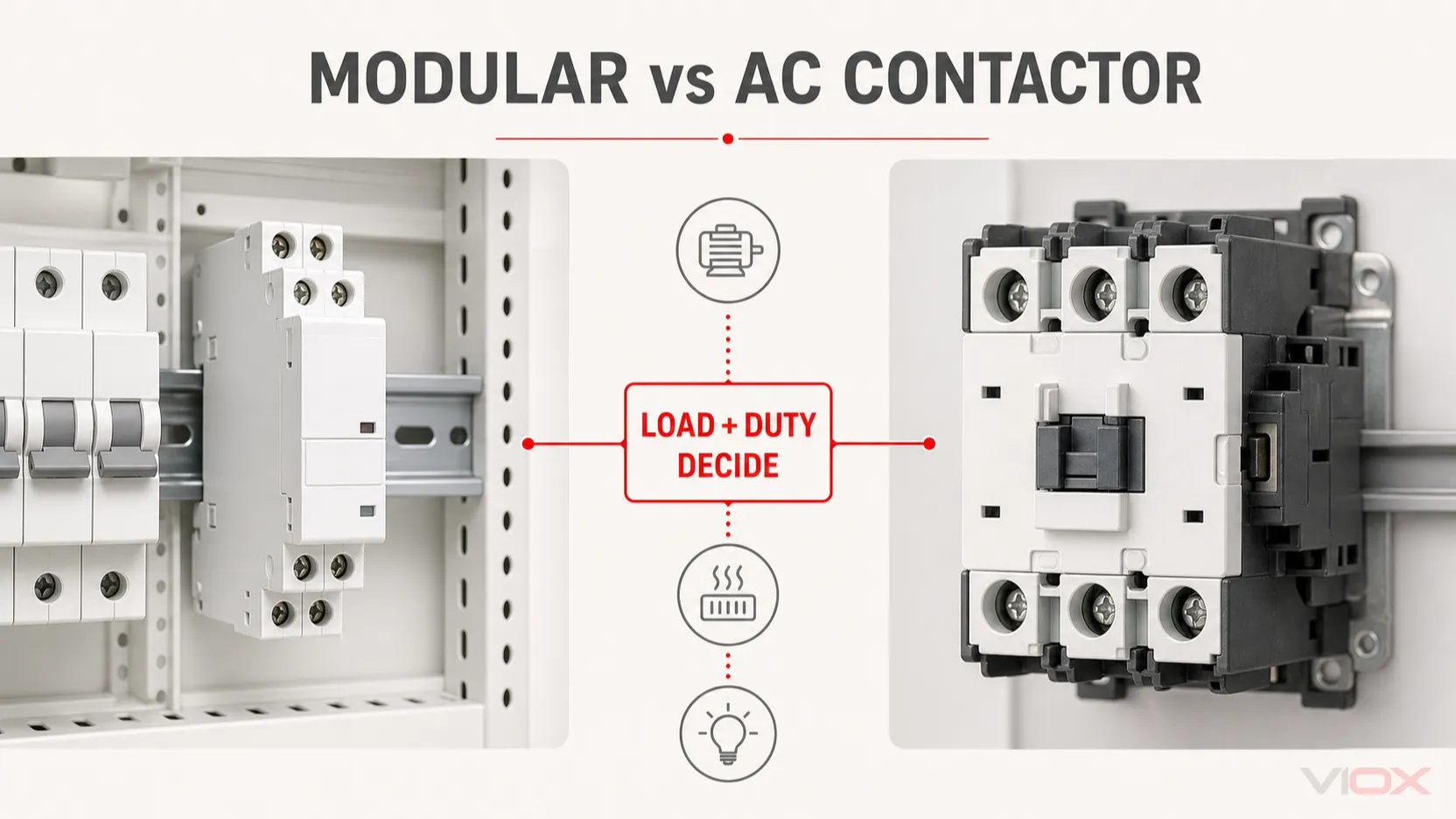
The main difference between a modular contactor and a traditional industrial AC contactor is not simply size or maximum current. It is the application and switching duty for which each product family is designed. A modular contactor is typically integrated into a DIN-rail distribution board to control suitable lighting, heating, ventilation and building-service loads. A traditional industrial AC contactor is commonly selected for motor starters, machinery and control systems that need industrial utilization ratings, overload-relay integration or a wider accessory system.
Choose between them by checking the load type, utilization category, operational current, switching frequency, pole arrangement, coil supply, panel conditions and protective-device coordination. Do not use a universal rule such as “modular below a certain amperage, traditional above it.” The same current number can represent very different switching capability under different load categories.
Modular Contactor vs Traditional AC Contactor at a Glance
| Selection factor | Modular contactor | Traditional industrial AC contactor |
|---|---|---|
| Common role | Building and distribution-board load control | Industrial motor and machine control |
| Typical installation | Modular DIN-rail board or compact control panel | Motor-control center, machine panel or industrial enclosure |
| Common load focus | Lighting, heating, ventilation and suitable small inductive loads | Motors, pumps, compressors, conveyors and industrial loads |
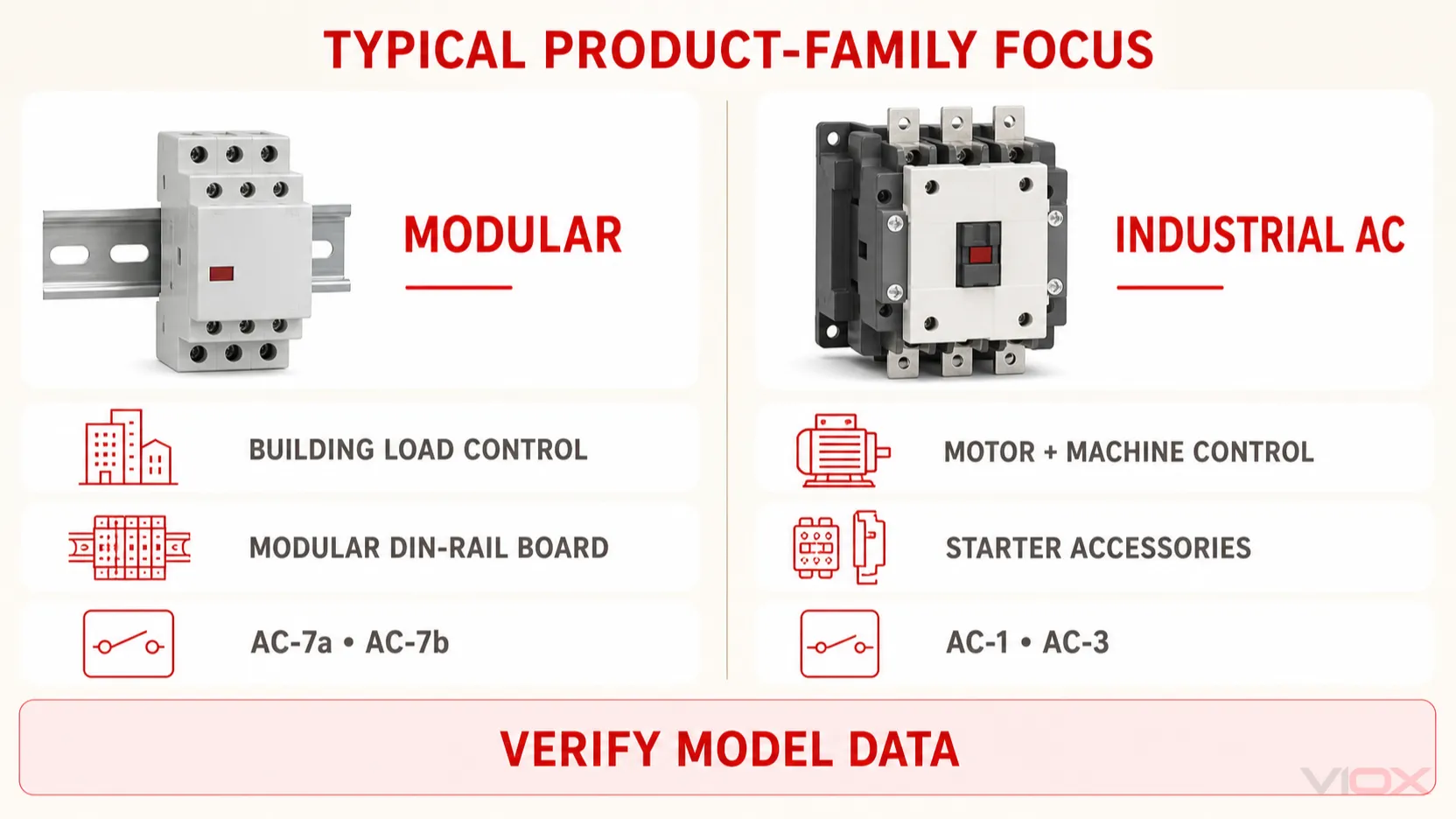
| Important utilization categories | Often AC-7a, AC-7b or other model-specific categories | Often AC-1, AC-3, AC-3e, AC-4 or other model-specific categories |
| Contact arrangements | Commonly multi-pole building-control arrangements; verify NO/NC state | Commonly three main poles plus configurable auxiliary contacts; series vary |
| Coil and noise priorities | Compact control and low-noise operation may be design priorities | Control compatibility, duty and industrial operation are usually primary |
| Accessories | Usually a focused modular accessory range | Often broader options for auxiliaries, interlocks and overload relays |
| Ratings | Must be read for the actual load category and duty | Must be read for the actual load category and duty |
| Best choice when | The product data matches a building or modular-panel load | The application needs industrial motor duty, starter coordination or accessories |
The table shows product-family tendencies. A model can differ, so its datasheet, markings and certificates remain decisive.
First, Clarify the Terminology
The terms used in online searches are not exact technical opposites:
- A modular contactor, sometimes called an installation or household contactor, normally uses a compact modular format for a DIN-rail board.
- An AC contactor is any contactor designed to switch an AC circuit. Both modular and industrial devices can therefore be AC contactors.
- A magnetic contactor describes the electromagnetic operating principle. It does not identify one housing style or application class.
- A traditional, normal or standard contactor usually means an industrial-style contactor in this comparison, especially one used for motor control.
DIN-rail mounting alone does not prove that a device is a modular installation contactor. Some industrial contactors also support DIN-rail mounting. Identify the product by its published application, utilization categories and accessories—not by the mounting clip alone.
For fundamentals without repeating them here, read What Is a Contactor? or the dedicated modular contactor wiring and selection guide.
The 9 Key Differences
1. Application Environment
Modular contactors fit naturally into distribution boards and compact building-control panels for scheduled lighting, heating, ventilation and selected auxiliary circuits. Traditional industrial contactors are more common in machine panels and motor-control centers that need overload-relay integration, interlocking or motor-control arrangements. Application is only the first filter: the actual load and duty still decide.
2. Load Type and Utilization Category
The utilization category tells you more than the headline ampere value. Resistive heating, discharge lighting, LED drivers and motors impose different making and breaking conditions. Two contactors carrying the same nominal number may have different operational ratings for those loads.
For household and similar applications, AC-7a covers slightly inductive loads and AC-7b covers household motor loads. The 2023 edition of IEC 61095 also includes AC-7d requirements for LED lamp control. Industrial motor-control selection commonly involves categories such as AC-1 for non-inductive or slightly inductive loads and AC-3 or AC-3e for motor duty. Always use the category and operating conditions published for the exact model.
The VIOX guide to AC-1, AC-3, AC-4 and other contactor utilization categories explains why category-specific ratings cannot be interchanged.
3. Form Factor and Mounting
A modular contactor uses a narrow housing intended for a distribution-board rail. An industrial contactor may use DIN-rail or screw mounting and often supports front- or side-mounted accessories. Compare actual dimensions, terminal access, conductor bend space and the complete assembly rather than assuming one family always occupies less panel space.
4. Pole and Contact Arrangement
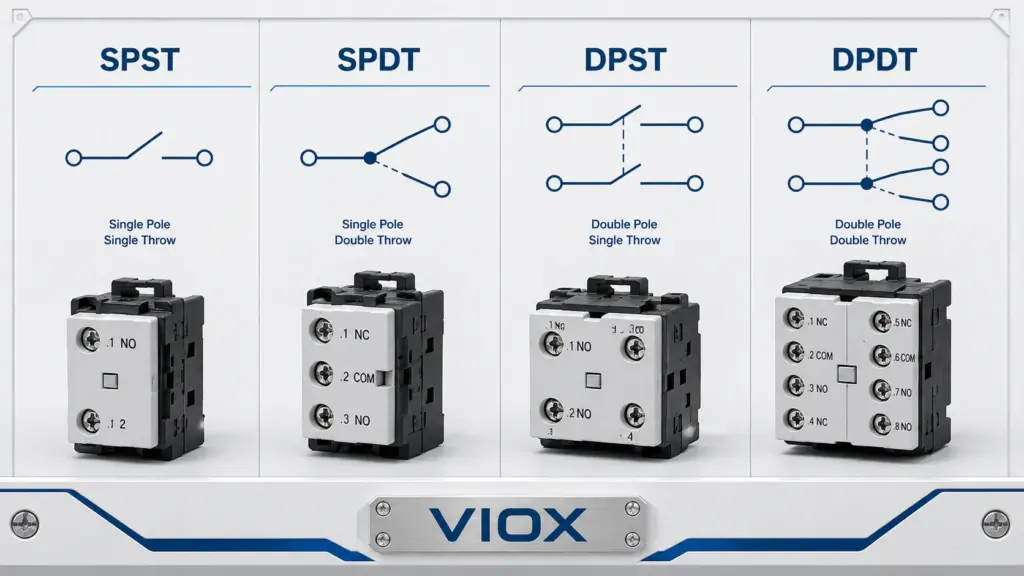
Building-control circuits may need two or four poles and may use combinations of normally open and normally closed contacts. Industrial motor circuits commonly switch three phases through three main power poles, with separate auxiliary contacts for sealing, signaling and interlocking.
Neither pattern is universal. Before ordering, map every required switched conductor and every control contact. Confirm whether the datasheet describes a main pole or an auxiliary contact, because their ratings and intended functions may differ.
5. Coil Supply and Operating Noise
Both families use a coil or electronically controlled operating system, and the coil must match the real control supply. Check AC or DC type, rated voltage, frequency where applicable, pickup and dropout behavior, and power consumption. If the coil is DC, verify whether polarity matters. Electronic coils and integrated surge suppressors can also impose polarity, leakage-current or control-output compatibility requirements.
Many modular products are designed with occupied buildings in mind, so low-noise or hum-reduced operation may be available. That does not make every modular contactor silent or every industrial contactor noisy. If sound matters, require published acoustic or low-noise product information instead of relying on the housing style.
6. Switching Frequency and Endurance
A contactor’s useful life depends on more than mechanical operations. Electrical endurance changes with the load, current, operating voltage, utilization category and switching rate. Motor starting, lamp inrush and frequent thermostat cycling can stress contacts in different ways.
Do not infer endurance from physical size. Compare the manufacturer’s electrical-endurance data under conditions close to the real application and check any permitted operating-frequency limits. If the process cycles rapidly, contact heating and coil duty need explicit review.
7. Accessories and Motor-Starter Integration
Industrial contactor families often provide coordinated overload relays, auxiliary contact blocks, mechanical interlocks, reversing assemblies and other starter accessories. This can make them the more practical basis for a motor feeder or machine-control function.
Modular contactor accessories are usually focused on distribution-board control. Available auxiliaries, spacers, suppressors and manual-control functions vary by series. If the circuit requires overload protection, do not assume the contactor provides it. A contactor is a switching device; short-circuit and overload protection must be designed separately or through a tested, coordinated assembly as applicable.
8. Panel Wiring, Heat and Maintenance
A modular device can align neatly with a compact board, but a dense layout also concentrates heat. For either type, verify ambient temperature, ventilation, grouping instructions, wire size, terminal torque and access for inspection. Installation time depends on the actual assembly, so do not apply a universal time-saving percentage.
9. Standards and Protection Coordination
IEC 61095:2023 covers electromechanical contactors for household and similar purposes within its stated scope. IEC 60947-4-1:2023 covers electromechanical contactors, motor starters and related equipment for industrial applications within its stated voltage scope. These standards overlap in subject matter but serve different application contexts and rating systems.
Do not assign a standard from appearance. Confirm the exact standard, edition, utilization category and certification shown in the model documentation. Also verify short-circuit protective-device coordination and any required overload relay using the manufacturer’s tested tables. A contactor’s standard compliance does not by itself define the complete panel’s compliance.
Application Decision Matrix
| Application | Likely starting point | What decides the final choice |
|---|---|---|
| Scheduled resistive heating | Modular contactor | AC-7a or other applicable rating, pole arrangement, cycling and enclosure temperature |
| Lighting or LED circuit | Modular contactor | Lamp/driver inrush, AC-7a or AC-7d data where published, switching frequency |
| Building ventilation fan or small pump | Compare both | Motor starting current, AC-7b or AC-3 rating, cycling and required protection |
| Direct-on-line industrial motor starter | Industrial AC contactor | Motor data, AC-3/AC-3e rating, overload relay and short-circuit coordination |
| Reversing or star-delta motor control | Industrial AC contactor | Compatible interlocks, auxiliaries, timing and coordinated starter data |
| Compact panel auxiliary load | Modular contactor may fit | Actual load duty, coil/control compatibility and thermal layout |
| Legacy replacement | Match the verified specification | Category rating, coil, contacts, dimensions, accessories and coordination—not model appearance |
This matrix narrows the product family; it does not replace model-specific verification.
Can One Replace the Other?
Sometimes, but only after a complete specification check. An equal operational-current figure does not prove interchangeability, and a larger industrial contactor is not better if it creates a coil, contact, enclosure or coordination mismatch.
Before substituting either family, verify:
- Load type and utilization category.
- Operational current at the actual voltage and duty.
- Making capacity, inrush and motor-starting requirements.
- Number of main poles and normal contact state.
- Coil type, voltage, frequency and DC polarity if applicable.
- Control-output compatibility, including electronic coils and suppressors.
- Switching frequency and electrical-endurance data.
- Mounting, dimensions, terminal capacity and enclosure temperature.
- Auxiliary contacts, interlocking and overload-relay requirements.
- Short-circuit protection and tested coordination tables.
- Required standards, approvals and certificates for the target market.
Common Selection Mistakes
- Comparing only the current printed on the front. Use the operational rating for the applicable utilization category.
- Assuming every DIN-rail contactor is a modular contactor. Verify the product’s application and standard data.
- Ignoring load inrush. LED drivers, transformers and motors can demand very different making performance.
- Treating the contactor as a protective device. Define short-circuit and overload protection separately.
- Using a universal current, horsepower, cost or installation-time threshold. Those shortcuts are not portable across product ranges and operating conditions.
- Forgetting the control side. The correct power contacts will not compensate for the wrong coil or an incompatible controller output.
Practical Selection Checklist
Start with the circuit:
- Define the load: heating, lighting, motor, transformer or another type.
- Record operating voltage, full-load current, inrush or starting behavior and switching frequency.
- Identify the applicable utilization category.
- Choose the required poles and NO/NC arrangement.
- Match the coil to the control supply and output device.
- Decide whether overload-relay integration, interlocking or auxiliary contacts are required.
- Check enclosure temperature, dimensions, ventilation and conductor requirements.
- Verify protection coordination and model-specific standard documentation.
- Compare total assembly fit and maintainability, then evaluate price.
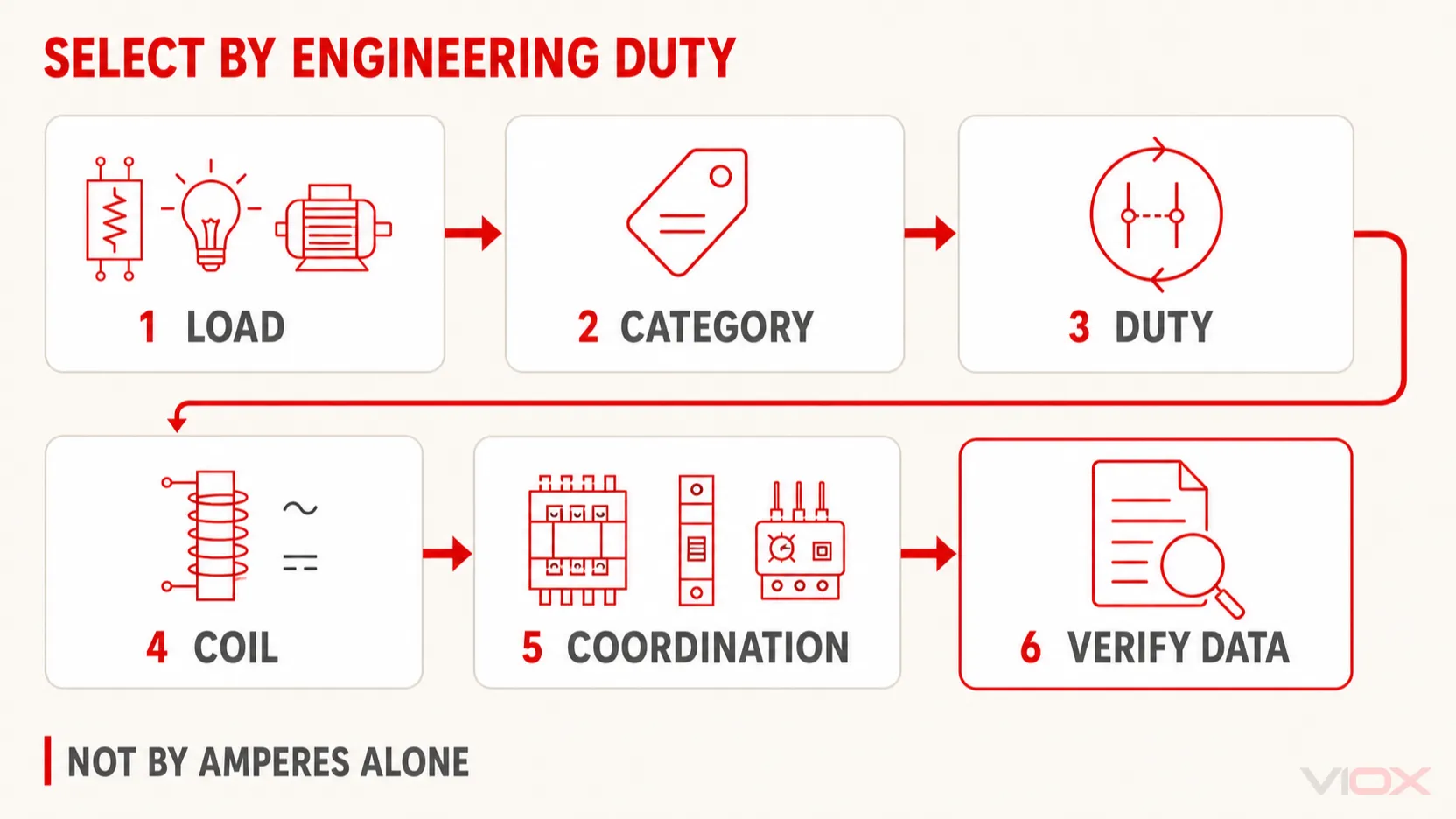
Once these requirements are known, compare the VIOX modular contactor range with the VIOX industrial AC contactor range. For a quotation or model check, send VIOX the load type, utilization category, operating current, voltage, coil supply, poles, switching frequency, target market and required quantity.
Frequently Asked Questions
Is a modular contactor the same as an AC contactor?
A modular contactor can be an AC contactor when it switches an AC load. “Modular” describes its form and typical installation context, while “AC” describes the circuit it switches. Industrial contactors can also be AC contactors.
Is a modular contactor the same as a magnetic contactor?
Not exactly. A magnetic contactor is operated electromagnetically. Many modular and industrial contactors use that principle, so “magnetic” does not distinguish the two product families.
Can a modular contactor control a motor?
Yes, if the exact model has a suitable operational rating for the motor load, starting conditions and switching duty. Check AC-7b, AC-3 or other relevant published data and provide the required overload and short-circuit protection.
Can an industrial AC contactor replace a modular contactor?
It can in some designs, but the coil, poles, contact states, dimensions, noise, accessories and protective coordination must all match. A higher headline rating alone does not prove compatibility.
Which contactor is quieter?
Some modular contactors are engineered for low-noise building operation, but noise varies by model, coil condition, supply quality and installation. Use manufacturer data when acoustic performance is a requirement.
Which standard applies to modular and industrial contactors?
IEC 61095 is relevant to contactors for household and similar purposes within its scope, while IEC 60947-4-1 covers industrial electromechanical contactors and motor starters within its scope. The product documentation determines which standard and edition apply to a specific model.
Does a higher ampere rating always mean a better contactor?
No. The rating must correspond to the load category, voltage, switching duty and environmental conditions. A correctly categorized lower-numbered device may be more appropriate than a larger device whose rating is stated for a different load.