

The MCCB full form in electrical systems is Molded Case Circuit Breaker.
An MCCB is a low-voltage circuit breaker used to protect feeders, larger loads, and distribution circuits from overload and short-circuit conditions. In brief, while many standard MCB applications stay within lower branch-circuit ranges, MCCBs are used across much higher current levels and can scale into much larger industrial and commercial protection duties, depending on the product family and standards framework such as IEC 60947-2.
The term matters because it does more than expand an acronym. It tells you that the breaker is enclosed in a molded insulating case and built for more demanding protection tasks than a typical miniature breaker.
For a broader device overview beyond this acronym page, see What Is a Molded Case Circuit Breaker (MCCB)?.
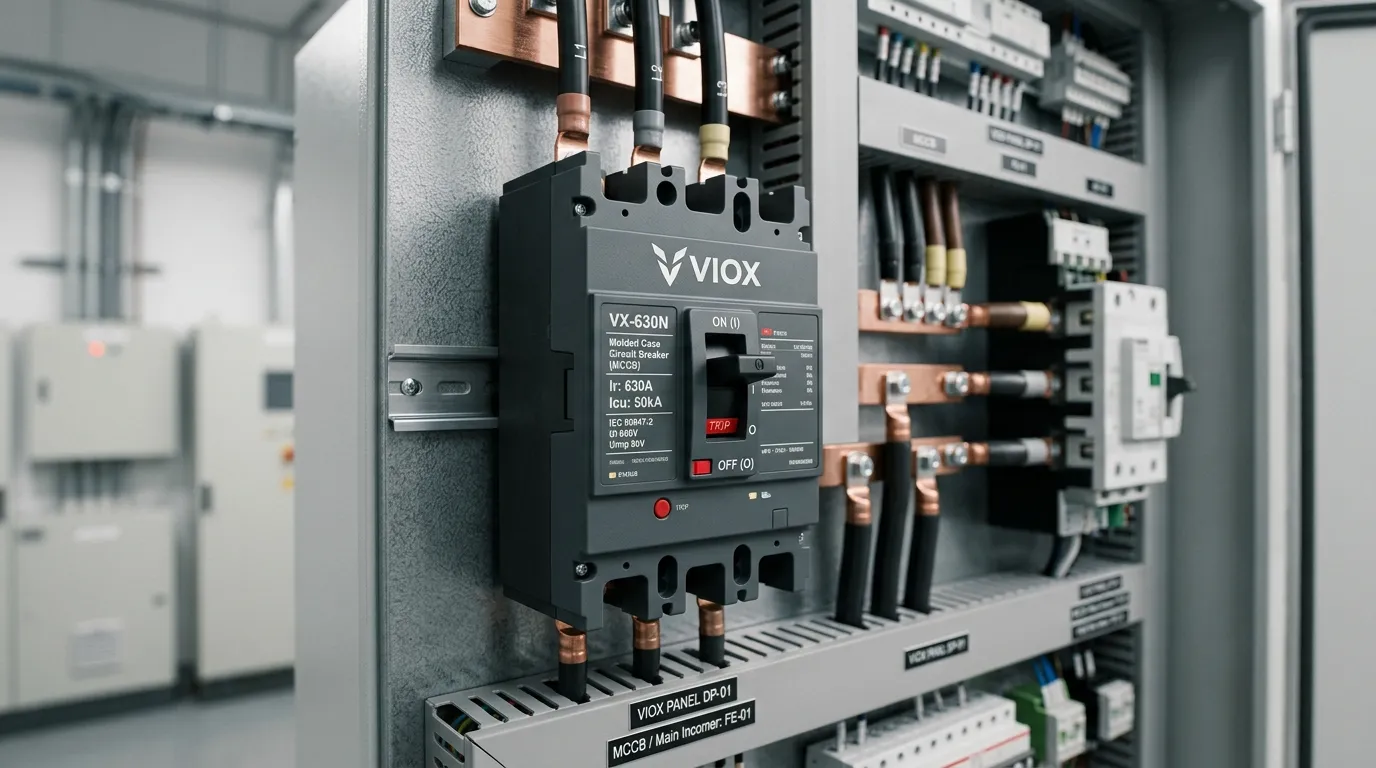
What Does MCCB Mean in Electrical Systems?
MCCB stands for Molded Case Circuit Breaker.
Each part of the name describes something useful:
- Molded refers to the insulating housing formed around the device body
- Case refers to the enclosed construction that contains the internal switching and trip mechanism
- Circuit Breaker refers to the device function: interrupting the circuit automatically when fault or overload conditions exceed the breaker design or settings
That is why MCCB is both an acronym and a device category. It describes construction, protection function, and application level at the same time.
What Does an MCCB Do?
An MCCB protects circuits and equipment by interrupting current when abnormal conditions occur. Depending on the trip unit and application, an MCCB may be used for:
- overload protection
- short-circuit protection
- feeder isolation and switching within maintenance procedures
- coordination with upstream and downstream protection devices
In many commercial and industrial systems, the MCCB is chosen because the protection task is too demanding for a small branch-circuit breaker. That may be due to current level, available fault current, adjustability, selectivity requirements, or the physical duty of the installation.
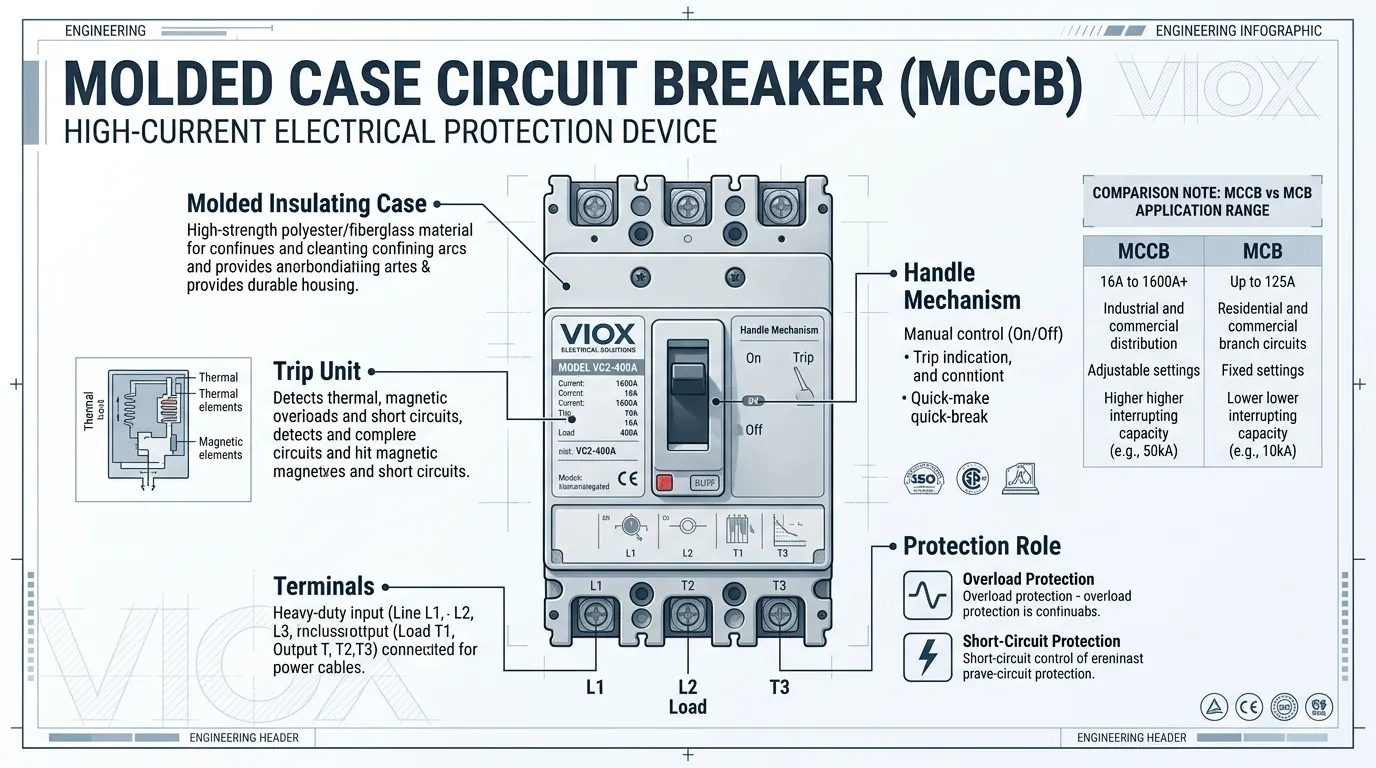
Why Is It Called a Molded Case Circuit Breaker?
The “molded case” part is important because it distinguishes this device from smaller breakers and from other switchgear families.
The molded case:
- provides insulation around internal live parts
- supports the breaker structure under thermal and mechanical stress
- encloses the contacts and trip mechanism
- allows the device to be built for more demanding current and interruption duties
This is one reason MCCBs are widely used in panelboards, switchboards, machinery feeders, generator systems, and industrial distribution equipment.
MCCB vs MCB: The Difference Most People Need First
The most useful first comparison is MCCB vs MCB.
| Device | Full form | Typical role | Main difference |
|---|---|---|---|
| MCB | Miniature Circuit Breaker | Final circuits and smaller loads | Compact device usually used on lower-current branch circuits with fixed or simpler protection characteristics |
| MCCB | Molded Case Circuit Breaker | Feeders, larger loads, industrial and commercial distribution | Higher current range, stronger interruption capability, and broader adjustability or trip-unit options |
The difference is not only physical size. An MCCB is typically selected when the circuit needs more protection flexibility, higher interrupting performance, or a more robust device platform.
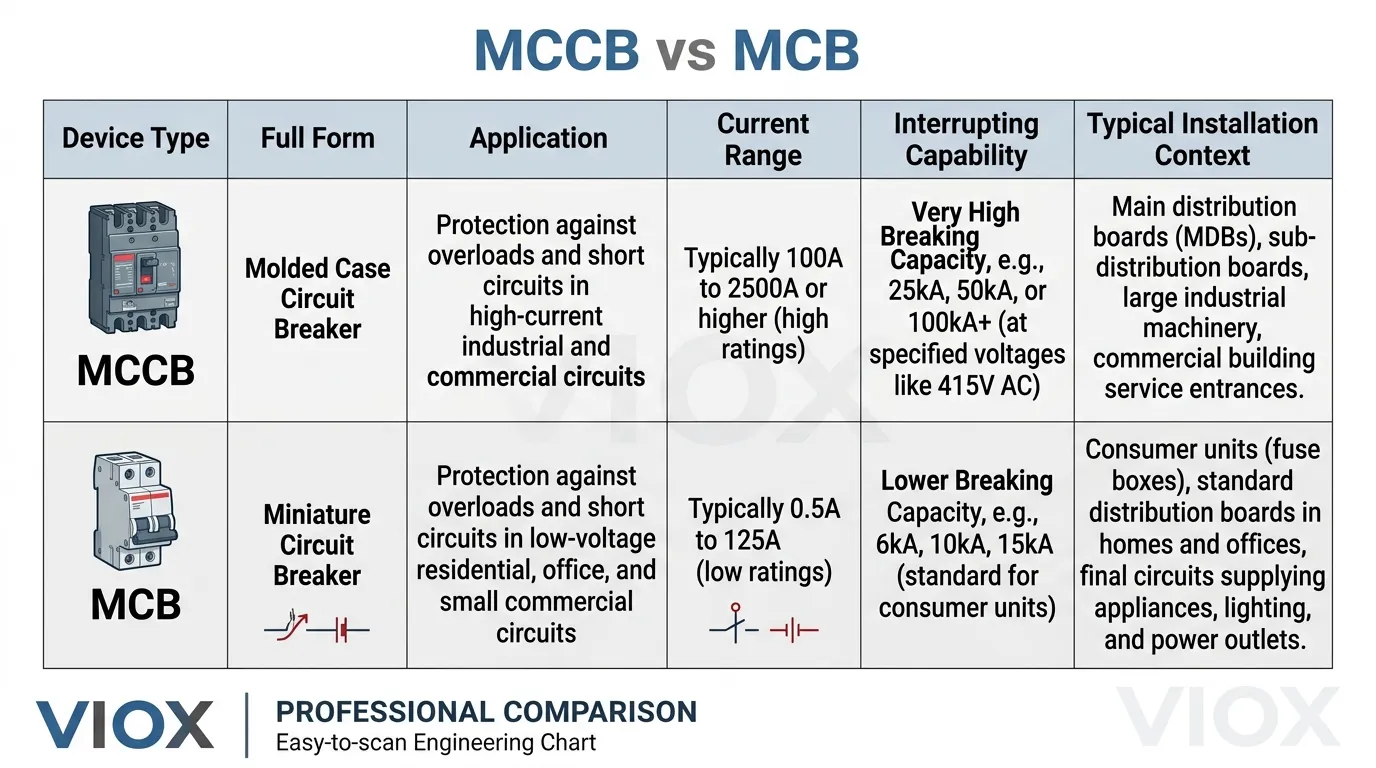
For the complete side-by-side comparison, see MCCB vs MCB.
Thermal-Magnetic vs Electronic MCCB Trip Units
One of the most important distinctions in modern MCCB design is the trip unit type.
Thermal-magnetic MCCBs
Thermal-magnetic MCCBs use:
- a thermal element for overload response
- a magnetic element for short-circuit response
They are common in conventional power distribution and are often preferred where simplicity, familiarity, and cost control matter more than advanced setting precision.
Electronic MCCBs
Electronic or solid-state trip MCCBs use electronic sensing and trip logic rather than relying only on thermal and magnetic elements. These designs are usually chosen when the system needs:
- more adjustable protection settings
- better coordination between breakers
- clearer protection tuning for feeders and larger loads
- improved monitoring or accessory integration in advanced systems
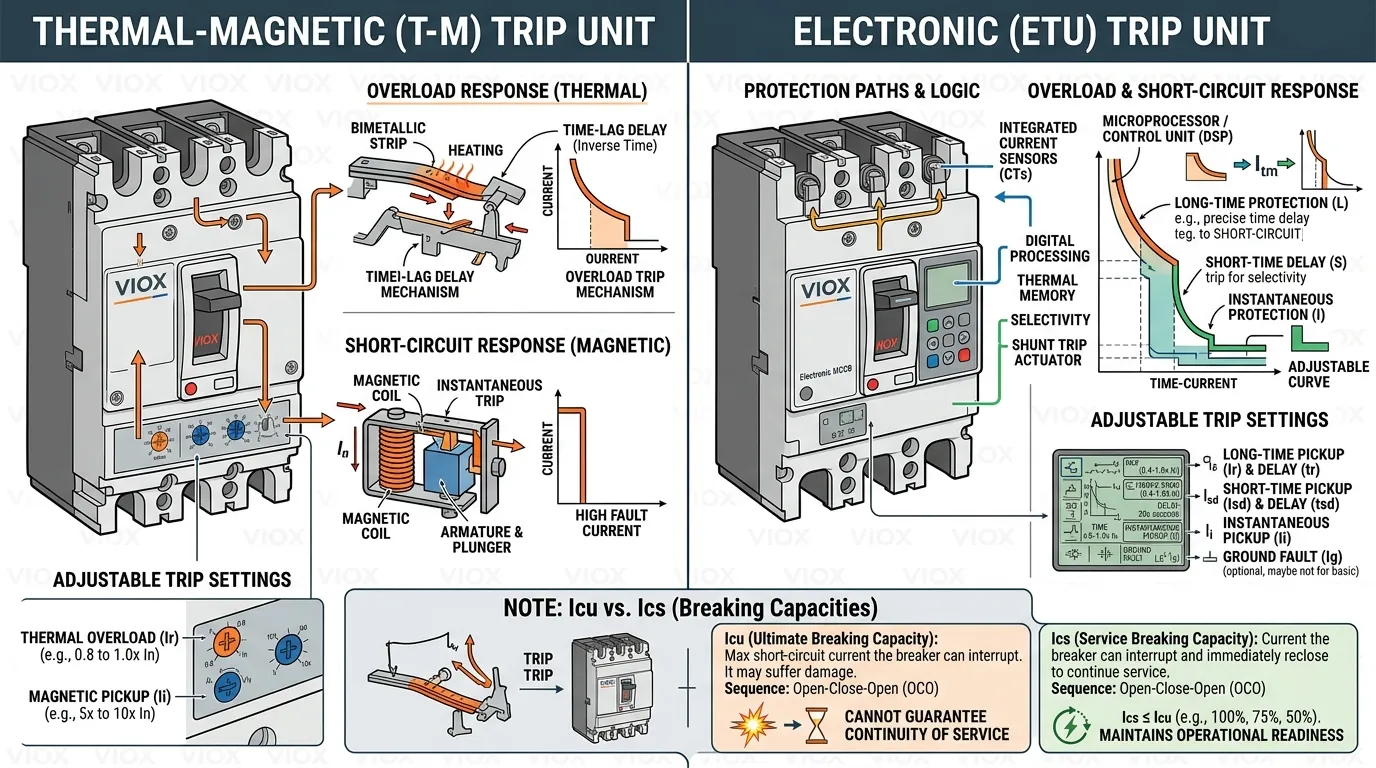
For readers who need that distinction in more detail, Electronic vs Thermal-Magnetic MCCB is the right follow-up page.
Key MCCB Specifications Worth Recognizing
This page is mainly about terminology, but a few specification terms explain why MCCBs belong in more demanding systems.
| Parameter | Why it matters |
|---|---|
| Rated current | Indicates the continuous current range the MCCB is intended to carry |
| Interrupting rating | Indicates how much fault current the breaker can safely interrupt |
| Ampere Frame (AF) | Helps define the breaker frame size and application range within a product family |
| Trip unit type | Shows whether the device uses thermal-magnetic or electronic protection logic |
| Adjustable settings | Important when the system needs tailored protection or coordination |
| Number of poles | Determines whether the breaker is used in single-phase or three-phase systems |
These terms explain why an MCCB is not just “a larger breaker.” They define how the breaker fits the system, how it coordinates with other protection devices, and how much control the engineer has over protection behavior.
A Quick Pro Tip: Icu vs Ics
One useful distinction that separates a basic MCCB description from a real engineering discussion is the difference between Icu and Ics.
- Icu is the ultimate short-circuit breaking capacity
- Ics is the service short-circuit breaking capacity
In simple terms, Icu describes the maximum fault interruption capability under defined test conditions, while Ics is more closely tied to the breaker’s expected service performance after interruption. When comparing MCCBs for real projects, looking only at a headline breaking number without understanding Icu and Ics can lead to poor device selection.
For specification-heavy work, How to Select an MCCB for a Panel is the better next step.
Where Are MCCBs Used?
MCCBs are commonly used where circuit protection must cover larger currents, stronger fault levels, or more demanding operational conditions than a miniature breaker is designed for.
Typical applications include:
- main incoming breakers in small and medium distribution boards
- feeder protection in commercial buildings
- industrial power panels
- machinery and motor supply systems
- generator and backup power distribution
- HVAC, pumps, and heavy electrical loads
- EV charging distribution systems in some commercial installations
In high-temperature environments, real-world application details also matter. Panel heat, enclosure conditions, and nearby equipment loading can all affect breaker behavior, so derating and thermal review should not be ignored in practical MCCB selection.
How MCCB Relates to Other Breaker Terms
MCCB is only one part of the broader breaker vocabulary used in electrical systems.
Quick reference table
| Acronym | Full form | Main role |
|---|---|---|
| MCB | Miniature Circuit Breaker | Protects smaller circuits from overload and short circuit |
| MCCB | Molded Case Circuit Breaker | Protects larger circuits, feeders, and industrial loads |
| RCCB | Residual Current Circuit Breaker | Protects against residual current or earth leakage, not overload protection on its own |
| RCBO | Residual Current Breaker with Overcurrent Protection | Combines residual-current protection with overcurrent protection |
| ACB | Air Circuit Breaker | Used in larger low-voltage systems above many common MCCB applications |
For the wider terminology map, see the difference between MCB, MCCB, RCB, RCD, RCCB, and RCBO.
FAQ
What is the MCCB full form?
MCCB stands for Molded Case Circuit Breaker.
What does an MCCB do?
An MCCB protects feeders, equipment, and distribution circuits by interrupting current during overload or short-circuit conditions within the protection scope of the breaker design.
What is the difference between MCCB and MCB?
An MCB is usually used for smaller final circuits, while an MCCB is used for larger circuits, feeders, and more demanding protection duties. MCCBs generally provide a broader current range, stronger interrupting performance, and more advanced protection options.
Why is it called a molded case circuit breaker?
The name refers to the molded insulating enclosure that houses the breaker mechanism and supports the device in higher-duty electrical applications.
Where are MCCBs commonly used?
MCCBs are commonly used in commercial and industrial power distribution, feeder protection, machinery panels, generator systems, and larger electrical loads.
What is the difference between thermal-magnetic and electronic MCCBs?
Thermal-magnetic MCCBs use thermal and magnetic trip elements, while electronic MCCBs use electronic sensing and trip logic for greater adjustability and coordination in more advanced systems.
Conclusion
The MCCB full form is Molded Case Circuit Breaker, but the term matters because it points to a specific class of protection device used in more demanding electrical systems. An MCCB is not just a larger breaker. It is a breaker designed for higher-duty protection roles, stronger interrupting requirements, and broader application flexibility in commercial and industrial power distribution.
That is why understanding the name, the trip-unit type, and a few key specifications goes much further than memorizing the acronym itself. Once the acronym is clear, the next practical step is to match the breaker to the system, the fault level, and the protection objective.

