

On this page
Direct Answer: Thermal Magnetic vs Electronic Trip MCCB
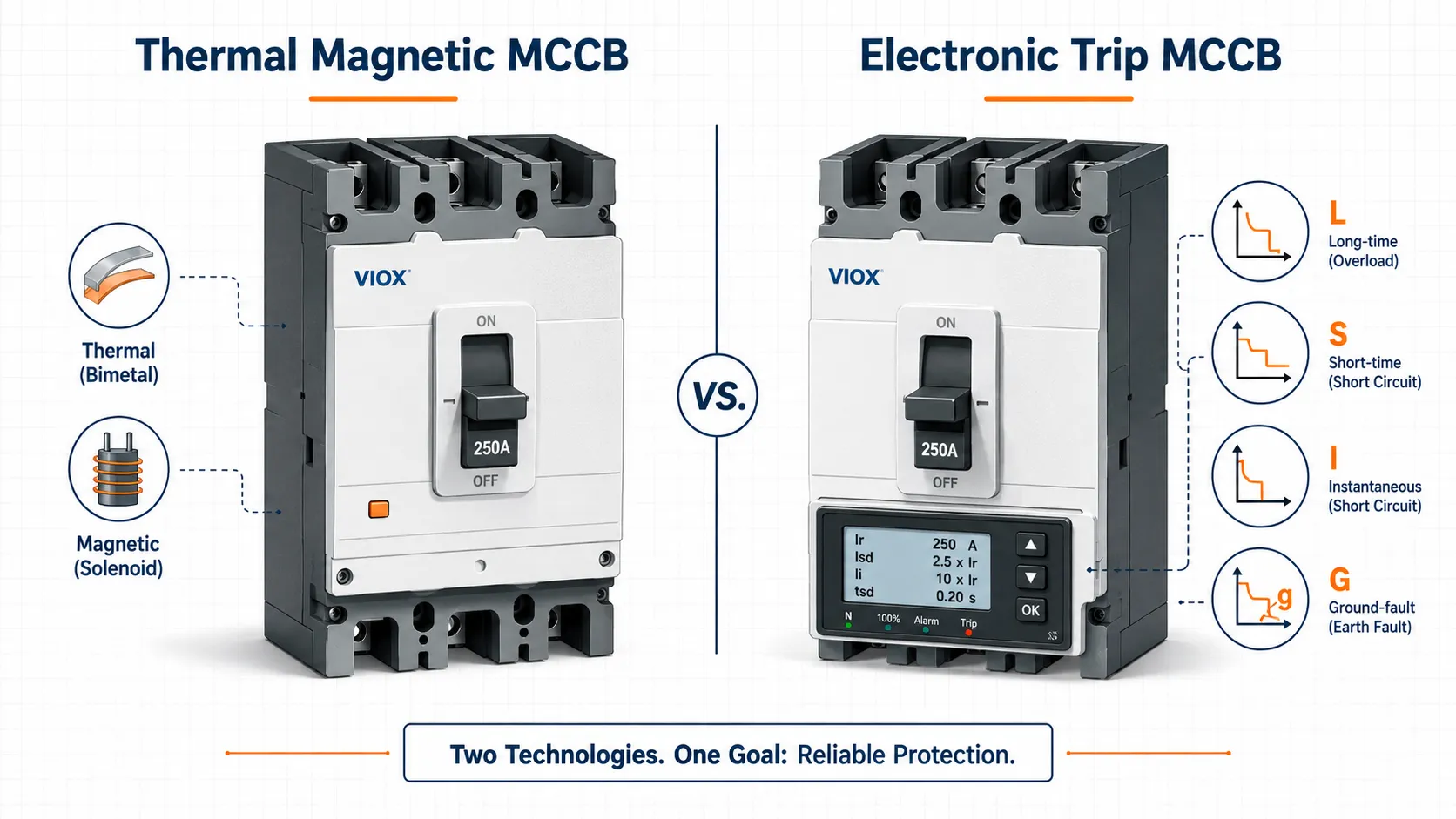
A thermal magnetic MCCB uses a bimetal element for overload protection and a magnetic element for short-circuit protection. An electronic trip MCCB uses current sensors and an electronic trip unit to provide more adjustable protection, such as long-time, short-time, instantaneous, and ground-fault settings.
Choose a thermal magnetic MCCB for simple feeders, standard distribution panels, and cost-sensitive applications where fixed or limited trip settings are acceptable. Choose an electronic trip MCCB when the system needs selective coordination, adjustable time-current curves, ground-fault protection, metering, communication, alarm contacts, or future-ready power monitoring.
Key Takeaways
- Thermal magnetic MCCBs are simple, proven, and cost-effective, but their trip curves are usually fixed or only partly adjustable.
- Electronic trip MCCBs provide more precise and flexible protection settings, especially for selective coordination in larger distribution systems.
- Electronic trip units may support LSI or LSIG protection, metering, event indication, and communication depending on the model.
- Electronic does not automatically mean better. For a simple branch feeder, thermal magnetic protection may be sufficient.
- The final choice should be based on load type, fault level, coordination study, maintenance strategy, panel budget, and project specification.
Thermal Magnetic vs Electronic Trip MCCB Comparison Table
| Factor | Thermal Magnetic MCCB | Electronic Trip MCCB |
|---|---|---|
| Sensing method | Bimetal strip and magnetic coil | Current transformer/sensor plus electronic trip unit |
| Overload protection | Thermal element bends with heat | Long-time pickup and delay settings |
| Short-circuit protection | Magnetic element trips rapidly at high current | Short-time and/or instantaneous settings |
| Adjustability | Fixed or limited depending on model | Wider setting range depending on trip unit |
| Selective coordination | More limited due to fixed curves | Easier with adjustable delay and pickup settings |
| Ground fault protection | Usually not integrated in basic models | Available on selected LSIG trip units |
| Metering and communication | Usually not available | Available on selected advanced trip units |
| Ambient influence | Thermal element can be affected by temperature | Electronic sensing may be less dependent on ambient temperature, but limits depend on datasheet |
| Cost | Lower initial cost | Higher initial cost |
| Best fit | Simple feeders, small panels, standard loads | Critical distribution, complex coordination, monitoring, facility power systems |
What Is a Thermal Magnetic MCCB?
A thermal magnetic molded case circuit breaker (MCCB) combines two trip mechanisms:
- Thermal trip: a bimetal strip heats and bends under sustained overload current.
- Magnetic trip: an electromagnetic coil reacts quickly to high short-circuit current.
The thermal part protects against overloads that last long enough to overheat cables or equipment. The magnetic part responds to short circuits, where current rises very quickly and must be interrupted before serious damage occurs.
This design is widely used because it is robust and easy to understand. For many standard feeders, pumps, small distribution panels, and non-critical loads, a thermal magnetic MCCB is still the practical choice.
Thermal Trip vs Magnetic Trip: How the Two Parts Work
| Function | Internal Element | Current Condition | Protection Purpose |
|---|---|---|---|
| Thermal trip | Bimetal strip | Moderate overload lasting for some time | Protects cable and equipment from overheating |
| Magnetic trip | Electromagnetic coil or solenoid | High short-circuit current | Provides fast fault interruption |
| Manual switching | Operating mechanism | Normal switching or reset | Opens and closes the circuit manually |
| Arc interruption | Contacts and arc chute | Fault interruption | Controls and extinguishes the arc |
This is why the term “thermal magnetic” should not be treated as one single action. It is two different protection behaviors inside one breaker.
For a broader explanation of MCCB ratings such as Icu, Ics, Icw, and Icm, see VIOX’s guide to circuit breaker ratings.
Thermal Magnetic Circuit Breaker Diagram: What to Show
A useful thermal magnetic circuit breaker diagram should show four internal areas:
| Diagram Area | What It Represents | Why It Matters |
|---|---|---|
| Bimetal strip | Thermal overload response | Explains delayed tripping under sustained overload |
| Magnetic coil | Short-circuit response | Explains fast tripping under high fault current |
| Contacts and mechanism | Opening and closing path | Shows how the circuit is physically interrupted |
| Arc chute | Arc splitting and cooling | Shows how the breaker controls the fault arc |
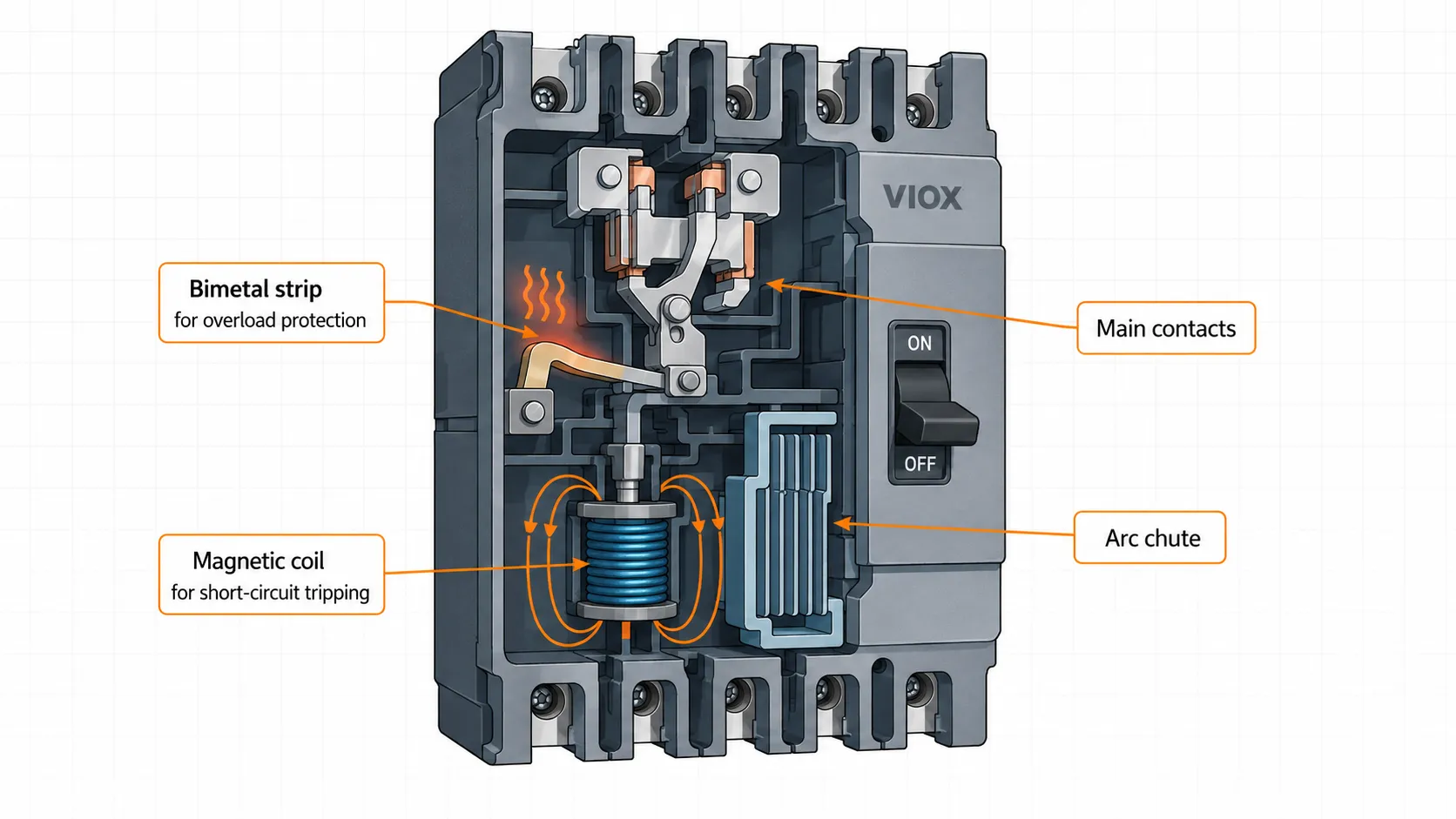
For engineering clarity, the diagram should not show a thermal magnetic MCCB as a black box. The value is in showing the two separate trip paths: slow heat-based overload protection and fast magnetic short-circuit protection.
What Is an Electronic Trip Unit?
An electronic trip unit measures current using internal sensors and processes that signal electronically. Instead of relying only on mechanical thermal response, the trip unit can compare measured current with adjustable settings.
Depending on the model, an electronic trip unit can provide:
- adjustable long-time protection
- adjustable short-time protection
- instantaneous protection
- ground-fault protection
- phase imbalance or neutral protection functions
- load current display or metering
- alarm output or communication interface
- event or trip indication
The exact functions depend on the MCCB frame, trip unit type, manufacturer, and project specification.
LSI and LSIG Settings Explained
Electronic trip MCCBs are often described by protection functions such as L, S, I, and G.
| Function | Meaning | What It Protects Against | Why It Matters |
|---|---|---|---|
| L | Long-time protection | Sustained overload | Similar purpose to thermal overload protection, but adjustable |
| S | Short-time protection | High fault current with intentional delay | Helps selective coordination with downstream breakers |
| I | Instantaneous protection | Severe short circuit | Trips without intentional delay |
| G | Ground-fault protection | Ground-fault current | Useful in selected distribution systems and critical facilities |
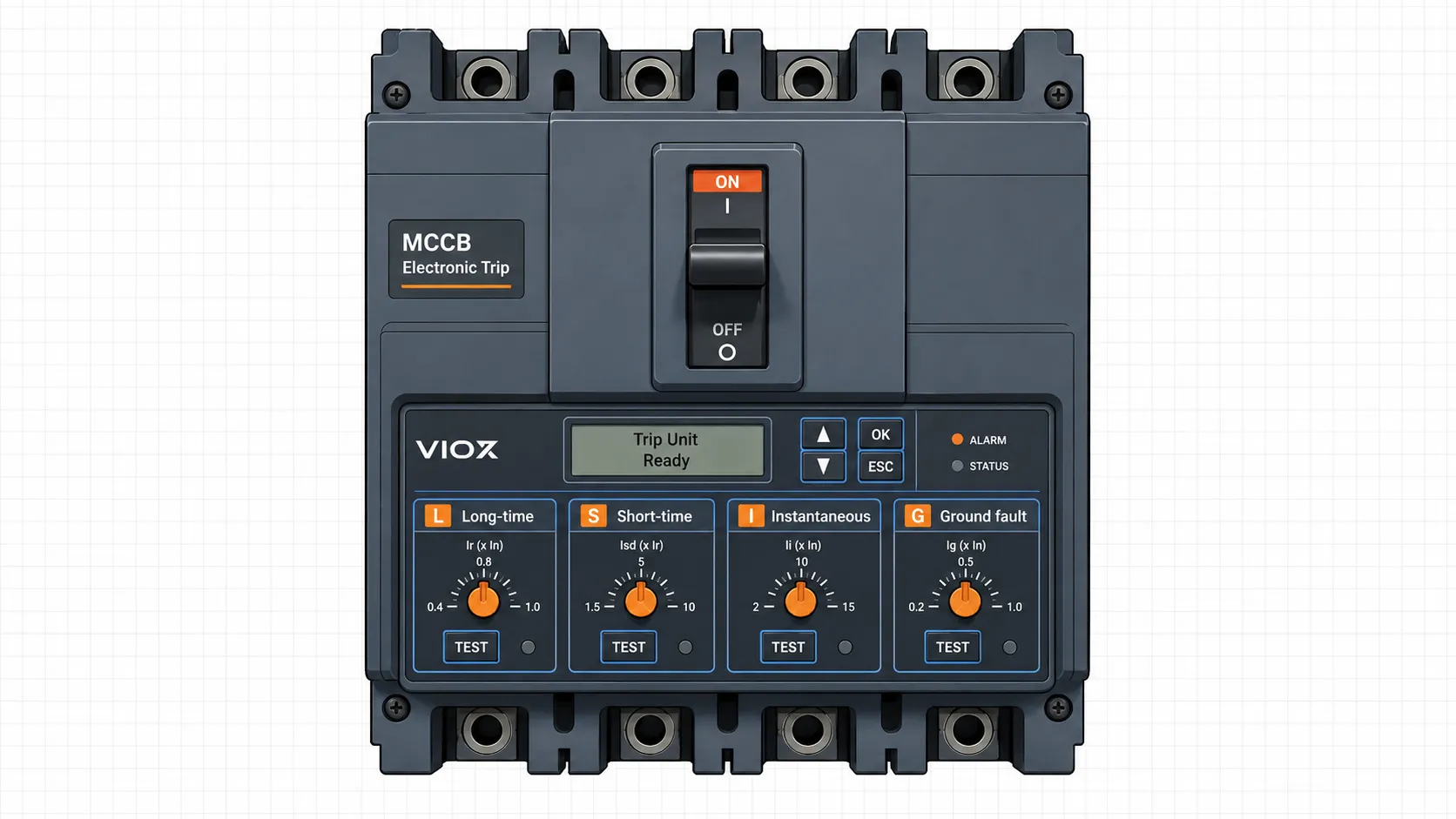
An LSI trip unit includes long-time, short-time, and instantaneous functions. An LSIG trip unit adds ground-fault protection. Not every electronic MCCB includes every function, so buyers should check the trip unit code, not just the breaker frame size.
Accuracy, Adjustability, and Time-Current Curves
The main benefit of an electronic trip MCCB is not that it is “digital.” The real benefit is control over the trip curve.
With a thermal magnetic MCCB, the protection curve is usually determined by the breaker design. Some models may offer limited magnetic adjustment, but the curve is still less flexible than an electronic trip unit.
With an electronic trip unit, engineers may be able to adjust:
- long-time pickup
- long-time delay
- short-time pickup
- short-time delay
- instantaneous pickup
- ground-fault pickup and delay
This matters when upstream and downstream breakers must coordinate. If every breaker trips at the same time, the whole panel can lose power for a downstream fault. A properly adjusted electronic trip unit can allow the downstream breaker to clear the fault first.
Selective Coordination: When Electronic Trip Units Are Worth It
Selective coordination means that only the protective device closest to the fault should trip. This is easy to say and hard to achieve in real distribution systems.
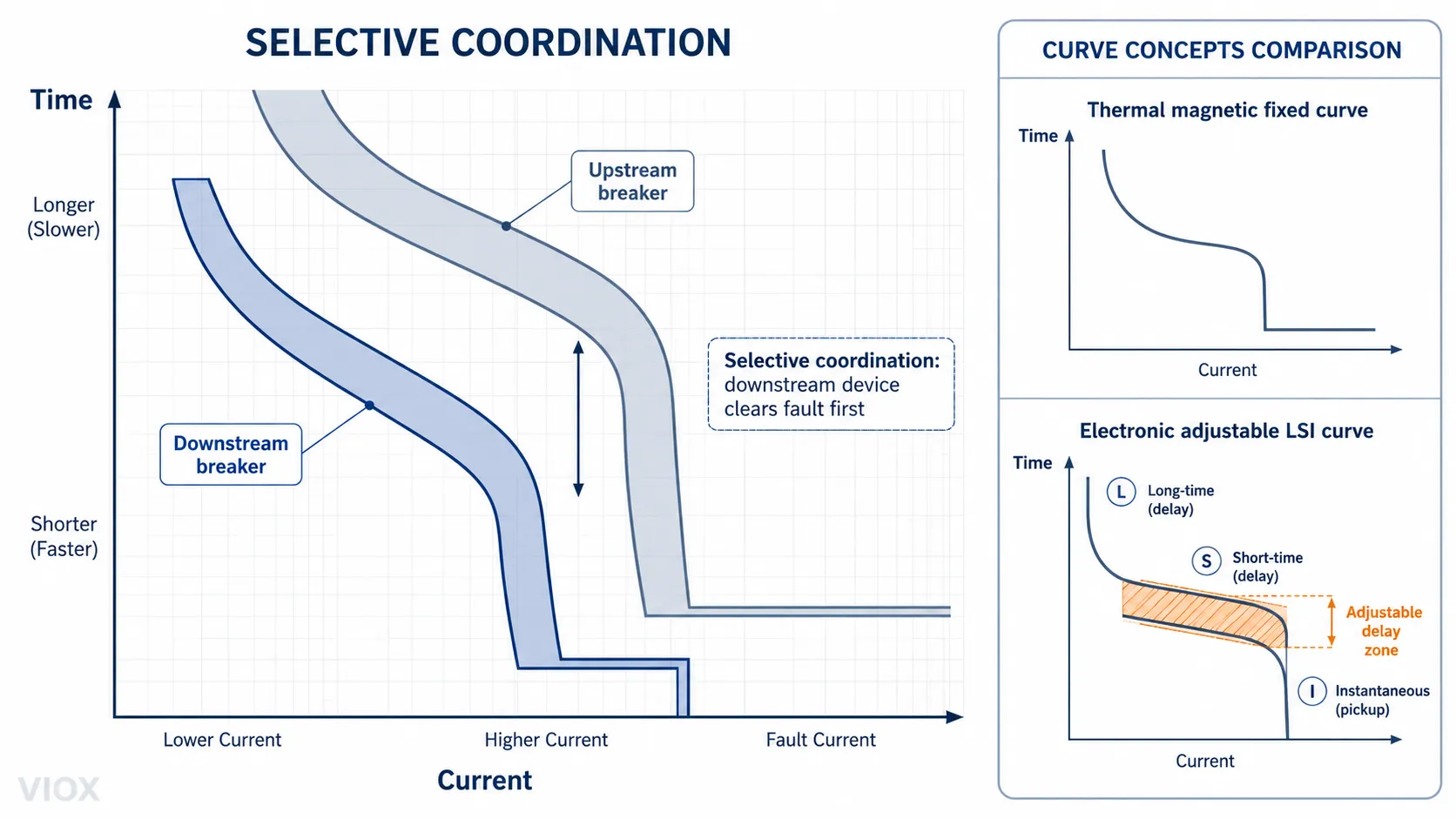
Electronic trip MCCBs are more useful when:
- there are multiple downstream distribution levels
- uptime matters
- a fault on one feeder should not shut down the whole panel
- breakers must be coordinated with transformers, generators, or large motors
- the project requires a coordination study
- maintenance teams need trip cause indication
Thermal magnetic breakers can still be coordinated in many simple systems, but the fixed curve gives the engineer less room to adjust.
Metering, Communication, Ground Fault, and ZSI Features
Some advanced electronic trip units can support functions beyond basic protection.
| Feature | What It Does | Important Caution |
|---|---|---|
| Metering | Displays or transmits current, power, or energy values | Accuracy and parameters vary by model |
| Communication | Connects to a monitoring system or BMS | Protocol and gateway support must be checked |
| Ground fault | Detects ground-fault current | Available only on selected trip units |
| Alarm contact | Signals overload, pre-trip, or trip condition | Wiring and control voltage must match the panel |
| ZSI | Zone selective interlocking for faster coordinated tripping | Only available when compatible upstream/downstream devices support it |
Zone selective interlocking (ZSI) should not be assumed to exist on every electronic MCCB. It is a system feature, not just a product label. The upstream breaker, downstream breaker, wiring, and trip unit compatibility must all be checked.
Cost and Total Cost of Ownership
Thermal magnetic MCCBs normally have a lower initial cost. They are easier to specify for simple circuits and do not require communication wiring, trip unit programming, or detailed settings documentation.
Electronic trip MCCBs cost more, but the additional cost can be justified when the system benefits from:
- fewer unnecessary upstream trips
- better coordination
- remote monitoring
- load data for maintenance
- ground-fault protection
- adjustable settings for future load changes
- better trip indication and fault analysis
For a simple lighting or small power feeder, the premium may not be justified. For a main distribution feeder, critical process load, hospital utility area, data center, large commercial panel, or industrial MCC, the additional functionality can reduce operational risk.
Application Selection Table
| Application | Better Fit | Reason |
|---|---|---|
| Small distribution panel | Thermal magnetic MCCB | Simple protection, lower cost, limited settings needed |
| Standard feeder with predictable load | Thermal magnetic MCCB | Fixed curve is often sufficient |
| Main incoming breaker | Electronic trip MCCB | Better setting control and monitoring options |
| Multi-level distribution system | Electronic trip MCCB | Selective coordination is easier |
| Generator-backed system | Electronic trip MCCB | Adjustable delay may help coordination and inrush behavior |
| Critical facility distribution | Electronic trip MCCB | Monitoring, alarms, and coordination matter |
| Cost-sensitive non-critical load | Thermal magnetic MCCB | Avoid unnecessary complexity |
| Future smart panel or BMS integration | Electronic trip MCCB | Communication and metering may be useful |
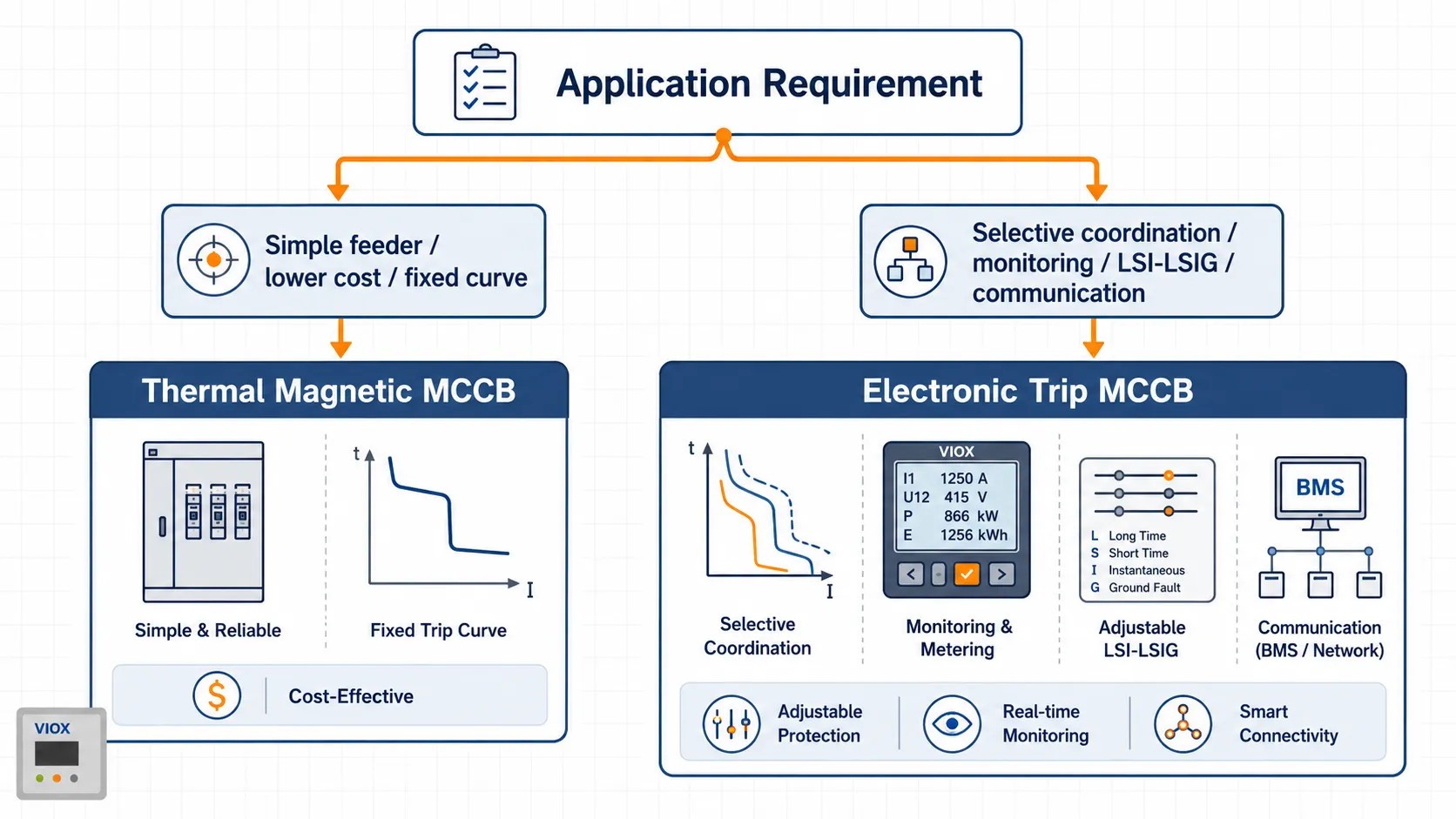
Common Selection Mistakes
Mistake 1: Buying an Electronic MCCB Only Because It Sounds More Advanced
Electronic trip protection is not automatically the correct choice. If the load is simple and the project does not require coordination, metering, or communication, a thermal magnetic MCCB may be the better value.
Mistake 2: Comparing Breaker Frames Instead of Trip Units
Two MCCBs can look similar but have very different trip units. Check the trip unit code, LSI/LSIG functions, setting range, communication options, and accessories before treating two breakers as equivalent.
Mistake 3: Assuming Communication Is Included
“Electronic trip” does not always mean Modbus, Ethernet, metering, or remote monitoring. These functions are model-specific and may require communication modules or gateways.
Mistake 4: Ignoring Selective Coordination
If upstream and downstream breakers are not coordinated, a downstream fault can trip a main breaker and shut down a larger area than necessary. This is one of the strongest reasons to consider electronic trip units.
Mistake 5: Forgetting Documentation and Settings Control
Electronic trip MCCBs require clear setting records. If maintenance teams change settings without documentation, protection coordination can be lost.
What to Check on an MCCB Datasheet
| Datasheet Item | Why It Matters |
|---|---|
| Rated current | Must match feeder and load requirements |
| Frame size | Determines physical size and maximum rating range |
| Breaking capacity | Must exceed prospective short-circuit current |
| Icu and Ics | Shows ultimate and service short-circuit performance |
| Trip unit type | Determines thermal magnetic, electronic, LSI, or LSIG capability |
| Setting range | Determines how much adjustment is available |
| Communication option | Determines BMS or monitoring compatibility |
| Ground fault option | Required for selected protection schemes |
| Accessories | Shunt trip, undervoltage release, auxiliary contact, alarm contact |
| Standards | Must match project and market requirements |
For product-level selection support, see the VIOX MCCB product page and the full guide to molded case circuit breakers.
FAQ
What is the difference between thermal magnetic and electronic trip MCCBs?
A thermal magnetic MCCB uses a bimetal strip for overload and a magnetic coil for short circuit. An electronic trip MCCB uses sensors and an electronic trip unit to provide more adjustable protection settings.
What is a thermal magnetic trip unit?
A thermal magnetic trip unit is a protection mechanism that combines thermal overload response with magnetic short-circuit response. It is simple, reliable, and common in standard MCCBs.
What is an electronic trip unit in an MCCB?
An electronic trip unit measures current electronically and trips the breaker according to adjustable settings such as long-time, short-time, instantaneous, and ground-fault functions.
Are electronic trip MCCBs better than thermal magnetic MCCBs?
They are better for coordination, monitoring, and adjustable protection. They are not always better for simple circuits where low cost and basic protection are enough.
What does LSI mean on an MCCB?
LSI means long-time, short-time, and instantaneous protection. These settings help engineers shape the breaker’s time-current curve.
What does LSIG mean on an MCCB?
LSIG means long-time, short-time, instantaneous, and ground-fault protection. The G function is useful in selected distribution systems where ground-fault protection is required.
Can electronic trip MCCBs communicate with a monitoring system?
Some can, but not all. Communication depends on the trip unit, accessories, protocol, and gateway. The datasheet and project requirements should be checked before specifying remote monitoring.
Which MCCB is better for selective coordination?
Electronic trip MCCBs are usually better for selective coordination because long-time, short-time, and instantaneous settings can be adjusted more precisely.
Conclusion
Thermal magnetic and electronic trip MCCBs solve the same basic problem: protecting low-voltage circuits from overload and short-circuit faults. The difference is how much control, visibility, and coordination the breaker can provide.
For simple feeders and cost-sensitive panels, a thermal magnetic MCCB is often enough. For critical loads, multi-level distribution, selective coordination, metering, ground-fault protection, or smart panel integration, an electronic trip MCCB is usually the stronger choice.