
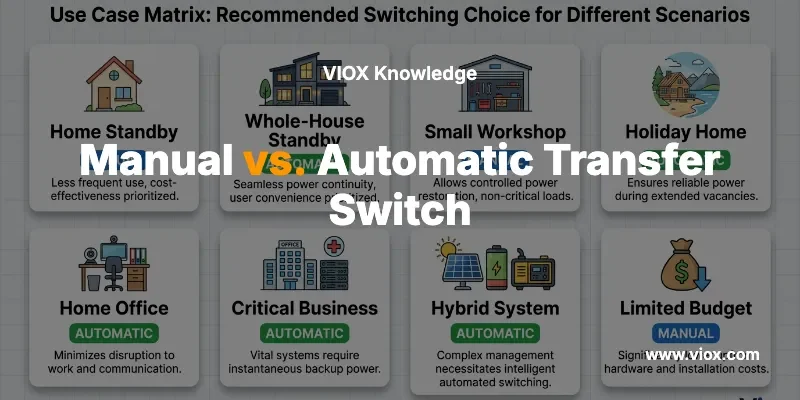

If you are comparing Manual vs. Automatic Transfer Switch options, the short answer is this: neither one is universally better. The right choice depends on how critical your loads are, how quickly backup power must take over, whether someone will be present during an outage, and how much system complexity you are willing to accept.
A manual transfer switch is often the better fit for cost-sensitive backup systems where an operator can safely start the backup source and transfer the load. An automatic transfer switch is usually the better fit when the system must respond without waiting for human action, such as in standby generator systems, critical operations, or unattended sites.
Quick Answer: Which Transfer Switch Do You Need?
| Your Priority | Choose This | Why |
|---|---|---|
| Lowest upfront cost | Manual | 40-60% cheaper; simpler installation |
| Unattended operation | Automatic | Responds in 10-30 seconds without human action |
| Critical loads (medical, data centers) | Automatic | Zero-delay transfer protects sensitive equipment |
| DIY installation | Manual | No complex wiring or control logic required |
| Vacation home | Automatic | Protects property even when you’re away |
| Budget under $1,500 | Manual | Total system cost typically $500-$1,400 |
What Is the Difference Between a Manual and Automatic Transfer Switch?
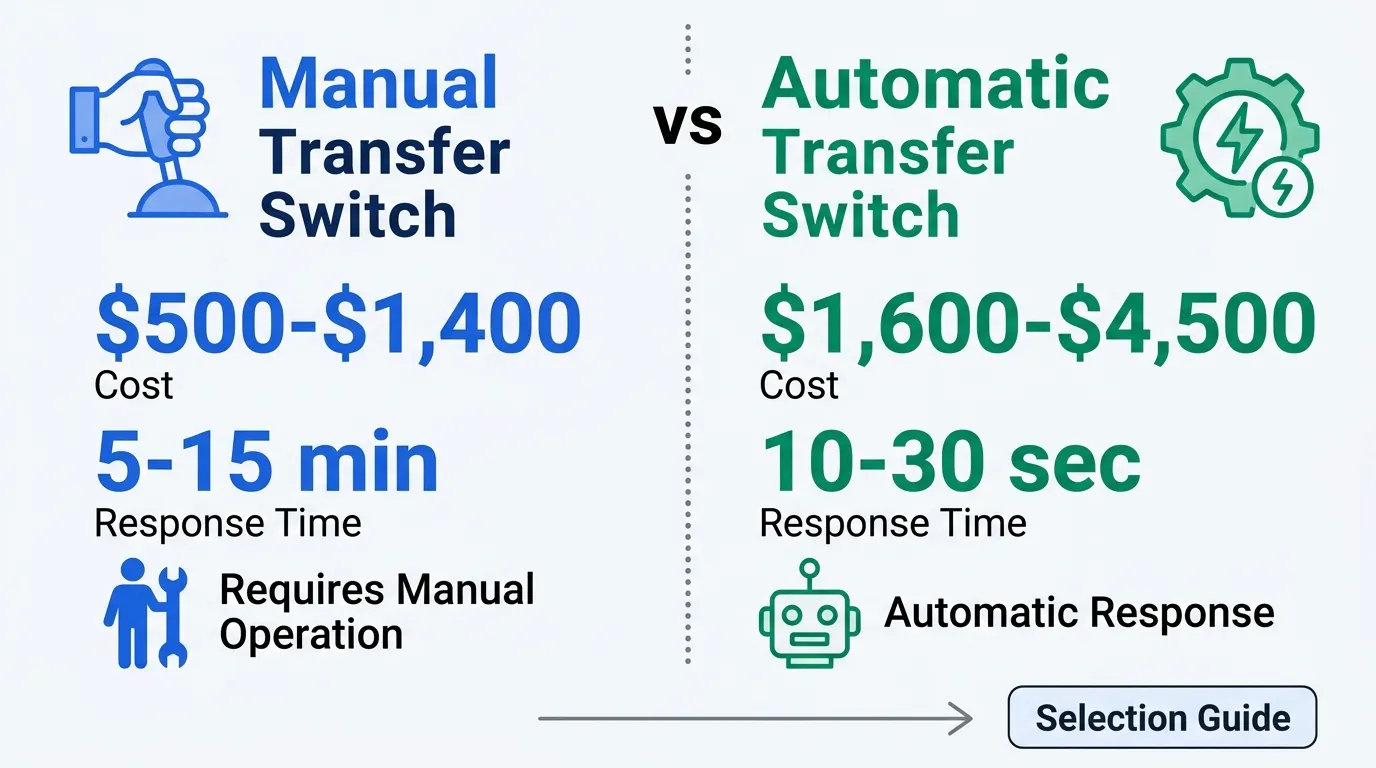
Both devices perform the same core job: they transfer electrical load from one power source to another, usually from utility power to a backup source and back again.
The real difference is how that transfer happens.
- A manual transfer switch requires a person to initiate the transfer.
- An automatic transfer switch detects the source condition and initiates the transfer automatically according to the system design.
In practical backup power terms, this means a manual system depends on operator presence and action, while an automatic system is designed to reduce or remove that dependency.
Quick Comparison Table
| Factor | Manual transfer switch | Automatic transfer switch |
|---|---|---|
| Transfer initiation | Human-operated | Automatic |
| Response time | 5-15 minutes (operator-dependent) | 10-30 seconds |
| Typical system complexity | Lower | Higher |
| Upfront cost | $500-$1,400 (total system) | $1,600-$4,500 (total system) |
| User involvement during outage | Required | Minimal or none |
| Best fit | Basic backup systems, operator-attended sites | Critical loads, standby systems, unattended sites |
If the reader is still new to ATS terminology, VIOX already has a useful foundation article on what a dual power automatic transfer switch is.
How a Manual Transfer Switch Works
A manual transfer switch relies on an operator to move the load from the normal source to the backup source.
In a typical backup-generator setup, that often means:
- The utility fails
- The operator confirms the outage condition
- The generator or backup source is started
- The transfer switch is manually operated
- Selected loads are supplied from the backup source
This design is simple, understandable, and often cost-effective.
It works well when:
- The site is occupied during typical outage times
- Outage response does not need to be immediate
- The loads are important but not ultra-critical
- The operator can follow a safe transfer process
That simplicity is a real advantage. But it also means the system does nothing until someone is present and able to act.
⚠️ Common Mistake: Choosing manual transfer for a vacation home or seasonal property. If you’re away when power fails, frozen pipes or spoiled food can cost $5,000-$15,000—far more than an automatic switch’s $800-$1,200 premium.
How an Automatic Transfer Switch Works
An automatic transfer switch monitors the normal source and is designed to transfer the load to the backup source when the source condition falls outside the acceptable operating window defined by the system.
In generator-based backup systems, that usually means:
- The switch detects utility-source failure or instability
- The backup source starts or is commanded to start
- The system confirms the backup source is available
- The load transfers automatically
- Once utility power is restored and stable, the load transfers back according to the system logic
This is why an automatic transfer switch is favored when continuity matters more than minimal hardware cost.
It is also why ATS selection often overlaps with other design decisions such as single-phase vs. three-phase ATS configuration, open vs. closed transition ATS selection, and PC-class vs. CB-class ATS selection.
Response Time Comparison
- ⚡ Automatic: 10-30 seconds (from outage to backup power)
- 🔧 Manual: 5-15 minutes (depends on operator availability and response)
This 90% reduction in response time can be critical for sensitive electronics, medical equipment, or business continuity.
Manual vs. Automatic Transfer Switch: Side-by-Side Comparison
This is the section users really come for when they search Manual vs. Automatic Transfer Switch.
| Comparison point | Manual transfer switch | Automatic transfer switch | Which is better when… |
|---|---|---|---|
| Outage response | Depends on a person being present | Responds automatically | Automatic is better when downtime must be minimized |
| Equipment cost | Usually lower ($200-$600) | Usually higher ($800-$2,500) | Manual is better when budget is tight |
| Installation complexity | Usually simpler ($300-$800) | Usually more integrated and control-dependent ($800-$2,000) | Manual is better for simpler systems |
| User convenience | Requires action during outage | Minimal human involvement | Automatic is better for convenience |
| Operational control | Operator decides when to transfer | System decides based on source logic | Manual can be better when hands-on control is preferred |
| Critical-load suitability | Limited by operator response and process control | Better for high-priority or unattended loads | Automatic is usually better |
| Maintenance expectations | Simpler mechanically, but still needs inspection | More complex logic and mechanism to maintain | Depends on site capability |
| Typical application | Homes, workshops, small backup systems | Standby generators, commercial facilities, critical systems | Depends on load priority and site risk |
This is where the competing pages are mostly shallow. They mention convenience and price, but they do not spend enough time on system fit. That is the real decision driver.
Real-World Cost Breakdown
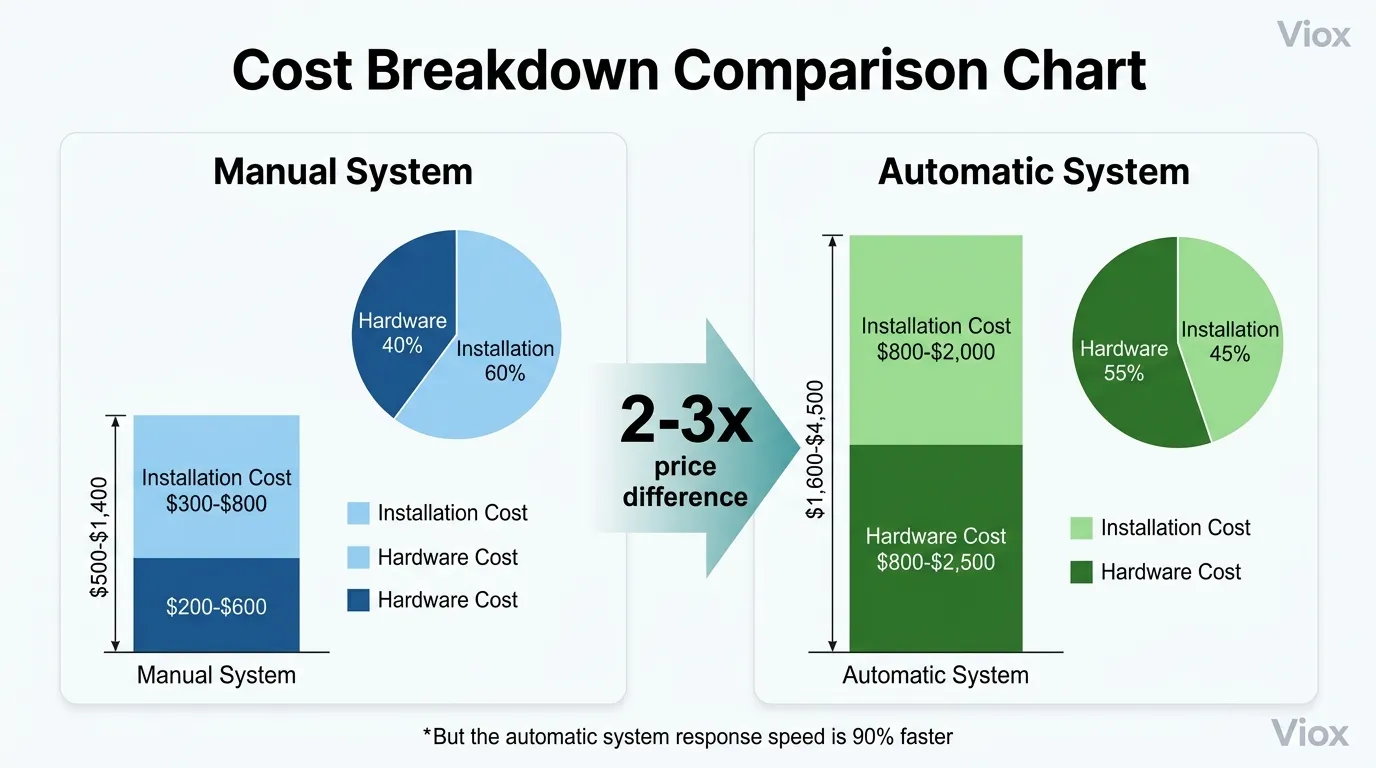
Understanding the true cost difference helps you make an informed decision.
Manual Transfer Switch System
- Switch hardware: $200-$600
- Installation labor: $300-$800
- Total system cost: $500-$1,400
Automatic Transfer Switch System
- Switch hardware: $800-$2,500
- Installation labor: $800-$2,000
- Total system cost: $1,600-$4,500
Price difference: 2-3x upfront, but automatic systems reduce outage response time by 90% and eliminate the need for operator presence.
Cost vs. Consequence: The Real Tradeoff
The easiest way to misunderstand Manual vs. Automatic Transfer Switch is to compare only purchase price.
Manual transfer switches usually win on upfront cost. They often require fewer control functions, less complex system integration, and a simpler operating concept. For many homes and small installations, that makes them the rational choice.
But automatic transfer switches are not expensive just for the sake of convenience. Their value comes from reducing the operational consequences of an outage:
- No delay waiting for an operator
- Less dependence on user training under stress
- More suitable for standby systems that must respond even when the site is empty
- Better alignment with critical loads and continuity planning
A Better Way to Compare Cost
| Cost question | Manual transfer switch | Automatic transfer switch |
|---|---|---|
| Lower initial hardware cost | Usually yes | Usually no |
| Lower system integration cost | Often yes | Often no |
| Lower outage-management risk | Often no | Usually yes |
| Better fit for unattended operation | Usually no | Usually yes |
In other words, the cheapest switch on paper is not always the cheaper system in practice.
Which One Fits Different Backup Power Systems?
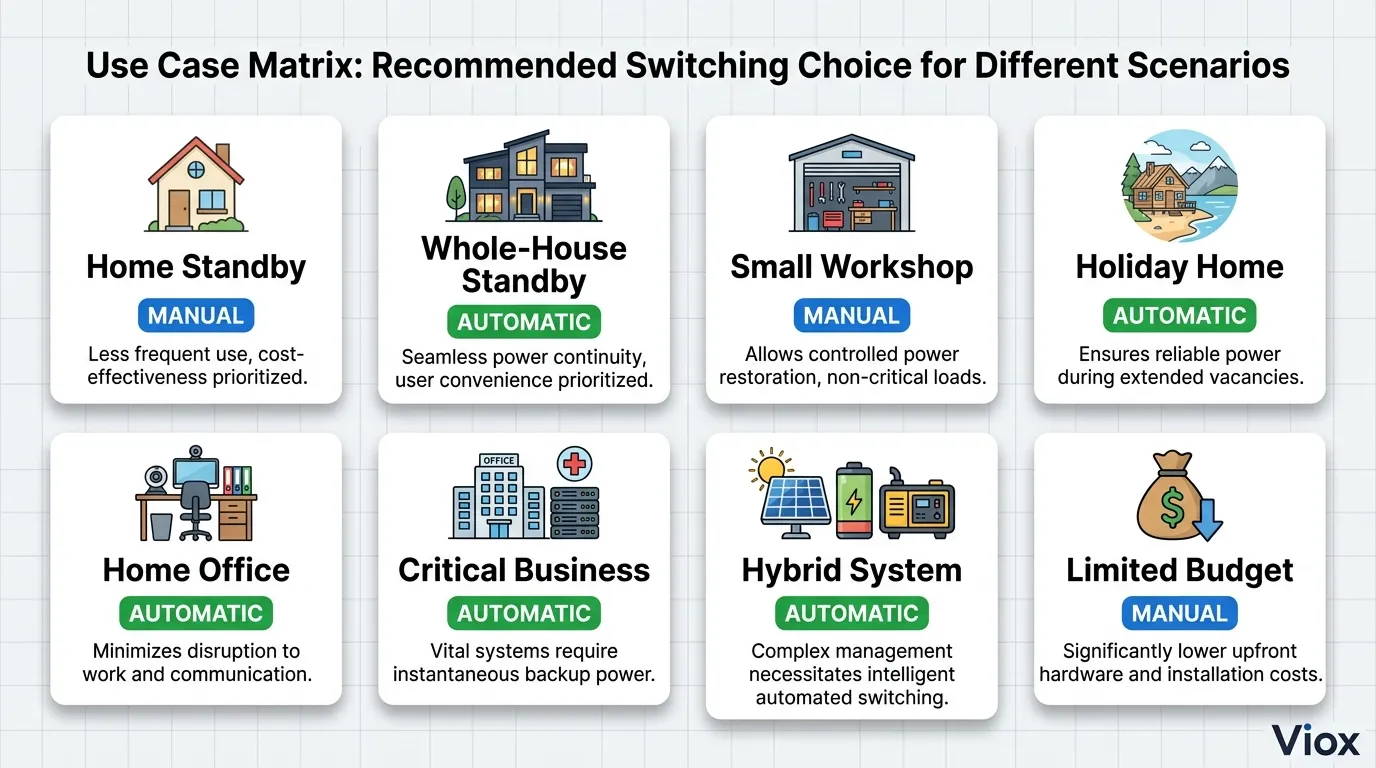
This is the most important section for ranking and for actual reader value. Users searching Manual vs. Automatic Transfer Switch usually want to know what fits their situation, not just the dictionary difference.
Home Standby Generator for Convenience
If the homeowner wants backup power to come on with minimal action during storms or outages, an automatic transfer switch is usually the stronger fit.
Typical reasons:
- The occupants may not be home when the outage starts
- Response speed matters for refrigerators, network systems, or heating controls
- The user wants a “standby” rather than “manual emergency” experience
Budget-Conscious Home Backup System
If the main goal is affordable backup power for selected circuits and the user is comfortable performing the transfer sequence, a manual transfer switch is often a reasonable choice.
This is especially true when:
- Only a few loads need backup
- The site is usually occupied
- A short delay before transfer is acceptable
Small Commercial or Workshop Backup
The answer depends on whether the site is staffed during likely outage periods and how much interruption the process can tolerate.
- If operators are present and the load is not highly critical, manual transfer can still make sense.
- If the site has refrigeration, communications, remote access, or continuity-sensitive operations, automatic transfer becomes much more attractive.
Critical Operations and High-Priority Loads
For data rooms, telecom, healthcare-adjacent systems, process equipment, or any installation where a delayed response creates operational or safety risk, automatic transfer is usually the better fit.
That is also why ATS decisions often connect to broader reliability topics such as ATS circuit-breaker coordination and ATS contact resistance and temperature rise.
Solar, Inverter, and Hybrid Backup Systems
Backup systems are no longer only “utility + generator.” If your system includes a hybrid inverter or a PV-linked backup source, the transfer-switch decision needs to account for system architecture, neutral handling, source behavior, and control logic.
That is why supporting articles like choosing the right ATS for solar PV systems and the hybrid inverter ATS wiring guide are relevant before final selection.
Real-World Case Studies
Case Study 1: Small Medical Clinic
Initial choice: Manual transfer switch (budget constraint: $1,200 vs. $3,500)
Problem: Weekend power outage occurred when clinic was closed. Staff member lived 25 minutes away. By the time they arrived and started the generator, 4 hours had passed.
Result: $12,000 in spoiled vaccines and medications that required refrigeration.
Solution: Upgraded to automatic transfer switch. System paid for itself in 18 months through avoided losses and insurance premium reduction.
Lesson: For any facility with temperature-sensitive inventory or critical equipment, automatic transfer is risk management, not just convenience.
Case Study 2: Home Office Professional
Initial choice: Manual transfer switch for home backup system
Situation: Worked from home 4 days per week with video conferencing and cloud-based work.
Problem: During a midday outage, had to leave an important client meeting to manually start generator and transfer power. Lost 15 minutes of meeting time and professional credibility.
Solution: After three similar incidents, upgraded to automatic system.
Lesson: If your income depends on uninterrupted power, automatic transfer becomes a business expense, not a luxury.
When a Manual Transfer Switch Is Usually the Better Choice
A manual transfer switch is often the better answer when:
- Budget is a primary decision factor
- The site is occupied during most outage scenarios
- The load can tolerate a 5-15 minute interruption
- The user wants simple, direct control
- The system is relatively basic and does not justify a more integrated ATS setup
- Backup power is for non-critical convenience loads only
This does not mean manual is “old-fashioned” or wrong. It means the system objective is different.
When an Automatic Transfer Switch Is Usually the Better Choice
An automatic transfer switch is often the better answer when:
- The load should transfer with minimal delay (under 30 seconds)
- The site may be unoccupied during typical outage times
- The outage response must not depend on user action
- The backup source is part of a dedicated standby-power strategy
- Continuity and operational confidence matter more than lowest first cost
- You have critical equipment, medical devices, or business operations that cannot tolerate interruption
This is especially relevant when comparing an ATS not just to a manual switch, but also to adjacent options such as an interlock kit vs. automatic transfer switch.
Common Selection Mistakes
1. Comparing Price but Not Outage Behavior
Many buyers compare hardware cost only and ignore what happens during a real outage. The true question is not just “Which switch costs less?” It is “What happens when power fails at the worst possible time?”
Better approach: Calculate the cost of a 4-hour outage for your specific situation (spoiled food, lost productivity, property damage, etc.) and compare that to the price difference between manual and automatic systems.
2. Ignoring Who Will Operate the System
Manual systems assume someone trained and available will perform the transfer safely. If that assumption is weak, the system fit may also be weak.
Questions to ask:
- Who will operate the switch during an outage?
- Will they be home/on-site when outages typically occur?
- Can they safely operate the system in darkness or bad weather?
3. Forgetting the Load Profile
Not every backup load deserves the same transfer strategy. If the loads are low-priority, manual may be fully adequate. If the loads are operationally critical, automatic transfer often becomes the safer decision.
4. Treating All ATS Products as Equivalent
Not all automatic transfer switches are the same. Transition mode, class, pole arrangement, coordination, and source type all affect performance.
5. Looking at the Switch Without the Whole System
A transfer switch is only one part of the backup power architecture. Generator behavior, source compatibility, circuit priority, and installation layout all affect the result.
A Practical Decision Matrix
If you want a simpler decision framework, start here.
| Your situation | Better starting choice | Why |
|---|---|---|
| Basic home backup with operator present | Manual transfer switch | Lower cost and simpler control |
| Whole-home standby expectation | Automatic transfer switch | Better convenience and outage response |
| Small workshop with non-critical loads | Manual transfer switch | Often sufficient and more economical |
| Remote or unattended site | Automatic transfer switch | No dependence on a person being present |
| Critical business continuity loads | Automatic transfer switch | Better fit for continuity planning |
| Vacation home or seasonal property | Automatic transfer switch | Protects property when you’re away |
| Home office or remote work setup | Automatic transfer switch | Protects income and professional reputation |
| Hybrid or advanced source architecture | Depends, but often ATS-led | System integration matters more than simple manual switching |
Decision Flow Guide
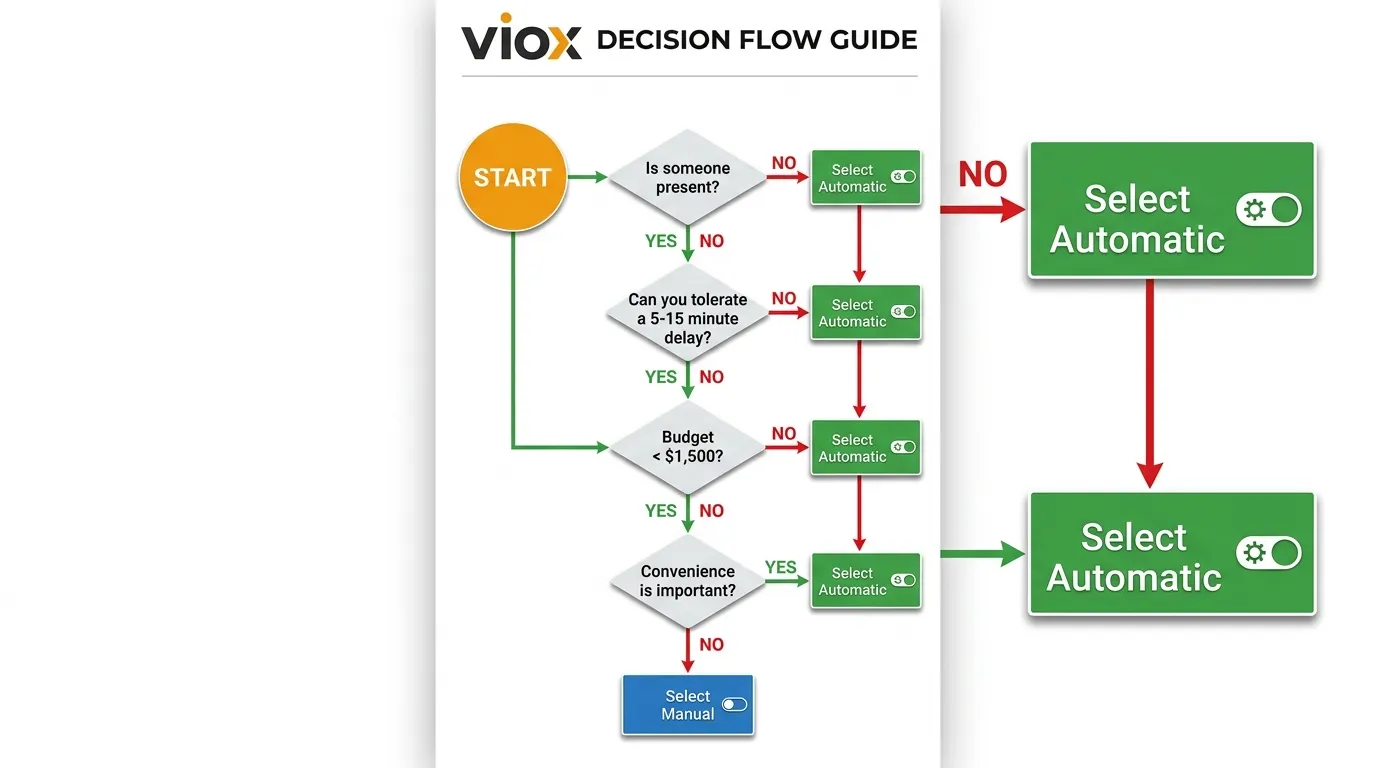
START → Is someone always on-site during typical outage times?
- NO → Choose Automatic Transfer Switch
- YES → Can your loads tolerate a 5-15 minute delay?
- NO → Choose Automatic Transfer Switch
- YES → Is your total budget under $1,500?
- YES → Choose Manual Transfer Switch
- NO → Do you value convenience over hands-on control?
- YES → Choose Automatic Transfer Switch
- NO → Choose Manual Transfer Switch
FAQ
Which is better, a manual or automatic transfer switch?
Neither is always better. The right choice depends on your specific situation:
Choose Manual if:
- Someone is always home during typical outage times
- You only need backup for lights and refrigerator
- Your total budget is under $1,500
- You prefer hands-on control
Choose Automatic if:
- Your home is unattended 20+ days/year
- You have medical equipment, home office, or critical systems
- Outages in your area last 4+ hours on average
- You want true “standby” convenience
Is an automatic transfer switch worth the extra cost?
Yes, if you meet any of these conditions:
- Your home is unattended during typical outage times (vacation home, frequent travel)
- You have medical equipment or home office equipment that cannot tolerate interruption
- Outages in your area typically last 4+ hours
- You have temperature-sensitive inventory or equipment
- The cost of a single 4-hour outage exceeds the price difference ($1,000-$2,000)
No, if:
- Someone is always home during typical outage times
- You only need backup for basic convenience loads
- Your budget is limited and you’re comfortable with manual operation
Can a manual transfer switch work for a generator backup system?
Yes. A manual transfer switch can work well in a generator backup system when an operator is available to manage the transfer and the loads do not require seamless or fully automatic response.
Manual switches are commonly used with portable generators and basic home backup systems where the user is present and can safely perform the transfer sequence.
When should I choose an automatic transfer switch?
You should strongly consider an automatic transfer switch when:
- The site may be unattended during outages
- The load is high priority (medical, business, critical systems)
- Response time matters (under 30 seconds vs. 5-15 minutes)
- The backup system is meant to respond automatically rather than depend on manual action
- You want true “set it and forget it” standby power
Is a manual transfer switch safer because it gives more user control?
Not necessarily. It gives more direct control, but it also depends more heavily on correct human action during an outage—often in darkness, bad weather, or stressful conditions.
The safer option depends on the application, training, and operating conditions. Automatic systems eliminate human error during the transfer process but require proper installation and maintenance.
Both types are safe when properly installed and operated according to manufacturer specifications and local electrical codes.
Does transfer-switch choice affect generator sizing and system design?
Yes. Transfer-switch choice interacts with source type, circuit strategy, pole configuration, transition mode, and downstream protection coordination, so it should be evaluated as part of the whole backup-power design.
For example:
- Automatic systems may require additional control wiring and power for the transfer switch logic
- Manual systems may need different circuit prioritization since not all loads can be transferred instantly
- Transition mode (open vs. closed) affects generator sizing and load-transfer behavior
How long do manual and automatic transfer switches last?
With proper maintenance:
- Manual transfer switches: 20-30 years (fewer moving parts and control components)
- Automatic transfer switches: 15-25 years (more complex electronics and control systems)
Both types require periodic inspection and testing. Automatic systems typically need more frequent maintenance due to their control logic and automatic testing functions.
Can I upgrade from a manual to an automatic transfer switch later?
Yes, but it typically requires:
- New transfer switch hardware ($800-$2,500)
- Additional control wiring
- Generator control interface (if not already present)
- Professional installation ($800-$2,000)
Total upgrade cost: $1,600-$4,500
Many homeowners who initially choose manual switches for budget reasons later upgrade when they experience the inconvenience of manual operation during actual outages.
Fact-Check Notes
- This article is written as a comparison and buying guide for the keyword Manual vs. Automatic Transfer Switch, so it avoids project-specific code claims and exact timing or rating figures unless tied to a specific product family or standard.
- Final transfer-switch selection should still be checked against the actual source type, load priority, pole configuration, transition mode, coordination requirements, and the applicable local installation rules.
- The article assumes a general international audience rather than a single-country residential-code framework, because the ranking pages currently mix homeowner education with broader backup power terminology.
- Cost ranges provided are typical US market prices as of 2026 and may vary by region, installation complexity, and specific product selection.

