2025年

複数のソーラーパネルをコンバイナーボックスに安全に配線する方法(およびアークフラッシュの驚きを避ける方法)

8:47 AM. The solar installer pops the latches on the combiner box lid. Inside, six PV strings terminate at busbars, each waiting for its fuse. He grabs his insulated screwdriver, reaches for the first positive wire, and makes contact. In 0.3 seconds, a 400Vdc arc flash erupts—brighter than a welding torch, hot enough to vaporize copper. His safety glasses melt to his face. The arc sustains itself, feeding on the DC current, until the breaker 50 feet away finally trips. The medical bills: $2,500 for the ER visit. The lost work: three weeks. The lesson: DC doesn’t play by AC rules. You’ve wired AC panels before. You’ve worked with 240V […]

複数のソーラーパネルをコンバイナーボックスに安全に配線する方法(およびアークフラッシュの驚きを避ける方法) 続きを読む »

Do You Need a PV Combiner Box for RV Solar? (Decision Guide + Wiring Configurations)

RVソーラーにPVコンバイナーボックスは必要ですか?(決定ガイド+配線構成)

Your shopping cart: 8×200W solar panels. One MPPT charge controller. One $150 PV combiner box. The Reddit thread says you absolutely need it. The YouTube video calls it a waste of money for your setup. The manufacturer’s product page is aggressively non-committal. You’re $150 away from clicking “checkout,” and you have no idea if you’re about to buy a critical component or the solar equivalent of undercoating on a used car. Quick Answer: You need a PV combiner box when you have more parallel strings than your charge controller has input terminals. For most RV solar systems with 2-3 panels or series wiring, you don’t need one. Here’s the truth:

RVソーラーにPVコンバイナーボックスは必要ですか?(決定ガイド+配線構成) 続きを読む »

DIY Solar Combiner Box: Why Most Homemade Designs Are Fire Hazards (And What You Actually Need)

DIYソーラーコンバイナーボックス:ほとんどの自家製設計が火災の危険性がある理由(および実際に必要なもの)

You’ve got 10 REC 350W solar panels ready to mount. Five strings of two panels each. Each string pumping out 93.4 volts DC at 9 amps. You’ve researched DIY solar combiner box designs online, and you’ve done the math—everything checks out. Then you price out a proper solar combiner box. $300. Maybe $400 if you want the one with integrated monitoring. You look at the Square D subpanel sitting in your garage—the one you paid $60 for last year. Same metal box. Same bus bars. Same circuit breakers. Why exactly are you supposed to pay 5× more for what looks like the same thing? Here’s why: Because that $240 price

DIYソーラーコンバイナーボックス:ほとんどの自家製設計が火災の危険性がある理由(および実際に必要なもの) 続きを読む »

太陽光発電接続箱の設置場所:「午前中の日差しだけ」が、あなたが思っているほど無害な詳細ではない理由

Your solar installer just offered you a choice: combiner box inside the garage, or outside on the wall.”The outside spot gets morning sun,” he says, “but only until midday. If it’s out there, you won’t need to be home for service calls. But you’ll probably want to run ethernet to it.” He makes it sound simple. Two options. Pick one. What he doesn’t tell you is that one of these choices will cost you $200-400 you’ll never see again. And the other might cost you something worse: 3-5 years of component life, shaved off by a thermal stress pattern that starts the moment that morning sun hits the box. So

太陽光発電接続箱の設置場所:「午前中の日差しだけ」が、あなたが思っているほど無害な詳細ではない理由 続きを読む »

どのように見隠れたジャンクションボックスは5段階の刑事法死回路

3 AM. Your father-in-law’s circuit goes dark. By morning, you’ve tested every outlet on that dead circuit—voltage checks, continuity tests, even traced the romex feeds from box to box. Everything checks out individually, but something’s wrong: three outlets in the living room share perfect continuity with each other despite having only single cables entering their boxes. That shouldn’t be possible. You’re looking at The Triangle Paradox. Somewhere in that wall, there’s a junction box you can’t see—The Ghost Junction—tying those three circuits together. The breaker’s still good. The wiring’s intact. The problem is buried behind drywall, and you’re facing what electricians call The $2,000 Wall Decision: guess wrong about where

どのように見隠れたジャンクションボックスは5段階の刑事法死回路 続きを読む »

金属vsプラスチックジャンクションボックスとは何者なのだと

You’re standing in the electrical aisle at Home Depot, holding two junction boxes.The blue plastic Carlon in your left hand costs $0.98. It flexes under your thumb like a yogurt container. The steel box in your right hand costs $6.47. It doesn’t flex at all. You need 50 of these for your house. That’s $49 versus $323.50. But something nags at you. Every new construction house uses plastic boxes—you’ve seen them in million-dollar homes. Your contractor texted: “plastic is fine, everyone uses it, code approved.” But late-night browsing on electrician forums revealed a phrase that haunts you: “blue box = homeowner special.” When professionals call something a “homeowner special,” that’s

金属vsプラスチックジャンクションボックスとは何者なのだと 続きを読む »

How Off-Delay Relays Keep Timing After Power Dies: The Capacitor Secret 

どのようオフ遅延リレーを保のタイミング後の電力金型のコンデンサの秘密 

When the Power’s Gone, The Timer Keeps Ticking The motor stops. The power’s cut. But your cooling fan needs to run for another 60 seconds to prevent bearing damage from residual heat. With a standard electronic timer, the instant you cut power to the relay, the timing circuit dies and the fan stops immediately. Three minutes later, you’re looking at a seized bearing and an $8,000 motor replacement—all because your “smart” electronic timer couldn’t outlive the power supply by 60 seconds. So how do you get reliable timing when the power source is already gone? The Power Paradox: Why Electronic Timers Need What They’ve Lost Here’s the irony: Electronic timing

どのようオフ遅延リレーを保のタイミング後の電力金型のコンデンサの秘密  続きを読む »

Why Is My Circuit Breaker Orange? (The Answer Could Save Your House)

なぜ私の回路ブレーカーはオレンジ色なのか?(その答えがあなたの家を救うかもしれない) 

2 AM. Half your house goes dark. You grab a flashlight, shuffle downstairs in the dark, and pop open the electrical panel. One breaker has orange showing—a little window or maybe a glow—and you’re hit with the question every homeowner dreads: Is this normal, or am I looking at a fire hazard? Here’s the thing: there are actually two completely different reasons a circuit breaker shows orange. Only one of them means you can safely reset it yourself. The other one? That’s the kind of orange that costs families $8,000 in fire damage every year. So let’s figure out which orange you’ve got. The Two Oranges: Why Circuit Breakers Show

なぜ私の回路ブレーカーはオレンジ色なのか?(その答えがあなたの家を救うかもしれない)  続きを読む »

Why Your MOV Surge Protector Isn't Working (The Invisible Resistor)

なぜあなたのMOVサージプロテクターは機能しないのか(見えない抵抗)

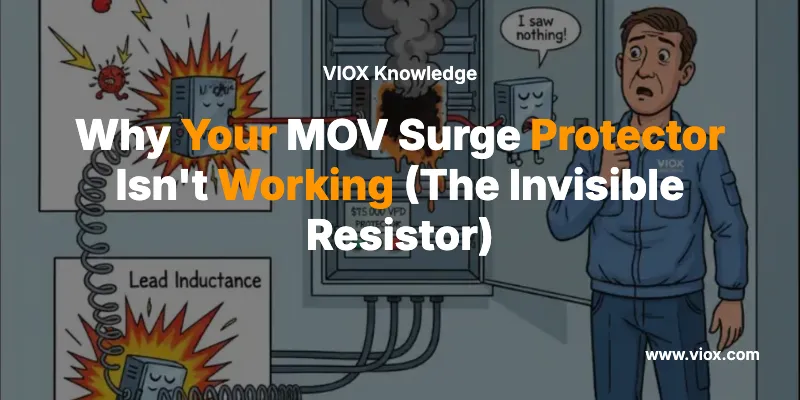
You’ve done everything right. The MOV surge protector is rated for 275V, properly sized for your 240V system, installed exactly per the wiring diagram—parallel with the load, just like every application note shows. You even added it to your panel schedule and documented it for the inspector. Then the storm hits. Lightning finds your service entrance at 2:47 AM. By the time you get the call, production has been down for three hours, and that $15,000 variable frequency drive you commissioned last month? It’s dead. Fried circuit boards, burnt smell, the whole catastrophe. But here’s the thing that doesn’t make sense: the MOV is still sitting in the panel, cool

なぜあなたのMOVサージプロテクターは機能しないのか(見えない抵抗) 続きを読む »

Why Doesn't the Neutral Bus Bar Shock You? (And When It Absolutely Will)

が記載されていないのはなぜ中性ブスバーショックです。 (ときには絶対になります)

You’re standing in your basement watching your electrician work. The main panel is open—live, energized, 200 amps of potential death just inches away. He reaches in with his bare hand and grabs the neutral bus bar. Your heart stops. But he doesn’t even flinch. Ten seconds later, he’s torquing down terminal screws on that same bar, skin contact the whole time, humming along like he’s changing a light bulb. So what’s happening here? If the neutral conductor carries current back from your lights, appliances, and motors to complete the circuit, why isn’t that bus bar electrifying anyone who touches it? And more importantly—when does it become deadly? The answer involves

が記載されていないのはなぜ中性ブスバーショックです。 (ときには絶対になります) 続きを読む »

今すぐ見積もりを依頼する