


En esta página
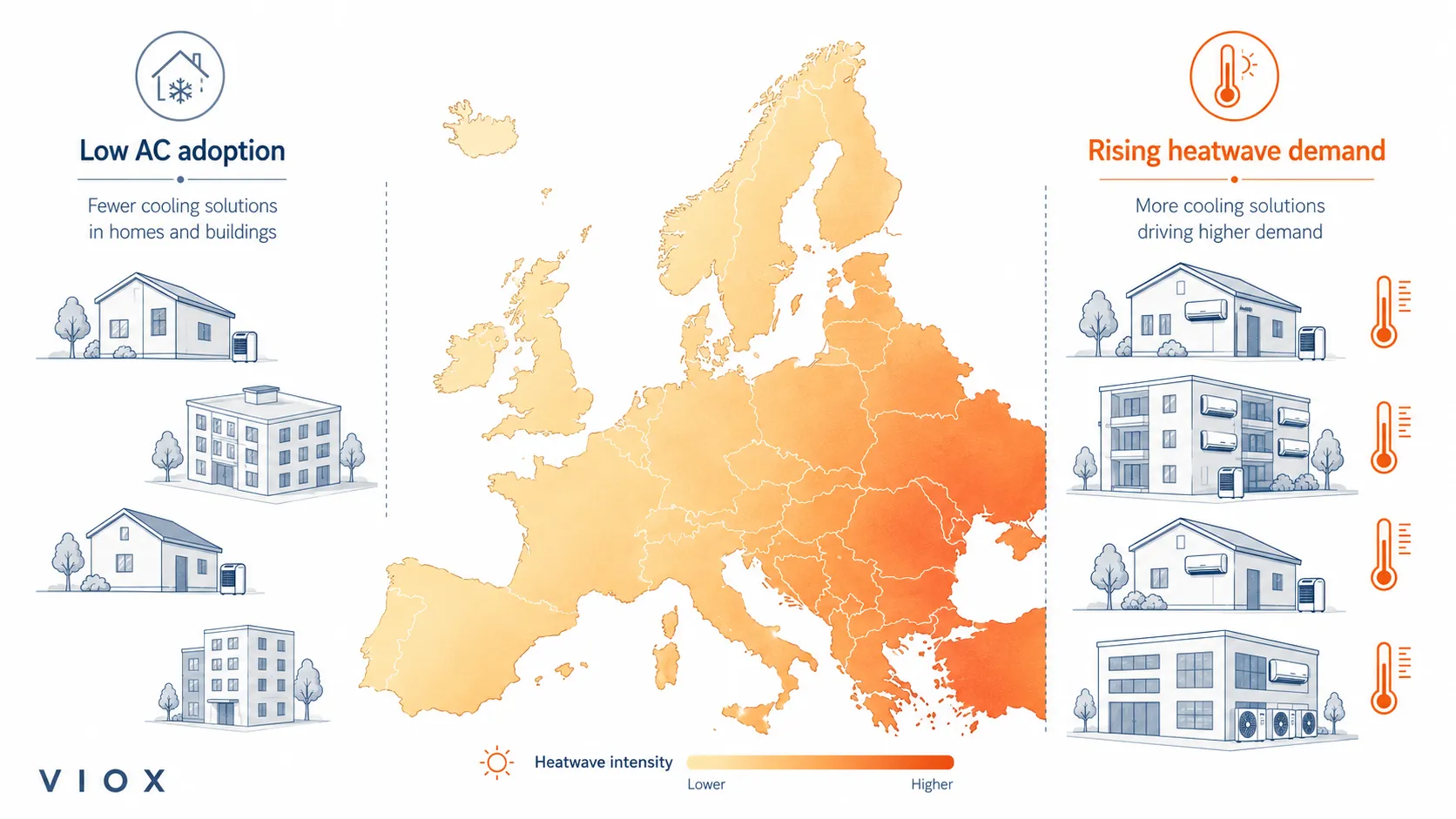
Europa se adentra en un momento de refrigeración extraño: las olas de calor son cada vez más difíciles de ignorar, pero la penetración del aire acondicionado residencial sigue siendo baja en comparación con Estados Unidos. Los informes recientes sitúan habitualmente la propiedad de aire acondicionado en aproximadamente alrededor del 20% de los hogares europeos, en comparación con cerca del 90% de los hogares estadounidenses, con grandes diferencias entre Italia, España, Francia, Alemania, el Reino Unido y el norte de Europa.
Esa brecha se está convirtiendo ahora en una demanda urgente. Durante una ola de calor, la gente no reforma los edificios lentamente; compran aires acondicionados portátiles, instalan unidades tipo split, utilizan bombas de calor en modo refrigeración y conectan cargas de refrigeración a circuitos que quizás nunca fueron diseñados para el funcionamiento prolongado de un compresor.
Es por esto que el auge del aire acondicionado en Europa no es solo una tendencia de electrodomésticos. Es un problema de protección de circuitos.
Muchas viviendas europeas fueron construidas para iluminación, electrodomésticos de cocina, controles de calefacción y cargas de enchufes comunes, no para que varias habitaciones funcionen con refrigeración basada en compresores durante horas en una ola de calor. Un aire acondicionado portátil o tipo split puede consumir una corriente de funcionamiento moderada a 230V, pero aun así puede generar problemas debido a la corriente de irrupción del compresor, el funcionamiento continuo, los circuitos de enchufes compartidos, los cables de extensión, la corriente de fuga, el cableado antiguo y los cuadros eléctricos obsoletos.
La pregunta sobre seguridad no es simplemente “¿Qué tamaño de interruptor automático necesito para un aire acondicionado?”. La pregunta más adecuada es:
¿Pueden el circuito, el cable, la curva del MCB, el RCD o RCBO, el cuadro eléctrico y el suministro aguas arriba soportar de forma segura esta carga de aire acondicionado durante el pico de calor?
Por qué este tema es importante ahora
Europa se enfrenta a olas de calor estivales más frecuentes e intensas, mientras que gran parte de su parque de viviendas sigue reflejando una suposición antigua: los veranos eran incómodos, pero no siempre eventos que requerían un diseño eléctrico específico. A finales de junio y principios de julio de 2026, los informes describieron temperaturas récord en varios países europeos, incluidos el Reino Unido, Alemania, los Países Bajos, Hungría y Francia. The Guardian informó que el Reino Unido alcanzó un récord de junio de 37,7°C en Norfolk, Alemania registró 41,7°C en Coschen, los Países Bajos alcanzaron los 39,4°C, Hungría llegó a los 42°C y partes de Francia superaron los 40°C durante el mismo periodo de ola de calor.
Ese tipo de clima cambia la forma en que las personas usan la electricidad. En regiones donde el aire acondicionado residencial era históricamente poco común, los propietarios e inquilinos añaden repentinamente:
- aires acondicionados portátiles
- unidades de aire acondicionado split portátiles
- sistemas split de montaje en pared
- modos de refrigeración por bomba de calor
- ventiladores adicionales y deshumidificadores
- mayor tiempo de funcionamiento diario de refrigeración
Un solo aparato puede ser manejable. Miles de apartamentos añadiendo refrigeración en el mismo pico de la tarde representan un perfil de carga eléctrica diferente.
Puntos Clave
- Un aire acondicionado portátil no es solo otra carga conectada. Por lo general, es una carga de compresor con corriente de irrupción en el arranque y largas horas de funcionamiento.
- A 230V, la corriente puede parecer moderada, pero el estrés del circuito sigue siendo importante. Los enchufes compartidos, los cables de extensión, los terminales antiguos y el aumento de temperatura en la unidad de consumo pueden convertirse en puntos débiles.
- Los MCB de curva B y curva C se comportan de manera diferente. Los interruptores de curva C toleran una mayor corriente de irrupción de motores, pero requieren la verificación de la impedancia del bucle de falla y el tiempo de desconexión.
- La protección mediante RCBO suele ser la vía de actualización más eficiente. Combina la protección contra sobrecorriente y corriente residual por circuito, reduciendo el impacto de disparos molestos en circuitos no relacionados.
- No instale simplemente un interruptor de mayor capacidad. El cable, el enchufe, el aislador, la unidad de consumo y la corriente de falla prospectiva deben ser compatibles entre sí.
- Los cuadros eléctricos antiguos son un cuello de botella oculto. El circuito final puede ser aceptable, mientras que el cuadro, la barra colectora, la regleta de neutro o la columna montante no lo sean.
Ola de calor en Europa + Baja penetración de aire acondicionado = Estrés en el cableado.
Los edificios europeos no fueron diseñados teniendo en cuenta las cargas de refrigeración. En partes del sur de Europa, el aire acondicionado es común. En el Reino Unido, el norte de Francia, los Países Bajos, Alemania, Bélgica y en el parque de viviendas urbanas antiguas, la instalación de aire acondicionado ha sido históricamente menor que en mercados más cálidos.
El resultado es un desajuste:
| Qué ha cambiado | Impacto eléctrico |
|---|---|
| Más unidades de aire acondicionado portátiles | Cargas de enchufe de mayor duración |
| Más adaptaciones de aire acondicionado dividido | Necesidad de más circuitos dedicados |
| Más apartamentos refrigerando al mismo tiempo | Mayor demanda coincidente en columnas montantes y subcuadros |
| Unidades de consumo antiguas | Espacio de reserva limitado, diseño de RCD antiguo, aumento de temperatura, etiquetado deficiente |
| Uso de cables de extensión | Caída de tensión, sobrecalentamiento, presión de contacto deficiente |
| Cargas de compresor | Corriente de irrupción en el arranque y posible disparo intempestivo |
El aparato es solo una parte del problema. El sistema de protección detrás de él determina si la instalación permanece segura bajo una operación estival repetida.
Lo que un aire acondicionado realmente demanda de un circuito
Un aire acondicionado residencial pequeño suele tener tres valores eléctricos importantes:
- Potencia de entrada nominal en vatios o kilovatios.
- Corriente nominal de funcionamiento en amperios.
- Corriente de arranque o de irrupción del compresor y del motor del ventilador.
A 230V, la corriente de funcionamiento puede parecer pequeña si se estima solo a partir de la potencia real:
| Potencia nominal de CA | Corriente equivalente resistiva a 230V | Comentario práctico |
|---|---|---|
| 700W | 3,0A | Común para unidades portátiles pequeñas |
| 1.000W | 4,3A | Carga de refrigeración típica para una habitación individual |
| 1.500 W | 6,5A | Unidad portátil más grande o unidad tipo split pequeña |
| 2.500W | 10,9 A | Unidad de estancia más grande o modo de bomba de calor |
| 3500 W | 15,2 A | Normalmente se requiere un circuito dedicado |
Esta tabla es solo una estimación aproximada de resistencia equivalente:
Corriente (A) = Potencia (W) / Voltaje (V)
Para un compresor de CA o un motor de ventilador, la relación de corriente de funcionamiento monofásica más precisa incluye el factor de potencia:
I = P / (V x cos phi)
Si un aire acondicionado de 1.500 W funciona a 230 V con un factor de potencia de 0,90, la corriente de funcionamiento es de aproximadamente 7,2 A, no 6,5 A. Muchos aires acondicionados inverter modernos operan con un factor de potencia en el rango de 0,85 a 0,95, pero el valor correcto debe obtenerse de la placa de características del aparato o de los datos del fabricante. La corriente de arranque, el modo de funcionamiento, la temperatura ambiente, la longitud del cable y la caída de tensión deben verificarse por separado.
El problema real: corriente de irrupción y funcionamiento continuo
Un compresor de aire acondicionado puede absorber una corriente de arranque breve superior a su corriente de funcionamiento. Los diseños de compresores de velocidad fija más antiguos suelen tener un pico de arranque más evidente. Las unidades con tecnología inverter pueden arrancar de forma más suave, pero introducen sus propias consideraciones, incluyendo la electrónica, los filtros y la corriente de fuga.
Para el interruptor automático, dos preguntas son importantes:
- ¿Se disparará el interruptor por error cuando arranque el compresor?
- ¿Se sobrecalentará el circuito cuando la unidad funcione durante varias horas?
Durante una ola de calor, una unidad de aire acondicionado puede funcionar durante la mayor parte de la tarde o la noche. Eso la acerca más a una carga continua que a un aparato de uso breve. Un hervidor de agua puede consumir más corriente, pero solo durante minutos. Una unidad de refrigeración puede consumir menos corriente, pero durante horas.
Curva B frente a curva C en interruptores magnetotérmicos (MCB) para circuitos de aire acondicionado
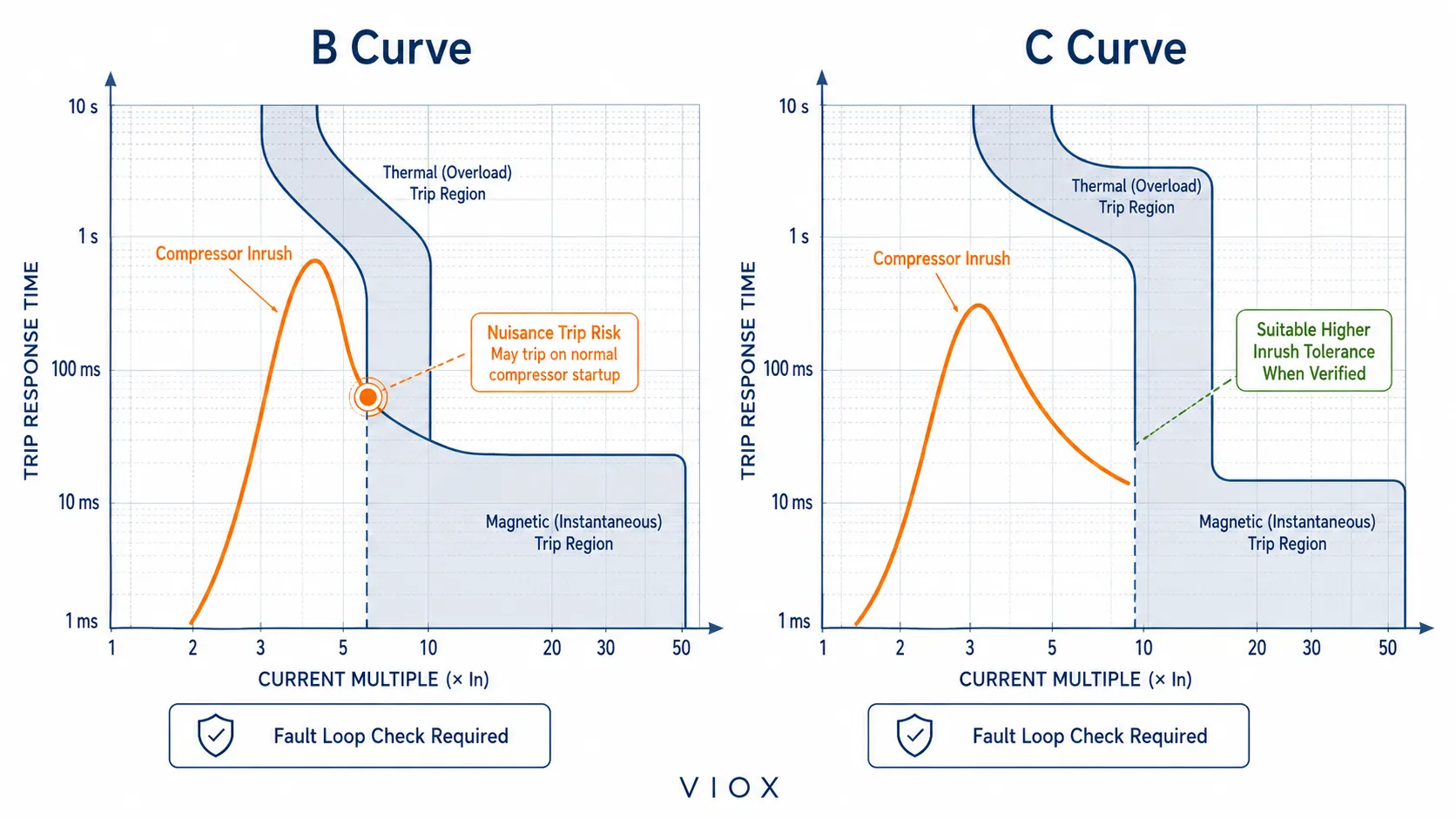
Los interruptores magnetotérmicos (MCB) tienen diferentes curvas de disparo magnético. La curva afecta la forma en que el interruptor reacciona ante picos de arranque breves.
| Curva del MCB | Rango típico de disparo magnético | Uso común | Nota sobre circuitos de CA |
|---|---|---|---|
| Curva B | 3-5 x In | iluminación, cargas resistivas, circuitos domésticos generales | Puede dispararse intempestivamente con la corriente de irrupción del compresor |
| Curva C | 5-10 x In | motores pequeños, bombas, ventiladores, compresores | A menudo considerados para circuitos de aire acondicionado |
| Curva D | 10-20 x In | equipos de alta corriente de irrupción, transformadores | Por lo general, no es apto para instalaciones residenciales de CA comunes a menos que esté diseñado específicamente. |
Un interruptor magnetotérmico (MCB) de curva C puede ser más adecuado para cargas de compresores, pero esto no autoriza a reemplazar cualquier interruptor B16 por uno C16.
Importante: La curva C requiere verificación del bucle de falla.
Un interruptor de curva C permite una corriente de irrupción inicial más alta antes del disparo magnético. Esto también significa que la instalación debe tener suficiente corriente de cortocircuito prospectiva para disparar el interruptor rápidamente en condiciones de falla.
Antes de cambiar un interruptor de curva B por uno de curva C, un electricista cualificado debe verificar:
- sección del cable y método de instalación
- longitud del circuito y caída de tensión
- impedancia del bucle de falla a tierra
- tiempo de desconexión requerido por la normativa local
- corriente de cortocircuito prospectiva
- compatibilidad con el cuadro eléctrico
- coordinación de RCD o RCBO
Aquí es donde muchas sugerencias rápidas de “actualización de interruptores” se vuelven inseguras. El interruptor correcto no es solo el que evita disparos molestos. Debe ser capaz de despejar fallos de forma segura.
Circuito dedicado frente a circuito de enchufes compartido
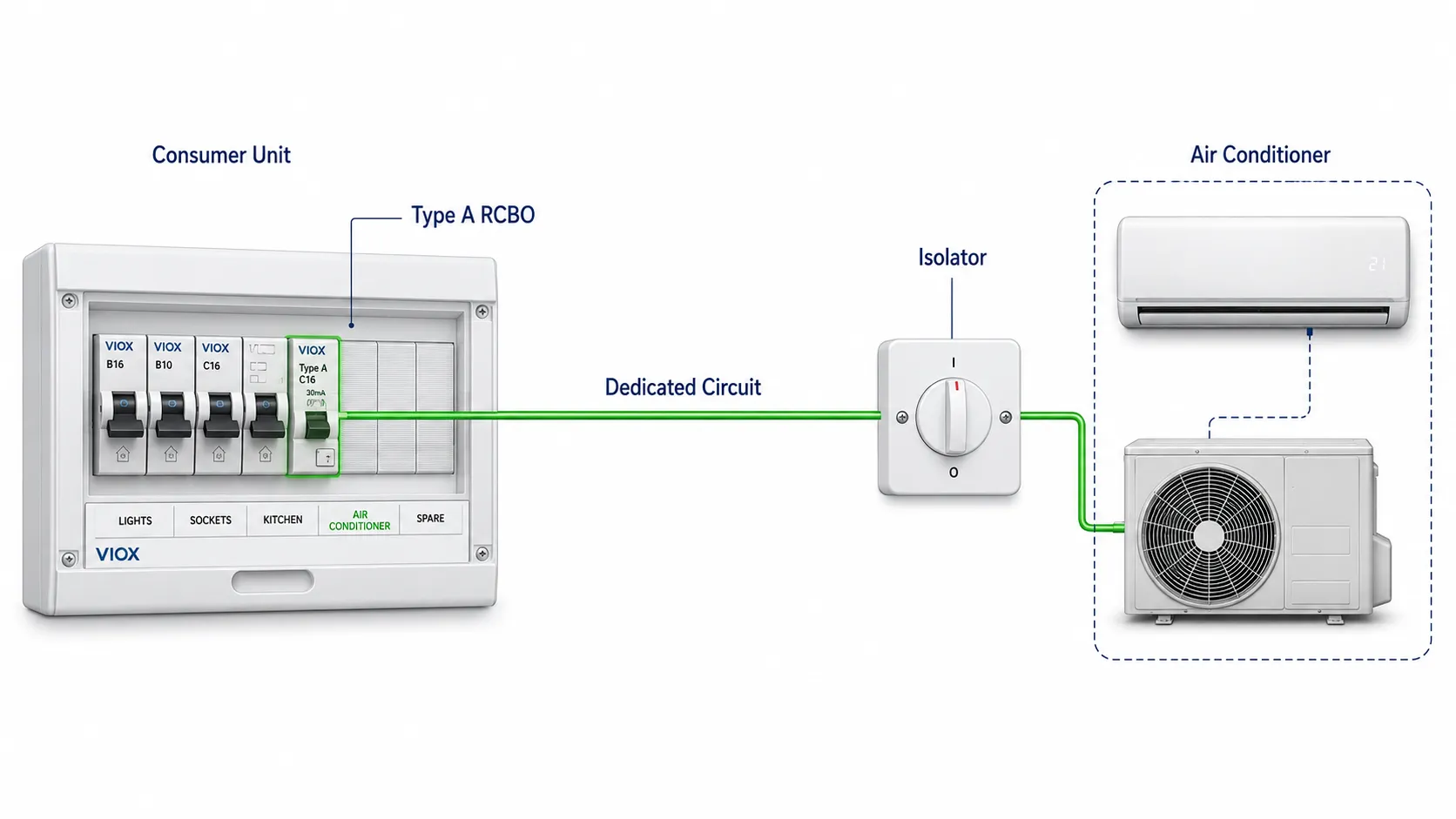
Para una unidad portátil pequeña, un circuito de enchufe estándar puede funcionar si el circuito está en buen estado y no tiene mucha carga. El riesgo aumenta cuando el aire acondicionado comparte el mismo circuito con otros aparatos de alta corriente.
Evite conectar una unidad de aire acondicionado en el mismo circuito que:
- hervidor de agua
- microondas
- calentador eléctrico
- horno o placa de cocina
- lavadora
- secadora
- lavavajillas
- múltiples refrigeradores o congeladores
- cables alargadores largos o regletas de enchufes múltiples
Para aire acondicionado tipo split permanente, un circuito dedicado suele ser el diseño más seguro y limpio. Ofrece al instalador un mejor control sobre el calibre del cable, la curva del interruptor, el aislamiento, la protección RCD/RCBO, el etiquetado y el mantenimiento.
Para una explicación más detallada y permanente, consulte la guía de VIOX sobre por qué un aire acondicionado necesita un circuito dedicado.
MCB, RCD o RCBO: ¿Qué debe proteger un circuito de aire acondicionado?
El interruptor protege contra sobrecargas y cortocircuitos. La protección de corriente residual protege contra fugas a tierra. Un circuito de aire acondicionado puede requerir ambas.
| Dispositivo | Contra qué protege | Función práctica del circuito de aire acondicionado |
|---|---|---|
| MCB | sobrecarga y cortocircuito | protege el cable y el circuito contra sobrecorriente |
| RCD/RCCB | corriente residual / fuga a tierra | protege múltiples circuitos contra fallas de fuga, dependiendo del diseño del tablero |
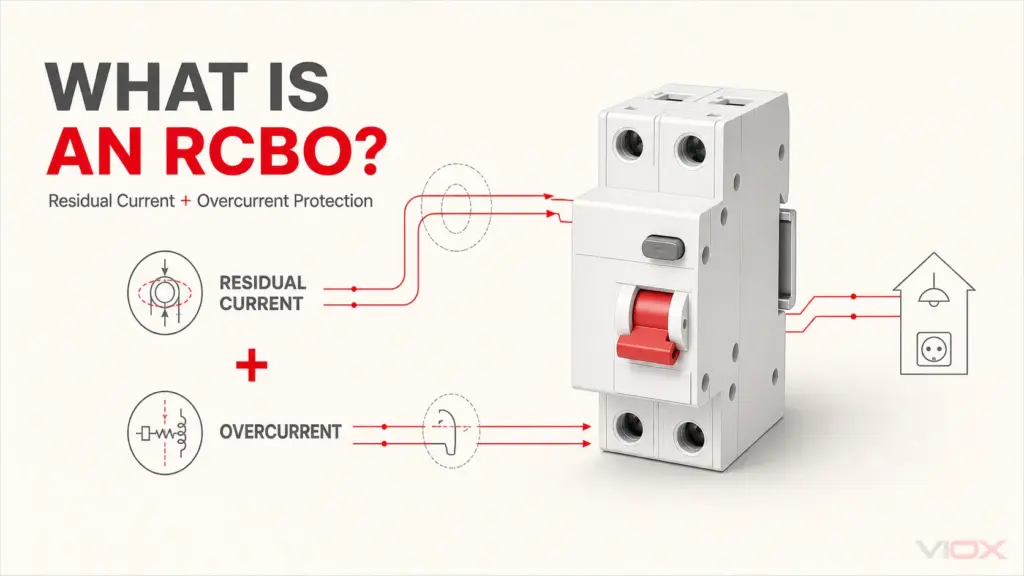
| RCBO | sobrecarga, cortocircuito y corriente residual en un solo dispositivo | a menudo es la mejor opción para circuitos de CA dedicados, ya que una falla solo dispara ese circuito |
Un RCBO puede ser especialmente útil cuando se añade un nuevo circuito de aire acondicionado a una unidad de consumo antigua, ya que evita colocar demasiados circuitos no relacionados detrás de un RCD compartido. Si el circuito de CA presenta fugas o disparos molestos, es más fácil aislar el problema sin apagar la mitad de la casa.
Para el enrutamiento de clústeres de productos VIOX, este tema se conecta naturalmente con:
- Selección de MCB
- Diferencias entre RCCB y RCBO
- Curvas de disparo
- Fundamentos de los cuadros eléctricos de distribución
RCBO tipo A y aires acondicionados con tecnología inverter
Muchos aires acondicionados modernos utilizan variadores de frecuencia (inverter). Estas unidades pueden incluir conversión de potencia electrónica y filtros que generan características de corriente de fuga diferentes a las de las cargas resistivas simples.
En muchos contextos residenciales y comerciales ligeros europeos, la protección diferencial tipo A se especifica habitualmente para circuitos con equipos electrónicos que pueden generar componentes de corriente residual de CC pulsante. El tipo exacto de RCD o RCBO debe seguir las instrucciones del fabricante del equipo y las normas de cableado locales.
No asuma que un RCD tipo AC antiguo es adecuado para todos los aparatos modernos con tecnología inverter.
Los cuadros eléctricos antiguos son el punto débil oculto
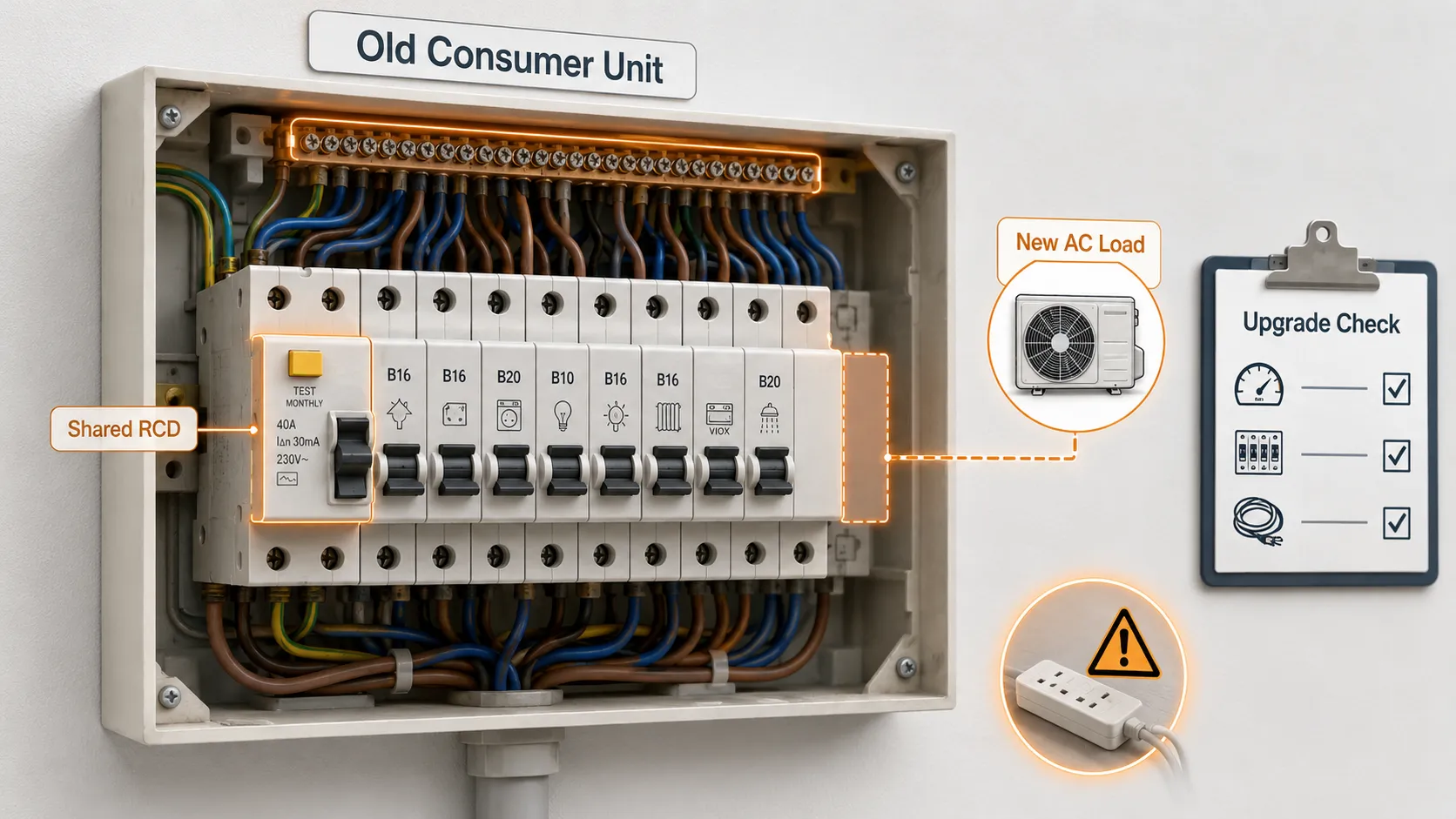
La parte más visible de la instalación es el enchufe o la unidad interior de aire acondicionado. El verdadero punto débil suele ser la unidad de consumo o la distribución aguas arriba.
Las unidades de consumo antiguas pueden tener:
- falta de vías de reserva para circuitos dedicados
- protección diferencial (RCD) compartida para muchos circuitos
- interruptores magnetotérmicos (MCB) antiguos o mal etiquetados
- terminales de neutro o tierra flojos
- conexiones de barras colectoras sobrecalentadas
- dispositivos de baja capacidad de ruptura
- espacio limitado en el gabinete y mala disipación de calor
- mezcla de marcas de interruptores o accesorios incompatibles
Cuando varios inquilinos en un mismo edificio añaden unidades de aire acondicionado portátiles, cada circuito de apartamento puede parecer aceptable por sí solo. Sin embargo, la columna montante compartida, el cable subprincipal, el cuarto de medidores o el tablero de distribución pueden sobrecargarse durante la misma tarde calurosa.
Esa es la parte que una guía de electrodomésticos enchufables no puede detectar.
Guía rápida de dimensionamiento para circuitos de aire acondicionado
Esta tabla es un punto de partida de ingeniería simplificado. Utilice siempre la placa de características del aparato y el código eléctrico local.
| Situación de carga de aire acondicionado | Dirección de protección típica | Qué verificar |
|---|---|---|
| Aire acondicionado portátil pequeño de menos de 1 kW | El circuito de enchufe existente puede ser aceptable si tiene poca carga | Estado del enchufe, evitar cables de extensión, carga del circuito |
| Aire acondicionado portátil de alrededor de 1-1.5 kW | Se prefiere un circuito de enchufe dedicado en edificios antiguos | Curva B frente a C, tamaño del cable, RCBO, estado del cuadro eléctrico |
| Aire acondicionado portátil más grande o tipo split | Normalmente se requiere un circuito dedicado | corriente de placa, corriente de irrupción, seccionador, recorrido del cable, tipo de RCD/RCBO |
| Multi-split o bomba de calor | Se requiere diseño de circuito de ingeniería | datos del fabricante, corriente máxima, seccionador de unidad exterior, curva del interruptor automático |
| Múltiples apartamentos añadiendo aire acondicionado | Se requiere revisión de carga a nivel de tablero | capacidad de la columna montante/subprincipal, factor de diversidad, aumento de temperatura de las barras colectoras, capacidad nominal del MCCB |
Qué verificar antes de instalar o conectar una unidad de aire acondicionado
| Elemento de verificación | Por qué es importante |
|---|---|
| Corriente de placa de características del aparato | El dimensionamiento del interruptor automático parte de la unidad real, no solo de los BTU o la capacidad de refrigeración |
| Corriente de irrupción del compresor | Determina si la curva B puede provocar disparos intempestivos |
| Tamaño del cable | El interruptor automático debe proteger el cable, no solo coincidir con el aparato |
| Estado de la toma de corriente | Los contactos flojos generan calor bajo carga continua |
| Uso de cables de extensión | Los cables largos o de sección insuficiente aumentan la caída de tensión y el riesgo de sobrecalentamiento |
| Curva del MCB | Las curvas B y C reaccionan de forma distinta al arranque de motores |
| Tipo de RCD/RCBO | Los electrodomésticos con inversor moderno pueden requerir una protección diferencial adecuada |
| Antigüedad del cuadro eléctrico | Los cuadros antiguos pueden no admitir la ampliación segura de circuitos dedicados |
| Corriente de cortocircuito presunta | Determina si el interruptor automático puede interrumpir fallos de forma segura |
| Capacidad del alimentador aguas arriba | Los edificios de varias unidades pueden sobrecargar la infraestructura compartida |
Errores comunes durante la fiebre del aire acondicionado en Europa
Error 1: Reemplazar el interruptor automático por uno de mayor capacidad
Si un interruptor automático se dispara, la causa no es automáticamente un interruptor de tamaño insuficiente. El circuito puede estar sobrecargado, el cable puede ser demasiado pequeño, el enchufe puede estar dañado o el aparato puede tener una falla.
Un interruptor automático más grande en el mismo cable puede convertir los disparos molestos en sobrecalentamiento.
Error 2: Tratar un aire acondicionado portátil como un cargador de teléfono
Las unidades de aire acondicionado portátiles a menudo se conectan al enchufe disponible más cercano. Ese enchufe puede compartir ya un circuito con electrodomésticos de cocina, una lavadora o cableado de extensión antiguo.
El enchufe encaja. Eso no significa que el circuito sea adecuado.
Error 3: Asumir que la curva C es siempre la solución
Los magnetotérmicos (MCB) de curva C toleran corrientes de irrupción más altas. También requieren verificar que la corriente de falla sea lo suficientemente alta como para dispararlos dentro del tiempo requerido. Si la impedancia de bucle es demasiado alta, una sustitución por curva C puede reducir el rendimiento de la protección contra fallas.
Error 4: Ignorar la disposición de los RCBO
Si un solo interruptor diferencial (RCD) protege muchos circuitos, un problema de fuga en un electrodoméstico puede dejar sin suministro a habitaciones no relacionadas. Un circuito RCBO dedicado suele ser más eficiente para cargas de refrigeración adicionales.
Error 5: Olvidar el edificio en su conjunto
En bloques de apartamentos, cada piso puede añadir una unidad de aire acondicionado portátil. Es posible que la columna montante y el cuadro general de distribución del edificio no hayan sido dimensionados para esa carga simultánea en verano.
De la demanda del propietario al suministro de modernización
Para los propietarios de viviendas, la cuestión visible es sencilla: “¿Puedo hacer funcionar este aire acondicionado de forma segura?”. Para los electricistas, fabricantes de cuadros y distribuidores, el trabajo real es más amplio: proporcionar un paquete de modernización que mejore la protección sin fomentar cambios de interruptores automáticos inseguros.
Esa es la oportunidad comercial más fluida en el mercado de aire acondicionado impulsado por las olas de calor en Europa. No se trata solo de “vender más interruptores”. Se trata de hacer que los circuitos dedicados para aire acondicionado, las actualizaciones a RCBO, la expansión de unidades de consumo y los accesorios de distribución seguros sean más fáciles de especificar e instalar.
Los grupos de productos útiles incluyen:
- MCB de curva B y curva C para diferentes circuitos finales
- RCBO de tipo A para circuitos dedicados a electrodomésticos
- unidades de consumo modernas con suficientes vías de reserva
- interruptores principales y seccionadores
- cajas de distribución para cuadros de modernización pequeños
- barras colectoras y accesorios de terminales
- protección contra sobretensiones cuando lo requiera el diseño de la instalación
- etiquetas de circuito claras y etiquetas de advertencia
Para VIOX, este tema conecta naturalmente la demanda de olas de calor a nivel del consumidor con el suministro de protección de circuitos B2B: MCB, RCBO, unidad de consumo, caja de distribución, barra colectora, terminal y accesorios de panel.
PREGUNTAS FRECUENTES
¿Qué tamaño de disyuntor necesita un aire acondicionado en Europa?
No existe un tamaño universal. Muchas unidades de aire acondicionado portátiles pequeñas de 230V consumen solo de 3 a 7A durante su funcionamiento, pero el disyuntor debe coincidir con la placa de características del aparato, el tamaño del cable, el diseño del circuito, la corriente de irrupción y las normas de cableado locales. Las instalaciones de aire acondicionado divididas permanentes a menudo necesitan un circuito dedicado.
¿Es mejor un disyuntor de curva C para un aire acondicionado?
Un MCB de curva C suele ser mejor para cargas de compresor porque tolera una mayor irrupción de arranque que un disyuntor de curva B. Sin embargo, solo debe utilizarse después de verificar el tamaño del cable, la impedancia del bucle, el tiempo de desconexión y la compatibilidad de la unidad de consumo.
¿Puedo conectar un aire acondicionado portátil a un enchufe europeo normal?
A veces sí, si el circuito está en buenas condiciones, no está sobrecargado y la corriente del aparato está dentro de la capacidad nominal del circuito. Evite el uso de cables de extensión, regletas y circuitos compartidos con aparatos de alta corriente.
¿Necesita un aire acondicionado un RCBO?
Un RCBO suele ser una buena opción para un circuito dedicado de aire acondicionado, ya que proporciona protección tanto contra sobrecorriente como contra corriente residual para un solo circuito. El tipo de dispositivo de corriente residual requerido debe seguir las normas locales y las instrucciones del fabricante del aire acondicionado.
¿Por qué salta mi interruptor automático cuando arranca el aire acondicionado?
Las razones más comunes son la corriente de irrupción del compresor, un circuito compartido sobrecargado, una curva de MCB incorrecta, un interruptor debilitado, caída de tensión, un aparato defectuoso o una mala conexión en el enchufe o terminal. No solucione los disparos repetidos simplemente instalando un interruptor de mayor capacidad.
¿Es el problema peor en los apartamentos europeos antiguos?
Sí. Los apartamentos más antiguos pueden tener un espacio limitado en el cuadro eléctrico, circuitos de enchufes antiguos, RCD compartidos, recorridos de cables largos y columnas montantes que no fueron diseñadas para que muchos apartamentos utilicen aire acondicionado simultáneamente.
Conclusión
Las olas de calor en Europa están convirtiendo el aire acondicionado de un electrodoméstico de confort poco común en una necesidad práctica durante el verano. Sin embargo, añadir carga de refrigeración a edificios antiguos no es solo una decisión de compra, es una decisión de protección eléctrica.
Para un aire acondicionado, verifique la corriente de placa, la corriente de irrupción, el cable, el enchufe, la curva del MCB y la protección del RCD/RCBO.
Para un edificio completo, verifique la unidad de consumo, la columna montante, el subcuadro, el cuadro de distribución, las barras colectoras y la protección aguas arriba.
La modernización más segura no es “un interruptor más grande”. Es un circuito correctamente protegido diseñado en torno a la carga real.