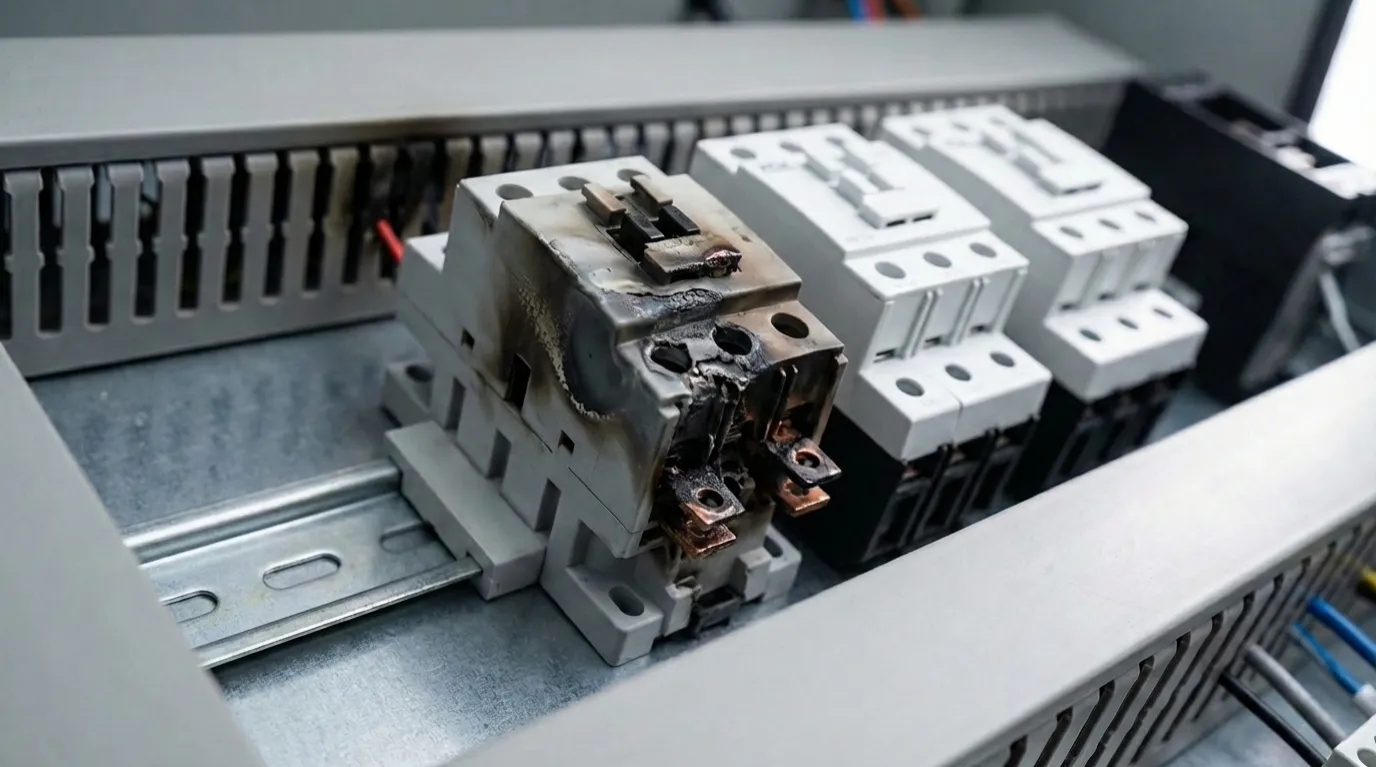
When modular contactors fail prematurely in household and light commercial applications, the root cause often traces back to a critical specification error: using an AC-7a rated contactor for an AC-7b application. This seemingly minor distinction—defined by IEC 61095 standards—represents the difference between reliable operation and catastrophic failure when controlling inductive loads like motors, fans, and compressors.
Understanding the technical differences between AC-7a and AC-7b utilization categories isn’t just about compliance—it’s about preventing equipment damage, avoiding costly downtime, and ensuring system longevity. This guide breaks down the engineering fundamentals, failure mechanisms, and selection criteria that every electrical professional needs to master.
What Are AC-7a and AC-7b Utilization Categories?
Utilization categories, standardized by IEC 61095 for household and similar applications, define the electrical load characteristics and switching duty cycles that contactors must withstand. Unlike the more commonly known AC-1 and AC-3 categories (defined in IEC 60947-4-1 for industrial contactors), AC-7a and AC-7b specifically address residential and light commercial equipment with current ratings typically ≤63A.
AC-7a: Slightly Inductive Loads
AC-7a contactors are designed for resistive or slightly inductive loads with power factors ≥0.95. These applications include:
- Resistive heating elements
- Incandescent and LED lighting systems
- Electric ovens and cooktops
- Small power tools (drills, mixers)
- Television and entertainment systems
The key characteristic: minimal inrush current (typically 1.2-1.5× rated current) and negligible arcing during switching operations.
AC-7b: Motor and Rotating Machine Loads
AC-7b contactors handle household motor loads with significant inductive reactance and high starting currents (5-8× rated current). Typical applications:
- Single-phase induction motors
- Fans and ventilation systems
- Central vacuum cleaners
- Washing machines and dryers
- Refrigeration compressors
- Pool pumps and HVAC equipment
The critical difference: AC-7b contactors must withstand severe electrical stress during motor starting, including high inrush currents, voltage transients, and intense arcing at contact separation.
The Critical Differences: AC-7a vs. AC-7b
| Parameter | AC-7a (Slightly Inductive) | AC-7b (Motor Loads) |
|---|---|---|
| Power Factor | ≥0.95 (nearly resistive) | 0.45-0.85 (highly inductive) |
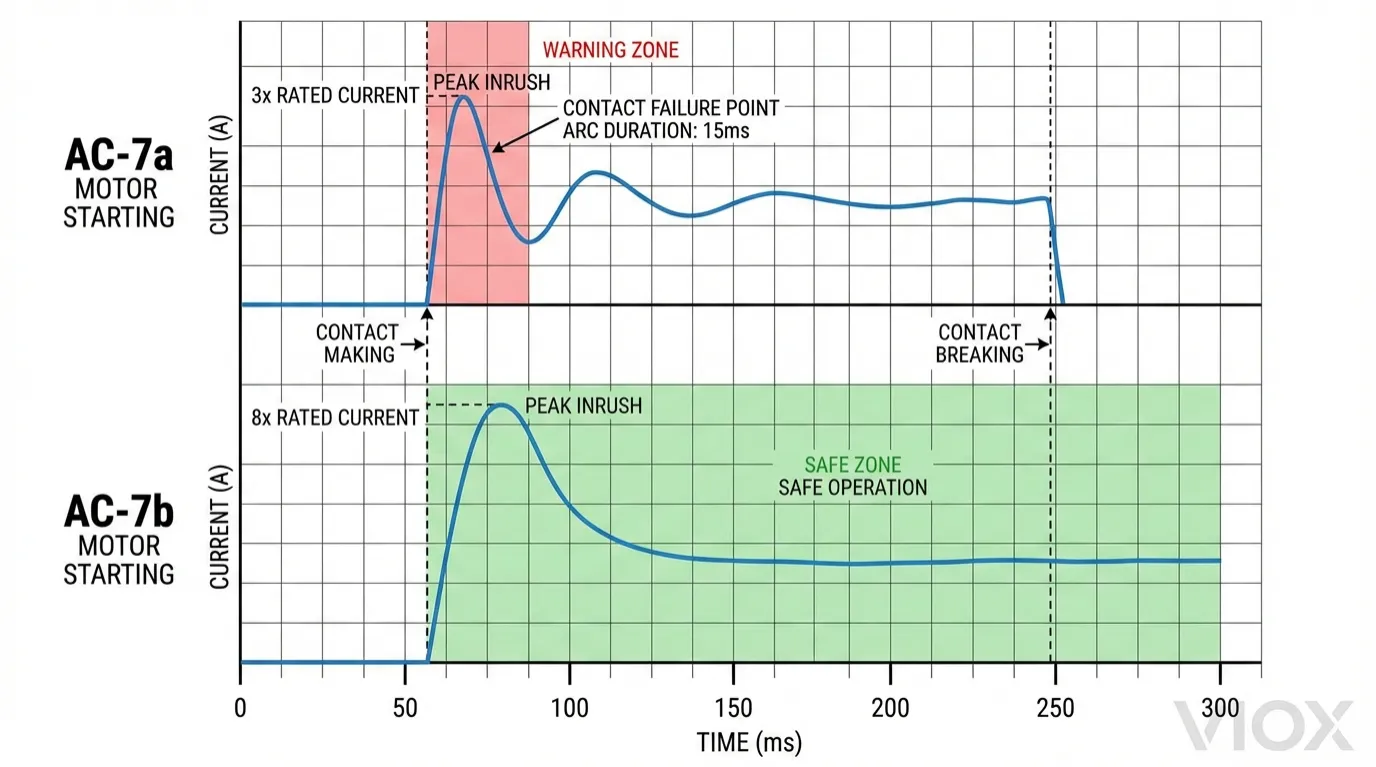
| Inrush Current | 1.2-1.5× rated current | 5-8× rated current |
| Making Capacity | Standard (1.5× Ie) | High (8-10× Ie) |
| Breaking Capacity | Low arc energy | High arc energy (motor back-EMF) |
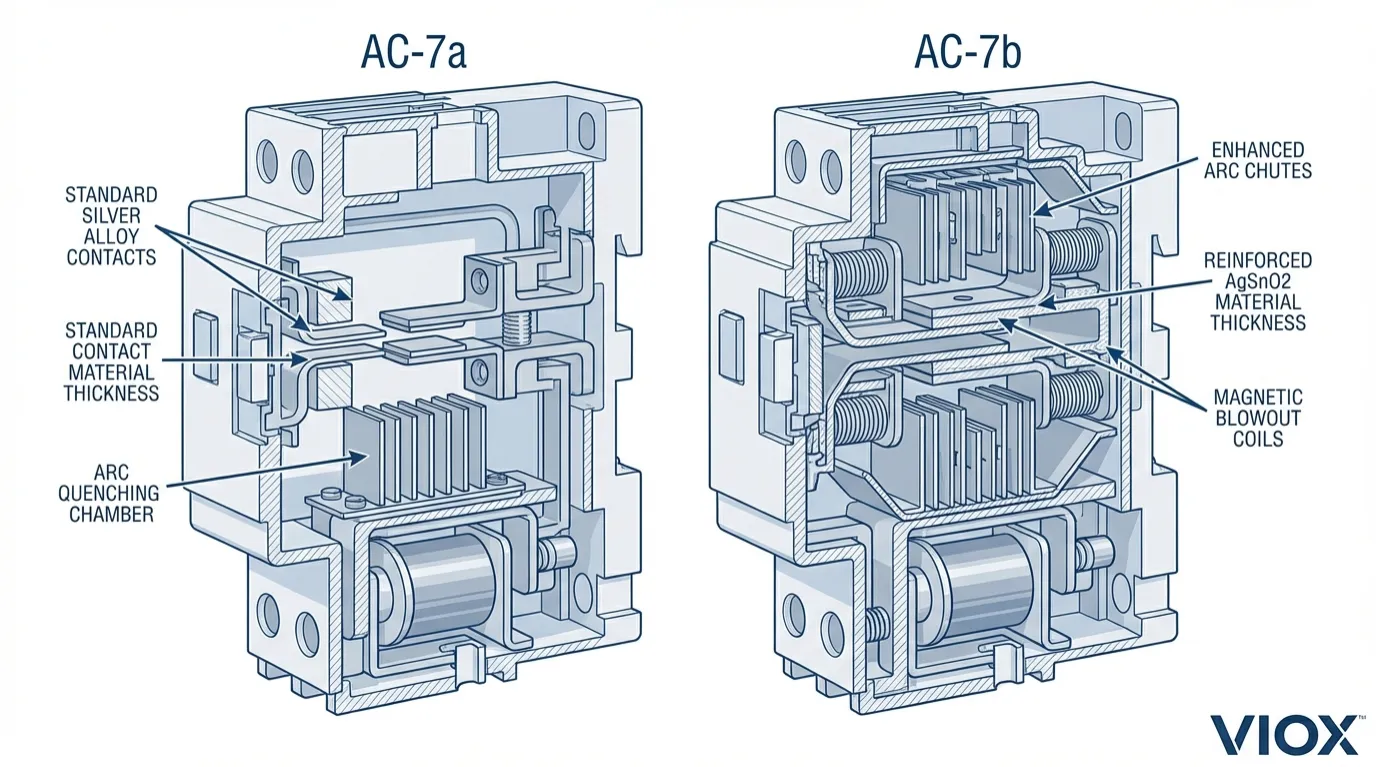
| Contact Material | Standard silver alloy | AgSnO2 or AgCdO (arc-resistant) |
| Arc Suppression | Minimal requirements | Enhanced arc chutes + magnetic blowout |
| Electrical Life | 100,000-500,000 operations | 50,000-100,000 operations |
| Mechanical Life | 1-10 million operations | 1-5 million operations |
| Typical Current Rating | Up to 63A | Derated to 25-32A (same frame size) |
| Coil Hold-In Power | Standard | Higher (to prevent dropout during voltage dips) |
| Standards Compliance | IEC 61095 Table 6 | IEC 61095 Table 7 |
Key Insight: An AC-7b contactor rated at 25A can handle the same motor load that would require a 63A AC-7a contactor—but only the AC-7b design survives the starting transients.
Why AC-7a Contactors Fail on Motor Loads
1. Contact Welding from Inrush Current
When a motor starts, the inrush current (typically 6-8× rated current for 100-300ms) creates a magnetic force between contacts that can exceed the contact spring pressure. In AC-7a contactors with lighter spring tension, this causes:
- Contact bouncing during closure, creating multiple arc strikes
- Micro-welding at contact surfaces from repeated arcing
- Progressive degradation until contacts permanently weld closed
Real-World Example: A 16A AC-7a contactor controlling a 1.5kW (7A) pool pump motor experiences 56A inrush current. The contacts, designed for 24A maximum making capacity (1.5× 16A), suffer immediate damage. After 50-100 starts, the contacts weld shut, causing the motor to run continuously and eventually overheat.
2. Arc Extinction Failure
Motor loads present a lagging power factor (0.45-0.85), meaning current and voltage are out of phase. When the contactor opens:
- Current continues flowing due to motor inductance (back-EMF)
- Arc voltage can reach 2-3× supply voltage
- AC-7a contacts lack sufficient arc chutes and magnetic blowout
- Prolonged arcing erodes contact material and carbonizes insulation
3. Thermal Overload
The higher I²t energy during motor starting heats contacts beyond their thermal design limits. AC-7a contactors typically use:
- Thinner contact material (0.5-1mm vs. 1.5-2mm in AC-7b)
- Lower thermal mass heat sinks
- Standard terminal connections without enhanced cooling
Result: Contact resistance increases, creating a positive feedback loop of heating → oxidation → higher resistance → more heating.
How to Select the Right Contactor
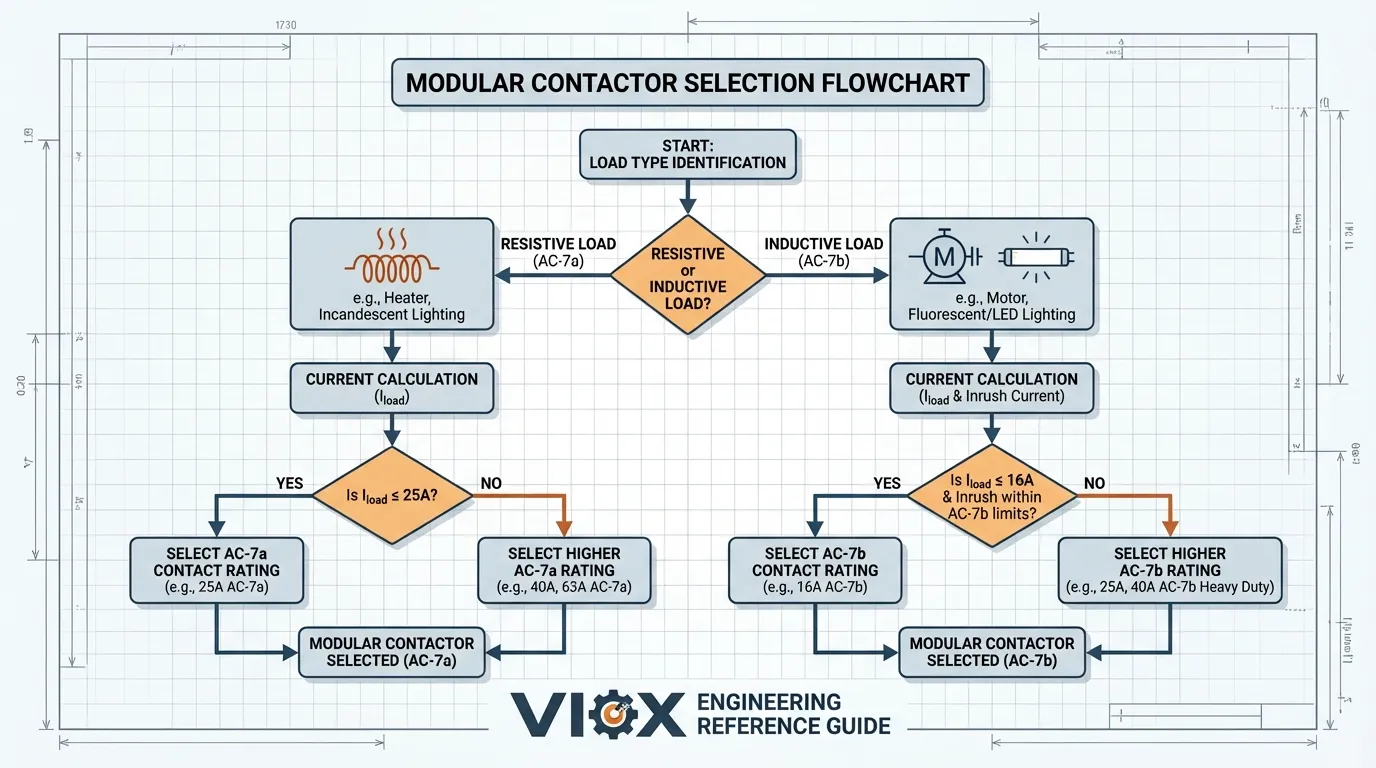
Step 1: Identify Load Characteristics
Use AC-7a for:
- Resistive heaters (power factor >0.95)
- Lighting circuits (LED, fluorescent with PFC)
- Non-motor appliances
- Loads with minimal starting surge
Use AC-7b for:
- Any single-phase motor (fans, pumps, compressors)
- Three-phase motors ≤2.2kW in residential settings
- Loads with starting current >3× rated current
- Equipment with frequent start/stop cycles
Step 2: Calculate Required Current Rating
For AC-7a loads:
For AC-7b motor loads:
But verify: Contactor making capacity ≥ Motor locked rotor current (typically 6-8× FLA)
Example Calculation:
- Motor: 1.1kW, 230V, single-phase
- Full Load Current: 5.5A
- Locked Rotor Current: 33A (6× FLA)
- Required: AC-7b contactor rated ≥7A (5.5 × 1.25)
- Verify making capacity: Must handle 33A inrush
A 16A AC-7b contactor (making capacity ~128A) is appropriate. A 16A AC-7a contactor (making capacity ~24A) would fail immediately.
Step 3: Consider Operational Factors
| Factor | Impact on Selection |
|---|---|
| Duty Cycle | >10 starts/hour requires AC-7b even for “light” motors |
| Ambient Temperature | >40°C requires derating (typically 0.9× per 10°C) |
| Altitude | >2000m requires derating (0.95× per 1000m) |
| Coil Voltage | Match control circuit voltage; use DC coils for noise immunity |
| Auxiliary Contacts | Ensure sufficient NO/NC contacts for interlocking |
Learn more about modular contactor selection
Common Mistakes and How to Avoid Them
Mistake #1: Assuming “Higher Amperage = Better”
Wrong: “I’ll use a 63A AC-7a contactor for a 10A motor—more capacity means more safety.”
Right: A 25A AC-7b contactor is the correct choice. The AC-7a lacks the contact material and arc suppression needed for motor starting, regardless of current rating.
Mistake #2: Ignoring Derating for Mixed Loads
When controlling both resistive and motor loads on the same contactor (e.g., heater + fan), always use the AC-7b rating. The inductive component dominates failure mechanisms.
Example: A bathroom heater with a 2kW heating element (8.7A) and 50W fan motor (0.2A). Total current: 8.9A.
- Incorrect: 16A AC-7a contactor (rated for resistive load)
- Correct: 16A AC-7b contactor (derated for motor component)
Mistake #3: Overlooking Frequent Switching
AC-7b contactors are designed for occasional starting (typically <5 starts/minute). Applications requiring frequent on/off cycles (e.g., compressor short-cycling) need:
- Upgraded AC-7b contactor with higher electrical life rating
- Soft-start circuits to reduce inrush current
- Time delay relays to prevent rapid cycling
Upgrading from AC-7a to AC-7b: Practical Considerations
Physical Compatibility
Most modular contactor families offer both AC-7a and AC-7b ratings in the same DIN rail footprint:
| Frame Size | AC-7a Rating | AC-7b Rating | DIN Modules |
|---|---|---|---|
| Small | 25A | 16A | 2 modules |
| Medium | 40A | 25A | 3 modules |
| Large | 63A | 32A | 4 modules |
Retrofit Tip: When replacing a failed AC-7a contactor, the AC-7b equivalent typically fits the same mounting space but requires verification of terminal wire sizing for the derated current.
Cost Analysis
AC-7b contactors cost approximately 20-40% more than equivalent AC-7a models due to:
- Enhanced contact materials (AgSnO2 vs. standard silver)
- Reinforced arc suppression components
- Higher-grade coil insulation
- Extended testing and certification requirements
ROI Calculation: The premium pays for itself after the first prevented failure. A typical service call for contactor replacement costs $150-300 in labor alone, plus equipment downtime.
Wiring and Control Integration
Both AC-7a and AC-7b contactors use identical control interfaces:
- Standard coil voltages: 24V, 110V, 230V AC/DC
- Auxiliary contact configurations: 2NO, 2NC, 2NO+2NC
- Compatible with 2-wire and 3-wire control circuits
- DIN rail mounting per IEC 60715
Advanced Topics: Beyond Basic Selection
Coordination with Overload Protection
AC-7b contactors must coordinate with thermal overload relays or motor protection circuit breakers. The contactor’s making capacity must exceed the overload relay’s tripping threshold to prevent nuisance trips during starting.
Recommended coordination:
- Contactor making capacity ≥ 10× motor FLA
- Overload relay trip class: 10A or 20A per IEC 60947-4-1
- Short-circuit protection: Type 2 coordination per IEC 60947-4-1
Coil Suppression for Inductive Loads
When controlling motors, the contactor coil itself becomes an inductive load. Without proper suppression, coil de-energization creates voltage spikes that can damage control circuits. Solutions include:
- RC snubbers (resistor-capacitor networks) across coil terminals
- Varistor (MOV) suppression for transient absorption
- Freewheeling diodes for DC coils
Learn more about coil suppression techniques
Environmental Derating
Both AC-7a and AC-7b ratings assume standard test conditions (25°C ambient, sea level, pollution degree 2). Real-world installations require derating:
Temperature Derating:
- 40°C: 100% rated current
- 50°C: 90% rated current
- 60°C: 80% rated current
Altitude Derating:
- 0-2000m: 100% rated current
- 2000-3000m: 95% rated current
- 3000-4000m: 90% rated current
Troubleshooting Failed Contactors
Symptoms of AC-7a Misapplication on Motor Loads
- Contact welding (contactor won’t open)
- Excessive coil buzzing during motor starting
- Visible arcing or light emission from contactor housing
- Burnt smell or discolored plastic near terminals
- Premature failure (<1000 operations vs. rated 100,000)
Diagnostic Procedure
Step 1: Verify load type and current
- Measure actual motor starting current with clamp meter
- Compare to contactor making capacity rating
Step 2: Inspect contact condition
- Check for pitting, erosion, or welding
- Measure contact resistance (should be <1mΩ)
Step 3: Evaluate operating environment
- Ambient temperature, humidity, pollution
- Switching frequency and duty cycle
Step 4: Select appropriate replacement
- Use AC-7b rating for any motor load
- Size for 125% of motor FLA minimum
- Verify making capacity ≥ locked rotor current
Complete contactor troubleshooting guide
Standards and Compliance
IEC 61095:2023
The current standard for modular contactors in household applications defines:
- Utilization categories AC-7a, AC-7b, AC-7c (capacitor switching)
- Test procedures for making/breaking capacity
- Endurance testing requirements (electrical and mechanical life)
- Temperature rise limits and thermal testing
- Short-circuit coordination requirements
Key Change in 2023 Edition: Introduction of AC-7d category for electronic motor loads (VFD-controlled motors), now adopted into IEC 60947-4-1.
Certification Requirements
Contactors must carry certification marks for the intended market:
| Region | Required Marks | Standards Referenced |
|---|---|---|
| European Union | CE, ENEC | IEC 61095, EN 61095 |
| North America | UL, CSA | UL 60947-4-1, CSA C22.2 |
| China | CCC | GB/T 14048.4 |
| Australia | SAA, RCM | AS/NZS 60947.4.1 |
VIOX Compliance: All VIOX modular contactors meet IEC 61095 and UL 60947-4-1 standards with third-party certification for global market access.
Key Takeaways
- ✅ AC-7a contactors are designed for resistive or slightly inductive loads (power factor ≥0.95) such as heaters and lighting—they will fail prematurely on motor loads.
- ✅ AC-7b contactors handle household motor loads with high starting currents (5-8× rated current) through reinforced contacts, enhanced arc suppression, and higher making capacity.
- ✅ The current rating alone doesn’t determine suitability—a 63A AC-7a contactor cannot safely control a 10A motor that a 25A AC-7b contactor handles reliably.
- ✅ Motor starting inrush current is the critical selection parameter—verify the contactor’s making capacity exceeds the motor’s locked rotor current (typically 6-8× full load current).
- ✅ Mixed loads require AC-7b rating—when controlling both resistive and motor loads on the same contactor, always use the AC-7b specification.
- ✅ Environmental factors require derating—high ambient temperature (>40°C), altitude (>2000m), and frequent switching reduce effective current capacity.
- ✅ Proper coordination with overload protection is essential—the contactor must withstand motor starting current without nuisance tripping of protective devices.
- ✅ AC-7b contactors cost 20-40% more than AC-7a but prevent catastrophic failures that cost far more in service calls, downtime, and equipment damage.
- ✅ IEC 61095 compliance ensures global market access—specify contactors with appropriate certification marks (CE, UL, CCC) for your region.
- ✅ Upgrading from AC-7a to AC-7b typically requires no panel modifications—most manufacturers offer both ratings in the same DIN rail footprint.
Frequently Asked Questions
Q: Can I use an AC-7b contactor for AC-7a applications?
A: Yes, AC-7b contactors are fully compatible with AC-7a loads. The enhanced contact materials and arc suppression provide no disadvantage for resistive loads, though you pay a premium for capabilities you don’t need. However, using AC-7a for AC-7b applications will cause failure.
Q: How do I identify if my existing contactor is AC-7a or AC-7b?
A: Check the nameplate or datasheet for the utilization category marking. It will explicitly state “AC-7a” or “AC-7b” along with the current rating. If only one current rating is listed, it’s likely AC-7a (the default for non-motor applications). AC-7b contactors typically show two ratings: a higher AC-7a value and lower AC-7b value.
Q: What’s the difference between AC-7b and AC-3 contactors?
A: AC-3 is an industrial motor contactor category (IEC 60947-4-1) for three-phase motors, typically >3kW, with higher voltage ratings (up to 690V) and current ratings (up to 1000A). AC-7b is specifically for household single-phase motors ≤2.2kW with current ratings ≤32A. AC-3 contactors are over-specified and more expensive for residential applications. Learn more about contactor standards
Q: How many starts per hour can an AC-7b contactor handle?
A: Standard AC-7b contactors are rated for occasional starting, typically ≤5 starts per minute or ≤10 starts per 10-minute period. For higher duty cycles (e.g., compressor applications), specify contactors with enhanced electrical life ratings or implement time delay protection.
Q: Do I need special wiring for AC-7b contactors?
A: No, the wiring requirements are identical to AC-7a. Use wire sized for 125% of the motor’s full load current per NEC Article 430 or IEC 60364. The contactor terminals accept the same wire gauges as the equivalent AC-7a model.
Q: Can I retrofit an AC-7b contactor into an existing AC-7a installation?
A: Yes, in most cases. Verify that:
- The DIN rail mounting footprint matches (usually identical within the same product family)
- Terminal wire sizing is adequate for the motor current
- The control circuit voltage matches the new contactor’s coil rating
- Overload protection is coordinated with the motor starting characteristics
Q: What causes the “buzzing” sound in contactors controlling motors?
A: Buzzing during motor starting indicates the coil voltage is dropping below the hold-in threshold due to supply voltage sag from the high inrush current. This is more common with AC-7a contactors that lack the reinforced coil design of AC-7b models. Solutions include using a DC coil with rectified supply or upgrading to an AC-7b contactor with enhanced coil hold-in characteristics. Troubleshooting guide
Q: Are there any safety concerns with using the wrong contactor category?
A: Yes. A failed contactor can weld closed, causing the motor to run continuously, leading to overheating and potential fire hazards. Alternatively, contacts can weld partially, creating high-resistance connections that generate excessive heat. Always use AC-7b contactors for motor loads to ensure safe operation and compliance with electrical codes.
Conclusion
The distinction between AC-7a and AC-7b modular contactors represents a fundamental engineering principle: matching component specifications to application requirements. While the 20-40% cost premium for AC-7b contactors may seem significant, it pales in comparison to the costs of premature failure, service calls, and potential safety hazards.
For electrical professionals, the selection criteria are clear: use AC-7a for resistive loads, AC-7b for motors—no exceptions. The enhanced contact materials, arc suppression systems, and making capacity of AC-7b contactors are not optional features but essential design elements for reliable motor control.
As household and light commercial equipment increasingly incorporates motor-driven components (HVAC systems, heat pumps, ventilation), the importance of proper contactor selection will only grow. By understanding the technical differences outlined in this guide and applying the selection methodology, you can ensure system reliability, safety, and longevity.
VIOX Electric manufactures a complete range of modular contactors with both AC-7a and AC-7b ratings, certified to IEC 61095 and UL 60947-4-1 standards. Our technical support team can assist with application-specific selection and coordination with protective devices. Contact us for detailed specifications and selection assistance.
Related Resources
- IEC 61095 vs. IEC 60947-4-1: Household and Industrial Contactor Standards
- Inside AC Contactor Components: Design Logic
- How to Choose Modular Contactor: AC vs DC
- Contactors vs. Relays: Understanding the Key Differences
- Contactor vs. Motor Starter: Complete Comparison
- Safety Contactor vs. Standard Contactor: Force-Guided Contacts Guide
- Industrial Contactor Maintenance Inspection Checklist
- Understanding 1 Pole vs. 2 Pole AC Contactors
- How to Select Contactors and Circuit Breakers Based on Motor Power
- Star Delta Starter Wiring Diagram: Sizing & Selection Guide