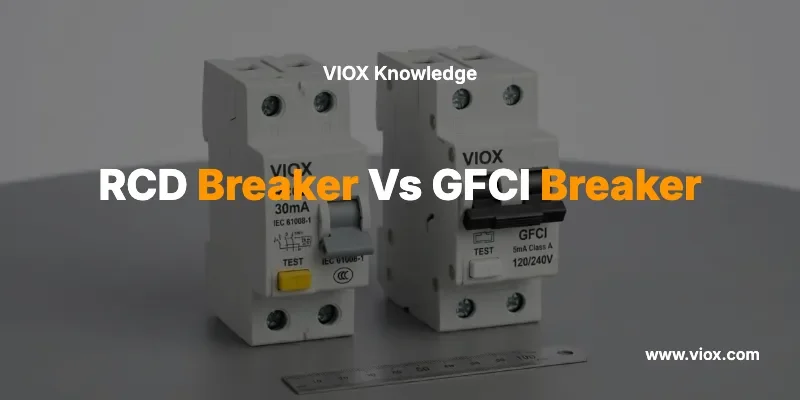
For international electrical contractors, panel builders, and procurement specialists, navigating the terminology between IEC (International) and NEC (North American) standards can be a source of constant frustration. The most common point of confusion? The distinction between an RCD Breaker and a GFCI Breaker.
Are they the same device? Can you use one in place of the other? Why does one trip at 5mA and the other at 30mA?
This guide dismantles the terminology barrier, explaining the technical, functional, and regulatory differences between these two critical safety devices. Whether you are specifying a project in Dubai (IEC) or Dallas (NEC), understanding these nuances is essential for safety compliance and system reliability.
The Core Truth: Same Technology, Different Names
At their heart, both RCDs and GFCIs are designed to save lives by detecting earth leakage currents—electricity leaking from a circuit to ground, often through a human body.
Both devices operate on the same fundamental physical principle: Kirchhoff’s Current Law. They monitor the current flowing out on the live (hot) conductor and compare it to the current returning on the neutral conductor. In a healthy circuit, these currents are equal. If they differ, current is leaking somewhere it shouldn’t.
- RCD (Residual Current Device): This is the umbrella term used by the IEC (International Electrotechnical Commission). It covers a family of devices including RCCBs and RCBOs. The term “Residual” refers to the “leftover” current that didn’t return via the neutral.
- GFCI (Ground Fault Circuit Interrupter): This is the specific term used in North America (NEC/UL standards). It emphasizes the fault condition (ground fault) rather than the measurement method.
While the physics are identical, the implementation, sensitivity, and tripping characteristics differ significantly due to divergent safety philosophies between North America and the rest of the world.
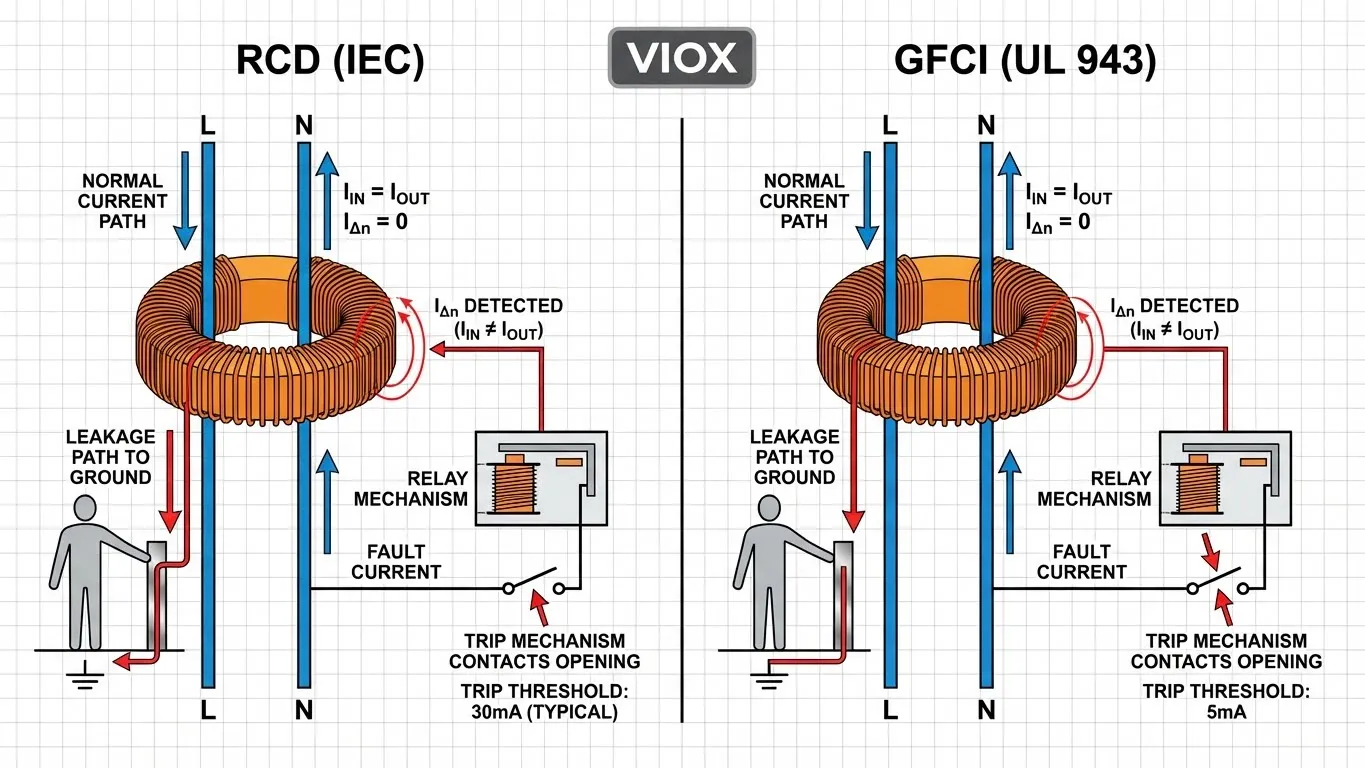
Terminology Breakdown: RCD Family vs GFCI Family
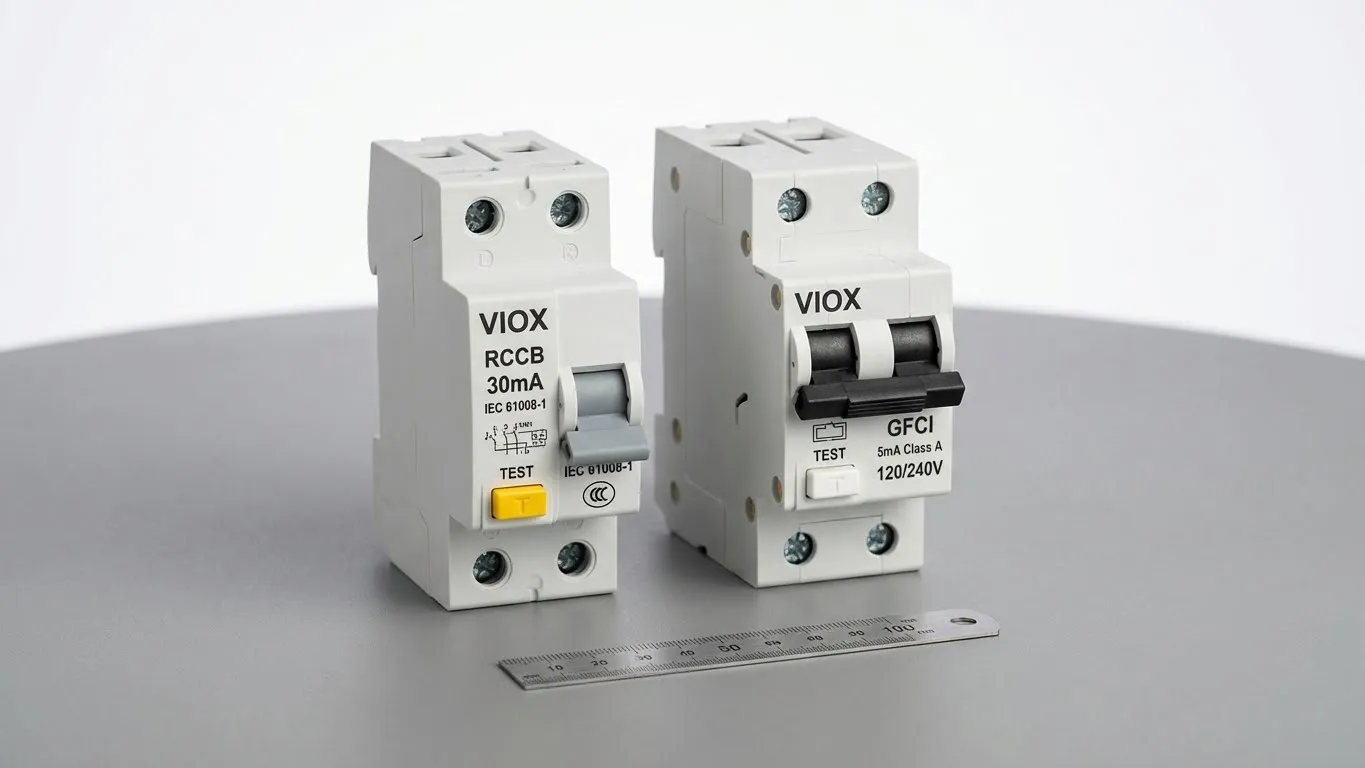
The confusion often stems from the fact that “RCD” is a category, while “GFCI” often refers to a specific product format. To clarify, we must look at how these functions are packaged.
For a deeper dive into these acronyms, refer to our guide on The Electrical Alphabet Soup: MCCB vs RCCB Explained.
Comparison of Global Terminology
| IEC / International Term | North American (UL/NEC) Term | Function | Primary Standard |
|---|---|---|---|
| RCD (Umbrella Term) | Ground Fault Protection | General term for leakage protection. | IEC 61008 / UL 943 |
| RCCB (Residual Current Circuit Breaker) | No direct equivalent (closest is a standalone GFCI switch, rare) | Provides leakage protection ONLY. Must be paired with an MCB. | IEC 61008-1 |
| RCBO (Residual Current Breaker with Overcurrent) | GFCI Circuit Breaker | Combines leakage protection + overload + short-circuit protection. | IEC 61009-1 / UL 943 |
| No direct equivalent (SRCDs exist but are rare) | GFCI Receptacle (Outlet) | Leakage protection integrated into the wall socket. | UL 943 |
The IEC Approach (RCDs)
In IEC markets (Europe, Asia, Australia), the protection is typically split. You might have an RCCB protecting a group of circuits, or an RCBO protecting a single critical circuit. Crucially, an RCCB cannot protect against overloads; it will burn out if current exceeds its rating. It must always be paired with an upstream fuse or MCB. See RCD vs MCB for more details.
The North American Approach (GFCIs)
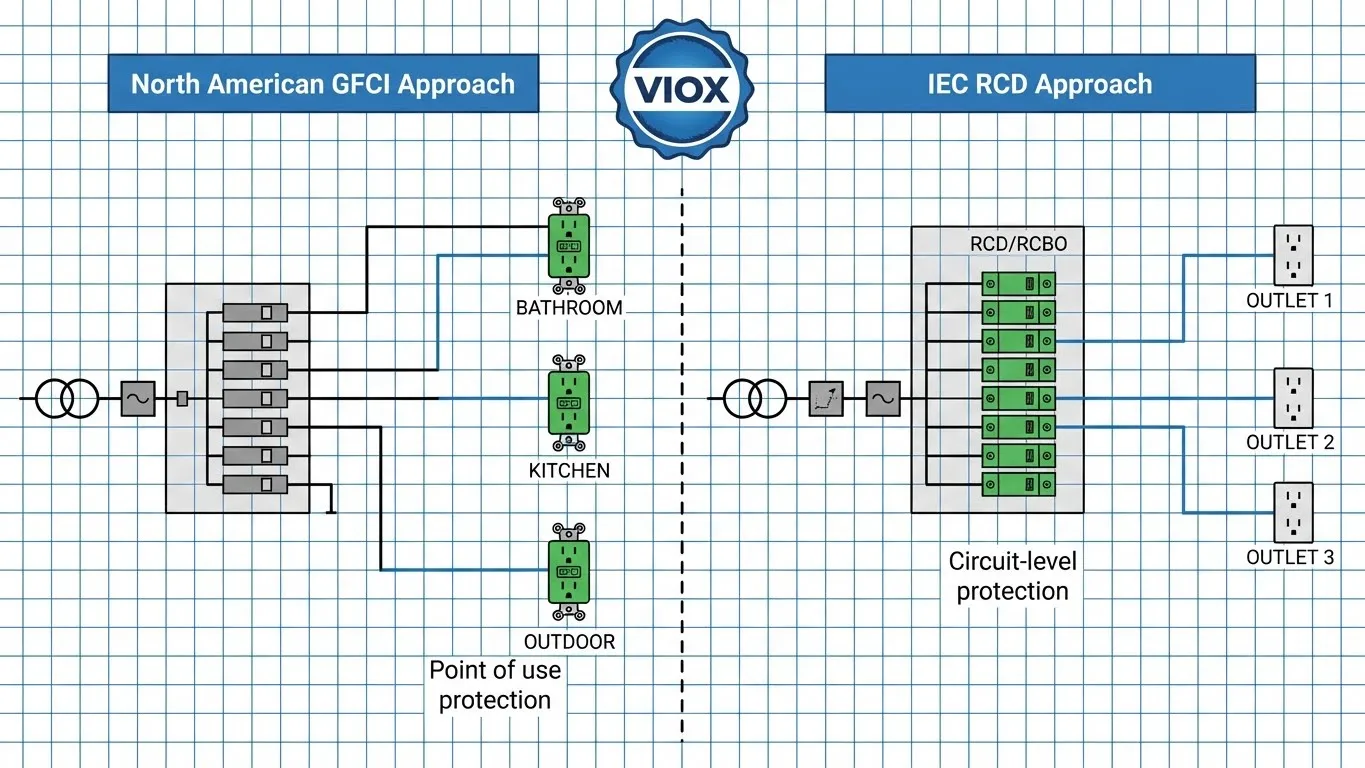
In the US and Canada, the GFCI Breaker is the direct equivalent of an RCBO—it handles everything (overload, short circuit, ground fault) in one package installed in the panel. However, the most common device is the GFCI Receptacle, which places protection right at the point of use (e.g., the bathroom socket).
The Critical Difference: Sensitivity Thresholds
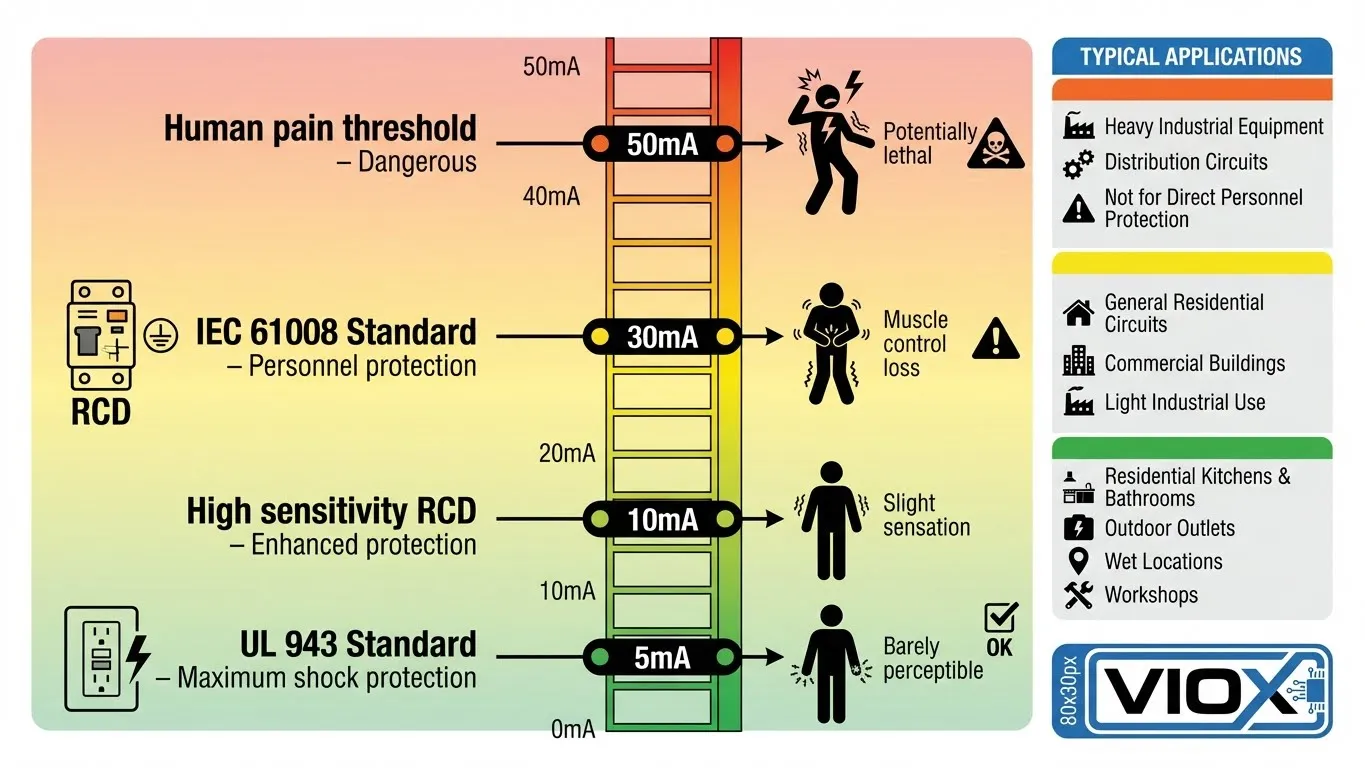
The most significant technical difference between an RCD and a GFCI is sensitivity. This dictates where and how they can be used.
| Parameter | RCD (IEC Standard) | GFCI (North American Standard) | Notes |
|---|---|---|---|
| Trip Threshold | 30mA (Typical) | 5mA (±1mA) | GFCI is 6x more sensitive. |
| Primary Goal | Prevent lethal fibrillation (shock protection). | Prevent any shock sensation (startle reaction). | |
| Nuisance Tripping | Low risk. 30mA allows for natural cable leakage. | High risk on long cable runs due to capacitive leakage. | |
| Trip Time | < 300ms (Instantaneous) | < 25ms (at higher faults) | GFCI generally trips faster. |
Why the difference?
North American standards (UL 943) prioritize the “Let-Go” threshold. A 5mA shock is painful but allows a person to let go of the wire. IEC standards (IEC 60479) recognize that while 30mA is a significant shock, it is generally below the threshold for ventricular fibrillation (heart stoppage) for a short duration.
The IEC chose 30mA to allow for “whole house” or “whole circuit” protection without constant nuisance tripping caused by the natural leakage current of computer power supplies and long cable runs. The NEC chose 5mA for maximum safety, but this often forces protection to be installed at the outlet (GFCI Receptacle) rather than the panel, to minimize cable length and leakage accumulation.
Implementation Philosophy: Point-of-Use vs Whole-Circuit
The sensitivity difference drives two distinct installation philosophies.
North American Approach (NEC): Point-of-Use
Because 5mA is so sensitive, GFCIs are historically installed as close to the load as possible—typically as a receptacle in the bathroom or kitchen. This prevents the device from tripping due to the cumulative leakage of 50 feet of Romex cable. While GFCI breakers exist, they are less common in older homes than GFCI outlets.
IEC Approach: Whole-Circuit Protection
With a 30mA threshold, an RCD can comfortably protect an entire circuit or even a group of circuits from the distribution board (consumer unit). This centralizes protection, making it easier to reset and manage.
| Feature | North American (GFCI) Approach | IEC (RCD) Approach |
|---|---|---|
| Location | Wall outlets (Receptacles) or Panel | Distribution Board (Panel) |
| Scope | Specific hazardous locations (wet areas) | All socket circuits (and increasingly lighting) |
| Maintenance | User must test each outlet monthly | User tests devices at the main panel |
| Cost | Lower (outlets are cheap) | Higher (panel devices are engineered components) |
Standards and Compliance Matrix
For manufacturers and importers, knowing the standard is more important than knowing the name. You cannot sell an IEC RCD in the US market as a “GFCI” unless it passes UL 943, which most 30mA RCDs will fail due to sensitivity requirements.
| Device Type | Primary Standard | Sensitivity | Test Requirement | Certification |
|---|---|---|---|---|
| GFCI | UL 943 / CSA C22.2 | 5mA ±1mA | Monthly (Auto-monitoring required in new versions) | UL / ETL / CSA |
| RCCB | IEC 61008-1 | 10, 30, 100, 300mA | Periodic (Test button) | CE / CB / KEMA |
| RCBO | IEC 61009-1 | 10, 30, 100, 300mA | Periodic (Test button) | CE / CB / CCC |
Note on Cross-Compliance: A 30mA RCD does not meet NEC requirements for personnel protection in bathrooms/kitchens (which require 5mA). Conversely, a 5mA GFCI installed in a European home might cause endless nuisance tripping due to the different earthing arrangements and allowable leakage currents.
For more on IEC standards, see IEC 61008-1 Standard: RCCB Requirements Explained.
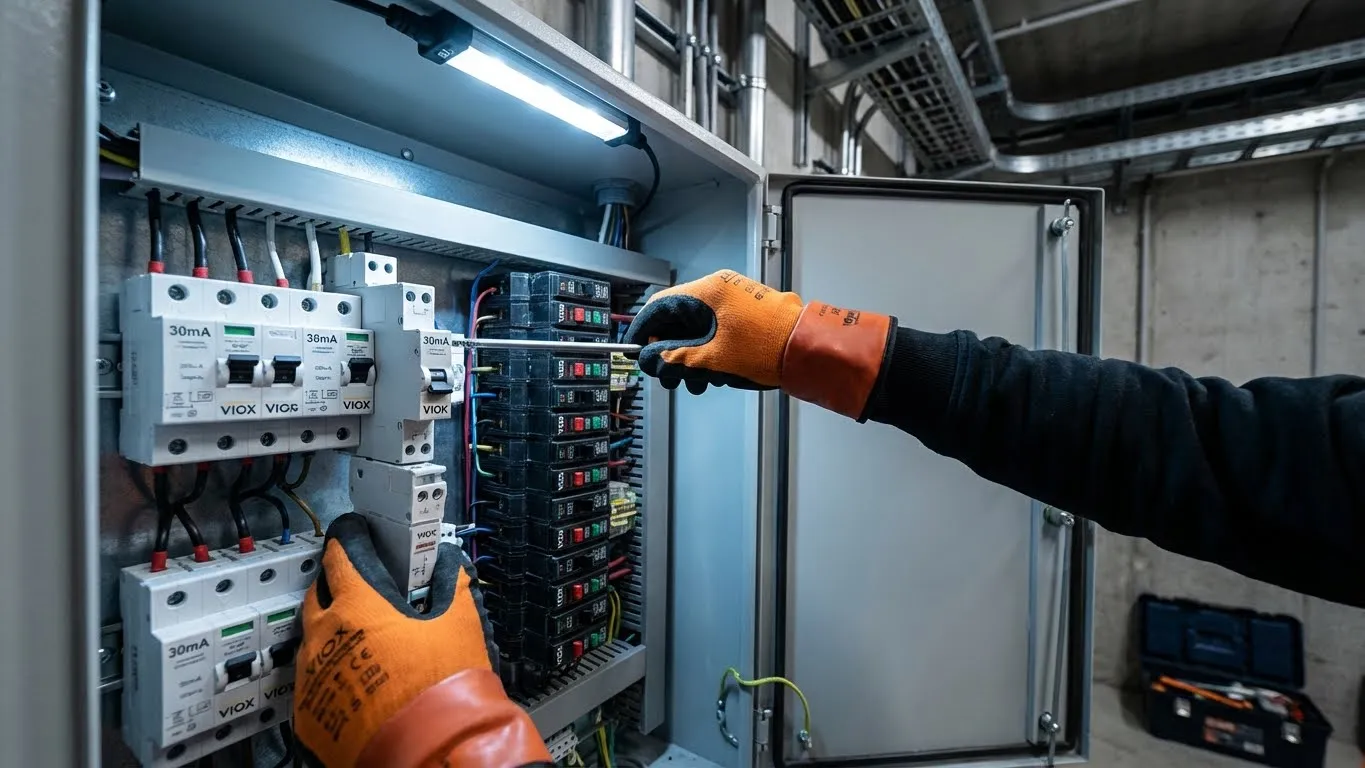
When to Choose RCD vs GFCI
The choice is almost always dictated by geography and local code.
- North America (USA, Canada, Mexico): You must use GFCIs.
- Use GFCI Receptacles for retrofits or specific wet locations.
- Use GFCI Breakers for new construction or when protecting circuits with hard-to-reach outlets (like heated floors or outdoor pumps).
- Rest of World (Europe, Asia, Africa, South America, AU/NZ): You must use RCDs.
- Use RCCBs (paired with MCBs) for general group protection in distribution boards.
- Use RCBOs for mission-critical circuits where you don’t want a fault on one circuit to trip the whole group. See How to Select the Right RCBO.
Special Case: High Sensitivity Needs
If you are in an IEC region but need protection for a swimming pool or medical equipment, you might specify a 10mA RCD. This mimics the sensitivity of a North American GFCI while maintaining IEC form factors.
Common Misconceptions Debunked
- Myth #1: “RCDs are just European GFCIs.”Fact: While the technology is similar, the 30mA vs 5mA difference makes them functionally distinct categories. They are not directly interchangeable.
- Myth #2: “GFCIs protect against overloads.”Fact: GFCI Receptacles (Outlets) DO NOT protect against overloads. Only GFCI Circuit Breakers do. An RCD (RCCB) also does not protect against overloads.
- Myth #3: “You can use a 30mA RCD in the US.”Fact: Generally, no. The NEC requires Class A GFCI protection (5mA) for personnel safety. A 30mA device is considered “Equipment Ground Fault Protection” (GFPE) in the US, not life safety protection.
- Myth #4: “RCCBs provide complete protection.”Fact: An RCCB detects leakage only. If you have a short circuit (Live to Neutral), the RCCB will likely melt before it trips. It must be paired with an MCB.
FAQ Section
Q: Can I use an RCD in place of a GFCI in a US installation?
No. The National Electrical Code (NEC) requires Class A ground fault protection, which trips at 5mA. A standard 30mA RCD does not meet this sensitivity requirement and would be a code violation for personnel protection.
Q: What is the difference between an RCCB and an RCBO?
An RCCB only provides earth leakage protection and must be used with a separate circuit breaker (MCB). An RCBO combines both functions (Leakage + Overload + Short Circuit) into a single device. See What is the difference between MCB, MCCB, RCB, RCD, RCCB, and RCBO.
Q: Why does North America use 5mA when the rest of the world uses 30mA?
North America prioritized the “let-go” threshold (5mA) to prevent any shock sensation/muscle lock-up. The rest of the world prioritized system stability and whole-circuit protection, determining that 30mA is safe enough to prevent heart fibrillation (death) while reducing nuisance tripping.
Q: Do GFCI breakers provide overcurrent protection too?
Yes. A GFCI Circuit Breaker installed in a panel provides three layers of protection: Ground Fault, Overload, and Short Circuit. However, a GFCI Receptacle (wall outlet) only provides Ground Fault protection.
Q: Which is better: 5mA GFCI or 30mA RCD?
Neither is “better”; they serve different philosophies. 5mA offers tighter shock protection but is prone to nuisance tripping on long circuits. 30mA is more robust for whole-house protection but allows a stronger (though non-lethal) shock before tripping.
Key Takeaways
- Same Tech, Different Rules: RCD and GFCI both use current transformers to detect leakage, but their trip thresholds differ significantly (30mA vs 5mA).
- Know Your Region: Use GFCIs (UL 943) for North American projects; use RCDs (IEC 61008/61009) for International projects.
- Device Types Matter:
- RCCB: Leakage only (needs MCB).
- RCBO / GFCI Breaker: Leakage + Overload + Short Circuit (All-in-one).
- Sensitivity Trade-off: 5mA (GFCI) is safer for direct contact but harder to implement on long circuits. 30mA (RCD) allows for centralized panel protection.
- Safety Layering: For complete protection, combine these devices with proper grounding and surge protection. Read Grounding vs GFCI vs Surge Protection for the full picture.
For premium circuit protection that meets global standards, explore VIOX’s complete range of RCCBs, RCBOs, and GFCI solutions.