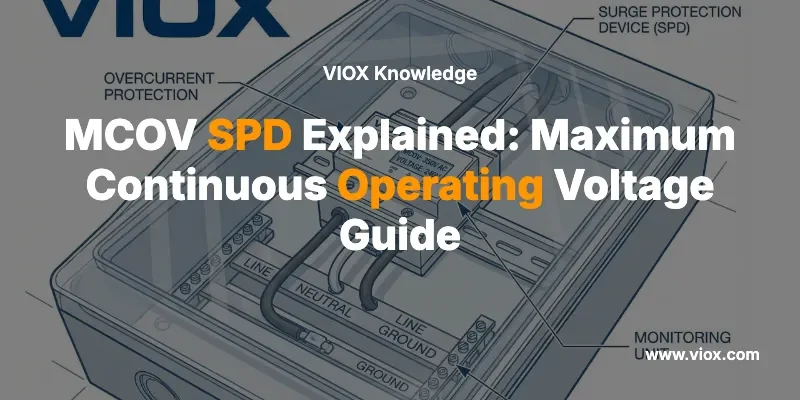
When specifying surge protective devices (SPDs) for electrical systems, understanding Maximum Continuous Operating Voltage (MCOV) is critical for ensuring reliable, long-term protection. The MCOV SPD rating determines whether your surge protection device can withstand the continuous voltage stresses present in your electrical system without premature failure. This comprehensive guide explores everything electrical engineers, facility managers, and procurement specialists need to know about MCOV for SPD applications, from fundamental concepts to practical selection criteria.
Selecting an SPD with the incorrect MCOV rating can lead to nuisance tripping, equipment damage, or complete protection system failure. As power quality issues become increasingly prevalent in modern electrical installations, proper MCOV specification has never been more important. Whether you’re protecting industrial facilities, commercial buildings, or critical infrastructure, understanding MCOV surge protection principles ensures your investment delivers maximum value and reliable performance.
What is MCOV for SPD?
Maximum Continuous Operating Voltage (MCOV) represents the maximum RMS voltage that a surge protective device can withstand continuously without degradation or failure. Unlike voltage protection ratings that describe transient surge handling capability, the MCOV rating defines the steady-state voltage threshold that the SPD’s metal oxide varistors (MOVs) or other protective components can tolerate during normal operation.
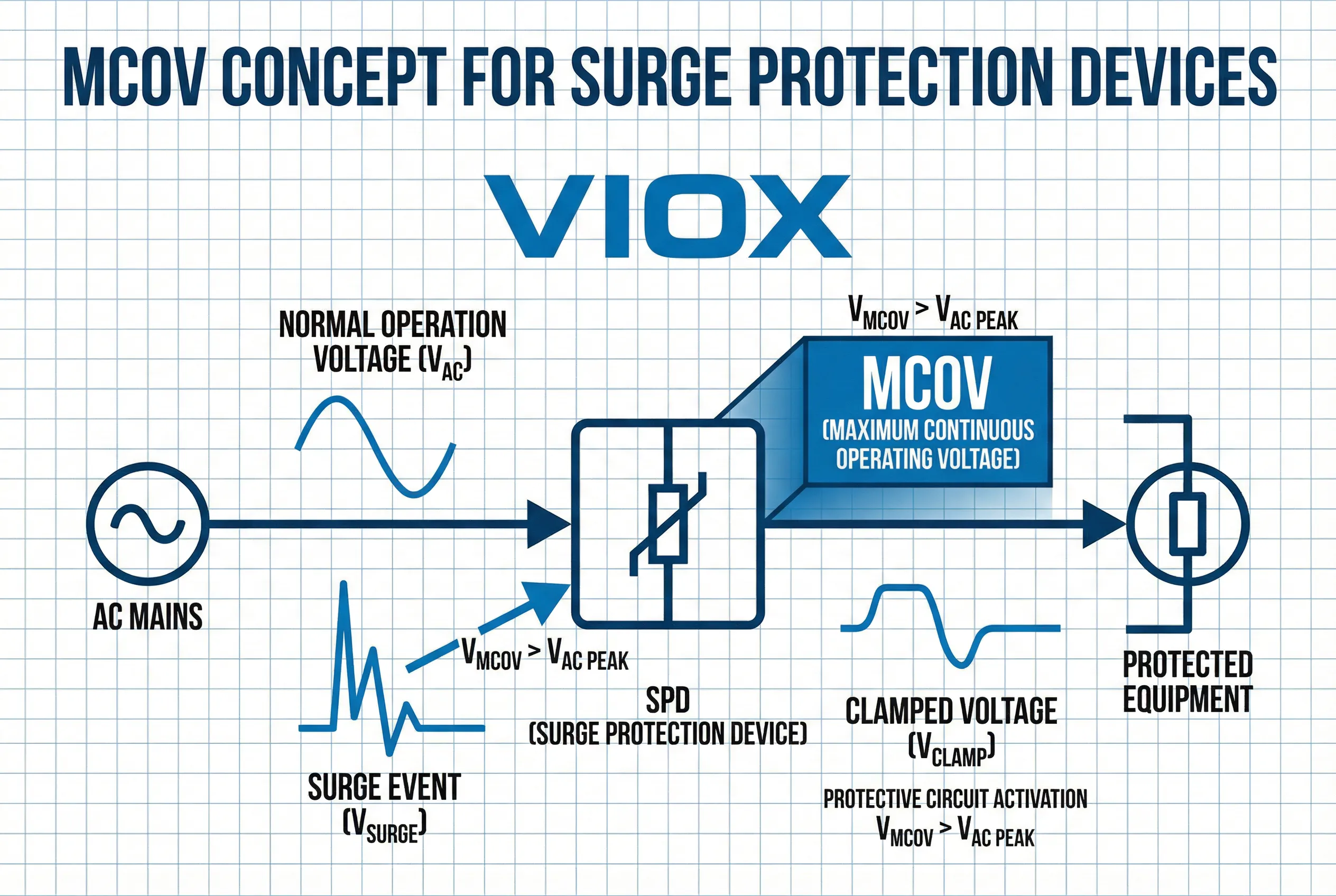
In practical terms, MCOV for SPD devices serves as a critical specification that must exceed the maximum expected system voltage, including temporary overvoltages (TOVs) that can occur during system faults, load switching, or utility voltage variations. When system voltage exceeds the MCOV rating, the SPD may conduct continuously, causing thermal stress, premature aging, or complete device failure.
The MCOV rating directly influences the SPD’s voltage protection level (VPL) and surge current handling capability. Higher MCOV ratings generally correlate with higher clamping voltages, creating a necessary balance between continuous operating capability and transient suppression performance. Understanding this relationship is essential for optimizing protection system design.
Why MCOV Matters in SPD Selection
Proper MCOV rating selection forms the foundation of effective surge protection system design. An undersized MCOV rating leads to chronic device stress, false disconnections, and shortened service life, while an excessively high rating may compromise protection effectiveness by allowing higher voltage levels to reach protected equipment.
The significance of MCOV in SPD selection extends beyond simple voltage matching. Electrical systems experience various temporary overvoltage conditions that must be considered:
Ground Fault Scenarios: During line-to-ground faults on ungrounded or high-resistance grounded systems, phase-to-ground voltages can rise to phase-to-phase levels. SPDs connected phase-to-ground must have MCOV ratings sufficient to withstand these elevated voltages without conducting.
System Voltage Variations: Utility voltage regulation typically allows ±5-10% variation from nominal values. Additionally, voltage rise can occur at the end of lightly loaded distribution circuits. The MCOV rating must accommodate these maximum expected operating voltages with adequate margin.
Harmonic Distortion Effects: Non-linear loads inject harmonic currents that can elevate RMS voltage levels. Modern facilities with variable frequency drives, switching power supplies, and LED lighting may experience voltage waveforms with significant harmonic content, effectively increasing the voltage stress on SPD components.
Resonance and Ferroresonance: Under certain system configurations, resonant conditions can produce sustained overvoltages. While less common, these conditions require careful MCOV consideration in sensitive applications.
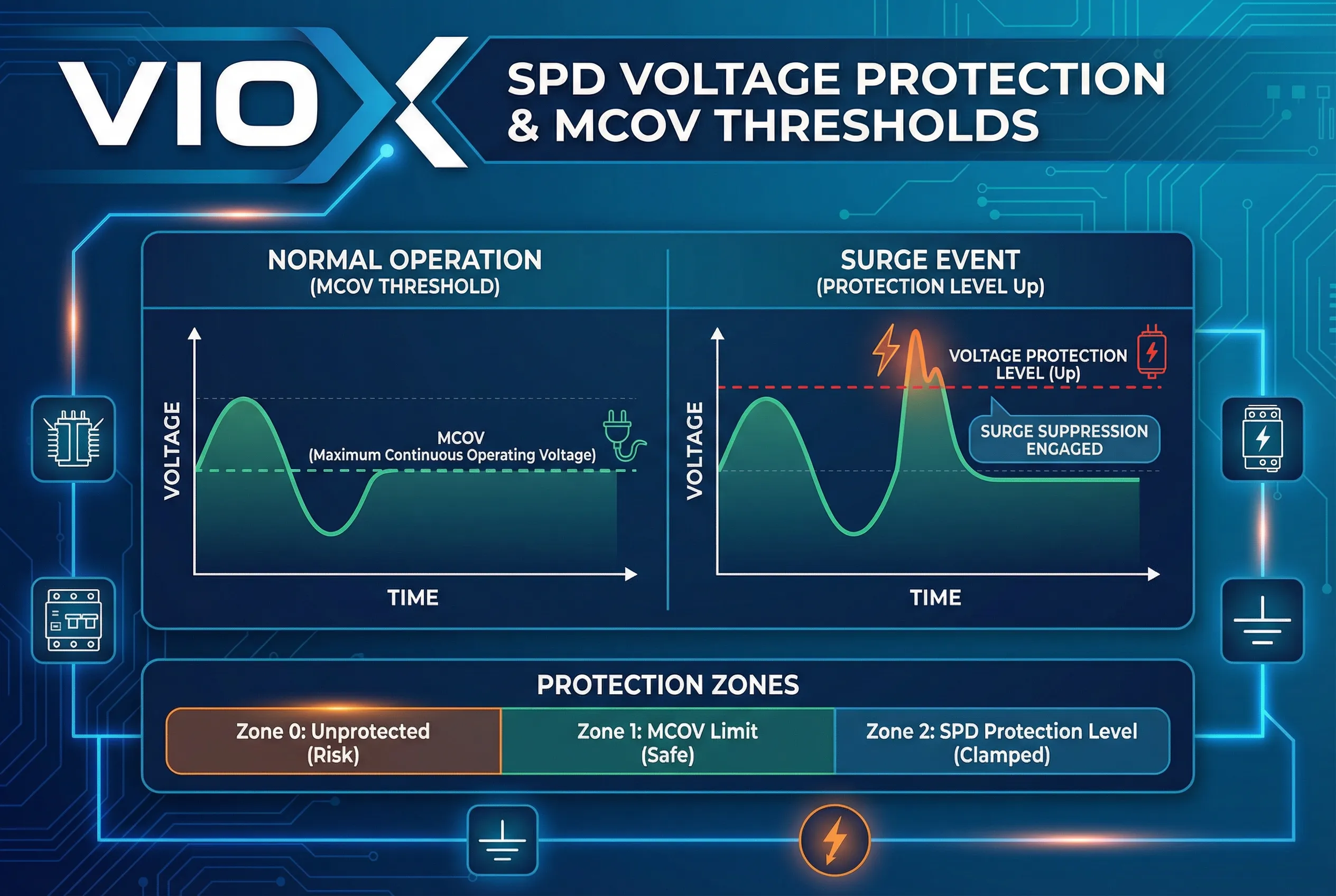
Standards organizations worldwide recognize MCOV’s critical importance. IEEE C62.41, IEC 61643-11, and UL 1449 all specify minimum MCOV requirements relative to system voltage configurations. Compliance with these standards ensures SPD compatibility with diverse electrical systems and provides a common framework for specification and procurement.
How to Calculate MCOV for SPD Systems
Calculating the required MCOV rating for SPD applications involves analyzing system characteristics and applying appropriate safety factors. The fundamental calculation process follows these steps:
Step 1: Determine System Configuration and Nominal Voltage
Identify whether the system operates as grounded (solidly grounded, resistance grounded, or reactance grounded) or ungrounded. This distinction fundamentally affects voltage stress during fault conditions.
Step 2: Calculate Maximum Expected Operating Voltage
For solidly grounded systems:
- Maximum Line-to-Neutral Voltage = Nominal Voltage × 1.1 (accounting for utility regulation)
- Maximum Line-to-Ground Voltage = Line-to-Neutral Voltage (during normal operation)
For ungrounded or high-resistance grounded systems:
- Maximum Line-to-Ground Voltage = Line-to-Line Voltage × 1.1 (during ground fault conditions)
Step 3: Apply TOV Factor
Temporary overvoltage duration and magnitude must be considered. IEEE standards recognize TOV conditions up to 1.25 times nominal voltage for durations of several seconds. The selected MCOV must exceed the maximum TOV expected:
Required MCOV ≥ Maximum System Voltage × TOV Factor
Step 4: Apply Safety Margin
Professional practice recommends applying an additional safety factor of 1.05-1.15 to account for measurement uncertainties, system variations, and long-term reliability:
Final MCOV Requirement = Required MCOV × Safety Factor (1.05-1.15)
Practical Calculation Example:
For a 480V, 3-phase, 4-wire solidly grounded system:
- Nominal Line-to-Neutral Voltage = 480V / √3 = 277V
- Maximum Operating Voltage = 277V × 1.1 = 305V
- TOV Factor Applied = 305V × 1.25 = 381V
- With Safety Margin = 381V × 1.1 = 419V
- Selected MCOV Rating: 420V minimum
For the same system but ungrounded or high-resistance grounded:
- Maximum Line-to-Ground Voltage = 480V × 1.1 = 528V
- TOV Factor Applied = 528V × 1.25 = 660V
- With Safety Margin = 660V × 1.1 = 726V
- Selected MCOV Rating: 730V minimum
These calculations demonstrate why system grounding significantly impacts SPD MCOV requirements. Always verify system grounding configuration before specifying SPD devices.
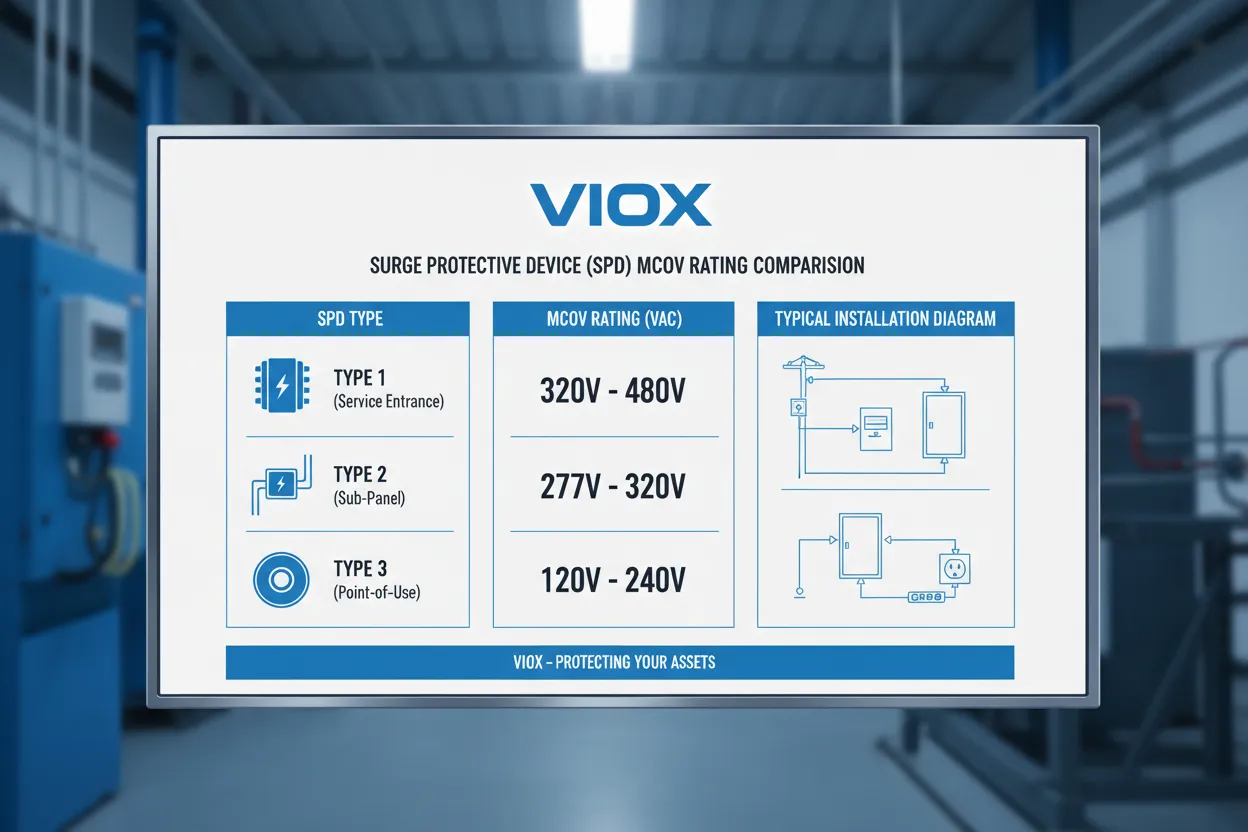
MCOV Ratings by System Voltage
Standard MCOV ratings have been established for common electrical system configurations. Understanding these standard ratings enables rapid specification while ensuring code compliance and optimal protection performance.
North American Low Voltage Systems:
| System Voltage | Configuration | Typical Application | Minimum MCOV (L-N) | Minimum MCOV (L-G Ungrounded) |
|---|---|---|---|---|
| 120/240V | Split-phase | Residential | 150V | 320V |
| 120/208V | 3-phase Wye | Commercial | 150V | 275V |
| 277/480V | 3-phase Wye | Industrial/Commercial | 320V | 660V |
| 347/600V | 3-phase Wye | Canadian Systems | 400V | 825V |
International Low Voltage Systems:
| System Voltage | Configuration | Region | Minimum MCOV (L-N) | Minimum MCOV (L-G) |
|---|---|---|---|---|
| 230/400V | 3-phase Wye | Europe/Asia | 255V | 440V |
| 240/415V | 3-phase Wye | UK/Australia | 275V | 460V |
| 220/380V | 3-phase Wye | China | 250V | 420V |
| 127/220V | 3-phase Wye | Brazil | 150V | 275V |
Medium Voltage Systems:
For systems above 1000V, MCOV calculations become more complex due to transformer winding configurations, insulation coordination requirements, and utility TOV characteristics. Typical medium voltage SPD MCOV ratings include:
- 4.16kV System: MCOV 3.3kV (L-N), 5.7kV (L-G ungrounded)
- 13.8kV System: MCOV 11kV (L-N), 19kV (L-G ungrounded)
- 34.5kV System: MCOV 28kV (L-N), 48kV (L-G ungrounded)
Medium voltage applications require coordination with utility TOV curves and consideration of system X/R ratios, making manufacturer consultation essential for proper specification.
Special Considerations:
- Ungrounded Systems: Always use L-G ungrounded MCOV ratings, typically 1.73 times L-N values
- High-Resistance Grounded Systems: Treat similarly to ungrounded systems for MCOV calculation
- Generator Applications: Account for potential voltage regulation variations (±10-15%)
- UPS Systems: Consider bypass and battery boost modes that may elevate output voltages
- Solar Installations: DC systems require special MCOV considerations based on maximum PV array voltage
Common MCOV Selection Mistakes
Even experienced electrical professionals can make critical errors when specifying MCOV ratings for surge protection devices. Understanding these common mistakes helps avoid costly failures and ensures optimal protection system performance.
Mistake 1: Using Nominal Voltage Without Safety Factors
Specifying an MCOV rating based solely on nominal system voltage ignores voltage variations, TOV conditions, and long-term reliability requirements. This mistake frequently leads to premature SPD failure in systems experiencing regular voltage fluctuations near upper regulation limits.
Mistake 2: Ignoring System Grounding Configuration
The most dangerous error involves specifying phase-to-neutral MCOV ratings for ungrounded or high-resistance grounded systems. During ground faults, these systems experience phase-to-ground voltages equal to phase-to-phase levels, causing SPDs with insufficient MCOV ratings to conduct continuously and fail catastrophically.
Mistake 3: Overlooking Utility TOV Characteristics
Utility systems can generate temporary overvoltages during fault clearing, capacitor switching, and load rejection events. Failing to account for these conditions, particularly in weak grid connections or end-of-line installations, results in SPD stress and reduced service life.
Mistake 4: Misapplying International Standards
Different standards (UL 1449, IEC 61643-11, IEEE C62.41) define MCOV requirements differently. Applying European IEC standards to North American installations, or vice versa, can result in under-protected or over-specified systems.
Mistake 5: Inadequate Coordination with Transformer Characteristics
Delta-wye transformer configurations, grounding transformer applications, and autotransformer systems create unique voltage relationships that affect SPD placement and MCOV requirements. Failure to analyze transformer connections leads to inappropriate SPD specifications.
Mistake 6: Neglecting Harmonic Content
Modern facilities with high levels of harmonic distortion experience elevated RMS voltages that stress SPD components. Ignoring power quality measurements when calculating MCOV requirements can result in unexpected device failures.
Mistake 7: Incorrect SPD Mode Selection
Confusion between common mode (line-to-ground) and differential mode (line-to-line or line-to-neutral) protection leads to MCOV mismatches. Each protection mode requires appropriate MCOV ratings based on expected voltage stress.
VIOX SPD Solutions: MCOV-Optimized Protection
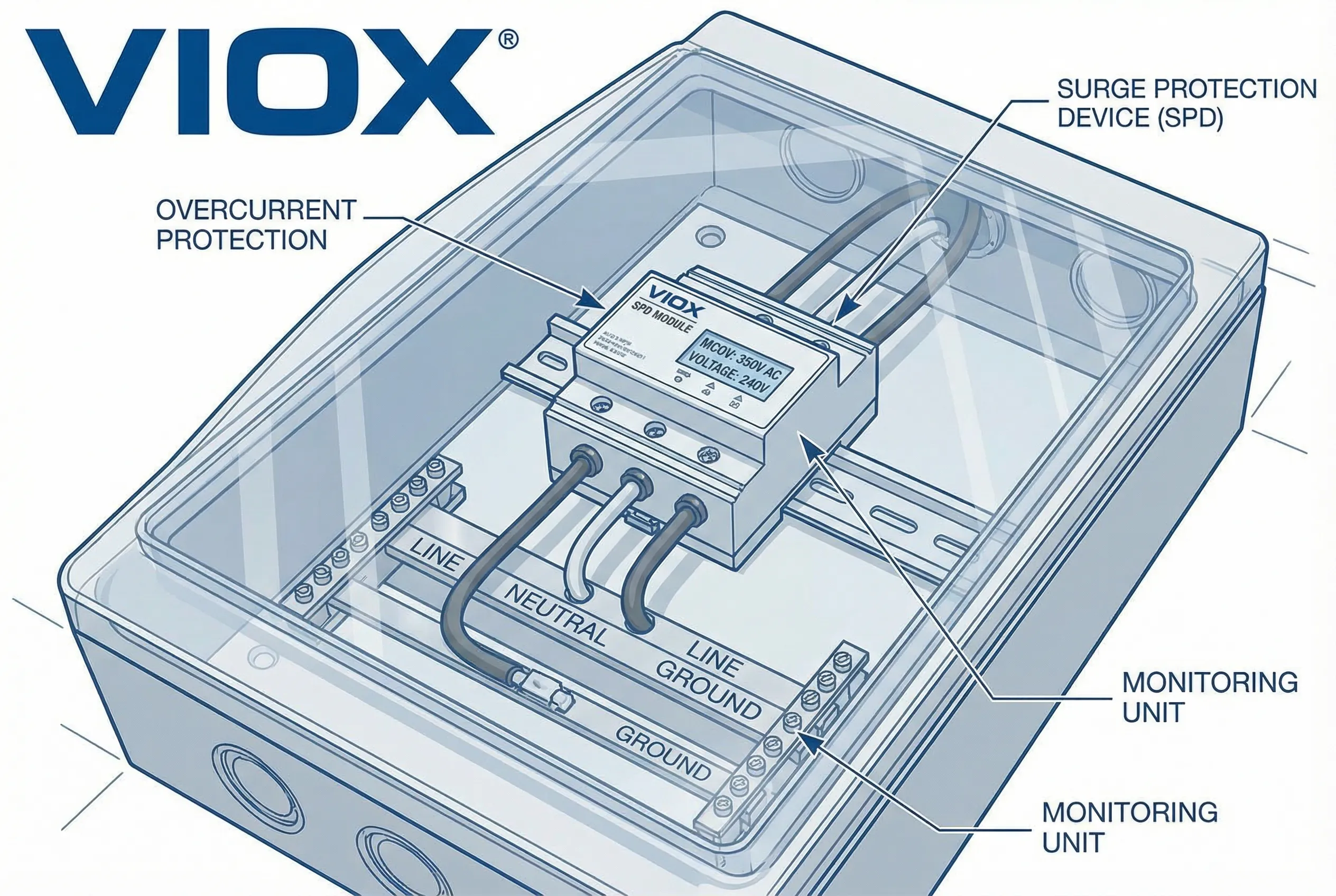
As a leading B2B surge protection device manufacturer, VIOX Electric specializes in delivering MCOV-optimized SPD solutions for diverse electrical system configurations. Our engineering expertise ensures every VIOX SPD meets or exceeds international standards while providing optimal protection performance for your specific application.
Comprehensive MCOV Rating Portfolio
VIOX manufactures SPDs with MCOV ratings spanning 150V to 825V for low voltage applications and extending to 48kV for medium voltage systems. Our product line covers:
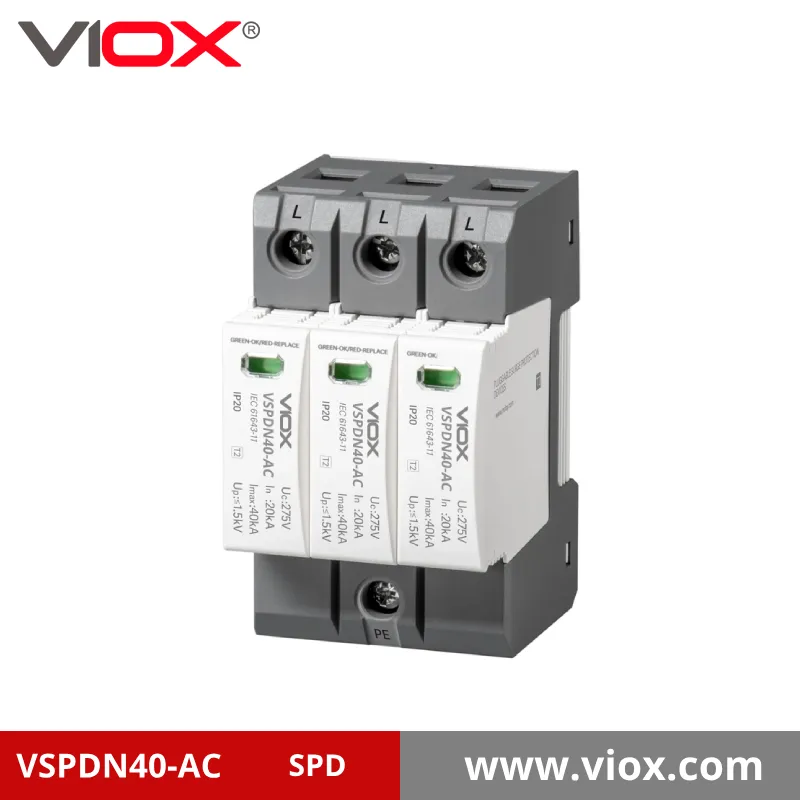
- Type 1 SPDs (tested per UL 1449 4th Edition) with MCOV ratings optimized for service entrance protection
- Type 2 SPDs engineered for distribution panel and branch circuit applications
- Type 3 SPDs designed for point-of-use protection with appropriate MCOV specifications
- Hybrid SPD designs combining multiple protection technologies with coordinated MCOV ratings
Advanced Protection Technology
VIOX SPDs incorporate premium metal oxide varistors selected for their superior MCOV capability and long-term stability. Our manufacturing process includes:
- 100% factory testing at 110% of rated MCOV to verify continuous operating capability
- Thermal management designs that prevent MCOV-related degradation
- Status indication systems that alert users to MCOV stress conditions
- Remote monitoring compatibility for predictive maintenance programs
Application Engineering Support
VIOX’s technical team provides comprehensive application engineering assistance, including:
- System voltage analysis and MCOV calculation verification
- Grounding configuration assessment and recommendations
- TOV evaluation based on utility characteristics and system impedance
- Custom MCOV specifications for unique applications
- Installation guidance ensuring proper SPD placement and connection
Quality Certifications and Compliance
All VIOX surge protective devices maintain rigorous quality standards:
- UL 1449 4th Edition Listed with published MCOV ratings
- IEC 61643-11 certified for international applications
- IEEE C62.41 compliant surge handling capability
- ISO 9001 manufacturing processes ensuring consistent quality
- RoHS and environmental compliance for global deployments
Partner with VIOX Electric for surge protection solutions engineered with proper MCOV specifications, backed by technical expertise, and manufactured to the highest quality standards. Contact our application engineering team to discuss your specific SPD requirements and discover how VIOX MCOV-optimized protection enhances electrical system reliability.


FAQ About MCOV SPD
What does MCOV mean on an SPD?
MCOV stands for Maximum Continuous Operating Voltage, which is the highest steady-state RMS voltage that a surge protective device can withstand continuously without damage or degradation. The MCOV rating must exceed the maximum expected system voltage, including normal variations and temporary overvoltages, to ensure reliable SPD operation and long service life.
How do I choose the correct MCOV rating for my SPD?
To select the correct MCOV SPD rating, identify your system voltage and grounding configuration, calculate maximum operating voltage including utility regulation (typically ±10%), apply temporary overvoltage factors (up to 1.25× nominal), and add a safety margin (1.05-1.15×). For a 480V solidly grounded system, specify MCOV ≥ 320V phase-to-neutral; for ungrounded systems, specify MCOV ≥ 660V phase-to-ground.
What happens if MCOV rating is too low?
If the MCOV rating is insufficient for the system voltage, the SPD will experience continuous conduction during normal operation or temporary overvoltage conditions. This causes excessive heating, rapid component degradation, nuisance disconnection via thermal protection, and potentially catastrophic failure. Undersized MCOV ratings represent a critical specification error that compromises both protection effectiveness and safety.
Is MCOV the same as system voltage?
No, MCOV is not the same as system voltage. The MCOV rating must significantly exceed nominal system voltage to account for utility voltage regulation (±5-10%), temporary overvoltages during faults or switching events, system grounding configuration effects, and long-term reliability margins. Proper MCOV calculation typically results in ratings 1.2-1.5 times nominal voltage for grounded systems and 1.7-2.0 times for ungrounded systems.
Can I use a higher MCOV rated SPD than required?
Yes, using an SPD with higher MCOV rating than calculated minimum is acceptable and may improve reliability, but excessively high ratings can compromise protection effectiveness. Higher MCOV ratings typically correlate with higher voltage protection levels (VPL), meaning the SPD allows higher surge voltages to reach protected equipment. Balance MCOV adequacy with optimal clamping voltage for best protection performance.
How does system grounding affect SPD MCOV requirements?
System grounding configuration dramatically impacts required MCOV ratings. Solidly grounded systems maintain phase-to-ground voltages near phase-to-neutral levels during faults, requiring lower MCOV ratings. Ungrounded or high-resistance grounded systems can experience phase-to-ground voltages approaching full phase-to-phase levels during ground faults, requiring MCOV ratings approximately √3 (1.73) times higher than grounded system ratings. Always verify grounding before specifying SPD MCOV.