MCCB Internal Parts and Structure: Diagram, Components, and Functions

Direct Answer: What Is Inside an MCCB?

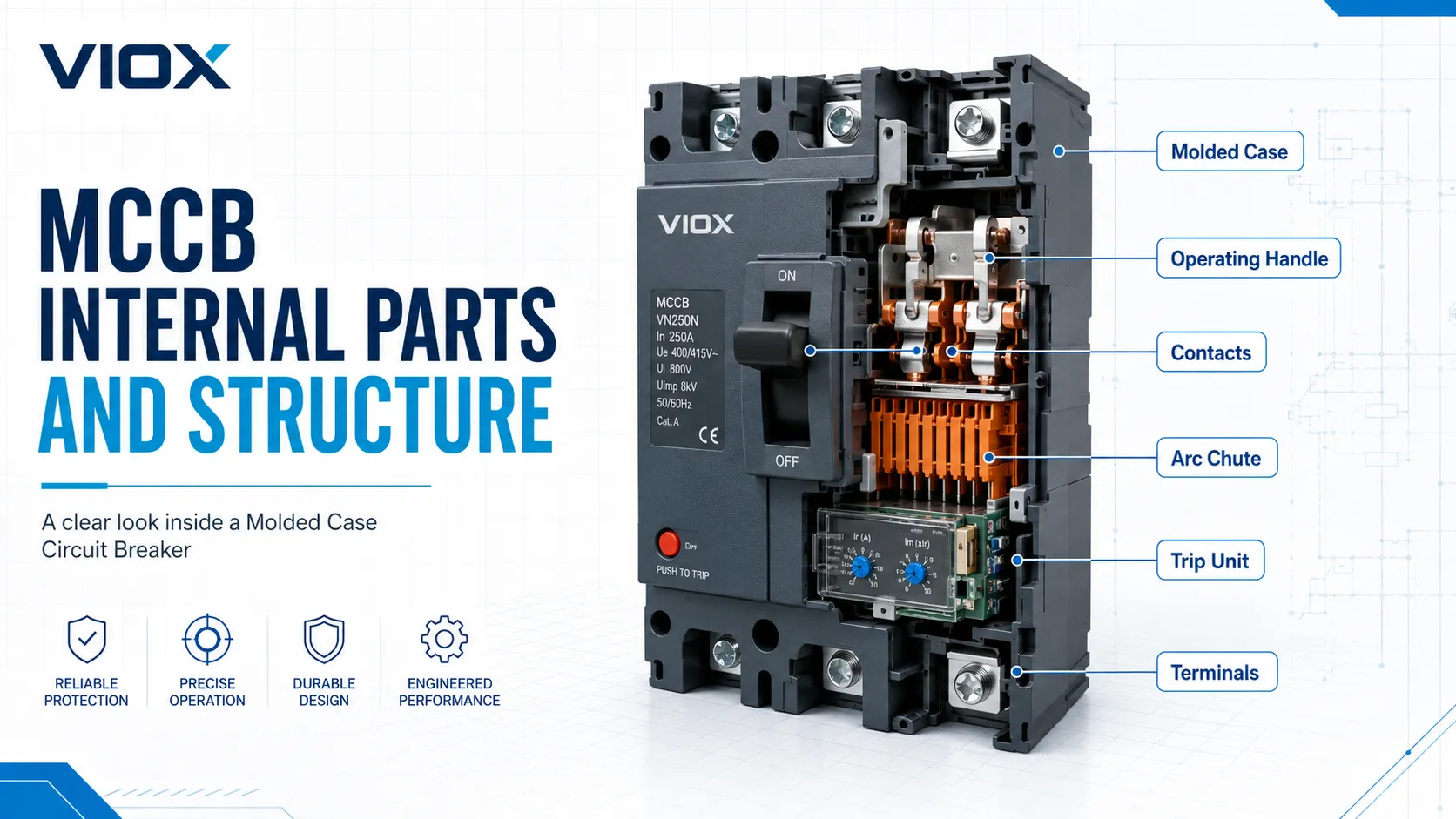
An MCCB, or molded case circuit breaker, contains a molded insulating case, fixed and moving contacts, an operating mechanism, a trip unit, an arc chute, line and load terminals, and optional accessories such as auxiliary contacts, shunt trips, alarm contacts, undervoltage releases, and motor operators.

These parts work together to carry normal current, detect overload or short-circuit conditions, open the contacts, extinguish the arc, and isolate the faulty circuit within the breaker’s rated capacity.

If you need the basic definition, ratings, and applications first, read VIOX’s MCCB란 무엇인가요? guide. This page focuses on MCCB internal structure, parts names, and component functions.


MCCB Internal Structure at a Glance

MCCB Part 주요 기능 왜 중요한가
Molded insulating case Holds and insulates internal components Provides mechanical support and electrical insulation
Operating handle Manual ON/OFF/RESET operation Gives local control and status indication
작동 메커니즘 Opens and closes contacts with stored mechanical energy Ensures fast contact separation during trip
고정 접점 및 가동 접점 Carry and interrupt current Contact material and pressure affect heating and endurance
아크 슈트 Splits, cools, and extinguishes arc Critical for safe short-circuit interruption
트립 장치 Detects overload and short circuit Determines protection behavior
터미널 Connect cables or busbars Connection quality affects temperature rise and reliability
Accessory compartment Holds control and signaling accessories Enables remote trip, status feedback, interlocking, and automation
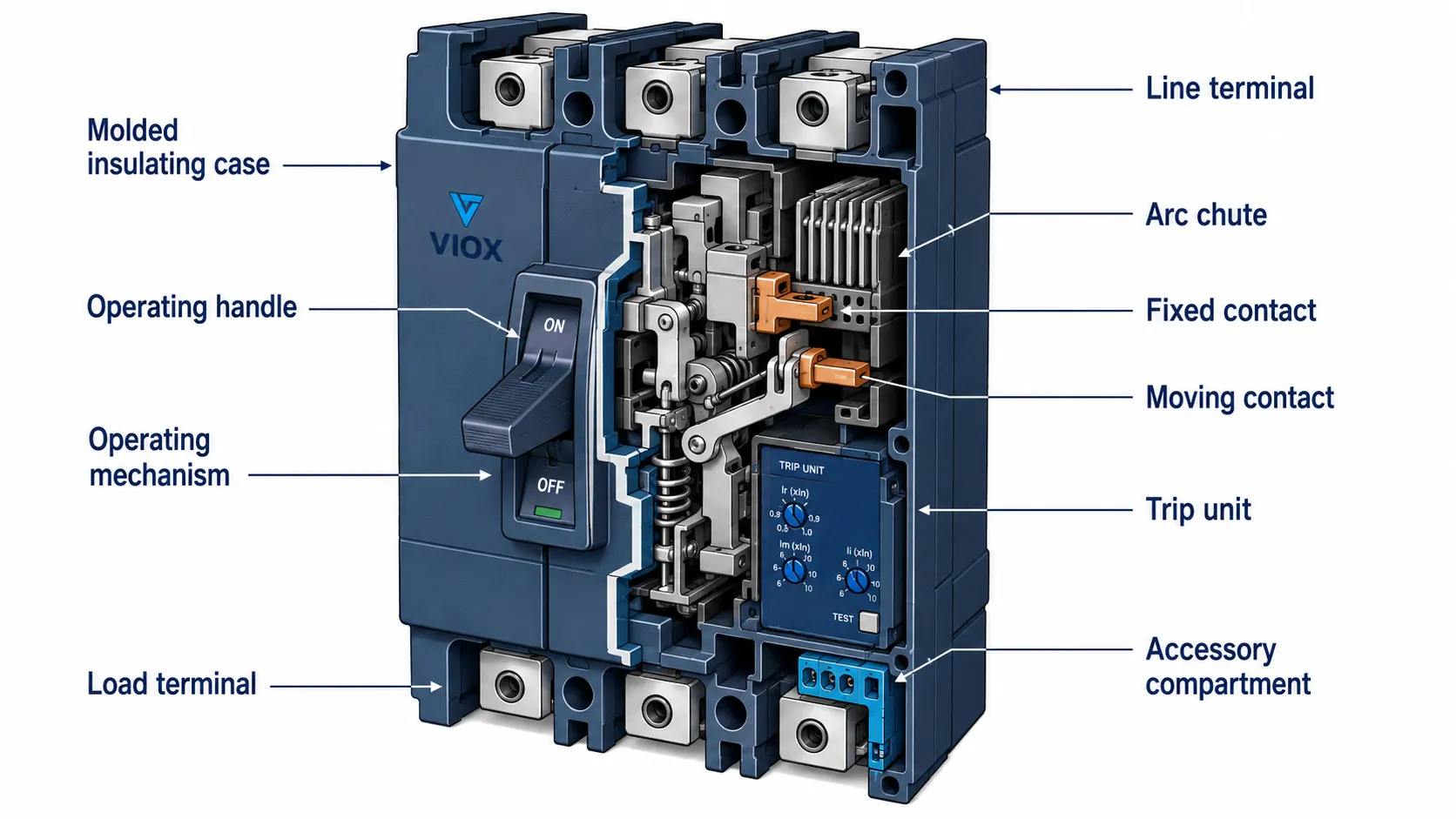
MCCB internal parts diagram with molded case, contacts, trip unit, arc chute, terminals, and accessories
MCCB internal parts diagram showing the molded case, contacts, trip unit, arc chute, terminals, and accessories.

MCCB Parts Diagram: What to Show

A useful molded case circuit breaker diagram should show these labeled sections:

Line terminal
↓
Fixed contact
↓
Moving contact and operating mechanism
↓
Arc chute beside the contact system
↓
Trip unit linked to mechanism
↓
Load terminal
↓
Accessory space for auxiliary contact, shunt trip, UV release, or alarm contact

The diagram should not only show the shell. The value of an MCCB internal structure diagram is that it explains how current flows, where the contacts open, where the arc is extinguished, and how the trip unit releases the mechanism.


MCCB의 일반적인 내부 섹션은 다음과 같습니다.

The molded case is the outer insulating body of the MCCB. It gives the product its name.

The case performs several functions:

  • supports internal current-carrying parts
  • provides electrical insulation
  • protects the mechanism from dust and accidental contact
  • maintains internal clearances
  • helps contain fault interruption stress inside the product design

The molded case is not just a plastic cover. In a real fault, the breaker body must tolerate heat, pressure, mechanical shock, and arc-interruption stress within the device rating.


2. Operating Handle

The handle is the visible control part of the MCCB. It usually shows whether the breaker is ON, OFF, or TRIPPED.

In many MCCBs, the tripped position is not exactly the same as the OFF position. The operator may need to move the handle fully to OFF before switching it ON again. This helps reset the internal latch mechanism before reclosing.

The handle is also useful for:

  • local isolation
  • manual switching
  • maintenance identification
  • lockout attachment depending on accessory or handle design

3. 작동 메커니즘

The operating mechanism stores and releases mechanical energy to open and close the contacts. During a trip, the mechanism must separate the contacts quickly and reliably, even if the user is holding the handle.

Important mechanism functions include:

  • snap-action opening and closing
  • trip-free operation in suitable designs
  • contact pressure control
  • linkage between trip unit and contact system
  • reset after trip

This is one reason an MCCB is not simply a large switch. It is a protective switching device with an internal release mechanism.


4. Fixed and Moving Contacts

The fixed and moving contacts carry current during normal operation. When the MCCB trips or is switched OFF, these contacts separate.

Contact design affects:

  • 온도 상승
  • 접촉 저항
  • electrical endurance
  • short-circuit interruption performance
  • risk of welding under severe fault conditions

During a high fault current, contact separation creates an arc. That arc must be controlled by the arc chute and internal arc path.

In actual panel inspections, the most worrying signs are often not dramatic external damage. They are small but serious internal symptoms: discolored terminals, heat marks near the connection area, pitted contacts, a stiff operating mechanism, or a breaker that has interrupted a severe fault and no longer feels mechanically consistent. These symptoms point back to the same internal parts discussed here: contacts, terminals, mechanism, trip unit, and arc chute.

MCCB inspection checklist showing discolored terminals, heat marks, pitted contacts, and mechanism issues
MCCB inspection checklist for discolored terminals, heat marks, pitted contacts, and mechanism issues after overload or short-circuit stress.

5. Arc Chute and Arc-Interruption Structure

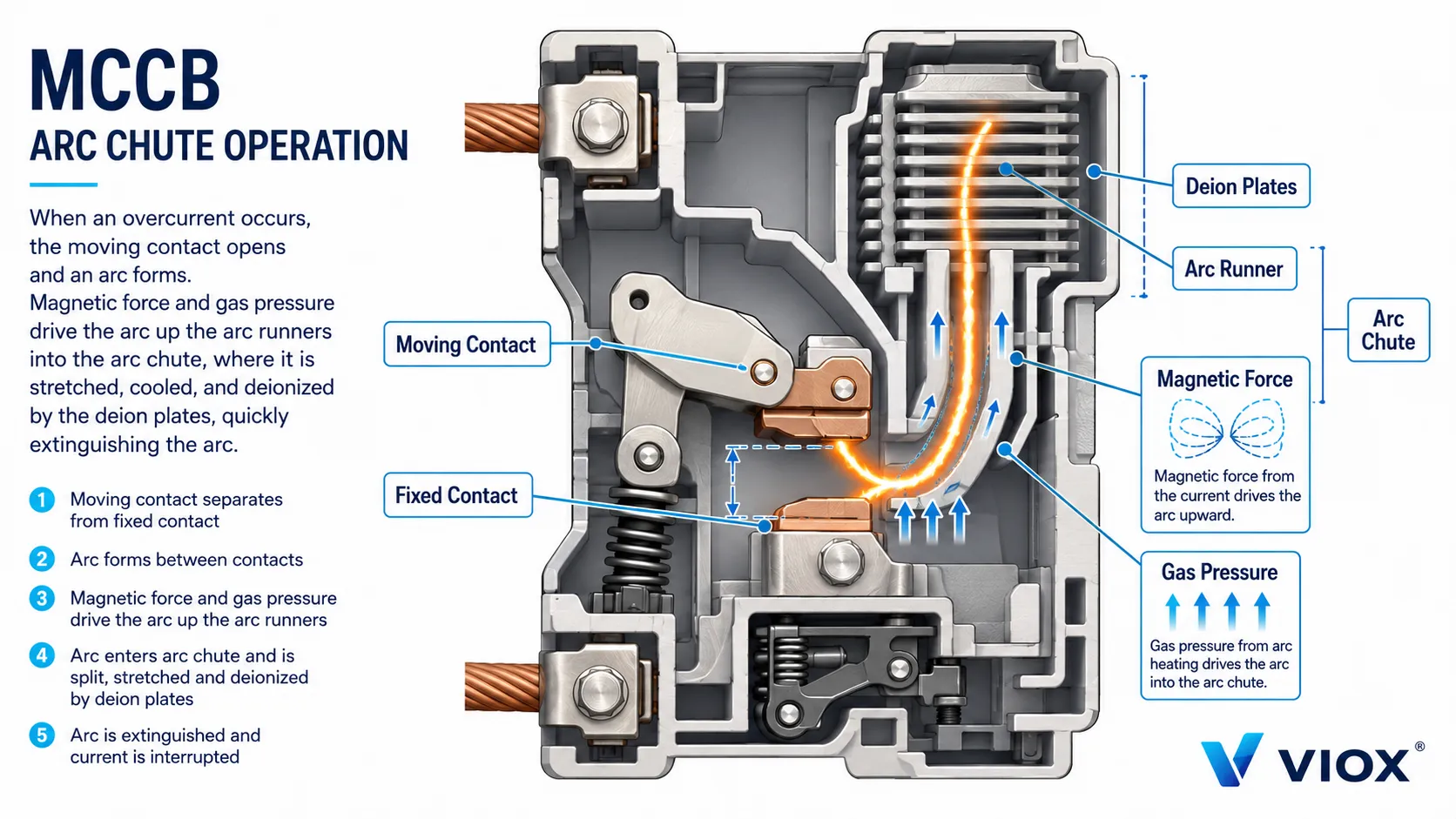
MCCB arc chute diagram showing arc runners, magnetic force, gas pressure, and deion plates
MCCB arc chute structure showing how arc runners, magnetic force, gas pressure, and deion plates help extinguish a fault arc.

The arc chute is one of the most important MCCB internal parts. When contacts separate under load or fault current, an arc forms between them. The arc chute divides the arc into smaller segments, lengthens it, cools it, and helps extinguish it.

The arc does not move into the arc chute by accident. In many breaker designs, the current path, contact geometry, arc runners, and magnetic forces help drive the arc away from the contact area and into the splitter plates. As current rises, electromagnetic forces around the arc path can push the arc root along the arc runner. At the same time, hot gas pressure inside the arc chamber can help move and stretch the arc. Once the arc enters the deion plates, it is divided into smaller arc segments, cooled, and forced to lose energy until current interruption is achieved.

Without proper arc control, the breaker cannot safely interrupt short-circuit current.

The arc-interruption structure may include:

  • 아크 러너(Arc runners)
  • deion plates
  • 아크 소호판
  • arc chamber
  • gas-generating or heat-resistant materials depending on product design
  • venting path depending on design

Arc chute design is closely related to breaking capacity. That is why two MCCBs with the same rated current may not be suitable for the same fault level.

For rating terms such as Icu, Ics, IcwIcm, see VIOX’s circuit breaker rating guide.


6. Trip Unit

The trip unit is the protection brain of the MCCB. It detects abnormal current and releases the operating mechanism when necessary.

열-자기식 트립 장치

A thermal-magnetic trip unit usually has:

  • thermal element for overload protection
  • magnetic element for short-circuit protection

The thermal element responds with time delay, while the magnetic element responds more quickly to high fault current.

전자식 트립 장치

An electronic trip unit uses sensors and electronic logic to measure current and trigger protection. Depending on the product family, it may support:

  • 조정 가능한 장시간 보호
  • short-time protection
  • 순시 보호
  • 접지 오류 보호
  • metering
  • communication
  • zone selective interlocking in advanced systems

For the detailed comparison, read 전자 대 열-자기 MCCB.


7. Terminals and Connection Area

MCCB terminals connect the breaker to cables, lugs, or busbars. Poor termination can cause overheating even when the breaker rating is correct.

Check the following during installation:

  • conductor type and size
  • lug compatibility
  • terminal torque
  • busbar alignment
  • phase spacing
  • 방열
  • line/load orientation if specified by the manufacturer

Many field failures blamed on “bad breakers” are actually connection problems: loose terminals, wrong lugs, poor busbar contact, or heat buildup inside the enclosure.


8. Accessories and Auxiliary Parts

Many MCCBs support internal or external accessories.

Accessory 기능
보조 연락처 Reports ON/OFF status
알람 연락처 Reports trip status
Shunt trip Trips the breaker remotely when voltage is applied to the coil
Undervoltage release Trips or prevents closing when control voltage is too low
Motor operator Enables remote opening and closing
Rotary handle Allows door-mounted operation
Mechanical interlock Prevents unsafe simultaneous closing in transfer or source-selection systems

Accessories turn an MCCB from a standalone protective device into part of a control, monitoring, or automation system.


How MCCB Parts Work Together During a Fault

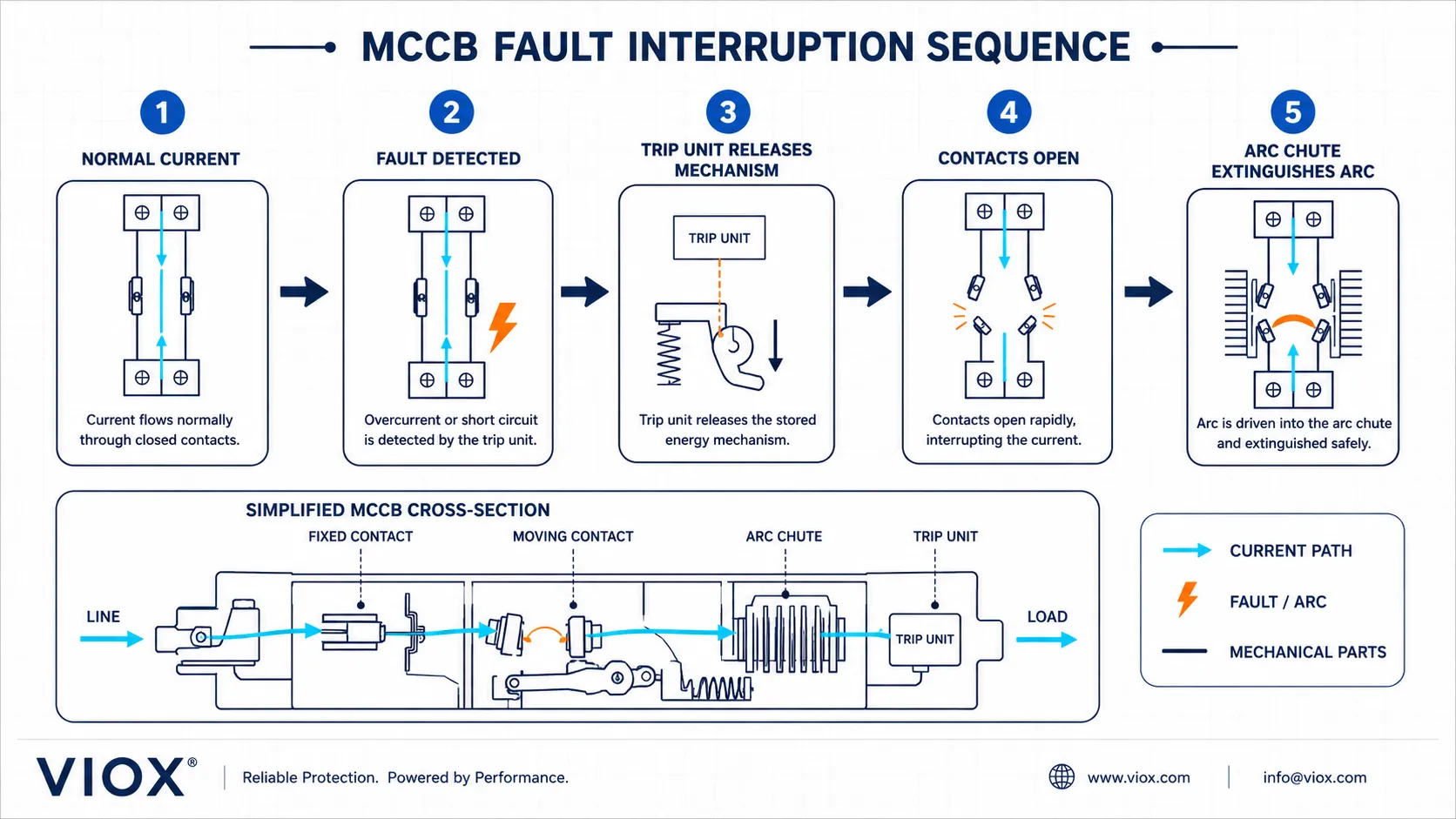
MCCB fault interruption sequence from trip unit detection to contact opening and arc extinction
MCCB fault interruption sequence from trip unit detection to contact opening, arc movement, arc chute cooling, and final extinction.

During a short circuit, the sequence is:

  1. 고장 전류가 급격히 상승합니다.
  2. The trip unit detects the abnormal current.
  3. The trip unit releases the operating mechanism.
  4. The mechanism separates the moving and fixed contacts.
  5. An arc forms between the contacts.
  6. The arc is driven into the arc chute.
  7. 아크 슈트가 아크를 분할하고 냉각합니다.
  8. The current is interrupted within the breaker’s rated capacity.
  9. The handle indicates trip status.
  10. The breaker is inspected and reset only after the fault is corrected.

This sequence explains why the trip unit, mechanism, contacts, and arc chute must be considered together. A high-quality MCCB is not defined by one part alone; it is defined by how the whole interruption system performs under rated test conditions.


MCCB Internal Parts vs MCB Internal Parts

MCCBs and MCBs have similar functional ideas but different duty levels.

Part or Function MCB MCCB
주택 Compact modular body Larger molded case
연락처 Smaller final-circuit duty Larger contact system for higher current
트립 장치 Usually fixed thermal-magnetic behavior Thermal-magnetic or electronic, often more adjustable
아크 슈트 Smaller arc chamber Larger arc-interruption structure
액세서리 Limited depending on model Broader accessory options
응용 프로그램 최종 회로 Feeders, industrial panels, motors, distribution

For the general product-family comparison, see VIOX’s MCCB vs MCB guide.


What Does a Standard MCCB Contain?

A standard molded case circuit breaker normally contains:

  • molded insulating housing
  • operating handle
  • opening and closing mechanism
  • fixed contacts
  • moving contacts
  • 아크 슈트
  • thermal-magnetic or electronic trip unit
  • line and load terminals
  • trip indication mechanism
  • optional accessory slots or compartments

The exact layout varies by manufacturer, frame size, trip unit, and accessory configuration. Always use the manufacturer’s datasheet and installation manual for actual product details.


MCCB Internal Structure FAQ

What are the main parts of an MCCB?

The main parts are the molded case, operating handle, operating mechanism, fixed and moving contacts, arc chute, trip unit, terminals, and optional accessories.

What is the most important part inside an MCCB?

There is no single part that works alone. The trip unit detects the fault, the mechanism opens the contacts, and the arc chute extinguishes the arc. All three are critical during fault interruption.

What is the arc chute in an MCCB?

The arc chute is the internal structure that divides, cools, and extinguishes the arc created when contacts open under load or fault current.

What is the trip unit in an MCCB?

The trip unit detects overload or short-circuit current and releases the operating mechanism. It may be thermal-magnetic or electronic.

What is the difference between thermal-magnetic and electronic MCCB parts?

A thermal-magnetic MCCB uses bimetal and magnetic elements. An electronic MCCB uses sensors and electronic logic, often with more adjustable protection functions.

What does a molded case circuit breaker diagram show?

A useful diagram shows the terminals, contacts, operating mechanism, trip unit, arc chute, molded case, and accessories, along with the current path and fault-interruption sequence.

Can MCCB internal parts be repaired?

In most normal field applications, MCCB internal parts are not repaired by users. If an MCCB is damaged, overheated, mechanically worn, or has interrupted a severe fault, follow manufacturer instructions and replace the device when required.


결론

The internal structure of an MCCB explains why it can protect higher-duty low-voltage circuits. The molded case supports and insulates the device. The contacts carry and interrupt current. The trip unit detects overload and short circuit. The operating mechanism opens the contacts. The arc chute extinguishes the fault arc. Accessories add control and monitoring functions.

For basic meaning and application, start with MCCB란 무엇인가요?. For product selection, continue to the MCCB 선택 가이드 그리고 MCCB 제품 페이지.

저자 소개
Author picture

안녕하세요,저는 조용문으로 12 년 동안의 경험을 전기 기업에서. 에 VIOX 전기,내에 포커스를 제공 높은 품질의 전기적에 맞는 솔루션의 요구를 충족하는 우리의 클라이언트입니다. 내 전문 지식에 걸쳐 있는 산업 자동화,배선 주거 및 상업적인 전기 시스템입니다.저에게 연락 [email protected] 면 어떤 질문이 있습니다.

요구 사항 알려주세요
지금 견적 요청하기