

On this page
The Core Difference: Distribution Box vs Combiner Box
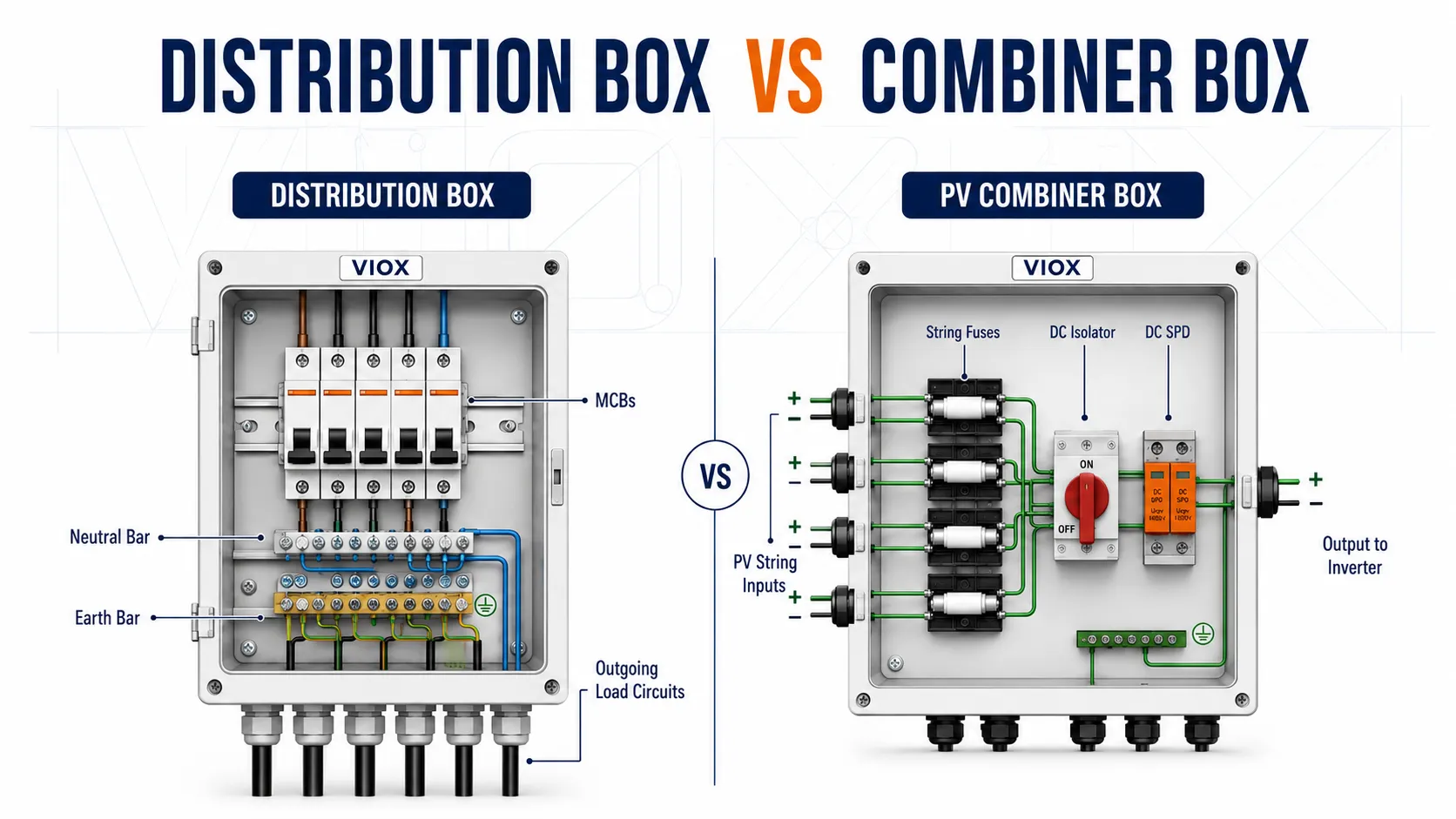
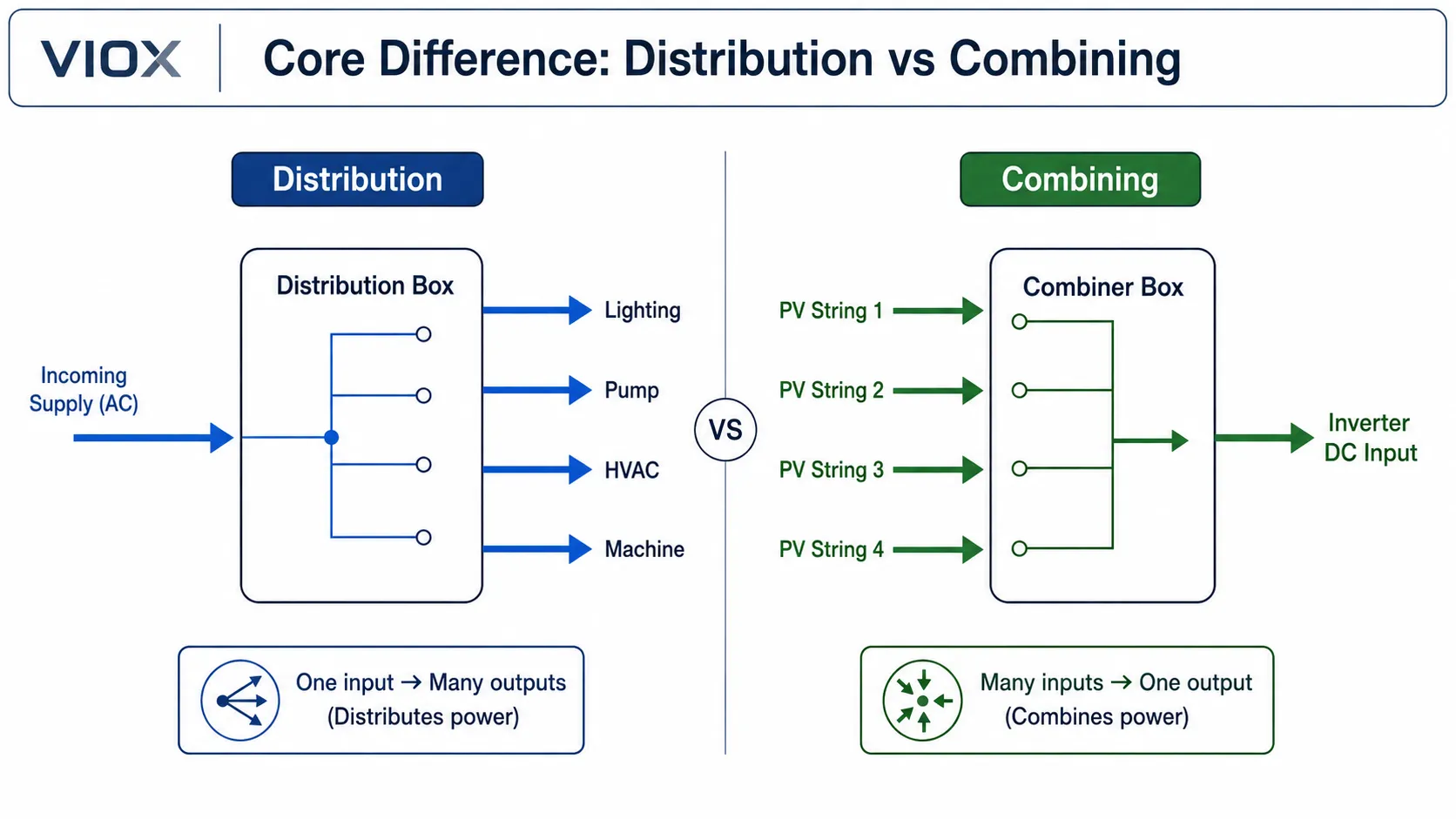
A distribution box distributes power from one supply source to multiple outgoing load circuits. A combiner box combines multiple source circuits, most commonly solar photovoltaic (PV) strings, into one or more outputs before the inverter or downstream DC equipment.
They are not interchangeable. A distribution box is selected around load distribution, branch-circuit protection, wiring space, and AC or DC system requirements. A PV combiner box is selected around string voltage, string current, reverse-current protection, DC isolation, surge protection, outdoor enclosure performance, and inverter input design.
If you are selecting a building or industrial power box, start with the Distribution Box and Selection Guide. If you are working on solar PV, see the PV Combiner Box Guide or the VIOX Combiner Box product page.
Distribution Box vs Combiner Box Comparison Table
| Item | Distribution Box | Combiner Box |
|---|---|---|
| Main purpose | Distributes power to multiple outgoing load circuits | Combines multiple PV strings or source circuits into fewer outputs |
| Common system | AC building distribution, industrial panels, some DC distribution | Solar PV DC side, sometimes AC combining in inverter systems |
| Typical location | Inside building, equipment room, machine area, outdoor load area | Near PV array, rooftop, ground-mount array, inverter DC input side |
| Circuit direction | From supply to loads | From multiple sources toward inverter or downstream equipment |
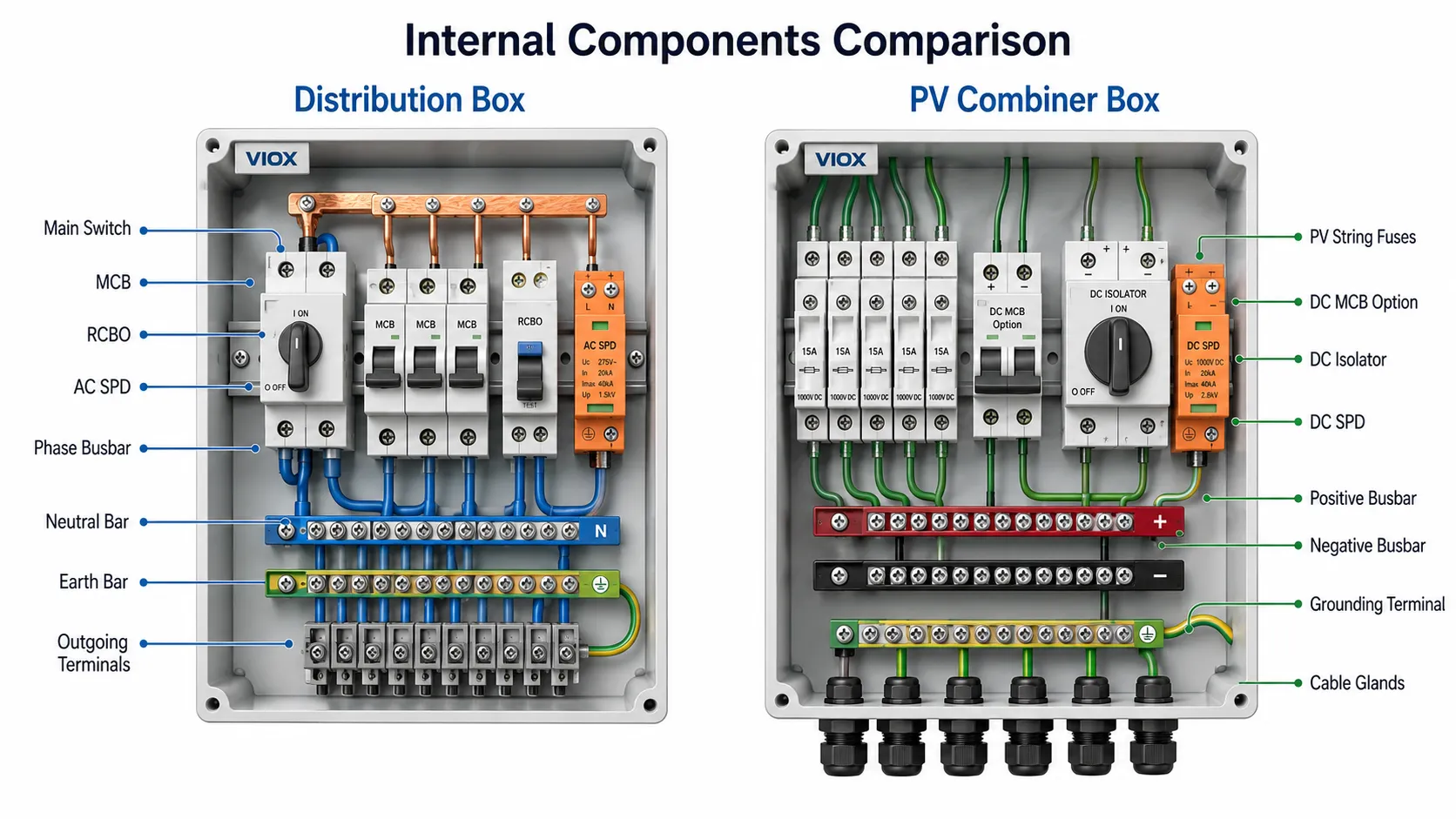
| Typical devices | MCB, MCCB, RCCB, RCBO, isolator, SPD, busbar, neutral bar, earth bar | String fuses, DC MCBs, DC isolator, DC SPD, monitoring, cable glands |
| Voltage concern | AC system voltage, branch-circuit rating, fault level | PV open-circuit voltage, cold Voc, DC arc risk, inverter input voltage |
| Protection focus | Overload, short circuit, earth leakage, surge protection, isolation | String overcurrent, reverse current, DC surge protection, isolation |
| Enclosure focus | Number of circuits, wiring space, IP rating, DIN rail layout | Outdoor IP rating, UV resistance, DC spacing, heat, cable entry sealing |
| Common standards context | IEC 61439 assemblies, IEC 60364 installations, local wiring codes | IEC 60364-7-712 PV installation context, IEC 62548/PV design practices, IEC 61643 for SPD selection |
| Can replace the other? | Usually no | Usually no |
The short version: a distribution box manages load circuits. A PV combiner box manages source strings.
What Is a Distribution Box?
A distribution box, also called a distribution board, distribution panel, or DB box in many markets, is an enclosure that receives electrical power and distributes it to multiple outgoing circuits. In many low-voltage installations, it contains protective and switching devices for each circuit.
Typical internal parts include:
- main switch or incoming isolator
- miniature circuit breakers (MCBs)
- molded case circuit breakers (MCCBs) in larger panels
- residual current devices (RCCBs or RCBOs)
- surge protective devices (SPDs)
- busbars
- neutral bar
- earth or protective earth (PE) bar
- DIN rail
- outgoing terminals
- cable glands or conduit entries
Distribution boxes are used in:
- residential buildings
- commercial offices
- factories
- workshops
- HVAC systems
- pump rooms
- machine control areas
- outdoor equipment power distribution
The role of a distribution box is not to combine generation sources. It is to divide power into safe, protected, maintainable branch circuits.
For internal structure details, see Distribution Box Internal Structure Diagram: MCBs, Busbars, Neutral Bars, and SPDs Explained.
What Is a Combiner Box?
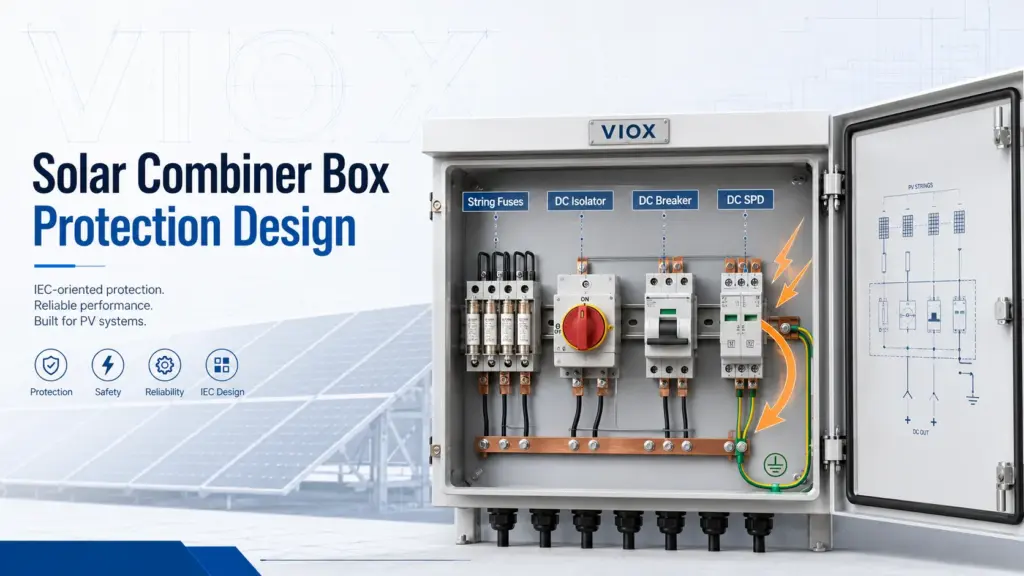
A combiner box is an enclosure that combines multiple input circuits into one or more output circuits. In solar PV systems, the most common type is the PV DC combiner box, which combines multiple PV string inputs before the inverter DC input.
In a typical string inverter system, several PV strings enter the combiner box, pass through string protection and isolation devices, and then feed the inverter DC input.
Typical PV combiner box components include:
- positive and negative string inputs
- string fuses or DC breakers
- DC surge protective device
- DC isolator or switch disconnector
- positive and negative busbars
- monitoring module, if required
- grounding terminal
- outdoor cable glands
- enclosure with suitable environmental rating
A PV combiner box is not just a junction box. It is part of the DC protection and wiring architecture of the solar array.
For the full solar-side explanation, see What Is a PV Combiner Box? and What Does a Solar Combiner Box Do in a PV System?.
Key Difference 1: Power Distribution vs String Combining
The biggest difference is the direction and purpose of the circuits.
A distribution box usually starts with one incoming supply and divides it into multiple outgoing load circuits. For example, one incoming feeder may supply lighting, sockets, HVAC, pumps, and small machinery through separate branch circuits.
A PV combiner box works in the opposite logical direction. It receives multiple PV source circuits and combines them into one or more outputs. For example, eight PV strings may be combined into one DC output pair feeding an inverter.
This difference changes everything:
- device selection
- wiring layout
- fault-current behavior
- isolation method
- surge protection
- enclosure design
- inspection procedure
Key Difference 2: Load Circuits vs Source Circuits
A distribution box protects and controls load circuits. The loads consume power. Current normally flows from the supply through the protective device toward the load.
A PV combiner box handles source circuits. PV modules generate power whenever there is sufficient light. Even if the inverter is off, PV strings may still present DC voltage at the combiner inputs.
This is why PV combiner boxes require special attention to:
- PV string open-circuit voltage
- low-temperature voltage rise
- reverse-current risk between strings
- DC arc interruption
- isolation before maintenance
- polarity and cable marking
The source-circuit nature of PV is the reason a normal AC distribution box should not be repurposed as a PV combiner box unless it is specifically designed and rated for that application.
Key Difference 3: AC/DC Ratings and Protection Devices
Distribution boxes are commonly used in AC systems, although DC distribution boxes also exist for telecom, battery, EV, and solar-related systems. A building distribution box usually focuses on AC voltage, branch-circuit current, short-circuit current, residual-current protection, and local wiring rules.
PV combiner boxes are commonly used on the DC side of a solar system. DC protection is more demanding because DC arcs do not naturally extinguish at a current zero. Devices must be rated for the actual DC voltage and fault conditions.
| Protection function | Distribution box | PV combiner box |
|---|---|---|
| Overload/short-circuit protection | MCB, MCCB, fuse | String fuse, DC MCB, DC fuse |
| Residual-current protection | RCCB or RCBO where required | Usually not inside DC combiner box; AC-side RCD/RCM depends on inverter/system design |
| Surge protection | AC SPD | DC SPD selected for PV voltage |
| Isolation | Main switch, isolator, switch disconnector | DC isolator or PV-rated switch disconnector |
| Busbar arrangement | Phase, neutral, PE busbars | Positive, negative, PE/grounding terminals |
| Monitoring | Metering, energy monitoring, status indication | String current monitoring, status contacts, SPD indication where required |
If the issue is AC vs DC protection, see AC Distribution Box vs DC Distribution Box and PV DC Protection Explained: MCBs, Fuses, SPDs vs RCDs.
Key Difference 4: Internal Structure
Distribution box internal structure
A typical distribution box is arranged around incoming supply, busbar distribution, and outgoing branch circuits.
Common structure:
- Incoming supply enters the main switch or isolator.
- Phase conductors feed busbars or distribution blocks.
- MCBs, RCBOs, or MCCBs protect outgoing load circuits.
- Neutral conductors terminate on a neutral bar.
- Protective earth conductors terminate on an earth bar.
- Optional SPD connects between live conductors and PE depending on system type.
This structure is designed for organized branch-circuit distribution and safe maintenance access.
PV combiner box internal structure
A PV combiner box is arranged around PV string inputs and DC output.
Common structure:
- PV string positive and negative cables enter through cable glands.
- Each string may pass through a fuse or DC breaker.
- Positive and negative outputs are combined on DC busbars or terminals.
- A DC SPD protects against surge overvoltage.
- A DC isolator may disconnect the combined output.
- Output cables run to the inverter DC input.
- Grounding terminals bond the enclosure and SPD path.
The design must respect DC polarity, creepage and clearance, heat dissipation, and outdoor environmental exposure.
For practical wiring context, see Solar Combiner Box Wiring Diagram.
Where Each Box Is Installed in a Solar PV System
Both boxes may appear in the same solar installation, but on different sides of the system.
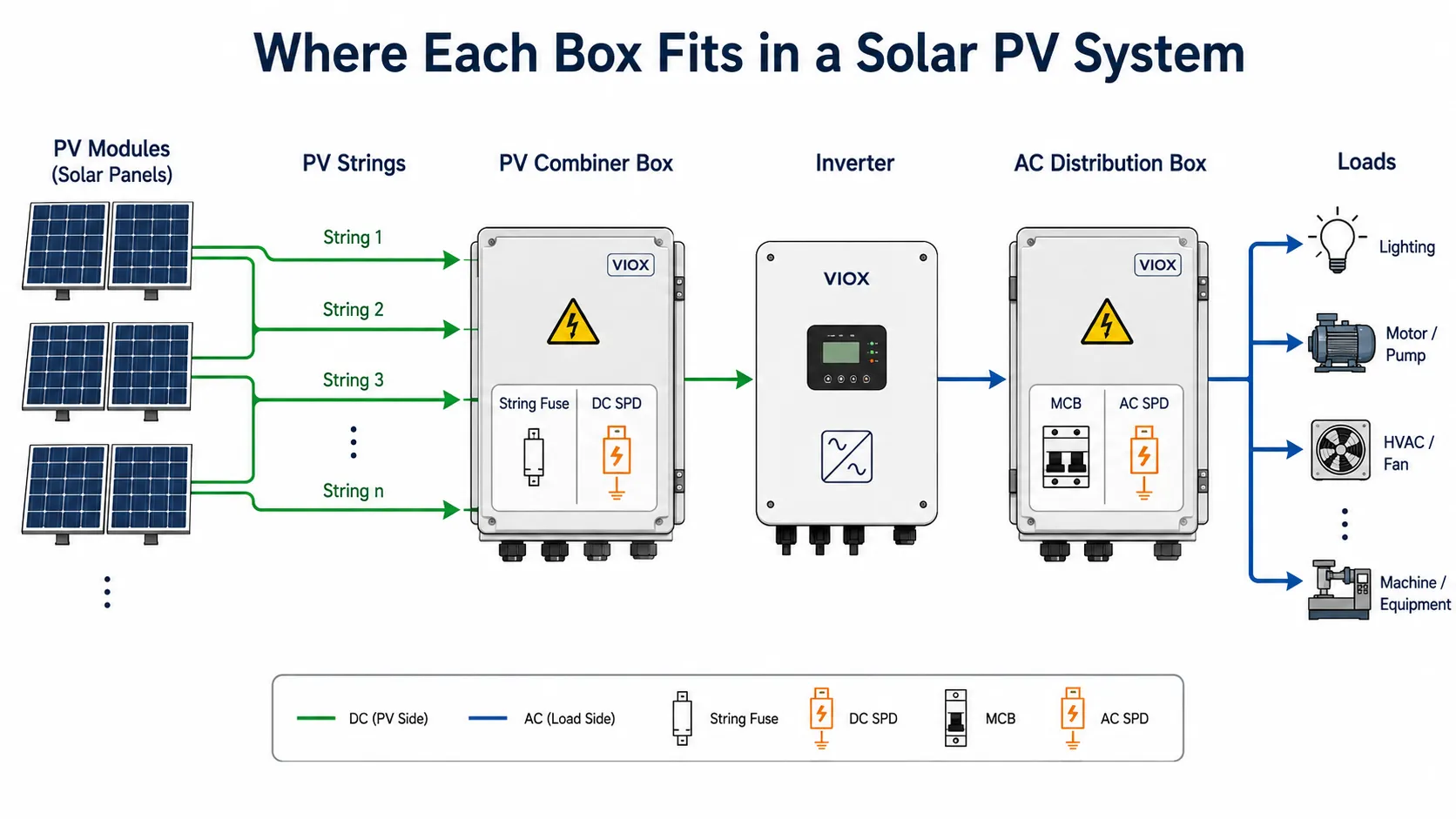
| Solar PV location | Box type | Role |
|---|---|---|
| Near PV strings on rooftop or ground mount | PV combiner box | Combines strings, provides DC string protection and DC SPD |
| Between PV array and inverter | PV combiner box or DC protection box | Organizes DC input and isolation before inverter |
| Inverter AC output side | AC distribution box or AC combiner panel | Distributes inverter output or combines AC inverter outputs |
| Building main distribution area | Distribution box / distribution board | Supplies loads and connects PV output into the electrical system |
| Battery or hybrid system DC section | DC distribution/protection box | Distributes or protects DC battery/inverter circuits |
This is where terminology can become confusing. Some solar systems use AC combiner panels to combine outputs from multiple inverters or microinverters. That is different from a PV DC combiner box used before the inverter.
Is a Combiner Box Always DC?
No. Most PV combiner boxes are DC combiner boxes installed between PV strings and the inverter DC input. However, some solar systems also use AC combiner boxes to combine AC outputs from multiple string inverters or microinverters before feeding an AC distribution panel.
This does not make an AC combiner box the same as a general distribution box. The function is still different:
- An AC combiner box combines multiple inverter outputs into fewer AC feeders.
- A distribution box distributes power from a supply to multiple load circuits.
- A PV DC combiner box combines multiple PV source strings before the inverter.
So “AC vs DC combiner box” is a useful subtopic inside the solar combiner box cluster, but it should not replace the main topic of this page. This page is about the broader difference between distribution boxes and combiner boxes.
Can a Distribution Box Replace a Combiner Box?
Usually, no.
A standard distribution box should not be used as a PV combiner box unless it is designed and rated for PV DC conditions.
Reasons include:
- ordinary AC breakers may not interrupt PV DC current safely
- neutral/phase layout does not match PV positive/negative string design
- internal spacing may not be suitable for high DC voltage
- enclosure may not be UV- and weather-suitable for PV array locations
- cable glands may not match PV cable requirements
- no string fuse layout or PV SPD arrangement
- no consideration of cold-weather open-circuit voltage
The visible enclosure may look similar, but the electrical duty is different.
Can a Combiner Box Replace a Distribution Box?
Usually, no.
A PV combiner box is not designed to distribute building loads. It may not include:
- MCB/RCBO branch-circuit layout
- neutral bar arrangement
- RCD protection
- enough outgoing circuit ways
- AC busbar structure
- correct labeling for load circuits
- proper space for building wiring
An AC distribution box and a PV combiner box solve different system problems. Treating either one as a generic enclosure with terminals inside is a common design mistake.
Selection Checklist
Use this checklist before selecting either box.
| Selection question | Distribution box | PV combiner box |
|---|---|---|
| What is the system type? | AC building, industrial, or DC distribution | PV DC strings, AC inverter outputs, or hybrid DC |
| What voltage must it handle? | AC line voltage or DC system voltage | Maximum PV string Voc at lowest temperature |
| What current must it carry? | Load current and feeder current | String current, combined output current |
| What protection is required? | MCB, MCCB, RCCB, RCBO, SPD | String fuse/DC breaker, DC SPD, DC isolator |
| What fault level applies? | Prospective short-circuit current at panel | PV string reverse current and DC fault conditions |
| Where will it be installed? | Indoor/outdoor, wall, machine, building service area | Rooftop, ground mount, inverter area, outdoor array zone |
| What enclosure rating is needed? | IP rating, corrosion, impact, wiring space | Outdoor IP, UV, thermal, cable glands, DC spacing |
| What standards or codes apply? | Local wiring rules, IEC 61439/IEC 60364 context | PV installation rules, IEC 60364-7-712/IEC 62548 context |
| What documentation is needed? | Wiring diagram, circuit schedule, rating label | String map, polarity labels, DC ratings, SPD status, fuse schedule |
Common Selection Mistakes
Mistake 1: Choosing by enclosure size only
An empty box with enough space is not automatically suitable. The internal devices, busbars, cable entries, insulation distances, heat dissipation, and ratings matter.
Mistake 2: Treating AC and DC protection as interchangeable
A device rated for AC distribution cannot be assumed suitable for PV DC circuits. DC voltage, polarity, and arc interruption must be checked from the datasheet.
Mistake 3: Ignoring PV cold-weather Voc
PV string voltage rises in cold conditions. The combiner box, fuses, DC breaker, DC isolator, and SPD must be selected against the maximum corrected open-circuit voltage, not only nominal PV system voltage.
Mistake 4: Forgetting surge protection
Distribution boxes often use AC SPDs, while PV combiner boxes need DC SPDs suited to PV system voltage and grounding arrangement. The wrong SPD type can leave equipment exposed or fail prematurely.
Mistake 5: Using a combiner box as a general junction box
A PV combiner box should provide a defined protection and wiring function. If it only joins cables without correct fusing, isolation, SPD, labeling, and environmental design, it may not solve the safety problem.
Mistake 6: Overlooking maintenance labeling
Both box types need clear labels. In a distribution box, technicians need circuit schedules. In a PV combiner box, they need string identification, polarity, DC voltage warnings, fuse ratings, and inverter destination.
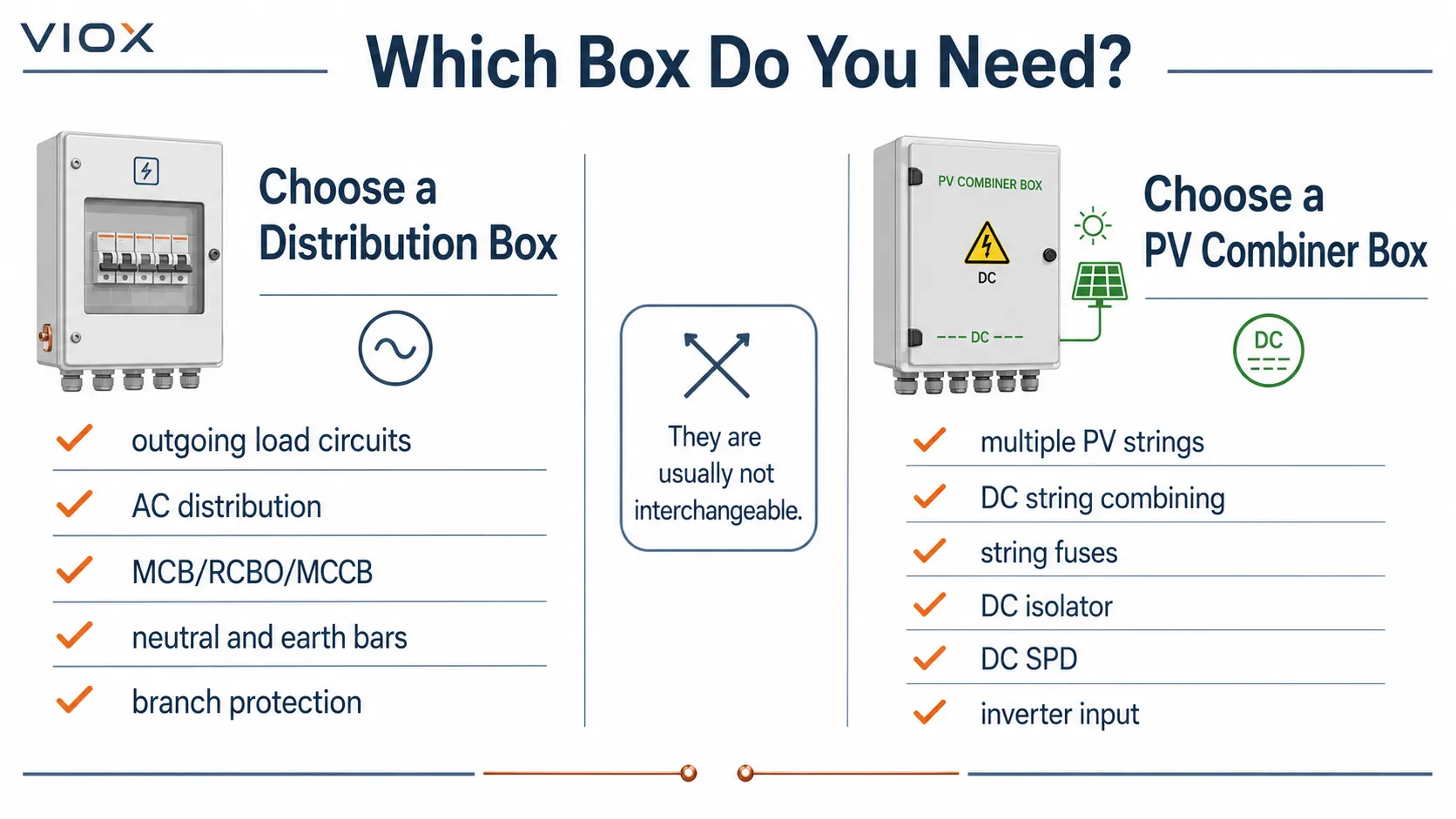
Which One Do You Need?
Choose a distribution box when you need to distribute power from one supply to multiple load circuits in a building, machine, facility, or outdoor equipment area.
Choose a PV combiner box when you need to combine multiple solar PV strings and provide string-level protection, DC surge protection, isolation, and organized output wiring to the inverter.
Choose both when the system includes solar PV feeding a building or industrial electrical system: the combiner box manages the PV DC source side, while the distribution box manages the AC load side or inverter output integration.
FAQ
What is the main difference between a distribution box and a combiner box?
A distribution box distributes power from one supply to multiple load circuits. A combiner box combines multiple source circuits, usually PV strings, into one or more outputs before the inverter or downstream equipment.
Is a PV combiner box the same as a distribution box?
No. A PV combiner box is built for solar string combining and DC protection. A distribution box is built for branch-circuit distribution and load protection.
Can I use a normal distribution box for solar PV strings?
Only if the complete assembly and internal devices are rated and designed for the actual PV DC voltage, current, string protection, isolation, SPD arrangement, and environmental conditions. A normal AC distribution box should not be assumed suitable.
What devices are inside a distribution box?
Common devices include MCBs, MCCBs, RCCBs, RCBOs, SPDs, main switches, busbars, neutral bars, earth bars, terminals, and DIN rails.
What devices are inside a PV combiner box?
Common devices include string fuses or DC breakers, DC surge protective devices, DC isolators, positive and negative busbars, string monitoring modules, grounding terminals, and outdoor cable glands.
Does every solar system need a combiner box?
No. Small systems with only one or two strings may connect directly to the inverter if the inverter and local code allow it. Larger systems with multiple strings often use combiner boxes for protection, wiring organization, monitoring, and maintenance.
Is a combiner box AC or DC?
Most PV combiner boxes are DC combiner boxes used before the inverter. Some systems also use AC combiner panels to combine outputs from multiple inverters or microinverters. The ratings and internal devices are different.
Which box needs surge protection?
Both may need surge protection depending on system design. A distribution box may use an AC SPD. A PV combiner box usually requires a DC SPD selected for the PV voltage and installation conditions.
What is the most important selection factor for a PV combiner box?
The first critical factor is the maximum PV string voltage, including cold-weather open-circuit voltage correction. Then check string current, reverse-current protection, DC SPD rating, DC isolator rating, enclosure rating, and inverter input design.
What is the most important selection factor for a distribution box?
Start with system voltage, load current, number of outgoing circuits, fault level, protective devices, wiring space, enclosure rating, neutral/earth arrangement, and applicable installation standard.
Summary
Distribution boxes and combiner boxes may look similar from the outside, but their electrical roles are different. A distribution box divides power into protected load circuits. A PV combiner box combines multiple solar source circuits and provides DC-side protection before the inverter.
For safe selection, do not choose by enclosure appearance alone. Check function first, then voltage, current, protection devices, AC/DC duty, installation location, environmental rating, wiring layout, and maintenance requirements.
For VIOX product selection, review the Distribution Box and Combiner Box product pages, then use the detailed guides on distribution box selection, PV combiner box components and wiring, and PV DC protection.