

On this page
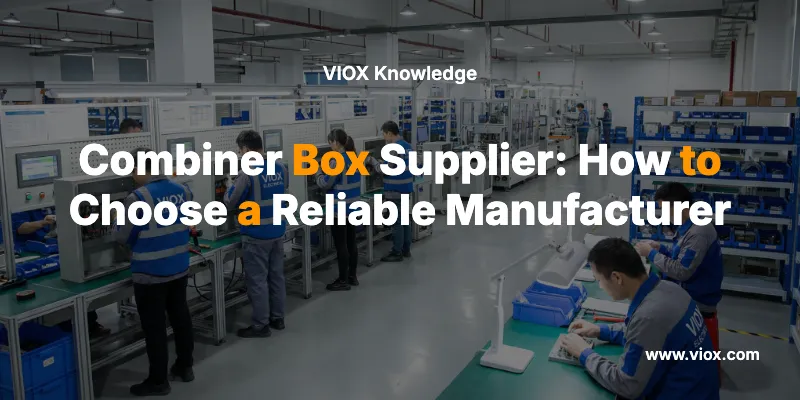
A reliable PV combiner box manufacturer is not just a sheet-metal enclosure supplier. The right supplier must understand PV string voltage, reverse-current protection, DC-rated switching, surge protection, outdoor enclosure design, factory testing, and project documentation. A low price is not useful if the box uses AC-rated devices, weak terminals, poor sealing, unclear wiring, or missing test records.
For procurement teams, the real question is simple: can this supplier prove that the combiner box is designed, wired, tested, and documented for the actual PV system?
That matters because a PV combiner box sits at a high-risk point in the system. Multiple strings are brought together, DC voltage can reach 600V, 1000V, or 1500V, and fault interruption is more difficult than in AC circuits because DC current has no natural zero crossing. A supplier that treats the combiner box as a generic junction box can create hidden risks in overheating, arc faults, surge failure, water ingress, inverter downtime, and project acceptance.
If you need project-specific options, VIOX supplies solar PV combiner box solutions for residential, commercial, and industrial PV applications.
PV Combiner Box Supplier Quick Checklist
Use this checklist before comparing quotations. It helps separate a real PV combiner box manufacturer from a basic box assembler.
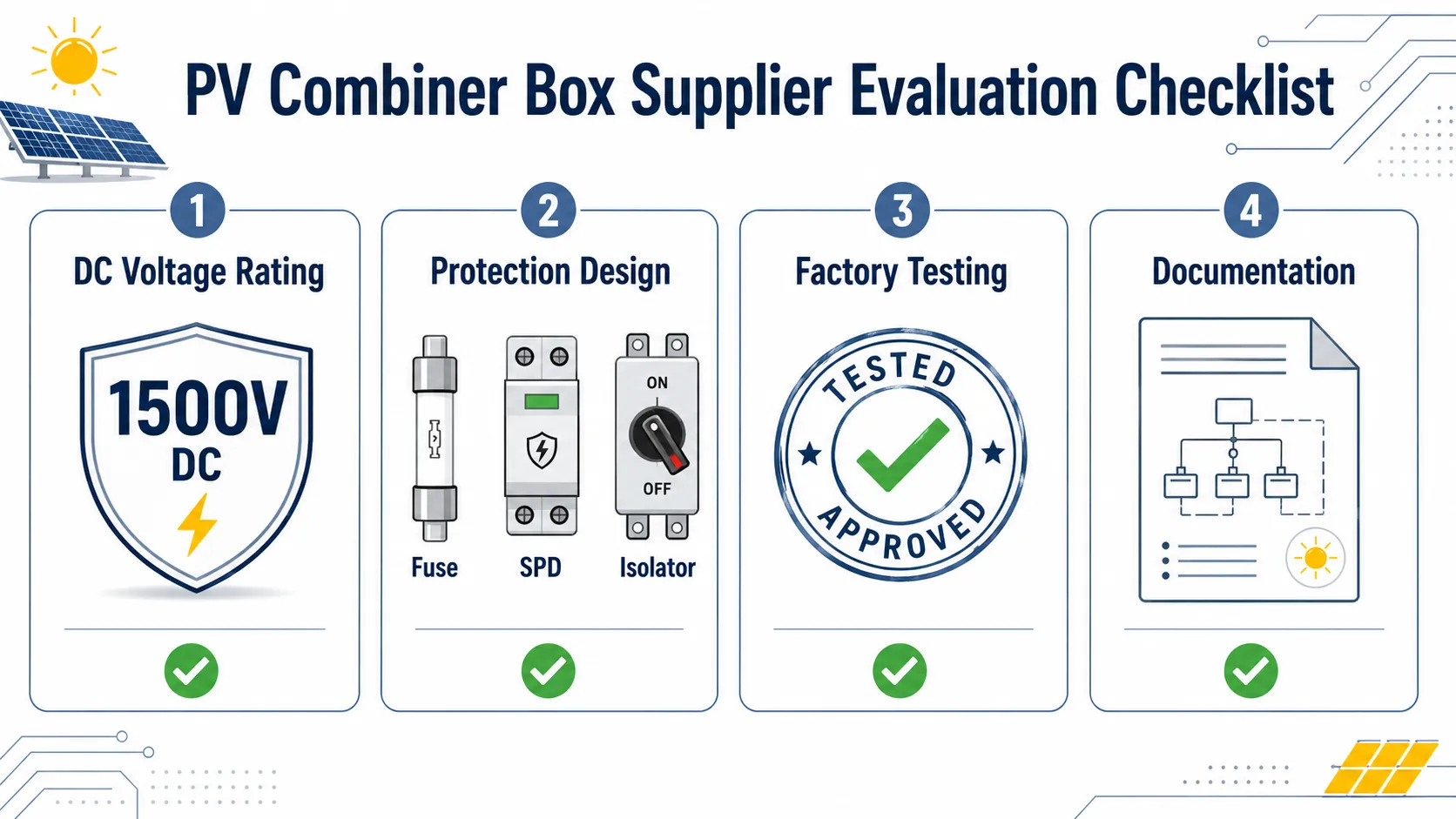
| Check item | What to ask the supplier | Red flag |
|---|---|---|
| DC voltage rating | Can you build 600V, 1000V, or 1500V DC configurations for this string design? | Same layout offered for every voltage class |
| Protection design | How are fuses, DC isolators, DC breakers, and SPDs coordinated? | Supplier cannot explain DC protection logic |
| Component ratings | Are the fuse holders, breakers, isolators, SPDs, terminals, and cable glands rated for PV DC use? | Only AC component certificates are provided |
| Factory testing | Do you provide routine inspection or test records for each order? | Only component datasheets, no assembled-box checks |
| Enclosure suitability | What IP rating, UV resistance, corrosion resistance, and thermal design are used? | Indoor enclosure used for outdoor PV installation |
| Documentation | Can you provide wiring diagram, BOM, layout drawing, labels, and torque guidance? | Generic datasheet only |
| Customization | Can you support string count, monitoring, SPD, isolator, breaker, connector, and cable gland options? | Supplier says yes to everything without engineering review |
| Traceability | Can the supplier identify the batch, BOM, and inspection record after delivery? | No serial, batch, or inspection traceability |
Why PV Combiner Box Supplier Selection Is Different
Choosing a PV combiner box supplier is different from buying a normal distribution box supplier. A standard AC enclosure mainly distributes power from one source to multiple load circuits. A PV combiner box combines multiple source circuits, usually PV strings, before feeding an inverter or downstream DC protection device.
That difference changes the engineering requirements:
- PV strings are current sources. A faulted string can receive reverse current from other parallel strings.
- DC arcs are harder to interrupt. DC protective devices must be rated for the actual DC voltage and current.
- Cold weather raises string voltage. Maximum string open-circuit voltage must be checked at the lowest expected temperature.
- Outdoor exposure is normal. UV, rain, dust, heat, condensation, and corrosion affect long-term reliability.
- Surge protection depends on layout. SPD lead length, PE connection, and grounding path affect real protection performance.
- Documentation matters. EPCs, distributors, and inspectors often need wiring drawings, component ratings, and test records.
For a broader technical overview, the PV combiner box guide explains the function, components, wiring, and selection logic of combiner boxes.
1. Verify DC Voltage and String Configuration Capability
The first supplier check is not price. It is whether the manufacturer can configure the box for the actual PV array voltage and string layout.
A serious supplier should ask for:
- number of PV strings
- modules per string
- module open-circuit voltage, or
Voc - module short-circuit current, or
Isc - lowest expected ambient temperature
- inverter maximum input voltage
- number of MPPT inputs
- required output configuration
- grounding and earthing arrangement
The manufacturer should not select the voltage class only from the nominal system label. In PV systems, maximum voltage is normally based on string Voc corrected for low temperature. A box marked 1000V DC or 1500V DC should use internal devices, spacing, terminals, wiring, and labels that match that voltage class.
Procurement warning: a 1500V PV combiner box is not simply a 1000V box with a different label. The DC fuse holders, SPD, isolator, breaker, clearance, creepage, wiring layout, and enclosure heat behavior all need to be checked.
For deeper voltage selection context, the VIOX article on solar combiner box voltage ratings: 600V vs 1000V vs 1500V explains how system voltage class affects component and layout choices.
2. Check the Protection Design, Not Just the Component List
A PV combiner box is a protection assembly. A supplier should be able to explain how each protective device works in the system, not just list brand names in the BOM.
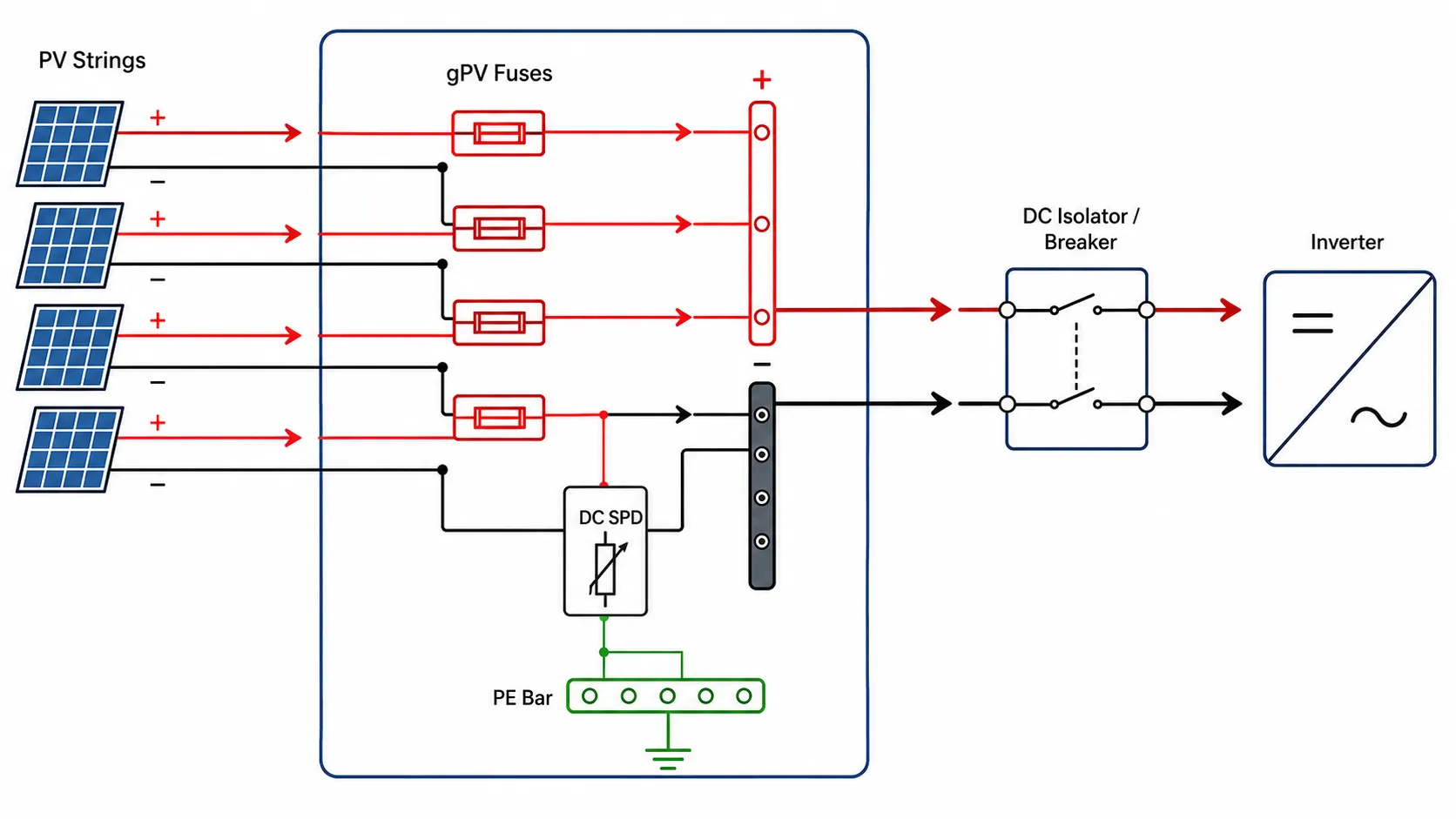
String Fuses
String fuses are commonly used when parallel strings can feed reverse current into a faulted string. The fuse must be designed for photovoltaic DC duty, not general AC protection. The rating depends on module Isc, the number of parallel strings, cable rating, local code, and the module manufacturer’s maximum series fuse rating.
For protection design details, see Solar Combiner Box Protection Design: Coordinating Fuses, DC Isolators, Breakers, and SPDs.
DC Isolators and DC Circuit Breakers
A DC isolator is mainly used as a manual load-break and isolation device. A DC circuit breaker can provide overcurrent protection when it is correctly rated and applied. They are related but not automatically interchangeable.
Ask the supplier:
- Is the output device an isolator, a switch-disconnector, a circuit breaker, or a molded-case DC breaker?
- Is it rated for the full PV DC voltage?
- Can it break load current under the stated DC utilization conditions?
- If it is a breaker, what is its DC breaking capacity at the specified voltage?
- Is polarity or series-pole wiring required?
For role separation inside combiner boxes, refer to DC isolator vs DC circuit breaker in solar combiner boxes.
Surge Protection Devices
PV combiner boxes often include DC SPDs to limit transient overvoltage from lightning-induced surges and switching events. The supplier should select an SPD with a PV DC continuous operating voltage suitable for the string voltage, a correct protection mode, a short PE path, and appropriate backup protection where required.
Do not evaluate an SPD only by a large kA number. The real selection also depends on Ucpv, Up, In, Imax, connection mode, grounding arrangement, and installation lead length. For SPD parameter reading, see How to Read an SPD Datasheet.
3. Confirm Enclosure and Outdoor Reliability
Many combiner box failures are not caused by the electrical diagram. They come from the enclosure and wiring environment: water ingress, overheated terminals, UV-damaged plastic, loose cable glands, condensation, or poor internal spacing.
A supplier should define:
- enclosure material, such as metal, stainless steel, thermoplastic, or fiberglass-reinforced material
- IP or NEMA rating required by the project
- UV resistance for outdoor installations
- corrosion protection for coastal or industrial environments
- cable gland type and sealing method
- internal heat rise management
- spacing around fuse holders, SPD modules, and isolators
- drain, breather, or anti-condensation strategy where needed
- label durability
For outdoor PV projects, the enclosure should be selected by actual installation conditions, not by catalog appearance. Rooftop, desert, tropical, coastal, and utility-scale ground-mount projects can require different enclosure materials and sealing strategies.
4. Ask for Factory Testing, Not Only Component Certificates
Component certificates are useful, but they do not prove that the assembled combiner box was wired correctly.
A professional PV combiner box manufacturer should be able to describe its routine inspection process. Depending on the project specification and order requirements, this may include:
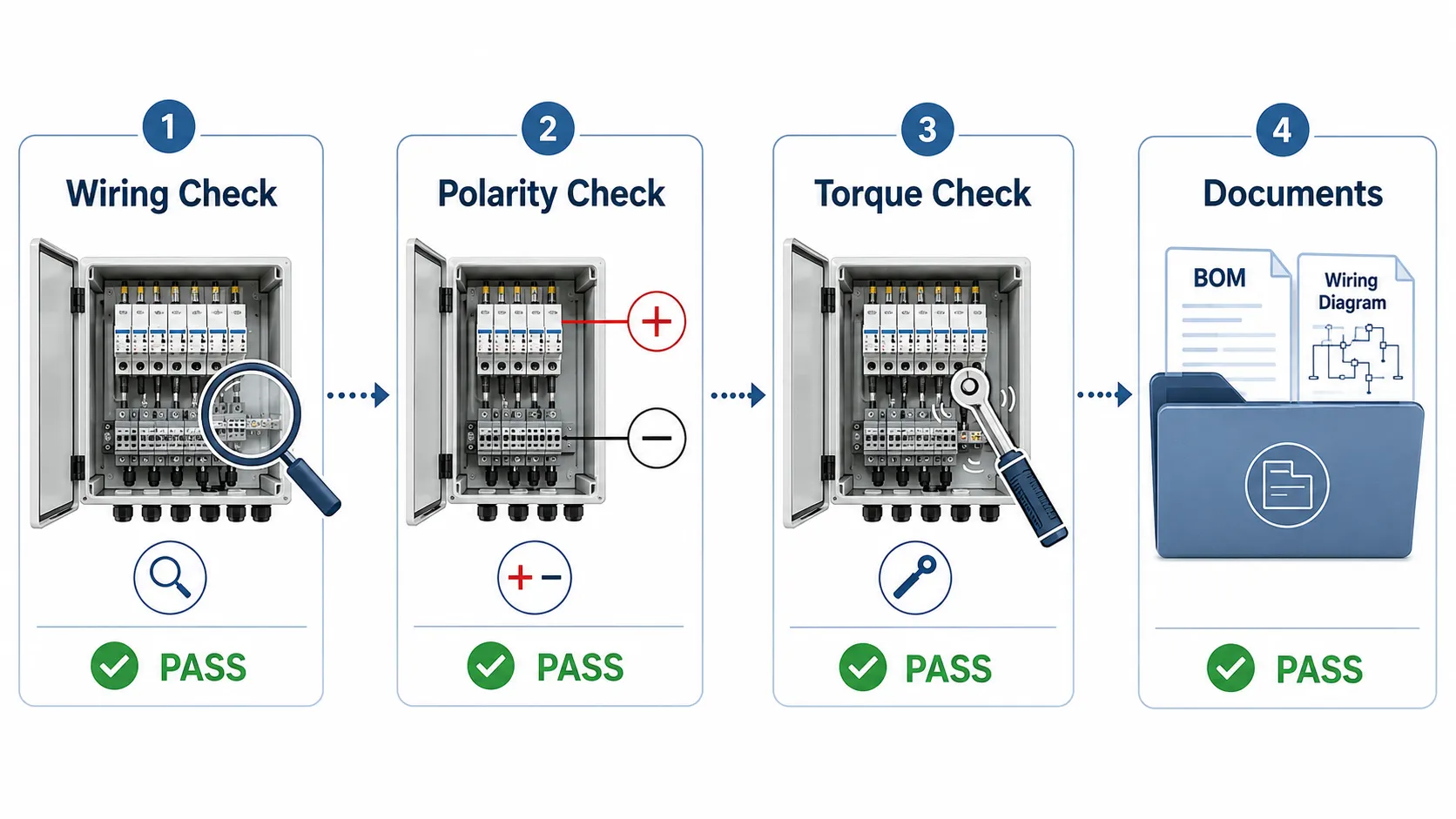
- incoming component inspection
- visual inspection of wiring and layout
- polarity check
- continuity check
- insulation or dielectric test where specified
- torque verification according to work instructions
- label and terminal marking check
- SPD status indicator check
- remote signal contact check if included
- packing and accessory check
- serial number or batch traceability
The key procurement question is not only “Do you have certificates?” It is also “How do you verify every assembled unit before shipment?”
5. Review Documentation Before Purchase
The documentation package is a strong indicator of supplier maturity. A weak supplier may send only a product photo and a generic datasheet. A reliable supplier should be able to provide project-specific documents before production approval.
Ask for:
- electrical schematic or wiring diagram
- internal layout drawing
- bill of materials
- string input and output configuration
- component datasheets
- enclosure datasheet
- applicable certificate list
- terminal torque instructions where relevant
- installation and maintenance notes
- packing list
- label drawing if OEM branding is required
For wiring-specific review, the solar combiner box wiring diagram article gives useful context on how fuses, SPDs, isolators, busbars, and outputs are typically arranged.
6. Standards and Certifications: Verify by Market and Project
PV combiner box compliance is market-dependent. Do not assume that one certificate covers every country, voltage class, or project type. The correct certification route depends on the installation location, utility requirements, project specification, voltage class, enclosure type, and the protective devices inside the box.
| Area to verify | Why it matters | Examples of standards or certification areas to check |
|---|---|---|
| Assembly design | Confirms the box is treated as an electrical assembly, not loose components | IEC 61439 series, depending on assembly type and project requirements |
| PV array installation requirements | Affects string protection, isolation, cable routing, and PV DC design | IEC 62548 series and local PV installation rules |
| DC circuit breaker | Confirms DC breaking capacity at the stated voltage | IEC 60947-2, UL 489B, or other market-required breaker standards |
| DC switch or isolator | Confirms load-break and isolation suitability | IEC 60947-3, UL 98B, or market-specific switch requirements |
| Surge protection | Confirms SPD suitability for PV DC or AC systems | IEC 61643-31 for PV DC SPD applications, IEC 61643-11 for low-voltage AC SPD applications |
| Inverter or system interconnection context | Relevant for North American PV equipment approval paths | UL 1741 may apply to inverter and power conversion equipment, not every combiner box directly |
| Enclosure protection | Confirms environmental protection level | IEC 60529 IP rating, UL/NEMA enclosure ratings where specified |
This table is not a universal compliance list. It is a procurement review map. Always verify the final standard set against the target market, system voltage, project specification, and certification body requirements.
7. Evaluate Engineering Response, Not Just Sales Speed
Fast replies are useful, but fast engineering is different from fast sales. A strong PV combiner box supplier will ask technical questions before confirming the design.
Good signs include:
- the supplier asks for string count,
Voc,Isc, inverter input, and voltage class - the supplier distinguishes between 600V, 1000V, and 1500V DC layouts
- the supplier explains when string fuses are required
- the supplier can discuss DC isolator vs DC breaker selection
- the supplier checks SPD
Ucpvand grounding path - the supplier can provide a wiring diagram before production
- the supplier warns when a requested design is unsafe or unclear
Bad signs include:
- immediate quotation without asking system parameters
- “same design fits all voltage classes”
- AC-rated MCBs, switches, or SPDs offered for PV DC use
- no wiring diagram
- no BOM transparency
- no routine test records
- no answer on spare parts or after-sales support
8. Supplier Risk Red Flags
| Red flag | Why it matters |
|---|---|
| Only AC component certificates are provided | PV combiner boxes require DC-rated protection devices |
| The same enclosure layout is used for every voltage class | Higher DC voltage may require different spacing, devices, and heat management |
| Supplier cannot explain fuse sizing logic | Reverse-current protection may be wrong |
| SPD voltage is selected only by nominal system voltage | Cold string Voc can exceed the SPD’s continuous operating voltage |
| No project-specific wiring diagram | Increases wiring, polarity, and installation errors |
| No torque or terminal guidance | Loose connections can cause overheating |
| Outdoor box uses weak sealing or indoor glands | Water ingress and corrosion risk increase |
| Supplier refuses inspection or test records | Harder to prove quality before shipment |
| Price is far below market without design explanation | May indicate downgraded components, thin enclosure, or missing testing |
9. Pre-Wired vs Custom Combiner Box Supplier
A pre-wired combiner box can reduce installation time and wiring errors, especially for distributors, EPCs, and repeat projects. A custom combiner box is better when the project has special string count, monitoring, enclosure, output, voltage, connector, or labeling requirements.
| Option | Best fit | Procurement check |
|---|---|---|
| Standard pre-wired combiner box | Repeated residential or small commercial systems | Confirm string count, voltage class, fuse/SPD/isolator ratings, and enclosure rating |
| Custom PV combiner box | Commercial, industrial, OEM, and project-specific systems | Confirm schematic, BOM, layout, approval drawing, and factory test record |
| DIY assembly | Low-risk learning or very small non-critical projects | Not recommended for professional PV projects without qualified design and inspection |
For B2B procurement, the most important difference is not whether the box is standard or custom. It is whether the supplier can prove that the configuration matches the system.
10. What VIOX Can Support as a PV Combiner Box Manufacturer
VIOX supports PV combiner box projects where distributors, EPCs, panel builders, and OEM customers need a configured solution rather than a loose collection of parts.
Depending on project requirements, VIOX can support:
- custom string count and output layout
- pre-wired PV combiner boxes
- DC fuse, DC breaker, DC isolator, and DC SPD options
- 1000V and 1500V DC configurations
- wiring diagram and BOM support
- OEM/ODM labeling and packaging
- project communication for distributors and system integrators
- routine inspection support according to order requirements
- export packaging and documentation coordination
If you already know the string count, maximum string voltage, module short-circuit current, inverter input arrangement, and target market, VIOX can help review the suitable combiner box configuration.
PV Combiner Box Supplier Evaluation Scorecard
Use this scorecard when comparing suppliers. It keeps the decision focused on project risk instead of unit price alone.
| Evaluation area | Suggested weight | What to check |
|---|---|---|
| DC technical design | 30% | Voltage class, string protection, DC switching, SPD coordination, wiring layout |
| Component selection | 20% | PV-rated fuses, DC isolators, DC breakers, SPDs, terminals, cable glands |
| Factory testing and documentation | 20% | Wiring diagram, BOM, inspection record, labels, traceability |
| Enclosure and outdoor reliability | 15% | IP/NEMA rating, UV, corrosion, heat, cable entry, sealing |
| Customization and engineering communication | 10% | Design review, approval drawings, response quality, OEM/ODM support |
| Business stability and service | 5% | Lead time, spare parts, replacement handling, export experience |
Common Procurement Mistakes
Choosing by Price Before Design
A low quote may hide missing fuses, under-rated SPDs, AC-rated devices, thin enclosure material, weak terminals, or no testing. Compare the design first, then compare price.
Treating Certificates as the Whole Quality System
A certificate for one component does not prove that the complete box is correctly designed, wired, labeled, and tested.
Ignoring Cold-Weather Voltage
PV string voltage rises at low temperature. If the supplier does not ask for Voc and temperature conditions, the voltage selection may be unsafe.
Assuming AC Devices Can Be Used in DC PV Circuits
AC breakers, switches, and SPDs should not be assumed suitable for PV DC use. DC voltage rating, arc interruption, polarity, and application category must be verified.
Buying a Box Without a Wiring Diagram
A wiring diagram is not optional for professional PV procurement. It helps installers, inspectors, and maintenance teams understand the protection sequence and terminal layout.
FAQ
What should I ask a PV combiner box manufacturer before ordering?
Ask for the supported voltage class, string count, protection design, component ratings, wiring diagram, BOM, enclosure rating, factory inspection process, applicable certificate list, and after-sales support.
Can a normal AC distribution box manufacturer make PV combiner boxes?
Only if the manufacturer understands PV DC design and uses correctly rated components. A PV combiner box is not just an AC distribution box with different labels.
What certificates should a solar combiner box supplier provide?
The required certificates depend on the target market and project specification. Buyers should check component certificates, assembly requirements, enclosure ratings, and any required IEC, UL, or local approval path for the final project.
Is a 1500V combiner box just a 1000V combiner box with a different label?
No. A 1500V combiner box may require different DC-rated components, spacing, SPD selection, insulation design, layout, and testing. Always verify the full BOM and wiring design.
Should a PV combiner box use fuses or DC breakers?
It depends on the string count, reverse-current risk, cable protection requirement, inverter input design, and project rules. String fuses are common for reverse-current protection, while DC breakers may be used for output or feeder protection when correctly rated.
What documents should be shipped with a combiner box?
At minimum, professional projects should request a wiring diagram, BOM, component datasheets, label information, installation notes, packing list, and inspection or test records where specified.
How do I know if a PV combiner box supplier is reliable?
A reliable supplier asks technical questions, provides project-specific drawings, uses PV DC-rated components, explains protection coordination, supports routine inspection, and can trace the supplied configuration after delivery.
Does VIOX support custom PV combiner boxes?
Yes. VIOX can support custom string count, pre-wired layouts, DC fuse or breaker options, DC isolators, SPDs, 1000V and 1500V configurations, OEM/ODM labeling, wiring diagram support, and export documentation coordination.
Conclusion
The best PV combiner box supplier is not simply the cheapest factory. It is the manufacturer that can match the combiner box to the real PV system: voltage class, string current, reverse-current protection, DC isolation, surge protection, enclosure environment, wiring layout, testing, and documentation.
For procurement teams, the safest buying process is to evaluate the supplier’s engineering capability before negotiating the final price. A properly designed and documented combiner box reduces installation mistakes, acceptance delays, maintenance problems, and long-term PV system risk.