

On this page
Quick Answer
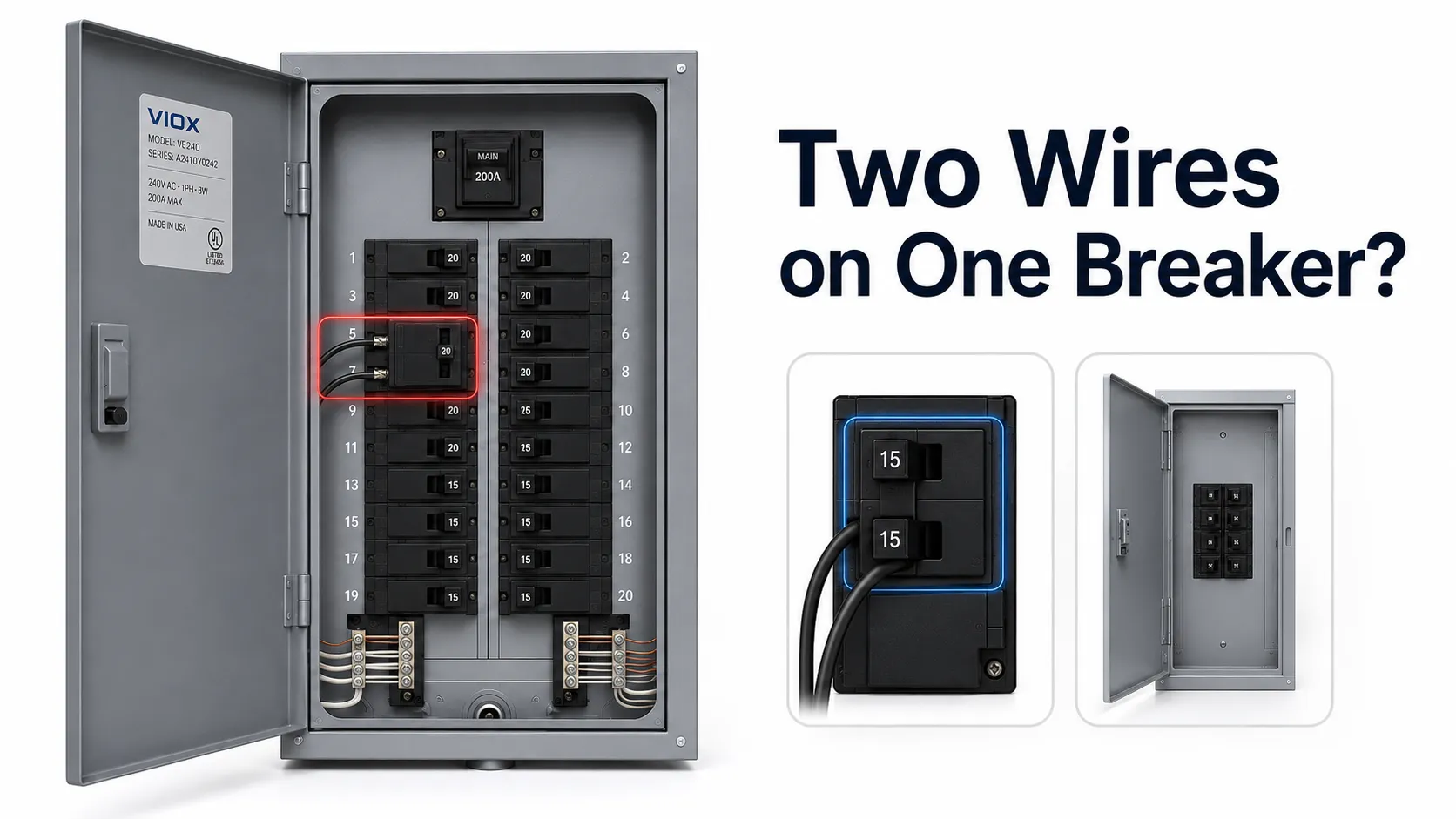
Usually, no. You should not put two separate circuit conductors under one breaker terminal unless that exact breaker is specifically listed and marked for two conductors of the correct size and material.
Two circuits can share one breaker only in limited, code-approved situations. The common examples are:
- a listed tandem breaker in a panel slot approved for tandem use
- a properly designed multi-wire branch circuit with the required simultaneous disconnect
- a subpanel feeder that supplies a secondary distribution board
- a single branch circuit that is intentionally split downstream, while still protected as one circuit
What is not acceptable is simply forcing two wires into one breaker terminal to save space. That is usually called a double-tapped breaker, and it can create loose connections, overheating, nuisance trips, fire risk, and inspection problems.
Key Takeaways
- Two wires on one breaker is not automatically allowed. The breaker terminal must be listed for two conductors.
- Two circuits on one breaker are usually not two independent circuits anymore. They become one protected circuit unless a listed breaker assembly is designed otherwise.
- A tandem breaker is different from a double-pole breaker. Tandem breakers provide two 120V circuits in one space; double-pole breakers usually serve 240V loads or common-disconnect circuits.
- Shared-neutral circuits need special care. A multi-wire branch circuit must be wired on different phases/legs and have the required simultaneous disconnect.
- Panel space is not panel capacity. Adding circuits with tandem breakers does not increase the service rating, busbar rating, or feeder capacity.
- The safer fix is often a listed tandem breaker, subpanel, or panel upgrade. The right solution depends on the panel label, load calculation, and local code.
Two Wires vs Two Circuits: They Are Not the Same Problem
Many people use the phrases interchangeably, but they describe different electrical situations.
| Question | What It Usually Means | Main Risk |
|---|---|---|
| Two wires on one breaker | Two conductors landed under one breaker terminal | Loose terminal, overheating, non-listed connection |
| Two circuits on one breaker | Two branch runs protected by one breaker | Overload, confusion, poor circuit separation |
| Tandem breaker | Two breaker mechanisms in one panel space | Only safe if panel and slot allow it |
| Double-pole breaker for two circuits | Two poles tied together or common trip | Must match MWBC or 240V requirements |
| Shared neutral circuit | Two hot conductors sharing one neutral | Neutral overheating if wired incorrectly |
| Subpanel feeder | One breaker feeding another panel | Requires correct feeder, grounding, bonding, and load calculation |
The first step is to identify which situation you actually have. A solution for one case can be unsafe in another.
What Is a Double-Tapped Breaker?
A double-tapped breaker is a breaker terminal with two conductors connected where only one conductor is permitted.
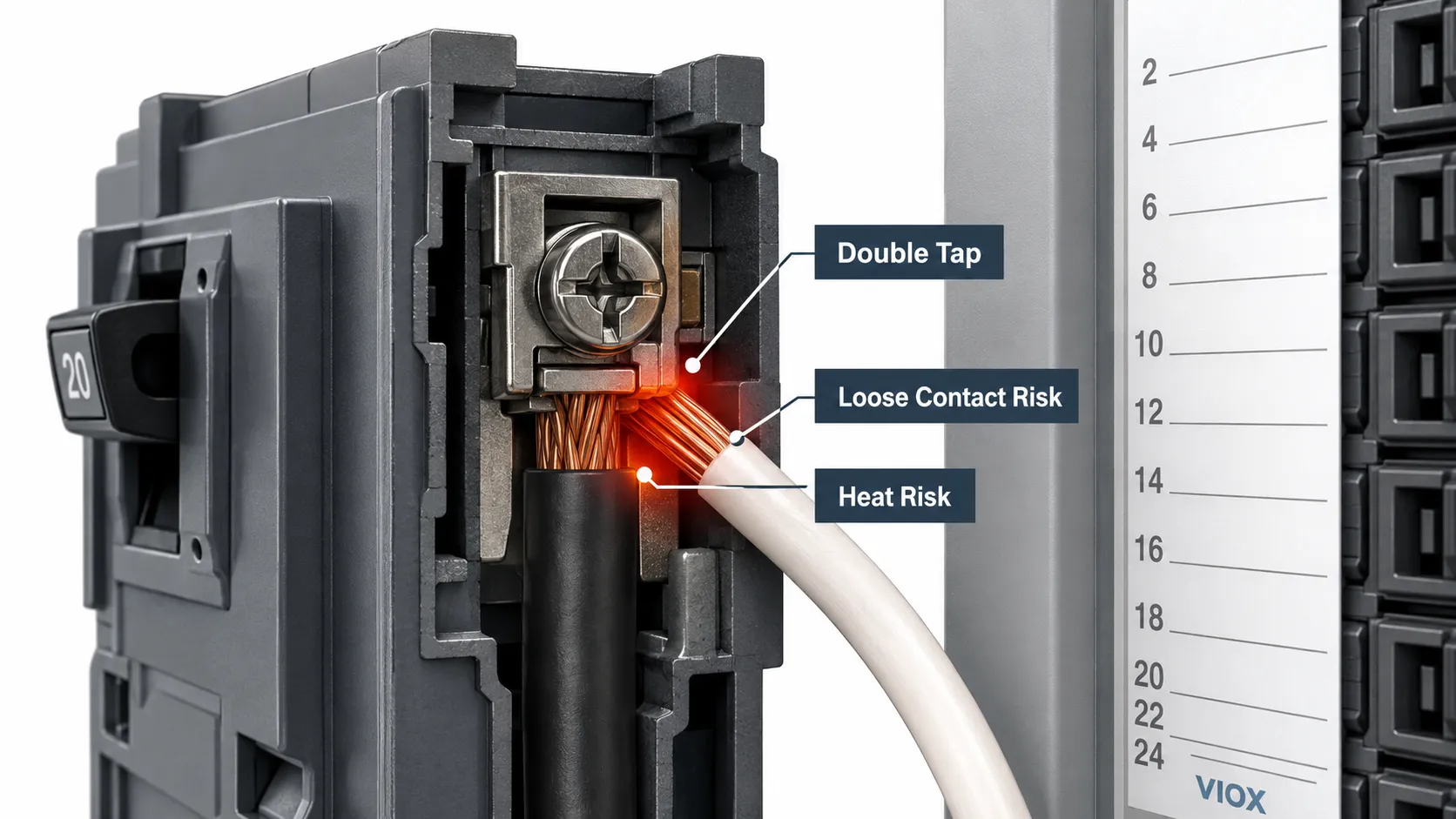
This is a common inspection finding in residential panels and small commercial panels. The problem is not just appearance. Breaker terminals are designed to clamp conductors with a specific pressure and contact area. If the terminal is not listed for two conductors, one wire may be clamped tightly while the other is only partly captured.
That can lead to:
- increased contact resistance
- terminal heating
- insulation damage
- arcing at the breaker terminal
- intermittent power
- nuisance tripping
- failed inspection
Some breakers are listed for two conductors. Many are not. You cannot decide by visual fit alone. You must check the breaker marking, manufacturer data, and panel compatibility.
When Can Two Wires Be Connected to One Breaker?
Two wires may be connected to one breaker terminal only when all of these are true:
| Check | Requirement |
|---|---|
| Breaker terminal listing | The breaker is marked or documented for two conductors |
| Conductor size | Both conductors are within the allowed wire-size range |
| Conductor material | Copper/aluminum compatibility matches the breaker rating |
| Torque | Terminal is tightened to the manufacturer’s specified torque |
| Panel compatibility | Breaker is listed or approved for that panel |
| Circuit design | Combined load and conductor protection are correct |
If the breaker is not rated for two conductors, do not treat the terminal as a junction point.
Is Pigtailing a Safe Fix?
Sometimes, yes, but it must be understood correctly.
A pigtail means two conductors are joined with an approved connector, and one short conductor runs from that splice to the breaker. This avoids placing two conductors under one breaker terminal.
However, pigtailing does not magically create two independent circuits. The breaker still protects the combined load as one circuit. The conductor size, total load, splice method, box fill, panel space, and circuit labeling must still be correct.
Use pigtailing only where the wiring method, connector type, enclosure space, and local rules allow it.
Can Two Circuits Share One Breaker?
In most ordinary cases, two separate circuits should not simply be combined onto one standard breaker.
If two branch circuits are connected to one breaker, they are no longer independently protected. A fault or overload on either branch trips the same breaker, and the total load of both branches is limited by that one breaker.
The bigger problem is conductor protection. For example, if a 20A breaker is used to protect conductors that are only rated for a 15A circuit, the smaller conductors may not be properly protected. The danger is not that two branches “add up to 30A” in a mathematical sense. The danger is that the breaker may be too large for one or more conductors and that the installation no longer matches its intended circuit design.
Can You Put Two Lighting Circuits on One Breaker?
You can split one protected lighting circuit into multiple branches downstream, but that is not the same as running two independent lighting circuits from one breaker.
A single lighting circuit may feed several rooms or multiple lighting points, depending on the wiring rules, cable size, breaker rating, and load. But if two previously separate lighting circuits are tied together at the breaker, you may create:
- confusing circuit identification
- unexpected outages
- overloaded conductors
- shared neutral problems
- inspection issues
- unsafe maintenance conditions
If the goal is simply to save panel space, use a listed panel-approved solution such as a tandem breaker or subpanel, not a hidden circuit merge.
Tandem Breaker vs Double-Pole Breaker vs Split Breaker
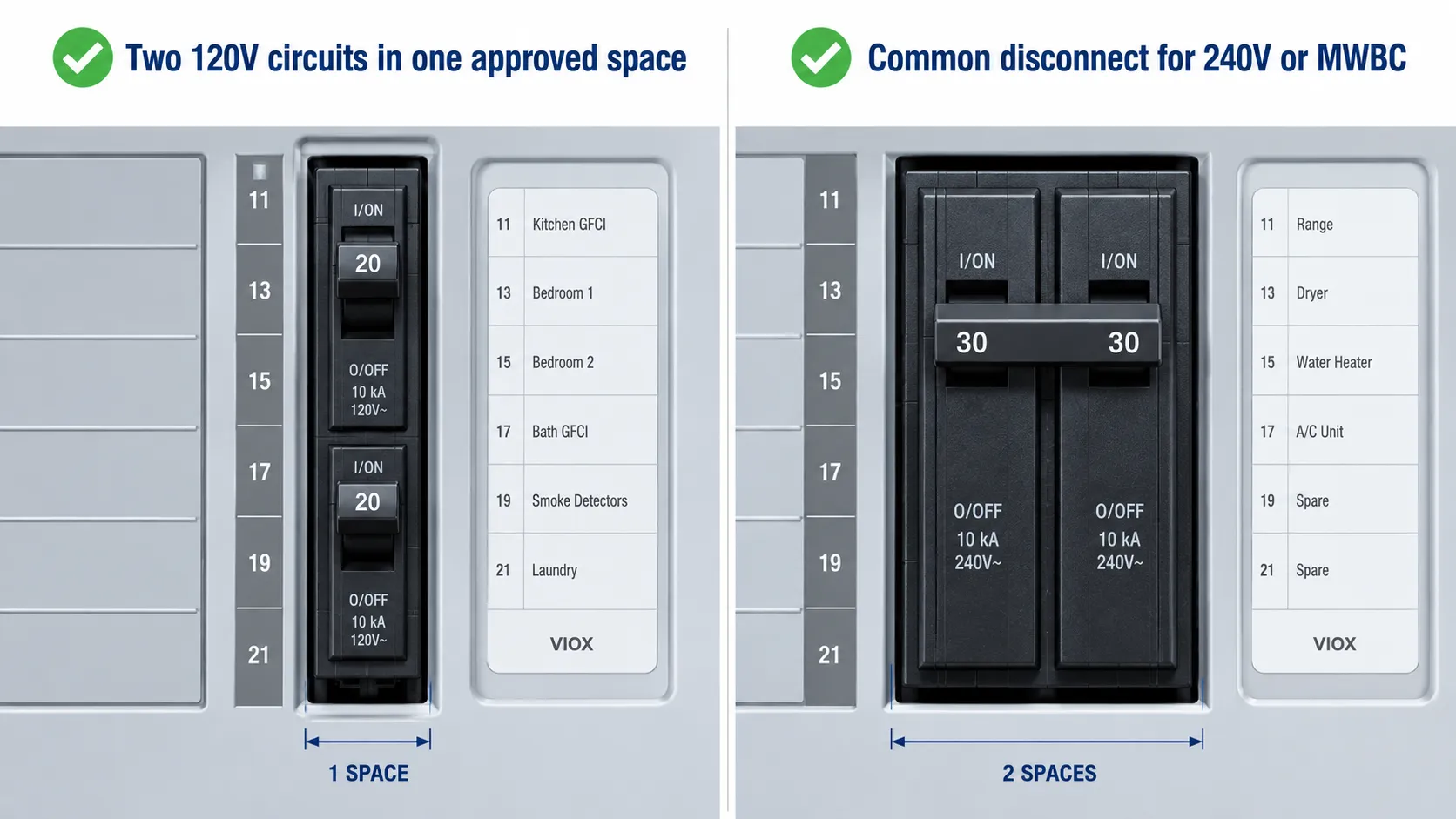
These breaker types are often confused.
| Breaker Type | What It Does | Typical Use | Key Warning |
|---|---|---|---|
| Standard single-pole breaker | Protects one 120V branch circuit in one space | lighting, receptacles, small loads | Usually one conductor per terminal unless marked otherwise |
| Tandem breaker | Provides two independent 120V breaker mechanisms in one panel space | adding circuits where panel allows tandem use | Only allowed in approved panel positions |
| Double-pole breaker | Uses two poles connected by common handle or common trip | 240V loads, MWBC disconnect, certain feeders | Not the same as a tandem breaker |
| Quad breaker | Combines multiple poles in compact form | panel-specific replacement or expansion | Must match panel listing and circuit need |
For a deeper explanation, see VIOX’s guide to tandem breakers, CTL, non-CTL, safety, and panel compatibility.
Can You Use a Double-Pole Breaker for Two Separate Circuits?
Sometimes, but only when the circuit design requires it.
A double-pole breaker may be used for:
- a 240V load
- a multi-wire branch circuit requiring simultaneous disconnect
- certain shared-neutral applications
- feeder circuits
- equipment requiring common trip or common disconnect
It should not be used randomly just because two handles look convenient. If two unrelated 120V circuits are placed on a double-pole breaker, one trip can shut off both circuits. That may be acceptable in some designs, but it must be intentional, labeled, and compliant.
How Many Circuits Can Share a Neutral?
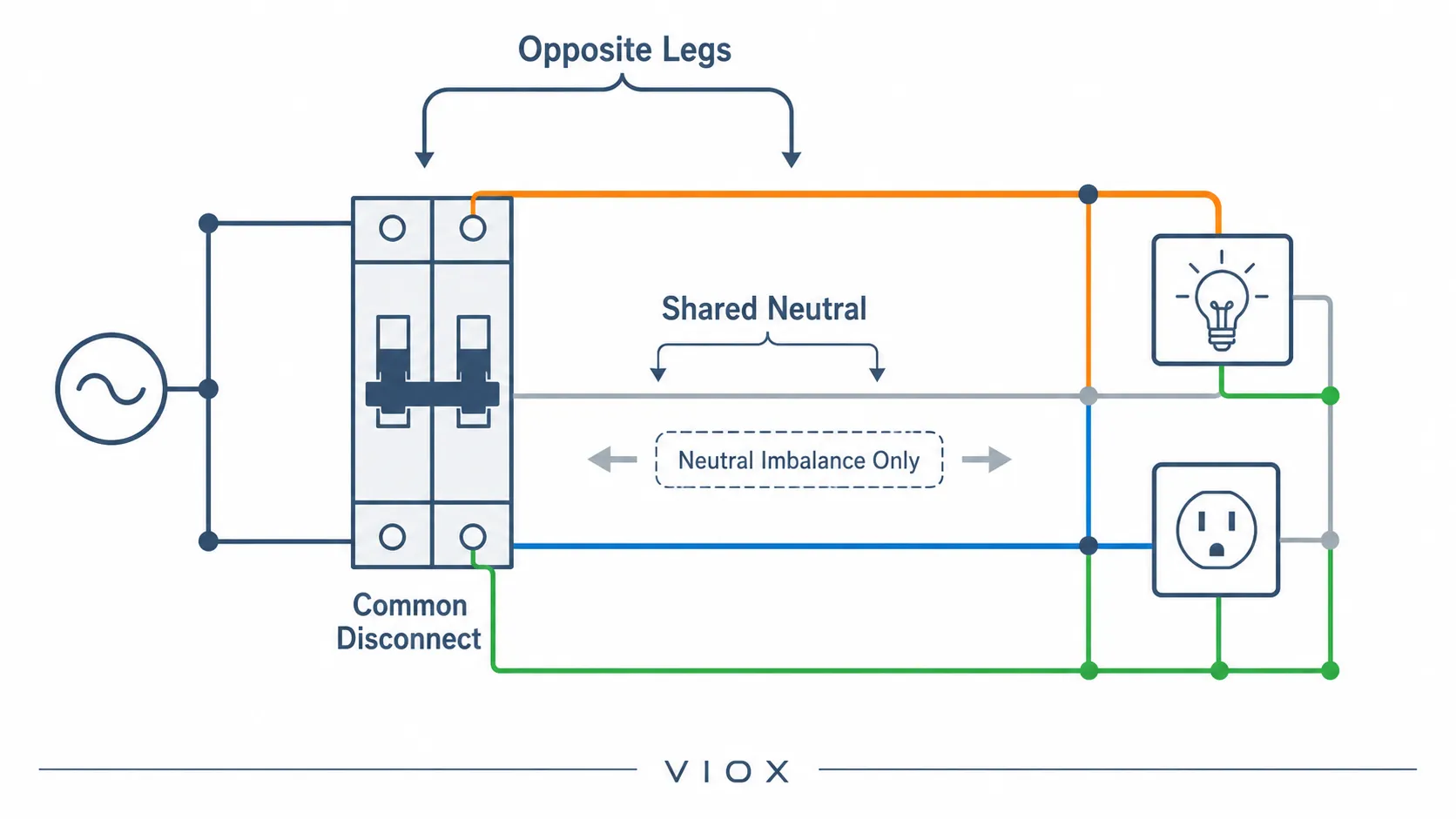
The most common legitimate shared-neutral arrangement is a multi-wire branch circuit (MWBC).
An MWBC uses two or more ungrounded conductors with a shared neutral. In a typical split-phase North American system, two 120V circuits share a neutral only when the hot conductors are on opposite legs. This allows the neutral to carry only the imbalance between the two loads rather than the full sum.
If both hot conductors are accidentally placed on the same leg, the neutral can be overloaded.
For MWBCs, key requirements typically include:
- hot conductors on different phases/legs
- simultaneous disconnect for all ungrounded conductors
- correct handle tie or common-trip breaker as required
- correct neutral continuity
- correct identification and labeling
- compliance with local code and panel rules
A tandem breaker is usually not the right device for a shared-neutral MWBC because the two circuits may be on the same phase/leg. The correct solution is normally a listed two-pole breaker or approved breaker assembly for that panel and circuit type.
What About “2 Circuits on One Breaker UK”?
The same safety idea applies in the UK and other IEC/BS-style systems, but the terminology differs.
In UK domestic wiring, the question may involve:
- radial circuits
- ring final circuits
- MCBs or RCBOs in a consumer unit
- spare ways in the board
- adding a second consumer unit
- RCD protection
- circuit schedules and labels
Do not simply land two outgoing conductors under one MCB unless the device terminal is designed and approved for that arrangement. If the goal is to add a new circuit, the usual route is to assess the consumer unit, protective device, cable size, RCD/RCBO requirements, maximum demand, and inspection/testing requirements.
For UK-style boards, an RCBO-based upgrade or additional consumer unit may be safer than crowding multiple conductors into one protective device.
Safer Alternatives When the Panel Is Full
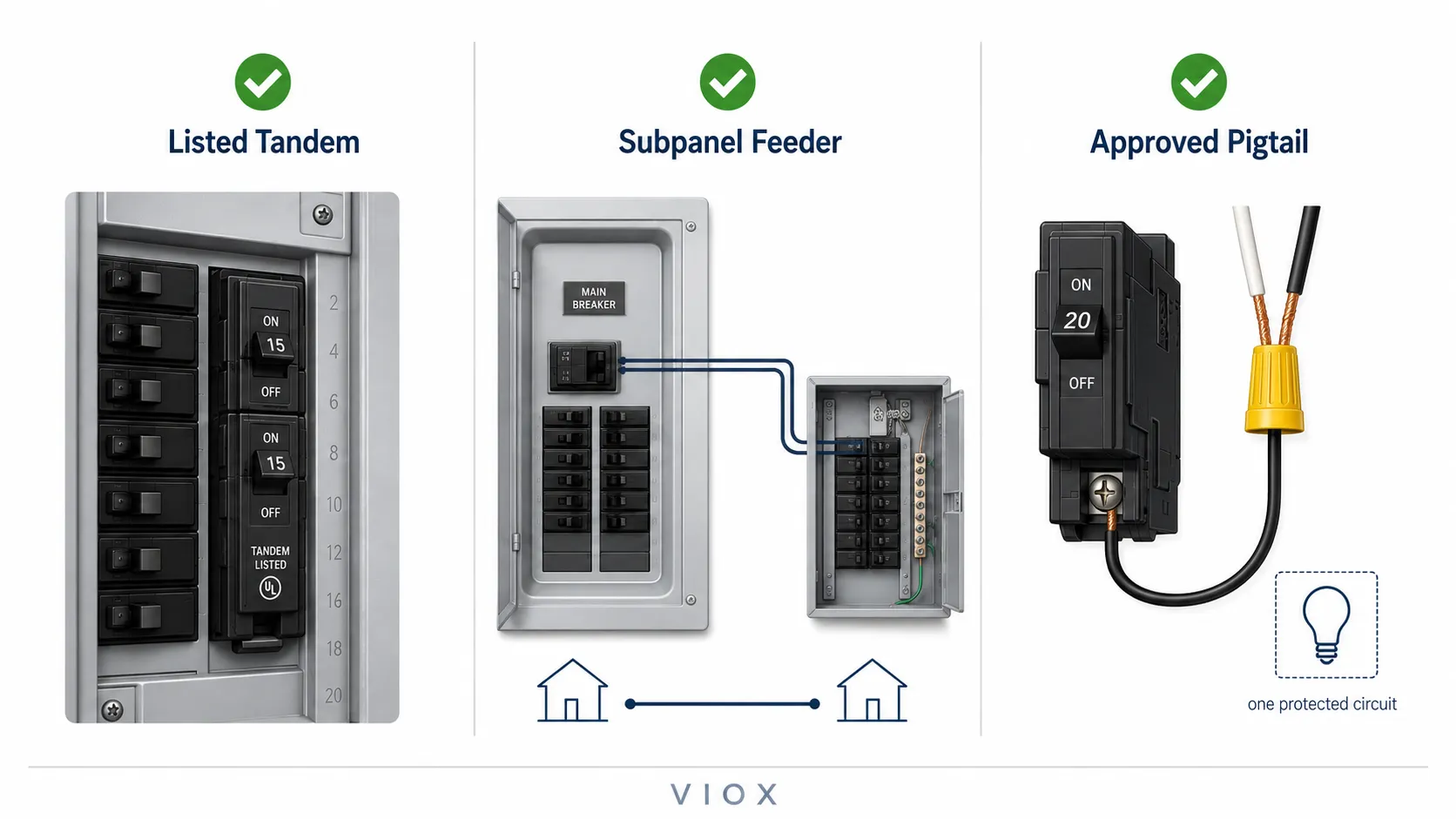
If the real problem is panel space, there are safer solutions than double-tapping breakers.
| Alternative | When It Helps | What to Verify |
|---|---|---|
| Listed tandem breaker | Panel has approved tandem positions | panel label, breaker type, AFCI/GFCI needs |
| Subpanel | More circuits are needed in a garage, workshop, addition, or outbuilding | feeder size, grounding/bonding, load calculation |
| Panel upgrade | Old panel lacks capacity, spaces, or modern protection | service size, utility requirements, code compliance |
| Dedicated circuit | New appliance or high-load equipment needs proper protection | load, cable size, breaker curve, RCD/RCBO |
| Junction/splice correction | Existing double-tap needs cleanup | approved connector, enclosure space, conductor size |
| Load management | Panel capacity is limited | demand calculation, priority loads, control strategy |
For breaker sizing fundamentals, see VIOX’s guide on how to size a circuit breaker. For breaker ratings and standard amp sizes, see standard MCB sizes.
Inspection Checklist
Use this checklist before deciding whether a breaker connection is acceptable.
| Question | Why It Matters |
|---|---|
| Is the breaker listed for two conductors? | If not, two wires under one terminal are usually not allowed |
| Are both conductors the same material and permitted size? | Mixed or incorrect conductors may not clamp correctly |
| Is the breaker compatible with the panel? | Physical fit does not prove approval |
| Is this a tandem breaker or a double-pole breaker? | They solve different problems |
| Does the panel label allow tandem breakers in that slot? | Tandems are position-specific in many panels |
| Is there a shared neutral? | MWBC rules may require simultaneous disconnect |
| Is AFCI/GFCI/RCBO protection required? | Basic tandem breakers may not meet modern protection rules |
| Is the breaker rating matched to the smallest conductor? | The breaker protects the wire, not just the load |
| Is the circuit clearly labeled? | Future maintenance depends on accurate identification |
| Has a load calculation been done? | More spaces do not increase panel capacity |
Common Mistakes
Mistake 1: Thinking “It Fits” Means “It Is Allowed”
Breaker terminals, panel busbars, and tandem slots are listing-dependent. If the manufacturer does not approve the connection, physical fit is not enough.
Mistake 2: Using a Tandem Breaker for a Shared Neutral
This can put both hot conductors on the same phase/leg and overload the neutral. Shared-neutral circuits require proper phase placement and simultaneous disconnect.
Mistake 3: Replacing a 15A Breaker with 20A to Stop Trips
If the wire is rated for a 15A circuit, installing a 20A breaker can remove the protection the conductor needs. Trips are symptoms. Do not treat the breaker as the problem until the load and wiring are checked.
Mistake 4: Adding Circuits Without Checking Panel Capacity
A tandem breaker may add spaces, but it does not increase service amperage, busbar rating, or feeder capacity.
Mistake 5: Ignoring AFCI, GFCI, or RCBO Requirements
Modern circuits may require arc-fault or ground-fault protection. A simple tandem breaker may not provide the required protection.
Mistake 6: Poor Labeling
When two areas of a building are affected by one breaker, service work becomes confusing. Poor labeling increases the risk of working on an energized circuit.
Recommended First-Screen Table for the Page
| Situation | Usually Allowed? | Safer Answer |
|---|---|---|
| Two wires under one ordinary breaker terminal | Usually no | Use only if breaker is listed for two conductors |
| Two circuits connected to one standard breaker | Usually no | Use separate breakers or approved circuit design |
| Tandem breaker in approved panel slot | Sometimes yes | Verify panel label and breaker series |
| Double-pole breaker for MWBC | Often required | Verify shared neutral, opposite legs, simultaneous disconnect |
| One breaker feeding a subpanel | Yes, when designed correctly | Use proper feeder, grounding, bonding, and load calculation |
| Split one branch circuit downstream | Often possible | It remains one circuit under one breaker |
FAQ
Can two wires be connected to one breaker?
Only if the breaker terminal is listed and marked for two conductors of the correct size and material. If the breaker is not rated for two wires, landing two conductors under one terminal is usually an unsafe double-tap.
Can two circuits be on one breaker?
Usually no, unless the design uses an approved method such as a listed tandem breaker, a properly wired multi-wire branch circuit, or a feeder to a subpanel. Two independent circuits should not simply be merged onto one ordinary breaker.
Is a tandem breaker the same as running two circuits from one breaker?
No. A tandem breaker contains two separate breaker mechanisms in one physical breaker body. It is only acceptable when the panel is listed for tandem breakers and the slot is approved for that breaker type.
Can I use a double-pole breaker for two separate 120V circuits?
Sometimes, especially for a multi-wire branch circuit that requires simultaneous disconnect. But it must be designed intentionally, wired correctly, and labeled. A double-pole breaker is not a general shortcut for unrelated circuits.
Can two lighting circuits share one breaker?
One lighting circuit can branch to multiple rooms, but two independent lighting circuits should not be randomly combined at one breaker. Check cable size, load, neutral arrangement, circuit labeling, and local rules.
Can I add a new circuit to a breaker box with no spare spaces?
Possible options include a listed tandem breaker, subpanel, or panel upgrade. The correct answer depends on the panel label, service capacity, required AFCI/GFCI protection, load calculation, and local code.
Can two circuits share a neutral?
Only in a properly designed multi-wire branch circuit or similar approved arrangement. The ungrounded conductors must be arranged correctly, and simultaneous disconnect is typically required. Incorrect shared neutrals can overheat.
Is pigtailing two wires to one breaker allowed?
Pigtailing may be used to correct a double-tap in some cases, but it does not create two independent circuits. The combined branch remains protected by one breaker, and the splice method, enclosure space, load, and conductor size must be correct.
Conclusion
The safest answer is simple: do not put two wires or two circuits on one breaker just because the terminal or panel space appears to allow it.
There are legitimate ways to handle limited panel space or shared circuit needs:
- use a listed tandem breaker in an approved panel slot
- use the correct double-pole breaker for a multi-wire branch circuit
- install a subpanel where more circuits are needed
- upgrade the panel when load and protection requirements have outgrown it
- correct double-tapped terminals with approved wiring methods
The breaker is not just a switch. It is the protection point for the conductor. Any solution must protect the smallest conductor, match the panel listing, satisfy local code, and remain clear for future maintenance.