Surge protection devices can be worth the investment when a system includes sensitive electronics, exposed outdoor circuits, long cable runs, solar equipment, automation devices, or costly downtime risk. They help limit transient overvoltages and reduce the chance that a surge event will damage connected equipment.
That said, surge protection devices are often misunderstood. An SPD is not a cure-all for every electrical problem. It does not replace proper grounding, overcurrent protection, equipment coordination, or good installation practice. It also does not guarantee that equipment will survive every surge event.
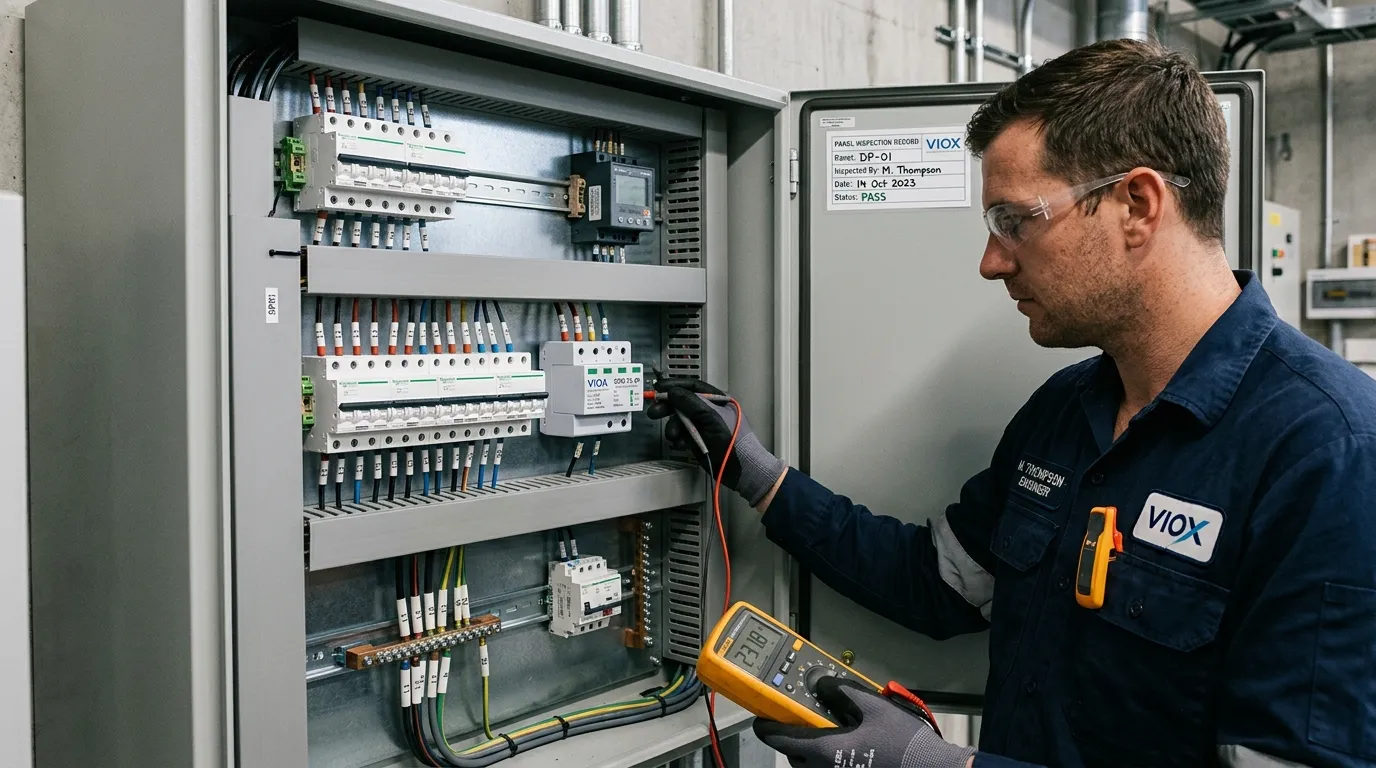
The practical decision is not simply whether surge protection devices have advantages. The better question is this: do the benefits of an SPD in this location outweigh its limitations, cost, and maintenance requirements?
For a general foundation, see what an SPD is.
What Are the Main Advantages of Surge Protection Devices?
The strongest case for an SPD is simple: modern electrical systems contain more electronics, control boards, communication modules, and power conversion equipment than ever before. These components are often more vulnerable to transient overvoltage than traditional resistive loads.
The main benefits of SPDs
| Advantage | Why it matters | Typical examples |
|---|---|---|
| Reduces transient overvoltage exposure | Helps limit surge energy before it reaches connected equipment | Panels, drives, PLCs, building systems, EV infrastructure |
| Supports uptime and reliability | Can reduce nuisance failures and unplanned equipment damage | Industrial controls, data interfaces, automation lines |
| Protects higher-value downstream assets | A relatively small protection component can help protect much costlier equipment | Inverters, control panels, communication devices, chargers |
| Improves layered protection strategy | Works as part of a coordinated protection design rather than as a standalone fix | Main service, sub-distribution, and point-of-use protection |
| Useful in exposed electrical environments | Especially relevant where lightning exposure, switching surges, or long feeders are present | Outdoor systems, rooftop solar, remote cabinets, long cable routes |
An SPD is often most valuable when it protects equipment that is expensive to replace, difficult to access, or disruptive to lose. That is why SPDs are common in solar systems, industrial automation, variable-speed drive installations, EV charging infrastructure, and critical building services.
What Are the Main Disadvantages of Surge Protection Devices?
The drawbacks are real, and this is where many articles get too optimistic. The value of surge protection depends on correct application. A poorly selected or poorly installed SPD creates a false sense of security, which is often more dangerous than having no clear strategy at all.
The main limitations of SPDs
| Limitation | What it means in practice | Why buyers overlook it |
|---|---|---|
| SPDs do not stop every type of electrical problem | They are designed for transient overvoltage, not overload, undervoltage, poor wiring, or sustained faults | Many buyers expect an SPD to act like a general power-protection device |
| Performance depends on installation quality | Lead length, grounding arrangement, and device coordination affect real protection performance | The device is often chosen more carefully than the installation layout |
| SPDs have a finite service life | Protection components can degrade after repeated surge exposure | Buyers often treat SPDs as fit-and-forget devices |
| Wrong type selection weakens the whole strategy | A mismatched Type 1, Type 2, or Type 3 device may not suit the installation point | Device type is often chosen by price instead of application |
| Not every site needs the same level of protection | The return on investment varies by environment, exposure, and equipment value | Many articles present surge protection as one-size-fits-all |
The biggest practical disadvantage is not the hardware cost. It is misapplication. A buyer installs an SPD, assumes the job is done, and overlooks the need for coordination, grounding, and proper placement. That is when the “pros” stop delivering real value.
If the question is whether SPDs are always worth it, the honest answer is no. If the question is whether they are worth it in exposed, electronic-heavy, downtime-sensitive systems, the answer is much more often yes.
The Technical Parameters That Decide Whether the Pros Are Real
A high-level pros-and-cons discussion is useful, but engineers usually want to know where the decision becomes technical. In practice, an SPD stops being “good” or “bad” in the abstract once you start checking whether its parameters match the system.
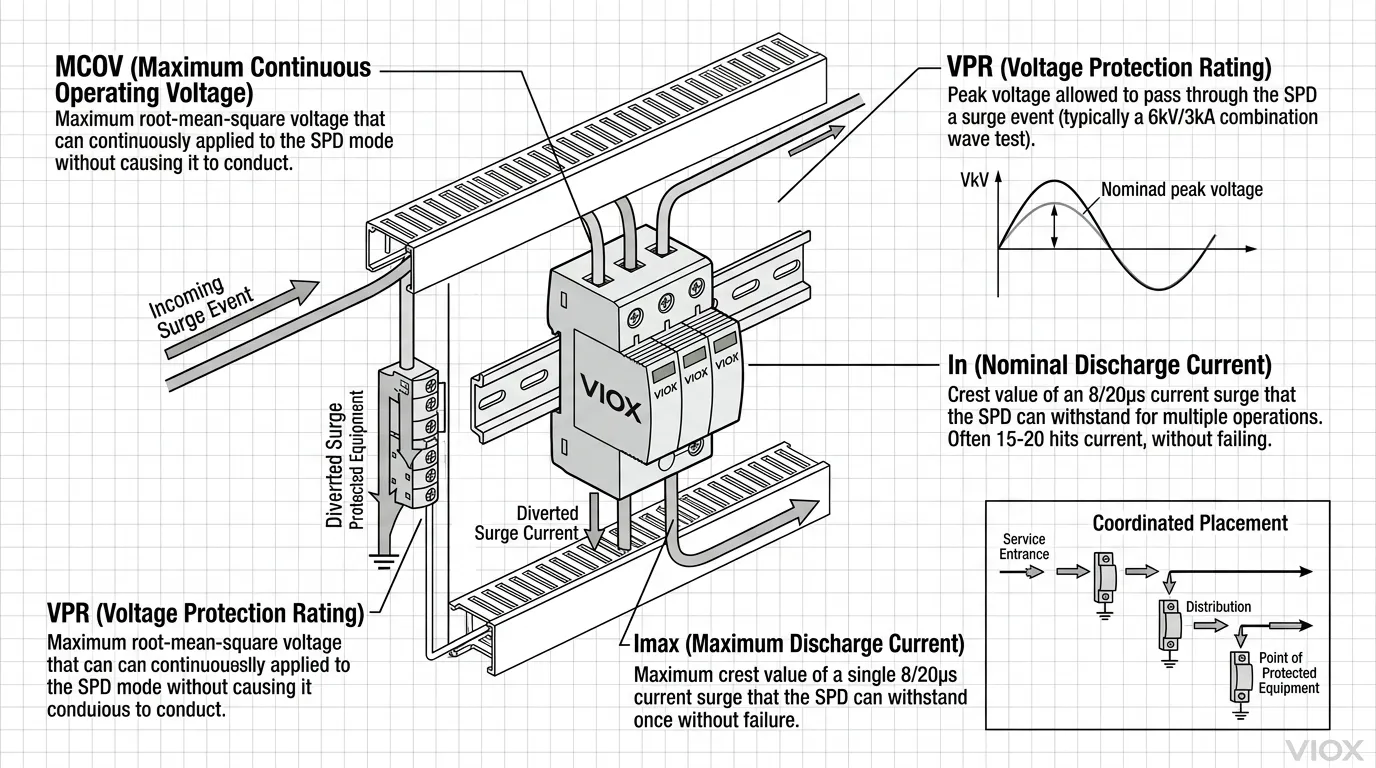
The most important SPD parameters to review
| Parameter | Why it matters | What can go wrong if it is misunderstood |
|---|---|---|
| MCOV (Maximum Continuous Operating Voltage) | Defines the maximum continuous voltage the SPD can withstand without entering unintended conduction | Too low a value can lead to overheating, premature aging, or destructive failure under real system conditions |
| VPR or protection level / clamping behavior | Indicates the residual voltage that downstream equipment may still see during a surge event | A device can be present in the panel and still allow a voltage level that is too high for sensitive equipment |
| In (Nominal discharge current) | Helps indicate the SPD’s ability to handle repeated surge duty | A device may survive the first event but age quickly under recurring exposure |
| Imax (Maximum discharge current) | Indicates high-end surge handling capacity for severe events | Buyers often compare only the biggest number and ignore whether the rest of the design fits the application |
These values should never be read in isolation. The meaningful engineering question is whether the SPD’s voltage class, discharge capability, location, and coordination role fit the actual system. For deeper parameter interpretation, the best follow-up pages are Imax vs In and Uc vs Up.
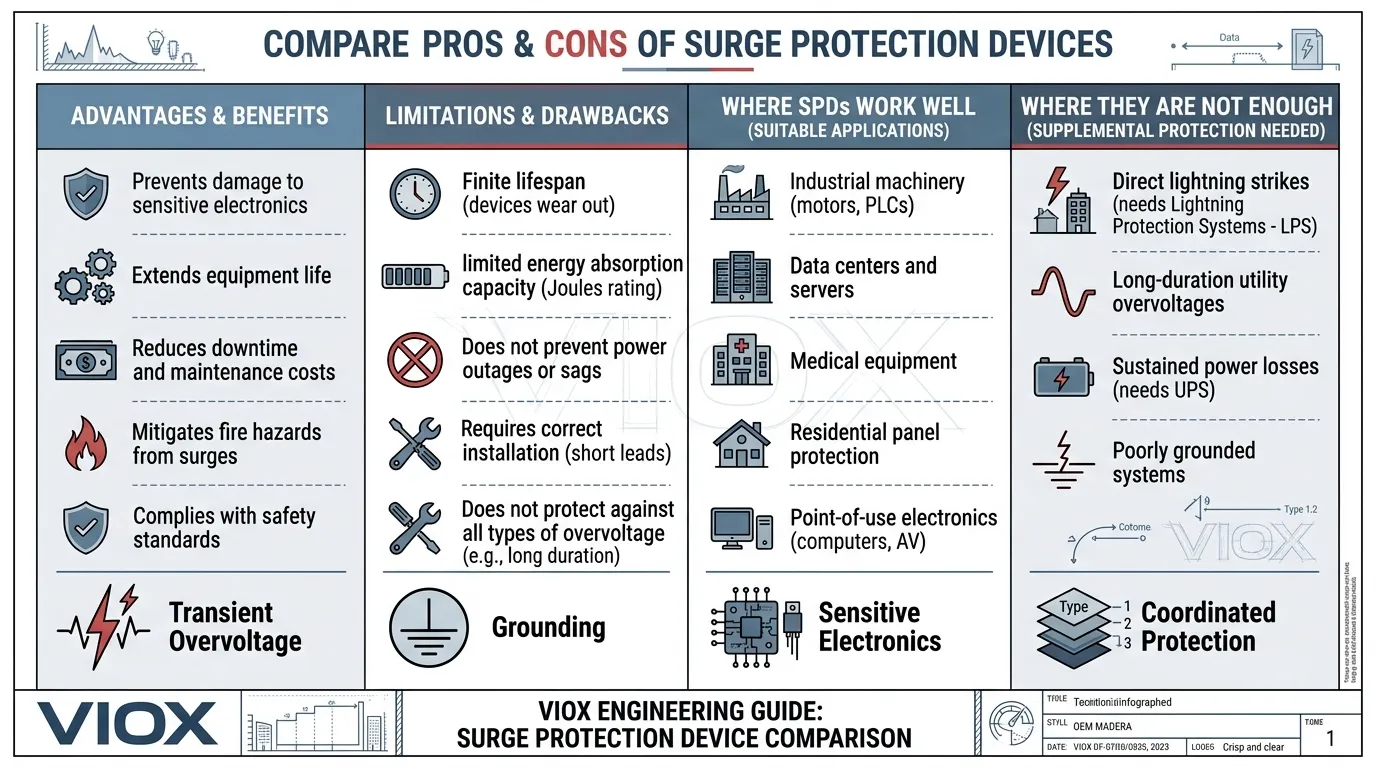
Surge Protection Devices Pros and Cons at a Glance
| Pros | Cons |
|---|---|
| Helps limit damaging transient overvoltage | Does not solve all electrical quality or safety issues |
| Can protect expensive downstream equipment | Requires correct selection and installation to work well |
| Supports system reliability and uptime | Can degrade over time and may need replacement |
| Useful for layered protection strategies | Wrong expectations lead to disappointment and poor design decisions |
| Particularly valuable in surge-prone or electronics-heavy systems | Additional cost and design effort may not feel justified in very low-risk applications |
When Surge Protection Devices Usually Make Sense
SPDs are usually easiest to justify when at least one of these conditions is true:
- The installation includes sensitive electronics, drives, inverters, controllers, or communication interfaces.
- The site has outdoor exposure, long cable runs, or lightning-related surge risk.
- The cost of downtime is much higher than the cost of the SPD.
- The panel serves equipment that is difficult to repair, restart, or replace.
- The project specification, site standards, or end-user requirements already expect surge coordination.
Typical examples include:
- industrial control panels
- commercial facilities with building automation
- solar PV systems
- EV charging infrastructure
- elevator systems
- VFD-driven equipment
- remote or outdoor cabinets
When an SPD Is Not Enough on Its Own
This is one of the most important points in the entire topic. SPDs are valuable, but they must be understood in context.
An SPD is not a substitute for:
- correct earthing and bonding
- proper overcurrent protection
- equipment-specific protective devices
- insulation integrity
- good cable routing and panel design
- coordinated system protection
For example, an SPD does not replace a breaker, fuse, or residual-current device. It also does not solve persistent grounding defects or poor panel workmanship. If a site has major earthing problems, simply adding surge protection will not create a reliable protection system.
It is also important to separate transient surges from temporary or sustained overvoltage conditions. An SPD is built to divert short-duration surge energy. A sustained overvoltage or TOV condition can do the opposite: it can overstress the SPD, accelerate MOV heating, and in severe cases destroy the device itself. That is one reason surge protection should never be treated as a substitute for correct system design.
The Most Common Reasons SPD Projects Underperform
When buyers feel that an SPD “did not work,” the root cause often falls into one of a few recurring patterns.
1. The wrong SPD type was chosen
The device may not match the installation location or surge environment. This is especially common when a low-cost Type 2 device is expected to cover duties that need upstream coordination or broader surge exposure planning.
See Type 1 vs Type 2 vs Type 3 for the most useful side-by-side explanation.
2. The specification focused on one rating only
Some buyers compare SPDs using one headline figure and ignore the rest of the performance context. That can produce a misleading result.
The better approach is to evaluate:
- installation point
- system voltage
- exposure level
- coordination with upstream and downstream devices
- relevant ratings and product family fit
3. The installation layout weakened protection performance
Even a good SPD can underperform if the connection layout is poor. In practice, installation quality influences results as much as the catalog selection itself. Lead routing, grounding quality, device location, and coordination with upstream protection all influence real performance. If installation discipline is weak, the theoretical pros in the datasheet may never show up in service.
For a dedicated installation follow-up, use SPD installation mistakes.
4. The reader expected the SPD to protect against everything
An SPD is not the same as a voltage regulator, UPS, breaker, fuse, or complete lightning-protection system. It plays one role in a broader protection design.
How to Decide Between Type 1, Type 2, and Coordinated Protection
The right decision is rarely “buy the strongest-looking SPD.” It is usually “match the device family to the location and protection role.”
| Protection approach | Best fit | Main decision logic |
|---|---|---|
| Type 1 SPD | Service entrance or sites with higher exposure conditions | Used where incoming surge exposure and upstream positioning matter |
| Type 2 SPD | Distribution panels and downstream equipment protection | Common choice for panel-level surge limiting in many buildings |
| Type 3 SPD | Point-of-use or sensitive end equipment | Used closer to delicate electronics as a final protection layer |
| Coordinated multi-stage protection | Facilities with valuable electronics, long feeders, or mixed exposure levels | Best when protection is treated as a system rather than a single device purchase |
In many projects, the most useful answer is not “Type 1 or Type 2?” but “Where should each protection stage sit, and what equipment is being protected at each stage?”
That is also where your main product page should come in. If the reader is moving from education to evaluation, this is the right place to direct them to VIOX SPD products.
Are Surge Protection Devices Worth It for Small Projects?
Sometimes yes, sometimes no.
For a small installation with low equipment value, low exposure, and minimal electronics, the benefit may feel limited. In that scenario, a basic and well-matched protection approach may be enough, and overdesign can waste budget.
But even in smaller projects, SPDs become easier to justify when the load includes:
- control boards
- communication equipment
- smart building devices
- EV charging equipment
- inverter-driven systems
- outdoor-connected systems
This is why “worth it” is not a universal yes-or-no answer. It depends on what is being protected, how exposed the site is, and what failure would really cost.
A Practical Buying Checklist
Before deciding that the advantages outweigh the disadvantages, check these points:
| Buying question | Why it matters |
|---|---|
| What surge sources are realistic at this site? | Lightning exposure, switching surges, and feeder length affect protection strategy |
| What equipment are you actually trying to protect? | The value and sensitivity of downstream loads determine the return on protection |
| Is the SPD being selected for the right installation point? | Type selection must match panel role and system architecture |
| Is the rest of the protection system properly coordinated? | SPDs work best as part of a complete design, not as a standalone patch |
| Is the installation quality likely to support real performance? | Layout, grounding, and correct integration shape real-world results |
| Is there a maintenance or inspection plan? | SPDs are protective components, not permanent guarantees |
For buyers who want a broader sourcing view, the distributor buying guide is the best bridge from technical selection to procurement.
FAQ
What are the biggest pros of surge protection devices?
The biggest advantages are reduced transient overvoltage exposure, better protection for sensitive electronics, and stronger overall system reliability when the SPD is correctly selected and installed.
What are the biggest cons of surge protection devices?
The biggest disadvantages are that they do not solve every electrical problem, they depend on correct system design, and they can lose effectiveness over time if the wrong device is selected or the installation is poorly executed.
Are surge protection devices worth it?
They are often worth it when the installation includes expensive electronics, exposed distribution paths, or costly downtime risk. They are less compelling when the site has low exposure, low equipment value, and no meaningful consequence from a surge-related failure.
Do SPDs protect against lightning?
SPDs can help limit surge energy associated with lightning-related events, but they are not a complete lightning-protection system by themselves. For that specific question, see lightning protection limits.
What can an SPD not protect against?
An SPD does not replace breakers, fuses, grounding, or general wiring quality. It also does not solve overloads, undervoltage, or every kind of electrical disturbance. It is also not a protective answer to sustained overvoltage or TOV conditions. Those conditions can actually overstress and destroy an SPD, especially MOV-based designs, if the device is exposed beyond its intended operating limits.
Is a Type 2 SPD enough on its own?
Sometimes, but not always. In many facilities, a Type 2 SPD is appropriate at the panel level. In others, coordinated protection across multiple stages is a better choice. That depends on exposure level, service entrance conditions, and downstream equipment sensitivity.
Do surge protection devices need replacement?
They should not be treated as permanent protection without inspection. SPDs can degrade after repeated exposure, so replacement decisions should follow product condition, indicator status, site history, and manufacturer guidance. Related reading: end-of-life warning signs and SPD lifespan.