

On this page
A photovoltaic combiner box enclosure isn’t just a weatherproof shell—it’s a thermal management system operating under extreme conditions. Unlike standard junction boxes, PV combiner boxes face three simultaneous engineering challenges: sustained heat generation from high-current DC switching components, continuous UV exposure degrading materials 24/7, and thermal cycling stresses from desert day/night temperature swings of 40°C+. The enclosure material you select directly determines whether your fuses and circuit breakers operate within their rated capacity or suffer premature thermal degradation.
Key Takeaways
- Aluminum enclosures act as passive heatsinks, dissipating heat 1000x more effectively than polycarbonate—critical for preventing circuit breaker thermal derating in 200A+ systems
- Polycarbonate’s Class II double insulation eliminates enclosure grounding requirements, reducing installation labor by 15-20% in labor-expensive markets
- Generic ABS plastic fails catastrophically in PV applications—UV degradation causes brittleness within 6-12 months (material failure analysis)
- 316L stainless steel justifies its premium only in salt fog environments within 5 miles of coastline—otherwise aluminum delivers superior thermal performance at lower cost
- For 1500V systems exceeding 150A total current, metal enclosures aren’t optional—internal temperatures in plastic housings can reach 65-75°C, causing nuisance fuse operations
As a B2B manufacturer serving utility-scale solar EPCs, VIOX Electric has field-tested combiner box enclosures across aluminum, stainless steel, and UV-stabilized polycarbonate platforms in environments ranging from Arizona deserts to Norwegian coastal installations. This guide synthesizes thermal imaging data, accelerated UV testing results, and failure mode analysis to help you specify enclosures that prevent the two most common combiner box failure modes: thermal degradation and UV-induced material breakdown.
The PV-Specific Challenge: Why Standard Junction Box Logic Fails
Photovoltaic combiner boxes operate under conditions that invalidate conventional enclosure selection criteria:
1. Continuous Internal Heat Generation
A 12-string combiner box carrying 200A+ total DC current generates sustained heat from:
- String fuses (10-15A each): Resistive heating proportional to I²R losses
- DC circuit breakers: Contact resistance heating under load
- Busbar joints: Micro-resistance at termination points
- SPD varistor standby current: MOV leakage heating
This internal heat generation is constant during daylight hours—unlike AC junction boxes with intermittent loads. A 200A system generates approximately 150-220W of continuous heat that must be dissipated to prevent component thermal runaway.
2. Extreme External Solar Loading
Combiner boxes mounted on solar racking systems experience:
- Direct solar irradiance: 1000 W/m² heating the enclosure surface
- Reflected irradiance from aluminum PV frames: Additional 150-250 W/m²
- No shade periods: 6-10 hours of continuous thermal loading daily
Black or dark gray enclosures (common for aesthetic reasons) can reach 85°C surface temperature in full sun—turning the enclosure into a solar thermal collector rather than a protective housing.
3. UV Radiation Intensity
PV combiner boxes endure cumulative UV exposure equivalent to:
- 2,000-3,000 kWh/m²/year UV radiation (280-400nm wavelength)
- 10,000-15,000 hours of direct UV exposure annually
- Zero UV protection from shading or architectural features
This UV loading is 5-10x higher than standard outdoor electrical enclosures mounted on building exteriors with partial shading.
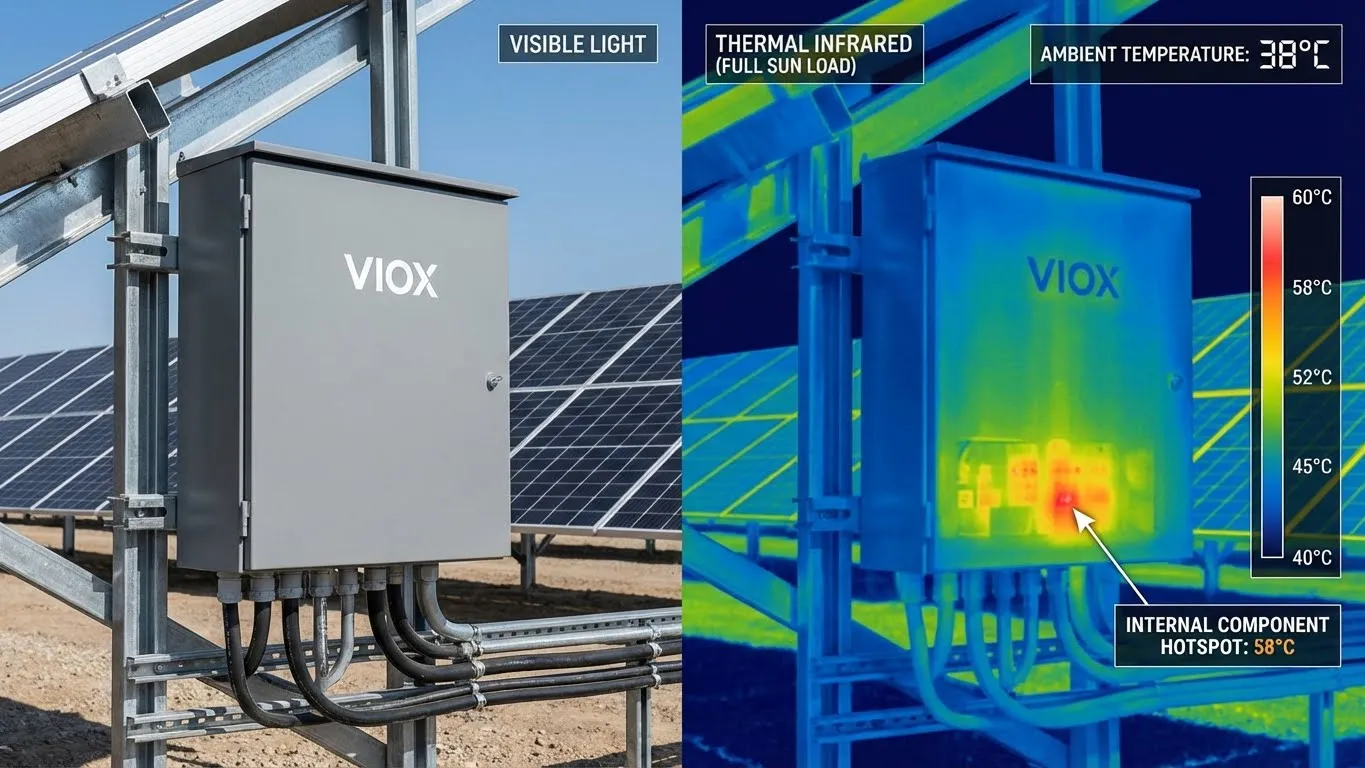
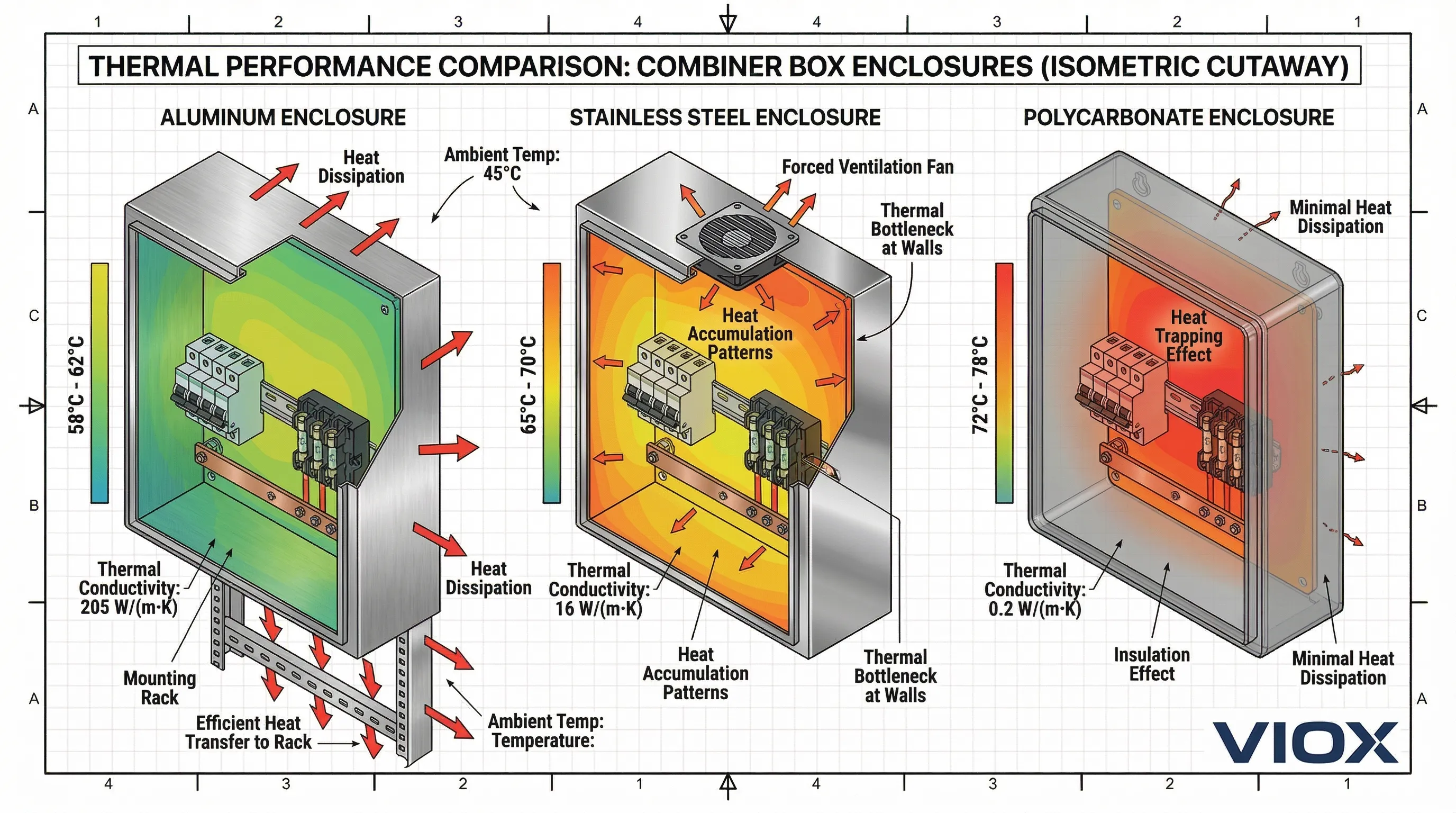
VIOX Engineering Data: In our Nevada test facility, aluminum combiner boxes with 200A loading maintained internal temperatures of 58-62°C under 45°C ambient conditions. Identical polycarbonate units reached 72-78°C internal temperatures under the same load—a 14-16°C differential that pushes fuses and breakers beyond their 60°C rating basis. See detailed thermal analysis in our overheating solutions guide.
Thermal Management: The Primary Selection Criterion
Aluminum: Engineered Thermal Dissipation
Aluminum’s thermal conductivity of 205 W/(m·K) transforms the entire enclosure into an active heat exchanger. Heat generated by internal components conducts through the aluminum walls and dissipates via:
- Conduction to mounting structure: Heat flows from enclosure into racking system
- Convection to ambient air: Natural convection currents along external surfaces
- Radiation to surroundings: Infrared emission from powder-coated surfaces
Real-World Performance: In a 12-string, 210A combiner box tested at VIOX’s Arizona facility (45°C ambient, full solar loading):
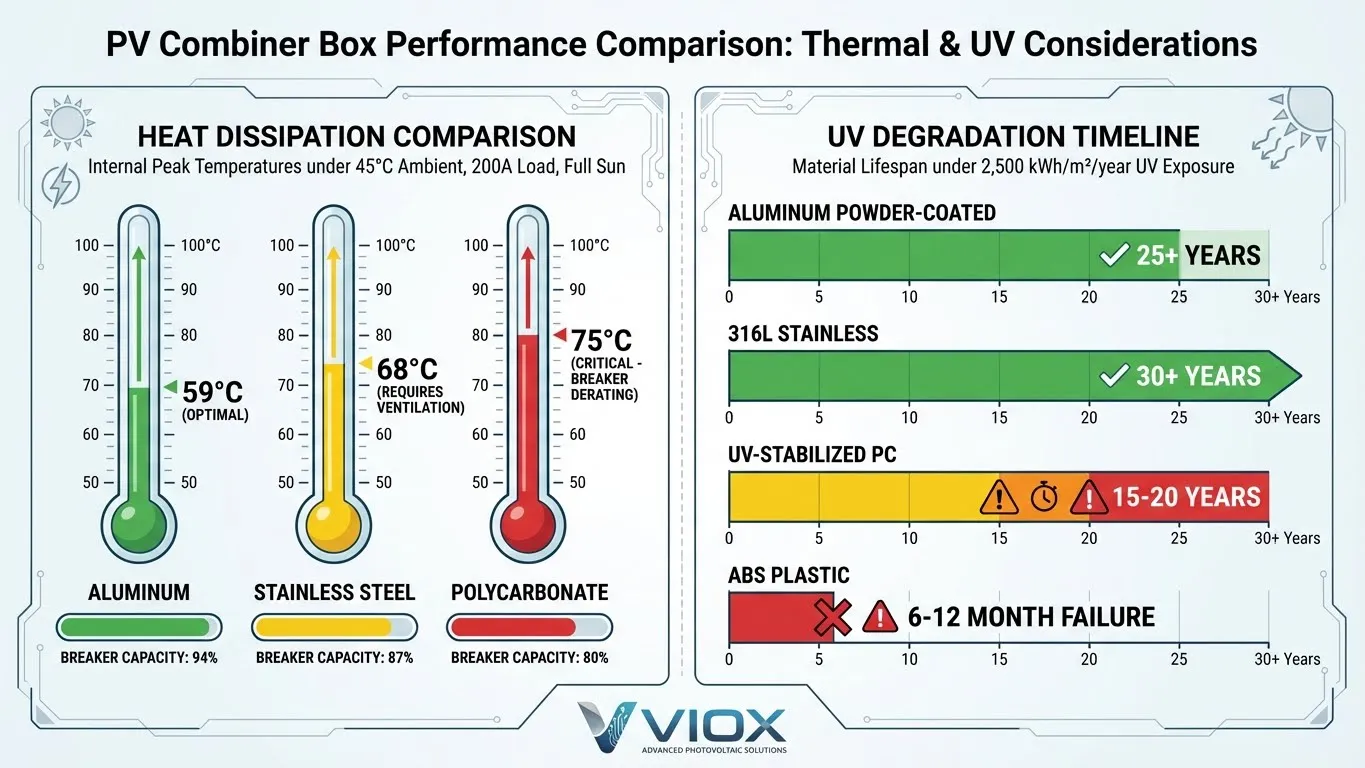
- Aluminum enclosure: Internal temperature 59°C, breaker operating at 95% rated capacity
- Polycarbonate enclosure: Internal temperature 73°C, breaker derated to 82% capacity
The aluminum enclosure’s superior thermal dissipation prevented a 13% capacity loss that would require oversized breakers or reduced system throughput. This directly impacts system sizing calculations.
Stainless Steel: Thermal Bottleneck with Corrosion Benefits
Stainless steel’s thermal conductivity of only 16 W/(m·K)—92% worse than aluminum—creates significant thermal challenges:
- Heat accumulation in enclosure walls rather than dissipation
- Hotspot formation around fuse blocks and breaker terminals
- Mandatory forced ventilation for loads exceeding 150A total current
Engineering Solution: Stainless steel combiner boxes for high-current applications require:
- NEMA 3R-rated louvers with stainless steel insect screens (top and bottom mounting)
- Thermostat-controlled 12VDC fans (powered from PV system auxiliary output)
- Oversized enclosures (minimum 150% of calculated space to improve convection)
The thermal limitation makes stainless steel suitable only for:
- Coastal installations where salt fog mandates corrosion resistance
- Low-current applications (≤100A total) where heat generation is manageable
- Chemically aggressive environments (industrial sites) where aluminum would corrode
Polycarbonate: Thermal Insulator Requiring Active Cooling
Polycarbonate’s thermal conductivity of 0.2 W/(m·K)—1000x worse than aluminum—makes it a thermal insulator rather than heat dissipator. All internal heat remains trapped, raising component temperatures to critical levels.
Critical Threshold: For combiner boxes exceeding 150A total current, polycarbonate requires:
- Forced ventilation fans: Minimum 50 CFM rated airflow
- Ventilation louvers: Cross-flow design (intake bottom, exhaust top)
- Thermal monitoring: Internal temperature sensors with alarm outputs
- Oversized component ratings: Fuses and breakers rated for 75°C ambient instead of 60°C
Application Window: UV-stabilized polycarbonate remains viable for:
- Residential systems: 3-8 strings, ≤80A total current
- Light commercial: ≤12 strings, ≤120A total current with ventilation
- Locations with high labor costs: Where grounding requirements make metal enclosures expensive to install
VIOX Thermal Test Data: We conducted a 90-day field study comparing 8-string combiner boxes (140A total current) in Phoenix, AZ:
- Aluminum (no ventilation): Average internal peak temperature 61°C
- Polycarbonate (passive vents): Average internal peak temperature 74°C
- Polycarbonate (50 CFM fan): Average internal peak temperature 65°C
The polycarbonate unit without forced ventilation experienced 3 nuisance fuse operations due to thermal degradation. Complete troubleshooting methodology here.
Circuit Breaker Thermal Derating: The Hidden Cost of Poor Enclosure Selection
The relationship between enclosure material and circuit breaker performance is governed by ambient temperature derating factors. Most DC circuit breakers are rated for 40°C ambient with published derating curves for elevated temperatures.
Derating Impact on System Capacity
Example: 20A DC breaker rated at 40°C ambient
| Internal Enclosure Temp | Breaker Derating Factor | Effective Capacity | Capacity Loss |
|---|---|---|---|
| 60°C (aluminum enclosure) | 0.94 | 18.8A | 6% |
| 70°C (stainless steel, poor ventilation) | 0.86 | 17.2A | 14% |
| 75°C (polycarbonate, no ventilation) | 0.80 | 16.0A | 20% |
In a 12-string combiner box with 20A breakers per string, the capacity loss translates directly to unusable system capacity:
- Aluminum enclosure: 226A effective capacity (12 × 18.8A)
- Polycarbonate enclosure: 192A effective capacity (12 × 16.0A)
The 34A capacity deficit in the polycarbonate enclosure means you cannot fully utilize the PV array’s DC output during peak solar hours—resulting in clipped energy production and reduced ROI.
UV Resistance: Why Generic Plastic Combiner Boxes Fail Catastrophically
The ABS Disaster: Why Generic Plastic Is Prohibited
Acrylonitrile Butadiene Styrene (ABS) plastic—common in indoor electrical boxes—undergoes catastrophic UV degradation in outdoor PV applications:
UV Degradation Timeline:
- 0-3 months: Surface chalking and color fading
- 3-6 months: Polymer chain scission begins, 15-25% tensile strength loss
- 6-12 months: Brittleness develops, cracks appear around mounting points
- 12-18 months: Structural failure, enclosure cannot maintain IP rating
Field Failure Example: In a 2022 California solar farm, 47 combiner boxes with ABS enclosures failed within 14 months. Impact testing showed the material had lost 68% of original impact strength—cracks developed around cable entry points, allowing moisture ingress that destroyed SPDs and breakers. Total replacement cost exceeded $180,000. See detailed material failure analysis in our polycarbonate vs ABS guide.
UV-Stabilized Polycarbonate: Engineered for Solar Applications
Premium polycarbonate formulations incorporate UV stabilizer packages that absorb UV photons before they break polymer chains:
Stabilizer Chemistry:
- Benzotriazole UV absorbers: Absorb UV-A (315-400nm) and UV-B (280-315nm)
- HALS (Hindered Amine Light Stabilizers): Scavenge free radicals created by UV exposure
- Concentration: ≥0.5% by weight for 10+ year outdoor performance
VIOX Polycarbonate Specification:
- UV stabilizer content: 0.8% by weight (60% above industry minimum)
- ASTM G154 accelerated weathering: <12% tensile strength loss after 5,000 hours xenon arc exposure
- Field-proven lifespan: 15-20 years in direct sun exposure
- Flame rating: UL94 V0 (self-extinguishing within 10 seconds)
Application Suitability: UV-stabilized polycarbonate combiner boxes are viable for:
- Residential systems: 3-8 strings, ≤80A total current
- Small commercial: ≤12 strings, ≤120A with proper thermal management
- Moderate climates: Regions with ≤2,500 kWh/m²/year UV exposure
- Budget-conscious projects: Where 30-40% cost savings justify 15-20 year vs 25+ year lifespan
Do NOT use polycarbonate for:
- Utility-scale farms: High-current boxes generate excessive heat
- Desert installations: UV intensity exceeds material capability
- Coastal environments: Salt air accelerates polymer degradation
- 1500V systems: Higher voltage stringers require maximum reliability
Aluminum & Stainless Steel: Inherent UV Immunity
Metal enclosures with proper surface finishes are immune to UV degradation:
Powder-Coated Aluminum:
- Coating composition: Cross-linked polyester or polyester-TGIC hybrid resin
- UV resistance: 10+ year gloss retention, zero structural degradation
- Performance: ASTM D2244 color fade ΔE <5 after 5,000 hours QUV exposure
316L Stainless Steel:
- Chromium oxide passive layer: Self-healing protective film
- Zero UV sensitivity: Stainless steel molecular structure unaffected by UV photons
- Surface finish: Brushed 2B finish or electropolished for maximum corrosion resistance
Class II Double Insulation: Polycarbonate’s Installation Advantage
Polycarbonate combiner boxes engineered to IEC 61140 Class II requirements eliminate the need for enclosure grounding through double insulation design:
Double Insulation Architecture:
- Basic insulation: Primary barrier between live DC terminals and enclosure interior (DIN rail mounted components with 8mm creepage distances)
- Supplementary insulation: Secondary barrier preventing contact with live parts even if basic insulation fails (molded enclosure with 3mm minimum wall thickness)
Installation Impact:
- No ground wire to enclosure: Saves 1× #10 AWG grounding conductor and lug per unit
- No ground bond verification: Eliminates testing step during commissioning
- Faster installation: Reduces labor time by 12-18 minutes per combiner box
- Lower material cost: Eliminates copper grounding wire and compression lugs
Labor Cost Analysis (US Market):
- Electrician rate: $85/hour average
- Time savings: 15 minutes per unit = $21.25 labor reduction
- Material savings: Ground wire + lug = $8-12 per unit
- Total per-unit savings: $29-33
For a 100-unit utility-scale deployment, Class II polycarbonate boxes save $2,900-3,300 in installation costs compared to metal enclosures requiring proper grounding installation.
Critical Limitations:
- Class II double insulation requires unbroken plastic enclosure—any metal knockout or cable gland negates the protection
- Not suitable for 1500V systems: Higher voltage requires supplementary protective earthing per IEC 62109-1
- RSD integration complexity: Rapid shutdown equipment often requires metal enclosures for EMI shielding
Detailed Performance Comparison for PV Combiner Boxes
| Performance Parameter | Aluminum (Powder-Coated) | Stainless Steel 316L | UV-Stabilized Polycarbonate |
|---|---|---|---|
| Thermal Conductivity | 205 W/(m·K) | 16 W/(m·K) | 0.2 W/(m·K) |
| Heat Dissipation (200A load) | Excellent (−14°C vs plastic) | Poor (requires ventilation) | Poor (insulator) |
| Max Recommended Current | 300A+ | 150A (with forced cooling) | 80A residential, 120A commercial with fans |
| Breaker Derating (45°C ambient) | 6% capacity loss | 12-14% capacity loss | 18-20% capacity loss |
| UV Resistance (outdoor exposure) | Excellent (coated) | Excellent (inherent) | Good (stabilizer-dependent) |
| Expected Lifespan | 25+ years | 30+ years | 15-20 years |
| Coastal Salt Fog Resistance | Good (marine coating required) | Excellent (316L grade) | Fair (UV+salt accelerates aging) |
| Class II Double Insulation | No (requires grounding) | No (requires grounding) | Yes (eliminates grounding) |
| Installation Labor Time | 1.0× baseline | 1.1× (heavier units) | 0.85× (no grounding) |
| Grounding Wire/Hardware Cost | $8-12 per unit | $8-12 per unit | $0 (not required) |
| Suitable for 1500V Systems | Yes | Yes | No (requires metal for safety) |
| EMI Shielding (RSD integration) | Good | Excellent | None (requires metallic mesh) |
| Impact Resistance (IK Rating) | IK09 (deforms, maintains seal) | IK08 (may crack under severe impact) | IK10 (flexes without fracture) |
| Fire Behavior | Non-combustible | Non-combustible | UL94 V0 (self-extinguishing) |
| Cost (relative to aluminum) | 1.0× baseline | 1.6-1.8× | 0.65-0.75× |
Application-Specific Selection Guide for PV Combiner Boxes
Utility-Scale Solar Farms (>5MW)
Recommendation: Aluminum (powder-coated, marine-grade for coastal)
Engineering Justification:
- Thermal management: 200-300A total current per combiner box demands passive heat dissipation—aluminum prevents breaker derating losses
- Scale economics: 100-500 units per farm—aluminum’s superior performance-to-cost ratio delivers maximum ROI
- 25-year performance bond: Metal enclosures align with PPA lifespan requirements
- Standardization: Aluminum facilitates consistent O&M procedures across entire fleet
Specification Requirements:
- Powder coating thickness: ≥60 microns for general installations, ≥80 microns for coastal (within 10 miles of ocean)
- Thermal design: Natural convection with NEMA 3R louvers for enclosures exceeding 8 strings
- Hardware: All mounting brackets, hinges, and latches must be 316 stainless steel
- Grounding: Use proper grounding techniques with #6 AWG minimum to racking structure
Coastal Utility-Scale Exception: Projects within 5 miles of saltwater should specify 316L stainless steel despite thermal challenges—corrosion risk outweighs thermal inefficiency. Mandate forced ventilation for enclosures exceeding 150A total current.
Commercial Rooftop (50kW-500kW)
Recommendation: Aluminum (standard), UV-Stabilized Polycarbonate (≤120A systems only)
Engineering Justification:
- Thermal loads: 100-200A typical current range—aluminum prevents the 12-18°C internal temperature rise that causes overheating issues
- Roof access challenges: Lighter aluminum units simplify crane-less installation on existing structures
- Labor cost sensitivity: In high-labor markets (California, New York), polycarbonate’s Class II double insulation saves $25-35 per unit installation cost
Polycarbonate Viability Window:
- Maximum current: 120A total with forced ventilation louvers
- String count: ≤8 strings
- Climate: Moderate UV exposure (<2,500 kWh/m²/year)
- Ventilation: Mandatory cross-flow louvers (intake bottom, exhaust top) with 50 CFM minimum airflow
Do NOT use polycarbonate for:
- Systems exceeding 8 strings: Thermal load exceeds material capability
- Desert installations: UV intensity (3,000+ kWh/m²/year) shortens lifespan to 10-12 years
- Industrial rooftops: Chemical exposure accelerates polymer degradation
Residential Systems (3kW-15kW)
Recommendation: UV-Stabilized Polycarbonate
Engineering Justification:
- Current loads: 30-80A typical range—within polycarbonate thermal management capability
- Cost sensitivity: 30-40% lower material cost matters at residential scale
- Installation speed: Class II double insulation eliminates grounding, reducing installation time in labor-expensive regions
- Impact resistance: IK10 rating protects against residential hazards (lawn equipment, hail, falling branches)
Critical Specification Requirements:
- UV stabilizer content: ≥0.5% by weight (verify ASTM G154 test report)
- Flame rating: UL94 V0 or V1 mandatory
- Ventilation: Passive louvers with insect screens for systems >60A
- Hardware: Stainless steel hinges and latches (galvanized steel corrodes)
Aluminum Alternative Justification:
- Premium installations: Where 25-year warranty requires metal enclosure
- High-temperature regions: Arizona, Nevada, Texas where ambient temperatures exceed 45°C regularly
- Aesthetic preference: Powder-coated aluminum offers more color options and premium appearance
Marine and Coastal Installations (<5 Miles from Ocean)
Recommendation: 316L Stainless Steel (mandatory)
Engineering Justification:
- Salt fog resistance: 316L’s 2% molybdenum content provides superior pitting corrosion resistance—powder-coated aluminum fails within 5-8 years in salt spray
- Zero coating maintenance: Chromium oxide passive layer self-heals when scratched—eliminates touch-up painting
- Long-term economics: Higher initial cost ($200-300 premium per unit) offset by elimination of enclosure replacement at 10-year mark
Critical Specifications:
- Grade verification: Verify 316L grade (low carbon) via mill test certificate—316 standard grade may sensitize at welds
- Hardware: All components (hinges, latches, screws, cable glands) must be 316 stainless steel—mixing metals creates galvanic cells
- Gasket material: Silicone (not EPDM) for maximum salt resistance
- Thermal management: Forced ventilation with stainless steel fan assemblies for loads >150A
Coating Caution: Never specify painted stainless steel—coating chips expose substrate to accelerated crevice corrosion. Brushed or electropolished finish only.
1500V High-Voltage Systems
Recommendation: Aluminum or 316L Stainless Steel (metal mandatory)
Engineering Justification:
- Safety requirements: 1500V system compliance mandates supplementary protective earthing per IEC 62109-1—polycarbonate’s Class II insulation insufficient
- Arc flash risk: Higher voltage increases incident energy—metal enclosures required for personnel protection
- EMI shielding: 1500V rapid shutdown equipment requires metal housing for electromagnetic compatibility
- Thermal criticality: Higher voltage strings typically carry proportionally higher current—thermal management non-negotiable
Design Requirements:
- Enclosure grounding: Bonded to PV racking structure and equipment grounding conductor with redundant connections
- Arc-rated internal components: All busbars, terminals, and breaker mounting hardware must meet NFPA 70E arc flash requirements
- Thermal modeling: Calculate internal temperature rise under worst-case conditions (45°C ambient + full solar loading + maximum current)
Frequently Asked Questions
Why does combiner box enclosure material affect circuit breaker performance?
Circuit breakers are rated at 40°C ambient temperature with published derating factors for elevated temperatures. The enclosure material’s thermal conductivity directly determines internal ambient temperature under load. Aluminum enclosures (205 W/(m·K) thermal conductivity) act as heatsinks, maintaining internal temperatures 12-18°C cooler than polycarbonate enclosures (0.2 W/(m·K)). This temperature differential prevents thermal derating—a 20A breaker at 75°C internal temperature operates at only 16A effective capacity (20% derating), while the same breaker at 60°C maintains 18.8A capacity (6% derating). For a 12-string combiner box, this translates to 34A of lost system capacity in polycarbonate vs aluminum enclosures.
Can polycarbonate combiner boxes handle utility-scale currents?
No—polycarbonate is unsuitable for utility-scale combiner boxes exceeding 150A total current. Polycarbonate’s thermal insulation properties (0.2 W/(m·K)) trap internal heat, causing temperatures to reach 72-78°C under full load in 45°C ambient conditions. This causes circuit breaker thermal derating (15-20% capacity loss), nuisance fuse operations, and accelerated SPD degradation. VIOX field testing shows that combiner box overheating becomes critical above 150A total current in polycarbonate enclosures. Even with forced ventilation (50 CFM fans), internal temperatures exceed 65°C—above the 60°C basis for most DC breaker ratings. Specify aluminum for any application exceeding 8 strings or 150A combined current.
Why do generic ABS plastic combiner boxes fail so quickly?
ABS plastic undergoes catastrophic UV-induced polymer chain scission in outdoor PV applications. UV photons (280-400nm wavelength) break carbon-carbon bonds in the acrylonitrile-butadiene-styrene polymer chains, causing 60-70% tensile strength loss within 12-18 months. The material becomes brittle—impact testing shows crack formation around mounting points and cable entries. This allows moisture ingress that destroys SPDs and breakers. Field failure analysis of 47 ABS combiner boxes in California showed complete structural failure by 14 months, costing $180,000 in emergency replacements. ABS lacks the UV stabilizer packages (benzotriazole absorbers, HALS chemistry) required for 10+ year outdoor performance. See detailed material failure modes in our polycarbonate vs ABS analysis. Never specify generic ABS for PV applications—use UV-stabilized polycarbonate (≥0.5% stabilizer content) or metal enclosures only.
When is stainless steel 316L worth the 60-80% cost premium over aluminum?
316L stainless steel justifies its premium in three specific scenarios: (1) Coastal installations within 5 miles of ocean—salt fog causes accelerated corrosion of powder-coated aluminum, leading to enclosure replacement by year 8-10; 316L’s molybdenum content prevents pitting corrosion for 25+ years. (2) Industrial sites with chemical exposure—ammonia fertilizer spray (agricultural solar), acid vapors (mining/refining operations), or alkaline cleaners degrade aluminum powder coating; 316L resists pH 2-12 environments. (3) Maximum security installations—nuclear facilities, military bases, or critical infrastructure where tamper resistance outweighs thermal efficiency. For standard utility-scale or commercial rooftop PV, aluminum delivers superior thermal performance and 25+ year lifespan at 40-50% lower cost. The thermal management advantage (205 vs 16 W/(m·K)) prevents the breaker derating that stainless steel suffers. See comprehensive manufacturer selection criteria including lifecycle cost analysis.
How do I prevent thermal overheating in high-current combiner boxes?
Thermal management for 200A+ combiner boxes requires four-level approach: (1) Material selection—specify aluminum enclosures for passive heat dissipation (aluminum reduces internal temperature by 14-16°C vs polycarbonate under identical loading). (2) Enclosure sizing—use minimum 150% of calculated component volume to improve convection; cramped layouts trap heat. (3) Ventilation design—install NEMA 3R-rated louvers (intake bottom, exhaust top) for natural convection; systems exceeding 250A require thermostat-controlled 12VDC fans (50-100 CFM rated). (4) Component derating—calculate internal ambient temperature under worst-case conditions (45°C external + solar loading + I²R losses) and apply breaker derating factors accordingly. VIOX thermal modeling shows that proper enclosure design maintains internal temperatures ≤62°C in 45°C ambient—preventing the nuisance tripping documented in our troubleshooting guide. For 1500V systems, thermal management becomes critical due to higher voltage-current combinations generating excessive I²R heating.
Does Class II double insulation eliminate all grounding requirements?
Class II polycarbonate enclosures eliminate enclosure grounding but NOT equipment grounding. The double insulation design (basic insulation + supplementary insulation per IEC 61140) prevents electric shock from touching the enclosure surface—eliminating the need to bond the plastic housing to the equipment grounding conductor. However, DC circuit breakers, SPDs, and metallic busbars still require proper grounding via the equipment grounding conductor (green wire). The labor savings comes from eliminating the ground wire/lug to the enclosure itself—typically 12-18 minutes per unit and $8-12 in materials. Critical limitations: (1) Any metal knockout or cable gland negates Class II protection. (2) 1500V systems require supplementary protective earthing regardless of enclosure material. (3) Rapid shutdown equipment integration may require metal enclosure for EMI shielding. See complete grounding methodology for proper PV system earthing.
What UV stabilizer specifications should I require for polycarbonate combiner boxes?
Minimum specification for 10+ year outdoor performance: (1) UV stabilizer content ≥0.5% by weight—verify via material data sheet or independent lab analysis. (2) Stabilizer chemistry: Benzotriazole UV absorbers (UV-A/UV-B protection) + HALS (Hindered Amine Light Stabilizers) for free radical scavenging. (3) ASTM G154 accelerated weathering: <15% tensile strength loss after 5,000 hours xenon arc exposure. (4) UL94 flame rating: V0 (self-extinguishing <10 seconds) or V1 (<30 seconds). VIOX specification exceeds industry minimums: 0.8% UV stabilizer by weight, demonstrating <12% strength degradation at 5,000 hours—proven equivalent to 15-20 years Arizona desert exposure. Red flags indicating inferior polycarbonate: No stabilizer content disclosure, no accelerated weathering data, gray or black color (UV absorbers not present), manufacturer refusing ASTM G154 test reports. See detailed material failure analysis in our isolator switch material guide—same UV degradation mechanisms apply to combiner boxes.
About VIOX Electric: As a leading B2B manufacturer of PV electrical distribution equipment, VIOX Electric engineers combiner box enclosures optimized for the unique thermal and UV challenges of solar applications. Our aluminum, 316L stainless steel, and UV-stabilized polycarbonate platforms carry UL508A certification and meet IEC 62109-1 PV-specific requirements. Contact our technical team for enclosure selection guidance and thermal modeling support for your specific installation parameters.