

On this page
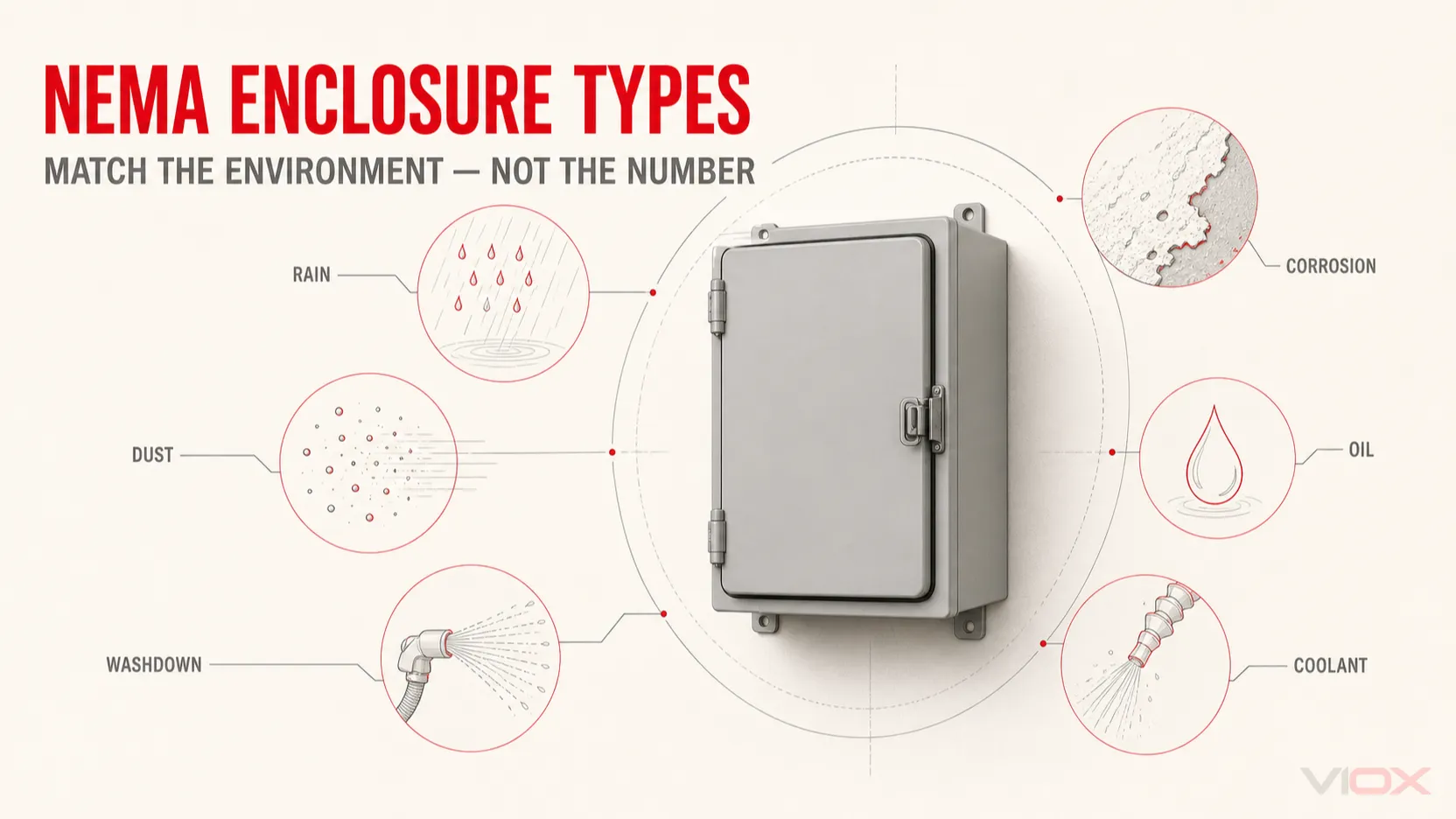
NEMA enclosure Types describe different environmental protection profiles; they are not a ladder where every higher number is automatically better. For common applications, start with Type 1 for dry indoor locations, Type 3R for outdoor rain, Type 4 for hose-directed water, Type 4X when corrosion protection is also required, Type 12 for indoor dust and dripping non-corrosive liquid, and Type 13 for indoor oil or non-corrosive coolant spray.
The Type is only a starting point. The finished enclosure must also suit the equipment inside, installation method, ambient conditions, openings, cable entries, mounted devices, and applicable electrical code. Always verify the rating marked on the complete product or assembly rather than choosing from the number alone.
Common NEMA Enclosure Types at a Glance
This quick chart covers the Types most frequently specified for industrial control and electrical equipment.
| NEMA Type | Typical location | Main protection profile | Important selection limit |
|---|---|---|---|
| 1 | Indoor | Limited protection against falling dirt and accidental contact | Not intended for rain, washdown, or circulating dust |
| 3R | Outdoor | Rain, sleet, and damage from external ice formation | Does not add the windblown-dust or hose-directed-water protection associated with other Types |
| 4 | Indoor or outdoor | Windblown dust and rain, splashing water, and hose-directed water; external ice damage | Does not by itself establish suitability for a corrosive environment |
| 4X | Indoor or outdoor | Type 4 environmental profile plus an additional corrosion-protection requirement | The suffix does not identify one required material; verify the marked product and its material compatibility |
| 12 / 12K | Indoor | Circulating dust, falling dirt, and dripping non-corrosive liquids | Not an outdoor rain or hose-down rating; 12K permits knockouts |
| 13 | Indoor | Dust and spraying water, oil, and non-corrosive coolants | Chemical compatibility and the exact fluid exposure still require verification |
These descriptions are condensed from the scope of ANSI/NEMA 250-2020 and UL’s official Panelboards and Enclosures Application Guide. Use the product’s current certification information and manufacturer documentation for final specification.
What a NEMA Enclosure Type Means
NEMA 250 classifies enclosures for electrical equipment rated 1,000 volts maximum according to defined environmental conditions. Its nonhazardous-location Type set includes indoor Types 1, 2, 5, 12, 12K, and 13, plus indoor/outdoor Types 3, 3X, 3R, 3RX, 3S, 3SX, 4, 4X, 6, and 6P.
A Type designation answers a bounded question: what external conditions was this enclosure construction evaluated to resist under the applicable requirements? Depending on the Type, those conditions may include falling dirt, dust, rain, sleet, splashing water, hose-directed water, oil or coolant, corrosion, ice formation, or submersion.
It does not mean that all environmental risks are solved. NEMA 250’s scope identifies conditions that may require additional consideration, including internal condensation, thermal effects, corrosive agents, and contaminants entering through conduit or other openings. A Type marking also does not replace evaluation of electrical clearances, heat dissipation, mechanical loading, hazardous-location suitability, or the compatibility of the enclosure material with a specific chemical.
If you need the broader context—what an enclosure does and how boxes, cabinets, and housings differ—start with the complete electrical enclosure guide. For the organization and terminology behind the standard, see What Is NEMA?.
NEMA Enclosure Rating Chart
The following chart is a practical selection summary for common nonhazardous-location enclosure Types. “Outdoor” means the Type is intended for both indoor and outdoor use within its stated protection profile; it does not remove the need to check temperature, sunlight, corrosion, mounting, and other site conditions.
| Type | Location | Condensed protection profile | Distinguishing point |
|---|---|---|---|
| 1 | Indoor | Falling dirt and limited personnel contact with enclosed equipment | Basic dry-indoor enclosure |
| 2 | Indoor | Falling dirt plus dripping or light splashing water | Adds limited dripping-water protection to Type 1’s role |
| 3 | Indoor/outdoor | Windblown dust, rain, sleet, and damage from external ice formation | Outdoor weather profile including windblown dust |
| 3X | Indoor/outdoor | Type 3 profile plus corrosion protection | X adds a corrosion requirement |
| 3R | Indoor/outdoor | Rain, sleet, and damage from external ice formation | Common outdoor rain enclosure; no windblown-dust claim in the Type 3R description |
| 3RX | Indoor/outdoor | Type 3R profile plus corrosion protection | Rain-oriented outdoor rating with added corrosion protection |
| 3S | Indoor/outdoor | Windblown dust, rain, sleet, and external ice; external mechanisms remain operable while ice laden | Used where operation during ice loading matters |
| 3SX | Indoor/outdoor | Type 3S profile plus corrosion protection | Adds corrosion protection to the ice-operability profile |
| 4 | Indoor/outdoor | Windblown dust and rain, splashing water, hose-directed water, and external ice damage | Common washdown or hose-exposure starting point |
| 4X | Indoor/outdoor | Type 4 profile plus corrosion protection | For applications that require both washdown protection and added corrosion resistance |
| 5 | Indoor | Settling airborne dust, falling dirt, and dripping non-corrosive liquids | Indoor dust-focused rating distinct from Type 12’s circulating-dust wording |
| 6 | Indoor/outdoor | Hose-directed water and occasional temporary submersion at limited depth; external ice damage | Adds temporary-submersion protection |
| 6P | Indoor/outdoor | Hose-directed water and prolonged submersion at limited depth; external ice damage | More demanding submersion profile than Type 6 |
| 12 | Indoor | Circulating dust, falling dirt, and dripping non-corrosive liquids | Industrial indoor dust/drip protection without knockouts |
| 12K | Indoor | Type 12 environmental profile | Permits enclosures constructed with knockouts |
| 13 | Indoor | Dust and spraying water, oil, and non-corrosive coolants | Common indoor choice where oil or coolant spray is part of the exposure |
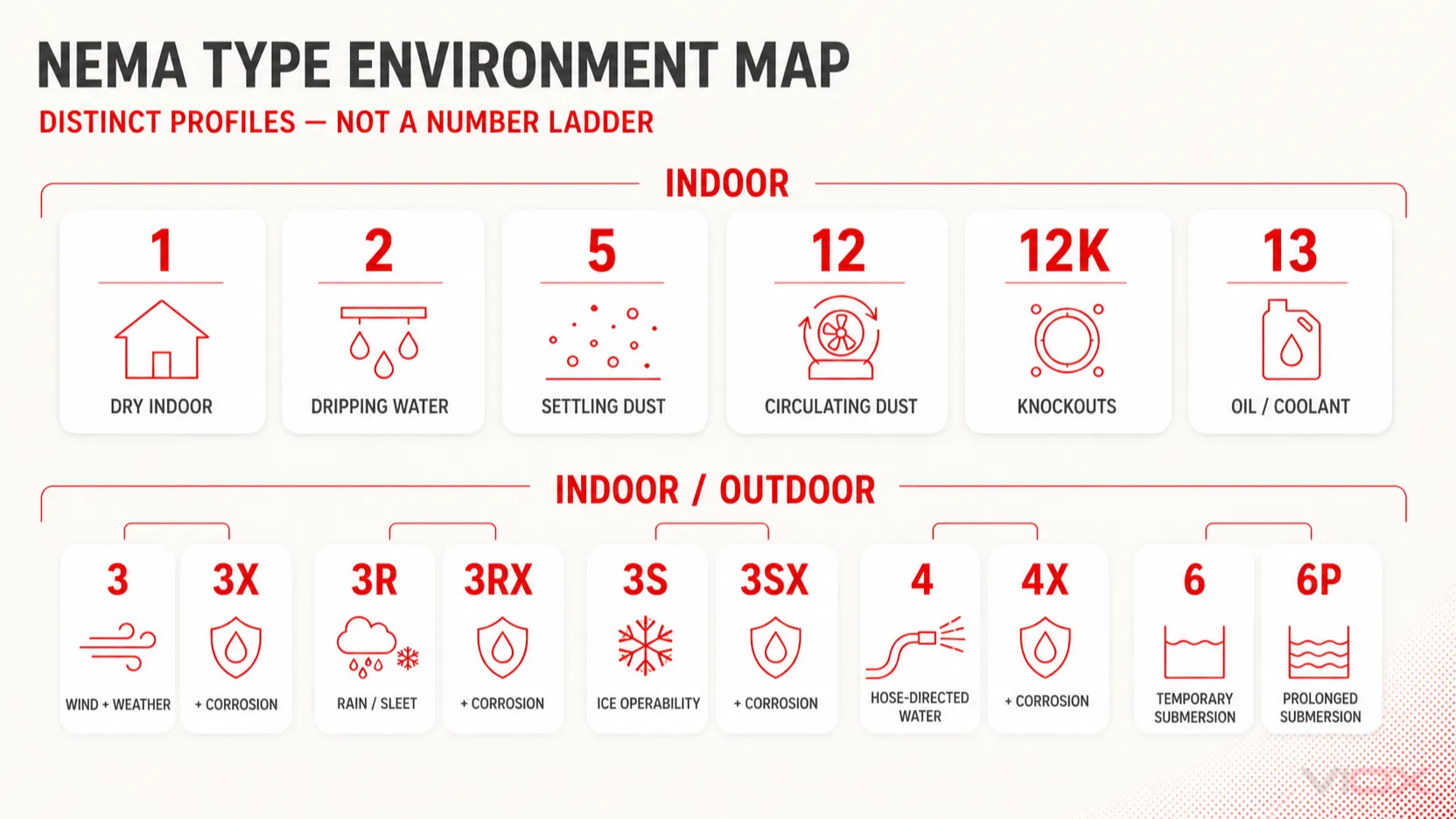
The words “dust” and “dust-tight” need care. Different Types address different dust exposures, and a NEMA Type should not be restated as a universal guarantee of zero particle ingress under every field condition. Select from the defined Type profile and verify the complete installed construction.
NEMA Type 1 vs Type 12
Both are indoor Types, but they solve different problems.
- Type 1 is the basic choice for a dry, relatively clean indoor location where the main concerns are falling dirt and access to live or moving parts.
- Type 12 is intended for industrial indoor environments with circulating dust, falling dirt, and dripping non-corrosive liquids.
Choose Type 12 over Type 1 when actual dust circulation or liquid drips are part of the exposure. Do not select Type 12 merely because its number is higher, and do not treat it as an outdoor rating. If a Type 12 enclosure requires field openings, distinguish Type 12 from Type 12K, and verify that the final opening and fitting arrangement preserves the required Type.
NEMA Type 3R vs Type 4 vs Type 4X
This is the most important outdoor comparison because all three may appear on an initial shortlist, but they address different exposure levels.
| Selection question | Type 3R | Type 4 | Type 4X |
|---|---|---|---|
| Outdoor rain and sleet | Yes | Yes | Yes |
| Windblown dust protection in the Type description | No | Yes | Yes |
| Splashing and hose-directed water | No | Yes | Yes |
| Added corrosion-protection requirement | No | No | Yes |
| Typical starting use | Outdoor rain shelter | Washdown, spray, or hose exposure | Washdown plus corrosive exposure |
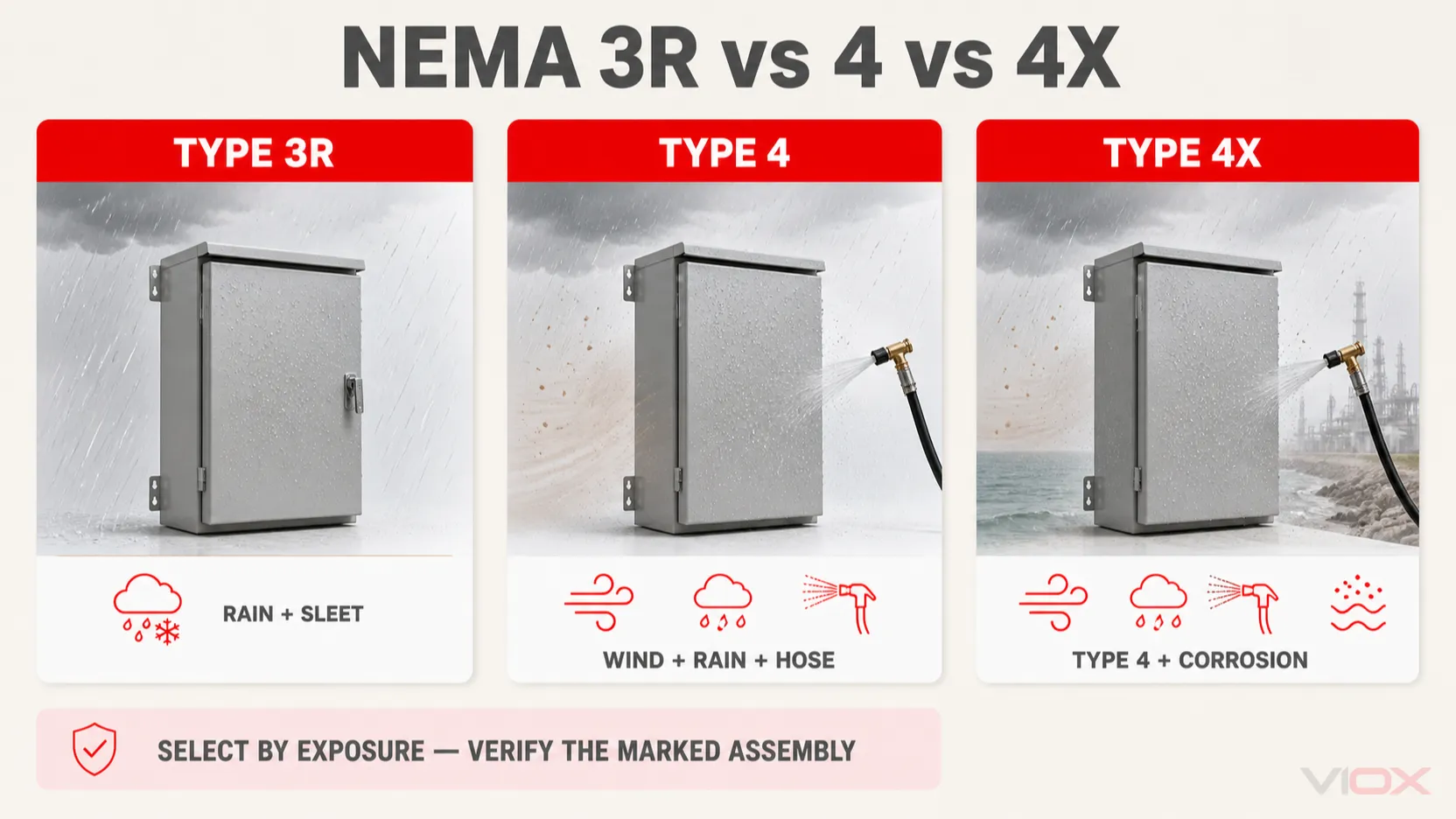
Use Type 3R when rain and sleet are the governing outdoor conditions and hose-directed water is not part of the exposure. Move to Type 4 when equipment may be exposed to splashing or hose-directed water. Use Type 4X when that water exposure is combined with a corrosion requirement.
Type 4X is not shorthand for “stainless steel only.” Metals, polymers, coatings, hardware, and construction details all influence corrosion performance. The correct material also depends on the actual chemical, concentration, temperature, UV exposure, cleaning method, and mechanical requirements. Use the electrical enclosure material selection guide for that separate decision.
NEMA Type 12 vs Type 13
Type 12 and Type 13 are both indoor industrial ratings and both address dust, but their liquid profiles differ.
- Type 12/12K addresses dripping non-corrosive liquids along with circulating dust and falling dirt.
- Type 13 addresses spraying water, oil, and non-corrosive coolants along with dust.
Type 13 is therefore the relevant candidate when oil or coolant spray is a defined exposure. That does not establish compatibility with every cutting fluid, cleaner, lubricant, or process chemical. Confirm the actual fluid formulation with the enclosure and seal material documentation.
How to Select a NEMA Enclosure Type
Use a hazard-based sequence instead of choosing the familiar number on a previous project.
1. Establish the location
Determine whether the enclosure is strictly indoors or may be exposed outdoors. Indoor-only Types cannot be upgraded to outdoor service by adding a rain hood unless the resulting assembly is evaluated and marked for the required Type.
2. List every credible exposure
Record the real conditions at the installation point:
- falling or circulating dust;
- rain, sleet, or wind-driven weather;
- splashing, directed spray, or cleaning hoses;
- corrosive atmosphere or chemicals;
- oil or non-corrosive coolant spray;
- temporary or prolonged submersion;
- external icing and whether mechanisms must operate while ice laden.
Select for the combined exposure, not just the most visible hazard. For example, outdoor rain may suggest Type 3R, but a maintenance hose changes the requirement toward Type 4; a corrosive cleaning environment may move it toward Type 4X.
3. Check what the Type does not cover
Consider risks outside the Type description: internal condensation, temperature rise, low ambient temperature, solar heating, UV exposure, pressure washing outside the evaluated conditions, aggressive chemicals, impact, vibration, and flood depth or duration.
Condensation deserves particular attention. Moist air can enter during pressure and temperature changes, and water can form inside even when external rain is excluded. Drainage, heaters, ventilation, desiccants, and climate control are application measures; each must be selected without defeating the required enclosure rating.
4. Verify installation orientation and construction
A product rating applies to the construction and installation conditions under which it was evaluated. Wall-mounted, floor-mounted, hinged-cover, screw-cover, and other configurations may not be interchangeable. Follow the manufacturer’s mounting, torque, gasket, and closure instructions.
5. Verify the complete assembly
Do not stop at the empty box label. Confirm the marked or documented Type of the final enclosure after devices and cable entries are installed.
What Does the “X” Mean in NEMA 3RX or 4X?
The X suffix indicates an additional corrosion-protection requirement within that Type family. It does not identify a universal material, alloy grade, or chemical-resistance list.
For example:
- Type 3RX combines the rain-and-sleet profile of Type 3R with corrosion protection.
- Type 4X combines the Type 4 water and dust profile with corrosion protection.
The X suffix also does not mean the enclosure is immune to every corrosive agent. Verify suitability for the specific salt, acid, alkali, solvent, cleaner, coolant, or atmosphere at the expected concentration and temperature.
The Installed Assembly Determines the Real Rating
An enclosure system is a chain. Its environmental performance can be limited by any modified or added part:
base enclosure → door or cover → gasket and hardware → mounted operators/displays → field-cut openings → cable glands or conduit fittings → plugs, drains, vents, and fans → final mounting and closure
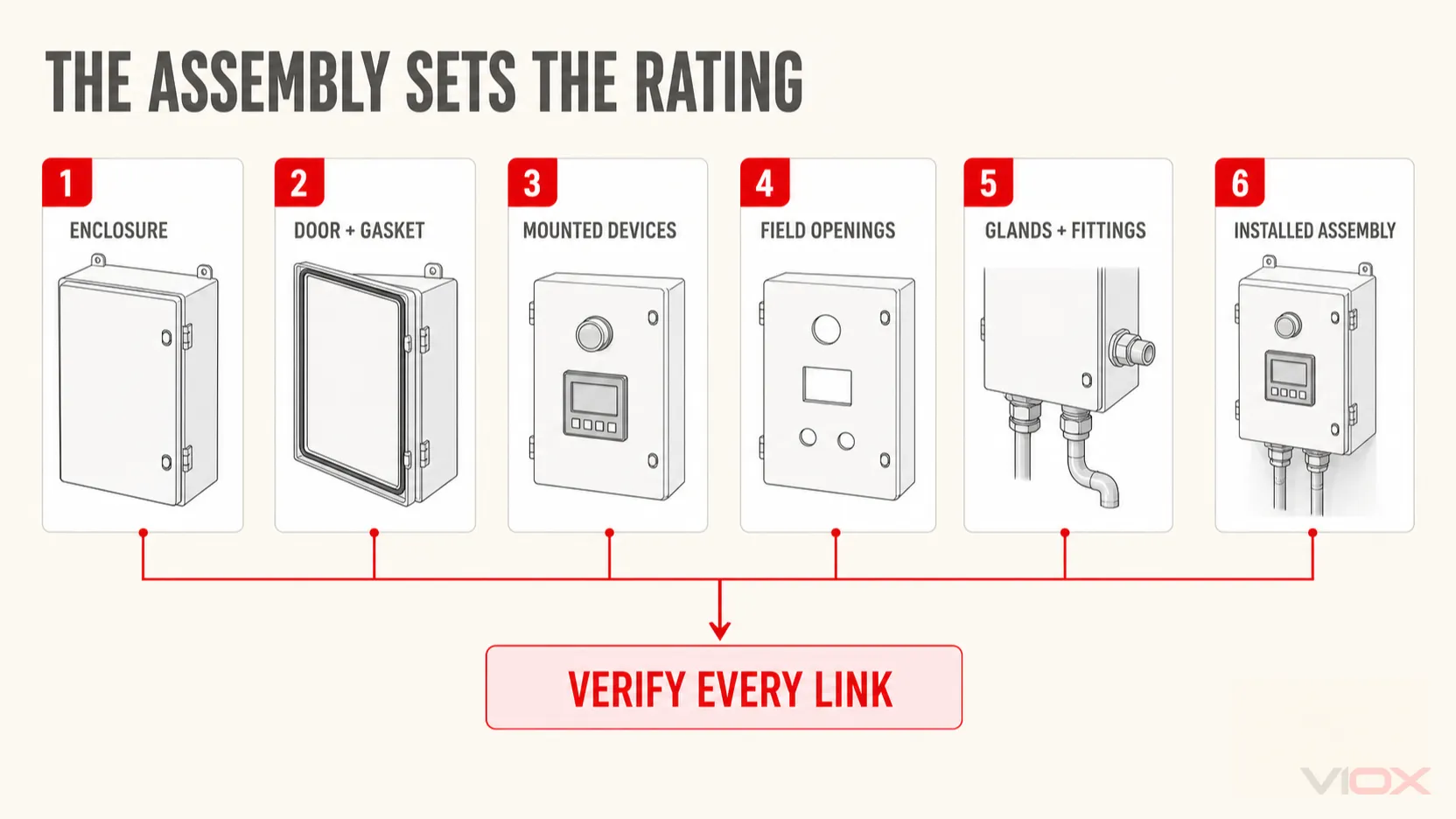
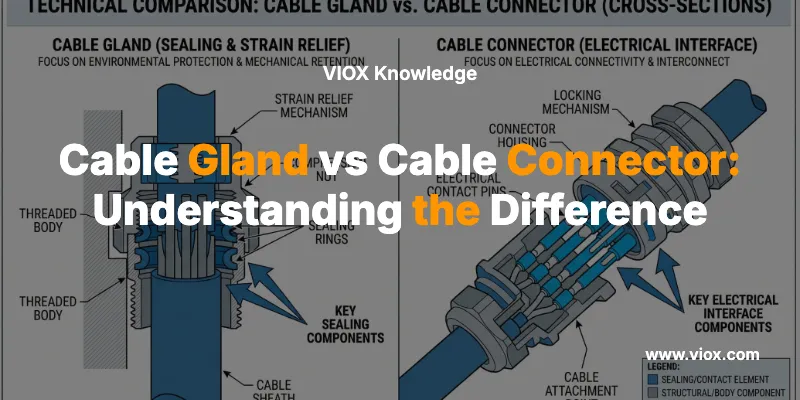
UL’s enclosure and related component certification guidance treats items such as window kits, hole plugs, filter fans, cable or pipe sealing devices, latches, and other enclosure accessories as rating-relevant components. This is why a Type 4X box fitted with an unsuitable cable gland, pushbutton, vent, or open conduit entry should not be assumed to remain Type 4X.
For every penetration or accessory:
- Verify that it carries a Type rating suitable for the target assembly and use.
- Check material and gasket compatibility with the environment.
- Follow hole size, panel thickness, orientation, torque, and installation instructions.
- Seal unused openings with appropriately rated devices.
- Reassess heat dissipation and condensation after adding sealed equipment.
For outdoor boxes and cable-entry applications, review the available waterproof junction box configurations and confirm the rating of the exact supplied assembly. For custom sourcing or application review, contact a qualified junction box manufacturer.
NEMA Type, UL Type, and Certification Evidence
NEMA publishes NEMA 250, which defines enclosure Type requirements. NEMA does not certify each individual enclosure simply because a manufacturer references the standard.
UL standards and certification programs provide a separate conformity-assessment route. A product may carry a UL certification mark and a specific enclosure Type designation when it has been evaluated within the applicable program. In procurement documents, avoid writing only “NEMA 4X style” or “built to NEMA.” Require the exact Type designation and the certification or test evidence appropriate to the project, authority having jurisdiction, and end-use equipment.
Also distinguish an enclosure component from completed equipment. The acceptability of a cabinet used as part of an industrial control panel, panelboard, or other assembly can depend on the certification conditions for both the enclosure and the finished equipment.
NEMA vs IP Ratings
NEMA Types and IEC IP codes are different classification systems. Both address enclosure protection, but NEMA Type profiles may include environmental conditions—such as corrosion, icing, oil, or coolant—that are not expressed by the two IP digits. Similar-looking protection descriptions therefore do not create a universal one-to-one mechanical or certification equivalence.
If a project specification uses both systems, verify each required marking independently. See NEMA vs IP ratings for electrical enclosures for the detailed comparison and the limits of approximate cross-reference tables.
Hazardous Locations Require a Separate Selection Process
Do not use a simple rule such as “Class I equals Type 7” or “Class II equals Type 9.” Hazardous-location suitability depends on the area classification system, class or zone, division where applicable, gas or dust group, temperature code, ambient range, equipment protection method, certification, and installation method.
A weather or washdown rating also does not establish explosion protection, and hazardous-location approval does not automatically provide the required outdoor or corrosion rating. If combustible gas, vapor, dust, or fibers may be present, stop the general NEMA Type selection and have the complete equipment specified under the applicable hazardous-location standard and electrical code.
NEMA Enclosure Specification Checklist
Before ordering or approving an enclosure, document:
- required NEMA Type and whether the location is indoor or outdoor;
- rain, dust, splash, hose-down, oil, coolant, corrosion, ice, or submersion exposure;
- actual chemicals, cleaners, concentrations, and temperatures;
- ambient temperature, internal heat load, solar exposure, and condensation controls;
- enclosure material, coating, gasket, fastener, and window compatibility;
- mounting orientation and accessibility requirements;
- door, latch, operator, display, vent, drain, and cooling-device ratings;
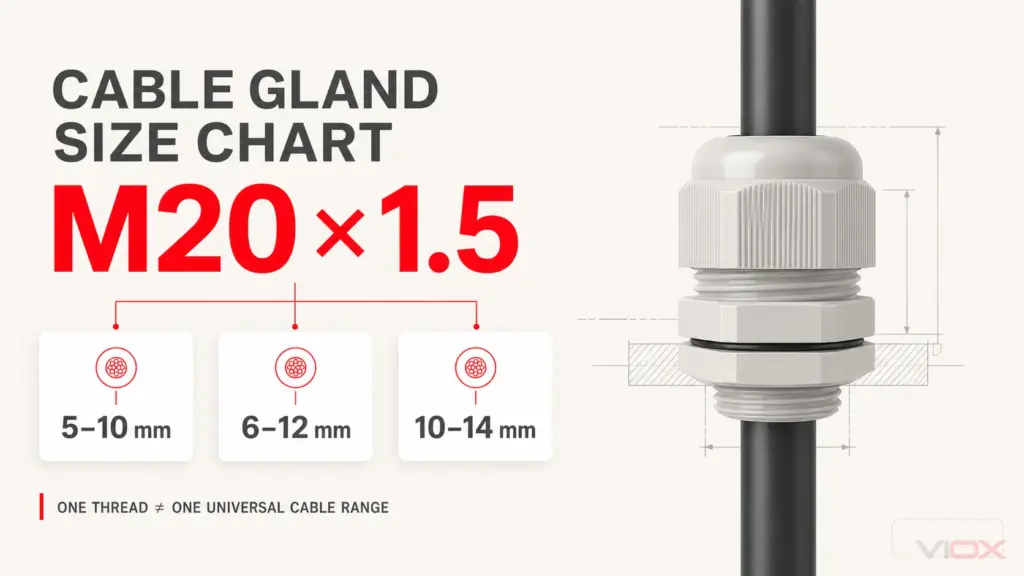
- cable gland, conduit fitting, hub, plug, and field-opening ratings;
- required product certification, markings, and project documentation;
- any hazardous-location classification or other code requirement.
The safest specification names the environmental requirement and the evidence required from the finished assembly. A phrase such as “outdoor enclosure” or “waterproof box” is not precise enough when rain, hose-down, corrosion, or submersion can change the appropriate Type.
Technical Sources
- ANSI/NEMA 250-2020: Enclosures for Electrical Equipment (1000 Volts Maximum)—Contents and Scope
- UL Solutions: Panelboards and Enclosures Application Guide
- UL Solutions: Electrical Enclosure and Related Component Certification
Technical scope reviewed August 2026. Standards, certification programs, and product constructions change; verify the current edition and the exact product marking for the jurisdiction and application.