Why Most Hybrid Inverter-ATS Installations Fail (And How to Wire Yours Correctly)
You’ve wired hundreds of transfer switches. But when a service call comes in at 2 AM because the RCD keeps tripping or the generator won’t auto-start, you realize hybrid inverter systems play by different rules. The problem? Most electricians treat automatic transfer switches as simple voltage-sensing devices. In hybrid systems with battery backup, that assumption creates dangerous ground loops, failed generator starts, and unhappy customers.
This guide covers the two critical elements that separate amateur installations from professional-grade systems: intelligent 2-wire start control and proper neutral-ground bonding. You’ll learn why 4-pole switching isn’t optional, how to implement dry contact generator control, and the exact wiring sequence that prevents code violations.
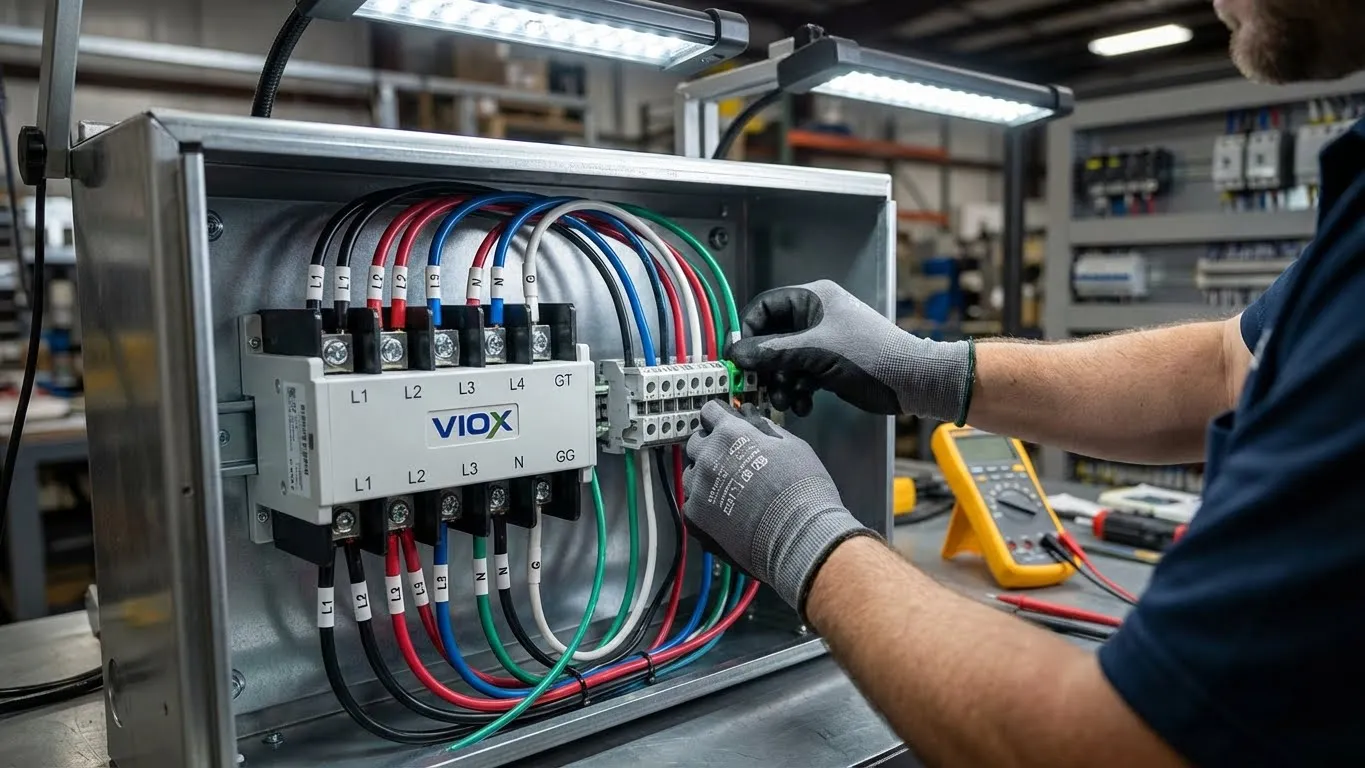
Application Scenarios: When Your Hybrid System Needs Intelligent Switching
Hybrid inverter systems with automatic transfer switches serve two distinct backup scenarios. Understanding which scenario applies determines your wiring approach, control logic, and safety requirements.
Grid-to-Inverter Switching
When utility power fails, the ATS disconnects the building from the grid and switches to battery-backed inverter power. This scenario is common in areas with unreliable utility service or for critical loads that cannot tolerate interruptions. The inverter supplies power from the battery bank until grid power returns. The ATS monitors grid voltage and frequency, automatically reconnecting when stable power resumes.
This configuration requires the ATS to handle the full building load capacity. Battery runtime determines how long your facility operates during outages. For most commercial installations, this ranges from 2-8 hours depending on battery capacity and load profile.
Inverter-to-Generator Switching
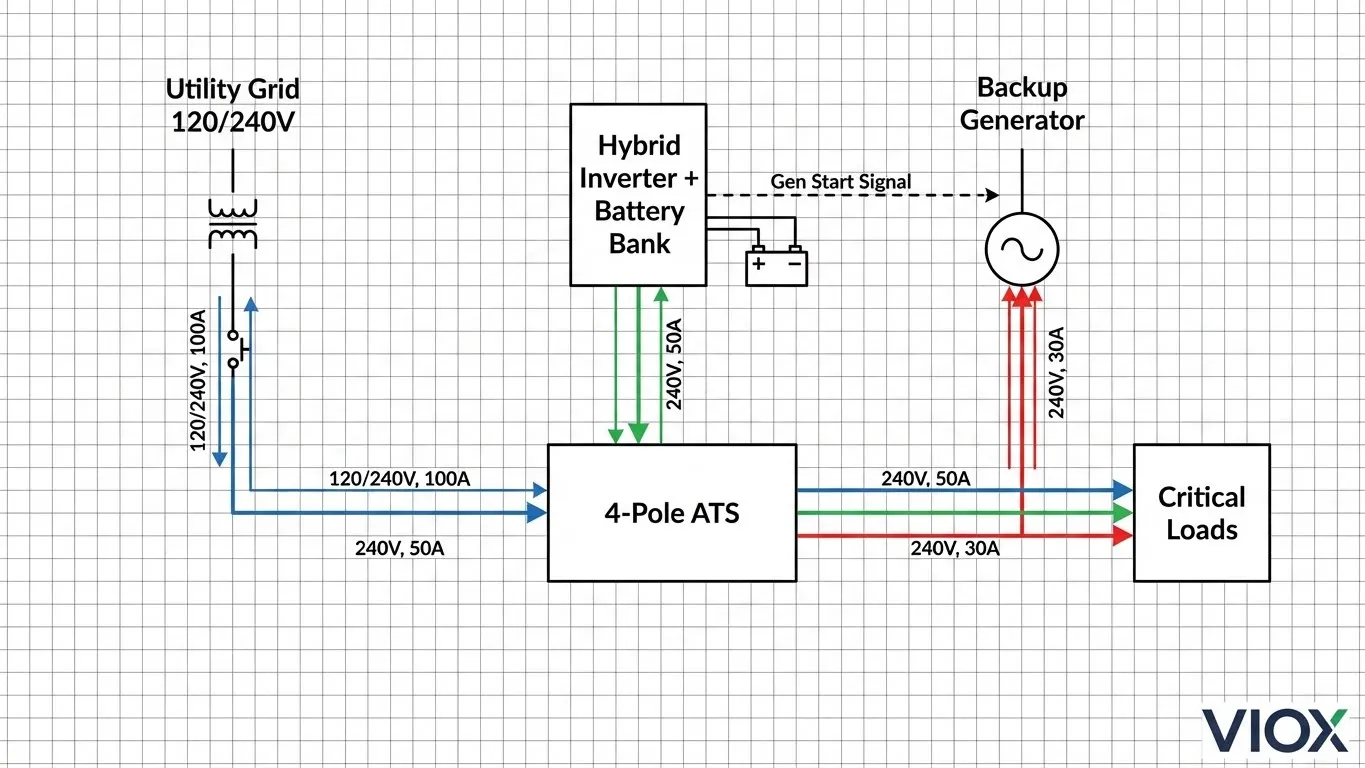
When battery state-of-charge (SOC) drops below a preset threshold—typically 20-30%—the inverter signals the ATS to start the generator. This secondary backup prevents complete power loss during extended outages or when solar production cannot keep batteries charged. The generator either powers the loads directly or charges the batteries while the inverter continues to supply conditioned power.
This scenario adds complexity because you’re coordinating three power sources: grid, inverter, and generator. The control sequence must account for generator startup time (typically 10-30 seconds), warm-up period, and safe transfer timing to prevent motor damage or voltage transients.
| Scenario | Primary Source | Backup Source | Trigger Condition | Typical Duration |
|---|---|---|---|---|
| Grid-to-Inverter | Utility Grid | Battery-Backed Inverter | Grid voltage <85% or >110% nominal | 2-8 hours (battery dependent) |
| Inverter-to-Generator | Battery Inverter | Standby Generator | Battery SOC <20-30% | Until grid restores or batteries recharge |
| Grid-to-Generator (Traditional) | Utility Grid | Generator Only | Grid failure (no battery) | Unlimited (fuel dependent) |
The third row shows traditional ATS operation without batteries for comparison. Notice that hybrid systems provide two layers of backup, which explains why proper coordination between the inverter and ATS is critical.
2-Wire Start Control: The Intelligence Layer Your System Needs
Standard automatic transfer switches use voltage sensing to detect power loss. When input voltage drops below 85% nominal, the ATS switches to the alternate source. This works fine for simple grid-to-generator setups. But hybrid inverter systems require smarter control logic.
Here’s why: Your inverter always outputs stable 120/240V AC, whether the batteries are at 90% or 10% SOC. A voltage-only ATS cannot detect that your batteries are depleting. It will happily continue passing inverter power to your loads until the batteries hit their low-voltage cutoff and the system shuts down completely. No generator start, no secondary backup—just a dead system.
How Dry Contact Generator Control Works
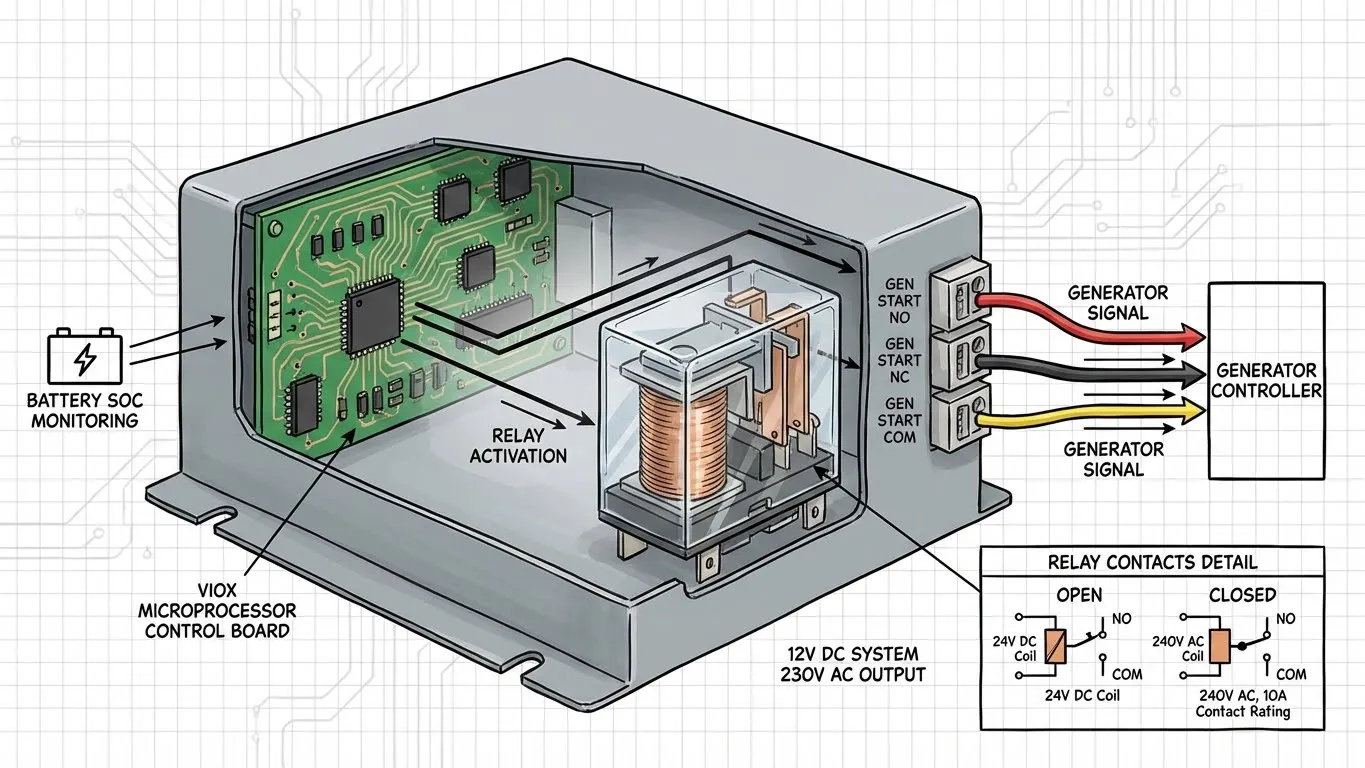
Professional hybrid inverters include “Gen Start” terminals—a dry contact relay that closes when battery SOC reaches your programmed threshold. This is a voltage-free contact closure, similar to a switch. When the contact closes, it signals your generator’s automatic start controller to begin the startup sequence.
The term “dry contact” means the relay provides no power itself. It simply makes or breaks the circuit. Your generator’s start controller supplies the 12V or 24V DC needed to energize its starting system. This isolation protects the inverter’s control board from voltage spikes and allows it to interface with any generator brand. Learn more about dry vs. wet contact fundamentals.
The Automated Control Sequence
- Battery Monitoring: Inverter continuously tracks battery voltage and calculates SOC
- Threshold Detection: When SOC drops to 25% (user-programmable), inverter activates Gen Start relay
- Generator Signal: Dry contact closure sends start signal to generator controller
- Warm-Up Period: Generator runs for 30-60 seconds (programmable delay) before accepting load
- ATS Transfer: Once generator voltage stabilizes, ATS switches from inverter to generator
- Charging Mode: Generator powers loads and charges batteries through inverter’s AC input
- Return Transfer: When batteries reach 80-90% SOC, inverter opens Gen Start contact, generator stops, ATS transfers back to inverter
This sequence ensures seamless transitions without power interruptions to sensitive equipment. The key is proper time delay settings—transfer too quickly and the generator hasn’t stabilized; wait too long and you risk battery damage from over-discharge.
| Parameter | Dry Contact (Standard) | Wet Contact (Not Recommended) |
|---|---|---|
| Voltage Supplied | 0V (passive switch) | 12-24V DC (active signal) |
| Current Rating | 1-5A @ 30V DC typical | Varies by source |
| Isolation | Electrically isolated | Shares common ground |
| Generator Compatibility | Universal (any 2-wire start) | Limited to matching voltage |
| Noise Immunity | Excellent | Susceptible to ground loops |
| Installation Complexity | Simple 2-wire connection | Requires voltage matching |
| Failure Mode | Open circuit (safe) | Short circuit (may damage controller) |
The dry contact approach dominates professional installations because it eliminates voltage compatibility issues and provides inherent safety through electrical isolation.
Wiring the Dry Contact Circuit
Run two wires from your inverter’s Gen Start terminals to your generator’s remote start input. Most generators label these terminals “2-Wire Start” or “Remote Start”. Polarity typically doesn’t matter for dry contacts, but verify in your generator’s manual.
Install a manual bypass switch in series with this circuit. During maintenance or testing, you can disable automatic starts without reprogramming the inverter. Use a DPDT switch if you want a “Manual/Off/Auto” configuration.
Add a time delay relay if your generator requires a specific cranking sequence that the inverter cannot provide. Some older generators need multiple start attempts with rest periods between cranks. The delay relay handles this timing automatically.
The Neutral-Ground Bond Trap: Why 4-Pole Switching Is Non-Negotiable
This single issue causes more service callbacks than any other aspect of hybrid inverter installations. Incorrect neutral-ground bonding creates ground loops that trip RCDs, damage equipment, and violate electrical codes. Understanding this requires knowing how grounding works in different system configurations.
On-Grid Systems: Single-Point Grounding
When your building operates on utility power, NEC Article 250.24(A)(5) requires exactly one neutral-ground bond—located at the service entrance (main panel). This bond provides the reference point for ground fault detection. Your breakers, RCDs, and ground fault protection rely on this single connection point.
The neutral conductor carries unbalanced current back to the utility transformer. The equipment grounding conductor (green or bare copper) provides a fault current path but normally carries no current. These two conductors must remain separate everywhere except at that single bonding point.
Off-Grid Systems: The Separately Derived Source Problem
When your system switches to inverter or generator power, you’ve created a separately derived system (NEC Article 250.20(D)). The utility is completely disconnected. Now your inverter or generator becomes the power source, and it needs its own neutral-ground bond to establish the ground reference.
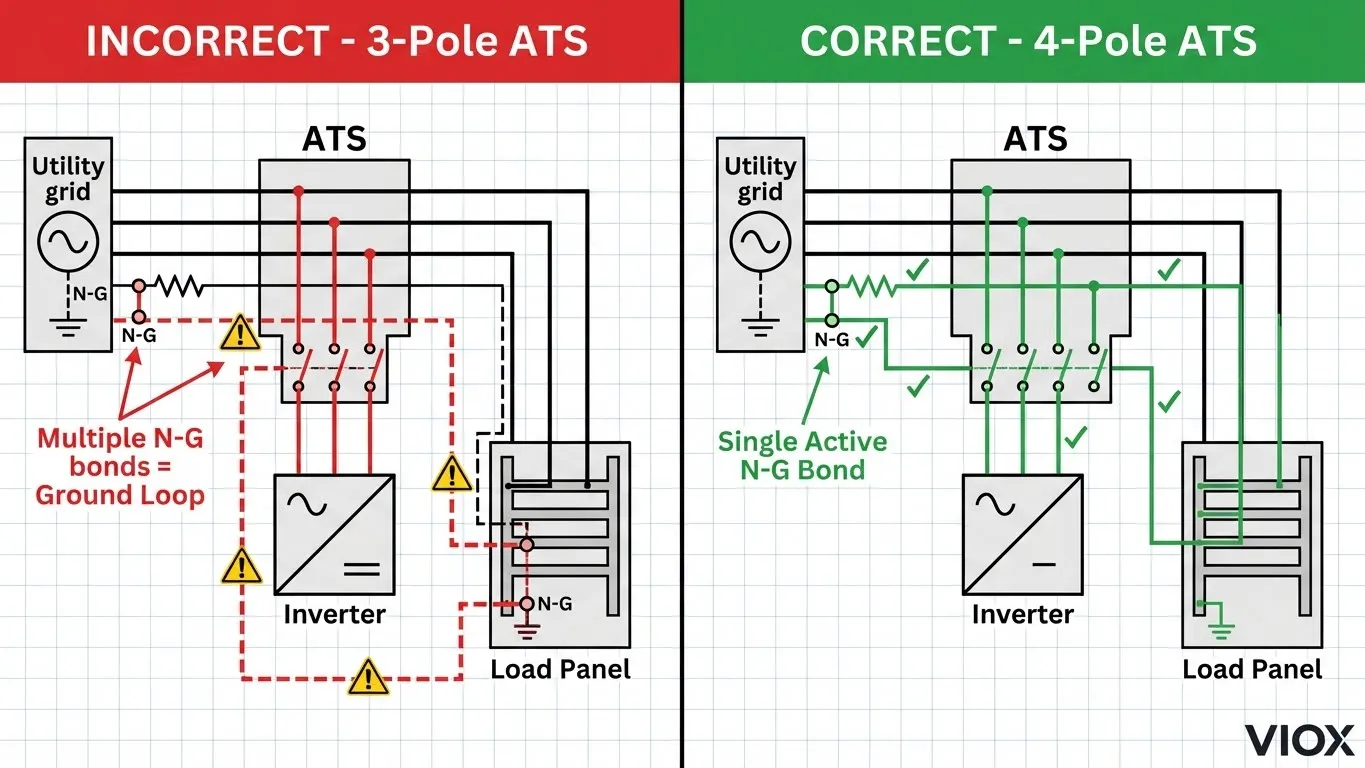
Here’s the trap: If you use a standard 3-pole ATS that doesn’t switch the neutral, both the utility bond and the inverter bond remain connected simultaneously. You’ve created a ground loop—a closed circuit through the neutral and ground conductors. This loop carries circulating currents that cause:
- RCD/GFCI nuisance tripping: The RCD detects current imbalance between phase and neutral
- Voltage on equipment enclosures: Creating shock hazards
- EMI and noise: Affecting sensitive electronics
- Code violations: Multiple neutral bonds violate NEC 250.24(A)(5)
Why 3-Pole ATS Creates Dangerous Situations
A 3-pole automatic transfer switch breaks the three phase conductors (L1, L2, L3 in three-phase systems, or L1, L2 in split-phase systems) but leaves the neutral solidly connected. This design assumes both power sources share a common ground reference—true for two utility services, but false for grid-versus-inverter or grid-versus-generator scenarios.
When the 3-pole ATS transfers from grid to inverter while leaving neutral connected, you now have the utility’s neutral bond (at the main panel) and the inverter’s neutral bond (internal to most inverters) connected through the neutral conductor. Current flows through this ground loop path instead of returning through the intended neutral path.
This creates phantom voltages between neutral and ground, typically 1-5V under normal conditions but potentially much higher during faults. RCDs trip because they sense this current imbalance. The protective device is working correctly—it detects what appears to be a ground fault, even though no actual fault exists.
Why 4-Pole ATS Is Mandatory for Hybrid Systems
A 4-pole transfer switch includes a fourth switching pole that breaks the neutral connection along with the phase conductors. This provides positive isolation between the two power sources’ neutrals. When the ATS transfers, it completely disconnects one source (including neutral) before connecting the other source.
The neutral switching must operate in a “make-before-break” sequence for the neutral pole while the phase poles use “break-before-make” operation. This ensures the loads always have a neutral reference during the brief transfer period, preventing voltage transients on sensitive equipment.
[VIOX 4-Pole ATS Product Recommendation]: VIOX manufactures 4-pole automatic transfer switches specifically designed for hybrid inverter applications. Our switches feature overlapping neutral contacts that maintain neutral continuity during transfer while still providing complete isolation between sources. View specifications and sizing guide.
| Feature | 3-Pole ATS | 4-Pole ATS (VIOX Recommended) |
|---|---|---|
| Neutral Switching | Solid neutral (always connected) | Switched neutral (break-before-make) |
| Ground Loop Risk | High – Multiple N-G bonds active | Eliminated – Only one N-G bond active |
| RCD Compatibility | Poor – Frequent nuisance trips | Excellent – No false trips |
| Code Compliance | Violates NEC 250.24(A)(5) for SDS | Compliant with NEC 250.20(D) |
| Hybrid Inverter Use | Not Suitable | Required |
| Cost | $200-600 (50-200A) | $350-900 (50-200A) |
| Best Application | Grid-to-grid transfer only | Grid-to-inverter, Grid-to-generator |
The cost difference of $150-300 is negligible compared to the service call expense and liability when incorrect wiring causes equipment damage or safety hazards.
Implementing Proper Neutral Bonding
On-Grid Operation:
- Main panel: Neutral bonded to ground (service entrance bond)
- Inverter: N-G bond disabled or disconnected (when in pass-through mode)
- Generator: N-G bond disabled or removed
Off-Grid Operation (Inverter):
- Main panel: Neutral-ground bond removed
- Inverter: N-G bond active (inverter becomes the source)
- Generator: N-G bond disabled
Off-Grid Operation (Generator):
- Main panel: Neutral-ground bond removed
- Inverter: N-G bond disabled (when bypassed)
- Generator: N-G bond active (generator becomes the source)
Many quality hybrid inverters include an automatic N-G relay that bonds neutral to ground when inverting and removes the bond when AC input is present. Verify this feature in your inverter specifications. If your inverter lacks this feature, you must use a 4-pole ATS to switch the neutral, effectively isolating the ground reference points.
For additional context on ground fault protection systems, see our guide on understanding ground fault protection and grounding vs. GFCI vs. surge protection.
Wiring Implementation: Step-by-Step Connection Sequence
Proper installation sequence prevents dangerous conditions during the wiring process and ensures first-time success when energizing the system. This procedure assumes a 120/240V split-phase system with a 4-pole ATS. Adjust for three-phase systems by adding additional phase conductors.
Pre-Installation Verification
Confirm your ATS rating exceeds your maximum continuous load by at least 25%. A 100A continuous load requires a 125A ATS minimum. Check your inverter’s pass-through rating—this must also exceed the load. Undersized transfer switches create voltage drop and overheating.
Verify your inverter includes proper neutral-ground bonding control. Most modern hybrid inverters above 3kW include automatic N-G relays. Lower-cost or older units may not, requiring you to manage bonding externally through a 4-pole ATS.
Obtain proper wire sizing from NEC Table 310.16 based on conductor temperature rating, ambient temperature, and conduit fill. Do not rely on “rule of thumb” sizing for critical backup systems.
Connection Sequence
Step 1: Install Grounding Electrode System
Drive two 8-foot ground rods spaced at least 6 feet apart. Connect with #6 AWG bare copper minimum. This serves as your system ground reference. Install before any other wiring. Test ground resistance—should be <25 ohms, preferably <10 ohms. If resistance exceeds 25 ohms, add additional ground rods.
Step 2: Mount and Ground ATS Enclosure
Install the VIOX 4-pole ATS in a location accessible for maintenance. Bond the enclosure to your ground electrode system with #6 AWG or larger. The ATS enclosure must have a permanent, low-impedance ground connection.
Step 3: Wire Grid Input (ATS Input 1)
Connect utility power to ATS Input 1 terminals:
- L1 (Black) to Input 1 L1 terminal
- L2 (Red) to Input 1 L2 terminal
- N (White) to Input 1 Neutral terminal
- G (Green/Bare) to ground bar
Install properly rated overcurrent protection (breaker) on the utility side per NEC 408.36. The breaker rating should not exceed the ATS rating. This allows you to de-energize the ATS for maintenance.
Step 4: Wire Inverter Output (ATS Input 2)
Connect your hybrid inverter’s AC output to ATS Input 2 terminals:
- L1 (Black) from inverter to Input 2 L1 terminal
- L2 (Red) from inverter to Input 2 L2 terminal
- N (White) from inverter to Input 2 Neutral terminal
- G (Green/Bare) from inverter to ground bar
Do not install a breaker between the inverter and ATS Input 2. The inverter’s internal breaker or relay provides overcurrent protection. Adding a second breaker creates coordination issues.
Step 5: Wire Load Connections (ATS Output)
Connect your critical load panel to ATS Output terminals:
- Output L1 terminal to load panel L1 bus
- Output L2 terminal to load panel L2 bus
- Output Neutral terminal to load panel neutral bar
- Ground bar to load panel ground bar
Remove the neutral-ground bonding screw from the load panel if present. The panel is now a subpanel, and only the main panel (when on-grid) or inverter/generator (when off-grid) should have an N-G bond.
Step 6: Connect Generator Start Control
Run 18 AWG two-conductor cable from inverter’s Gen Start terminals to generator remote start input. Label both ends “Generator Auto-Start Control”. Install a manual bypass switch if desired. Wire the bypass switch in series with one conductor for simple on/off control.
Add a time delay relay if your generator requires a specific cranking sequence that the inverter cannot provide. Most modern inverter-generators with electric start accept simple dry contact inputs without additional control.
Step 7: Install Control Power
Most ATS units require 120V AC control power. Connect from a protected source—typically the load side of the ATS so control power remains active regardless of source. Some installers prefer connection to ATS Input 1 (grid) so the controller can monitor source availability before transfer.
| Load Current (Continuous) | Minimum ATS Rating | Recommended Wire Size (Cu, 75°C) | OCPD Rating | Typical Application |
|---|---|---|---|---|
| 40A | 50A | #8 AWG | 50A | Small cabin, RV, essential circuits |
| 80A | 100A | #2 AWG | 100A | Residence, main critical loads |
| 120A | 150A | #1/0 AWG | 150A | Large residence, light commercial |
| 160A | 200A | #4/0 AWG | 200A | Commercial facility, whole-building |
Wire sizes assume 75°C rated conductors in conduit with no more than 3 current-carrying conductors. Increase one size for long runs (>100 feet) or high ambient temperatures (>30°C/86°F).
Testing and Commissioning
Voltage Verification: Measure and record voltages at each ATS terminal before energizing. Grid input should show 118-122V L1-N and L2-N, 236-244V L1-L2 for North American 240V systems.
Transfer Testing: Simulate grid loss by opening the utility breaker. ATS should transfer to inverter within the programmed delay (typically 1-5 seconds). Verify all loads receive power. Restore grid power—ATS should re-transfer after the programmed delay (typically 5-30 minutes to allow temporary outages to clear).
Generator Auto-Start Test: Manually lower battery SOC or use inverter’s test function to trigger Gen Start relay. Generator should crank and start. After warm-up, ATS should transfer to generator. Verify loads receive stable power.
Neutral-Ground Verification: With system on inverter power, measure voltage between neutral and ground at the load panel. Should be <2V. Higher readings indicate neutral bonding issues. Recheck your N-G bonds—ensure only one is active.
RCD Function Test: Press the test button on all RCDs in the load panel. They should trip immediately. Reset and verify normal operation. If RCDs nuisance trip during normal operation, you likely have a ground loop from multiple N-G bonds.
For more guidance on proper ATS selection, review our 3-step guide to automatic transfer switch selection and the comparison between automatic transfer switches vs. interlock kits.
Common Mistakes and How to Avoid Them
Mistake 1: Using 3-Pole ATS Instead of 4-Pole
Problem: Neutral remains connected to both grid and inverter, creating ground loop and RCD tripping.
Fix: Specify 4-pole automatic transfer switch from the start. If you’ve already purchased a 3-pole unit, it cannot be retrofitted—you must replace it. Don’t try to “make it work” with external bonding switches or relays. The safety and code compliance issues aren’t worth the component savings.
Mistake 2: Forgetting Generator Start Time Delays
Problem: ATS attempts to transfer to generator before it reaches stable voltage/frequency, causing voltage sags, motor damage, or failed transfers.
Fix: Program inverter’s Gen Start signal to close at 25% SOC (or desired threshold). Program ATS to delay transfer by 45-60 seconds after detecting generator voltage. Most generators need 30-45 seconds to stabilize after starting. The additional ATS delay ensures clean transfer.
Also program an “off delay” so the generator continues running after batteries recharge. Shutting down immediately after full charge causes thermal shock to the engine. A 5-10 minute cool-down period extends generator life.
Mistake 3: Improper Grounding Electrode Connection
Problem: Ground rods too close together (<6 feet), inadequate wire size (#10 AWG instead of #6 AWG minimum), or poor connections corrode over time.
Fix: Follow NEC Article 250.53 exactly. Two rods minimum, 6 feet apart, driven to full depth (8 feet). Use listed grounding clamps, not hardware store hose clamps. Apply anti-oxidant compound to all connections. Test ground resistance after installation and annually thereafter.
If you’re in rocky soil where driving rods is difficult, use alternative grounding methods like ground plates or chemical ground rods. Document the as-built grounding system with photos and resistance measurements.
Mistake 4: Load Imbalance Between L1 and L2
Problem: All 120V loads connected to L1, leaving L2 lightly loaded. This creates neutral current issues and may confuse the ATS voltage sensing.
Fix: Balance your loads across L1 and L2 within 20% of each other. For example, if L1 carries 60A, L2 should carry 48-72A. Use a clamp meter to measure actual current on each leg under typical operation. Move circuits between legs to achieve balance.
Many hybrid inverters measure per-leg current and will alarm if imbalance exceeds their programmed threshold (typically 30-40% difference). Proper load balancing prevents these nuisance alarms and extends component life.
Mistake 5: Undersized Wire for Future Expansion
Problem: Installing minimum wire size for current load, then adding circuits later that exceed capacity.
Fix: Size wire for 125% of anticipated maximum load, not current load. The cost difference between #2 AWG and #1/0 AWG is minor compared to pulling new wire later. Conduit fill rules (NEC Chapter 9, Table 1) limit how many conductors you can add later, so oversizing initially provides expansion capability.
Document your wire sizing calculations and keep them with the system documentation. Future technicians need to know the ampacity limits when adding loads.
For related ATS topics, explore the differences between PC-class vs. CB-class transfer switches and learn about dual power automatic transfer switch configurations.
Frequently Asked Questions
Q: Can I use a 3-pole ATS with a hybrid inverter if I disable the N-G bond in the inverter?
A: No. Disabling the inverter’s N-G bond while on battery power creates a dangerous floating neutral condition. Your RCDs won’t function, and equipment enclosures can develop hazardous voltages during ground faults. A 4-pole ATS properly manages neutral switching so the active source always provides the N-G bond. Don’t compromise on this—electrical safety requires proper neutral-ground bonding in the active source.
Q: What happens if neutral-ground bonding is wrong?
A: Multiple simultaneous N-G bonds create ground loops that carry circulating currents. These currents cause RCDs to trip unpredictably because they detect current imbalance between the phase and neutral conductors. You may also experience electromagnetic interference affecting computers and LED lights, phantom voltages between neutral and ground (typically 1-5V), and potential shock hazards from voltage on equipment enclosures. In severe cases, incorrect bonding can damage sensitive electronics or create fire hazards from overheated neutral conductors.
Q: How do I set up 2-wire generator start?
A: Connect two wires from your inverter’s “Gen Start” dry contact terminals to your generator’s remote start input (often labeled “2-Wire Start”). The dry contact is simply a relay that closes when battery SOC drops below your programmed threshold. Install a bypass switch in series if you want manual control. Program your inverter’s Gen Start threshold (typically 20-30% SOC) and Gen Stop threshold (typically 80-90% SOC). Most modern generators with electric start accept this simple contact closure without additional control electronics. For older generators, you may need an automatic start controller module that manages choke, cranking duration, and shutdown sequences.
Q: What ATS rating do I need for my system?
A: Your ATS rating must exceed your maximum continuous load current by at least 25%. For example, a 100A continuous load requires a 125A minimum ATS. This accounts for inrush currents when motors and compressors start. Also verify your inverter’s pass-through rating equals or exceeds your ATS rating—some inverters have lower pass-through ratings than their invert ratings. Check both the ATS and inverter specifications. When in doubt, oversize slightly. The cost difference between rating steps is small compared to the expense of replacing an undersized unit.
Q: Does my generator need its own N-G bond if I’m using a 4-pole ATS?
A: Yes, when the generator is the active source (feeding the loads), it must have an N-G bond. With a 4-pole ATS, the neutral switching ensures only one bond is active at a time. When the ATS is on grid power, the grid’s neutral (bonded at the utility transformer or service entrance) is active. When on inverter power, the inverter’s N-G bond is active. When on generator power, the generator’s N-G bond is active. Many portable generators come with the neutral floating—you’ll need to install the bonding screw or jumper per the manufacturer’s instructions for use as a separately derived system.
Conclusion: Get It Right the First Time
Hybrid inverter systems with automatic transfer switches provide sophisticated backup power capability, but only when properly designed and installed. The two critical elements—intelligent 2-wire start control and correct neutral-ground bonding—separate amateur installations from professional-grade systems.
Using a 4-pole ATS isn’t a luxury or optional upgrade. It’s the only code-compliant way to prevent ground loops while ensuring proper safety ground references. The dry contact generator start system provides intelligence that simple voltage sensing cannot match, automatically managing the transition between battery, inverter, and generator power.
The additional engineering effort and slight cost premium for these proper components pays dividends in system reliability, code compliance, and customer satisfaction. More importantly, correct wiring prevents the safety hazards that come with improper neutral bonding and ground loops.
Ready to specify the right components? Browse VIOX’s complete line of 4-pole automatic transfer switches engineered specifically for hybrid inverter applications. Our UL 1008-listed switches include overlapping neutral contacts, programmable time delays, and voltage/frequency monitoring—everything you need for a professional installation that passes inspection the first time.